
YOU CAN’T CONVINCE US

By Joe Cillo

WHY ARE WE SO STUBBORN?

Why do you hit your head against the wall?

Because it feels so good when I stop.

I see so many people my age struggling to carry packages they could put in a trolley if they would only spend the money to buy one or staggering up set of stairs when the escalator is right there across the hall. I know there is a better way.  But just you try to TELL them that.


Do not even consider “Mother, if you would walk on the side of the street, you wouldn’t block everyone hurrying to the office” because it isn’t going to work.  Your mother knows that she keeps her balance better in the middle of the sidewalk and avoiding a broken shoulder is a lot more important to her than her social responsibility not to impede the pedestrians on their way to something she already did years ago….and if she wants to wear her bedroom slippers with that horrid coat…so what?  SHE is retired.


Just try telling your Dad that if he would have purchased power steering on that huge gas eating clunker he drives, he could parallel park in seconds and not keep smashing his front headlight.    He is going to give you that look you hate and say, “I bought this car used ten years ago and I paid cash for it.   I know how it works and it doesn’t give me any surprises.  If it takes me 40 minutes to park it, that isn’t MY problem….


I like familiar things.  I don’t have to learn how to use them.  Silly as it may seem, I don’t like a dishwasher.  It feels better to me to wash each dish and know it is clean.  It is the same with the car I drive.  I can still remember when I bought my Toyota Matrix.  It was bigger than my ancient Valiant, more fuel efficient and had a great CD player. The first year I drove it, I smashed the right fender so many times the auto repair shop recognized my voice when I called. I hit the wall of the garage twice and I drove in the middle of the road for at least 6 months before I figured out that there was plenty of room on the right.  My old car soaked up gas like a drunkard, didn’t have power steering and when it rained water flooded the back seat.  But I never hit anything with it.  It was familiar. You cannot get me to admit that it wasn’t the king of all cars.  I loved it.  I understood it.  And it understood me.


That is how it is with older people. We cling to what we used to do because that is comfortable and feels safe.  Take credit cards.  When I was a kid they didn’t exist.  I paid for everything with cash.  The idea of shoving a piece of plastic into the wall and getting money was as ridiculous to me as looking up at the clouds and expecting it to rain silver coins.  Now I cannot imagine living or traveling without my credit card but I know a lot of my friends who never use them.  They like to see the cash, pay with it and get the receipt for the same reason they like to watch your face when they talk to you before they give you an answer.  It might not make sense to you, but it does to them.


There is a couple across the street in their mid eighties who live in a three story house. Bob has sciatica and Sarah has Multiple Sclerosis.  They both are in so much pain, they had to crawl up the stairs to get to their bedroom.  Finally, after years of coaxing and talking and convincing, they allowed their children to buy them a stair-master so they could both ride upstairs in seconds instead of the half hour they both took, each helping the other.  You guessed it.  The stair-master has been sitting for five years now, in pristine condition at the bottom of the stairs and my neighbors struggle up the stairs to the bedroom they have slept in for almost 60 years.


I know just what you are thinking.  Why don’t they move the bed downstairs to the living room?  I asked them that and Sarah looked at me as if I had suggested she dance naked in the street.  “I love my living room just the way it is.  I remember when we redecorated it in 2000 and it took me forever to get used to where everything was.  I sure don’t want to go through that again.”


Will and Deborah will celebrate their golden anniversary this year.  It will be a sad celebration because Will’s Cerebral Palsy has gotten so much worse and he is in the early stages of Alzheimer’s.  Their children have been begging them to have a care giver in to help Deborah cook meals, bathe Will and get him into bed but she is adamant.  “I don’t want strangers walking around my house,” she told her daughter.  “They all have butterfingers..”


About three months after she said this, she called her daughter and said, ”I just took Will to the doctor and he had the best idea!!! He told me about an agency that will send someone out to bathe Will and get him into bed.  Isn’t that a wonderful idea?”


Her daughter had the wisdom to say, “I think so too!” and not, ”Why wouldn’t you listen to ME when I told you the same thing?” The truth is that if we are going to change our minds, we have to hear a reason from what we think is an expert.  That expert is never our children.  Ever.


So next time you say to your mom, “Why don’t you order those groceries on line?” don’t expect her to say ”What a good idea!”  I will give you odds that her response would be “I like to pick out my own vegetables and fruit.  Those delivery people don’t care.  All they want to do is make money.”


The older we get, the more we do the things we want, not the things we should.  We have earned that freedom and you will too, eventually.  I make my own rules and take my own advice.  When I ushered at The Opera, I seated a 95 year old lady and when I went back to help the next patron, she moved two rows closer.  I came back down the aisle to seat someone in the seat she had moved into and I said, “Mrs. Stoneham, that isn’t your seat. “ She looked up at me her mouth a straight determined line.   “I LIKE it here,” she said.


That is what we are about.  We are going to do what we like and the only way you are going to understand it is when you are 95, sitting in a theater in the seat you want.  The usher might have moved you when you were 60 but when you are 95, you’ve earned the right to sit wherever you like.


Hero retreats in “Death of the Novel”

By Judy Richter

Traumatized by losing several loved ones over the years and by seeing people leap from the Twin Towers on 9/11, a brilliant young novelist has retreated to the perceived safety of his New York apartment for the past two years.

That’s the premise of “The Death of the Novel” by Jonathan Marc Feldman, being given its world premiere by San Jose Repertory Theatre to open its 33rd season..

When we meet the novelist, 26-year-old Sebastian Justice (Vincent Kartheiser of TV’s “Mad Men”), he’s talking with the psychotherapist ordered by his agent in hopes of ending his writer’s block and overcoming his agoraphobia. Much as Perry (Amy Pietz) tries, though, she can’t break through his cynical, sarcastic barriers. He might also be overwhelmed by the success of his first novel and afraid of not equaling it.

Also unable to break through Sebastian’s barriers are his longtime friend, Philip (Patrick Kelly Jones), and a hopeful writer, Claire (Zarah Mahler), an expensive hooker who visits him weekly. Actually, she doesn’t try to break through. She’s just an outlet for him.

Not until the lovestruck Philip introduces him to his latest girlfriend, the beautiful, mysterious Sheba (Vaishnavi Sharma), does Sebastian gradually reveal his feelings. And even then, it takes a long time, well into the second act, for him to make much headway. In the meantime, he and Sheba have a terrific time during five weeks of playful fantasy.

Although artistic director Rick Lombardo has assembled a fine cast and paces the action well, the play tends to drag, especially in the first act when Sebastian is given to long speeches that can be repetitious. Consequently, he comes across as a smartass, making it difficult to care much about him. He’s more sympathetic in the second act, which works better because events unfold more quickly.

Sheba is an intriguing woman, especially when Sebastian goes to Google and Facebook and discovers she might not be the native Saudi woman she says she is. It turns out that she’s mentally disturbed, too, nurturing various delusions that may or may not make her dangerous. Certainly psychotherapist Perry warns Sebastian about her.

John Iacovelli has designed a handsome set of brick walls and an expanse of glass offering a view of the brick buildings across the street and the New York skyline behind that. The set also revolves to reveal Sebastian’s bedroom. The mood-setting lighting is by David Lee Cuthbert with smart costumes by Denitsa Bliznakova. The music and sound by Haddon Givens Kime generally work but can sometimes be intrusive.

If Feldman had made Sebastian seem a bit more concerned about his situation rather than so cynical in the first act, the play might work better overall. Still, the playwright does wrap things up rather nicely.

“The Death of the Novel” continues through Sept. 22. For tickets and information, call (408) 367-7255, or visit www.sjrep.com.

By Judy Richter

THE DEATH OF THE NOVEL is confusing and tedious at SJrep

By Kedar K. Adour

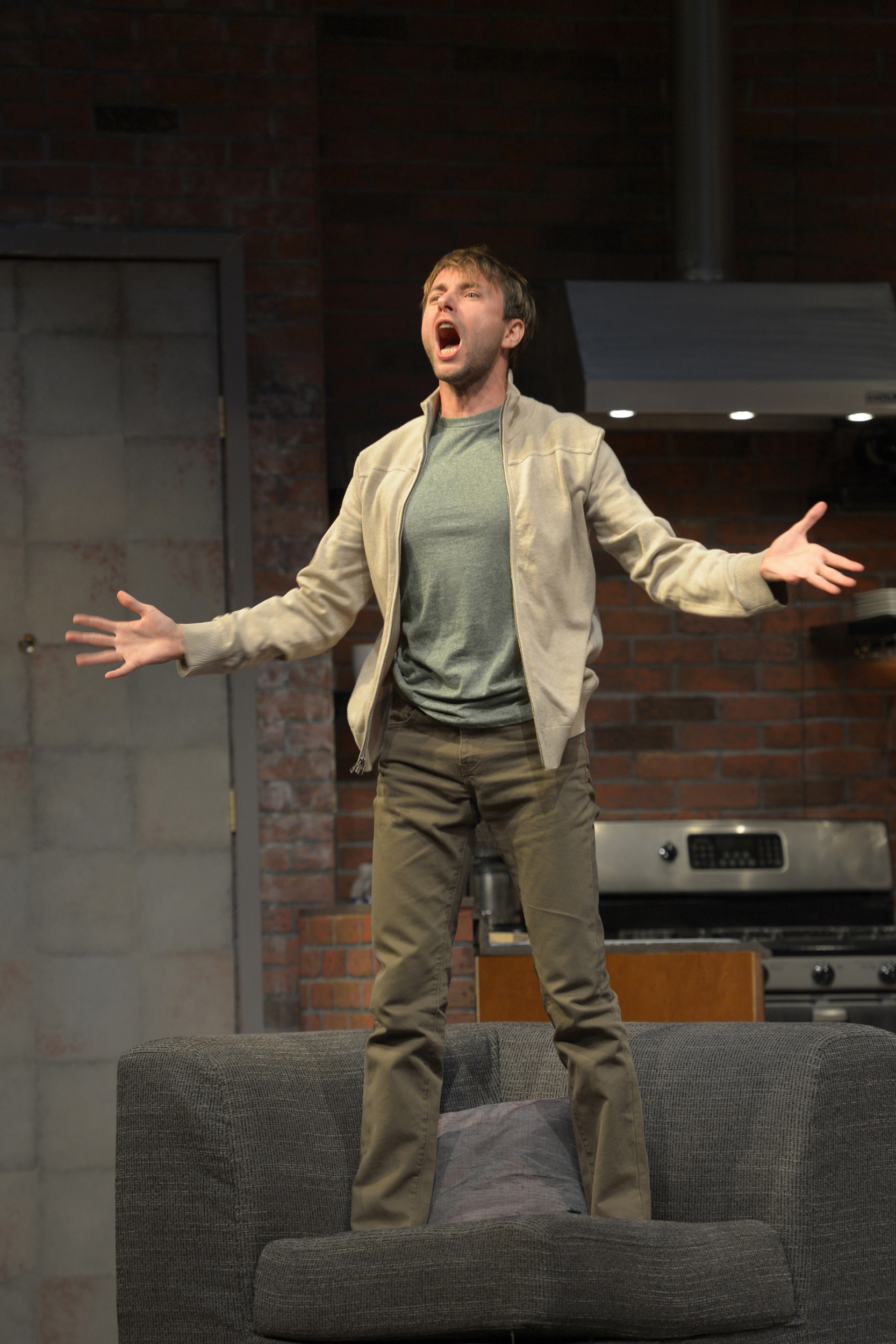
Sebastian Justice (Vincent Kartheiser) rants about the predictability of this world in San Jose Rep’s world premiere of The Death of the Novel.

THE DEATH OF THE NOVEL: Drama by Jonathan Marc Feldman and directed by Rick Lombardo. San Jose Repertory Theatre, 101 Paseo de San Antonio, San Jose, CA.

408-367- 255 or www.sjrep.com. August 30 – September 22, 2012.

THE DEATH OF THE NOVEL is a confusing and tedious evening at SJrep.

Did you know that there are psychologists/psychiatrists who specialize in treating writers who have writer’s block? There are and there were times when this reviewer could use one. Today is not one of them but help is needed to untangle the web of emotional angst that unfolded on opening night of The Death of the Novel that begins San Jose Reps 2012-2013 season.

Jonathon Marc Freeman’s main character is a brilliant young novelist Sebastian Justice (Vincent Kartheiser) who has agoraphobia, a mental condition where the patient has abnormal fear of public places or open areas and becomes home bound. This is often triggered by traumatic events that can begin in childhood and reach a peak in the mid to late 20s. Sebastian is a classic case and claims he is “the most well-adjusted, depressed agoraphobic in Manhattan.” He is not. He is a mixed up mess parading bravado to cover up his fears.

Sebastian has had enough trauma in his life, including as a teenager watching men fall from the World Trade building, to send a dozen men to a shrink. We learn about the others piecemeal as the play unfolds in a tedious two hours and 20 minutes before all the reasons are laid out and they are not very convincing. The author is vice-chair of the Southern California Committee of Human Rights Watch and one might consider this play as an extension of his commitment. He even has inserted a character named Phillip (Patrick Kelly Jones) as sort of his alter ego, or something like that to espouse his themes.

After a young lady steps to the stage apron, becomes enthralled as she reads a passage from novel, she presses the book to her bosom and exits. Now what was all that about? Was it a passage from Sebastian’s highly acclaimed and financially successful first novel and who is she? Lights up on a spectacular loft set (John Iacovelli) where Sebastian in what amounts to a non-stop monolog is having a session with Perry (Amy Pietz) a publisher-ordered psychologist (a “writer’s block-whisperer”).  Out of the bedroom comes an attractive lady whom we later learn is a hooker named Claire (Zarah Mahler), who is enraptured with his novel, has writing ambitions and hopes he will help get them published.

Enter Phillip, Sebastian’s best friend and a professed humanitarian (see paragraph two) who falls in and out of love  as often as he changes his underwear but this time he has met the true one and only Sheba (Vaishnavi Sharma) a drop dead gorgeous Saudi Arabian who is also dazzled by the novel entitled “The Seventh Day.” Through the media of Facebook and Twitter Sebastian learns that Sheba is not what she professes to be and Perry suspects she is a stalker since Sheba is delusional and unable to separate truth from reality.

Sheba

When Phillip goes off on a Humanitarian mission to the Middle East, Sebastian makes his move on Sheba and they have five weeks of passionate love and mutual confession.  Phillip returns, Sheba deserts Sebastian and goes back to Phillip although he knows her true identity . . . a Kuwaiti whose father has been unjustly rounded up by Homeland Security.

From this point on Sebastian has a break with reality and there is a scene where he visualizes Sheba. Phillip returns to tell him that Sheba who has travelled to the Iraq with has been blown up by a suicide bomber. Sanity returns to Sebastian when he throws the barbecue grill over the edge of the patio and is forced to leave the flat by the police. Really and he is cured of his agoraphobia.  End of play.

If you disregard the muddled psychology of post 9-11angst and the intricate mental states of the two main characters you can enjoy the acting and staging. Vincent Kartheiser has gained famed as a member of the TV series “Mad Men” and I cannot vouch for his previous work, he is a whirlwind performer and dominates the stage. Vaishnavi Sharma as Sheba is stunning and Amy Pietz believable as the level headed psychologist.

Kedar K Adour, MD

Courtesy of www.theatreworldinternetmagazine.com.


WE LOVE TO TALK

By Joe Cillo

WHY DO WE TALK SO MUCH?

If someone would teach the younger generation how to talk,

And their elders to listen, the generation gap would not exist.

Lynn Ruth

People my age talk a lot.  We do it because words are what we are comfortable using to express ourselves.  When we hear it, we can figure it out. You people communicate differently and I think that is great.  I saw a young couple standing together outside a movie theater sending messages to each other on their I-Pads.  They nodded wisely as if they were exchanging very special secrets.    I can’t do that.  I have to use my vocal cords to communicate.  Besides I don’t want to send anyone pictures of what I just did an hour ago. I was on the can.


I was in the grocery store and the clerk smiled as he was taught to do and said without looking at me, “How are you today?” and I actually told him.


I discussed how hard it was to get out of bed in the morning because of my sciatica, why my shoes didn’t fit because of the heat, the new place I found to shop for vitamins, and my problem with the neighbor’s dog.  When I finished, I looked at him expectantly and he said.  “83.43.  Cash or charge?”


When I was your age, I was really careful about everything I said. I didn’t want to hurt anyone’s feelings and I wanted them to love me. Now, I am of a certain age and the brakes are off. Censorship went the way of continence.


Being blunt can really mess you up if you are looking for a date.  Not long ago, I enrolled in a new dating service in the states called Table for 6.  The idea is that if you get six people together around one table sharing ideas and talking to one another you will find the love of your life.  I went to one of their events and sat there with five strangers from my generation.  The talk never stopped because that is what we love to do.  One guy discussed his new dentures, the other his hiking trip in the Arctic.  A woman who looked 106 told about her face lift and another talked about her kid with Turrets.  “He shouts obscenities EVERYWHERE,” she said. “Just yesterday I was buying a screwdriver and some fertilizer when Percy shouted I WANT TO SEE THE MONEY SHOT!’

“I was humiliated.”


When the evening was over, we all knew all about each other and we knew we never wanted to see any of these boring people again.


I looked over at the next table. It was filled with 6 people in their thirties.  Everyone there was absolutely silent except for the clink of their wine glasses and the sound of their forks picking up their stroganoff.  Each had his I Pad in his hand and now and then one would tap his neighbor on the shoulder and point to a picture or hold it to her ear to listen to a song.  At the end of their meal, while everyone at my table went his separate way, the 6 of them paired off holding hands and staring lovingly into each others eyes.


My generation likes to hear the words you say, even though we don’t really hear that well.  Our eyes are shot and we forget how to end the sentence we just began.  I went to the funeral of my friend’s husband and she was standing by the coffin talking a mile a minute to the corpse.  “I TOLD you not to take that aspirin,” she said.  “But you never listen…and now look at you! Dressed in a suit you never wore on your way to God knows where with a mortgage that is sky high and a house underwater…”

“Millie,” I whispered “He can’t hear you anymore….”

“He couldn’t hear me when he was alive, either,” she said.  “But now he can’t walk away.”


The truth is talk was our style of communication even though I have to admit we really don’t say much that is memorable.    I think we want you to know we are still alive and we want to convince ourselves that we matter to you because believe me, you matter to us.  You are the ones who will care for us when we fall apart.  The thing is, when you can’t hear, your sight is blurred and your arthritis is killing you, it feels good to talk about it. The more you chatter the less you notice the pain.


I have tried your way of communicating and sometimes it works really well.  When I have a headache I would rather text my buddy to complain, but on the other hand, there is no way any computer message can ever make me feel as good as someone’s hand on my forehead saying.  “Let me put some ice on your head and make it better.”


Everyone has their own way of getting their point across and all of us need to feel we are heard.  I don’t mind reading what you say to my computer, but sometimes, when you aren’t running from one business meeting to a mixer or a concert, I would really love it if you’d answer the telephone.


MY ADVICE WON’T WORK FOR YOU

By Joe Cillo

WHY DO YOU GIVE US THE WRONG ANSWERS

Better be wise by the misfortunes of

Others than your own

Aesop

In the beginning, my generation heard exactly the same propaganda that your parents fed to you.  For example when I was a child I was taught that mother knew best.  “Look both ways before you cross the street,” she said.  If I didn’t listen, a car hit me.  Very effective.  Right?  I am willing to bet your mom told you the same thing.


When I was in my teens, this faith that my parents had all the answers began to fade.  “Stop smoking those disgusting cigarettes,” said my mother. This time I ignored her.  What did she know?  SHE was addicted to alcohol and you know what that did to her.


Once I began school, my teachers said, “Cheaters don’t prosper.” I knew that was rubbish.  If I looked at the guy’s paper next to me, we both passed the exam and who remembered the answer to those ridiculous tests the next week anyway?  In those days, if you complained about your teacher, you had to sit outside in the hall.


Those lessons we learned then were pounded into our heads over and over and we believed them.  The policeman is your friend.  Evil is punished.  Pretty is as pretty does.  That is where we are coming from.


Today, most of us know in our heads that these are ridiculous assumptions, but they guided us when we were young and we cannot let them go.  That is why your mother’s advice won’t help your social life.  Your mother grew up in a time when a girl’s looks determined her future.  If you didn’t look like a magazine centerfold, you were destined to live a barren life alone as a librarian, a secretary or a nun.  Catching a man was a fundamental life skill for your mom.  Looking gorgeous wasn’t a choice for her.  It meant her survival.


YOU don’t need to worry about silly things like that.   You are free to use your mind.  Marriage is an option, not a goal.  You can run a marathon and sweat…. You don’t have to wear a bra.  Your mother didn’t have that freedom.


The worst response you can give to your mother’s advice is “Are you out of your mind?”  Because the truth is, she isn’t. She is living in her own past, not yours.  Getting a guy is not a major goal these days.  Living a life is.  You can have sex and never see the guy again. You have the pill.  All she had was a coat hanger.


We love to give you advice that worked 30 years ago because we want you to avoid the mistakes we made. We love you, remember?   The catch is that now isn’t 30 years ago, is it?   I mean 30 years ago we ate rich, goopy potatoes dripping in fat and didn’t feel guilty; when we acted funny, they locked us in the attic, and being an altar boy was our first sexual experience.  You were a slut if you had sex on the first date. Now you’re a slut if you don’t.  Times have changed.


Look at the workplace.  The one we knew doesn’t exist.  Your dad is not going to be able to help you find a job because he doesn’t know about on line applications.  He read the want ads.  His advice won’t work because the job he had doesn’t exist anymore.  You dad believes you need a pay check you can count on because HIS parents told him that is what honorable men had.  Girls stayed home, had babies and cooked dinner.  My buddy Charlie Gunther told me, “I’d never send my girls to college.  It is a waste of money.  Why did you bother?”


See what I mean?

I can still remember complaining to my mother because my social life was dead.  She said, “Sign up for a modeling class.”  This was back in the fifties and I knew there were better ways to spark up my night life than learning to walk with a book on my head.


My mother was telling me how she got my father back in the early thirties.  My father was a workaholic who played golf every day. He left before I woke up and came home after I was in bed.  I was certainly NOT going to toddle with a book on my head for THAT kind of relationship.  I opted to sample everything out there and keep my relationships brief and interesting.


NOW I am 79 years old, and my goals for romance have changed because I have changed.  These days, I look for someone with a fat wallet and a full head of hair.  So don’t ask ME for advice on how to find a lover…I would tell you to shop for survivors at funerals.


If you want the right answers to help you solve the challenges you face in life, ask someone your age.  They have been where you are and they will tell you what they did to make it all work.  If you want a glimpse into the past so you can see how lucky you are to be living in today’s world, ask us, but for heaven’s sake don’t do what we say.  It’s not that we’re stupid…just out of date.


GRANNY TELEPHONE; JUNIOR TWEETS

By Joe Cillo

WHY GRANNY TELEPHONES AND JUNIOR TWEETS


Each generation imagines itself to be more intelligent than the one

That went before it, and wiser than the one that comes after it.
George Orwell

“Why are the elderly so set in their ways?”  “Why won’t they stop driving?”  “Why do they tell the same story over and over again?”


How many times have you heard criticism like that?  How many times have you made those very comments yourself?


I am almost eighty years old and I do many of those very things young people hate.  I will take five minutes to answer a simple question like “How are you?”  I will drive three miles an hour on a motorway so I can read the signs. I will call you darling when I have just met you.   I know why I do those things, but you do not.  You are not 79 years old.


It occurred to me that if I told you the reason I respond to you the way I do, you will no longer snap back when someone my age frustrates you.  We do things our way because it is the way most comfortable to us.  That is why I wrote these essays.  They might help you get what people my age are about and they certainly help me realize how different the world is today.


The generation gap has been around ever since Adam and Eve left the garden, but in the twenty-first century it is wider than ever.  Each person is unique and each one of us has our own idiosyncrasies. I am a single woman; I am American.  My frame of reference is my own.  I can only tell you my own experiences, but there are certain commonalities all people my age share. Hopefully, my answers to your questions will help you understand and even forgive the older people you see every day for annoying the hell out of you.


Lynn Ruth Miller

2012


Last of the Red Hot Lovers Faces A Mid-Life Crisis at NTC

By Flora Lynn Isaacson

Susan Stein, Molly McCarthy, Ron Dailey and Susan Gundunas in Last of the Red Hot Lovers at NTC

The 93-year old Novato Theater Company has just opened its new season with Neil Simon’s Last of the Red Hot Lovers which opened on Broadway on December 28, 1969 and was released as a film in 1972.

Last of the Red Hot Lovers is one of the most amusing of Neil Simon’s comedies. It focuses on Barney Cashman (Ron Dailey), a 47-year old owner of a seafood restaurant who is afraid that the sexual revolution of the 1960’s is passing him by.  Over the space of 9 months, he invites three different women to his mother’s Manhattan apartment in an attempt to have an afternoon of extra-marital sex. None of the affairs are consummated, however, Barney decides, after the last one, that he would prefer a romantic afternoon with his wife Thelma.

Act One is a late afternoon in December when Barney meets Elaine Navazio (Susan Gundunas) who is in her late 30’s, attractive, tough, sexy who likes cigarettes, whiskey and other women’s husbands.  Act Two is a late afternoon in August when Barney meets Bobbi Michele (Molly McCarthy) who is about 27, an actress, pretty and very fresh/cool looking despite oppressive heat outside and at times, mad as a hatter.  Act Three is a late afternoon in September when Barney meets Jeanette Fisher (Susan Stein), about 39 years old, a moralist and singularly the most oppressed woman on the face of the Western hemisphere.  She is the best friend of Barney’s wife Thelma.

Barney’s doing all right for a guy who spent his life running a Manhattan seafood restaurant and raising a family with his dull but decent wife, but now he wants more. He wants to see what sex would be like with another woman. He wants adventure and romance so he sneaks into his mother’s apartment from 3 to 5 p.m. to use it as a love nest.  But Elaine is too cold, Bobbi too crazy and Jeanette too depressed.

Beautifully directed by Jamey Hurwitz with a very talented cast, Last of the Red Hot Lovers is a hot ticket.

The Novato Theater Company is in new surroundings at 32Ten Studios where you sit in loge seats that George Lucas and Company also sat in watching Star Wars and other films.  32Ten Studios is located at 3210 Kerner Blvd., San Rafael.  Last of the Red Hot Lovers runs August 31-September 23, 2012.  Performances are Thursday-Saturday at 8 p.m. and Sunday at 3 p.m. For tickets, call 415-883-4498 or go online at www.novatotheatercompany.org.

Coming up next at Novato Theater Company will be Nunsense by Dan Goggin October 18-November 11, 2012.

Flora Lynn Isaacson


LUCKY STIFF comes alive at Center Rep in Walnut Creek

By Kedar K. Adour

Harry Witherspoon (Keith Pinto) and Annabel Glick (Dani Marcus) are rivals for the 6 million dollar inheritance from recently deceased Uncle Anthony (Joel Roster).

LUCKY STIFF:  A Musical Murder Mystery Farce! Based on The Man Who Broke the Bank at Monte Carlo.”  Book and Lyrics by Lynn Ahrens.  Music by Stephen Flaherty. Directed and Choreographed by Robert Barry Fleming. Musical Direction by Brandon Adams. Center REPertory Company, Lesher Theatre,1601 Civic Drive in downtown Walnut Creek, CA. 925-295-1420 or www.centerrep.org. Through October 7, 2012

LUCKY STIFF comes alive at Center Rep

Lynn Aherns and Stephen Flaherty will always be remembered as the musical comedy creative team that captured audiences with Ragtime that won honors for original score (Flaherty) and outstanding lyrics (Ahern) on Broadway in 1998. They started their collaborative careers 10 years earlier with a madcap musical farce Lucky Stiff that had a brief Off-Broadway run and garnered a few accolades. Since that time, the show has been around the block making the boards from the midlands of England to New Zealand and is now being made into a movie starring Jason Alexander. On opening night Artistic Director Michael Butler confessed that he had designs on this play for years.  And here it is mustering up all the talents of Center Rep for another visual treat and evening of fun. It doesn’t match the brilliant farce Rumors that graced the stage last year but does match the staging of Xanadu. Once again it is Center Rep  not to be missed musical.

Surprisingly Butler who is adept at directing physical comedy turned over the reins to Robert Barry Fleming to shepherd the production. It was a wise choice since the multitalented Fleming also choreographed the show. The play is absolutely silly and harebrained with nonstop action that is the stuff good farce is made of. The set is a marvel with the obligatory four plus doors needed for farce but more about that later.

When the lights come up we are treated to a rousing opening number with the entire cast in unbelievable costumes parading about singing “Something Funny is Going On”  People in hum-drum jobs often fantasize about what life might be like if they were in other circumstances. Shy, English shoe salesman Harry Witherspoon (great musical comedy tenor voiced Keith Pinto) stuck in a dull job is able to fantasize about where specific shoes will carry the wearers. On this specific Friday night his personal shoes will carry him back to a boarding house run by a landlady from Hades (Tielle Baker) guarded by vicious (unseen but heard) dogs and filled with raunchy denizens from East London.

Rita La Porta (Lynda DiVito) discovers why Uncle Anthony (Joel Roster) has been unresponsive to her advances.

Harry receives a telegram informing him that he has (had) and unknown American casino owner Uncle Anthony(Joel Roster) who has been murdered and left him $6,000,000. Before we find out what is to unfold, enter Rita La Porta (Lynda DiVito who belts her song “Rita’s Confession” with gusto) the legally blind lover of Uncle Luigi whom she accidently shot but has also stolen his funds to buy six million dollars in diamonds.  She elicits the aid of her optometrist brother Vincent (Benjamin Pither) for her nefarious mission to get the diamonds back.

When Harry meets the lawyer (Marcus Klinger) he is told there is a stipulation. . . Harry must take the embalmed wheel-chair ensconced corpse (Joel Roster) to Monte Carlo. Don’t ask why, just go and see for yourself.

Every musical must have a secondary love plot. How about a do-gooder dog lover Annabel Glick (diminutive charming Dani Marcus) who represents the Home for Wayward Dogs who will get the dough if Harry doesn’t comply with the will. Of course Harry and Annabel will get together (again) after she brings the house down saying to Harry who calls her Annabel “It’s Miss Glick to you. Sharing a bed does not put us on first name basis [or something like that].”

There we are, all set to move around Monte Carlo to continue the wacky, quirky show. This is Aherns and Flaherty’s first show and some of the songs seem forced but the lyrics are extremely clever and satirical.  They give their characters ample opportunity to share the spotlight switching to the plethora of roles they invest. Sexy Taylor Jones as a French chanteuse in high-heeled red wedges dances and sings up a storm to match the scene stealing Lynda Divito. There is a hysterical/terrifying dream-nightmare dance number utilizing Kurt Landisman’s lighting to great effect.

Colin Thompson is always a joy to watch in his many get ups including Uncle Luigi or as an Arab Prince. Marcus Klinger morphs from a stuffy English lawyer to a French master-of-ceremonies and others. The willowy Even Boomer fills every other minor role with class and seems to be everywhere at once. You won’t believe the transformation of Tielle Baker from nosy boarding room hag to a drunken French cleaning maid who complicates the action allowing director Fleming to use all the doors on the stage and upper level ramp for a chase to end all chases.

The inventive Kelly Tighe’s set utilizing a revolving stage allows the action to move smoothly. Christine Crook’s costume designs will surely win a Bay Area Critics award. You will never see a roulette table like the one she designed. Joel Roster earns a Tony Award as The Dead Body for his immobility and ‘stiff’ acting.  Running time 2 hours and 10 minutes with an intermission.

Kedar K. Adour, MD

Courtesy of www.theatreworldinternetmagazine.com


THE ELABORATE ENTRANCE OF CHAD DIETY is a slambang show at Aurora

By Kedar K. Adour


he Mace (back, Tony Sancho*) watches the elaborate entrance of fellow THE wrestler Chad Deity (c, Beethovan Oden*) in the Bay Area Premiere of The Elaborate Entrance of Chad Deity

The Elaborate Entrance of Chad Deity: Comedy. By Kristoffer Diaz. Directed by Jon Tracy. Aurora Theatre, 2081 Addison St., Berkeley. 510-843-4822 or www.auroratheatre.org. Through September 30, 2012.

The Elaborate Entrance of Chad Deity is a slam bang show at Aurora

When you enter the small three sided Aurora Theatre to see their first offering of the 2012-13 season be prepared for a shock. An almost full sized boxing/wrestling ring fills three quarters of the acting area with just enough room at its periphery for the feet of the first row of patrons who swiftly learn they must share that space with one or more combatants who will cavort in and out of that ring. Set design by Nina Ball.

The adjective ‘cavort’ is apt since the play’s central theme is professional wrestling, and those in the know, know that pro wrestling is unreal physical acting to earn a buck. But do not tell that to the aficionados of the ‘sport’ who refuse to accept it as only theatre for profit. From the reaction of the few pro wrestling matches I have seen on TV the audience reaction seems authentic, spontaneous and hysterical. Surprisingly the women are the most vocal since many of the wrestlers are muscle-bound hulks exuding sex.  It certainly was that way with the two women seated in back of us who were the most vocal with hysterical exhortations as the menacing characters make their entrances dressed in sparse, very revealing  spandex and hardly anything more (Costumes by Maggie Whitaker). Their exhortations really were not spontaneous since the muscular Dave Maier instructed us how to respond as each actor with names like “The Bad Guy”, “Billy Heartland”, “Old Glory”, “The Mace”, and lastly “Chad Diety” when theymake their entrances. Maier is not only an actor(s) in the play but is the fight director.

 This satirical put down of the duplicity of wrestling mixes in more than a dollop of social injustice inflicted upon racial minorities and ethnic stereotyping. Elaborate entrances, hence the title, are de rigor. The most elaborate is reserved for an African-American that has been given the name of Chad Diety (Beethoven Oden) whose appearance in the arena with his huge gold “World Champion” belt around his midriff elicits a cacophony of cheers as he throws dollar bills in the air.

But there is no true champion since the matches are arranged as to who will be the good guy and win the match and who will be the bad guy to lose. The fights are finely choreographed to make body slams, camel humps, Korean kicks etc. all seem real without inflicting physical harm to both participants. To stimulate fan interest the promoters devise fake enmity often based on class hatred or perceived malfeasance.  Author Kristopher Diaz has created Macedonio “The Mace” Guerra (Tony Sancho), a barrio born Puerto Rican as his protagonist giving him reams of line to explain to the uninitiated the ins and outs of the game.

After Dave Maier has whipped up the audience and taught them how to respond, “The Mace” spouts in non-stop fashion his background, his role as a perpetual loser, his ability to make the other guy look good and his desires for something better. It really is an incessant monolog that Sancho sinks his teeth into as he bounces in and out of the ring or straddles the ropes. He is a marvel, extremely likeable and adept at physical maneuvers. “The Mace’s” opinion of the Chad Diety’s ability doesn’t amount to a hill of beans compared to him but he knows his role, plays it to the hilt and gets paid.

Not only does he know his role, he is constantly reminded by “EKO” Olson (Rod Gnapp) the sleazy promoter who fosters class and individual hatred to stimulate more attendance thus increasing the profitable bottom line. When “The Mace” develops a friendship with a first generation Indian American named Vigneshwar “VP” Paduar (Nasser Khan) an idea for a new act germinates and that will give “The Mace” more control over his destiny.

Their act will be a match between VP as a Muslim terrorist given a name of “The Fundamentalist” complete with a turban and fake beard resembling Osama Ben Laden. “The Mace” is cast as Che Chavez Castro a Mexican guerrilla complete with bandolier and garish sombrero. But alas, Mace is assigned the role of introducer and VP is pitted against Chad Diety. From this point the play tackles the crime of ethnic stereotyping and racial hatred detracting from the fun of wrestling mania.

VP (l, Nasser Khan) and Mace (r, Tony Sancho*), dressed as their wrestling alter egos, shoot a promo directed at champion Chad Deity in the Bay Area Premiere of The Elaborate Entrance of Chad Deity

The staging and acting are marvels. But even with the top-notch acting of Tony Sancho, Rod Gnapp, Dave Maier, Nasser Khan and Beethovan Oden the staging under Jon Tracy’s direction, steals the show. Tracy is known for his physical directing style and is perfect for this play. He makes full use of two screens placed high on the rear wall to project stock video clips and live projections of the action in the ring. (Congratulations to Jim Gross). Curt Landisman’s red white and blue (after all wrestling is an American sport) lighting is enhanced by Cliff Caruthers’ evocative sound design. Running time about two hours including intermission.

Kedar K. Adour, MD

Courtesy of www.theatreworldinternetmagazine.com.

Whither the Willows: Why Did This Theatre Die?

By Joe Cillo

By now, most people in the Bay Area theatre community are aware that The Willows Theatre Company, after a run of 35 years, is out of business.  The Willows Board filed for Chapter 7 bankruptcy on August 16.

Cast members of The Willows latest (and last) production, Ibsen’s A Doll’s House, were notified on August 13 that the final week of the show, August 15-18, had been cancelled.  Cast members reported receiving a phone call giving them thirty minutes to remove their belongings from the theatre in Concord.

I am, that is, I was the publicist for The Willows, on and off, from 2004 until the sudden closing two weeks ago.  The first I heard of the shut-down was when I read Lisa White’s Contra Costa Times online article, “It’s Curtains for the Willows Theatre,” on Monday afternoon, August 13.  Thank God for Google Alerts.

Many people knew that The Willows was on shaky financial ground, but what theatre isn’t?  The Willows had been through serious money problems before, closing its 210-seat Concord mainstage in 2009 and moving everything to its second space, the 150-seat Campbell Theatre in Martinez.  A new artistic/managing director team took over in 2010 and reopened the Concord stage in 2011.  The shows, as they say, went on – in both venues.

And then the lights went out.

How could this have happened?  Potential culprits abound: declining and ageing audiences, hard economic times, misjudging audience preferences, cannibalizing the same base of supporters with two theatres, fiscal mismanagement and overspending, corporate funding drying up, lukewarm community support, a board beset by too many problems coming at them too fast, perhaps even a publicist who couldn’t build a case for 9 to 5, the musical version of a 1980s Dolly Parton film – you can choose any or all of them all of them.

It’s probably too early for the autopsy, but in my view, at least right now, the demise of The Willows was caused by a series of Big Ideas that proved to be unsustainable.

“A Brief History of the Willows Theatre,” which appeared in each printed program for many years, recounts that “in the spring of 1977, Theatre Concord, a program of the City of Concord, began producing plays and musicals in the new Willows Theatre.  Nine years later, Theatre Concord became CitiArts Theatre, the first company in Contra Costa County to operate under a seasonal contract with Actors Equity Association.  In 1994 CitiArts Theatre became an operation of The Benefactors, a non-profit corporation organized in 1974 to support quality live theatre in Concord, and the company is now known as The Willows Theatre Company.”  In later years, The Willows estimated that it served over 70,000 patrons annually.

The Willows was dedicated to developing and producing “contemporary American plays and musicals,” although it extended its reach to include works originating in the U.K., as well.  It was, therefore, a real stretch for them to stage Ibsen’s A Doll’s House, the only non-US/UK show in their history.

As for Shakespeare, records indicate a production of The Taming of the Shrew in 1987. Former artistic director Richard Elliott once told me, “there are enough companies in the Bay Area doing Shakespeare.  We leave the Bard to them.”

The Willows’ stated mission was to “strive to perpetuate the art form of live theatre by creating relationships with playwrights, designers, actors, students and other theatre artists whose work will impact current and future audiences.”

The next part of the mission hints at why the Willows’ demise hurts the theatre community: “We provide a valuable opportunity for first employment for many developing theatre artists.”  In addition, since the Willows was an Equity house, many actors over the years were able to work their way toward their Equity card by performing there.

My wife and I became Willows subscribers in 1994, not long after moving to Clayton.  The Willows was, in essence, our local theatre, and we found the shows well cast, well directed, and quite simply, fun.  For my money, four or five of the best pieces of theatre I’ve ever seen were at The Willows, thanks to excellent casts and direction by Andy Holtz (Cabaret), Richard Elliott (On Golden Pond), Jon Marshall (Avenue Q), and Eric Inman (Chicago).

In our early subscriber days, my wife and I volunteered at the theatre. I read through stacks of unsolicited manuscripts, looking for the next blockbuster in the rough.  Kathy organized the mailing lists, using floppy disks that Rich or Andy would drop off at the house.  That was the state of technology then: no email, no Zip files, and disks that were truly “floppy.”

In 2004, after I’d started Rising Moon, Andy Holtz, the managing director, and Rich Elliott, the artistic director, contracted with me to do publicity for the revival of the theatre’s outdoor musical, John Muir’s Mountain Days, at the amphitheater in Martinez.  I was asked to stay on to publicize the next show, the musical version of The Night of the Hunter.  Both were stretches for a small East Bay theater – Mountain Days was a huge undertaking, with more than 50 in the cast, along with a team of horses. Hunter was based on the very creepy film that starred Robert Mitchum as an itinerant preacher who menaced two children and killed their mother. It’s the movie where Mitchum has the words “Love” and “Hate” tattooed on his fingers – hardly a show for the Hello, Dolly! Crowd, but it showed The Willows wasn’t afraid to take chances on a show that its Los Angeles producer was planning to take to New York.

In 2008, I was again contracted to do publicity for The Willows.  By this time, Andy Holtz had left for the Arizona Theatre Company in Tucson, and I worked with Rich Elliott and general manager Chris Marshall, the lady who wore a dozen hats and held the place together.  I was there from Brighton Beach Memoirs and Pageant, to the closing of the Concord theater in 2009, the restructuring under David Faustina and Eric Inman, the reopening of the mainstage in 2010…to what would be the last shows, Vaudeville at the Campbell and A Doll’s House at the original Willows Theatre.

So, The Willows is gone, joining the now defunct American Musical Theatre of San Jose, which died in 2008.  SF Chronicle critic Robert Hurwitt points out that, “a few years earlier AMTSJ had more subscribers than either A.C.T. or Berkeley Rep.” More recently, we’ve seen the departure of the Hapgood in Antioch, Arclight in San Jose, and Woman’s Will in Berkeley.

For many theatre companies, survival is day-to-day, show-to-show.  As one artistic director I know told me, “you’re only one flop away from closing the doors.”

Why did The Willows close?  Earlier, I listed a series of “culprits” that might have led to its going under, and to varying degrees, they are all probably to blame.  But I see the major problem as more than just running out of money.  That’s a symptom, not the cause.  In my opinion, The Willows went under because it was too ambitious, perhaps even too creative, and certainly too willing to follow a Big Idea.

The first Big Idea was getting a theater space of its own.  The Willows had for years been leasing its space in Concord’s Willows Shopping Center and grew tired of paying rent, along with all the associated issues renters face.  (Side note:  one positive for a theatre in a suburban shopping center – it solves the parking problem.)  As early as 2006, they were negotiating to move to the YMCA building in Danville.  While that idea remained on the back burner, Willows management looked north to Martinez and made plans to convert the old train station into a theatre, a plan that at the time found favor with the city of Martinez.  The Willows got as far as hiring an architect, developing blueprints and renderings, and starting a fundraising drive.  Why Martinez?  Rich Elliott and Andy Holtz lived there, liked the town, and thought it –and the train station – would be the ideal place for a theatre.

After the train station idea stalled, the Big Idea focused on another location – an unused auto parts warehouse on Ward Street. Thus, the Campbell Theatre came to be, thanks to a raft of donors led by the very generous Campbell family.

Every successful theatre has (or should have) a guaranteed moneymaker, a “Christmas Carol,” a “Nutcracker,” a “Sound of Music.”  Or an “Annie,“  the show that guarantees that every parent, grandparent, aunt, and uncle of the kids in the cast will buy tickets – and twice that number if you double-cast.

For The Willows, it was the Nunsense series, seven slapstick musicals by Dan Goggins (Nunsense, Nunsense Jamboree, Mushuga-Nuns, etc.) featuring five loony nuns. Ending the season with a Nunsense show pretty much paid for the rest of the year.  Nunsense became part of the Big Idea – the original proposal for the Campbell Theatre was for it to showcase nothing but Nunsense, year ‘round.  It would make money.

The all-Nunsense idea was soon abandoned, but the cabaret concept at the Campbell remained.  Was Martinez the right town for it?  Would Willows’ subscribers attend both theatres?  Or would the finite audience pie be divided in two?  Would a cabaret concept have to be marketed differently than a standard theatre?

As the theatre’s fortunes spiraled downward in 2009, the board and management decided the only way to save the company was to close one of the theatres – they chose to shutter the mainstage and move everything to the Campbell.

This turned out not to be a solution.  By 2010, a new management team was in place, led by managing director David Faustina and artistic director Eric Inman.  They saw that the only hope for sustaining the company was to return to Concord and reopen the theatre there, where the bulk of their patrons were.  Which they did, thanks to a fundraising campaign and a lot of volunteer hours, along with a big boost from the local IBEW, who donated the rewiring of the entire mainstage venue.

But for many reasons associated with the city of Martinez, the company wasn’t able to leave the Campbell behind; it had to sustain both theatres.  The Campbell was starting to find its audience, but it was too late.  What began as a Big Idea ended as Too Big a Task.

Another Big Idea was the amphitheater in Martinez, which was planned to be home to a whole series of outdoor historical musical dramas.  John Muir’s Mountain Days was only the first, and at first it was extremely successful.  It attracted a large audience when first staged at the amphitheater in 2005, but it was very expensive to produce.

Nevertheless, plans took shape under Andy and Rich for a series of seven musicals that would play in repertory at the amphitheater.  The next was Sacajawea, the tale of the Lewis and Clark expedition centering on the Native American woman who was their guide.  The book and lyrics for Sacajawea were by New York playwright  Mary Bracken Phillips, with music by San Jose native Craig Bohmler, the same team who had done Mountain DaysSacajawea was staged in 2008, but at the Alhambra Arts Center in Martinez, because the amphitheater was in disrepair.

The next in the amphitheater series was to be about the “Big Four,” the industrial barons (Leland Stanford, Collis P. Huntington, Charles Crocker, and Mark Hopkins) who brought the railroads to California.  However, the script for it and the other four shows in the series was never commissioned.  The amphitheater remained, however, as a continuing burden.  The upkeep was too much for the Willows, and the city of Martinez shied away from pumping municipal funds into the venue.  Another Big Idea foundered.  In retrospect, the historical drama project would have needed a Disney Corporation to make it work.

A third Big Idea is banking on a show to be a hit, or even artistic triumph that will lift the company to new heights and at least break even…and then seeing the show fail.  The Willows suffered its share of “one flop away from closing” events. The Kentucky Cycle, a two-part, six-hour production asked the audience to come to the theatre twice to see the story work out.  It was a wonderful piece, but it asked too much of its audience.  On another level, there was the afore-mentioned 9 to 5: the Musical – Dolly Parton brought no cachet.  Neither did two other musicals based on movies, The Night of the Hunter and The Wedding Singer.

Ironically, two weeks before The Willows closed, it was named one of the “Best Theatre Companies in the East Bay” by critic Charles Kruger in the Examiner.com and the CBS-5 web site. Kruger placed it in the company with Berkeley Rep, Shotgun Players, Aurora Theatre, and Central Works. Indeed, The Willows has, over the years, won more than its share of Drama-logue, Shellie, and Bay Area Theatre Critics Circle awards.

Kruger praised the theatre for “specializing in the great American tradition of the Broadway musical…delivering the old razzle dazzle with grace and style, presenting both classics and new musicals…constantly trying to take theatre to the next level.”

But it’s difficult, if not impossible, to rise to a new level when you’re tied to three very disparate venues – a proscenium house, a cabaret, and an outdoor amphitheater – at a time when the political and economic cards are stacked against you.

It will be interesting to see what rises from the ashes of The Willows…which shards will be reassembled, and by whom.

Like Ishmael in Moby Dick, I am only here to tell the tale from my perspective.  Others with deeper experience on the voyage of the good ship Willows are welcome to add their comments, corrections, and insights. – GC

Contact: Gary Carr, (925) 672-8717, carrpool@pacbell.net.  Learn more about Rising Moon Marketing & Public Relations at www.risingmoonarts.com.