THE PLAY ABOUT THE BABY has a great cast

By Kedar K. Adour


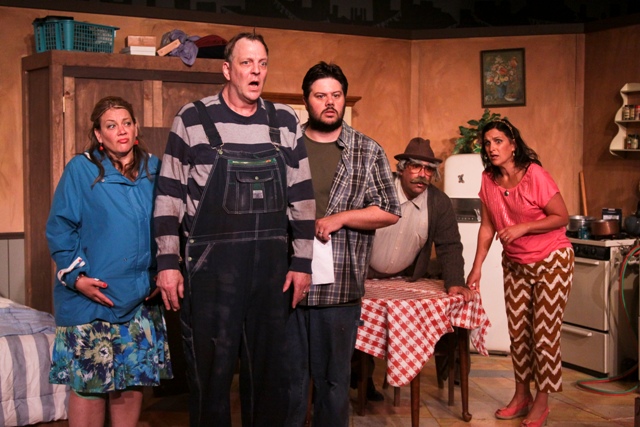
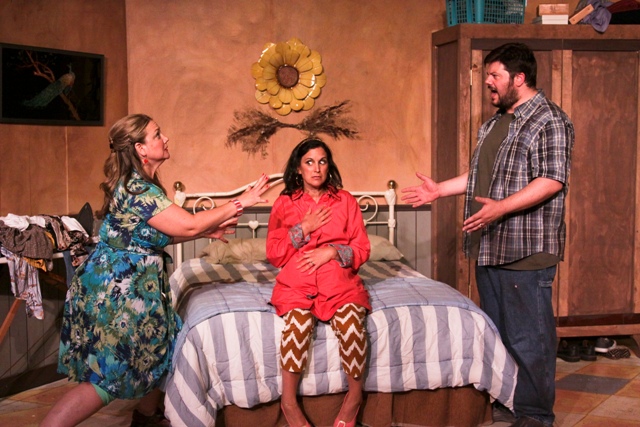
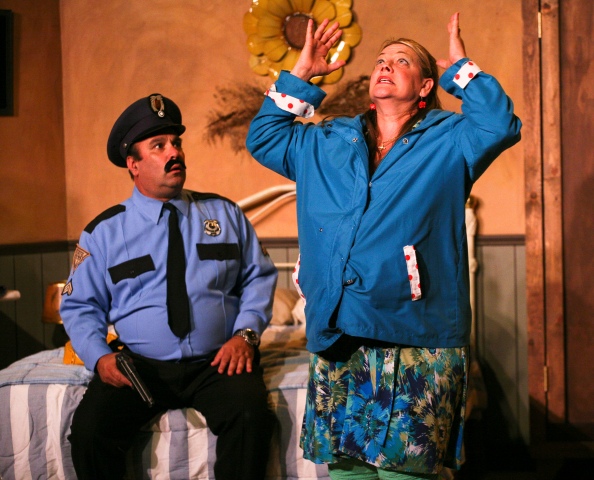
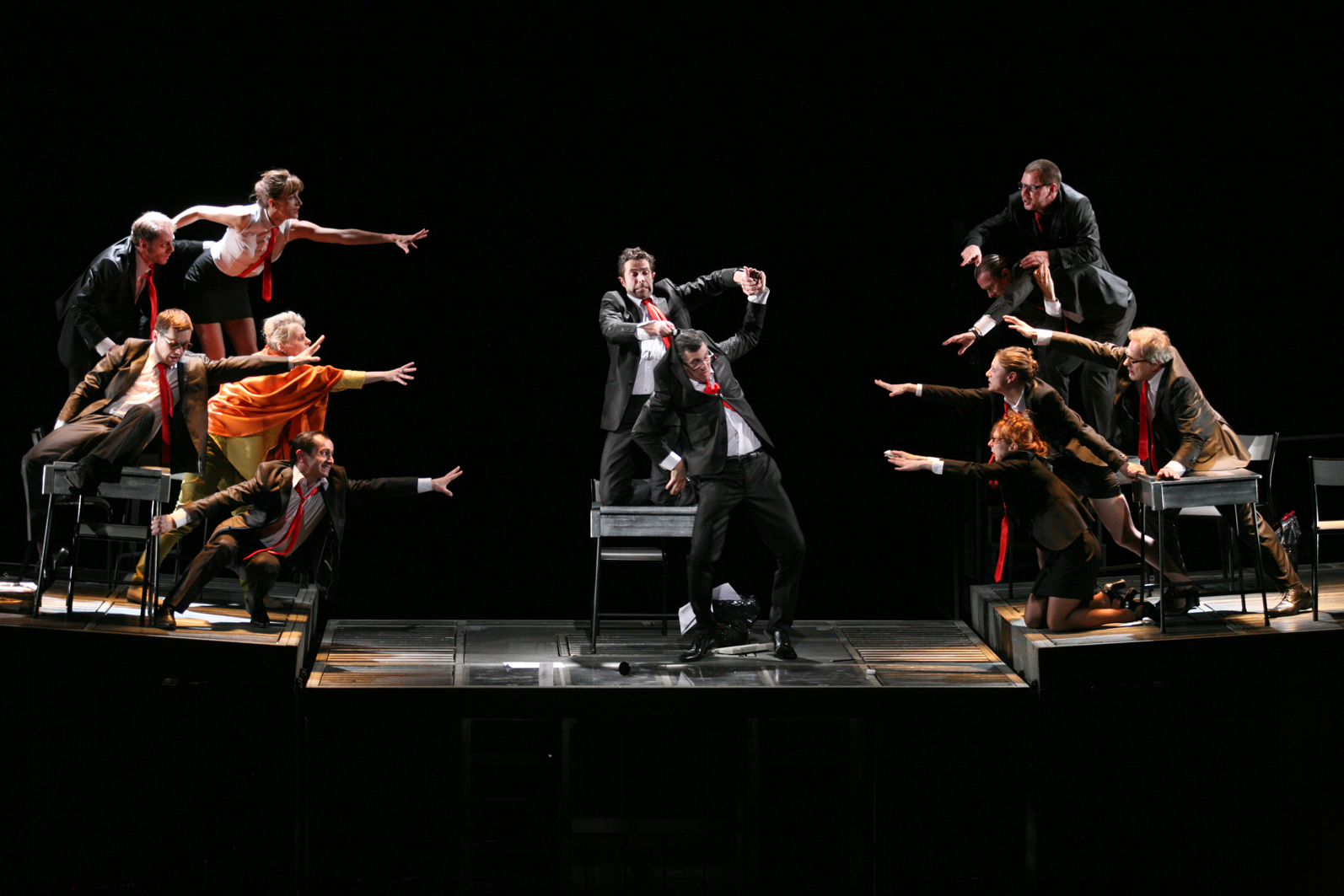
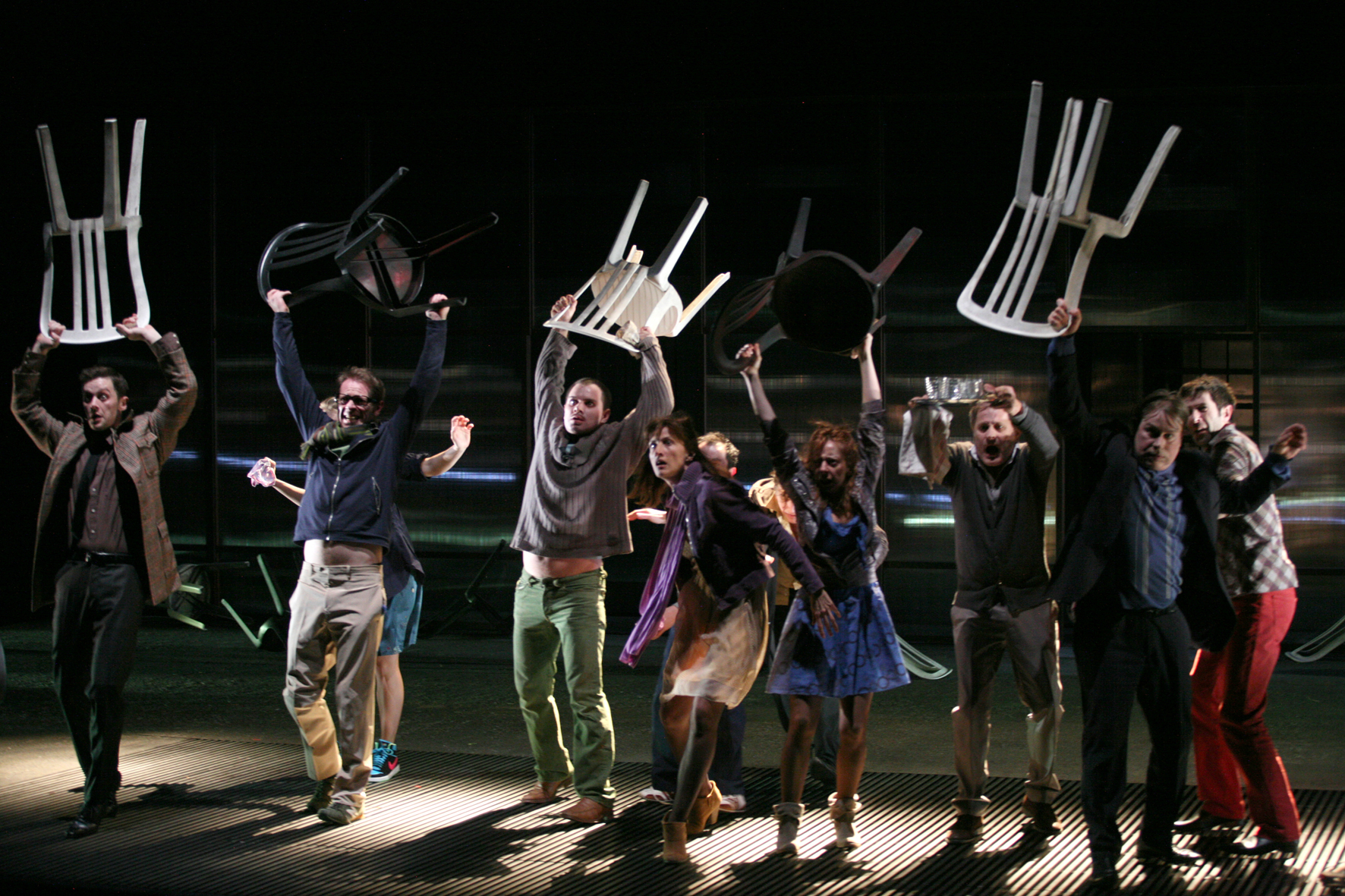
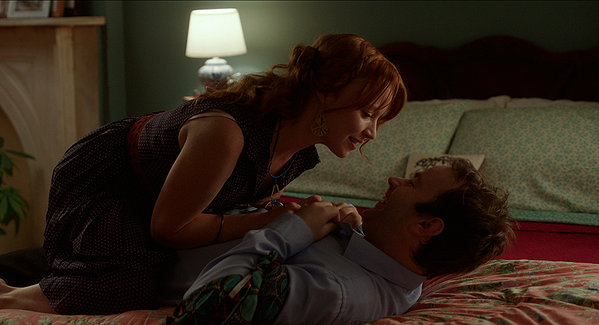
(top L) Anya Kazimierski, Shane Rhoads as Boy and Girl and Baby. (Top R) Richard Aiello as Man telling his tale  with bank of chairs.  (Lower R) Linda Ayes-Frederick as Woman remembering Prince Charming in Custom Made’s production of The Play About the Baby.

The Play About the Baby by Edward Albee. Directed by Brian Katz. Gough Street Playhouse, 1622 Gough Street, San Francisco. 415-798-2682 or www.custommade.org/the-baby. Through October 14, 2012

THE PLAY ABOUT THE BABY at Custom Made has a great cast

When Edward Albee, in a 2001interview with Charlie Rose, was asked what The Play About the Baby was about, the answer was “It is about 2 hours.” In that same interview when asked “What’s the idea of the play?” his response was “I don’t know.” In Custom Made’s excellent production of the play under Brian Katz’s firm hand the play is about one hour and 45 minutes including a 10 minute intermission and when you leave you won’t know what Albee’s idea was for writing the play.  Director Katz plays directly into Albee’s hands (trap?).

Albee also insists that his plays are written for small 100 seat theatres. He gets his wish for this play at the intimate theatre attached to a church on Gough Street. The devious and inventive director gets the audience into the right frame of mind to enjoy (?) this play by creating a set utilizing a floor to ceiling wall of chairs invoking the image of The Chairs an absurdisttragic farce” by Eugene Ionesco written in 1952. OK Brian, you’ve got our attention and we are going to see an absurdist play. Now where do we go from here?

Since the play is about the baby we need a baby and in two extremely brief black out scenes the younger pair (named Boy and Girl) of the quartet in the play are blessed with a baby. Marital bliss abounds and when Girl breast feeds the baby, Boy says “Save some for me” and he gets his share. If this were not an absurdist play a psychiatrist would be needed.

The other half of the quartet (quintet if you count the unseen baby) is an older couple Man and Woman. Man is the interlocutor of the evening. Yes, interlocutor is an appropriate designation since what plays out is a circus of reality and unreality. If, as Albee insists, the baby is real then what transpires amounts to terror. If the baby is fictional as in Who’s Afraid of Virginia Woolf then just sit back and let your mind try to absorb what in hell is Albee trying to say.

Is he equating love with sex since he gives Boy multiple lines insisting, “We’re truly in love. I always have a hard on!” and to girl, “I love being on you – in you.” Albee is obsessed with sex (just ask local playwright Joe Besecker who has written a play Bee-Eye with Albee as a major character). He evokes eroticism with the imagery of Man appearing to be blind stroking the bronze penis of a bull in a museum.  He also throws in a suggestion of homosexuality (so what else is new?) What seems like an innocuous tale told to Girl by Boy about a Gypsy scam involving a switch of paper bags in act one becomes a horrible suggestion in act two. Don’t ask.

To the incessant question of Boy/Girl to Man/Woman, “Who are you?’ the first reply is “We know your mother. We may not be remembered but not forgotten.”  The more cogent/questionable reply is “We are your destination” intimating that they will morph into personae of Man and Woman. Now that’s scary. What is even scarier is that this creepy couple can invade the minds of the youthful couple and erase from memory the conception and birth of their baby.

Yes, The Play About the Baby is confusing and Albee Like Picasso is putting us on and laughing up his sleeve as we praise their absurdist so called master pieces. Fortunately Brian Katz has a superb cast of Anya Kazimierski, Shane Rhoads, Richard Aiello and Linda Ayes-Frederick who give each of their characters verisimilitude in a morass of confusion. We agree with Woman who tells Man “You go too far.” That being said, this reviewer highly recommends seeing another side of Albee whose plays have had a resurgence in the Bay Area.

Marin Theatre Company mounted the overlong and tedious Tiny Alice and Aurora won praise from the author for their brilliant A Delicate Balance. The Play About the Baby can be categorized as falling between the two confirming that Albee is Albee is Albee. “If you have no wounds how can you know if you’re alive? If you have no scar how do you know who you are? Have been? Can ever be?” and you should not miss this production. (Full frontal nudity)

Kedar K. Adour, MD

S,F,Fringe Cheesecake and Demerol

By Guest Review

S.F. Fringe’s Cheesecake and Demerol. A Female’s Journey to Freedom

At the S.F. Fringe’s 21styear, hosted in San Francisco’s downtown Exit Theatre, among the over forty independent new creations was nurse Gene Gore’s story of her life time journey to female freedom. Her storytelling piece is a well constructed work that reveals Gore’s’s life from childhood during the Depression to nursing school and career, marriage, children, divorce, caring for aids patients, and female emancipation all of which is seasoned along the way with pathos and humor. Gene Gore’s testimony of a life of female growth toward liberation is a rare experience narrated with heartfelt simplicity and intimacy as though our storyteller is openly confiding in each one of us.

Cheesecake and Demerol plays through Sept 16 at the Exit Left ,156 Eddy St. For info visit www. 2012 San Francisco Fringe Festival

TIME STANDS STILL

By Joe Cillo

TheatreWorks presents…..

TIME STANDS STILL

By

Donald Margulies

Directed by Leslie Martinson

Starring Rebecca Dines, Mark Anderson Phillips, Rolf Saxon & Sarah Moser

Your only obligation in any lifetime

Is to be true to yourself. Richard Bach

This is a play about finding out who you really are.  “One of our greatest contemporary dramatists, Donald Margulies is a photojournalist of our lives, gifted with an extraordinary lens,” says TheatreWorks Artistic Director Robert Kelly.


In Time Stands Still, Margulies examines the conflict we all face in sorting out what we need to be as human beings and what we are actually doing with our lives.  Although the plot weaves many themes together, that of career, marriage, human need, and our obligation to ourselves and to society, the real story is the juxtaposition of the relationships of the two couples we see on stage.  The play “is very much about the choices and compromises we all make —in love, in work, and particular to this play, in war,” says Margulies.  “Ethical struggles touch on all aspects of life.”


Rebecca Dines is Sarah, a photojournalist severely injured while recording the terror and slaughter in Iraq.  We meet her when her lover Jamie (Mark Anderson Phillips) is bringing her home, her leg and arm broken and her body a mass of abrasions.  Jamie went to a hospital in Germany to be with her as she fought for her life. “I had my fifteen minutes (to become famous)  and I spent it unconscious,” she says.


As she contemplates her career and her need to return to it, she says, “I live off the suffering of strangers.”


Jamie counters with, “You help them in ways you can’t see,” but the truth is that Sarah gets far more out being in the midst of combat than a good picture.  She is addicted to the danger and feeds off the violence she captures on film. ‘The women and men who put themselves in unimaginable situations to capture images and stories…aren’t simply doing it for the public good,” says Margulies.  “Their courage is immense, to be sure, but there is an unmistakable kind of thirst for it as well.”


Jamie is a journalist who uses words to record the horrors that Sarah photographs and he has had enough.  “We don’t have to do this,” he says to Sarah.  “I don’t want to watch children die.  I want to watch them live.”


The other couple, Richard (Rolf Saxon) and Mandy (Sarah Moser) is in direct contrast to the tormented, battle scarred main characters.  Richard was once Sarah’s lover and employer. He is a newsmagazine photo editor and is instrumental in creating a book of Sarah’s photographs and Jamie’s writing.  He is wildly in love with Mandy now, an idealistic, sweet and unbelievably naïve girl thrust into the company of three hard core liberal realists. Richard excuses her:  “She’s young,” he says but Sarah delivers the final put down”  “There’s young and there’s embryonic.” she says.


Mandy has brought Sarah balloons to cheer her up and she says, “Balloons have an amazing way of making you feel better.”


Although Sarah and Jamie obviously dismiss her as inconsequential, Sarah Moser has given Mandy an exquisite persona the audience cannot help but love.  She is obviously sincere and there is a great deal of wisdom in her innocence.  She tells Sarah, “I’m an event planner,” and Sarah counters with, “I’m in events, too.  War.”


But Mandy refuses to be diminished and she will not allow Sarah to believe her relationship with an older man is nothing but fluff and sex.    “People think I am Richard’s mid-life crisis,” she tells Sarah.  “But it is not that at all.  Whatever it was that brought us together was what brought us together.”


As the action develops, we see that Richard and Mandy have built a solid foundation for their relationship.  It is a fulfilling one for them both without a hint of the sugar-daddy/bimbo infatuation Jamie and Sarah assume created it.   All the actors in this production are superb, but I have to say that Moser and Saxon mesmerized me with the veracity of their portrayals.  They brought their characters to compassionate life without a hint of sentimentality.  When Mandy hears that Sarah has photographed a dying child, she is horrified that the older woman did nothing to help or save that child.  She cannot believe the cynicism she feels in the room and she says, “There is so much beauty in the world.  I wish you’d let yourself feel the joy.  Otherwise what’s the point?”


It might sound trite and it might be a one dimensional sentiment said by anyone else, but Moser transforms her lines into exquisite observations on what we can make of our destiny if we really want to see its potential instead of its loss.  When the two get married and have a baby, Mandy decides to stay home to rear it.  “You make me feel like less of a woman because I want to stay home with my baby,” she tells Sarah and Sarah understands, but she knows that isn’t the life she would choose.


It is when Jamie sees how happy Richard is that he realizes that he and Sarah can have something more…the happiness, the positive future, the security…if they will but give it a chance.  He tells Sarah: “When a couple has been together as long as we have and has seen what we’ve seen and done what we’ve done, it’s time to call it what it is…a marriage.”


And Sarah agrees…in principle…but she doesn’t take into consideration her own drive to do the thing she loves and her thirst for the action that feeds her. She justifies the value of her work to herself and to Mark.   “If it wasn’t for people like me, the ones with the cameras, who would know?  Who would care?“ she says and he realizes then that the relationship isn’t going to work for him.  “You need drama more than you need me,” he says.


Until the final scene, the plot held together beautifully for me.  Leslie Martinson is a superb director and the movement of the characters, the use of silence, the juxtaposition of innocence and cynicism is masterful.  Erik Flatmo’s scenic designs are right on the mark, accenting the action and never detracting from the action on stage.  Both Dines and Phillips occasionally had trouble convincing me that they were the real thing and often their chemistry on stage disturbed rather than enhanced the action. There was falseness to their intensity that did not ring true.   It was Saxon and Moser who charmed me throughout.  That said, the entire production is a must see on every level.  The script is truly wonderful and TheatreWorks has given us a theatrical masterpiece, beautifully presented. As an ensemble production, it excels.


Time Stands Still continues through Sept. 16. at the  Mountain View Center for the Performing Arts, 500 Castro St., Mountain View. Tickets  $23-$73.

More information: (650) 463-1960, www.theatreworks.org.


THE LIAR at Marin Shakes a barrel of fun

By Kedar K. Adour

                                                                      (l to r) Elena Wright as Lucrece, Darren Bridgett as Dorante, Cat Thompson as Clarice in Marin Shakespeare’s THE LIAR.

THE LIAR: French Farce adapted by David Ives from the comedy by Pierre Corneille. Directed by Robert Currier. Marin Shakespeare Company, Forest Meadows Amphitheatre, Dominican University, 1475 Grand Ave., San Rafael, CA, 415-499-4488, www.marinshakespeare.org  Through September 23, 2012.

THE LIAR at Marin Shakes a barrel of fun.

Before the play begins Associate Artistic Director Leslie Currier informs the Sunday matinee audience some of the ins and outs of the play we are about to see. It is absolutely unnecessary but highly informative. All you must do is sit back and enjoy one of the best productions staged by the Marin Shakespeare Company that has assembled it best Equity actors to romp around in fancy dress 1600’s costumes (Abra Berman) speaking in poetic (sort of) couplets in the French farce The Liar.

The play was written in 1643 by Pierre Corneille and Washington’s D.C. Shakespeare Company commissioned the wickedly humorous David Ives to write this adaptation that was produced there in 2010 and has appeared on the boards off Broadway and in local venues across the country. Ives insists “It’s neither exactly a translation nor an adaptation. It’s what I call a translaptation . . .” He goes on to talk about social satire and how lies can go on to feed love and create happiness. Observations that are completely unnecessary (se paragraph one) because the delightful lines and intricate lies stand on there own creating a masterly funny play. Marin Theatre Company performed his seminal series of short plays titled All in the Timing a few years ago and if memory is not faulty, matches the laugh meter quality of The Liar.

It all begins when Cliton (Stephen Muterspaugh), who ends up as the servant to the main character Dorante (Darren Bridgett), has an opening expository monolog telling us that the play is written in pentameter and that he has a fatal flaw of not being able to tell a lie. He need not worry with Dorante as his mentor by the end of the play he becomes fairly adept at the art of fabrication/prevarication. Bridgett and Muterspaugh are perfect for their parts. They both bounce around the stage with Dorante affecting a swash-buckling manner and Cliton doing double takes and pratfalls. One might suspect that Ives had Bridgett in mind when he wrote the adaptation.

Dorante arrives in Springtime Paris avoiding his father Geronte (Jarion Monroe) who has arranged a marriage for him. In only one day in Paris and after one look at Clarice (Cat Thompson) Dorante falls in love desirous of marriage. You won’t believe the extravagant lies Dorante fabricates for the ladies to the chagrin of Lucrece (Elena Wright) the companion to Clarice and the put upon Cliton.

Complications occur with the arrival of the buffoon Alcippe (James Hiser ) and his companion Philiste (Scott Coopwood). Alcippe is Clarice’s secret fiancé and Hiser milk’s the role for a modicum of laughs with some partially funny shtick. Wait there are other characters to round out the cast. They are identical twins Isabelle and Sabina, servants to Clarice and Lucrece respectively. Cliton flips for the vivacious Isabelle but somewhere along the plot line he confuses the puritanical Sabina for Isabelle. Natasha Noel plays both parts making quick exits and entrances and seems to have a ball doing so. The audience certainly has fun with the quick change act.

Thrown in with all the personal intricacies of the plot are tricky lines and stage directions. In one scene Bridgett is chastised for attempting to explain his love in Shakespearean language and in unison all members of the cast intone, “No Shakespeare!”  Jarion Monroe as Geronte has not shed his Shakespearean mantle and is great contrast to the silly farce that surrounds him. Running time about two hours with intermission of fun that received appreciative extended applause.

Kedar K. Adour, MD

Courtesy of www.theatreworldinternetmagazine.com

Shakespeare: The Biography, Peter Ackroyd — Book Review

By Joe Cillo

Shakespeare: The Biography.
By Peter Ackroyd. New York: Random House/Anchor Books. 2006 [2005]. 572 pp.

There is much that is not known about Shakespeare, a circumstance that always poses difficulties for a biographer, and one which often tempts the biographer to overreach the spare facts that are known with surmises and interpretations that become merged with known facts leaving a distorted, confused impression. Peter Ackroyd avoids this pitfall by masterfully recreating Shakespeare the person through the context of the time and circumstances in which he lived. The time and circumstances of Shakespeare’s life can be discerned with much more clarity and much more fullness than Shakespeare himself, but that context illuminates the person that Shakespeare must have been, and together with the writings that he left and other documents that pertain to his life, a remarkably clear and convincing portrait of Shakespeare the person emerges. What makes this reconstruction possible and so rich and informative is Ackroyd’s depth of knowledge of Elizabethan England, and particularly of the city of London. This far reaching grasp of the history and culture of the time in which Shakespeare lived, together with encyclopedic knowledge of Shakespeare’s writings, as well as the writings of Shakespeare’s contemporaries, gives his presentation of Shakespeare a convincing weight of authority.
Shakespeare was a country boy. Ackroyd vividly reconstructs the village life of sixteenth century Stratford and points out how Shakespeare’s plays are full of references to life upon the land that are of such richness and specificity that they evince one who could only had lived and grown up there.
“There are images of stopped ovens and smoking lamps, of washing and scouring, of dusting and sweeping; there are many references to the preparation of food, to boiling and mincing and stewing and frying; there are allusions to badly prepared cakes and unsieved flour, to a rabbit being turned upon a spit and a pasty being ‘pinched.’
An ill-weeded garden is an image of decay. He knows of grafting and pruning, of digging and dunging.
In all he alludes to 108 different plants. In his orchards hang apples and plums, grapes, and apricots.
The flowers of his plays are native to the soil from which he came; the primrose and the violet, the wallflower and the daffodil, the cowslip and the rose, sprang up wild all around him. . . He uses the local names for the flowers of the meadow, such as Ophelia’s crowflowers, and Lear’s cuckoo-flowers; he uses the Warwickshire word for the pansy, love-in-idleness. He employs the local names of bilberry for the whortleberry and honey-stalks for stalks of clover. In that same dialect, too, a dandelion is a ‘golden lad’ before becoming a ‘chimney sweeper’ when its spore is cast upon the breeze.
No poet besides Chaucer has celebrated with such sweetness the enchantment of birds, whether it be the lark ascending or the little grebe diving, the plucky wren or the serene swan. He mentions some sixty species in total.” (p. 33-34)
Born in 1564, he was a first-born son to parents who had already lost two daughters. Infant mortality was high in the sixteenth century and adult male life expectancy was only forty-seven years. Shakespeare himself died on his fifty-second birthday. Death was always a looming presence in sixteenth century England. Plague struck London with regularity and often forced Shakespeare’s acting company to go on the road for the summer while the city of London endured the plague.
As an adult, Shakespeare visited Stratford once a year and in 1597 bought a sumptuous house there where he resided until his death in 1616. Shakespeare was not at all the poor, struggling artist. His father, John, was a member of the glovers’ guild. He also dealt in wool, barley, and timber. He is also known to have leant money at excessive interest rates. John Shakespeare was active in the governance of Stratford, serving in numerous official positions including mayor. He was apparently quite well respected and of some substance in the town. His son, Will, would later become quite adept and astute in money matters. Shakespeare, by the end of his life had actually become rather well to do.
The issue that overshadowed Shakespeare’s life and touched him personally at numerous points was a culture war going on in England at the time between Catholicism and Protestant reformers. It began with Henry the Eighth (1491-1547) and continued for the next couple of centuries. It encompassed more than just religion; it was also about secular power and governance. Shakespeare’s family was Catholic. Shakespeare seems to have had Catholic sympathies although he was not overtly devout or outspoken on matters of religion.  Ackroyd summarizes it thus:
“It is true that he used the language and the structure of the old faith in his drama, but that does not imply that he espoused Catholicism. His parents are likely to have been of the old faith, but he did not necessarily take it with him into his adulthood. The old religion was part of the landscape of his imagination, not of his belief.” (p. 472)
“Despite the myriad allusions to the old faith, Shakespeare in no sense declares himself. In the tragedies, for example, the religious imperatives of piety and consolation are withheld; these are worlds with no god. He never adverts to any particular religious controversy . . . The safest and most likely conclusion, however, must be that despite his manifold Catholic connections Shakespeare professed no particular faith. The church bells did not summon him to worship. They reminded him of decay and of time past. Just as he was a man without opinions, so he was a man without beliefs.” (p. 474)
“Shakespeare grew up with a profound sense of ambiguity. It is one of the informing principles both of his life and of his art. In the plays themselves the themes and situations are endlessly mirrored in the plots and sub-plots, so that the reader or spectator is presented with a series of variations on the same subject without any one of them given preeminence.” (p. 268)
“Entire plays seem to be made up of parallels and contrasts and echoes. All of his characters have mixed natures. Despite the apparently orchestrated harmony of his endings, there are in fact very few genuine resolutions of the action. The closing scenes are deliberately rendered ambiguous, with one character generally excluded from the happy picture of reconciliation. That is why some critics have agreed with Tolstoy that Shakespeare really had ‘nothing to say.'” (p. 269)
Shakespeare seems to have had a strong sexual constitution. We’ll leave aside his “orientation.”
“There are more than thirteen hundred sexual allusions in the plays, as well as the repeated use of sexual slang. There are sixty-six terms for the female vagina. . . There are a host of words for the male penis as well as insistent references to sodomy, buggery, and fellatio. ” (p. 314)
“The poems to his ‘black mistress’ contain allusions to sexual disgust and sexual jealousy that are also to be found in his drama. There is a hint of homosexual passion in The Merchant of Venice, Twelfth Night, Othello, and elsewhere — a passion not unlike that evinced by the writer of the sonnets to his favoured boy. There are also veiled references to venereal disease in connection with the ‘Dark Lady.’ Shakespeare’s sonnets are suffused with sexual humour and sexual innuendo. The language of the poems is itself sexual, quick energetic, ambiguous, amoral. From the evidence of the drama alone it would be clear that he was preoccupied with sexuality in all of its forms.” (p. 314)
“The Elizabethan Age was one of great and open promiscuity. London women were known throughout Europe for their friendliness, and travellers professed to be astonished by the freedom and lewdness of conversation between the sexes. It was not only in the capital, however, that sexual activity was commonplace.”
“It was not always a clean or hygenic period in matters pertaining to the body, at least from a modern perspective, and the sexual act veered between mud wrestling and perfumed coupling. In order to avoid the more unpleasant sights and odours, it was customary for men and women to have sexual congress almost fully clothed.”
“In certain of the sonnets that act provokes shame and disgust. Hamlet is a misogynist. Loathing for the act of sex is apparent in Measure for Measure, and in King Lear, in Timon of Athens, and in Troilus and Cressida. ” (p. 315)
Sexual jealousy is a common theme in Shakespeare’s plays. His own sexual identity seemed to be, shall we say, flexible. Ackroyd points out that Shakespeare created more memorable female roles than any of his contemporaries. He used cross dressing more frequently than any other dramatist. He could identify with and express the hearts and minds of females as well as males with great sensitivity. In his later plays, especially, there is a preoccupation with father-daughter relationships. Ackroyd notes that many biographers of Shakespeare surmise that he suspected his wife, Anne Hathaway Shakespeare, of infidelity, but he points out that this is unprovable. But infidelity, both real and imagined, is a significant element in many of his plays as well as in the sonnets. (p. 317)
This brings up a point that I was hoping to hear more about from Ackroyd, and that is Anne Hathaway and Shakespeare’s marriage. Ackroyd has very little to say about Anne and Will’s marriage. He does research Anne’s family background and notes the relationships between some of her relatives and Shakespeare. But the marriage between Anne and Will remains shrouded in fog. This is not due to any deficiency or neglect on Ackroyd’s part. If anything were known about it, I’m sure he would be aware of it and included it. Shakespeare’s marriage is one of those dark patches that have resisted the penetration of posterity’s curiosity.
Ackroyd reveals a lot about how Shakespeare worked as a dramatist and it is very interesting. He often wrote roles with specific actors in mind. He adapted, revised, and rewrote. Numerous versions of his plays have been found apart from the Folio edition. A play could change depending on the venue and the actors available. Shakespeare always had his eye on the performance. He was not just a scriptwriter, and was perfectly willing to adapt a script to the needs of a performance. He tended to write about the aristocracy: kings, court intrigue, etc., but he was equally familiar and convincing in his portrayals of common people and lowlifes. His characters are often ambivalent and ambiguous as he was himself. Some have noticed in Shakespeare an ambivalence about the theater itself.  “One of his persistent metaphors for human futility and pretension is the theater. When he compares one of his characters to an actor, the allusion is generally negative.” (p. 313)
While much of Shakespeare’s life remains murky and beyond the reach of our prying curiosity, Ackroyd has compiled an impressive wealth of information richly set in the cultural context of Elizabethan England. I have only touched on a few of the many interesting subtopics that he covers. There is so much that is informative, engaging, interesting in this book that it is bound to please anyone drawn to Shakespeare and his writings or the history of England.

Indulge for a Cause! a benefit for Project Open Hand

By Guest Review

This years Ghirardelli’s Chocalate Festival, held annually for 17 years, is the biggest yet. Tomorrow, Sunday, Sept 9 is the final day – so go! You can Indulge for a Cause. At today’s event Bay Area chocolate lovers sampled delicacies ranging from chocolate vodka, cupcakes and ice cream. Entry includes lots of fun events, the best of which – for me – was watching the ice cream sundae eating contest with NO HANDS allowed. Chocolate sauce and ice cream erupted as faces were buried in the treat – audience quickly developed favorites – cheered them on. The competition was fierce! But everyone had a great time.

Many events going on at the same time – sampling – live entertainment – belly dancers – a chef’s demo – the bake off – live auction – a hunt – test ride the new Cadillac – what to do? It will be enjoyable…so almost doesn’t matter where you start. The people and views added to the excitement and the pleasure of the day. The Ghirardelli Chocolate company is celebrating its 160 years of creating irrisistable premium chocolate with this festival benefitting Project Open Hand. Since 1985 POH has provided “meals with love” to people living with serious illnesses and to seniors in San Francisco and Alemada Counties.

Tomorrow you can lend a hand and indulge for a cause. Go early, don’t miss a minute of the fun.

WHAT WE DO NOT TALK ABOUT

By Joe Cillo

WE WON’T ADMIT WE DID IT

I can remember when the air was clean

 And sex was dirty.

George Burns

When it comes to pre-marital sex, most of the people my age say one thing and do another.  There is no doubt that since the fifties, most people have sex before marriage.  But if you were born in the thirties, you will have a different mindset.  Sex was a danger for women, not a pleasure.  It could destroy a girl’s life forever.  For men it was a wild adventure fraught with the danger of venereal diseases that had no cure.


I was born in 1933.  When I was twelve years old, my mother sat me down and told me all about reproduction.  She discussed ovaries and fallopian tubes, penises and menstruation.  She never mentioned need or desire.  She did manage to convince me that any contact with anyone of the opposite sex including the dog, would destroy all my hopes for a decent future.  Gone my hope of a college education: “Smart girls don’t do it, Lynn Ruth,” said my mother.


Do what?  Menstruate? Ovulate?  She had never actually named this horrible act that would destroy me but she convinced me that I didn’t dare do it.   If I succumbed to temptation (and I have to say she didn’t make it sound very delectable) my hope of marriage would vanish.  “Men don’t want anything used,” said my mother.


That one really puzzled me.  I couldn’t think of one thing on my body that hadn’t been there ever since I could remember and I attributed the changes I was beginning to notice to eating too much chocolate or not getting enough sleep.


Today, you might think my mother was a demented alarmist, but remember she was talking to me in 1945. The pill did not exist.   Men did not use condoms.  Abortions were taboo and illegal.  You had that baby even if you were raped and most people blamed you instead of the rapist.   A venereal disease was virtually incurable and a stigma that haunted you for the rest of your life.


The girls I went to school with discussed love and sex continually, but they all agreed that it was way too dangerous to even consider such a thing before you had  the ring, the china and that piece of paper that locked the guy into supporting you ‘til death do you part.


I listened …indeed I believed.  I was a virgin when I married and I now know I was one of very few who actually held out until after the ceremony.  I believed that sex and love was the same thing.  I would no more have had sex with a stranger than I would have used his toothbrush and I assure you oral sex was not an option.  I did not know it existed.


Your parents were brought up with the same taboos that I had.  They didn’t always believe them and they didn’t always pay attention to the ridiculously rigid rules that limited me.  Like all parents, they brought up their children on the premise that they should do what they say not what they did.  It is as ludicrous for your father to tell you never to smoke pot when every kid who lived and breathed in the sixties tried it as it is for your mother to tell a daughter who knows about the pill, understands birth control and can take a morning after medication if all else fails that sexual intercourse will destroy her life.


To people of my generation, the danger of pregnancy was so immense it immediately erased any desire no matter how powerful.  That is why your mom told you to wait until you are married to have sex even though it is ten-to-one that she didn’t.  When you hear this kind of advice from my generation, you need to understand where it is coming from and why they believe they are saving you from pain and unhappiness.  You need to remember that they have not bought into the sexual revolution and deep down they still think sex is a dirty deed.


I am not sure if I would have been better off had I been more promiscuous.  I always believed that my first husband was the only one I had a right to sleep with…and I firmly believe that, for me, love must come first.  After two failed marriages and much heartbreak, I finally accepted that a marriage license was not the only permit for sexual intercourse, but I still held on the premise that I have to really care about a person before I drop my pants.


Most of us in my generation understand intellectually that this maxim only applies to them.  Times have changed and morals have loosened.  But when it comes to giving advice to your children or your nieces and nephews, it is a different story.  You want them to have extraordinary lives.  You don’t want them to suffer what you suffered.  Your head tells you sex is not the big deal it once was, but your heart wants to protect them from the hurt you suffered.  So it is that if you are a girl, your mother will tell you to keep your legs crossed to protect your virginity and if you are a boy, you will be told that girls who give you sex too easily are sluts.


You know it isn’t true and so do they.  Just don’t tell them you figured it out.


WE DO IT OUR WAY

By Joe Cillo

WE DO IT OUR WAY

Advice is like castor oil, easy to give, but dreadful to take.
Josh Billings

You are waiting for your mother on her front porch.  You watch her as she puts on her coat and grabs her purse.  She opens the door and smiles at you and then stops.  “I forgot my keys,” she says and disappears back into the house.  She returns to the door, opens it and says, “Oh dear! Fluffy!”


She disappears into the house and puts the dog in his cage.  She returns to the door, and then she pauses.  She goes into her closet to get her scarf.  She approaches the door and then she says, “Oh, Oh.  I can’t remember if I put money in my wallet.”


She checks her wallet and says, “Sorry, darling.  I didn’t mean to keep you waiting,” and   she pauses.  She goes back to her desk, takes out her check book and puts it in her purse.  She buttons her coat, shuts her purse gives the house one more look and beams at you.  “All ready!!!” she exclaims.


Then she stops.  “Did I leave the gas burner on?” she asks.


It is more than you can stand.  “Mother, why don’t you make a check list and tape it to the door?  Then you would be able to go right down that list and get everything ready before I get here.”


She looks at you and her eyes narrow.  “Why should I do that?” she says.  “My memory is perfect.  I know what I need to take with me when I leave the house.”


If you were smart, you would take her arm and help her down the steps without saying a word.  But you are human.  You had seen this ridiculous rigmarole every single time you take her shopping or to the doctor and it is just too much.  “Mother,” you say.  “I will make the list for you.  I have seen you do this at least a hundred times and it takes forever.  I got here fifteen minutes ago and now you are late for your appointment.”


You mother looks at you with fire in her eyes.  “You go on,” she says.  “I will call a cab.”


Why won’t she take your advice?


She won’t listen to you because she has spent a lifetime telling YOU what to do.  She has convinced herself that she knows better than you even though it is obvious now that she doesn’t.  To make matters worse, the next time you pick her up she is standing at the door completely organized.  She beams at you.  “Ellen was telling me how she had so many little things to think about before she left the house that she never got out.  So do you know what she does?”


You shake your head afraid to say anything and your mother nods wisely.  “She tapes a list to the front door and checks everything off. See?” and your mother points to a checklist taped to the side of the door.  “I thought that was such good idea that I did it myself.”


Your mother went to school with Ellen.  She was her bridesmaid.  The two of them exchanged advice about how to toilet train YOU and what to do when your dad got a wandering eye.  Your mother listens to Ellen and Ellen listens to her.  They have been on the same page for years.


Your father pays all his bills in person.  At the end of each month, he gets in the car and drives to the water company, the phone company payment center, the garbage collector and the gardener.  He writes his check right in front of them and waits for each of them to stamp ‘paid’ on the bill.  Some months this routine can take him two days to complete.  “I don’t trust the post office,” he said.  “They lose letters all the time.  I am not going to pay interest on a bill when I know I paid on time.”


“Dad,” you say.  “Your bank has an on line bill payment program.  I can show you how to use it and you could save all the money you spend on those personalized checks and all the time and gasoline you waste driving to all these companies by spending less than fifteen minutes at the desk.”


You father looks at you as if you had just suggested he run over an innocent child.  “I have been paying my bills this way for fifty years,” he says.  “I have a perfect credit rating.  I don’t owe one cent to anyone and I intend to keep it that way.”


You know better than to argue with that one.  You have been trying to pay off your credit card for five years now and your college loan is still years from being off the books.  Your car payments are overdue and you still haven’t managed to pay anything toward the principal on your mortgage.


Not two months after this conversation, your father takes you out for a beer and he says, “Son, have you heard about the new bill payment option at Chase Bank?  It is really simple.  My banker showed me how to do it in less than an hour.  Why I can even set up automatic payments and not have to worry.  I tell you, its amazing what these financial guys think of, isn’t it?”


And if you are smart, you will say, “It sure is!  How about another beer, dad?  This one is on me.”


No one likes to feel that they cannot handle their own business of living.  The last person in the world they think can tell them a more efficient way to operate is the child they brought into the world.  They spent a lifetime teaching you how to organize your life and they aren’t going to admit that you could have discovered an easier way to accomplish the same thing.  They take advice from people they think are experts and they listen to their friends.  When you think about it, your parents have underwear that is older than you are.  What right have you to tell them how to run their lives?


You will understand how they feel the day your five year old says “Daddy why are you trying to light that match in the wind?  It keeps blowing out.” and you say,” Listen Junior. You let daddy light this match his way and you go play with your scooter. “


Get it?

WHY GO ON LINE?

By Joe Cillo

WHY DO WE NEED A COMPUTER?

To err is human, but to really

Foul things up requires a computer.

Farmer’s Almanac, 1978)

Edna Jane was 90 years old when she bought her first computer.  Her family thought it was marvelous that she wanted to learn to communicate the way they did and they were very proud of her.  She signed up for computer classes and she took a cab to the computer store to learn about her new plaything twice a week for 8 weeks. When they gave her a certificate of completion, she felt very confident and knew she was ready to send e mails to her family.


She came home, booted up and promptly forgot her sign-in name.  She called her son who explained how to establish a new sign-in name and a password and told her to make note of it so she wouldn’t forget again.  However, Edna Jane has macular degeneration.  She wrote down the proper information but now she cannot find that piece of paper.


Every now and then, she dusts off the computer and tries to reboot again but she KNOWS it’s not going to work.  It never does.  Then, she picks up the phone to call her daughter in law, Susan.  “Would you mind ordering my groceries, darling?” she says.  I”I have the list right here….but I can’t seem to find it.”


“Never mind, Mother,” says Susan who has had this identical conversation every Monday since she married George.  “I have last week’s list.  I’ll take care of it.”


Every one of you has an Edna Jane in your family.  Your mother reads maps instead of googling a location.  Your father doesn’t know what a video game is.  He does crossword puzzles.  Your Aunt Lucy takes books out of the library and when she wants to see a film, she drives downtown to a movie theater.  Your Uncle Jeff uses a dictionary when he can’t spell a word.  What is wrong with these people?  Are they still in the dark ages?


When I was your age, I used a telephone to stay connected with my friends and the people in my workplace.  I used the library for research on topics I wanted to understand better. I typed the articles I wrote for newspapers and magazines on an electric typewriter.  When I proofread my stories, I cut out phrases with a scissors and taped them in a new paragraph.


I drove or walked to the grocery store to select the food I would eat and I wrote letters to people too far away to be in my immediate circle when I wanted to keep in touch.


I bought a computer in 1985.  It was my substitute for that typewriter.  Nothing else.


It wasn’t until 1989 that I became hooked on e mail to communicate and I was ahead of my time.  Most of my friends didn’t get into e mail until the mid-nineties.  The idea of using the computer for anything but communication and composition is still foreign to me.  I know people do it, but I do not.  I have begun to check out news on the computer but if a story looks interesting I always print it out to read.  I like to see words in ink on paper.


It must be very frustrating to buy your mom a computer and spend several hours showing her all the wonderful things she can do with it.  She smiles and says thank you and never boots it up again until you come over to ask her how she is doing. You are ready to bundle up the computer and give it to your neighbor’s kid, but that would accomplish nothing.  All it would do is confuse your mom who is trying very hard not to hurt your feelings.


The truth is she is more comfortable living her life the way she has been living it all these years.  She doesn’t NEED a new way to shop, communicate or entertain herself.   When you are used to accomplishing a task a particular way, you really don’t want to change.  It involves too much effort and way too much concentration.


Most computer savvy people order products on line.  It has been years since I have browsed in a book store, or even wandered into a department store.  I wouldn’t think of wasting an afternoon at  Macy’s when I could be outside walking my dogs or painting a picture in my studio.  What has astounded me is how many people in your generation now have decided they would rather SEE the dress on the rack or the pot in the culinary display before they actually purchase it.  That is the way I used to do it.  I am amazed at how many of my old fashioned ways are back in style.  I suspect you are beginning to see it our way.


I walked into the Apple Store and it was crowded with people of all ages playing with computers and I pads.   Every one of those shoppers could have saved money by purchasing their computer on line but they preferred to actually SEE what they were getting. I for one have ordered my last two computers on line.  It saved me hours of time.  And after all, compared to you, I don’t have that much time left.  I don’t want to waste it.


The increase in farmer’s markets is another example of the way computer shopping is beginning to lose its luster for you.  You like to chat with the farmers, squeeze those melons and inspect the lettuce for vermin before you buy.  You are willing to spend almost double for organic produce you can see and bring home yourself.  My generation doesn’t feel that way anymore.  The aging process has changed our minds.   The truth is, it has become an effort for us to leave the house these days.  We don’t see the way we should.   Our joints hurt and our energy level fades with the sun.  It is much easier for us to go on line and order our groceries, buy our underwear and find discount books.


Entertainment is a different story.  We like to go out to see a play or hear a symphony.  We like to play board games or bridge with real people sitting across from us. Computer games don’t tempt us at all.  We cannot understand why your generation is hooked on them  There is one young man who got so involved in the virtual games on his computer that he couldn‘t pull himself away for four days.  He didn’t sleep, he didn’t eat, and when he collapsed his parents took him to the emergency ward because he was dehydrated.


My generation would never do a thing like that.


The best way to explain our attitude about computers to you is to say, of course we use them, but for different things.   Our computers are only tools to make our lives easier.  Your computers set the tone of your day.  You might ask me why I don’t check out face book every morning to see what my friends are up to and I will say, “I if I want to know how they are, I telephone.”  It’s an age thing.


YOU PUSH OUR BUTTONS

By Joe Cillo

YOU ARE VERY RUDE

Young men think old men are fools;

but old men know young men are fools.
George Chapman

I was sitting in a closed booth in the ladies room when I heard “Hey what are you doing?” from the next booth.  I didn’t know who the voice belonged to but I didn’t want to be rude so I said, “I am going to the toilet.  What are you doing?”


The voice in came back with, “Sorry Joe.  Some idiot in the next booth is horning in on the conversation.  I’ll text you instead.”  The toilet flushed, I heard the door open and footsteps recede.


I was furious.  What right did that young lady have to criticize ME?  I wasn’t the one talking on the phone in an inappropriate place.  How could she be so inconsiderate?


That is the kind of reaction your generation cannot understand.  You were not brought up in a society that used phone booths for telephone conversations and didn’t carry instruments of communication into a rest room.


We were taught that it was rude to ignore someone who asked you a question.  And speaking of questions, how many times have I said to someone your age, “Isn’t this a nice day?” and you answer with another question.  “Are you kidding?  Don’t you see the fog?”  If I ask you to please pass the potatoes, I don’t want to hear, “Do you really want potatoes?”  I want you to give me the potatoes.  I said please, didn’t I?


It’s all about what we were taught by our parents.  The difference is that you have drifted a long way from what we taught you and we can’t understand it.   You changed our rules and we don’t like it.   We have lived through a lifetime of challenges and we think we have figured out how to solve them.  We watch you fussing over things like the clean air and dog waste and frankly, we think your generation is making a big deal over nothing.  We forget that our parents got annoyed with us when we didn’t do things their way, too. And we forget how hurt we felt when they snapped at us.


When I graduated from college I was absolutely certain I knew everything and my mother knew nothing at all.  I came home from school and said,”Okay Mother, get dressed.  I am taking you to the art museum to enlarge your horizons.”


My mother looked at me as if I had just told her to set fire to the house.  “You leave my horizons right where they are, Lynn Ruth.” she said.


And I thought, “Why is she so annoyed?  I wanted to give her a treat.”


I am almost 80 years old and when a clerk young enough to be my grandchild calls me by my first name, I am very insulted.  My head tells me that there is absolutely nothing wrong with addressing your elders by their first name, but my gut has told me this is rude for so many years that I don’t even think before I snap.  I would agree with you immediately that this is a silly formality.  But I cannot help snarling when you address me as Lynn Ruth. “Who do you think you are?” I’ll say and you will look at me as if I am brain dead.


Proper forms of address are hammered into us when we are young and we often use them without thinking. My generation always called younger people endearing names.  Whenever I see you, I will call you sweetheart.  It never occurred to me that this was demeaning or insulting until I read about a bank teller who was sued by its customers for calling them all darling.  I guess it works both ways.


I was taught that you stand up when someone older or frailer needs a seat.  This isn’t something young people in the United States do but in Britain it is as automatic as saying please and thank you. (Something else Americans don’t do much anymore.)  I was seated in the underground when I saw a mother standing with a three year old child in her arms.  I stood up.  She looked at me and was horrified.  No way was she going to take the seat of someone old enough to be her grandmother.  I tired to insist but she insisted louder until finally the guy across the aisle gave her his seat and I remained in mine.  The interesting thing was that we each were just a bit annoyed with the other.  We all like to think we are the ones acting correctly don’t we?


Then there are table manners.  When my generation sees someone eating without their hand in their lap, you can see the distaste as clearly on our faces as if we spit at you.  Now everyone my age and yours knows this is a trivial formality and good manners at the table are a cultural thing that really make very little difference in a culture as diverse as ours.  Still, when I see someone chewing with his mouth open, or reaching across me to grab a platter, I am miffed.  That person cannot figure what on earth he did that was offensive. And I am not going to tell him.


My generation was taught to be polite.


I for one am a lot happier when I am not furious and I don’t like anyone criticizing me, so I understand how you feel when we get annoyed with you.  The trick is to put yourself in our shoes.  When your mom reprimands you for something that seems ridiculous, remember that you love your habits as much as she loves hers.  You would be pretty upset if someone grabbed your cell phone and told you it was rude to text while waiting in line at the movies.  The good news is that when you are ninety, can’t hear a word anyone says and need a walker to get where you want to be, no one will care if you get angry at anything at all.   They will think you are adorable.   It’s just one more privilege of age.