THE OTHER PLACE an engrossing medical mystery at the Magic

By Kedar K. Adour

THE OTHER PLACE: Drama by Sharr White and directed by Loretta Greco. Magic Theatre, Fort Mason Center, Building D, 3rd Floor, San Francisco, CA 94123. 415.441.8822 or www.magictheatre.org. September 12 – October 7, 2012.

THE OTHER PLACE an engrossing medical mystery at the Magic

Magic Theatre and Artistic Director Loretta Greco continue there love affair with multi award winner Sharr White mounting a very engrossing The Other Place that is somewhat a medical mystery as the lead character Juliana (Henny Russell) descends into a morass of confused memory. Just as AIDS was the medical mystery in last night’s ACT production of The Normal Heart, mental illness, often referred to as Alzheimer’s, takes center stage in this West Coast premier that is heading for Broadway in 2013.

Performing it here under the auspices of the Magic is an excellent decision since this local group has rightfully earned the reputation as a great place to smooth out any rough spots in the text and production. Comparing the written text with the staging reflects that changes are being made and there probably will be some minor fixes to remove ambiguity.

That being said, just as the causes of mental illness are ambiguous it is appropriate that the audience accept the ambiguities of the staging as part of Greco’s overall directorial conceits. Have you ever thought of problems attempting to of portray present action, past events and mental cognition simultaneously and making sense of it?

First, cast a superb actor in that role and they have done that by importing talented Henny Russell from Broadway. (In the scheduled NYC production Laurie Metcalf will repeat the role that she played in the award winning Off-Broadway staging). Then surround her with a top-notch a supporting cast that includes our own local favorite Carrie Paff (The Woman) and Donald Sage Mackay (Ian). Patrick Russell does yeoman duty as The Man with multiple small parts.

Of equal importance is the technical crew of Brando Wolcott (sound), Eric Southern (lighting), video (Hana Kim) necessary to make the shifts from present, past and mental ruminations understandable. With minor exceptions they are flawless.

Juliana is a brilliant scientist and “the original patent holder” of a new drug to cure brain lesions “with sales projected to exceed one billion dollars a month.” The play is non-linear reflecting and reinforcing the vacillating thoughts in her mind.

While giving a lecture to a group of doctors about the structure and effects of this new drug with slides projected on a stark white rear wall, her amplified lecture switches to her mental thoughts delivered un-amplified as an explanatory monolog to the audience. While addressing the doctors, Juliana envisions a young girl in a yellow bikini in the audience. This triggers a mental collapse and she is returned to her home and husband Ian and mention of “the other place” becomes a paramount importance.

The interaction between Ian and Juliana is cataclysmic, as her mind switches between real past events and auditory fantasies about a daughter that disappeared years ago. When the probable truth is blurted out by Ian in abject frustration it is a devastating suggestion.

Interposed between the Ian/Juliana scenes are her visits to a neuropyschiatrist (Carrie Paff dressed in clinical garb [costumes by Myung Hee Cho]) that are both humorous and frustrating. In a later scene the white projection screen opens and we are in the “other place”, a Cape Cod cottage formerly owned by Ian/Juliana but now owned by The Woman played by Paff.

Juliana has traveled to the cottage and her encounter with The Woman leads to a beautiful scene as Paff grasps the turmoil within Juliana and assumes the role of the missing daughter before Ian arrives to take her away. Before the final scene where we learn the identity of girl in the yellow bikini (marvelous video projections), Sharr White inserts a short scene where Juliana is probably going off to a sanitarium.  It is not as dramatic as Blanche’s “I have always been dependent on the kindness of strangers” but it works. Running time 80 minutes and worth every minute of your time.

Kedar Adour, MD

Courtesy of www.theatreworldinternetmagazine.com


THE NORMAL HEART brilliant at ACT

By Kedar K. Adour


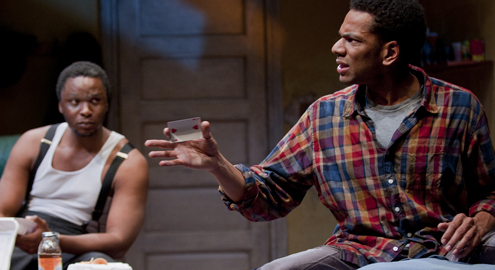
  The cast of The Normal Heart—playing at A.C.T.’s Geary Theater, September 13–October 7, 2012. Photo by Kevin Berne

 THE NORMAL HEART : Drama by Larry Kramer. Directed by George C. Wolfe. American Conservatory Theater (ACT), 415 Geary St., San Francisco. (415) 749-2228 or www.act-sf.org. September 13–October 7, 2012

A gut wrenching THE NORMAL HEART at ACT

As a practicing medical doctor in the 1980s this reviewer shared the frustration of the character Dr. Emma Brookner (Jordan Baker) who bookends the brilliant production of The Normal Heart gracing ACT’s Broadway transplant of Larry Kramer’s play. Whereas Kramer’s semi-autographical play is specific to New York City there was, unbeknownst to us in the medical profession, the “plague” that was devastating his gay friends was a world-wide problem that was to infect millions of people . . . gay and straight.

The Normal Heart that was first produced in 1985 at Joseph Papp’s Public Theater centers around Ned Weeks, who is Kramer’s alter ego (Patrick Breen) and his circle of friends who were dying of this mysterious illness that became named as acquired immunodeficiency syndrome (AIDS) caused by the Human immunodeficiency virus (HIV). Being given that diagnosis was a death sentence and deaths were frequently occurring in the Gay NYC population and became known as the “Gay Disease.”

Because of condemnation for gay people by political, religious and even the general population on the grounds that gays practiced abnormal sex, obtaining funds for research was almost impossible. In the play Ned is a Jewish writer who himself has lost friends and lovers undertakes a quest for the political community to declare an epidemic and spur research for the cause and treatment. Forward thinking Dr. Brookner suggests that the disease (virus) is sexually transmitted and the password amongst gays should be “abstinence.”  That is not be.

Ned appeals to his loving wealthy straight-laced lawyer older brother Ben (Bruce Altman) for financial help without getting a commitment. Ned, who is abrasive in his speech, sets out to form a group to obtain funds for research. When they are unsuccessful they establish a group to help those with the disease to cope with their progressive deterioration. To Ned this is not enough when NYC Health Department worker Mickey Marcus (Michael Berresse)tells him that the deaths have jumped to 41 in one week Ned goes ballistic and that is to be his downfall when he is ejected from the group(s) that he has championed.

All this may sound didactic but be assured it is not. The characters become real in their time upon the stage, and as they die on and off the stage. You will become involved in each as distinct individuals. Bruce Niles (Nick Mennell) a former Green Beret and now as collar and tie investment banker refuses to come out of the closet for the simply reason he will be fired. Late in the second act when he tearfully recounts how the body of his former lover who died of complications of AIDS was mistreated there were tears in the eyes of the audience.

The gorgeous Matt McGrath, as New York Times staff writer and eventual lover of Ned, underplays his role to perfection. His transformation from a charming, humorous boy to a patient with a deteriorating body is so heart wrenching to make you hold your breath.

The production values created by the Broadway and Washington’s Arena Stage staffs are superb and have been transferred intact to ACT. The stage is framed with bare white walls etched with lines and quotations from Newspaper articles and can be considered a mausoleum for dead. The first written word is ‘Patient Zero” and ending with a moving projection of all those who followed in death. Director Wolfe keeps the cast balanced and tempers Breen’s depiction of Ned allowing him intermittent breathing room but rarely for more than a couple of minutes. He may overstep the directorial conceit of bringing the wheel chair bound Dr. Brookner to the stage apron and lecture us about the unfairness of it all, but Jordan Baker ejects so much sincerity into her lines that you must listen as you recognize the problems of today as those of the past.

Kedar Adour, MD

Courtesy of www.theatreworldintermagazine.com


The cast of The Normal Heart—playing at A.C.T.’s Geary Theater, September 13–October 7, 2012. Photo by Kevin Berne.

Albee’s Challengiing Absurdist “Play About the Baby” at Custom Made Theatre

By Guest Review

Albee’s absurdist “Play About the Baby ” premiered on the West Coast at San Francisco’s Custom Made Theatre to bring a stark caricature of young marriage, the birth and loss of a baby, and an older couple’s lessons. The  action includes vaudeville and commedia style acting in a farce like approach that heightens the cruel caricatured tone and sharpens the irony of the message that life brings loss and wounds that nonetheless show us that we are alive and who we are.

Masterfully directed by veteran director Brian Katz, the role of the Woman is performed with gracious charm and command by Linda Ayres Frederick and with vivacity and wit by Richard Aiello. Anya Kazimierski and Shane Rhodes bring youthful freshness and innocence to their roles of Girl and Boy.

Kudos to Custom Made’s efforts and perserverance to produce thought provoking absurdist theatre inciting query.

“The Play About the Baby”  plays until Oct. 7th followed by Tracy Letts’ “Superior Donuts”. For info call 415-798-2682 or visit www.CustomMade.org.

Annette Lust


2Beholden: Or Not 2B! – Five New Short Plays by Susan Jackson

By Flora Lynn Isaacson


Susan Jackson as Jessie and Diana Brown as Jenny 
in Eye Tooth, Part 2.  Photo by Stacy Marshall

The Southern Railroad Theatre Company’s mission is to bring the true Southern experience to the Bay Area in the plays of Susan Jackson.  Her main characters are strong, irrepressible women, facing sudden challenges.  All of the characters in her plays are related by blood or marriage, and this family tree is the foundation of her producing calendar beginning with Heathen which takes place during the Civil War and continues to the present day. In addition, the selections of the plays are connected thematically–Blessings 2010, Forgiveness 2011, Mercy 2011 and Beholden 2012.

Act One opens with Heathen Part 2 which takes place in Bess Canaan’s bedroom in 1865.  Here Ann Kuchins has remarkable stage presence as Bess Canaan as she explains to Posey, her slave girl (Margo Sims) how she has always taken care of her and saved her life making Posey beholden to her for life.  This is followed by  contrasting scene in Posey Carter’s home, two miles from the Canaan Plantation in 1929 in which Posey has a monologue speaking her thoughts, explaining why she is never beholden to anyone.

The next play is Eye Tooth, Part 2 directed by Ann Thomas.  Eye Tooth takes place in the present day at a California State mental hospital. Here Diana Brown has a great deal of spontaneity as Jenny Safrit who explains in group therapy, why she took the life of Jessie Waters (Susan Jackson) who was one of her husband’s “bitches.” Susan Jackson is effective as the ghost of the waitress, Jessie Waters.  Robert Cooper is very professional as Dr. Phillip Brevard who is in charge of a group of patients which includes Adrienne Krug, Ann Kuchins and Margo Sims.

Act One concludes with For I Am Not Breaking, Part 5 directed by Stephen Drewes, which takes place at the Charlotte International Airport, September, 2011.  Here, Susan Jackson, in an appealing performance as Marion Peallin, soon to be ex-wife of bigamist Judge Peallin, meets a stranger (Eric Nelson) while waiting for the flight for her first trip to New York City.

Act Two opens with Rockets Red Glare: Lacy’s Story directed by Ann Thomas which stars Adrienne Krug as Crazy Lacy.  Here we join Lacy on her survival journey from an abandoned three year old in 1970 through 2012, a few days before The Wedding of the Century in 2012.  Here Krug gives a wonderful tour de force performance as Lacy at two years old, seven years old, nine years old, thirteen years old, twenty one years old, forty years old and forty five years old.

The grand finale of the evening is Rockets Red Glare: The Wedding directed by Ann Kuchins. This play takes place in the Anterooms and Sanctuary of the Beaver Dam Free Will Baptist Church in the present, 2012.  Here the entire cast joins in, in wonderfully comic performances.  The folks in Beaver Dam never thought they’d see the day that Salacious and Nancy (Diana Brown) would stop fighting long enough to actually get married, yet it seems that the day has finally arrived.  They are joined by a supporting cast in top notch performances which include Ann Kuchins as Rev. Rainbow, Robert Cooper as Billy Barnett, Susan Jackson as Mayor Peaches Nasterson, Adrienne Krug as Crazy Lacy and Margo Sims as Tulita.

Thanks to Susan Jackson’s marvelous sense of humor, a great time is had by all!

2Beholden or Not 2B! runs through September 29. Performances are held Thursday-Saturday at 8 p.m. at the Royce Gallery, 2901 Mariposa, San Francisco. For tickets and information, contact www.brownpapertickets.com/event/252834 or call 1-800-838-3006.

Rigoletto in the Ballpark

By David Hirzel

For those of us who are not opera purists, and by the 30,000+ turnout at San Francisco’s ATT+T Park September 16, I suspect there are a whole lot of us, this venue has got to be the best way to enjoy Verdi’s Rigoletto.  If you remembered to leave home with enough layers to keep you warm as the evening rolls along, you will find that there are no bad seats.  From the lawn (outfield) below to the upper deck, everyone has a good view of a BIG screen with excellent video graphics coupled with distortion-free amplified sound to carry the music to your ears.  Before each act a written synopsis appears briefly, to get you oriented to what’s about to happen, and much (not all) of the singing is subtitled.  Not that you need to read to enjoy such phenomenal singing, but it helps to keep you oriented to the players and the action onscreen: lust, treachery, tender love, betrayal, murder.

Such is Rigoletto.  The title character (Zeljko Lucic) is a jester to the Duke’s court, but he has a serious side, and a secret daughter, and it is on this Gilda (Aleksandra Kurzak) whom he dotes, and the depth and breadth of their relationship is the heart of the story.  It is in their tender moments together that the real value of this ballpark opera house makes itself known.  The big screen focuses on their faces, their eyes and lips, the bond they share, while their voices intertwine in music of marvelous beauty.  This passionate actress makes the show, lovely to behold and hear, a perfect match to her burly father’s abiding love.

The staging is a simple wonder.  Vertical panels angling into the distance do multiple duty, serving as the brilliant court or a dark alley or Verona’s empty square during a violent storm, with just a change of light and color.  A similarly undecorated room slides into view, and it changes into house, an inn, a bedroom with barred windows, again with just lighting and the most minimal of props.  The primary colors used—red, yellow, blue-gray—set the scenes so well that nothing more is needed.

Altogether, what a show!  Here’s how it works.  This is a simulcast of the live performance onstage at the SF War Memorial Opera House.  At the conclusion of the show, when the cast came on for their (well-deserved) applause, each was bearing or wearing a bit of Giants fan-gear: a big orange We’re Number One, a baseball bat, a black beard—a special nod to those of use in the stands.  It’s free, and this night at the opera in the ballpark comes but once a year in the fall, so look for it in 2013 and don’t miss it.  Special treat for those coming from Marin:  get the special opera ferry at Larkspur, straight to McCovey Cove.  But don’t forget to print out your online reservation, or you won’t get home by ferry later that night.

Review by David Hirzel

http://www.davidhirzel.net


Lend Me A Tenor–The Show Must Go On at RVP

By Flora Lynn Isaacson

Laura Domingo as Maria, Craig Christiansen as Tito and Gwen Kingston as Maggie in Ross Valley Players’ production of Lend Me a Tenor

Ross Valley Players opens their 83rd season with Lend Me A Tenor by Ken Ludwig, directed by Kris Neely and produced by Anne Ripley.

In 1934, renowned tenor Tito Morelli (Craig Christiansen) is scheduled to sing the lead in Otello. The opera is being produced as a gala fundraiser for the Cleveland Opera Company.  Unfortunately, even before the star leaves his hotel room, everything begins to unravel.  Chaos ensues when Morelli’s wife, Maria (Laura Domingo), who has mistaken an autograph-seeker hidden in the closet for a secret lover, leaves him a Dear John letter. The distraught Morelli, accidentally, is given  double dose of tranquilizers to calm him and passes out. Saunders, the company’s General Manager (David Kester) is determined that the show will go on (for his own financial interest), so he asks his assistant Max (Robert Nelson) to impersonate the opera star.  Max puts on the black-faced makeup required for the role of Otello and his disguise succeeds admirably–until Morelli, also in black-face, wakes up and heads for the stage. What follows is a chain reaction of mistaken identity, farcical plot twists, double entendres, innuendoes and constant entrances and exits through six different doors.

Kris Neely takes on the directorial challenge of creating a three-ring circus of slamming doors, double takes and pratfalls at top speed and top volume in his eight character romp. In the slapstick sweepstakes, David Kester, as the long-suffering director of the opera company, wins hands down, followed by Robert Nelson and Craig Christiansen who do a wonderful second act dance as the two Otellos being pursued by women (Christina Jacqua as a lecherous dowager, Gwen Kingston as an ingenue admirer, Dylan Cooper as a prima donna who hopes seducing the tenor may be her ticket to the Met and Amanda Grey as a sexy female bellhop in awe of the tenor).  Laura Domingo as the tenor’s long (but not silently) suffering wife, was almost as skillful and overblown in her stage Italian as her husband in their arguments.

There were lots of opportunities for actors to hustle in and out of the six doors in Ken Rowland’s handsome red and white set, hiding in bedrooms and closets, disappearing in the nick of time into the hallway or the kitchen.  The beautiful costumes by Michael A. Berg are easy on the eyes.

Lend Me A Tenor achieves true comic delirium at the curtain call when the cast romps through a mimed version of the lunatic plot in about two minutes.  Those two minutes are more charming and fundamentally funnier than the two hours of hard labor that have come before.

Lend Me A Tenor runs September 14-October 14 at Ross Valley Players’ Barn Theatre, Marin Art and Garden Center, 30 Sir Francis Drake Blvd., Ross, CA. Performances are Thursday at 7:30 p.m.; Friday-Saturday at 8 p.m. and Sunday at 2 p.m. For reservations, call 415-456-9555, ext. 1.

Coming up next at Ross Valley Players will be You Can’t Take It With You by George S. Kaufman and Moss Hart, directed by Jim Dunn, November 16-December 16, 2012.


“The Great American Trailer Park Musical”

By Greg & Suzanne Angeo

Craig Miller, Julianne Lorenzen

 “The Great American Trailer Park Musical” at 6th Street Playhouse, Santa Rosa CA

Reviewed by Suzanne and Greg Angeo

Photos by Eric Chazankin

Come for the Fun, Stay for the Shoes – “Trailer Park” an Irresistible, Raunchy Good Time

It’s safe to say that 6th Street Playhouse has never featured pole dancers, dead skunks, agoraphobia, false pregnancies, and guys sniffing magic markers all on the same stage before. Well, there’s a first time for everything, and this first – a risky little gem – really pays off big-time. “The Great American Trailer Park Musical” at 6th Street is one rockabilly-rowdy, awesome show.

“Trailer Park” premiered off-Broadway in September 2005, and has seen sold-out shows in regional performances all over the country ever since. Music and lyrics are by David Nehls, and the book is by Los Angeles comedy writer Betsy Kelso, known for her irreverent spoofs and somewhat risqué humor.

(From Left) Shannon Rider, Julianne Lorenzen, Daniela Beem, Alise Gerard

Once settled in our seats at 6th Street’s Studio Theatre, we find ourselves in a north Florida trailer park called Armadillo Acres, where the outdoor thermometer is stuck at 118 degrees. Their motto is “We accept almost everybody” , and they aren’t kidding.  The park’s little travel-type trailers (minus the wheels) are just like the residents: really very cute, but slightly smudged and dilapidated, bravely scraping the bottom of the barrel of life. Park manager Betty, and her cohorts Lin and Pickles, worry about their neighbor Jeannie, who hasn’t left her trailer in 20 years. And now it seems like Jeannie’s husband Norbert has taken to canoodling with the new gal in town, a stripper named Pippi.  When Pippi’s slightly crazed roadkill-obsessed boyfriend Duke shows up with an impressive supply of magic markers, you don’t need much imagination to guess what happens next. This is part of this show’s lowbrow charm.  

“Trailer Park” is filled to the brim with non-stop laughs and relentless, high energy music, very much in the spirit of “The Rocky Horror Show”. The characters could have stepped right out of a comic book. Sure, they’re crude and vulgar, and maybe they play on broad stereotypes, but they’re so likeable you can’t help but fall in love at first sight. And the ladies wear the most fabulous collection of footwear seen in recent memory: sky-high glittery golden heels, thigh-high lace-up boots, acrobatic wedgies and scary-sharp stilettos. The shoes are nearly matched in tawdriness by the cheap-chic clothes and over-the-top hairstyles (all tributes to the talents of costume and wig designers Tracy Sigrist and Michael Greene). But these are mere accessories. What really makes this show is the stunning performers. 

(From Left) Taylor Bartolucci DeGuillio, Daniela Beem, Craig Miller

Each and every cast member is superb, a goldmine of North Bay talent. Betty, played by the truly amazing Daniela Beem, captures your heart with her spectacular voice, tacky wardrobe and unfailing concern for her neighbors. Also excellent is noted area vocalist Shannon Rider. She plays Lin (short for Linoleum!), the park’s resident bad girl whose bad boy hubby is on death row. She prowls the stage, alternately squatting and strutting, seething with resolve. Alise Girard (also the show’s choreographer) plays the charmingly goofy teenager Pickles. After using a pillow to fake her pregnancy, she produces a big surprise for everybody at the end of the show (Natalie Herman also plays Pickles for three shows, but we did not catch her performance).  Each of these ladies delivers exceptional individual vocals, but it’s their three-part harmonies that really get the joint a-jumpin’.

Julianne Lorenzen is at the top of her game as the neurotic Jeannie, who can’t make herself leave her dingy trailer ever since the day her baby was kidnapped long ago. Her character is less one-dimensional than the others, one you can identify with. She’s sympathetic and real, and serves as the pivot point around which the other characters move. In such a demanding role, she not only needs to be funny; she needs to be dramatically strong and believable, and she is, with her wild hair and wilder eyes. And on top of all this, she has a beautiful singing voice. Her buffoon of a husband Norbert is played to clownish perfection by 6th Street Artistic Director Craig Miller.

Mark Bradbury


Jeannie’s nemesis is Pippi, the sleazy but fiercely proud pole-dancer who moves into the trailer next to theirs. Taylor Bartolucci DeGuillio is outstanding not just in her vocals, but in her ability to make her character smolder with passion and heart. It’s not long before Pippi’s loony boyfriend Duke comes a-lookin’ for his woman. Mark Bradbury’s entrance nearly steals the show, which is really saying something. His nimble craziness as Duke, and in a couple of smaller non-speaking roles, provides the veritable icing on the cake.

The four-piece band, directed by Lucas Sherman, is cleverly tucked away upstage, on the rooftop of one of the trailers. Each musical number seems better than the last, but especially memorable are: “Flushed Down the Pipes” featuring the ladies twirling plungers; the pulse-pounding disco beat of “Storms A-Brewin”; and the rousing finale, featuring a breathtaking solo by DeGuillio. The ingeniously compact set, including those cute little travel-type trailers, is the creation of set design wizard Paul Gilger.

Director Barry Martin delivers a home-run hit with “Trailer Park”. He told us he didn’t want to give the audience a chance even to catch their breath, and he doesn’t. There are no pauses between scenes (except for intermission) and the pacing is fast and furious. With his full use of the Studio Theatre’s simple, open thrust stage – meaning there are views from three sides – Martin allows ample opportunity for the cast to mingle with the audience. You really feel a part of the story, and the fun.

“Trailer Park” is what musical theatre is all about – pure escapism. You think you got troubles? Nothing compares with the back-breakin’, heart-achin’ comic strivings of these zany folks. It’s been reported that shows are selling out in advance, so it’s advised that you call ahead for tickets. But be forewarned – the characters are colorful, and so is the language. You may want to leave the kiddies at home.

When: Now through September 30, 2012

8:00 p.m. Thursdays, Fridays and Saturdays

2:00 p.m. Sundays

2:00 p.m. Saturday, September 29

Tickets: $15 to $25 (general seating)

Location: Studio Theatre at 6th Street Playhouse

52 West 6th Street, Santa Rosa CA
Phone: 707-523-4185

Website: www.6thstreetplayhouse.com


Girl Model — Film Review

By Joe Cillo

Girl Model
Directed by David Redmon and Ashley Sabin

This film is a public relations piece for organized criminal rackets operating internationally between Russia and the Far East. I couldn’t quite figure out why this film was made. It is a pack of lies and misrepresentations from beginning to end. The proof of this is in the film itself and I will point it out to you, although the film tries to cast itself as something benign or even benevolent. But it is such a thin veneer that it is almost laughable. This is quite obviously sordid and sinister. The more I think about it, the darker and more frightening it becomes. It’s very curious what was motivating these filmmakers?
It starts out in Siberia, of all places. Really. The opening scene reminded me of a factory farm where animals are kept in large warehouse-like facilities by the hundreds and thousands being raised in close quarters for slaughter. Except these are girls between the ages of about twelve and fifteen. Their bikini covered bodies are examined one after another in a seemingly endless assembly line, supposedly in search of some ideal of feminine beauty that will be successful as a model in Japan.
From the outset it is apparent that this is a scam. If these self appointed mavens of the fashion world actually knew as much as they claim about the tastes of Japanese publishers and fashion, then there would be successful models to interview to validate the success of their judgments. But there are none. The only adult woman interviewed in the film is Ashley Sabin, one of the filmmakers, who seems deeply ambivalent about the modeling business and who said that “no one hated the modeling business more than me.” Yet she is now a recruiter for the enterprise she once despised, and she doesn’t seem all too pleased with herself.
I spent the first part of the film wondering why this was taking place in Siberia? I’m not sure I’ve got it right, but Siberia is an out of the way place and far from media attention and public scrutiny. The population is mostly rural and economically challenged, let’s say, and probably unsophisticated in their knowledge of the outside world. It’s a good place to do something if you want to keep a low profile, and there is evidently a large pool of naive young girls who dream of escaping to a better life in a faraway place.
Tigran, the supposed owner of the modeling agency that recruits the Russian girls and transports them to Japan, is the paradigm of a smooth talking con man. He presents himself as something a few pegs below sainthood, giving these deprived girls from rural Siberia an opportunity to live an exciting life as a model in Japan and make a lot of money for their struggling families. But this avatar of his organization is belied on a number of counts, and once quite explicitly and threateningly, which I found very interesting, and a bold intimation of what he is really all about.
First of all, there are no successful models who can be held up as examples of what he has can accomplish for a girl. A successful agent should have successful clients as examples of his capabilities and judgment, and he doesn’t have any.
Second, the contract that the girls have to sign with his agency is actually quoted on screen, and promises them two jobs in Japan and $8000. But Madlen and Nadya, the two girls followed in the film, do not get jobs, and leave Japan at least $2000 in debt — to him. So they are lied to and swindled.
Third, the contract specifies that the terms of the contract can be changed from day to day at the will of the agency. This means that there is no contract, that they are basically working at his whim.
Fourth, once the girls are in Japan, he does not attend to them in any way. They are passed on to Japanese handlers who send them on an series of fruitless auditions that amount to nothing. If they do get work or their photos are used they are not paid for it, and he does not see to it that they are paid. There is not one named Japanese advertising agency, publication, retail business, or fashion house in the whole film that has used the models that this agency has represented. Not a single one.
Fifth, and most tellingly, he relates how some young girls can be”difficult” — Lord knows — and in order to subdue them, he takes them on an outing to the morgue, so they can see the dead bodies of other young girls like themselves. Purportedly, this is to discourage the girls from drug use. Tigran vouches for its powerful effectiveness. But if this is such an effective technique for keeping young girls off of drugs, maybe we should start doing it here. Why hasn’t anyone here ever thought of this after so long in the War on Drugs? Maybe we should start organizing field trips for young girls to visit morgues to see the bodies of other young girls who died from drug abuse? Perhaps this film does have one valuable insight to offer that can turn young girls’ lives around.
Actually, this is intimidation of the most heavy handed sort. This is to let the girls know that ‘you belong to us, now. We own you. And you’d better do as we tell you, or this is your destiny.’ It is a very stark choice, and he means it. He admits that he used to be in the military and that he has killed a lot of people. He wants you to know that he is capable and experienced at killing people. The military part of it is questionable, but that this man is a killer I have no doubt. This guy is intimidating and very dangerous.
The scam works like this. Girls from poor families in rural Russia are recruited by the Russian Mafia. Ashley works as a scout and a recruiter. She gives the whole process its veneer of benign legitimacy. The modeling tryouts and the search for the ideal of feminine beauty are a sham. What they are really looking for, and Tigran says this explicitly, are girls from disadvantaged backgrounds whose families have financial problems. He said they check the girls out very carefully in terms of their background and their family circumstances. They are looking for girls with the right kind of vulnerabilities. Once they find an appropriate candidate, they are lured to Japan or Taiwan or somewhere else in the Far East with the promise of a successful modeling career. But, of course, that does not happen. The girls are treated miserably. They barely have enough to eat. They have to call home to get money to live on. They get no jobs. If their photos are used, they are not paid for it. After a while they are sent home several thousand dollars in debt to the “modeling agency.”
The one instance where Nadya’s photo does appear in a magazine is one where her face is covered. Why is her face covered? With her face covered she can’t be identified. We don’t even know for sure if that is her. This “modeling agency” does not want anyone to see their models in a magazine. They don’t want anyone to know she was ever in Japan. They want her to remain invisible. What about all the tryouts and photo shoots? Some of the photos may indeed be used, but probably not in Japan, and she will never be paid for any of them. What is really going on here?
This is recruitment for prostitution. Prostitution is where the real money is, not modeling. The criminal gangs have no illusions. Very few girls can make much money modeling, but almost any girl can make substantial money as a prostitute, even a gray mouse like Nadya. That is what this is about, ladies and gentlemen. This is why the film you saw doesn’t make sense, and why it is hard for me to figure out why it was even made in the first place. The “modeling agency” is just an elaborate cover. The few thousand dollars spent on sending the girl to Japan and shaking her loose from her family is the mob’s initial investment, their startup cost. Once the girl is working as a prostitute, she will make that back and more in a very short time.
The first step is to get the girl deeply in debt. Once she is in debt beyond her ability to repay, and her family unable to bail her out, the Russian Mafia makes her an offer she can’t refuse. Remember that girl you saw in the morgue? We spent a lot of money to send you to Japan or Taiwan on those fruitless modeling tryouts, and we expect to get that money back. You’ve proven that you can’t make money as a model. But we’ve got a surefire way for you to make money, but it is not exactly modeling. It’s a little different, but another way of selling your body.
Ashley Sabin talks a little bit in the latter part of the film about prostitution and how some girls who fail as models end up going that route. She points out how some countries and cultures do not stigmatize prostitution and claims it is a perfectly legitimate way to earn a living. She professes not to know anything about that aspect of the modeling business, and claims she has nothing to do with it herself. This is very likely a lie, along with the lie we see her relating in the next few moments to Russian parents of prospective recruits that the girls from her modeling agency never return to Russia with debt, when we have just seen two girls from her agency return to Russia with thousands of dollars in debt. So her credibility is zero, and her capability and effectiveness at deception is documented right before our eyes. Some women are able to deal their way out of the prostitution aspect of the business by acting as recruiters of younger girls. That could be Ashley’s story, but she speaks very good English and appears to be an American. Perhaps those qualities were seen as more valuable assets that working as a prostitute. Ashley is a bit of a puzzle, but there is clearly much that she is not telling. It is evident that she has very mixed feelings, but apparently strong survival instincts, and she is doing what she has to do.
At the very end of the film in a textual postscript, we are told that Nadya went back to Japan the following year — a rather surprising turnaround given her disagreeable experience the first time — but maybe not, if you consider the scenario that I have painted. We are told that she failed again to achieve success as a model and racked up still more debt and was sent on to Taiwan and China and other places in the Far East. It did not tell us what she was doing or how she was living, but I think we can make a pretty good surmise that she is not making money as a model. If she was, then they would have pictures and publications and advertisements to show us as evidence of her success. But rest assured, she probably is making money, and more than she could ever make modeling, but she is not getting much of it. Ask Tigran where the money goes.
This film leaves me puzzling. Not about what is going on. That is very clear. But what were the filmmakers intentions in making this film? What were they trying to accomplish? They didn’t seem to be able to bring themselves to tell the real story, so they concocted something half-assed, that intimated very obliquely what was going on, and left a lot of loose ends dangling nonsensically, but they never really pursued the matter in any depth. And they promoted a viewpoint that they knew very well was a lie. They seem afraid to really follow this where it is leading, — understandable, actually — but if they don’t want to tell the story, why make the film at all? The people and organizations running this operation don’t usually like to be the subjects of documentary films. Why would a guy like Tigran appear in this film? Did he really think that people would buy his tale about his having such a good heart and doing this for the good of the girls, when the film plainly shows that that could not be true in any shape or form? Did they delude themselves into thinking that this would encourage young girls around the world to want to become models? I don’t get it. It must have something to do with the relationship between Ashley and Tigran. I think she is very much afraid of him. I can’t even speculate about it.

LEND ME A TENOR is ‘buffo’ at Ross Valley Players

By Kedar K. Adour

( L to R) David Kester as Saunders, Robert Nelson as Max and Craig Christiansen as Tito “Il Stupendo cavort on Ken Rowland’s 5 door set in  Ross Valley Players production of Lend Me a Tenor.

LEND ME A TENOR: Farce by Ken Ludwig. Directed by Kris Neely. Ross Valley Players, Barn Theater in the Marin Art & Garden Center at 30 Sir Francis Drake Blvd.,  Ross CA. 415-456-9555, ext. 1 or go to www.rossvalleyplayers.com  September 14 – October 14, 2012

LEND ME A TENOR is ‘buffo’ at Ross Valley Players

Ross Valley Players (RVP) must be the envy of every non-equity theatre company in the Bay Area. Talented, attractive actors must flock to their auditions for them to consistently mount (with minor exceptions) shows that are audience pleasers of professional quality. They have done it again with Ken Ludwig’s old chestnut Lend Me a Tenor to open their 83rd (count them 83rd) season “as the oldest continuously producing theatre west of the Mississippi.” After its 1986 premiere in London it has been around the block (25 countries) with a 2010 Broadway revival that received multiple Tony nominations.

To this reviewer true farce must have at least four doors. RVP, actually Ludwig, ups the ante with five doors and one passageway. The brilliant stage designer Ken Rowland has created that magnificent set and the actors use every inch of stage and every door multiple times invoking double-takes by the actors and guffaws from the audience. Those guffaws from act one turn to raucous laughter in the sure fire action of act two making this show a not to be missed hit. All is not perfect but more about that later.

Then there is an ingenious farcical plot with broadly drawn characters, ridiculous story line, mistaken identity, double entendres, a love story gone awry and fast and furious physical activity. It is 1934 and all the action takes place in hotel suite with living room, bedroom, bath and closet with the aforementioned doors. This is to be the suite where the famous Italian opera singer Tito Merelli (Craig Christiansen) called “Il Stupendo” by his adoring fans is to be staying while in Cleveland. He is coming there to sing the lead in Otello as part of a gala fund raiser for the Cleveland Grand Opera Company. Grand Opera in Cleveland?

Awaiting him in the hotel room is Max (Robert Nelson) the nerdy gofer for the Opera Company and Maggie (Gwen Kingston) the object of his affections who just happens to be the daughter of Saunders (David Kester) the chief honcho of the Opera Company. She is there because she has a mad crush on Tito who briefly kissed her hand when they met in Milano years ago. Unbeknownst to her or anyone else is the unnamed female Bellhop (Amanda Grey) opera fan, a Tito Merelli groupie who is waiting, and wanting to accost, or at least take her picture with him.

Don’t quit yet there are more characters to come, two of whom have the hots for “Il Stupendo” and they will add to complications that ensue. There is the soprano opera singer Diana (Dylan Cooper) who feels that by seducing our intrepid tenor, who has a voracious sexual appetite, it will lead to her ascent to the Met. Poor Julia (Christina Jaqua) a member of the Opera Board will just have to stand in line for her turn for a romp in the hay with Tito.

Alas, Tito has a wife Maria (Laura Domigo) who is very upset that Tito has not approached her sexually for three whole weeks. Poor Tito, who arrives late and is not feeling well, needs a rest before the performance. Maria gives him a double dose of sedative and Max not knowing this spikes Tito’s wine with another double dose.

Before Tito goes to the land of nod, he bonds with Max who is a clandestine opera buff/singer. Tito gives Max lessons on breaking his tension and that will hold Max in good stead when he replaces Tito in the lead role. Alas, Maria has caught Maggie in the closet with her clothes partially off and in a pique writes a farewell note to our intrepid lothario Tito. With Tito unresponsive, that note is thought to be his suicide note and Saunders and Max devise a unconscionable plan to hide the facts in order that the show must go on. . .  and the money does not have to be refunded.

By the time the second act arrives the doors have been put to great use but are get even more use  with Max and Tito both in Otello costumes being seduced by three different women and confusion reigns. Maria returns and the question of who slept with whom becomes a problem because of mistaken identity. Never fear, it all gets resolved AND there is a 90 second “curtain call” to end all curtain calls that recreates all the shenanigans that have taken place in the previous hour and 45 minutes.

Christiansen is perfect as “Il Stupendo” and looks the part. Robert Nelson plays the nerd to the hilt and has a marvelous transformation after he stars in Otello. Gwen Kingston is gorgeous, seductive with great comic timing but would be more loveable in future productions if she becomes less shrill. Laura Domingo’s tantrums as the put upon Italian wife Marie could not be portrayed better. Gwen Kingston’s acting as the diva that will succeed by being good in bed has more than a touch of reality. Christina Jaqua will have to settle for being described as classy with her regal bearing, in a stunning in form fitting evening dress. Michael Berg’s costumes for the ladies are elegant and the Otello costumes rightfully hilarious.  You will love Amanda Grey as the cutest bellhop you will ever see showing of her quaint blue and gold uniform as she stalks our hero Tito. David Kester, a mainstay at RVP, has a tendency to ‘emote’ and does so again in this farce but that may be a directorial conceit and the entire cast probably would be better served to turn down the decibels in their lines seeking variation rather than volume.

Kedar K. Adour, MD

Courtesy of www.theatreworldinternetmagazine.com

Pacifica Spindrift Stage 2: “Time Was” and “Partitions”

By David Hirzel

Stage 2 is an experimental offshoot of Pacifica Spindrift Players, where out-of-the mainstream productions have a chance to get staged.  This season’s offering is a pair of short plays by a new playwright Kathryn Murdock, simply staged as readers’ theatre for three nights only.  Director Barbara Williams managed to make the most of the bare-bones staging—a pair of stepladders, a handful of chairs and a table before a blue curtain—and the cast, most of them taking a role in each of the plays.

The evening opened with Time Was, an elliptical theatre of the absurd, Murdock’s ruminations on the nature of time, memory, and mortality (“Big whoop!”) given voice by actors on a stage within a stage.  “I wanted to remind you, I’m equity.”  First one character, then another and another are given sacks to carry dangling from their necks: “My childhood, I carry it with me everywhere.”  But sometimes this is a good thing.  A child sees everything through a lens of awe and wonder.  Just not for everyone, or all the time.  White shrouds, even the stage manager herself, become characters, leading to a surprise and snappy ending.

At intermission, you have a chance to meet the cast and production staff in the gallery, one of the wonderful features of small productions like this.

The evening’s second offering, Partitions.  left the absurd and entered the  complicated world of ordinary life, of a sea-captain loved by, and seen through the eyes of four different women:  a past love, a present fling, a sister, and an office manager.  Each knows some but not all things about him, and none of them know or understand the same things.  Each deludes herself as she enables his free-wheeling philandering, until the climactic scene following his sudden death in the hospital.  In the wild confrontations there each comes to see herself as a part of a larger whole that was his life, and included them all.

The direction and acting in these productions, particularly the latter, brought the show almost out of the realm of readers’ theatre, to the point that one was barely aware that each had a script in hand throughout.  A special nod to Dianna Collett for her spot-on and sensitive portrayal of the betrayed Melinda in Partitions.  If you want to catch this show, you’ll have to hurry.  Three nights only, final performances Saturday 9/15 8:00, Sunday 9/16 2:00.  Admission for this Stage 2 is FREE, but bring a little cash for the donation box.

Box office:  (650) 359-8002  or   http://www.pacificaspindriftplayers.org/Tickets/index.html

Review by David Hirzel:  http://www.davidhirzel.net