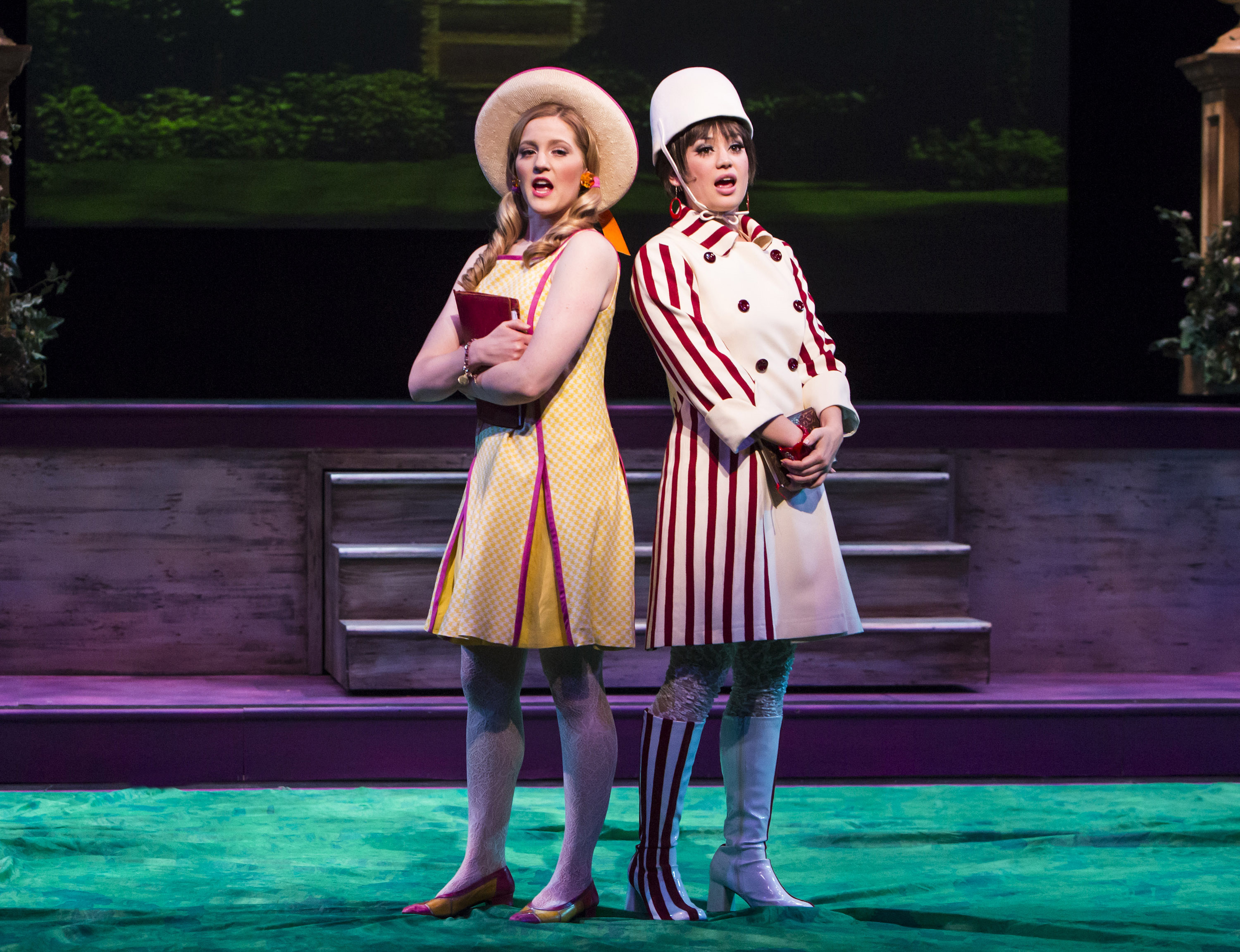
Costumes outshine music in “Being Earnest”

By Judy Richter

Oscar Wilde’s play “The Importance of Being Earnest” has amused audiences with its wit and satire on English society, romance and human foibles since 1895. Now it’s the basis for a world premiere musical, “Being Earnest,” presented by TheatreWorks.

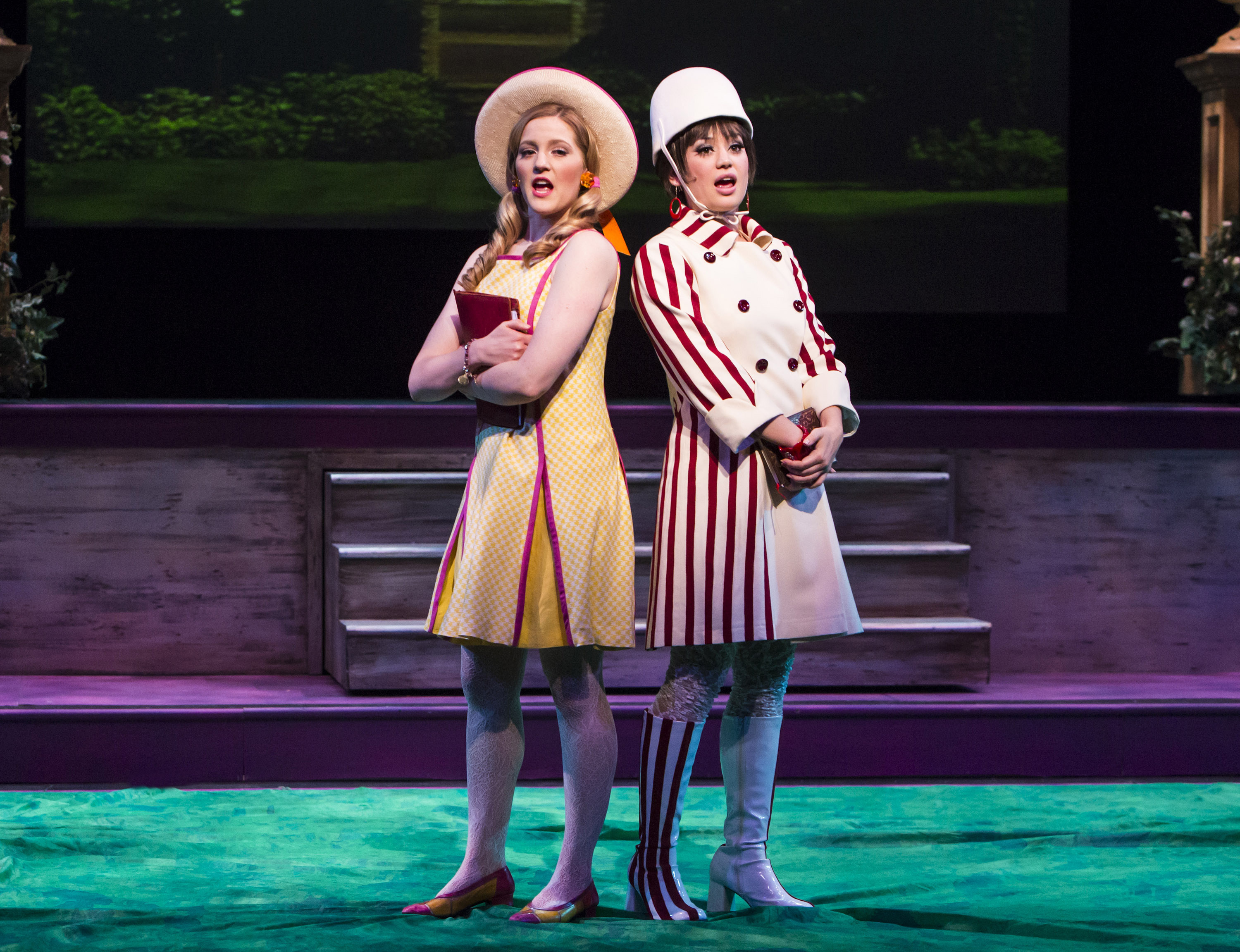
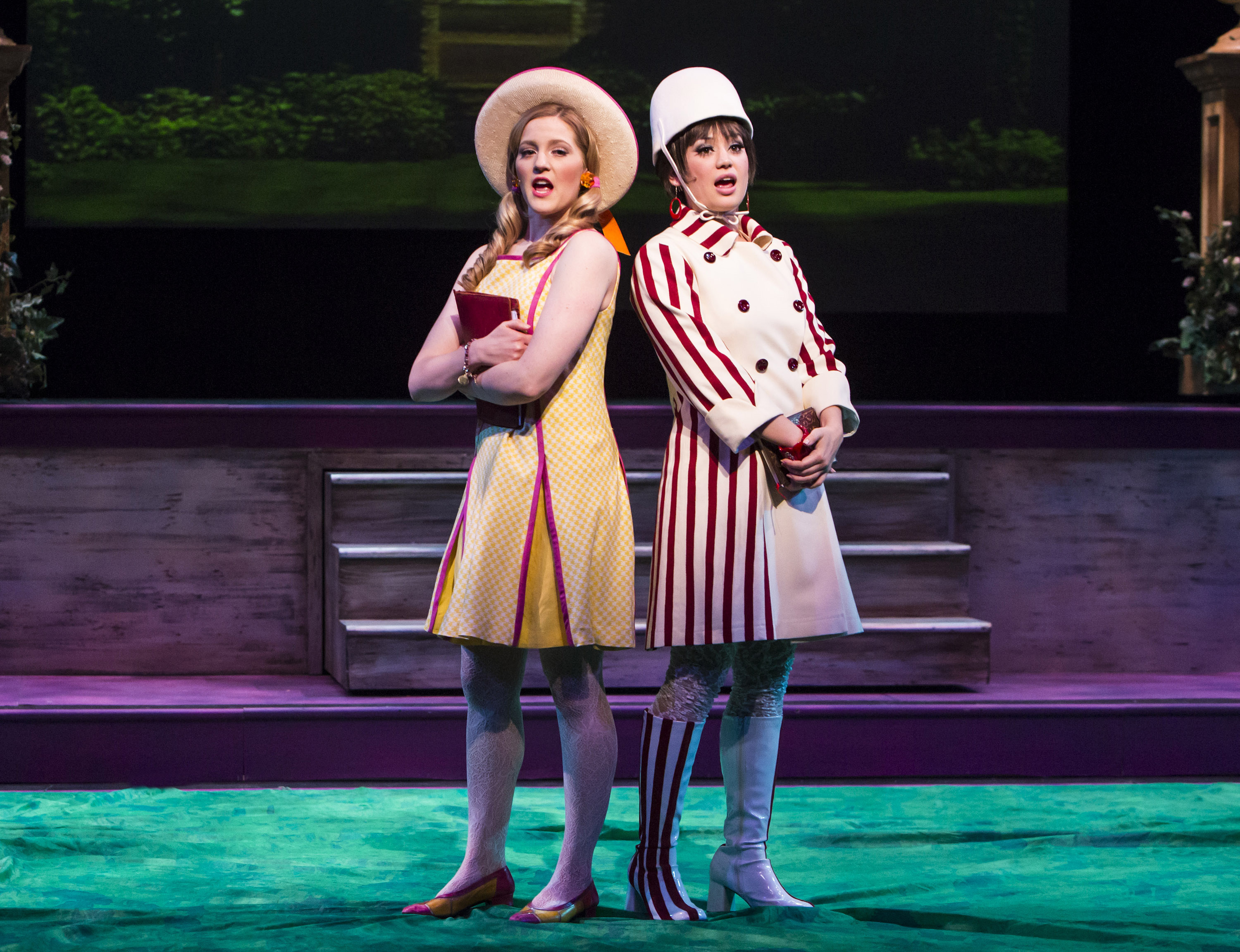
Composers Paul Gordon and Jay Gruska have updated the setting to 1965, a time perfectly captured by Fumiko Bielefeldt’s costume designs, which are inspired byCarnaby Street denizens. Unfortunately, the costumes are more appropriate to the times than the music. While the Beatles and other such groups were dominating pop charts with bouncy, hummable tunes, Gordon and Gruska’s score seems bland and repetitious.

Thanks to a topnotch cast and Robert Kelley’s direction, however, the show still has entertainment value. It also benefits enormously from Wilde’s words, which Gordon has incorporated into his book and some of the lyrics.

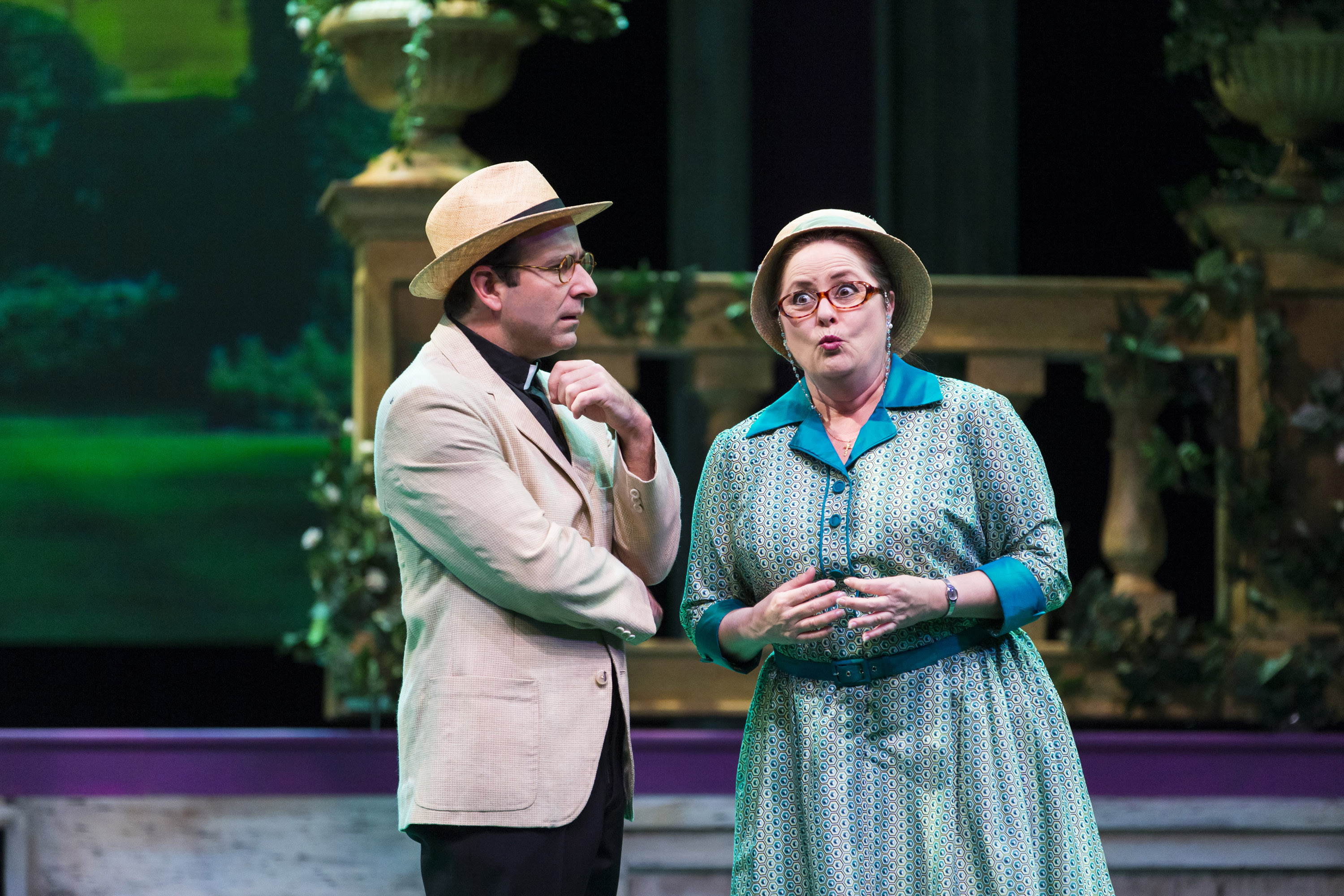
The plot focuses on two young English gentlemen, Algernon Moncrieff (Euan Morton) and Jack Worthing (Hayden Tee), who resort to deception to woo the young women to which they’re attracted. Algernon pursues Cecily Cardew (Riley Krull), who is Jack’s ward, while Jack is in love with Gwendolen Fairfax (Mindy Lym), Algernon’s cousin. One of the obstacles they face is Gwendolen’s mother, Lady Bracknell (Maureen McVerry), who’s very concerned about being proper and maintaining her social status.

Completing the cast are Diana Torres Koss as Miss Prism, Cecily’s tutor; and Brian Herndon as three male characters.

All of the performers are fine singers, but Morton’s unflappable Algernon and McVerry’s Lady Bracknell are especially noteworthy. A mainstay of Bay Area theater, McVerry also may be familiar to Peninsulans because of her musical theater work with middle school students.

Another reason why she is a standout is that Bielefeldt has given her some gorgeous costumes, especially her outfit in the final scenes. Bielefeldt has also given a show-stopper outfit to Lym, who appears in a Mary Quant-inspired ensemble in the second act. Both Lym and Krull sport the go-go boots so popular at that time.

Musical director William Liberatore conducts four other musicians from the pit. The flexible set is by Joe Ragey with lighting by Steven B. Mannshardt. The sound design by Jeff Mockus is sometimes too loud. It also was plagued by some microphone pops at the reviewed performance.

Gordon successfully turned “Emma” and “Jane Eyre” into award-winning musicals, but with “Being Earnest,” the costumes are more memorable than the music.

“Being Earnest” continues at the Mountain View Center for the Performing Arts, Castro and Mercy streets, Mountain View, through April 28. For tickets and information, call (650) 463-1960 or visit www.theatreworks.org.


Glitz, glitter and song at The Hypnodrome

By Joe Cillo

Lynn Ruth [rating:4] (4/5 stars)

The Thrill Peddlers present….
TINSEL TARTS IN A HOT COMA
Music and lyrics: Scrumbly Koldewyn
Book: Sweet Pam” Tent
Directed by Russell Blackwood

“The Cockettes were basically complete sexual anarchy
Which is always a good thing.
John Waters

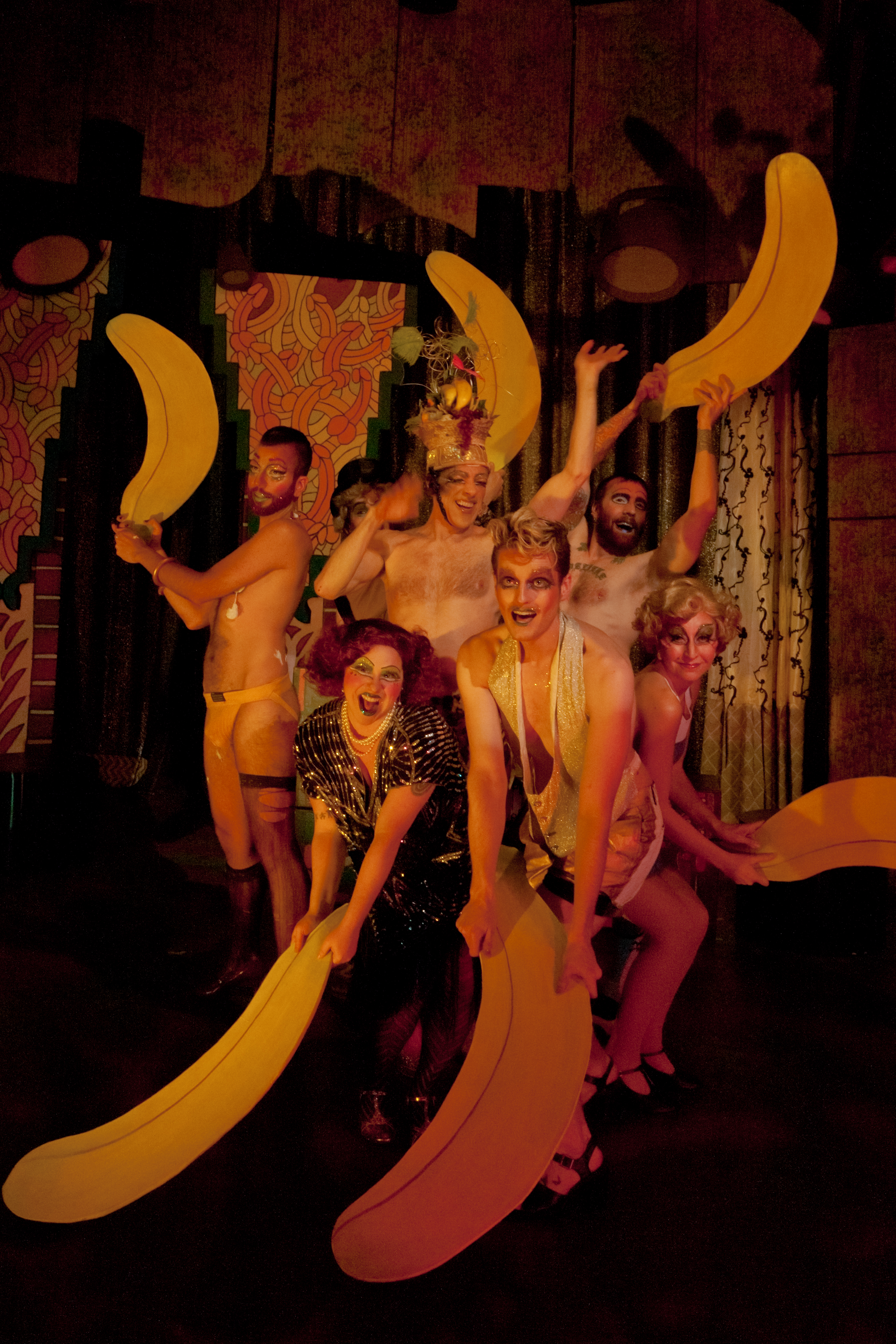
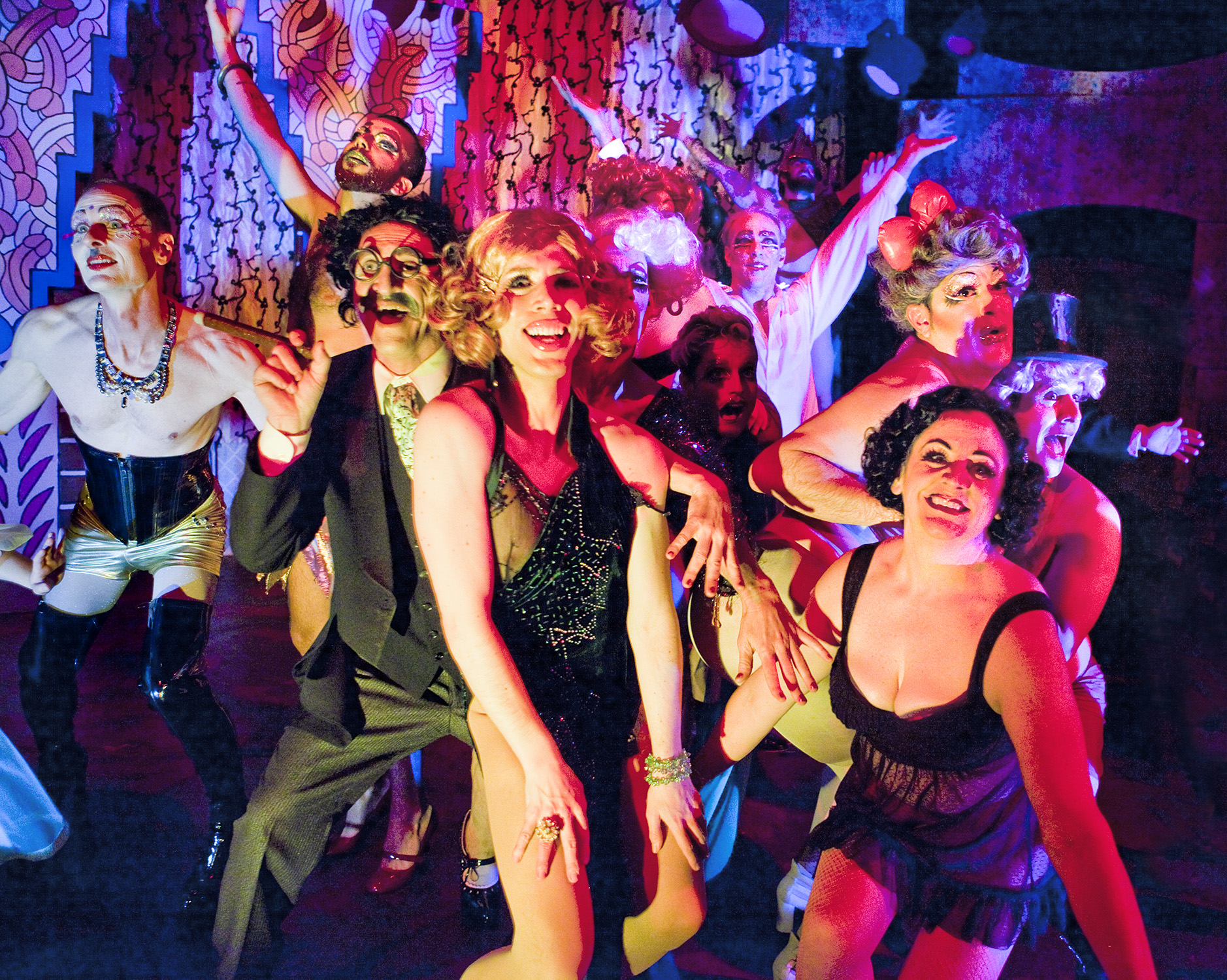
“The Cockettes were the first hippie drag queens,” said filmmaker John Waters,  “Insane hippie drag queens on and off the stage.”  And that sentence sums up that outrageous and delightful group of wild, flamboyant hippies, transsexuals, gays and rebels that managed to destroy all our sacred cows on and off the stage.  They created a series of drug infused ostentatious musical shows so camp only the sub-culture in San Francisco could understand them.  Their musicals were disorganized and wild, filled with glitter and nudity, mad and maddening yet irresistible to anyone ready to accept the unacceptable.

When they brought the original production of “Tinsel Tarts in a Hot Coma” to New York In 1971, the establishment simply could not handle their “in your face” exuberance. It was critic Lillian Roxon who realized that, inexperienced, chaotic and rough as they were, the group blazed a trail for a cultural evolution we are experiencing today “Their influence will be felt years from now,” she said. “Every time you see too much glitter or a rhinestone out-of-place, you (will) know it’s because of the Cockettes.”

Russell Blackwood, director of the Thrill Peddlers fell in love with the Cockette spirit and in 2009 he re-invented the Cockette production Pearls Over Shanghai  and followed it with Vice Palace.  Now, we have his re-imagining of  Tinsel Tarts In A Hot Coma the 1971 musical originally performed by The Cockettes at The Palace Theatre in San Francisco.

Blackwood’s interpretation of that production is on stage now at the Hypnodrome theatre and if you like splashy costume, great energy and not much plot, this production is your cup of tea.  Three of the original Cockettes are in this version of the musical that blossomed in San Francisco and died in New York.   Two of them, Scrumbly Koldewyn and Pam Tent also rewrote the book and added 18 songs from the original four-page outline used in that first production.  For this reviewer, Scrumbly Koldewyn is worth hearing and seeing anytime he takes to the stage.  His musical talent is beyond words, so original and exciting are his compositions; so thrilling his keyboard technique. Pam Tent steals the show in a parody of Hedda Hopper and no one can resist her.

The energy and enthusiasm of the cast is infectious and everyone who sees the show cannot help but have a wonderful time.  This production is so much more than a musical,  It is a happening and great fun from the opening number Ain’t We Deluxe to the spirited finale loaded with flashing breasts, swinging dicks, glittering gams and feathers, Hades Lowdown.

The question is: Are we so jaded by all that has gone before that the Cockette spirit is just a bit too over the top for today’s audiences?  “It’s nothing but a high school musical,” said one member of the audience. “All the performers put out lots of effort and enthusiasm, and the songs were clever….but  I didn’t see any reason for the nudity in the finale. I’m hardly a prude but it just seemed out of place.”

The truth is naked bodies aren’t that shocking anymore and too much glitter and glitz is boring.  We have all been there, done that and seen it so many times before.  That said; if you want a fun evening that does nothing to enrich you but everything to tickle your funny bone, don’t miss this fast-moving, melodic farce.  Tinsel Tarts in a Hot Coma is a production you’ll not soon forget: more colorful than a rainbow, and as delightful as a surfeit of ice cream and cake.

The sixties are gone; dope will never be as cheap
Sex never as free and rock & roll never as great.
Abbie Hoffman

TINSEL TARTS continues through June 1, 2012
Thursday-Saturday @ 8pm
The Hypnodrome Theatre 575 Tenth Street, SF
Tickets: brownpapertickets.com or 800 838 3006
Info: thrillpeddlers.com 415 377 4204

‘Cats’ prowls Redwood City stage

By Judy Richter

“Cats” has been gracing musical theater stages across the nation and world ever since it premiered inLondon in 1981 and went on to Broadway, where it won a slew of awards. It first came toSan Franciscoin 1986 and has returned several times.

Now it’s at the Fox Theatre inRedwood City, where Broadway By the Bay is staging an exuberant production. The show is based on “Old Possum’s Book of Practical Cats,” a series of whimsical poems by T.S. Eliot. All of the characters are cats, each a distinct individual introduced through songs by Andrew Lloyd Webber.

The best-known song is “Memory,” here poignantly sung by Heather Orth as Grizabella, a once-glamorous cat now long past her prime and shunned by the other cats. The biggest crowd-pleasers are “Jellicle Songs for Jellicle Cats” and “The Song of the Jellicles and the Jellicle Ball,” along with “The Old Gumbie Cat.” All three feature terrific solo and ensemble dancing by the energetic cast, while “Gumbie” adds a fun tap scene to the enjoyment.

The show is directed and choreographed by Robyn Tribuzi, who has honed the dancers into a precision ensemble. The only misstep in her direction comes from Jack Mosbacher, who sings well and struts like Mick Jagger but overdoes the pelvic thrusts in “The Rum Tum Tugger.”

Musical direction is by Sean Kana, who conducts the orchestra from the keyboards. Even with only eight musicians, including Kana, the orchestral sound is full. Likewise, the vocal ensemble is well balanced even though a few singers seem less accomplished in their solos. Diction is sometimes a problem.

The cat-like costumes and junk yard set come from FCLO Music Theatre. A few glitches were evident in Michael Ramsaur’s lighting design opening night. The sound is by Jon Hayward.

As for the show itself, the plot is thin, while Lloyd Webber’s music becomes repetitious, especially in the second act. Still, there is much to admire in both the show and this production, which runs about 135 minutes with intermission.

“Cats” continues at the Fox Theatre, 2215 Broadway St., Redwood City, through April 21. For tickets and information, call (650) 579-5565 or go to www.broadwaybythebay.org.


Nudity is no longer PC

By Joe Cillo

NAKED IS AS NAKED DOES

The male body is hairy and lumpy
And should not be seen by the light of day
Richard Roeper

For Shame

Americans do not mind seeing people murdered on their television screen and they love watching heads flying and limbs severed at the movies.  They like the rat-a-tat-tat of gunfire, bodies strewn across the pavement and little children crying for their lost mummies and daddies.   The more violence the better.  That is the American way.

The truth is that violence and tragedy make great entertainment.  So does pornography.  Americans actually prefer to watch lust happening even more than they like doing it. What a thrill to see a man and women tearing each other’s genitals to pieces or whipping and chaining each other for the sheer pleasure of hearing them scream.  Porn is almost as popular in America as violence.  We watch both every day and love it all.

But let some poor schnook walk outside to get the newspaper in the altogether and he ignites public outrage. “It offends me to see anyone that way,” said one insulted observer. “It is disgusting.”

That is why San Francisco decided to compromise its image of freedom of expression and tolerance of the odd-ball and ban public nudity from its streets.  No more can raunchy old men spread a towel on a stone bench and sun themselves in the Castro district.  No more, can its citizens strip to the flesh to bathe in the afternoon sun.  San Francisco now supports the theory that our bodies are so hideous they must be concealed in public.  No matter, that liberated women, forward thinking men and eating disorder specialists are trying to make us comfy with our diverse shapes and sizes.  In San Francisco, it is pc to be ashamed.

Now, it seems that the Japanese, too are offended by nudity, but they have taken it one step further.  They do not want to see representations of the human body, much less the real thing. Michelangelo’s David  was presented to the town of Okuizumo and the inhabitants ran for cover.  “It’s frightening the children and worrying the adults with its nakedness,” said one of the town’s bigwigs.

I can only assume that they have also stripped their museums of reproductions of Van Gogh’s NUDE WOMAN ON A BED or Renoir’s AFER BATHING not to mention Whistler’s shocking NUDE GIRL WITH A BOWL.

Obviously, the very sight of a naked body horrifies the more sensitive among us.   It is difficult to understand why we think the sight of a penis or a breast will frighten our children more than the sight of shattered limbs and battered heads. Will our innocent youth smash the bathroom mirror when one day they see those very banned organs protruding from their own bodies?

The truth is that in America our bodies are considered repulsive and offensive unless we film them and flaunt them on a screen.  The only answer to this dilemma is to cover every baby at birth with ornamental tattoos so that as they mature, no one will recognize the new growth.  And everyone will be amazed when it rises to an occasion.


I don’t even like to be naked
In front of myself!
Camryn Manheim

Marin Theatre has another winner

By Joe Cillo

MARIN THEATRE COMPANY PRESENTS
THE WHIPPING MAN
by Matthew Lopez
Directed by Jasson Minadakis
Starring L. Peter Callender, Nicholas Pelczar and Tobie Windham

The people made worse off by slavery
Were those who were enslaved.
Thomas Sowell

Marin Theatre consistently gives us exceptional productions and Jasson Minadakis is without equal as a director.  Any production he touches becomes thought provoking, meaningful theater at its best. THE WHIPPING MAN is no exception.  “Set a week after the fall of Richmond at the end of the Civil War and spanning the date of President Abraham Lincoln’s assassination, THE WHIPPING MAN explores a moment in our history when everything changed and anything seemed, and perhaps actually was, possible,” says Minadakis.  “Matthew explores how faith is one of the strongest ways to build family and community and to honor history…..….Faith in ourselves, our family and friends, our community or a divine power is the light that parts the darkness.”

The faith in this play is Judaism.  When the Southern Aristocracy owned slaves, those people became a part of their family.  Although they were possessions, they were still expected to follow the moral constructs of the people who owned them.   Simon (L. Peter Callender) and John (Tobie Windham) are Jewish. They belonged to Caleb’s (Nicholas Pelczar) family.  The play opens in Caleb’s now almost destroyed home in Richmond, Virginia in 1865 on a Friday night during the Jewish Passover.  It is important to understand the Jewish humanistic philosophy when you watch this play because it colors each characters reaction to one another.  Jewish law forbids unethical treatment of slaves and encourages owners to make them part of the family.  They were forbidden to physically abuse their slaves or to sell them to harsh masters.

And yet, these people were property and no matter how well meaning the master was, there were moments when he fell from grace.  In this play Caleb’s father who was portrayed as a kind, humane man beat both Simon and John, and violated Simon’s wife.  Caleb was overbearing and cruel to John even though the two grew up together as brothers.  As Simon explains, ”You did it because you could.”

Caleb disillusioned by the cruelty and bloodshed of the war has abandoned his faith. “I stopped believing.  It’s as simple as that,” he tells Simon.  And Simon who still believes there is a higher power to protect them all says, “God doesn’t like fair weather friends.  “  He continues, ”You don’t lose your faith by stopping believing; you lose your faith by not asking questions.”

As the play develops, we are asked to question where justice begins and why men abandon their sense of humanity when they have power over another.  The acting in this play is nothing short of amazing.  L Peter Callender is a supreme artist and anyone who has the privilege of seeing him perform on stage knows he is unforgettable in any part he plays.  He outdoes himself in this play.  He carries the action and he is breathtaking every moment he is on that stage.  Tobie Windham is perfect as the rebellious angry brother and Caleb is right on the mark as the disillusioned son of a Jewish plantation owner who finally sees how little help his faith was to him when faced with impossible choices not just on the battlefield but in a home where people were subjugated to humiliation because they were owned.

The production is a masterpiece on every level and we have Jasson Minadakis to thank for that. He is both the director of this fine and memorable piece of theater and artistic director of the theater.  One can wax eloquent about the set, the lighting and the action…but there are no words to substitute seeing the play for yourself.  It is far more that a work of fiction on a stage.  It is a reflection of what life means and how we can all try to live it with honor and dignity.

Whenever I hear anyone arguing for slavery,
I feel a strong impulse to see it tried on him personally.

ABRAHAM LINCOLN

THE WHIPPING MAN continues until April 21, 2013
Marin Theatre Company
397 Miller Avenue
Mill Valley, CA 94941
415 388 5208
www.marintheatre.org

Drama scrutinizes famed journalist’s mind, spirit, vitriol

By Woody Weingarten

Concetta Tomei (right, as Oriana Fallaci) and Marjan Neshat (as a journalist) star in “Fallaci” at the Berkeley Rep. Photo, courtesy kevinberne.com.

“Fallaci” is — according to my personal stage evalu-ometer — 85.3 percent brilliant, 14.7 percent boring or overly dense.

It’s 82.2 percent sterling drama (with a tinge of comedy), 17.8 percent polemic.

Despite its negligible drawbacks, I believe the drama’s definitely worth experiencing.

“Fallaci,” at the Berkeley Rep through April 21, confronts myriad Big Issues — truth, women’s freedom and power (and their nonexistence), domestic abuse, torture, tyranny, hatred, destiny, motherhood, father-daughter relationships, anti-Islamism, forgiveness.

So many, in fact, it’s easy to become inundated with the gravitas.

Playwright Lawrence Wright probes the liberation of women through the famed, cynical eyes of inconsistent, caustic Italian journalist Oriana Fallaci, who insists that, always, “you have to find the lie” underneath what interviewees offer as the truth.

Contrasted and compared is the view of a young female writer, Maryam, who wavers between awe and distaste for the elder journalist’s technique, mind and spirit but settles for empathy.

Wright’s skill at fictionally getting inside Fallaci’s head at the tail of her life is complemented tidily by the unwavering direction of Oskar Eustis.

It’s noteworthy that these two talented men are responsible for the onion-like peeling that occurs on stage to delineate each woman’s self-deception and lies — a verbal scrutinizing that links the essences of the females.

Wright, a writer for The New Yorker and author of eight books, including a Pulitzer Prize-winning volume on al-Qaeda and a headline-grabbing tome on Scientology, actually traces Fallaci’s life all the way back to her childhood resistance against the Nazis.

Concetta Tomei portrays the combative, opera-loving Fallaci with a comprehensive range of emotions and outbursts as omnipresent as the cigarette in her aging hand.

Tomei, whose Broadway credits include stints with Kevin Kline and David Bowie, smoothly captures the polarized segments of Fallaci’s life — after a tenure in Hollywood, she becomes the verbal darling of the left (when she mercilessly bludgeons the likes of Ayotollah Khomeini, Moammar Qaddafi, Yasser Arafat and Fidel Castro), then is adopted by the right after she attacks all of Islam in reaction to 9/11.

The actor’s Italian accent and physicality are impeccable.

Majan Neshat competently plays a “lowly” obituary writer cum inquisitor — first with a coupling of reserve and youthful brashness, then with panache.

She seamlessly integrates her Iranian background and position with The New York Times in a way that makes her believable, all the while running a heady gauntlet to unearth her own truth.

The lone set by Robin Wagner, a three-time Tony Award-winner, represents Fallaci’s obsession with words via a cavernous room that has books stacked on the floor, a table and ceiling-high shelves.

The costumes (by designer Jess Goldstein, also a Tony winner) are drab, drabber and drabbest (perfectly in keeping with outer-appearances).

Considering the fiery quality of Fallaci, one of the first rock stars of modern journalism, and some of the gut-wrenching topics it tackles, it’s strange the highly intellectual play lacks much of a visceral punch.

Intermittently, in fact, I now and then felt I was witnessing a tableaux of a corpse being autopsied, made even worse by a hokey ending.

Wright, unfortunately, may have become too entangled in his theatrical conceit of a writer writing about two writers.

Still, “Fallaci,” which reveals how debilitating a diet of controversy, controversy and controversy ultimately can be on a journalist, can be riveting — especially whenever it pauses to let the audience’s reactions catch up with the verbiage.

That said, it should be noted that I often found Wright’s weighty subject matter stunning (for instance, when a reflective Fallaci wistfully intones, “They say I lost the appetite for blood”).

Opening night, despite the 90-minute show being without intermission, not one soul left the theater before the play went dark.

It may be ironic that the opening of this world premiere, which at one point deals with the rape of a condemned woman who can’t be executed unless her virginity is taken, occurred on the same day as some fundamental Muslims ripped into a U.S. document on combatting violence against women.

So it looks like “Fallaci” is hardly just a story of yesterday.

“Fallaci” plays at the Berkeley Repertory Theatre‘s Roda Theatre, 2015 Addison St., Berkeley, through April 21. Night performances Tuesdays, Thursdays, Fridays and Saturdays, 8 p.m.; Wednesdays and Sundays, 7 p.m.; matinees, Thursdays, Saturdays and Sundays, 2 p.m. Tickets: $14.50 to $89, subject to change, (510) 647-2949 or www.berkeleyrep.org.

A BEAUTIFUL PIECE OF THEATER AT HILLBARN

By Joe Cillo

Lynn Ruth [rating:5] (5/5 stars)

HILLBARN THEATRE PRESENTS…..

JOHN & JEN
Music by Andrew Lippa; Lyrics Tom Greenwald
Directed by Jay Manley
Starring Alicia Teeter and William Giammona

Our brothers and sisters are there with us
From the dawn of our personal stories
To the inevitable dusk.
Susan Scarf Merrell

Cast aside your preconceived notions about what a musical is before you come to this beautifully staged and artistically produced play.  Jay Manley has taken a weak text and poorly developed plot and transformed it into a theatrical work of art. jon & jen is the musical story of a sister and brother who protect and love each other, yet are foiled by their own inadequacies.  Jen is the older sister determined to protect her baby brother from their dysfunctional parents.  Sadly, because she is only a child, she cannot keep him from absorbing their irrational behavior and warped values.  She can only give her brother her unconditional love and support.  John, determined to defy his sister and get his father’s approval enlists in the army and is killed.  When Jen marries, she names her baby after her lost brother and when her own marriage falls apart, she smothers her son with love and protection just as she did her brother.

It is very difficult to create believable characters when the only vehicle is song.  Andrew Lippa’s music and Tom Greenwald’s lyrics are lovely and deep but alone they cannot draw the depth of character we need to fully understand and relate to this poignant story.

Alicia Teeter is perfectly cast in her role as Jen.  She manages to touch our hearts with every note she sings and with every nuance of expression. She is a fine actress to the core.   Andrew Lippa has a much more challenging job.  He must portray a baby and grow up into a man in both acts.  He carries it off very well…but the audience must take a leap of faith to believe in the validity of his character.

And that is where Jay Manley’s genius shines through.  By choreographing the movements of these two fine performers and creating costume changes that tell as much of the story as the libretto itself, he carries the story through to its lovely resolution when the two stars sing the unforgettable Every Goodbye Is Hello.  Robert Broadfoot has outdone himself in designing the set…it is simple and yet perfect for action that spans 42 years. He has created four different levels to indicate the many changes of time and place on the spacious open stage at Hillbarn.

“Ultimately this musical play is about familial love, loss, grief, forgiveness of others and self, and most important, moving on – learning how to let go and forge a way forward,” says Manley.  “Who has not been touched by these universal tests?”

This is not a play for everyone.  It is deep and disturbing and will touch your heart, if you let it.  Kudos to Hillbarn for including it in their season.  jon and jen is a theatrical masterpiece.

IF YOU GO:

JON & JEN CONTINUES THROUGH APRIL 7, 2013

Ticket Flash Sale! $28 tickets to any remaining shows of “john & jen” Enter promo code “HBFLASH” when buying online and instantly save. MORE INFORMATION AT hillbarntheatre.org or 650 349 6411

HILLBARN THEATRE is located at 1285 Hillsdale Blvd. in Foster City.


THE NEW BRAND OF ARTIST

By Joe Cillo

ART IS GOING TO THE APES

A NEW TALENT

An ape cannot speak about his art
Anymore than a monkey can discuss a his digestion.
Jacques Cocteau and Lynn Ruth

In the late sixties, a gorilla won the Modern Art competition at the Detroit Museum of Art. The animals’ owner put several tubes of paint and a blank canvas in the ape’s cage.  The furry artist, whom I shall call Sybil, stomped on the tubes of paint and smeared the colors on the canvas with her paws.  After an hour, she tired of dancing and began eating the tubes of paint.  Her owner pulled the canvas out of her cage, hosed Sybil down and was amazed at the finished canvas.   It reminded him of a combination of a Jackson Pollack with a smattering of Kandinsky, a dash of Picasso and traces of Klee.  When Sybil’s masterpiece dried, he varnished it, framed it and entered it in the museum’s competition.

To his delight, the painting won first prize.  He bought a jeweled collar for Sybil, pinned a pink ribbon in her hair and brought her to the award ceremony. It was a little dicey getting her in the front door  but the owner insisted she was a service animal  He managed to keep her from molesting the guests by feeding her bananas and bit of cadmium red. When they called his name to accept the award, Sybil joined him on stage.  He told the astounded judges that it was not he who created the masterpiece they so admired.  It was his Sybil.

Years later, I took a class with the fabulously talented realistic painter Joseph Sheppard and he told me that Sybil was indeed a magnificent talent.  Indeed, he had joined her in her cage a few years after her triumph to raise money for the museum.  Together they painted a still life that hangs now in that same museum.

Evidently, gorillas not only paint, but they know what they are painting. Sister and brother gorillas Michael and Koko were taught sign language.  As a result, Koko (the artist in the family) was able to explain to her curator Dr. Penny Patterson, that she had painted a bird.

Just this past month, word is out that a zoo in North Dakota is selling the artwork of its 275 pound orangutan named Tal. His paintings are so colorful that they literally fly off the wall.  The animal’s favorite color is yellow and often he eats as much of the paint as he smears on his canvases. “Could be because it looks like a banana,” said the zoo’s curator.

There is no doubt that creativity is fundamental in the ape psyche. The animals  love using crayons, pencils and finger paint although they prefer oils they can eat. Everyone knows that children have the same propensity to eat the colors they use to paint. I believe we can learn a lot from the apes and their ability to transform their creative efforts into funds that support their favorite institutions.  I propose that we exhibit and sell all the paintings from local kindergarten classes to pay for amenities in their schools.  Think of it! We would no longer have to pay taxes to support education!  Our kindergartners would finance the system for us…and who knows?  There might be enough money left to reward the young artists with a few bananas.


Stevie Nicks: In Your Dreams — Film Review

By Joe Cillo

Stevie Nicks: In Your Dreams

Directed by Dave Stewart and Stevie Nicks

This is a self-indulgent infomercial for Stevie Nicks recent CD, In Your Dreams.  If I had known what it was going to be, I wouldn’t have gone.  Ninety percent of it is Stevie Nicks.  Most of the other ten percent is people telling how much they love Stevie Nicks, thanking her for everything she has done, and rhapsodizing about how great she is.  She is a great song writer and a great singer.  That still works.  The music in this is good.  There should have been more music and less talk.  You do learn a lot about her character.  However, I didn’t like a lot of what I saw.  I think she is a very needy woman in the depths of her heart with an insatiable need for attention and adulation.  She has to be the center of attention at all times and completely dominates everyone around her.  She is very self absorbed and preoccupied with herself.  I found her oppressive after a while.  This kind of extreme neediness taxes me beyond my limits.  I don’t think I could stand being around her for very long.  But I would go see her in a concert.  Her voice still has that sultry, smoky, mesmerizing power that it always did, and her songs are still thoughtful and poignant.  The people who filled the theater where I saw this film applauded enthusiastically.  They seemed to be exactly the kind of adoring fans she needs.  Parts of the film mimic those video pieces for MTV, where an imaginative, theatrical video depicts the song being featured.  But the film also casts some light on her sources of inspiration and the creative process in writing a song and putting a recording together.  For example, Cheaper than Free started from a remark of Reese Witherspoon offering to let her use a condo she owns.  Dave Stewart is her guitarist and lead partner in the songwriting.  Mick Fleetwood appears and plays drums on a number of the songs.  Lindsay Buckingham also participates on a few of the numbers — but says little or nothing.  The recording took place in her Southern California home.  It presents each of the songs on In Your Dreams, informatively and sympathetically.  I would rather have seen a documentary about her life and career, preferably not directed by her.  If you are a dedicated fan of Stevie Nicks, you’ll probably enjoy this, but I would suggest instead just skipping this film and buying the CD.


Emperor — Film Review

By Joe Cillo

Emperor

Directed by Peter Webber

This is two films in one.  The main story is a narrative about the aftermath of the Japanese surrender to the Americans at the end of World War II and General Douglas MacArthur’s deliberations over what to do with Japanese Emperor Hirohito.  The issue was whether he should he be tried and executed as one of the architects of the war, or allowed to continue as titular ruler of Japan?  The film is misnamed.  It is not about the Emperor.  The Emperor is only a minor figure in the film.  It is about General Bonner Fellers on MacArthur’s staff, who is charged by MacArthur with investigating Hirohito’s guilt in war crimes.  His report will provide a justification for a decision that MacArthur had already made to allow Hirohito to continue on as Emperor of Japan.  The secondary story is a love story between Fellers and a Japanese woman Fellers met in the United States, who is related to a senior officer in the Japanese military.  The love story is much more interesting and better presented than the political narrative.  The girl is gorgeous (Eriko Hatsune) and she plays the role perfectly.  I think if this film had been recast to present the love story as the center weight of the film with the political drama as a backdrop, it might have worked better.

I am not steeped in the history of this period or in the biographies of any of the individuals portrayed.  So I am taking the film at face value.  I won’t make any judgment about whether the portrayals and the facts and the interpretations are historically accurate.  I will say that I did not find the performance of Tommy Lee Jones as Douglas MacArthur convincing at all.  In general, none of the portrayals of the American military officers came across as genuine.  On the other hand, the Japanese actors who played the roles of the Japanese officials were very effective.

The film attempts to teach some lessons on the nature of Japanese culture or the essence of the Japanese soul.  These discussions between Japanese and American officials take place mostly in the context of the military investigation into the role of Hirohito during the war.  This also has a superficial quality about it that I found myself resisting.  What actually taught more about the Japanese mentality and the culture was the romance.  It did it through the action and characterizations rather than through analytical discussion.

The film also tries to raise the issue of responsibility for the war and the nature of war crimes by comparing the war time behavior of the Japanese military and the American.  Again, this is a lightweight treatment that is completely unimpressive.  The romance (and Eriko Hatsune) is the best part of this film.

The film is engaging and tells an interesting story — actually two interesting stories that are intertwined.  The things it tries hardest to do probably don’t succeed all that well.  The subplot that simply told itself and didn’t think too much worked a lot better.