Rebekah Brockman is a brilliant Juliet at Cal Shakes

By Kedar K. Adour

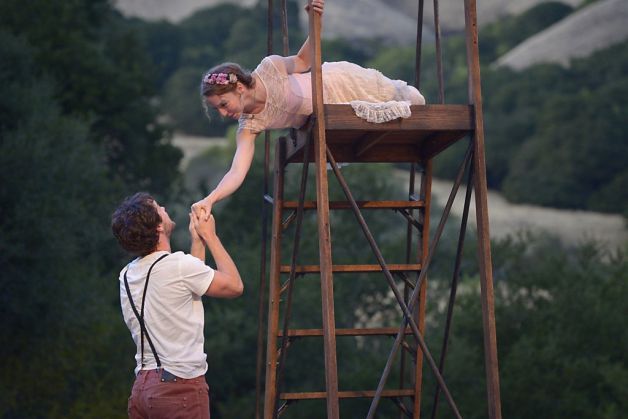
Romeo (Dan Clegg) visits Juliet (Rebekah Brockman) at her balcony in Cal Shakes’ production of “Romeo & Juliet.” Photo: Kevin Berne

ROMEO AND JULIET by William Shakespeare. Directed by Shana Cooper. California Shakespeare Theatre (CalShakes), Bruns Amphitheater, 100 California Shakespeare Theater Way, Orinda. (510) 548-9666. www.calshakes.org.  July 6-28, 2013.

Rebekah Brockman is a brilliant Juliet at Cal Shakes

Director Shana Cooper and Amanda Dehnert are cast from the same mold. Dehnert shamelessly confesses at the Oregon Shakespeare Festival “Life isn’t neat and theater isn’t clean,” Life is messy, so should theater be. You should see where the lights hang, see the clothes being put on and taken off, see how people transform through the power of imagination.” Cooper may not have taken a page from Dehnert’s book but her reimagining of Romeo and Juliet accepts those precepts and Cal Shakes production is proof of the observation.

The stage is bare wooden planking with miscellaneous props on the outer perimeter including an upright piano, a wheelbarrow, a tall wooden stepladder, a table resembling disco paraphernalia and a cot bed.  Even before the virtual curtain is to rise the cast dressed in non-descript costumes stand on center stage while the perfunctory pre-show festivities are dispensed with. I guess that is sufficient information that we are about to see a modern concept of our beloved Shakespearean play.

Cooper uniquely conceptualizes the play featuring a seven member ensemble cast playing all the roles with only Romeo (Dan Clegg) and Juliet (Rebekah Brockman) remaining in character. Stylistic fisticuffs replace sword play and each blow is emphasized with the crack of brick hitting brick.  And that is just the first scene where Tybalt Capulet (Nick Gabriel) engages Mercutio Montaque (Joseph J. Parks) setting the scene for the further violence to come.

Early on, the piano and disco are put to use for the fateful meeting of R & J staged as a wild party given (thrown?) by the Capulets to introduce Paris (Gabriel again) ending with a love ballad with banal lyrics “I must have you and through with love etc.”). Erika Chong Shuch (listed as Movement director) must have had a ball (pardon the pun) staging that party.

Just when this audience member was ready to say “Enough, already, get on with the play!” the wooden step ladder is wheeled on stage and Rebekah Brockman delivers the balcony speech that is riveting and worthy of a Tony award. Cooper emphasizes the fact that Juliet is only 14 years old and Brockman nails the characterization.  She is fresh from her stunning performance as Thomasina in A.C.T.’s production of  Arcadia and adds further accolades to her curriculum vitae.  Dan Clegg’s Romeo is only a partial match for Brockman’s superb Juliet.

In the supporting roles the always reliable Dan Hiatt stands out, first entering the stage as a supercilious servant, is charming as the Friar and is mesmerizing as the infuriated Lord Capulet insisting that Juliet marry Paris. Arwen Anderson does yeoman work as Benvolio, Lady Capulet and in the ensemble along with Dominigue Lozano as the nurse and Prince.

All the directorial conceits taking place on the bare stage have an unfortunate consequence: The death scene becomes anticlimactic and is further degraded by the staging of the lover’s burial. However, the lighting (Lap Chi Chu) and sound cues (Paul James Pendergast) for the final scene are brilliant with pillars of light surrounding the stage extending to the sky partially illuminating the beautiful trees and hills in the background. A great deal is cut from the script and running time about 2 hours and 20minutes including a 15 minute intermission.

Kedar K. Adour, MD

Courtesy of  www.theatreworldinternetmagazine.com.

WHISTLING THEN AND NOW

By Joe Cillo

WHISTLE POWER

Whistle and dance the shimmy
You will find your audience.
Anonymous

Robert Smith has been arrested several times for whistling on the streets of Portland Oregon. Residents said he was disturbing their peace.  The court listened to shop owners, pedestrians and outraged mothers’ complaints and last February, decided that Smith was free to whistle as long as he didn’t stand still.  Now, Robert Smith walks throughout downtown Portland, whistling a penetrating, tuneless melody so loud you can hear him blocks away.   “I get more self-worth out of whistling. I do it every day — weather permitting,” he said. “I’m not out here to be the best whistler in the world. I’m just trying to make people smile.”

I think that is a lovely attitude, one that all of us should think about adopting.  Whistling is a delightful way to spread joy, catch someone’s attention and call the dog.  My sister could whistle before she could say a sentence.  She, like Robert Smith, used to love to whistle while she walked.  The difference is that my sister was a fat, adorable three year old who toddled happily in the neighborhood; Smith is a grown man; a construction worker, who should have better things to do with his time.

However, the end results for both of them are the same.  When neighbors saw my sister wandering through Birkhead Place, they would call my mother and say, ”Ida, your kid ran away again.”

That served to alert my mother and give my sister the attention she wanted. She too had no intentions of being the best whistler in Toledo, Ohio.  She wanted her mother.  My sister’s whistling often took her out of our gated community and into the main thoroughfare.

One summer day, in 1944, my sister wandered out of the house whistling and attracted a mangy dog who fell madly in love with her unique melody.  The dog followed her down the street, past manicured lawns and budding maple trees, across busy intersections and crowded parking lots until at last, a policeman noticed the tiny, dimpled whistler followed by a large, flea infested hound.

He stopped my sister and said, as kind policemen did in the days before they carried guns and a chip on their shoulder, ”Darling where are you going?”

My sister, who had not mastered speech as well as she had her tuneful art, said, ”Dog!” and she smiled at the policeman expecting him to tell her she was a brilliant child because she said a complete word.  At this very moment, my mother dashed into the street her apron strings flying behind her yelling, ”Marsha Dee!!! STOP!!!”

The policeman stopped.  Pedestrians stopped   My sister kept walking and whistling her way past the drugstore toward the bakery.  She pointed to the dog.  “We hunnry.” she announced.

The policeman went into the bakery, bought a bag of cookies: He gave one to my sister and one to the dog.  “Say thank you,” my mother said to my sister.  The dog barked, my mother popped a tranquilizer and the policeman continued his beat.

The moral of this story is: There was a time when a whistle got you a cookie, but now-a-days, all you get is a citation.”


Thorny issues in “This Is How It Goes”

By Judy Richter

An already shaky marriage is shaken even more when a third person enters the scene in Neil LaBute’s searing “This Is How It Goes,” presented by Aurora Theatre Company.

The marriage is between Belinda (Carrie Paff, whose character is called Woman in the program), a white woman, and Cody Phipps (Aldo Billingslea), a black man. The third person, called Man (we never learn his real name), is a white man played by Gabriel Marin.

The three of them were in high school together 15 years ago, but Man left their small Midwestern town after graduation, served in the Army, got married and became a lawyer. He returns after losing his job and wife. By chance, he runs into Belinda at a shopping mall and winds up renting an apartment over the Phipps’ garage.

Man also serves as the narrator. Introducing the play, he cautions that his descriptions aren’t necessarily reliable. He even has Cody and Belinda enacting two versions of a scene for which he wasn’t present.

That first meeting between Man and Belinda is understandably awkward, but there’s a spark of attraction that for him began in high school. When he asks Belinda about her marriage, her vagueness signals that all is not right.

The reason becomes apparent when Cody first appears. One of the few blacks in town, he’s a successful businessman who’s proud of his status. He also has a chip on his shoulder and becomes jealous and suspicious of Man.Soon racism becomes a major issue that brings out even more negative behavior and volatility.

This 2005, one-act play runs a swift 100 minutes, thanks to ATC artistic director Tom Ross and his outstanding cast. Along the way it takes numerous twists and turns, some predicated on something as seemingly mundane — in the larger scale of things — as a rare Jackie Robinson baseball trading card.

With his imposing stage presence as Cody, Billingslea embodies the character’s ability to intimidate others, keeping the audience on edge, too. Paff’s Belinda does her best to try to placate him and cater to Man as their guest, but Cody will have none of it. Marin’s Man comes across as garrulous and not always sure of himself, but he does a great job of propelling the story and action.

Kim A. Tolman’s set for the intimate space consists mainly of a back wall covered by sheets of writing, augmented by a few pieces of furniture such as a bench. Kurt Landisman’s lighting design differentiates between Man as narrator and Man as participant. Costumes by Laura Hazlett are notable for Belinda’s attractive outfits. The sound is by Chris Houston.

This is not a play for the faint of heart. It deals directly and sometimes profanely with thorny issues, but it’s also an intelligent, provocative examination of those issues.

“This Is How It Goes” will continue at Aurora Theatre, 2081 Addison St., Berkeley, through July 28. Tickets and information are available by calling (510) 843-4822 or visiting www.auroratheatre.org.


Shaw’s ‘Candida’ inspires musical, ‘A Minister’s Wife’

By Judy Richter

By Judy Richter

A husband who deeply loves his wife and who believes his marriage is secure finds his belief shaken by a much younger man who also professes to love his wife.

That’s the premise of “A Minister’s Wife,” a 2011 musical based on “Candida,” a relatively early play by George Bernard Shaw.

In this West Coast premiere presented by San Jose Repertory Theatre, the husband is the 30-something Rev. James Morell (Christopher Vettel), who has become renowned for his eloquent lectures about Christian socialism.

His wife is Candida (Sharon Rietkerk), who returns home with 18-year-old poet Eugene Marchbanks (Tim Homsley) after being gone for a while. Initially quite shy, the idealistic Eugenes oon declares his love for Candida and challenges the practical James to ask her to choose between them.

Like many other Shaw heroines, Candida can be regarded as an early feminist, a woman who has a strong sense of herself and easily asserts herself. She also has a deep understanding of James and their marriage.

Set in an English parsonage in 1894, the show includes two other characters, the Rev. Alexander “Lexy” Mill (Jarrod Zimmerman), a young curate who’s James’s assistant; and Miss Proserpine “Prossy” Garnett (Liz Baltes), James’s efficient secretary. This musical version of the play omits a sixth character, Candida’s father.

Conceived and directed by Michael Halberstam, the show has melodic music by Joshua Schmidt, sometimes repetitious lyrics by Jan Levy Tranen and a strong book by Austin Pendleton.

In general, it follows the play closely and incorporates some of Shaw’s dialogue, yet manages to consolidate everything into 95 minutes with no intermission.

The band also is consolidated with musical director Dolores Duran-Cefalu conducting a violin, cello and bass clarinet from the piano. The musicians sit upstage in Collette Pollard’s elaborate drawing room set (lit by David Lee Cuthbert). 

Everyone in the cast sings and acts well. However, Homsley’s foppishEugeneslumps, cowers or glares throughout most of the show, in sharp contrast to James’s forceful bearing. This difference alone could determine Candida’s decision.

Overall, though, it’s a pleasant, enjoyable production.

“A Minister’s Wife” continues at San Jose Repertory Theatre, 101 Paseo de San Antonio, San Jose, through July 14. For tickets and information, call (408) 367-7255 or visit www.sjrep.com.

A MINISTER’S WIFE is a charming musical interlude at San Jose Rep

By Kedar K. Adour

(l to r) Eugene Marchbanks (Tim Homsley)The Reverend James Mavor Morell (Christopher Vettel) his wife, Candida (Sharon Rietkerk), Miss Proserpine “Prossy” Garnett (Liz Baltes) and Reverend Alexander “Lexy” Mill (Jarrod Zimmerman)

A Minister’s Wife: Musical Theater. Adapted by Austin Pendleton from G.B. Shaw’s “Candida.” Music by Joshua Schmidt. Lyrics by Jan Levy Tranen. Conceived and directed by Michael Halberstam. San Jose Repertory, 101 Paseo de San Antonio, San Jose. (408) 367-7255. www.sjrep.com

 June 27 – July 14, 2013.

A MINISTER’S WIFE  is a charming musical interlude at San Jose Rep

After seeing a perfect production of George Bernard Shaw’s (GBS) Candida by California Shakespeare Company in 2011, there was a bit of trepidation when we took the trip to the musical version receiving its West Coast premiere at San Jose Rep. There should not have been any qualms about going if one has faith in Terry Teachout’s July 2009 Wall Street Journal review. A clipping received from a friend and writer of reviews for opera (RVS) advised to be on the lookout for it. That review ends with: “A Minister’s Wife is that rarity of rarities, an adaptation of a major play that improves decisively on its source material.”

According to SJ Rep’s Artistic Director Rick Lombardo since its world premiere at the Writers’ Theatre in Glencoe, Illinois the artistic creators have continued to refine it even after its successful Lincoln Center staging in 2011. He has brought along Michael Halberstam, a member of that artistic group, to direct the play. As an added plum Liz Bates returns to the role of Miss Proserpine “Prossy” Garnett that she originated in its world premiere and had won a Jeff Award (Chicago’s version of the Tony Award) for Best Supporting Actress.

Candida by GBS’s standards is a relatively short play and A Minister’s Wife runs a scant 95 minutes without intermission.  It is not a musical comedy in the mode of My Fair Lady but  rather is a chamber music opera affair with much of the dialog sung in recitative with a backup by a partially hidden on-stage quartet consisting of piano/Conductor (Dolores Duran-Cefalu), violin (Petr Masek), cello (Robin Snyder) and bass clarinet (Michael Touchi).

A Minister’s Wife is a charming musical interlude that is well worth seeing but Mr. Teachout’s profuse adulation is misplaced for the present production. The overall essence maintains Shaw’s philosophical/political/social leanings but this musical adaption centers on the “love triangle.”   

Although the main character is the well liked Reverend James Morell (Christopher Vettel) a Socialist clergy it is Candida (Sharon Rietkerk) whom is Shaw’s protagonist.

 Morrell is admired by his curate Lexy (Jarrod Zimmerman) and Secretary Miss Proserpine “Prossy” (Liz Baltes) and his parishioners but spends most of his time writing sermons and giving political lectures.  He regards his wife Candida as the “perfect woman.”  All those around Candida truly love her for being a pillar of strength, a devoted mother/wife with a strong social conscious. That social conscious has led to her taking in a destitute idealistic young poet Marchbanks (Tim Homsley) who has fallen in love with her and is determined to take her away from the unappreciative Morrell. Thus the love triangle evolves without Candida’s knowledge.

The verbal and physical battle between Morrell and Marchbanks take up most of the action while the interplay between Lexy and Prossy adds the much needed humor. The lyrics maintain Shaw’s words and the dialog is very often delicious. When Morrel suggests that Marchbank’s love is “calf love”, Marchbank retorts that Morrel’s gift-of-gab is just rhetoric and metaphors and the fight is on. This eventually leads to asking Candida to choose between them. That was not a good idea and Candida’s response is a high light of the evening. 

Christopher Vettel and Tim Homsley have fine tenor voices and handle the intricate lyrics adroitly but director Halberstam may have erred  with Homsley who seem much too harsh thus detracting from what should be a clear dichotomy between the combatants.

Jarrod Zimmerman and Liz Baltes are a joy to observe with their playful banter to match their excellent singing voices.  It is the beautiful charming dulcet voice of Sharon Rietkerk who steals the show as she makes her entrances in magnificent Victorian dress (Costumes by Brandin Baron).  Added to all this is a magnificent set (Collette Pollard) and lighting (David Lee Cuthbert) that adds luster to SJ Rep’s consistent production values.

With only five characters and the need only for a musical quartet, this show will surely be produced in a plethora of smaller venues around the U.S. You should really see it in this present extravagant production thus to be able to compare when the smaller venues mount the show, and they will.

Kedar K. Adour, MD

Courtesy of www.theatreworldinternetmagazine.com


Shaw heroine inspires new musical, ‘A Minister’s Wife’

By Judy Richter

A husband who deeply loves his wife and who believes his marriage is secure finds his belief shaken by a much younger man who also professes to love his wife. That’s the premise of  “A Minister’s Wife,” a 2011 musical based on “Candida,” a relatively early play by George Bernard Shaw.

In this West Coast premiere presented by San Jose Repertory Theatre, the husband is the 30-something Rev. James Morell (Christopher Vettel), who has become renowned for his eloquent lectures about Christian socialism.

His wife is Candida (Sharon Rietkerk), who returns home with 18-year-old poet Eugene Marchbanks (Tim Homsley) after being gone for a while. Initially quite shy, the idealistic Eugenesoon declares his love for Candida and challenges the practical James to ask her to choose between them.

Like many other Shaw heroines, Candida can be regarded as an early feminist, a woman who has a strong sense of herself and easily asserts herself. She also has a deep understanding of James and their marriage.

Set in an English parsonage in 1894, the show includes two other characters, the Rev. Alexander “Lexy” Mill (Jarrod Zimmerman), a young curate who’s James’s assistant; and Miss Proserpine “Prossy” Garnett (Liz Baltes), James’s efficient secretary. This musical version of the play omits a sixth character, Candida’s father.

Conceived and directed by Michael Halberstam, the show has melodic music by Joshua Schmidt, sometimes repetitious lyrics by Jan Levy Tranen and a strong book by Austin Pendleton. In general, it follows the play closely and incorporates some of Shaw’s dialogue, yet manages to consolidate everything into 95 minutes with no intermission.

The band also is consolidated with musical director Dolores Duran-Cefalu conducting a violin, cello and bass clarinet from the piano. The musicians sit upstage in Collette Pollard’s elaborate drawing room set (lit by David Lee Cuthbert). Costumes are by Brandin Barón with sound by Steve Schoenbeck.

Everyone in the cast sings and acts well. However, Homsley’s foppish Eugenes lumps, cowers or glares throughout the show, in sharp contrast to James’s forceful bearing. This difference alone could determine Candida’s decision.

Overall, though, it’s a pleasant, enjoyable production.

“A Minister’s Wife” continues at San Jose Repertory Theatre, 101 Paseo de San Antonio, San Jose, through July 14. For tickets and information, call (408) 367-7255 or visit www.sjrep.com.

BETRAYAL by Harold Pinter

By Joe Cillo

BETRAYAL

Reviewed by Jeffrey R Smith of the San Francisco Bay Area Theatre Critics Circle

Harold Pinter’s BETRAYAL is presently being performed by the Off Broadway West Theatre Company.

At the onset, this complex play appears to be aiming at a precise definition of a seemingly simple word like betrayal; in the end it seems to have diffused the word into a vaporous hollow abstraction.

Jerry betrays his best friend and publishing associate, Robert, by snaking Robert’s wife Emma.

For five years Jerry and Emma conduct assignations in a cozy love flat not far from where they work … imagine eating a late afternoon lunch, with wine, perhaps a little dessert and then going home to their respective families … duplicitous almost to the point of schizoid.

When Robert married Emma, Jerry served as his best man.

Not long after the bouquet had withered and the garter had faded on the rear view mirror, Jerry ambushes Emma in her upstairs bathroom; he professes his adoration and adulterous love for her and plants the first kiss and the first brick in the road to infidelity.

After the affair begins to feel like a second year Birkenstock, the publishing business calls Jerry to New York leaving Emma alone with Robert.

In Jerry’s absence, Emma compromises her romantic integrity and makes love with her own husband; naturally she finds herself pregnant and has to explain to her returning Lothario that it’s okay; she was essentially faithful to him, after all, it was her own husband.

As C.S. Lewis once said, “Once you let go of reality, the possibilities are endless.”

Once the subterfuges, circumlocutions and prevarications get started, the three vertices of the love triangle are no longer communicating, they are collaborating on a script.

Jerry, as played to the Klieg lintels by Brian O’Connor, is an absolute rascal, a regular Paolo Malatesta; seducing with literary pretentions and pulp fiction in hand; you wouldn’t trust Jerry at a petting zoo let alone with your wife; what was Robert thinking?

Emma is an enigma: an attractive woman with options whose healthy sense of entitlement assures her that good wine, good food and frequent trips to Italy are just not sufficient.

Director Richard Harder perhaps does his best work with Emma, who is finely played by Sylvia Kratins.

Kratins’ Emma never sits still; her restless spirit keeps her head on a swivel, her eyes spinning like a rotifer and limbs in constant motion trying to get comfortable in the here in now while her mind is occupied elsewhere; is she Lady Macbeth or Madame Bovary?

Lighting is another creative strength of the show; low intensity illumination provides the audience with a keyhole feel: an intimate sense that we are eavesdropping on conversations; much in vogue these days given the liberties the NSA has taking with our liberties.

Keith Burkland as Robert is the axel about which the play revolves on.

Burkland’s Robert is opaque: a mystery shrouded in a reservation.

Is Robert mistakenly trusting Jerry and Emma or is he disinterested to the extent that he is willing to time share little Miss Francesca di Rimini?

Burkland is both an artist and a craftsman; polishing and burnishing his character until you can almost feel the tweed; acting is not what he does, it is who he is.

BETRAYAL is the best of Pinter and Richard Harder elevates it a step higher.

If you enjoy intimate theater where acting is an art, you don’t want to miss BETRAYAL at the Phoenix at Mason and Geary.

Call 1-800-838-3006 or www.offbroadwaywest.org.

Why Hunger fundraising party at Hanna Winery

By Guest Review
JUNE 28,  20l3
I traveled up to the lovely, but very warm Hanna Winery for the Why Hunger fundraising party, with my publicist, Joe, and his companion, Mary.    Hanna winery founded in l985 is located in southern end of the Alexander Valley in Healdsburg, CA.   We braved the Friday night commute traffic, which was difficult, and finally reached this lovely winery on a hillside, after a pleasant 2 hr. drive, mostly on the backroads of the valley.  We actually past a street sign on those backroads, that said, “no where road.”
The staff was very welcoming to us, upon our arrival,  and everyone started the evening in the air-conditioned tasting room, enjoying white and red wines.   I went up to one gentleman, asked how far he came to be here tonight, he said, “New Jersey.”   His name is Oliver Lake, and he had flew in to SFO this morning, for a gig in Healdsburg Center for the Arts the following night.   Oliver, plays the sax., and told me his first name stands for peace.   Oliver also told me he lives in a small town in New Jersey, the same town where that small cafe is, the one that “The Soprano’s had there last meal on the acclaimed H.B.O. TV show.
I met  the very tall Jan Chapin in the tasting room, wearing a striking dark green dress.  Jan and her trio were that night’s entertainment.  Jan is daughter of the late, great, Harry Chapin, who’s hit songs included, “Cats in the Cradle”, and “Taxi.”   Harry died in l981, in a car accident.    Jan chairs the board of directors of WhyHunger, her dad was deeply committed to fight world hunger.
We sat outside under a beautiful giant oak tree, which shaded us from the 95 degree heat, and enjoyed a lovely buffet dinner, tasty, mouth watering pizza, salad, desserts, and as much wine as we wanted.   We enjoyed talking to a nice couple from Mill Valley, they said the drive took them 3 hrs.
All in all, it was a wonderful evening, and I got to catch up on news with Mary and Joe, and hear more about they 7 week recent trip to England, and France.   One place they went to, I actually have seen, StoneHendge.  Joe, told me it was very cold there when they visited this great landmark, not far from the Winchester Cathedral.

Solo Gershwin show at Berkeley Rep thrills crowd

By Woody Weingarten


Hershey Felder portrays the legendary composer in “George Gershwin Alone” at Berkeley Rep. Photo: Mark Garvin.

Hershey Felder may be channeling George Gershwin.

If that’s not what’s going on, he must at least be sensing the composer’s fascinating rhythms through the fingertips of both hands.

He also has a nuanced, carefully researched understanding of Gershwin’s colorful, truncated life.

The charismatic performer exhibits all that as he plays the musical genius’ melodies on a concert grand Steinway, and dramatizes tidbits of his bio, in a solo 90-minute Berkeley Rep show titled “George Gershwin Alone.”

The work is an outgrowth of five years of study (interviewing family members and biographers, perusing correspondence and checking out original manuscripts, listening to old audio recordings).

Felder’s been touring the show across the globe for 13 years (including a Broadway stint).

But he jokes that what came before this run was merely preliminary — practice sessions for his East Bay appearance.

He also claims he’s tired.

So many performances (3,000 and counting), yet to me he’s as fresh as if this were his world premiere.

My wife, a highly talented jazz pianist and “spoke-alist” who’s performed in countless senior venues in Marin, San Francisco, Sonoma and the East Bay, labels him a virtuoso.

I’m biased, of course, but, considering her skill level, I find the pronouncement high praise indeed.

Not to mention astute — and accurate.

She particularly lauds his flying fingers and classical flourishes, and calls him “a confident pianist, confident vocalist, confident raconteur.”

I’ll add “confident humorist.”

The show’s prime conceit of having Felder inhabit Gershwin’s persona works divinely, thank you, except for the moments he’s depicting the composer’s death at age 38 from an undiagnosed brain tumor. They’re awkward.

Thankfully, Felder doesn’t end the show that way.

He plays “Rhapsody in Blue” at length instead, then involves the audience in a boisterous, half-hour sing-along “encore” (which includes an “It Ain’t Necessarily So” call-and-response and an uproarious, unfamiliar novelty tune penned with Irving Berlin).

The bulk of the show, naturally, focuses on standards — in addition to excerpts from “Porgy and Bess,” “An American in Paris” and Gershwin’s concerto: “S’Wonderful,” “Embraceable You,” “Our Love Is Here to Stay,” “The Man I Love,” “I Got Rhythm” and “They Can’t Take That Away from Me.”

But the character study also pinpoints the composer’s flaring insecurity when berated by movie mogul Samuel Goldwyn for not writing tunes simple enough to whistle — a la Irving Berlin.

And his anger after being targeted by auto tycoon Henry Ford’s anti-Semitic rants.

Although Gershwin’s legend has outlasted such commentaries (probably because he wrote more than 1,000 tunes), his fame, according to some other critics, was mainly due to Ira’s lyrics — or stemmed from the luck of having superstar Al Jolson sing his first hit, “Swanee.”

This tour de force starts with poignant chord-less notes from “Porgy,” the composer’s jazz opera about poor Southern blacks that initially flopped and caused the affluent son of immigrants to lose his shirt.

And it glimpses a childhood in which Gershwin wandered “the streets of lower Manhattan with my hoodlum friends.”

Felder also touches on the composer’s tenure as a rehearsal pianist with the “Ziegfeld Follies” (“they used to call us piano pimps”), and he deftly performs duets with antique recordings of Gershwin and Jolson.

His anecdotes, for the most part, are extremely amusing.

Such as his recounting Gershwin’s father (a cutter of shoes) mistakenly believing “Fascinating Rhythm” to be “Fashion on the River.”

Felder, who created his own book for this show, is abetted by the smooth direction of Joel Zwick, who’d spearheaded the comedy film “My Big Fat Greek Wedding,”

Scenic designer Yael Pardess also helps via a lean set that features blown-up covers of sheet music, a plush curtain implying wealth, and two chairs that enable Felder to get closer to the audience at either end of the stage.

He’s aided, too, by projections that capture images of George’s lyricist brother, Ira, and best friend/lover, Kay Swift.

The night I saw the show, the Berkeley crowd was more gray-haired, wrinkled and frail than the usual Rep audience.

Many, like a blissed-out woman across the aisle from me, were so familiar with the material they quietly sang or hummed along with Felder throughout.

Audience reaction to Felder approaches ecstasy.

I understand.

Because he’s that good.

“George Gershwin Alone” plays at Berkeley Rep’s 400-seat Thrust Stage, 2025 Addison St., Berkeley, through July 7. Night performances, 8 p.m. Tuesdays through Saturdays, 7 p.m. Wednesdays and Sundays. Matinees, 2 p.m. Saturdays and Sundays. Tickets: $14.50 to $77, subject to change, (510) 647-2949 or www.berkeleyrep.org.

Two local women who resisted the Nazis can’t forget

By Woody Weingarten

Some things we should never forget.

Like, the Holocaust wasn’t limited to Jews. And, Jews did fight baWe certainly must remember the six million dead. But the Nazis also killed millions of non-Jews — Soviet prisoners of war, Polish citizens, Gypsies, the disabled, political and religious dissenters, gays.

Decades ago, my first day at the Jewish Bulletin of Northern California, a man who’d survived Auschwitz-Birkenau and four other World War II camps pleaded, “No matter what else you do, don’t let anyone forget the Holocaust.”

Sonia and Paul Orbuch. Photo: Woody Weingarten

I never forgot him, or the slogan “Never forget!” — the rallying cry for Jews the world over.

But it was a while before I’d encounter anyone who’d joined the resistance.

They, too, bear scars — physical, emotional.

A month ago I met octogenarian Sonia Orbuch. She fought Nazis as a teen, part of a partisan unit whose mission was resistance and sabotage, including the mining of train tracks.

Mostly she was an impromptu field nurse, helping doctors amputate limbs, treating the wounded with skimpy supplies and blood-soaked bandages — and cradling the dying.

The Corte Madera resident can’t forget the nightmare, or a brutal winter hiding in a Ukrainian forest.

She lived fearfully “all the time” then, and knows she’ll never forgive. “Even when it’s a happy moment or a holiday, I cannot smile, cannot laugh,” she told me. “The pain is tremendous.”

In a book aimed at teenagers, Sonia said, “Every day my heart aches for the loss of my mother and two brothers, dozens of other relatives, and nearly all of my childhood friends.”

But she also knows it’s crucial to dispel the myth that Jews didn’t resist the Nazis.

Her son, Paul, a San Anselmo resident, actualized his legacy by co-founding the Jewish Partisan Educational Foundation, www.jewishpartisans.org. It, he noted, is “seeking 100,000 teachers, Jewish and non-Jewish” to inspire new generations by showing “the history and life lessons of the Jewish partisans.”

What’s it like being a survivor’s child?

“I always go back to what Sonia’s said, ‘You have to stand up early against tyranny, oppression, discrimination, anti-Semitism, whenever and wherever it occurs, and you have to teach the kids.’”

Yet even as his messages spread hope, others dispense hatred: The Associated Press reported a 30 percent worldwide surge in anti-Semitic violence and vandalism last year, economic nosedives again making Jews scapegoats.

Paul once told a Marin Jewish Community Center audience about hearing Sonia’s friends reminisce “about the war, their losses and their survival experiences. They did so with tears and sometimes with humor. And almost always there was anger and the refrain…of ‘never again.’”

His daughter, Eva, who lives in San Jose, subsequently recalled that she’d told her bat mitzvah tutor she “understood what my grandmother had gone through. My tutor challenged me…and I came to realize…I may never be able to truly understand or feel what my family and millions of others endured. I will only be able to ask questions and grapple with my past.”

Another resister, Paula Ross, lived in Fairfax since 1990 but just moved to the Veterans Home of Yountville.

Paula Ross outside Whistlestop in San Rafael. Photo: Yvonne Roberts.

The Vienna-born 92-year-old can’t forget either — how she fought with the resistance to retaliate: “They killed my uncles, aunts, cousins and friends.”

She still doesn’t “like to talk about it, because it was very traumatic,” but, despite misgivings, she returned to Austria two years ago “and taught teenagers about the Holocaust, telling them exactly what the Nazis did.”

Morgan Blum, a Tiburon native, is director of education for the Holocaust Center, part of Jewish Family and Children’s Services in San Francisco. She says a survivor once was defined as someone who’d been in a death camp but now signifies “anyone who was targeted for death and survived.”

That means they “may have been in an extermination camp, may have been a hidden child, may have been a Partisan, may have fled in 1936.”

Morgan recently gathered “600 students and teachers from 101 private, public and parochial schools to participate in our annual Day of Learning. About 95 percent were not Jewish. Over 70 percent had never heard a survivor before, but meeting one, they could make a connection.”

One attendee, after hearing about Rwandan, Cambodian, Bosnian, Darfur genocides, vowed “to prevent this from happening again, to not be a bystander.”

Another told Morgan it’s critical “to carry on this story because the next generation won’t be able to hear from a living survivor.”

Yes!