Cal Shakes stages elegant ‘Lady Windermere’s Fan’

By Judy Richter

By Judy Richter

After hearing some gossip, an upper-class Englishwoman thinks her husband is having an affair in Oscar Wilde’s “Lady Windermere’s Fan.”

However, appearances aren’t always what they seem in California Shakespeare Theater’s elegant production of this witty satire on Victorian morality.

Lady Windermere (Emily Kitchens) is about to celebrate her 21st birthday and receives a lovely fan from her husband, Lord Windermere (Aldo Billingslea).

They’ve been happily married for two years and have a 6-month-old son. Her happiness is marred when an afternoon visitor, the Duchess of Berwick (Danny Scheie), tells her that Lord Windermere has been visiting a fallen woman, Mrs. Erlynne (Stacy Ross), and giving her large sums of money.

Confirming the outlays by ripping open his locked checkbook, Lady Windermere confronts her husband. He says that nothing improper has happened and asks to her invite Mrs. Erlynne to her birthday party that night.

When she refuses, he writes the invitation himself, resulting in even more unhappiness for his wife both then and at the party. Afterward the fan plays a large role in the conclusion, but secrets remain unrevealed, allowing illusions to continue.

Wilde subtitled his work “A Play About a Good Woman.” One would assume that the good woman is Lady Windermere, but she could also be Mrs. Erlynne, who does some great kindnesses for the unknowing Lady Windermere.

This polished Cal Shakes production is directed by Christopher Liam Moore from the Oregon Shakespeare Festival.

It features an elegant set by Annie Smart with complementary lighting by York Kennedy and sound by Will McCandless. The period costumes by Meg Neville reflect the rigidity of Victorian society with the women constrained by bustles and corsets under their beautiful dresses.

The cast is excellent, led by Kitchens as an increasingly upset Lady Windermere and Billingslea as her husband.

One telling aspect of their relationship becomes clear in the final scenes when he often refers to his wife as “my child,” as if he doesn’t see her as an equal partner in their marriage even though he loves her.

The first act is highlighted by the irrepressible Scheie as the Duchess of Berwick. Flouncing about with the duchess’s socially inept daughter (Rami Margron) in tow, Scheie is absolutely hilarious.

Ross skillfully portrays the conflicting emotions of Mrs. Erlynne.

Sharp characterizations come from the rest of the cast: L. Peter Callender, James Carpenter, Dan Clegg, Nick Gabriel, Tyee Tilghman and Bruce Carlton.

All of these elements add up to an enjoyable, thought-provoking theatrical experience.

“Lady Windermere’s Fan” continues in the Bruns Memorial Amphitheater, 100 California Shakespeare Way(off Hwy. 24), Orinda, through Sept. 8. For tickets and information call (510) 548-9666 or visit www.calshakes.org.

LADY WINDERMERE’S FAN opens unevenly at CalShakes

By Kedar K. Adour

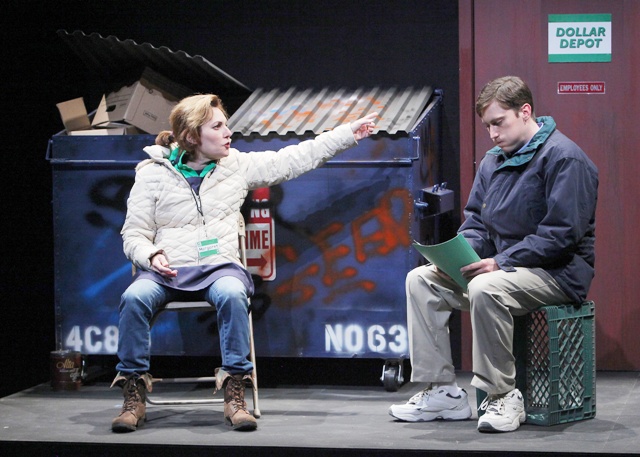
Stacy Ross (Mrs. Erlynne) and Emily Kitchens (Lady Windermere) in Cal Shakes’ production of Oscar Wilde’s Lady Windermere’s Fan, directed by Christopher Liam Moore; photo by Kevin Berne.

Lady Windermere’s Fan, A Play About a Good Woman: Comedy/Melodrama by Oscar Wilde. Directed by Christopher Liam Moore. California Shakespeare Theater (CalShakes), Bruns Amphitheater, 100 California Shakespeare Theater Way (formerly 100 Gateway Blvd.), Orinda, CA 94563.510.548.9666 or www.calshakes.org. August 14 – September 8, 2013

LADY WINDERMERE’S FAN opens unevenly at CalShakes

This seems to be the year for actor/director Christopher Liam Moore to add luster to his reputation as a director.  This year at the Oregon Shakespeare Festival, where he is an associate artistic director he helmed a brilliant, touching production of Midsummer Night’s Dream and received accolades for his compelling staging of A Street Car Named Desire. Therefore expectations were high on entering the Bruns’ Amphitheatre where a gorgeous set (Annie Smart) awaited the entrance of the actors to give life to Oscar Wilde’s delicious/cutting/devilish/ socially incorrect lines.

The play is described as a comedy/melodrama and previously reviewed productions were a well balanced mixture of comedy and drama. In director Moore’s staging there is greater emphasis on the comedy with a touch of farce introduced by having the inimitable Danny Scheie appear in drag in a pivotal role of the Duchess and two other Grand Dames. His is a dominating performance that preempts the stage.

He is not the only performer with that innate ability to wrest accolades from the audience. Emily Kitchens as the Lady with the fateful fan turns in a splendid acting job as the 21 year old wife of Lord Windermere (Aldo Billingslea) whom she suspects of having an extramarital affair with the mysterious seductive Mrs. Erlynne (Stacy Ross). The sub-title of “A Play About a Good Woman” refers with different connotations of “good” to Lady Windermere and Mrs. Erlynne. But that is getting ahead of the story.

Written in 1862 early in Oscar Wilde’s career, rewrites were shared his producer Sir George Alexander. In this Victorian Era, social class distinction defined the different mores for woman and men and Wilde had the stunning ability to skewer both sexes with many of his infamous lines that are rampant in this play.  (http://www.goodreads.com/work/quotes/1897835-lady-windermere-s-fan.)

When Lady Windermere suspects her husband of infidelity she hastily decides to accept Lord Darlington’s (Nick Gabriel) proposal to take her away from it all. Doing so would be catastrophic and when Mrs. Erlynne discovers the potential disaster she takes matters into her own hands. This leads to a confrontation between the two women. Kitchens and Ross play their roles with palpable and memorable sincerity. The reasons behind Erlynne’s intervention gradually become known and the Windermeres reunite.

The initial foppish entrance by Nick Gabriel as Darlington was unimpressive and confusing but in his later scenes he rises to the level of a true lover with a touch of the rue. James Carpenter’s Lord Augustus smitten by the charms of Mrs. Erlynne is a gem of a performance. L. Peter Callender makes the most of his underwritten part of Mr. Dumby using perfect diction to enunciate Wilde’s wild lines. It is Dan Clegg, who recently gave an award winning performance as Romeo, who takes Wilde’s lines to the heights they deserve when he appropriately dominates the men in the penultimate scene. Aldo Billingslea who has given SF Bay Area Critic Award performances as Othello, the Elephant Man and others seems uncomfortable as Lord Windermere.

With the exceptions of Lord Darlington’s doubtful costume in the early scene, Meg Neville’s costume designs are stunning. A nice touch is the black and white costume she designed for Mrs. Erlynne underscoring the dichotomy of the character.

Running time 2 hours and 10 minutes including the intermission.

Courtesy of www.theatreworldinternetmagazine.com


Ellison’s Japanese art exhibit offers superb cultural synopsis

By Woody Weingarten


Detail from “Dragon and Tiger,” part of “In the

Moment” exhibit at the Asian Art Museum.

Photo: Courtesy, Larry Ellison Collection.


Peanut butter and jelly. Ginger Rogers and Fred Astaire. Beauty and the beast.

Famous couplings that trickle off my tongue.

I’m sure you can conjure up dozens more. But you’d probably never list Larry Ellison and Emily Sano.

You should.

Few would dispute that Sano, who was its executive director, was the driving force in moving the Asian Museum to the old San Francisco Library building opposite City Hall and growing its collection to a world-class status.

That was 10 years ago.

Then, in 2008, the billionaire founder of Oracle surprised virtually everyone — including, perhaps, Sano, who’d announced her retirement the year before — by offering her almost a blank check to become his personal consultant and build his collection.

The two obviously have shared a lot more than “J,” their middle initial.

Like philosophy and taste in art.

Now, coinciding with the running of the America’s Cup, which Ellison also has a little something to do with, 60 pieces of his collection that span more than 1,100 years are on display at the museum through Sept. 22 (though a few components are slated to be rotated out this week).

Folding screens, hanging scrolls, lacquer-, metal- and woodworks prove the Ellison-Sano collaboration has worked well.

Consider, for instance, the amazing introductory display that showcases folding screens and fluctuating lights that, in a three-minute span, simulate the passage of a single Japanese day. It’s a visual echo of the way artworks were seen in pre-electric times, by natural sunlight or flickering candlelight.

“In the Moment: Japanese Art from the Larry Ellison Collection” ranges from “Waves and Rocks,” a pair of screens with ink, light colors and gold on paper from the early 1600s, to exquisite sculpture from the 4th century.One of the most striking items is a scroll from the 1300s that depicts the death of Buddha (which traditionally had been removed from its box and unrolled for display only one day a year).

Another favorite of mine is the 20 painted fans that are part of “24 Paragons of Filial Piety,” a pair of folding screens addressing “the self-sacrificing behavior of Chinese children [and their] strong respect, obedience, and care for parents, elderly, family members and ancestors.”A superb cultural synopsis, if you ask me — like the exhibit itself.

Other not-to-be-missed items include screens titled “Dragon and Tiger,” a 1780s work (purportedly Ellison’s favorite object) in which the former symbolizes yang and the latter yang, and “White Elephant,” a hanging scroll from 1768 that shows the Japanese can superimpose a sense of humor onto their sense of seriousness.

Jim Brown, a friend who’s just begun his last leg of a three-year intensive course at the museum so he can be certified as a docent, guided my wife and me through the show (which was curated by Laura Allen).

His torrent of words — a distinct contrast with the spare, spartan exhibit — mesmerized me.

He later showed us more of the building (a mere hint of the 2,200 objects on display

, out of a more than 15,000-piece permanent collection that covers 6,000 years) — focusing his “practice tour” on one of his leanings, art that depicts mythical and real animals.I enjoyed experiencing “Buffalo,” a rock crystal sculpture in the jade room; a bronze ritual wine vessel in the shape of a rhinoceros (whose inscription I could see in the reflection of the glass case if I tilted my head and twisted my body pretzel-like); and a Taoist ceremonial robe with countless critters (including dragons and phoenixes) that emphasized longevity plus balance and order in the cosmos.

But a “Money Tree” sculpture that incorporated scores of animals that represent

ed Confucian, Taoist and Buddhist beliefs of “creation, birth and rebirth” in one piece utterly captivated me.And since we only scratched the proverbial surface of both the Ellison exhibit and the rest of the museum, I definitely plan to return.

Soon.

The Asian Art Museum, 200 Larkin St., San Francisco, is open from 10 a.m. to 5 p.m. Tuesdays to Wednesdays and Fridays to Sundays; 10 a.m. to 9 p.m. Thursdays. Tickets: $8 to $12. Information: (415) 581-3500 or www.asianart.org.

Hannah Arendt — Film Review

By Joe Cillo

Hannah Arendt

Directed by Margarethe von Trotta


This is my kind of film.  It is a film about ideas, about the big picture, about the ambiguities and contradictions in human nature, about broad philosophical implications of ordinary events.  If you have never had a serious thought in your life, if you like to go to the movies to be entertained, to escape from your humdrum existence, to have your fundamental preconceptions, your basic world view and moral outlook on life confirmed and validated by some contrived story line and stereotypic, one-dimensional characters, then don’t go see this.  It’s not for you.  The friend I went with was yawning.

In contrast to the previous film I reviewed about Wilhelm Reich, this film, also a dramatization, is much better conceived and much better executed.  It is altogether a superior effort.  The character of Hannah Arendt is effectively and convincingly created by Barbara Sukowa.   I also liked Julia Jentsch, who played Lotte.   The nature of her relationship to Hannah Arendt wasn’t exactly clear.  She was not a relative.  She served as a kind of secretary and all purpose assistant, but the relationship seemed to have a marked personal quality as well.

Although the film effectively draws the character of Hannah Arendt and summarizes many of the major aspects of her life, the central concern of this film is her coverage of the trial of Adolf Eichmann in the early 1960s for the New Yorker magazine, and the aftermath of its publication.  Eichmann had been a top level S.S. officer in the Third Reich, who was responsible for the transport of millions of Jews to death camps.  He had been renditioned by the Israeli Secret Service from Argentina and brought back to Israel to face trial for war crimes.  Hannah Arendt, a Jew who was briefly held in a Nazi detention camp in France before escaping with her family to New York, volunteered to cover the Eichmann trial for the New Yorker, and the New Yorker accepted her offer.

She did more than cover the trial.  Hannah Arendt was a trained philosopher who studied with Martin Heidegger and Karl Jaspers.  She had published several major philosophical works before covering the Eichmann trial including The Origins of Totalitarianism (1951) and The Human Condition (1958).  She brought her philosophical acumen and formidable erudition to bear on her reporting of this trial.  It was entirely fitting and appropriate.  We have to congratulate the New Yorker for choosing her to report on this trial.  No one could have covered it like she did, and no one could have raised the issues implied in this trial with such clarity and force and intellectual depth as she brought to them.  The outcome was six long articles that appeared in the New Yorker in 1963 followed by a book, Eichmann in Jerusalem:  A Report on the Banality of Evil (1963), which is still in print.

I read the opening article from the February 16, 1963 issue of the New Yorker.  From the outset, Arendt not only reports on the trial vis-a-vis Eichmann, but she analyzes the trial and sets it in its political and historical context, which she has the knowledge and capability to do.  Her understanding of Jewish history and culture and the contemporary political context is especially rich.  It would be hard to imagine someone doing a comparable job in terms of quality and depth of understanding.  She seems uniquely qualified for this assignment and the New Yorker  did itself and the world a great favor by choosing her for this task and providing her with a venue to put her singular perspective before the public.

Arendt saw the trial as not being about Eichmann and what he did during the Third Reich, as much as it was about a political agenda of Israeli Prime Minister David Ben-Gurion.

this case was built on what the Jews had suffered, not on what Eichmann had done. (New Yorker, Feb. 16, 1963, p. 41)

It was history that, as far as the prosecution was concerned, stood at the center of the trial.  “It is not an individual that is in the dock at this historic trial, and not the Nazi regime alone,” Ben-Gurion said, “but anti-Semitism throughout history.” (New Yorker, February 16, 1963, p. 54)

The logic of the Eichmann trial, as Ben Gurion conceived of it — a trial stressing general issues, to the detriment of legal niceties — would have demanded exposure of the complicity of all German bureaus and authorities in the so-called Final Solution of the Jewish question; of all civil servants in the state ministries; of the regular armed forces, with their General Staff; of the judiciary; and of the business world.  . . . the prosecution . . . carefully avoided touching on this highly explosive matter — upon the almost ubiquitous complicity, stretching far beyond the ranks of Party membership. (New Yorker, February 16, 1963, p. 52)

So from the outset Arendt sees the trial as going far beyond Eichmann.  And indeed, as the trial goes on Eichmann’s significance diminishes in relation to this broad  historical drama.

Despite all the efforts of the prosecution, everybody could see that this man was not a ‘monster,’ but it was difficult indeed not to suspect that he was a clown.  (New Yorker, February 16, 1963, p. 113)

Half a dozen psychiatrists examined Eichmann and found that “his whole psychological outlook, including his relationship with his wife and children, his mother and father, his brothers and sisters and friends, was “not only normal but most desirable.” (New Yorker, February 16, 1963, p. 67)

Eichmann, the Nazi S.S. officer who presided over the transport of millions of people to their deaths, was a perfectly good guy.

He went to considerable lengths to prove that he had never harbored any ill feelings toward his victims, and, what is more, had never made any secret of that fact. (New Yorker, February 16, 1963, p. 76)

Arendt goes on to explain that he had a Jewish mistress during his service in the S.S., a rarity among S.S. officers.

His enlistment in the S.S. was not motivated by ideological fervor or even political conviction.  He said, “it was like being swallowed up by the Party against all expectations and without previous decision.  It happened so quickly and suddenly.”  He had no time and less desire to be properly informed; and he did not even know the Party program, and he had not read (as he never did read) Mein Kampf.  Kaltenbrenner had said to him, Why not join the S.S.? and he had replied, Why not?  That was how it happened, and that was about all there was to it. (New Yorker, Feb. 16, 1963, p. 80)

What disturbed people about Arendt’s take on the Eichmann case is that Arendt saw that the face of Evil is not a monster, not demonic, not a raging lunatic, but a mediocre bureaucrat, an ordinary man, with a wife and a healthy family, who would never have done what he did had he not been caught up in large historical currents which he did not create and had very little personal interest in.  Somehow it didn’t sit well with people that such an inconsequential person could be responsible for the deaths of millions of people, whom he did not hate, and actually did not seem to have any strong feelings about.  He was just doing his job to the best of his ability and trying to survive and get by.  He understood what he was doing, to be sure.  He didn’t pretend to be ignorant of what was going on.  But he said he would have shot his own father if the Führer had ordered him to do so.  For Eichmann the overarching value in his life and his outlook was to follow the program, to do what he was told, and to execute his assigned tasks faithfully and effectively.  And that is exactly what he did.  He was the quintessential bureaucrat.

Arendt argued that making Eichmann the public face of the Holocaust was a historical and cultural cop out.  It was an evasion.  It is not that Eichmann was not responsible and should not be held accountable.  Arendt agreed with his sentence and was glad to see him hanged, but she also saw that Eichmann was being given too much credit.  He was being made into a false symbol: a personification of something that was much bigger and deeper than any one person could represent or be responsible for.  I think her assessment of the trial and of Eichmann is absolutely correct.  The film does a very good job of presenting the philosophical issues as well as the personalities involved.  It is an excellent achievement, although heavy to watch.

What interested me about this film and about the Eichmann case was its relevance to contemporary events in the United States.  If you think about the contrast between Adolf Eichmann and Edward Snowden or Bradley Manning, you notice something significant.  Snowden and Manning are both rather inconsequential individuals, of unimpressive backgrounds and credentials, very much like Eichmann, who found themselves cogs in a huge bureaucratic machine that they realized was monstrous.  But what distinguishes them from Eichmann is that they were not content to just continue in their jobs, carrying out their assigned tasks, oblivious to the dire consequences that they knew would ensue from their work.  They threw a monkey wrench into the machine, at great cost to themselves, rather than let the Beast continue on its ruinous rampage.

In 1934 Eichmann applied for work in the Security Service of the S.S (the S.D.).  The S.D. had been founded by Himmler to serve as an intelligence service to the Nazi party.

Its initial task had been to spy on party members — an activity giving the S.S. an ascendancy over the regular party apparatus.  Then it had taken on some additional duties, becoming the information and research center for the Geheime Staatspolizei (Secret State Police, or Gestapo).  This was the first step toward the merger of the S.S. and the police, which was not carried out until September of 1939 . . . (New Yorker, February 16, 1963, p. 86)

A similar evolution is in progress in the United States, where the intelligence services are being inexorably merged with state and local police departments.  It is an important point to emphasize that in a totalitarian state the intelligence services, protected by the utmost secrecy, and charged with spying on citizens — and indeed, everyone — ultimately become merged with policing functions, so that what results is one monolithic oppressive force within society, intimidating and brutalizing with impunity anyone deemed a threat or subversive.  Edward Snowden has exposed the mountains of data being gathered by our own intelligence services on every American citizen, and indeed, nearly every citizen throughout the world.  The security services claim that they need all this information about who we talk to and associate with in order to protect us — and many people among the citizenry buy this line, or are at least indifferent to it.  But it is only a matter of time before those massive amounts of data will be turned with a most heavy hand and without the possibility of challenge or recourse against the people who now comfort themselves with the thought that this is all benign and innocent.

Eichmann . . . seems to have known nothing even of the nature of the S.D. when he entered it — which was not really strange, since operations of the S.D. were always top secret.  According to what he told Captain Less, he joined the S.D. under a misapprehension . . . (New Yorker, February 16, 1963, p. 86)

Edward Snowden, and many others like him, had no idea of the nature of the work he would be doing for the NSA.  But, unlike Eichmann, he became increasingly shocked and appalled at the nature of the work he was expected to carry out.  In response to Snowden’s revelations, the NSA has vowed to tighten their selection process so that only the Adolf Eichmann’s of the world can work for the intelligence services.

The totalitarian state needs the Adolf Eichmanns of the world.  It despises the Bradley Mannings and Edward Snowdens.  Every conceivable vilification and depredation is being heaped upon them.  At all costs they must be discredited and punished mercilessly.  A totalitarian state, or a state that has pretentions of becoming one, like the United States, cannot allow people like Edward Snowden and Bradley Manning to become heroes.

But it is important to point out:  the difference between Adolf Eichmann, and Edward Snowden and Bradley Manning, is one of values.  Eichmann valued only following orders and being a good soldier, whereas Snowden and Manning had a vision for society that went beyond themselves.  They were capable of evaluating what they were doing and passing judgment on their own professional conduct, because their vision of themselves and their relation to society went beyond simply doing their jobs, understood as carrying out their assigned tasks as they came down from on high.   They actually cared about how people would live in the kind of society being fashioned by the work they were charged with carrying out.  Eichmann did not.  He had no vision of society beyond himself and his immediate circle.  It is very important to understand where these values held by Snowden and Manning come from, and how they become instilled in children.  It is important because it is the best hope of preserving America as a society where individual freedoms and basic civil rights for average citizens are protected and institutionalized in both law and culture, just as it is important for totalitarian states that want to crush such people and snuff out those values in order to enslave everyone.  The Edward Snowdens and Bradley Mannings of the world are an obstacle to totalitarianism.  Eichmann, the quintessential bureaucrat, is the totalitarian hero and ideal.

The longer one listened to him, the more obvious it became that his inability to speak was closely connected with an inability to think; that is to think from the standpoint of somebody else.  No communication with him was possible, not because he lied, but because he was surrounded with the most reliable of all safeguards against the words of others, or even the presence of others, and hence against reality as such.  (New Yorker, February 16, 1963, p. 106)

This film and its theme, the banality of evil, is highly relevant to our own time as   America moves increasingly toward a totalitarian police state.  This can be seen in the erosion and often complete disregard of the Constitution and its protections of citizens rights against the prerogatives of government.  The current President, who is supposedly an expert on the Constitution, has shown more disrespect for the Constitution than any President in recent times.  The indifference of average citizens in allowing this to happen, the narcissism of simply focusing on one’s own job, one’s own living, one’s own problems, one’s own success and promotion, without regard to one’s connection to the whole; the failure to perceive that the quality of life within the whole society matters to one’s fate as an individual; this lack of perception, this narcissism of unrelatedness is the greatest danger to America as a free society.  The biggest threat to the United States is not terrorists blowing up buildings.  This is what the Security State wants people to believe, and this phantom is promoted relentlessly in the media that constant threats of this type are afoot.   But actually, it is the indifference of average citizens to the ever growing presence of the Security State and the erosion of basic liberties for others as well as oneself that is the much more profound threat.  There is an obliviousness that allows one to think that the government can trample the rights of others, disregard the Constitution, violate civil rights, even commit heinous crimes against people portrayed as “enemies of the State,” and somehow that will never come home to me.  What affects others does not affect me.  That’s their problem, not mine.  This attitude on the part of the average citizen is the most ominous threat to America as a free society.  It is the Eichmannization of the citizenry that is our most profound enemy.

Eighty million Germans had been shielded against reality and factuality by the same self-deception, lies, and stupidity that had now become ingrained in Eichmann’s nature.  These lies changed from year to year, and they frequently contradicted each other; moreover, they were not necessarily the same for the various branches of the Party hierarchy or the people at large.  But the practice of self-deception had become so widespread — almost a moral prerequisite for survival — that even now, eighteen years after the collapse of the Nazi regime, when most of the specific content of its lies has been forgotten, it is sometimes difficult not to believe that mendacity has become an integral part of the German national character.  (New Yorker, February 16, 1963, p. 111)

This could describe current conditions in the political and cultural climate of the United States.  There are so many lies being promoted by the government and the “information” media to the public with such a heavy handed insistence, being repeated so often and with such uncritical aplomb that they have almost become clichés.  People who point out the lies, the contradictions, the inconsistencies, the delusions, and question their sources are labeled ‘crackpots,’ or ‘conspiracy theorists.’

How many lies have the American people been told and accepted as fact going back many years to Vietnam, Iran-Contra, Iraq, Afghanistan, 9/11, the War on Drugs, the War on Terror, climate change, among many other issues?  We seem to eagerly embrace hysteria and sensationalism, particularly when it provides opportunities to vent boundless spite and venom upon some demonized enemy.  Israel was probably hoping for such an opportunity in the trial of Adolf Eichmann, but it did not work out so well, because Eichmann turned out not to be a demon with fangs and horns, but a rather mediocre, almost innocuous, person.  Had he been in a different position with different responsibilities, no one would ever have heard of him.  It was almost bad luck, rather than malice, that resulted in his presiding over the extermination of millions of Jews.

Living in America you know that most of the population is deluded about many issues of vital public importance.  And yet, they are content to remain in that condition of numb indifference focusing mostly on themselves and their immediate circle, and when they do cast their eyes beyond that short field of vision, they see only bewildering, amorphous threats, and thus defer to the authorities to take care of it.

David Rousset (French inmate of Buchenwald) They [the S.S.] know that the system which succeeds in destroying its victim before he mounts the scaffold . . . is incomparably the best for keeping a whole people in slavery.  (quoted on p. 42, New Yorker, February 16, 1963)

This is understood by the United States government, and particularly by the Security Services.  This is why it is so important to destroy the Edward Snowdens and the Bradley Mannings, and to prevent such people from coming into existence.  Controlling the available information, controlling access to resources and information, controlling the attention and preoccupations of the public, while at the same time keeping one’s own actions secret and invisible, is key to maintaining and growing the Security State.  This is why it is necessary to keep track of everyone’s conversations, who talks to who, and what people look at and read on the internet.  It is the preliminary step to controlling and limiting who one can talk to and what information one may see and be exposed to.

The trial of Adolf Eichmann and the penetrating analysis of it by Hannah Arendt illustrates the perverse extremes to which a Security State can go, and those extremes are made possible and realized by the inconsequential, unthinking, unreflecting bureaucrat, obsessed with his own personal security and indifference to the consequences of his own actions beyond the fulfillment of his given duty.  Adolf Eichmann lives today, and is, in fact, very much in demand by the intelligence services of the United States government.  The Israelis were right to hang him.  But they thought they were hanging Anti-Semitism.  That would have been the simple, scripted outcome that the Israeli government was hoping for.  In actuality, Eichmann wasn’t even an Anti-Semite.  Instead, the trial revealed a much more profound truth: that the excesses and atrocities of totalitarian states are not fundamentally a manifestation of collective hatred, but rather a reflection of collective numbing of sensibility that brings on collective complicity and collective willful blindness.  The greatest Evil is turns out not to be a crazed terrorist throwing bombs and spitting venom.  The greatest Evil is a mundane, banal, average bureaucrat, going about his job, doing what he is told, even when he knows he is participating in madness.

This film, directed by Margarethe von Trotta is an excellent introduction to these issues and the personality and life of Hannah Arendt.  It directly bears on some of the most pressing trends in the political culture of the United States, and is illustrative of the human foundations of every totalitarian state.  I highly recommend it.

Berkeley Rep successfully navigates ‘No Man’s Land’

By Judy Richter

By Judy Richter

Four superb actors, one skilled director and one genius playwright add up to an unforgettable experience as Berkeley Repertory Theatre presents Harold Pinter’s “No Man’s Land.”

Guided by director Sean Mathias, actors Ian McKellen, Patrick Stewart, Billy Crudup and Shuler Hensley successfully navigate the ambiguities of Pinter’s 1975 play.

It opens as the impeccably tailored Hirst (Stewart) serves a drink to the rumpled Spooner (McKellen ), who has apparently been invited to Hirst’s home after running into him at a nearby pub. As Hirst becomes staggeringly drunk, his two manservants, Foster (Crudup) and Briggs (Hensley), assist him, leaving Spooner locked in the drawing room overnight.

As the two-act play progresses, one can’t be sure what’s true and what isn’t. What is clear, however, is the subtle air of menace that permeates the production, starting with the foreboding original music by sound designers Rob Milburn and Michael Bodeen.

The manservants, Foster and Briggs, are especially menacing — Foster because he’s so slick and Briggs because he’s so big and stolid..

Hirst and Spooner both claim to be poets and may or may not have known each other atOxford. In one scene, Hirst has no idea who Spooner is, yet in another he goes into great detail about an affair he may have had with Spooner’s late wife. This subtle juggling for power among the various characters is a Pinter hallmark, along with the ambiguities and menace.

Bay Area audiences last saw McKellen as the title character in a memorable production of Shakespeare’s “Richard III”  inSan Francisco. Here he’s a far different man, apparently down on his luck and seemingly unsure of himself as he nervously shifts from one foot to the other and holds his coat throughout most of the play.

One would be hard-pressed to say exactly what the play is about or what actually happens, but it doesn’t matter because this production conveys the subtexts of Pinter’s writing, complete with his trademark pauses. The actors and director also mine the humor in the writing, relieving some of the tension.

The character-specific costumes are by Stephen Brimson Lewis, who also designed the spare but dignified set. The lighting is by Peter Kaczorowski.

After it completes its limited run in Berkeley, this production will move to Broadway, where it will be presented in rotating repertory with Samuel Beckett’s “Waiting for Godot,” also featuring McKellen and Stewart.

For now, Bay Area audiences can enjoy “No Man’s Land” through Aug. 31 in Berkeley Rep’s Roda Theatre, 2015 Addison St., Berkeley. For tickets and information, call (510) 647-2949 or visit www.berkeleyrep.org.


Pinter’s NO MAN’S LAND a brilliant production at Berkeley Rep.

By Kedar K. Adour

(l to r) Legendary actors Ian McKellen and Patrick Stewart star as two writers in a special presentation of the pre-Broadway engagement of Harold Pinter’s No Man’s Land at Berkeley Rep. Photo courtesy of kevinberne.com

NO MAN’S LAND: Drama by Harold Pinter. Directed by Sean Mathias. Berkeley Rep’s, Roda Theatre, 2015 Addison St., Berkeley, CA. (510) 647-2949. www.berkeleyrep.org.

August 11 – 31, 2013

Pinter’s NO MAN’S LAND a brilliant production at Berkeley Rep.

What you read in this first paragraph should not be construed as a negative review of Harold Pinter’s No Man’s Land that received a well deserved spontaneous standing ovation on opening night.  Ian McKellen and Patrick Stewart give superb performances handling the nuances of “Pinteresque” infamous pauses written into the text with perfection. Sean Mathias’ meticulous direction demonstrates complete understanding of the author’s idiosyncrasies. However, becoming an aficionado of Pinter’s plays requires learned behavior since his brilliance and intention are often elliptical.

The elliptical nature of his dialog (and often the entire play) is understandable since Pinter was a student/admirer of Samuel Beckett’s obtuse style of writing. There is difficulty separating truth from untruth, myth from reality and past from the present.  So it is with No Man’s Land that is in the Bay Area for only 34 performances before mounting the boards on Broadway to play in repertory with Beckett’s Waiting for Godot.

With soft ominous original music (Rob Milburn & Michael Bodeen) wafting through the theatre, a gray aged tree branch is projected on the transparent proscenium arch curtain (Zachary Borovay) that lifts revealing an elegant curved study without books (Stephen Brimson Lewis) furnished only with a well stocked wet bar, one wing-back chair and two antique sitting chairs.

Sitting stoically in the wing chair is an inebriated Hirst (Patrick Stewart) while an equally drunk Spooner (Ian McKellen) stumbling about flooding the stage with dialog interspersed with the expected Pinter pauses.  Apparently, you can never be sure, the rich famous man of letters Hirst has been carousing at the Jack Straw Castle and brought back the semi-disheveled failed poet Spooner to his home. Hirst often asks Spooner, “Who are you” or “Do I know you.”

In act one the question of knowing who knows whom is never resolved nor do we get to know the relationship of two men who live with Hirst. One is the smaller talkative Foster (Billy Crudup) and the other the burly taciturn Briggs (Shuler Hensley). They resent the “lower class” Spooner for invading Hirst’s posh territory. The liquor flows for Hirst and Spooner. Spooner adroitly avoids being thrown out and Hirst falls to the floor and as he crawls out the only door, lights fade to black. It is the best non-verbal exit line yet devised. End of Act one.

In the intermission the audience conversations were muted with questions about what was going on in the play. Things clear up, sort of, in act two as Pinter adds back story for the characters. It is morning and a sober Spooner has been inexplicably locked into the room during the night. Why is never answered. When Briggs brings Spooner a fancy breakfast including a bottle of champagne, Briggs become talkative describing how

(l to r) Tony Award-winners Shuler Hensley and Billy Crudup co-star

he and Foster became partners (a suggestion as lovers) with Foster moving in as Hirst’s secretary/jack-of-all trades while Briggs remains as Hirst’s bodyguard. Hensley brings gales of laughter with his one major dialog that Pinter gives to him.

When a sober, immaculately dressed Hirst enters truth will out—or is it truth- when Pinter’s protagonist share reminiscences about their days at Oxford and their family life. When Hirst unabashedly tells Spooner that he has seduced his wife the banter about sexual encounters becomes a give and take with, again, the dichotomy of truth and fiction.

Pinter assigns Spooner the major share of dialog and Ian McKellen could not be better with interpretation of ambiguity and body language. Never fear about Patrick Stewart being upstaged. His non-verbal nuanced hand and face motions in act one is perfect foil for McKellen’s verbosity. In Act two Stewart’s Hirst becomes the dominant personae as McKellen as Spooner is assigned the act of pleading to remain in the house. McKellen nails the lines given the play’s title. They are at an age where memory, fact, fiction, truth, untruth and fantasy create a “no man’s land.”

Kedar K. Adour, MD

Courtesy of www.theatreworldinternetmagazine.com

The Strange Case of Wilhelm Reich — Film Review

By Joe Cillo

The Strange Case of Wilhelm Reich


Directed by Antonin Svoboda


There are many things about Wilhelm Reich that never made sense to me.  I was hoping this film would clarify some of them, but it did not.  In fact, seeing this fictional depiction of him made me even more puzzled.  I have read many of Reich’s psychoanalytic writings and always judged him to be the smartest and best of the younger generation of psychoanalysts that succeeded Freud.  Reich understood the social implications of psychoanalysis and he understood the limitations of therapy focused individuals and the particular symptoms they present.  He saw the “neurotic” symptom as a manifestation of a structural problem that has to be understood in the context of one’s general character.  The symptom never occurs in isolation, but always in the context of one’s personality and familial constellation.  Similarly, the problems of individuals, although always specific and unique to particular circumstances, occur at the same time within a wider social context that provides the soil and the nurturing for similar kinds of difficulties that arise in the lives of many individuals living under those same cultural circumstances.  It is therefore necessary to understand and to address mental illness not only on the level of the individual, but also as a manifestation of cultural and social malaise.  This was one source of friction between Reich and the political and institutional establishment.

But there were others.  I am not as familiar with his later work on what he called “orgone energy.”  I was hoping  that the film would shed some light on this since this was what led to his wrangling with the U.S. government, the FDA, the American Psychiatric Association, and the Justice Department.  However, this film is not an in depth presentation of ideas.  It is a dramatization, not a documentary.   There is nothing inherently wrong with this approach, but the outcome differs considerably from my expectations and hopes. 

If we take the film on its own terms, and evaluate how well it accomplishes the tasks it sets for itself, I would only give this a grudging C minus.  It is nice to see someone lifting Wilhelm Reich once again into public view, but what you get here is a kindly, benign, grandfatherly figure who seems harmlessly eccentric, yet for some reason is relentlessly and severely pursued by the FBI and the FDA — quite unjustly as it appears.  But it doesn’t make sense.  If Reich were crazy, if his ideas were loony, if he were simply on some bizarre, fruitless quest destined to go nowhere, why would the FBI and the FDA spend so much time and energy trying to thwart him, stop him, silence him, and eventually put him in jail?  Reich was a much more rough edged person that what is portrayed in this film.  Reich was combative, driven, stubborn, nonconforming, egotistical, and paranoid (perhaps with good reason).  And his ideas were subversive.  However, one does not get that from this film.  I would like to see a little more clearly who was out to get him and why. 

Reich had considerable difficulty in his personal life.  The film shows some hints of ambivalence in his relationship with his daughter, Eva, but we don’t get any insight into this, no deep exploration that might reveal character or psychic conflict.  There is nothing about his background in Vienna, nothing about growing up, his parents, his first wife, Freud makes only a cameo appearance, and we do not see his influence on Reich nor the reasons they parted ways.  It is very shallow biographically.  It is hard to understand the point of this film.  Are they just trying to portray Reich as the hapless victim of a mindless vendetta by the U.S. government?    Is that all there was to it?  The film is completely vacuous on this score. 

The film brings up Reich’s disappointing relationship with Albert Einstein, but it leaves open whether Einstein himself considered Reich to be a quack or if Einstein’s aides blocked Reich’s access to Einstein and prevented their collaboration.  This is another point where, in my view, the dramatization does not offer enough substance to do the issue justice.   A more straightforward, documentary approach would have been more satisfying, here, and in many other issues raised by the film.  

To get started on understanding Reich, you have to understand his ideas on psychoanalysis and particularly his differences with Freud and the intellectual debt he owed to Freud.  In Reich Speaks of Freud, Kurt Eissler conducted a lengthy interview with Reich about Freud and related topics that is fascinating for its illumination of the personal relationship between Reich and Freud and the intellectual differences that led to their parting.  You can get a much better feel for who Reich was as a person and the direction of his ideas from this volume than you can from this film.  But this lengthy interview leaves much unexplored and unexplained, and that was where I was hoping the film would pick up and expand.  But, alas, it did not.  The film creates an impression of Reich that differs markedly from the Reich we see in this 1952 interview.  The Reich in the film is a tame version, a soft soap version of the Reich in the interview.  It is clearly a fictionalization and one that tends to obscure and distort rather than enhance ones understanding of the subject.  I came away very disappointed in this film.  There is a lot more I would like to know about Wilhelm Reich.  I hope someday someone will put together a film that will treat him with the depth and insight that he deserves. 

Seen at the Jewish Film Festival, Castro Theater, San Francisco, July 30, 2013.  


Higgins, Mary; and Raphael, Chester M.;  Eds. (1967)  Reich Speaks of Freud.  New York:  Farrar, Straus, and Giroux.

Dixie Swim Club — Teammates for Life

By Judith Wilson
Jayme Catalano as Jeri Neal, Pamela Ciochette as Dinah, Stephanie Albergh as Sheree and Hilda L. Roe as Lexie in the Ross Valley Players’ production
of “The Dixie Swim Club.”

The bond between women is often a strong one. It can be so powerful that a community in Japan puts girls together in groups of five when they are young, establishing friendships that last for life, in the belief that the social connection is one of the keys to longevity. That kind of enduring friendship is at the heart of “The Dixie Swim Club,” the current Ross Valley Players production, which explores the theme with mixed results.

The play, by Jessie Jones, Nicholas Hope and Jamie Wooten, opens in 1980, when five women who became friends as members of their college swim team gather for an annual get-together at a cottage in North Carolina’s Outer Banks. They are 44, and the yearly weekends each August have become a permanent fixture on their calendars, giving them a chance to catch up on the changes in their lives, share their ups and downs and give each other moral support. We see four such meetings over the course of 33 years, with the last scene in 2013, when the women are 77.

The first scene shows four friends waiting for a fifth, who has promised a surprise and arrives with a dandy. As they interact, the persona of the various characters becomes evident quickly. The most grounded appears to be Sheree, portrayed by Stephanie Ahlberg, who was captain of their college team and continues to take a leadership role, trying to organize the group as best she can. The needy, seemingly self-absorbed Lexie (Hilda L. Roe) laments one divorce after another, and accident-prone Vernadette (Floriana Alessandria), who makes her customary dash for the bathroom on arrival, takes life’s disappointments in stride with a sigh. Rounding out the group are Jeri Neal (Jayme Catalano), a former nun, and Dinah (Pamela Ciochette), an independent professional woman, who softens as time goes on.

It’s a diverse group, and over the course of their lives, they stick together to help each other share good times, face challenges and accept change. In the early scenes, the issues are less weighty, but as time goes on, the women confront some serious issues, such as aging, failed expectations and loss. The play, however, never really finds a sense of balance. Occasional scenes are almost slapstick, and some very clever lines draw the laughs, but when the comedy is juxtaposed with heavier themes, the play doesn’t know what it wants to be and somehow seems out of sync.

In a character-driven play like “The Dixie Swim Club,” development of the individuals is a crucial element in driving the story forward. We see the most growth in Lexie, who becomes less superficial as she ages and gains depth, realizing that what’s within is more important than one’s outer appearance. Sheree has substance from the beginning, but she is somewhat fixed in her ways, serving the same hors d’oeuvre year after year, until she has a breakthrough moment involving biscuits, which reflect her acceptance of change. Dinah is an interesting character, who as a heavy-drinking, unmarried litigation attorney must have been an anomaly for her generation, and yet the script never goes beyond the surface to give insight into the strength she must have summoned to overcome the obstacles she undoubtedly encountered.

Jeri Neal, in contrast, comes off as a complete airhead who never seems to mature, and Vernadette appears to be something of a ditz, whose family problems concern her—but not too much.

The characters aren’t fully fleshed out, yet the chemistry between the actresses works, and the strength of the story lies in the loyalty and kinship the women feel for each other, with revelations in the final scene showing how much they really do value each other.

All the action takes place in the screened porch of the cottage at the beach, and Ron Krempetz’s set design and Michael Walraven’s construction make it a realistic and effective setting for the character’s interaction, with various doors working to support the action. Sound design by Bruce Vieira takes advantage of popular songs to open scenes with lyrics appropriate for what is to come.

Costumes by Michael A. Berg reflect the personality of each character and change with the times, as do the women’s hairstyles and makeup.

On opening night, director Linda Dunn revealed that “The Dixie Swim Club” was her first experience directing an all-female cast, and she described it as a joy. She expected women to relate to it and said she hoped it would give men insight.

The script is lightweight, and chances are most men won’t perceive the importance of female bonding because it’s not part of their experience. They can, however, sit back, enjoy a few laughs and pay attention to the lyrics of the songs to get a clue.

“The Dixie Swim Club” opened on Friday, July 19, and runs through Sunday, August 18. Performances take place Thursday through Friday. Talk Backs with the director and actors take place after matinée performances on Sunday, August 4, and Sunday, August 11.

Tickets are $26 general admission and $22 for seniors 62 and over and children 18 and under. Thursday night tickets are $20 for all ages.

For information on performance times and to reserve tickets, go to www.rossvalleyplayers.com.

Country Western Adaptation of Shakespeare’s A Comedy of Errors at MSC

By Flora Lynn Isaacson

Patrick Russell as Antipholus and Joe Deline as Dromio in A Comedy of Errors.  Photo by Eric Chazankin

A Comedy of Errors meets comedic cowboys in Marin Shakespeare Company’s Wild West theme take on William Shakespeare’s timeless farce written in 1594.  This version of A Comedy of Errors finds the cities of Abilene and Amarillo at war when some luckless cowboy merchants get caught up in a wild adventure of mistaken identity and romantic love.

A Comedy of Errors is one of Shakespeare’s earliest plays. It is his shortest and one of his most farcical comedies, with a major part of the humor coming from slapstick and mistaken identity, in addition to puns and word play.

A Comedy of Errors tells the story of two sets of identical twins who were accidentally separated at birth.  Antipholus of Amarillo and his servant Dromio of Amarillo arrive in Abilene which turns out to be the home of their twin brothers, Antipholus of Abilene and Dromio of Abilene.

When the Amarillos encounter the friends and families of their twins, a series of wild mishaps, based on mistaken identities, lead to wrongful beatings, a near seduction, the arrest of Antipholus of Abilene and false accusations of infidelity, theft, madness and demonic possession. This madcap farce is adapted and directed by Lesley and Robert Currier and features live music and original songs, written for this adaptation by Leslie Harlib.

Outstanding performances are given by Patrick Russell playing both roles of Antipholus and John Deline, in a clown suit, as the two Dromios.  The two ladies of the town are delightful as played by Amanda Salazar as Adriana and Elena Wright as her sister Luciana.  Jack Powell as Aegeon opens and closes the show as a country hick and his wife, Jessica Powell closes the show in a surprise ending. Gary Grossman is particularly funny in a small role as Dr. Pinch.  Choreographer Lesley Schisgall Currier opens the show with a delightful square dance to put us in the mood. Billie Cox and her imaginative sound design back her up throughout.  The authentic country western costumes are designed by Tammy Berlin and Ellen Brooks does a great job with lighting.

A Comedy of Errors is a fun introduction to Shakespeare for all ages with some delightful new twists for Shakespeare fans.  A Comedy of Errors runs July 19-September 29, 2013 at Forest Meadows Amphitheatre, Dominican University, 890 Belle Avenue, San Rafael.  For tickets, call the box office at 415-499-4488 or go online at www.marinshakespeare.org.

Coming up next at Marin Shakespeare Company will be All’s Well That Ends Well directed by Robert Currier, August 24-September 28, 2013.

Flora Lynn Isaacson

‘Damn Yankees’ disappoints at Foothill

By Judy Richter

By Judy Richter

Sports fans can be a fanatical lot. Some will go to almost any lengths to help their favorite team.

That’s what happens in “Damn Yankees,” presented by Foothill Music Theatre and Foothill Theatre Arts. Frustrated that his beloved Washington Senators baseball team always loses the pennant to the hated New York Yankees, an avid fan says he’d sell his soul to see the Senators come out on top.

The devil incarnate takes him up on the offer. He’ll transform the middle-aged, out-of-shape fan into a young slugger who’ll lead the Senators to victory. The fan agrees, disappearing from his present life and reappearing as a young man with a different name.

Thus “Damn Yankees” illustrates a well known caution: Be careful what you wish for.

That’s what the hero, Joe Boyd (Matt Tipton), learns when he becomes the young Joe Hardy (Daniel Mitchell). Joe leaves behind his wife, Meg Boyd (Mary Melnick), and finds that he misses her more than he ever would have imagined.

The Tony-winning “Damn Yankees” was a smash hit when it opened on Broadway in 1955, and most of its subsequent productions have followed suit. The FMT production is not one of them.

As directed by Tom Gough of the Foothill faculty, it lacks some of the focus and cohesion that have characterized Foothill productions directed by former artistic director Jay Manley, who founded FMT but who recently retired to freelance.

Still, with its large cast of students and community members, the show has some strong qualities. They include performances by several principals, such as Boyd as older Joe, Mitchell as younger Joe and Melnick as Meg. Mitchell acts and sings well, especially in “Goodbye Old Girl,” sweetly sung first by older Joe and then by younger Joe as the transformation takes place.

Melnick is believable as Meg expresses her frustration in “Six Months Out of Every Year,” when her husband and so many others pay more attention to baseball than their wives. She also is convincing in Meg’s steadfast belief that Joe will eventually return.

Also noteworthy is Jeff Clarke as Applegate, the smooth-talking devil who’ll do anything he can to keep younger Joe from returning to his original life. Clarke has fun with “Those Were the Good Old Days,” in which Applegate recalls some of his nefarious deeds through the ages.

Richard Lewis makes a suitably crusty Benny Van Buren, manager of the Senators. His big moment comes in “(You Gotta Have) Heart.” Caitlin Lawrence-Papp does well as Gloria Thorpe, a nosy reporter.

Jen Wheatonfox sings well as Lola, the vamp sent by Applegate to make younger Joe forget Meg.

Choreography by Katie O’Bryon lacks precision and imagination. Musical director Catherine Snider’s orchestra sounds ragged at times.

Margaret Toomey’s scenic design also lacks imagination (or a more generous budget). The costumes are by Janis Bergmann, the lighting by Edward Hunter and the sound (sometimes problematic) by Ken Kilen.

Attending a show at Foothill always is pleasant because the campus is so attractive. Seeing “Damn Yankees” also was pleasant because of the show itself, but it was a bit of a letdown after so many outstanding FMT productions in the past.

“Damn Yankees” will continue in Smithwick Theatre, FoothillCollege, 12345 El Monte Road, Los Altos Hills, through Aug. 18. For tickets and information, call (650) 949-7360 or visit www.foothillmusicals.com.