‘1776’ remains relevant today

By Judy Richter

By Judy Richter

With today’s Congress sharply divided, “1776” seems quite timely. In fact, one of its main characters has a song, “Piddle, Twiddle,” in which he describes the failure of the Second Continental Congress to agree on much of anything during the hot early summer of 1776  in Philadelphia.

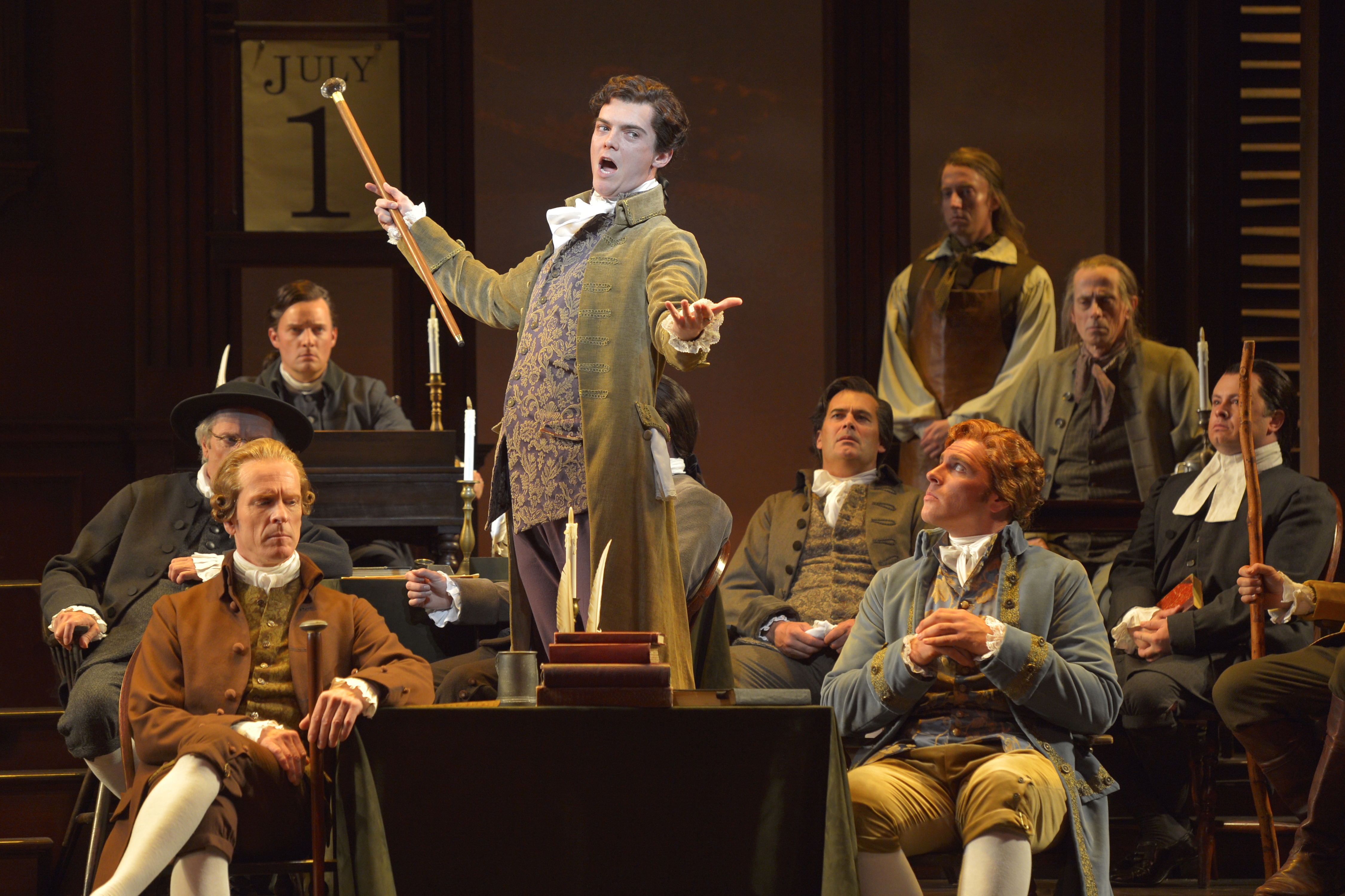
The major point of contention is whether the 13 American colonies should oppose British rule and declare their independence in this 1969 musical play that opens the American Conservatory Theater season. The main spokesman for independence is the prickly John Adams (John Hickock) of Massachusetts. His principal opponents are Edward Rutledge (Jarrod Zimmerman) of South Carolinaand John Dickinson (Jeff Parker) of Pennsylvania.

AfterDickinson insists that any vote on independence be unanimous, Adams proposes that Congress have a declaration to make its intentions clear. Adams, Benjamin Franklin (Andrew Boyer) of Pennsylvania, Thomas Jefferson (Brandon Dahlquist) of Virginiaand two others are appointed to write it. The actual writing is left  to Jefferson.

After some delays, Jefferson comes up with a document for debate. He agrees to many changes, but the big sticking point comes when Rutledge says that unless a passage opposing slavery is removed, he won’t vote for the declaration, thus scuttling it. Adams and Jefferson reluctantly agree, and the Declaration of Independence is eventually approved and signed by delegates from each colony.

Even though anyone who has studied American history knows how the story turns out, composer-lyricist Sherman Edwards and book writer Peter Stone imbue the show with high drama fueled by personality conflicts and story-compelling songs.

The names are straight out of American history, even legend, but director Frank Galati and his cast of 24 men and two women create flesh-and-blood characters with all the complexities that go into real people. Hence, “1776” isn’t just some routine history lesson. It’s an insightful look at how our system of government began to evolve.

While some characters take on larger roles and do well, everyone in the topnotch ensemble cast has at least a moment in the musical or dramatic spotlight. Led by musical director Michael Rice from the keyboard, the individual and ensemble singing is excellent, as is the 10-member orchestra.

Costumes by Mara Blumenfeld, set by Russell Metheny, lighting by Paul Miller and sound by Kevin Kennedy lend an air of authenticity. Peter Amster’s choreography enlivens several songs.

The two-act show runs about two hours and 45 minutes, but most of it speeds by because it’s so well created and executed.

It continues at ACT’s Geary Theater through Oct. 6. For tickets and information, call (415) 749-2229 or visit www.act-sf.org.


BAND FAGS! is a coming of age play at the New Conservatory Theatre Center

By Kedar K. Adour

BAND FAGS!: Comedy. Written by Frank Anthony Polito.  Directed  by Stephanie Temple.  New Conservatory Theatre Center Walker Theatre, 25 Van Ness Ave @Market, San Francisco, CA. 415-861-8972 or www.boxoffice@nctcsf.org.  

September 13 – October 13, 2013

BAND FAGS! is a coming of age play at the New Conservatory Theatre Center

Coming of age stories are almost always personal reminiscences and can be charming, bitter-sweet or dark. Since playwright Frank Anthony Polito sets the place of Band FAGS! in his home town of Hazel Park, a Detroit superb known as “Hazeltucky” one can assume it is at least semi-autobiographical. The time is October 1984 to October 1988 when he would have been a pre-teen.

His characters in this two-hander grow from age 13 to 17 and from junior high-schoolers to seniors.  It is a time when sexual hormones begin and in that four year span can rage. So it is with best friends Jack Paterno and Brad Dayton, who is black. They developed a close friendship when they became members of Varsity Band and they often need to reassure themselves that they are best friends.

Sadly the male members of the band are derogatorily called “Fags” hence the title of the play. As the 20 plus scene play progresses there is no subject off limits for the boys and director Temple allows them to excessively horse around taking the sting out of some hurtful observations. They constantly deny that they are fags but often the dialog suggests otherwise. Author Polito does not put forth nor explore any new observations about the hardships of growing up gay and his two characters lack distinctive qualities.

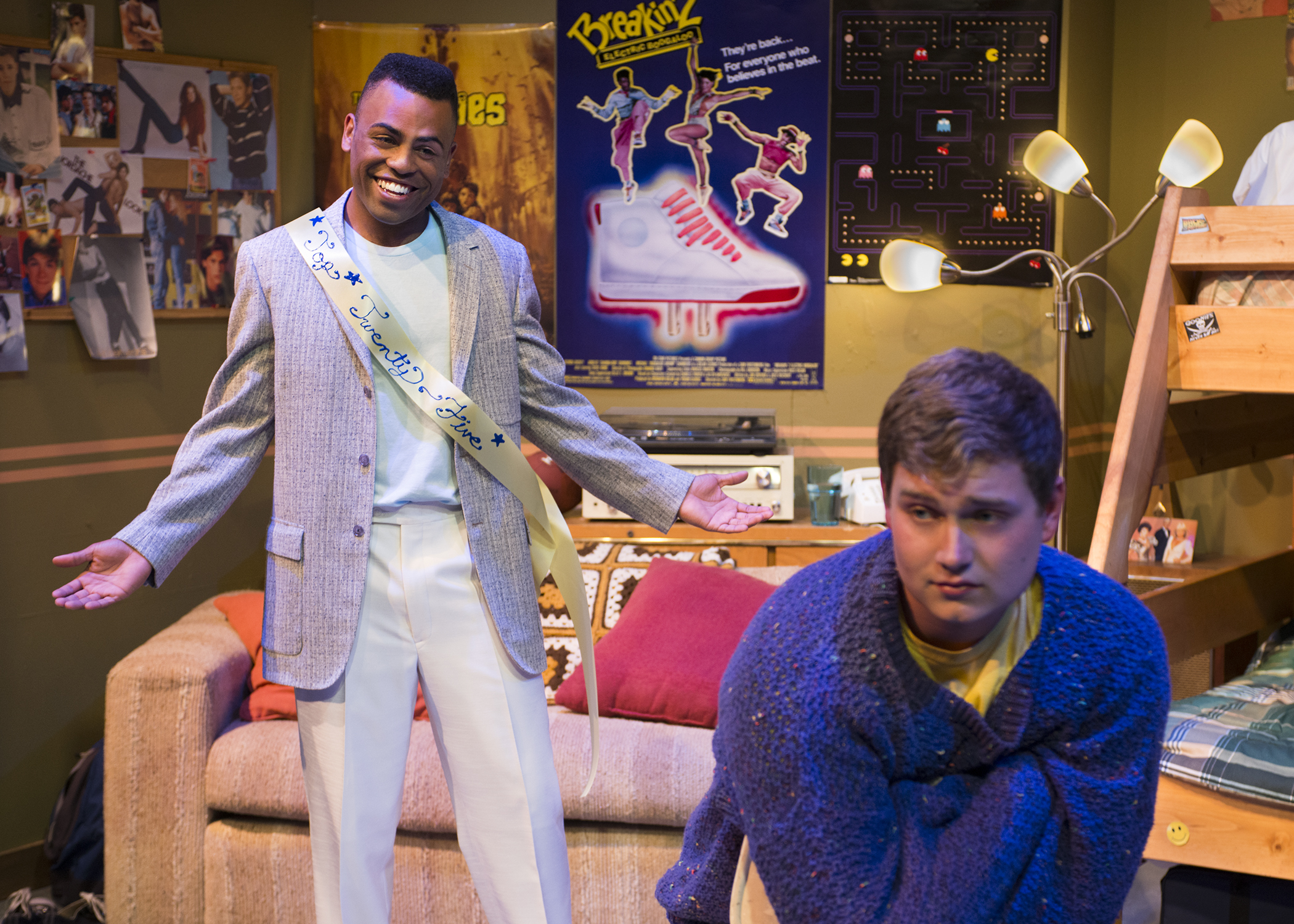
Whereas Brad is the dominant more masculine one of the two and has secretly accepted his homosexuality, it is Jack who is in denial and filled with angst. Polito has written the angst into the dialog but neither Paterno nor Dayton has sufficient acting ability to covey that angst. This is very apparent in one of the final scenes where Brad has been elected as one of the “Top 25 Personalities” in the Senior Class and Jack who has coveted that honor for years has not. As staged by Temple the poignancy is absent. Similarly, when Jack has received a valentine from Joey his heartthrob and “other friend”, Brad’s confrontation lacks depth.

(L-R)James Arthur M as Brad shows off his Top 25 award to a disappointed Jack (Blake Dorris)

Further, the multiple scenes lack fluidity and are demarcated by the boys changing a sweater, a trouser or both on stage with an occasional reference to the date such as when Brad is writing a letter he begins with “October 6”, Dear Jack.

Paterno and Dayton are to be commended for their enthusiasm and apparently never missing a line but the arduous task of aging from age 13 to 17 would stymie an Equity actor. Knowing that actors have an aversion to “line direction” director Temple who has successfully helmed other shows would have better served by doing so creating what could have been a charming, heartwarming evening.

Kedar K. Adour, MD

Courtesy of www.theatreworldinternetmagazine.com.

1776: A mesmerizing musical look at the creation of the Declaration of Independence

By Kedar K. Adour

Jarrod Zimmerman (Edward Rutledge) and the cast of the West Coast premiere of Tony Award-winning director Frank Galati’s triumphant new staging of the musical 1776, now playing at A.C.T.’s Geary Theater through October 6, 2013. Photo by Kevin Berne

1776: A Musical Play. Music and lyrics by Sherman Edwards and book Peter Stone.Directed by Frank Galati. American Conservatory Theater (A.C.T.), 415 Geary Street, San Francisco.  415.749.2228 or www.act-sf.org  September 11 – October 6, 2013.

1776: A mesmerizing musical look at the creation of the Declaration of Independence

A block-buster production of the musical play 1776 opened American Conservatory Theater’s (ACT) 2013-14 season with a superb 26 member cast bringing an entertaining yet realistic look at American history, specifically the adoption of the Declaration of Independence.  For this production ACT has imported the brilliant director Frank Galati who helmed its run at the Asolo Repertory Theatre in Florida. He has brought along seven of that cast and integrated them with local talent to create a memorable evening.

In 1969 during 1776’s out-of-town tryouts major changes were made and its 1969 Broadway run was a smashing success earning three Tony Award nominations winning as Best Musical. It starred Williams Daniels, Howard de Silva, Betty Buckley and Ken Howard and ran for 1217 performances. Similar success was attained in its London run and on the road. Although ACT’s staging is listed as a West Coast premiere; Willows Theatre mounted an excellent production in 2000.

The physical action takes place during the Second Continental Congress from May 8 and July 4, 1776 on hot and humid days in the main chamber of the Pennsylvania State house in Philadelphia. Irrepressible, obnoxious and disliked John Adams (John Hickok) of Massachusetts is spearheading a resolution to disavow English rule and seek independence for the 13 colonies. The separate factions and infighting are harbingers of what is happening in our present Congress. The inability to reach any consensus is rather ridiculously apparent when no decision could be made whether to open a window. With the lines drawn between the North and South colonies, John Dickinson of Pennsylvanian (Jeff Parker) posits a resolution that any decision must be unanimous.  It is passed.

In an attempt to break the deadlock Benjamin Franklin (Andrew Boyer) proposes that a written document (declaration) would be needed to clarify what independence means. Thomas Jefferson (Brandon Dahlquist) is maneuvered into writing it. Jefferson who misses his bride of six months Martha (Andrea Prestinario) is unable to complete the task. Franklin sends for her and after a night of delight he is able to finish the task.

When the declaration is submitted to the Congress changes are insisted upon and mostly accepted by Jefferson with the exception of the one stating slavery be abolished.  Rutledge of South Carolina (Jarrod Zimmerman) being the most vocal in a devastating song with singing “Molasses to Rum” forcefully telling the hypocrisy of the North whose ships bring in the slaves in exchange for the rum trade. Zimmerman controls the stage and received thunderous applause for his scathing satirical presentation.

Although the major characters who individually add great class to this well constructed play, it is a true ensemble performance with the minor characters adding depth to the action. John Hickok’s booming voice is commanding but he has to share accolades with the fore mentioned Jarrod Zimmerman, the avuncular Andrew Boyer, and Jeff Parker who nails the song “Cool, Cool Considerate Man” as he leads the conservatives in a dance.

The only two ladies in the show are absolutely perfect in their rolls. In the sequences between John Adams and his wife Abigail (“Yours, Yours, Yours”), Abby Mueller is a shining gem with a personality to match her flawless voice. Andrea Prestinario as Martha Jefferson in her turn in the spotlight with Hickok and Boyer is sheer delight with “He Plays the Violin.”

The most poignant moment of the evening belongs to the beautiful rendition of “Momma, Look Sharp” sung by Zach Kenny as the courier describing a mother looking for her wounded son on the battlefield.

There is a great deal of necessary humor throughout the play beginning the rousing “Sit Down John” and “Piddle, Twiddle” and continuing to a “battle of canes” between the members of congress. There might be unintentional humor injected into scene 2 when Ryan Drummond as Richard Henry Lee performs an energetic foppish song and dance “The Lees of Old Virginia” as he is off to get a proclamation approving independence from the Governor of Virginia.

Frank Galati’s direction is brilliant utilizing every member of the cast bringing them forward to the step-down apron that covers the hidden ten piece orchestra directed by Michael Rice and back into the framework of Russell Metheny’s set. Add to this are the fantastic costumes created by Mara Blumenfeld.

All in all it is an unforgettable stirring history lesson with a running time of 2 hours and 30 minutes including the 15 minute intermission.

Kedar K. Adour, MD

Courtesy of www.theatreworldinternetmagazine.com


BURIED CHILD rivets the audience to their seats

By Kedar K. Adour


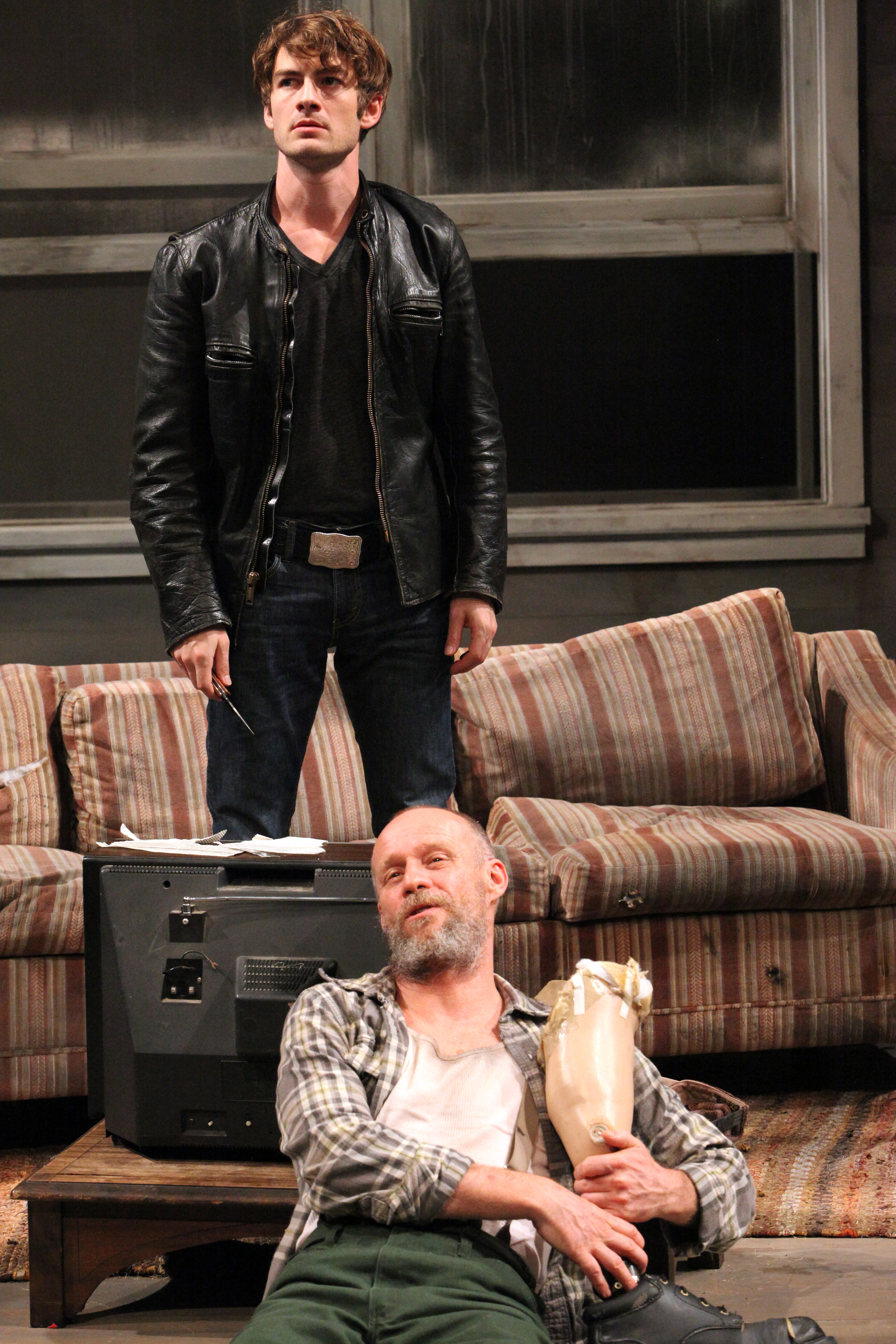
Vince (Patrick Alparone, standing) comes to terms with his family legacy with his grandfather Dodge (Rod Gnapp) in Sam Shepard’s Buried Child at Magic Theatre through October 6. Photo: Jennifer Reiley

EXTENED THROUGH OCTOBER 19, 2013 

Buried Child by Sam Shepard. Directed by Loretta Greco. Magic Theatre, Fort Mason Center, 2 Marina Boulevard, Building D, 3rd Floor, San Francisco, 93123.  415-441-8822 OR or www.magictheatre.org.   September 11 – October 6, 2013

BURIED CHILD rivets the audience to their seats

Opening night audiences at the Magic Theatre are very loyal and appreciative often times giving spontaneous standing ovations to a great or near great performance. Last night at the return of Buried Child to the Magic stage the applause was thunderous but nary a person standing.  The entire evening was mesmerizing thus riveting the audience to their seats.

To inaugurate their 47th season the Magic has reached back into its archive for a revival of Sam Shepard’s Buried Child that he wrote when he was play-wright-in- residence in 1978. During the 12 years in that position the Magic also produced his True West (1980) and Fools for Love (1983). When Buried Child moved to New York in 1979 it won the Pulitzer Prize and Sam Shepard became a theatrical personage to reckon with. In the year 2000 he received a  performance by the Magic of a new play, The Late Henry Moss with an all-star cast, including Sean Penn, Nick Nolte, Woody Harrelson and Cheech Marin at the Theatre on the Square in downtown San Francisco.

Shepard revised the Buried Child script for the Steppenwolf Company for their 1995 Broadway production. Using that script  The Magic have gathered a superb cast, used every inch of the three sided stage with a fantastic set (Andrew Boyce) and as helmed by director Lorreta Greco it is an evening not to be missed. Even with all those accolades the entire play defies description and might be called abstruse realism. It certainly is a family play involving three generations living in an unnamed rural mid-west locale.

It is a thoroughly dysfunctional family with a deep dark secret tearing them apart and at the same time binding them together for emotional and culpable reasons. It begins with Dodge (Rod Gnapp) the alcoholic and dying septuagenarian patriarch sitting on an exceedingly worn sofa watching an ancient TV without sound with a light flickering on his face. He is having an extended conversation with his younger wife Halie (Denise Balthrop Cassidy) off-stage at the top of a two story staircase that is symbolic of the emotional as well as physical distance between them.

Tilden (James Wagner), a compellingly mentally crippled son has returned to the homestead under devious unexplained circumstances and is charged by Halie to look after his father. At the same time Dodge is charged with keeping him from going outside. Yet strangely Tilden harvests corn and carrots from the fields that have been barren for 12 years.

An eldest son Bradley (Patrick Kelly Jones) has lost a leg in a chain saw accident and has become maniacal terrorizing Doge and Tilden.   There is reference to a younger deceased son Ansel who was Halie’s favorite and she fantasizes about erecting a bronze statue to his memory enlisting her paramour Father Dewis (Lawrence Radecker)to the effort. All the boys were athletic with competitive jealousy that carries over into their adult life.

Into this mélange enters Tilden’s young son Vince (Patrick Alparone) who has been away for six years and has returned to relive the past. When he is not recognized by the family he quickly learns Thomas Wolff’s truism you can’t go home again. Sanity is introduced by Kevin’s girlfriend Shelly (Elaina Garrity) whose inquisitive personality and understanding nature pries the naked truth from Dodge that leads to a gut wrenching final scene leaving the audience stunned.

With the exception of the rightfully underwritten part of Father Dewis, Shepard has created fully rounded realistic characters while placing them in a mystical family conclave. Rod Gnapp, who never leaves the stage, gives a tremendous performance combining pathos with humor yet blending into the ensemble. James Wagner uses spare full body movements and facial expressions capturing the mental retardation of Tilden. Patrick Kelly James’ realistic anger permeates the stage. Patrick Alparone and Elaina Garrity dominate the second act almost upstaging Rod Gnapp who has a brilliant denouement speech. It seems that Shepard has given short shrift  Halie and Densie Balthrop Cassidy’s performance defies accolades although her off-stage dialog with Rod Gnapp is beautifully timed.

You have the facts but it is neither hardly a full discussion of Shepard’s motivations nor the technical structure of this particular or subsequent plays.  Questions will remain when you leave the theater after seeing this performance. Running time 2 hours and 10 minutes including the intermission.

Kedar K. Adour, MD

Courtesy of www.theatreworldinternetmagazine.com


‘Revolution’ asks whether right and wrong can flip-flop

By Woody Weingarten

Woody’s rating:3.5 (3.5/5 stars)

How many American Marxists can dance on the head of the pin?

Emma (Jessica Bates) learns the truth about her blacklisted grandfather from Ben (Rolf Saxon, seated) as Leo looks on (Victor Talmadge) in “After the Revolution.” Photo: David Allen.

“After the Revolution,” the Aurora’s Theatre’s cerebral immersion in the ethical struggles of three generations of a left-leaning family, doesn’t answer my cheeky question.But it does deal with other Big Issues.

Such as whether the Machiavellian aphorism that the end justifies the means has validity, if right and wrong are written in concrete, and how yesterday’s actions impact today’s decisions.

Along the way, the dramedy makes sure to swipe at the Red-baiting, witch-hunting tactics of Sen. Joseph McCarthy.

Watching the show is like gazing into a retroscope — and then deconstructing what you think you’ve seen. Not that far removed from a multi-pronged Talmudic discussion about the essence of truth.

In effect, it’s a history lesson wrapped in secrets and lies.It helps if you’re familiar with Julius and Ethel Rosenberg, with the Verona Project (that led to decryptions that in turn revealed data about U.S. spies), and with initial Jewish hopes and subsequent disenchantment with Josef Stalin.

But if you’re not, the program guide will give you an abridged crash course.

Playwright Amy Herzog and director Joy Carlin, an actor and theatrical teacher who has an unforgettable scene opposite Cate Blanchett in Woody Allen’s “Blue Jasmine,” do their utmost to sketch a living portrait of a family ruptured by an old secret.It’s a serious look in the rearview mirror.

But they also extract the max from two roles that lend themselves to laugh-lines.

That of Vera, the rickety but still feisty widow of Joe, the Joseph family’s blacklisted hero, and Jess, the drugged-out sister of Emma, an overachiever who just graduated from law school and is determined to spread the clan’s social-justice messages.

Vera becomes a carry-over character in Herzog’s subsequent play, “4000 Miles,” a comic drama that shows the playwright’s evolution as an artist and that has infinitely more charm and tenderness than “Revolution.”When I reviewed the American Conservatory Theatre’s “Miles” production in January, I wrote that Herzog leaned on the six months she’d lived in Manhattan with her 96-year-old grandmother, the natural resource for the Vera persona.

Here she’s immensely likable.

But Em, the focus of the play portrayed by Jessica Bates, is not. She’s robotic, humorless and abrasive.An intellectual, cold fish.

The story takes place in 1999, when Em wants to use the foundation that bears the name of her grandfather to free accused Black Panther cop-slayer Mumia Abu-Jamal.

We learn early on, however, that Joe wasn’t quite so innocent: He’d given the Russians classified material. We also discover that Emma’s dad withheld that information from her. So Emma suddenly must deal with both father and grandfather having clay feet.

“After the Revolution” has numerous positive attributes.

Ellen Ratner is the top one. She steals the show many-faceted Vera, the cranky die-hard lefty with a big heart.

Rolf Saxon is also outstanding, as Ben, a history instructor who gets off on rubbing people the wrong way (even at parent–teacher confabs).And Sarah Mitchell depicts Jess, the sister who’s repeatedly been confined to rehab but ultimately snaps her twin bonds of agony and isolation, as concurrently weak and strong.

The dual-level set by J.B. Wilson, compact and simple (with plain wooden tables and chairs, a distinctly indistinct couch and a backdrop telephone poles and wires), allows quick scene changes.

The cast, not incidentally, frequently and artfully accomplishes those changes in the dark.

Costuming by Callie Floor, with robes and pajamas establishing a contrasting tone to commonplace daily apparel, also is highly effective.As are the frequent upswept hairstyles adopted by the protagonist, each a hint of where Emma’s head is at any given point — hopeful, depressed, angry, elated.

Herzog occasionally tries to sum up her thinking.

Notes Emma, for instance, “‘Good politics’ in my generation is different from ‘good politics’ in your generation.” And Peter Kybart, playing Morty, an elder who wants to leave his estate to the foundation, refers nostalgically to a past in which, in the East Village, you could throw a stone anywhere and hit a spy.Ben sets the mood: “Clinton is a big-business president, the poor are getting poorer, racial divides are deepening…and it’s hard to image things getting much worse.”

Because McCarthyism targeted a member of my own family, I went to “After the Revolution” with high hopes of being able to relate. I left disappointed  — because I’d wanted to be touched.

And my brain was but my heart wasn’t.

“After the Revolution” runs at the Aurora Theatre, 2081 Addison St., Berkeley, through Sept. 29. Night performances, Wednesdays through Saturdays, 8 p.m., Tuesdays and Sundays, 7 p.m.; matinees, Sundays, 2 p.m. Tickets: $16-$50. Information: (510) 843-4822 or www.auroratheatre.org.

Chapter Two–A Semi-Autobiographical Play by Neil Simon at RVP

By Flora Lynn Isaacson

Outstanding [usr=5.0 max=”5″]

 Kate Fox Marcom as Jennie Malone, Jennifer Reimer as Faye Medwick in Chapter Two at Ross Valley Players.  Photo by Robin Jackson

 Chapter Two is widely perceived to be an autobiographical revelation of Neil Simon coming to terms with the death of his first wife, followed by his love affair and subsequent marriage to Marsha Mason.  This poignant play is based around four brilliantly penned characters—George Schneider (David Shirk), a mourning writer; Jennie Malone (Kate Fox Marcom), a level headed actress; Leo Schneider (Johnny DeBernard), George’s talkative but loving brother; and Faye Medwick (Jennifer Reimer), Jennie’s utterly clueless but enchanting friend.

George has not “moved on” from the untimely death of his wife despite Leo’s best efforts to fix him up with other women.  Then he meets Jennie who’s just walked out of a terrible marriage to a football player, and in a very short span of time, they’re in love and get married.  But George’s memories catch up with him, and he soon finds himself trapped between the past and present, and their relationship starts to crumble.  How does George reconcile his past and move forward with Jennie—a sentimental woman with a strong head on her shoulders?  Do they give up or can they work things out?

Although it seems like a heavy subject to deal with, Simon’s wonderful narrative and witty dialog makes Chapter Two an immensely likeable play.  In George and Jennie, Simon shows both complexity and simplicity.  In Leo and Faye, Simon presents two confused, yet adorable characters.

The play is sensitively directed by James Nelson (who combines Simon’s frequent phone call dialog in order to show the parallel nature of Chapter Two) He creates an invisible line through the middle of the stage, so each character only exists in half of their former world.   When the two come together, they form one “whole.”  Nelson also added, in several occurrences of what he calls “moments alone”—short transitioning scenes where we simply get a glimpse of the two main characters alone in their own space. The time and place is winter/spring 1977, in the New York apartments of George and Jennie.  This remarkable set design is by Eugene deChristopher.

David Shirk and Kate Fox Marcom work well together digging deep for the panorama of emotions that Simon intended.  Jennifer Reimer milks the audience for laughs in a fun, supporting role.  Johnny DeBernard is perfectly cast as George’s brother Leo.

Be sure not to miss Chapter Two, the opening play of Ross Valley Players’ 2013/2014 season. Chapter Two runs September 13-October 13, 2013. Performances are Thursday at 7:30 p.m.; Friday-Saturday at 8 p.m. and Sunday at 2 p.m. at the Barn Theatre, home of the Ross Valley Players—30 Sir Francis Drake Blvd., Ross, CA.  To order tickets, call 415-456-9555, ext. 1 or visit www.rossvalleyplayers.com.

Coming up next at Ross Valley Players will be their RAW Festival of four plays with “Unintended Consequences” from October 18-27, 2013. This will be followed by Harvey by Mary Chase and directed by Robert Wilson, November 15-December 15, 2013.

Flora Lynn Isaacson


NEW EMPLOYMENT IDEA FOR WOMEN OF A CERTAIN AGE

By Uncategorized

Sugar Grannies?

Older women are like French bread.
The crust is tough, but soft in the middle.
Lynn Ruth

Teaching is such a poorly paid profession that many young educators have joined a dating website called Sugar Babies.  This is a service that pairs young women with older men for “companionship.”  They charge an average of $3000 a visit. Personally, having gone out with several very old men myself, I think they are giving themselves away.  Do they realize what they are getting into?  Once they discover that chronic erectile dysfunction, loss of memory and incontinence are but the tip of the iceberg, they will realize that the current fee is cheap at the price.

It seems to me that there is a neglected market here.  Why can’t older women do the same in reverse?  I am all for creating a website for Sugar Grannies to offer their services to younger men.  The benefits are so obvious.  There isn’t a young man in the world who can figure out how to romance a partner properly on his own.  The only person who can teach him these days is his father….and you know how unlikely it is that a daddy has any technique.  The older a man is, the more his strategy was get ‘em drunk, give ‘em a roofie or pay for a quickie. By the time he is settled and locked into a relationship, he thinks the best way to get laid is to remember to take out the trash.

The truth is that every young Lothario needs an impartial coach, and what safer, better teacher than a woman of a certain age?  Think of the advantages: no worries about becoming an unexpected father; no inconvenient time of the month; no problem if she gets possessive…she’ll kick off in a year or two anyway.

Every woman knows that young men in their twenties make marvelous raw material for women like me.  Think of it!  A dowager can teach him patience; she can show him what foreplay really means; she can encourage him when he is done before she has begun.  Sadly by the time men hit thirty, they are no longer good candidates. They get locked into nasty habits like never bathing, smoking too much pot and wanking in the shower)

I believe a service like this could well become a necessary prerequisite for a relationship of any kind. Every woman should insist that her partner-to-be enroll in a 6-month training period with an older woman to learn the ropes of a romantic communication and mutual satisfaction.  A course like this is far more important than a prenuptial agreement.  The truth is, if you get a young man trained soon enough, you won’t need a pre-nupt agreement.  He will be properly housebroken and ready to love.  In short, with proper discipline and good reinforcement, an older woman can transform any little devil into a keeper.

And let’s not forget the advantages to the national economy.  Women over 70 will no longer need government assistance.  After all, $3000 a night can buy a lot of oatmeal and the AARP takes care of the rest.


Mephistopheles — San Francisco Opera Performance Review

By Joe Cillo

Mephistopheles

San Francisco Opera Performance

September 14, 2013


The title of this opera is Mephistopheles.  Mephistopheles is supposed to be the Devil.   But this is not about Mephistopheles or the nature of evil.   Mephistopheles becomes little more than a tour guide in this opera.  It seems to be about Faust more than it is about anything, the aging scholar who trades his soul to the Devil.  But it is not clear what he traded it for or what either of them got in the bargain.  This opera is a series of disconnected, incomplete vignettes that do not form a coherent narrative or portray any characters with clarity, or depth.     

It is a mediocre work by a mediocre mind.  I don’t understand why they even staged this.   The person who wrote this, Arrigo Bioto, does not understand evil.  This opera reflects a typical religious ascetic mentality that associates evil with the body, sex, and especially women, who are the inspirers and the objects of lust.  It is a celebration of conservatism, pessimism, asceticism, and archaic religious nonsense.   This man is not a deep thinker, not insightful, has no interesting ideas or perspective, and no psychological sophistication.  I have an extremely low opinion of him as an intellect. 

I wouldn’t say a word against the performance, however.  The imaginative staging, the singers, the chorus, the dancers, the costumes, the lighting and sets, create a brilliant spectacle that saves this lumbering monstrosity from becoming a total quagmire.  Unfortunately, all of this splendid display is in the service of an insipid concept.  If you can just sit there and watch it for its visual brilliance, without thinking too much about what it means or asking yourself what it is all about, you might like it.  The nudity, the strip tease, the simulated sex, the dangling penises, are all interesting to watch.  If you don’t get much chance to see naked human bodies you might be titillated, but this lurid sensuality does not save the story line, and it is done with a lightheartedness that underlines the shallowness of the whole performance.  It is cartoonish.  These are caricatures rather than characters.  It is not interesting, and it becomes increasingly ridiculous and repulsive as it goes along. 

The ending is extremely confusing and idiotic.  Faust, after making a bargain to sell his soul to the Devil, ends up going to heaven.  Margherita, his lover, whose mother he poisons and whose child is drowned in the ocean is executed (ascetics always blame women for sexual misadventures and punish them severely).   Mephistopheles is just a footnote to all of this.  He is a kind of master of ceremonies, but is never a principal in the action. 

The nature of evil could be an interesting subject and the Devil could be a fascinating character for dramatic portrayal.   This opera does not do justice to either of these topics.  Someone should write a different opera on this subject.  This one should fall into deserved oblivion.  It is quite long and slow moving.  There are two long intermissions.  There is not enough substance to make it worth sitting through.  This art form needs an upgrade.    

AROUSAL and THE LOVER

By Joe Cillo

AROUSAL and THE LOVER

Reviewed by Jeffrey R Smith of the San Francisco Bay Area Theatre Critics Circle

What? Bohemians living in Alameda? And, Thespians? Right here in River City?

Alameda’s own Laura Lundy-Paine is currently starring in a double-header at the Phoenix Theatre on Mason Street in San Francisco.

MS Lundy-Paine, a first class actress, has formally studied acting at Pomona College and has classically trained at the Royal Academy of Dramatic Art in London.

She has graced west coast stages from the Portland Shakespeare Festival, to the Oregon Stage Company, Stinson Shakespeare and our own Rhythmix Cultural Works.

Presently at the Phoenix, the accomplished MS Lundy-Paine shares the Klieg Lights with John Steen; they open with George Pfirrmann’s AROUSAL followed by Harold Pinter’s THE LOVER.

In AROUSAL MS Lundy-Paine plays the sintering Albena: an exotic therapist of sorts; she is severed from her native Ukraine and for a small fee, she is willing to help Clifford, via very unconventional therapies, to overcome the isolating social handicaps associated Asperger’s Syndrome.

Albena proves that you don’t have be handicapped, to have a handicap; a turbulent history in a ruthless, lawless, post-Soviet wasteland and a family swine circus is more than sufficient.

At the end of her rope—okay extension cord—Albena finds that a human connection, rather than on-line Scrabble, might provide her a reason to go on living.

In THE LOVER, Lundy-Paine ratchets up her intensity, nearly setting off the smoke alarm with sangfroid sensuality.

She plays Sarah: a married woman trying to infuse a ten-year marriage with the brio, élan and endocrinal rush that it had back in the early days.

Sarah and Richard, mired in the doldrums of middleclass suburban London, fantasize the way most people do, only they share their fantasies to spool up marital intimacies and save on their heating bills.

This is high-intensity theatre in an intimate setting; no one is more than three rows from the end of the stage; you can almost smell Albena’s rot-gut vodka and cheap perfume.

MS Lundy-Paine is a resident member of the award winning Virago Theatre; the company includes Robert Lundy-Paine and Eileen Meredith, also from Alameda.

For a tantalizing and provocative evening visit www.ViragoTheatre.ORG.

The Phoenix Theater is on the 6th floor of 414 Mason Street in San Francisc

Random Acts of Love a “should see” at SF Fringe Festival

By Kedar K. Adour

RANDOM ACTS of LOVE: 3 Dark Comedies by Lee Brady. Directed by Scott Boswell. Company Players at the SF Fringe Festival. Exit Theatre on Eddy, EXIT Stage Left, 156 Eddy Street, San Francisco. Tickets online www.sffringe.org.  

SEPT 7th@1:00, 11th@7:00, 14th@7:30, 15th@4:00
Random Acts of Love a “should see” at SF Fringe Festival
Getting a play or performance piece into the 22nd San Francisco Fringe Festival is completely the luck of the draw. The submissions are not scrutinized in any manner and the result is a mélange, thus selection of what to see is daunting. Luckily for this years audiences local auteur (playwright, songwriter, actor and director) Lee Brady has had her submission Random Acts of Love selected.
Brady’s virtues as a playwright and songwriter are  on display and her selection of a director and actors are equally virtuous. These selections are essential since most of the productions use  minimal props on black box bare bone stages. Director Boswell is a film maker by trade and is adept at keeping a tight rein on the actors and the acting.
The total evening is only 50 minutes long but are diverse and tied together by failings of love. The curtain raiser, Sunday Lovers,  is without plot but a series of verbal vignettes with the five male actors sitting on high stools sharing their thoughts with the audience without reference to each other. Brady’s use of dialog allows each to be distinctive even as they inter cut each other. Boswell adroitly  keeps a sharp tempo and at the same time allows the audience to form a complete picture of the tribulations of each character. It is a bittersweet experience and true ensemble acting by Nathan Brown, Paul Gerrior,  George Duryea,  Austin Nation and Steve Johnson.
Next up is Too Old To Ride a musical interlude about a man and his bike sweetly performed by Tom Shaw with book in hand and an off stage piano accompaniment. San Francisco is probably the city most  populated bicycles. There is a “love affair” between the bicyclists and the city. That is not the only tie in with love. The poor performer sings that he has love problems in the mid west and hops on his bike to San Francisco. All does not go well but his love persists.
The final show is the darkest of the evening and uses violence and strong language to make its point. Although BART (Bay Area Rapid Transit) and Antioch exist in the Bay Area, Brady’s play is metaphorical with realistic touches to whet the appetite. The train will never reach Antioch , the ancient city on the Mediterranean, that was torn asunder by battles. Brady throws in the “battle” actors have auditioning for parts. But it is the love (again) of the stage that keeps the actor always striving. So it is with Actor (George Duryea) who thinks he has nailed a part. A macho man called Cowboy (Austin Nation) gets on the train with the oversexed Solange (Danielle O’Dea) and conflict arises as it usually does when there is one woman and two men.  The tension builds slowly and erupts in violence. O’Dea has choreographed the violence and one would hope the actors have medical insurance.
Random Acts of Love most probably one of the better to be “selected” for the Fringe. Try not to miss it. 

Kedar K. Adour, MD
Courtesy of  www.theatreworldinternetmagazine.com