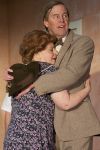
DON’T DRESS FOR DINNER a four door farce at CenterREP

By Kedar K. Adour

DON’T DRESS FOR DINNER: Sexual Farce by Marc Camoletti, adapted by Robin Hawdon and directed by Michael Butler. Center REPertory Company 1601 Civic Drive in downtown Walnut Creek. 925-943-7469, or  www.CenterREP.org. . October 29 – November 23, 2013

DON’T DRESS FOR DINNER a four door farce at CenterREP  [rating:4] (5/5 Stars)

Don’t Dress for Dinner is being pedaled as “brilliant sequel to REP’s hilarious and stylish sold-out hit, Boeing-Boeing.” Unfortunately this reviewer did not see that show or any other production so this review is strictly based on what transpired on the stage on Halloween Night. It is a classic farce with the obligatory minimum of four doors and is directed at breakneck speed with more than sufficient physical shtick to supplement the hilarious misunderstandings that build and build until even the actors may be confused about who is doing what to whom.

Amongst his many other laudable directorial attributes Michael Butler is a master at directing farce. He has taken a mediocre convoluted play, populated it with a superb cast and added directorial conceits to create a laugh filled evening.  The popularity of Don’t Dress For Dinner is attested by the fact that after a two year run in France Camoletti’s play was adapted for the English stage and had a six year run in London. The only connection to Boeing,-Boeing are the male leads Bernard (Liam Vincent) and his best friend Jack (Cassidy Brown).  

The time has shifted from 1960 to 1970 both the miscreants are still up to their nefarious ways. Bernard is married to a hot bodied Italian Gabriella (Nika Ericson) and they live in a converted chic modern French farm house (terrific set by Eric Flatmo) and he has a mistress Suzanne (Brittany Danielle).  In the original play the wife was French named Jacqueline and one can assume that director Butler could pump more energy into the play with a more volatile wife and he does.

Gabriella is about to go visit her mother. While she is away the sneaky Bernard has planned a birthday party for Suzanne. Robert has been invited to the party. A Cordon Blue chef named Suzette (Lyndsy Kail) has been hired from an agency to prepare the dinner. This will cause great confusion when both Suzanne and Suzette respond to the diminutive “Suzi.” Confusion will be compounded when Gabriella intercepts telephone call discovering that Robert is coming. She, come hell or high water, is not about to go visit dear mama because Robert is her lover.

When Suzette arrives Robert assumes she is Suzanne and in short order she is conned (for two 100 franc notes) to go along with the charade. When dumb blonde sexy Suzanne shows up, [wearing a very expensive coat that is integral to the plot] she has to pretend to be the cook but she is more of a short order cook rather than a Cordon blue chef.

There are the obligatory four doors needed before a play can be a farce. The country house is actually a converted barn with the two spare bed rooms that were formerly a cow stall and piggery. That detail gets a lot of guffaws when decisions must be made as to who will sleep with whom and where.

Cassidy Brown*, Lyndsy Kail*

Liam Vincent creates a marvelous priggish Machiavellian Bernard who gradually uses all those around him to cover up his misdeeds. Nika Ericson’s incendiary Italian has perfect control hiding her own peccadillo with consummate composure and controls the stage when it is time to play the “wronged wife.” Amongst the female roles, Lyndsy Kail is the audience favorite morphing from an ordinary girl to a seductive model, to niece actress or to whatever is needed for the cover-up earning every franc proffered by the two timing men. The audience burst into applause when she is stripped of her maid costume to play the role of mistress.  Brittany Danielle is completely believable as the not too bright sexy Suzanne.

The major accolades belong to Cassidy Brown with his mobile face, elastic body that would get him a job in Comedie del Arte, and his superb double takes.  Khary L. Moye adds a touch of class with his underplayed depiction of a possibly wronged husband and can be considered a deus ex mechina.  No further explanation will be given.

A brilliant directorial touch involves a large, low fuzzy white ottoman downstage center where Butler gives every member of the cast time to cavort.  Although he uses broad comedy just short of slapstick there is directorial sophistication and intricate timing to obtain maximum humor from the script. Running time two hours with intermission.

(From Top to Bottom)Lyndsy Kail*, Nika Ericson* Brittany Danielle*, Khary Moye,

Production Crew: Set Design by Erik Flatmo, Lighting Design by Ray Oppenheimer, Costume Design by Maggie Morgan, Sound Design by Matt Stines, Stage Manager Kathleen J. Parsons*

Kedar K. Adour, MD

Courtesy of www.theatreworldinternetmagazine.com

Nika Ericson*,Lyndsy Kail*, Khary Moye, Brittany Danielle*


Cassidy Brown*, Lyndsy Kail*

“Social Security” in Pacifica Spindrift’s new black box

By David Hirzel

The Spindrift Theater (the building, not the troupe) in Pacifica suffered a structural near-catastrophe in August—a major ceiling beam was about to give way, and the stage was closed.  Nothing daunted, the troupe put on their production of Noises Off on a borrowed stage, but tonight’s opening of Social Security proved they are HOME AGAIN!.

I knew this new production would be staged in the Muriel Watkins Gallery, an auxiliary room of the theater building.  I know this room, I thought.  How are they going to pull this off?

The answer is, with an unmitigated, unqualified, HUGE SUCCESS!  To start with, the unsung backstage hands transformed this smallish room into an intimate and beautifully designed black box.  It seats about 30—reserve early, Andrew Bergman’s wildly funny Social Security is sure to be a hit. Spindrift has  added two shows to their normal season, but this probably won’t be enough the sellout crowds expected for this wonderfully hilarious performance.

The intimate black-box setting brings each of us right into the apartment living room of NY art dealers David and Barbara (real-life husband-and-wife Gary and Joanie Pugh Newman), just as Barbara’s uptight sister Trudy (Joy Eaton) and her nerdy husband Martin (Harry Sellenthin) come to call with some bad news.  This first act taken on its own is hilarious.  Keep an eye on Trudy—to me this character is the heart of the show, and Ms. Eaton’s subtle performance makes everything else in the play work.

And work it does. There are many, many laughs in this show, and they only gather strength as it moves along.  One of the unintended consequences of this newly created black box is the contagion of laughter.  We are all in the living room with these souls and their problems and reactions become our own as only such an intimate setting can permit.

If you thought the first act was funny, wait until you see the second. Now Jackie Blue as mother and mother-in-law Sophie starts to steal the show, even moreso when new love interest Maurice (Jim Sousa) shows up to light her fire.  You’ll just have to see it.

Act three brings home some of the sublter lessons we’re all going to have to learn about how to deal with aging, with aging parents, with the loss of our illusions and the changes that time can bring to our lives.  With a whole lot of laughs.  As it should be.

Special kudos to director John Tranchitella, for putting the whole package together, and to the crew for creating this marvelously intimate stage in the  Muriel Watkins Gallery.

Don’t miss it!  Limited engagement and seating.

Through November 24, 2013 at Spindrift Players Theater at 1050 Crespi Dr., Pacifica CA

Box Office:  650-359-8002

Website: pacificaspindriftplayers.org

Review by David Hirzel  www.davidhirzel.net

Mystery in ‘Underneath the Lintel’ goes around the world

By Judy Richter

By Judy Richter

Checking books that have been returned overnight, an unassuming Dutch librarian found an annotated travel guide that was 113 years overdue.

Curious about who had had it all that time, he set off on a quest that took him to far off places in “Underneath the Lintel” by Glen Berger. Presented by American Conservatory Theater and directed by its artistic director, Carey Perloff, this one-man, one-act, 90-minute play features David Strathairn as the character known only as the Librarian.

As the play begins in the here and now, the somewhat rumpled Librarian (costume by Jessie Amoroso) apparently is in an old theater (versatile set by Nina Ball) giving a lecture about his discoveries. One by one he reveals the bits of evidence that led him on his trail of discovery, starting in 1986.

In the book, for example, was a 1913 receipt from a London dry cleaner. Other places from around the world cropped up. Slides and projections by Alexander V. Nichols, who also designed the lighting, help to illustrate some of his points. Sound by Jake Rodriguez also enhances the production.

Along the line, he began to suspect that his elusive subject is none other than the legendary Wandering Jew. After losing his library job because he was gone so long on his travels, he’s become rootless, similar to the Wandering Jew, albeit for a different reason.

Despite the elements of mystery in this tale, it tends to drag. Perhaps it needs cutting. Perhaps Strathairn needs to add depth to his performance or be directed to pace it differently.

The end result is a moderately interesting evening of theater.

“Underneath the Lintel” has been extended through Nov. 23 at ACT’s Geary Theater, 415 Geary St., San Francisco. For tickets and information, call (415) 749-2228 or visit www.act-sf.org..

THE PIANIST OF WILLESDEN LANE earns a standing ovation at Berkeley Rep

By Kedar K. Adour

In her one-woman show The Pianist of Willesden Lane, piano virtuoso Mona Golabek chronicles her mother’s escape from the Holocaust. Photo courtesy of mellopix.com

THE PIANIST OF WILLESDEN LANE: Solo Performance.  Based on the book “The Children of Willesden Lane” by Mona Golabek and Lee Cohen. Directed and adapted by Hershey Felder. Berkeley Repertory Theatre, Thrust Theatre, 2015 Addison Street @ Shattuck, Berkeley, CA 94704. (510) 647-2949 or  www.berkeleyrep.org. EXTENDED THROUGH January 5, 2014

THE PIANIST OF WILLESDEN LANE earns a standing ovation at Berkeley Rep

 [rating:5] (5/5 stars)

Just four months ago Berkeley Rep mounted a highly successful and critically acclaimed solo performance of George Gershwin Alone written and performed by the author who has set his sights on demonstrating that music can and does sooth the savage beast. This time around he has directed and adapted a true story based on the book The Children of Willesden Lane by Mona Golabek & Lee Cohn proving “music has the power to help us survive.”

 The primary survivor in the book is 14 year old Lisa Jura a fledging pianist studying with a master teacher in 1938 Vienna. When the Nazis issued laws preventing her teacher from giving Jews lessons her dreams of a concert debut of Grieg’s Piano Concerto in Vienna are dashed but not crushed and her resiliency is dramatized in words, projections and stunning piano music.

Mona Golabek, an accomplished pianist is the daughter of Lisa Jura and she gives a heart wrenching performance without histrionics often allowing the piano music do the speaking. Grieg’s haunting A Minor concerto frequently weaves in and out of the narrative reminding the audience of Lisa’s heartbreak.

After the devastating crystelnach (the night of the broken glass) seats on the kindertransport train were in great demand as families were vying for passage to a safe haven in England for their children. The one ticket available to the Jura family was given to the middle daughter Lisa because of her potential as a classical pianist.

After being unable to live with a relative she was assigned to a beautiful county estate called Peacock Manor where she was assigned household chores. When she was denied the privilege of playing the piano and told that the piano was for show and not to be played, she returned alone to London alone and assigned to the house on Willesden Lane packed with children. A piano became her salvation and that of the adults as well as the children.

During the Blitzkrieg the museums were stripped of their art and the famous pianist Myra Hess convinced the authorities to allow her and fellow musicians to use the museums as concert halls. Every week a single masterpiece painting was hung in the hall. The music continued even during the Blitz.

Lisa’s talent was recognized and she was given an audition for a scholarship to the Royal Academy of Music. Golabek gives a charming description of that audition both in words and brief cords of classical music with snippets from Bach, Beethoven and Chopin.

Mona Golabek is a master at the piano both in interpretation and body language. All the interludes are played without sheet music and include Beethoven, Debussy, Chopin, Grieg, Bach Rachmaninoff and Gershwin.

Mona Golabek as Lisa Jura

Her brilliant piano interludes and quiet dialog are enriched with slide and video projections on four gilt edged frames hung above the lone piano elevated on center stage.  Lisa Jura’s resiliency, bravery and the power of music played dazzlingly by her daughter Mona Golabek is an evening not to be missed.  Just when you thought the show was over and applause erupted from the appreciative audience, many with tears in their eyes, Lisa Jura returned to the stage to give her much delayed concert debut with Grieg’s Piano Concerto in A Minor, opus 18; third movement.

Running time an unforgettable 90 minutes without intermission.

Kedar K. Adour, MD

Courtesy of www.theatreworldinternetmagazine.com


UNDERNEATH THE LINTEL an intellectual bemusement at A.C.T.

By Kedar K. Adour

UNDERNEATH THE LINTEL: Solo Drama by Glen Berger. Performed by David Strathairn. Directed by Carey Perloff.  American Conservatory Theater (ACT), 415 Geary St., San Francisco, CA. (415) 749-2228 or www.act-sf.org. October 23 – November 17, 2013.

UNDERNEATH THE LINTEL an intellectual bemusement at A.C.T. [rating:3](5/5stars)

With a title of Underneath the Lintel one might expect that a “Lintel” is a tree and we may be in for an evening of romantic endeavor or pithy philosophizing. We do get a bit of unrequited romance and some mundane philosophy before the stage lights black out, but it seems to be an afterthought in Glen Berger’s solo drama that began as a one night theatrical piece performed by the author in 1999 at the Yale Cabaret.  There have been many revisions since the first professional performances began in 2001. Since then it has been staged throughout the world with the first local production at the Live Oak Theater in Berkeley in July 2013. It received good reviews.

Those good reviews may be related to the production being mounted in a 99 seat theater with minimal props and a fine local non-equity actor (Mike Mize) giving a big performance to a small intellectual bemusement. However, as often happens at A.C.T, one of the premiere acting companies in the nation, there has been a propensity to over-produce a less worthy script. So it is again with Under the Lintel pretentiously subtitled An Impressive Presentation of Lovely Evidences.

Director Carey Peroff has wisely selected award winning/nominated David Strathairn to play the of an obscure, introverted yet obsessive librarian to deliver Glen Berger’s well researched, sometimes obtuse and other times imaginative lines. However, the play is not the thing but Strathairn’s acting carries the evening as he rambles around on Nina Ball’s cluttered set.

That set is integral to the story. Strathairn, playing the unnamed Dutch librarian, has rented a second-rate music hall theatre to deliver a lecture to a small audience about his “evidences” proving a certain biblical myth is an actuality.  On stage right there is a large chalk board that is used to aid in listing “his evidences” that he produces one by one, appropriately tagged and numbered, from his non-descript suitcase. That suitcase has been with him on a world-wide quest as he finds “evidences” that have convinced him that the myth of the Wandering Jew is reality. To illustrate his “evidences’ he also uses a slide projector and a tape player.

Although the story of the Wandering Jew has numerous variations, depending on the country or the era in which it is told, Berger elected to use the storyline of a Jewish shoemaker whose shop was along the route Jesus was forced to take to the site of His crucifixion. The shoemaker while standing “underneath the lintel” (the supporting beam of his window) refused to offer Jesus assistance when He collapsed on the doorstep. Jesus was said to say, “I will see you again when I return.” That return is the second coming of Christ and is yet to happen and the Jew is forced to live in perpetuity and never resting.

The Librarian’s quest began with his fascination and obsession with the late return of a dog-eared Baedeker’s Travel Guide. That book is 113 YEARS late and there are notations in the margins as well as a claim check for cleaning a pair of trousers. The cleaning establishment is still operating in London no less. Our intrepid Librarian heads off to London. Thus the journey begins. With each “evidence” uncovered another is found, has been duly numbered and presented to the audience as proof of his theorem. 

His has been fired from his job (without a pension) and is now free to roam. One wonders where he got the money for travel but remembering this is a mythical tale . . . maybe, we must suspend disbelief.  He travels, in order of his “evidences’ from: 1. Hoofddorp, Netherlands,  2. London, England, 3. Bonn, Germany, 4. Derby, England, 5. Dingtao, China, 6. New York City, New York, 7. Brisbane, Australia, 8. Acropolis, Greece, 9. Paris, France, 10. The coast of Norway, 11. Juneau, Alaska, 2.Uxmal, Mexico, 13.Stamford, Connecticut, 14. Easter Island.

David Strathairn as The Librarian showing the map of his travels

His journey is liberally illustrated with his slides and Perloff moves him about in a hectic manner probably conveying his restlessness. Near the end of his lecture, the librarian frantically shows photos of inscriptions “I was here” to prove his points and even invokes the memory of the ubiquitous “Kilroy was here!” Yes there is humor but the stretches between laughs are a bit tedious.  Running time 90 minutes without intermission.

Creative Team: Nina Ball (scenic design), Jessie Amoroso (costume design), Alexander V. Nichols (lighting design), and Jake Rodriguez (sound design).

Kedar K. Adour, MD

Courtesy of www.theatreworlditernetmagazine.com

Opposites attract in ‘Next Fall’

By Judy Richter

Despite some significant obstacles, two gay men fall in love and manage to stay together for some five years before a crisis intervenes.

In Geoffrey Nauffts’ “Next Fall,” presented by San Jose Repertory Theatre, one obstacle is that the 40ish Adam (Danny Scheie) is about 20 years older than Luke (Adam Shonkwiler). A greater obstacle is that Adam is a nonbeliever while Luke is a fundamentalist Christian. The age difference results mainly in lighthearted teasing, but the religious difference is tougher.

And there’s one more problem: Luke hasn’t come out to his divorced parents. Therefore, when Luke is hit by a taxi and hospitalized, they can’t understand why Adam is so insistent on seeing Luke.

It may be that Luke’s fundamentalist, bigoted father, Butch (James Carpenter), could have an inkling that Luke is gay, but he won’t acknowledge it, not even to himself. Having been a free spirit in her younger days, Luke’s mother, Arlene (Rachel Harker), probably would be more accepting if she knew.

The action shifts between the present in the hospital and the past, starting with the night that Luke and Adam met and continuing at various times in their relationship. One constant in their lives is Holly, a straight friend who owns the candle shop where they have worked. As portrayed by Lindsey Gates, Holly is funny, supportive and straightforward, a kind of rock for them.

The play’s sixth character is Brandon (Ryan Tasker), Luke’s Christian friend who’s even less accepting of his own homosexuality.

Director Kirsten Brandt guides the talented cast with a sensitive hand, allowing the humor to come through and stressing poignancy rather than pathos. Playing Adam, Scheie, a veteran Bay Area actor who often plays over-the-top characters, shows deeper emotions here while allowing some of his comedic skills to come through.

Shonkwiler’s Luke is a fun guy most of the time, but as a believer in heaven and hell, he’s worried about Adam’s fate. He’s also worried about coming out to his father. When Butch says he’s coming toNew York from his Florida home, Luke tries to “de-gay” the apartment he shares with Adam and asks Adam to leave for a few hours. This leads to one of the play’s best scenes when Luke goes out on an errand and Butch arrives early, leading to an uncomfortable first meeting between him and Adam. Carpenter, another veteran Bay Area actor, plays well off Scheie in this scene and others.

More fine acting comes from Harker as Arlene, especially when she tells Adam about how she tried to reach out to a young Luke after being absent from most of his life.

Scenic designer Annie Smart’s set easily adapts to shifting scenes, as do Cathleen Edwards’ costumes. Lighting by Dawn Chiang and sound by Steve Schoenbeck enhance this Bay Area premiere of the Tony-nominated play.

“Next Fall” will continue at San Jose Repertory Theatre, 101 Paseo de San Antonio, San Jose, through Nov. 10. For tickets and information, call (408) 367-7255 or visit www.sanjoserep.com.

Two-legged park critters creating all sorts of things

By Woody Weingarten

Sterling Johnson blows bubbles on White House lawn.

Salvi Durango and guitar. Photo: Tim Bonnici.

Tylor Norwood (left) and Dylan Hurley check monitor on Robson-Harrington shoot.

Students concentrate at Michael Feldman’s art camp in Creek Park.


An escapee from San Quentin, an obsessive-compulsive San Anselmo writer and a tipsy five-legged giraffe strut into a bar.

There’s no joke there, no punchline.

I just wanted your attention.

I was afraid if I told you this column’s about creative two-legged critters encountered in Ross Valley parks, you might stop reading.

Please don’t.

Those folks are almost as compelling as the above trio.

Let’s try it this way: A filmmaker, a singing cowboy and a guy who plays second fiddle to his own bubbles operate fruitfully in local parks.

Why?

Because the parks, and their tranquility, spur creativity.

Tylor Norwood’s a San Anselmo resident I met in Robson-Harrington. He was directing two actors under a white canopy.

One actress exclaiming “my vagina” hooked me even before I spied the surrounding equipment.

Only later did I learn he was polishing a comedic scene for his new full-length feature. Tylor also swims in deeply creative TV waters: The BBC and HBO are commercial clients for his SkyDojo production company.

The 2007 San Francisco State film school grad subsequently informed me about the technological revolution, life on the road (“always hectic, so it’s a comfort to come back here”), and a crew in West Marin attacked by yellow jackets (causing eight adults to run “screaming into this little farmhouse to hide”).

No one fled during the re-shoot.

Sterling Johnson, 67, has been toying with bubbles since discovering them during a high-school science project. Nowadays he can be found with them in Fairfax’s Bolinas Park, near his home.

“It’s a great way to connect with people,” he said.

He’s good enough to make a living with his inventiveness, at least part-time. He’s even been asked to perform twice in Tokyo and once at the White House.

Heady stuff.

But more touching for him was the day “an autistic girl blew bubbles at a Formica-topped table I was working at and just lit up.”

Salvi Durango is a longhaired, white-bearded ex-Sleepy Hollow resident recently encountered in Bolinas Park while writing “Old Singing Cowboys Never Die.”

It’s well constructed, easy on the ears.

Salvi told me he’s been penning songs 33 years, and “playing in small bars and taverns all along the West Coast.”

He’s been name-dropping that long, too — with good reason: He’s been befriended by Willie Nelson (who backs him on a patriotic YouTube ditty, “Bankin’ on the Red, White and Blue”), Johnny Cash, Pete Seeger, Merle Haggard and Ramblin’ Jack Elliott.

He remembers chatting on a San Francisco street with John Lennon, who autographed his birth certificate, the only paper Salvi had on him.

He never sought fame but “never gave up on my dream — just singing for people, like I did for you in the park.”

Michael Feldman, who traded in ad-agency billing pads for a diminutive San Anselmo gallery, uses park benches and tables in Creek Park to facilitate his art camp students spreading their materials and smiles.

He encourages them to “explore different mediums and feel good about themselves through art, rather than copying the masters or doing what teachers demand.”

His prime hope? “That some of these kids will use art in their lives forever.”

Daniel Ezell also utilizes Creek Park’s facilities for classes — for Golden Gate Tutoring Center, which the San Anselmo resident founded with his wife, Celeste. They accentuate geometry, comic art and inventions.

“I get the greatest pleasure from instilling a curiosity in my students,” he told me.

Several weeks ago, for instance, students made an old-style diddly guitar from scratch. Result?  ”A lot of noisy music, a lot of fun.”

Michael Grossman lives in San Rafael but also has started to create music in Creek Park.

A professional classical violinist, he began writing pop songs on guitar “as a catharsis, a result of my wife dying.” He’s completed five so far, and declares he will “share my work in any way that’s share-able.”

He sees “the public park as a sanctuary right down the middle of town.”

I concur.

And the range of park creativity has inspired me to ponder where I put one word after another.

I normally create at a cluttered desk at home. Maybe I’ll venture out, park myself in a park and craft a column in the sunlight.

Play about Bill Gates enthralls, but with a big ‘but’

By Woody Weingarten

Woody’s [rating:2.5] 

Jeremy Kahn and Rinabeth Apostol are counterpoints as Bill Gates and Luz Ruiz in “First.” Photo: Kent Taylor.

“First” is a fictional glimpse into the future of today from the yesterday of 1976.

It’s an episodic feast of words and ideas — for geeks, freaks, nerds and eggheads. Or recovering or aging geeks, freaks, nerds and eggheads.For others not obsessed with computers, not so much.

Count me in the latter list.

Why? Because the 105-minute play’s excessively crammed with factoids and history and real icons of the computer and software universe that may make delicious provender for techies but overpower folks like me.

I remember having a friend in the early ‘80s who swore by The Well, a social networking site where co-owner and “First” playwright Evelyn Jean Pine first experienced this ‘n’ that.

My gal-pal constantly regaled me with stories of bulletin boards and other now-obsolete niceties — niceties I couldn’t grok (or sometimes even pronounce properly).

I remember that she’d tell me of the hours and hours she’d spent on this game or that, on locating this obscure piece of trivia or that.

And I recall endlessly discussing such nonsense like whether online should be spelled on-line or OnLine instead.

Mostly, I couldn’t get excited. Then.

But I got hooked on the software and hardware like everyone else (just as Bill Gates and his Microsoft co-founder, Paul Allen, and a handful of other technology prophets had predicted).

“First,” which was commissioned and developed by PlayGround and which will play in the tiny Theatre Werx space through Nov. 3, details the origins of the digital revolution.

With drama. And humor.Exactly how much is accurate, how much exaggerated, I can’t say.

But I can say that it’s interesting.

And entertaining.

And amusing.

And that all six actors are competent at worst, excellent at best. The latter category includes Jeremy Kahn as a 20-year-old Gates, a mono-focused, egocentric boy wonder, and Rinabeth Apostol as Luz Ruiz, ex-pot dealer waitress.

Ruiz, the only grounded character, acts as a significant counterpoint to the head-in-the-clouds, persona non grata Gates.Instead of perceiving him as a future-seeking marvel, she sees him as “the kid doing wheelies in the parking lot this morning.”

She speaks in English, he in gobbledygook.

Except for a telling moment when he seriously advises her, “People let you do anything — if you push hard enough.”

The catch-all scene is the first personal computer conference.

There, Gates, a Harvard absentee, faces Ed Roberts (David Cramer) — a real-life guy who manufactured the first commercially successful PC kit, the $397 Altair.

He faces, too, a horde of customers irate because he’s demanding they stop sharing software.

Gates reads hate mail; the throng he perceives is “robbing him blind” boos; and Roberts (“I didn’t know I was inventing the future”) futilely urges him to apologize to the crowd.

Michael French directed this world premiere, and does well for the most part.

He does stumble into opaqueness a couple of times, however — when staging a game of keep-away with a Basic code disc, for example, and when IBM marketer Kevin Panik (Tim Green) does an awkward striptease.It’s also problematic trying to define a flighty character, Georgia Potts (Brandice Marie Thompson), self-taught programmer and computer addict who’s drawn to Valentine Smith (Gregory W. Knotts), visionary-dreamer-philosopher who renamed himself for a character in a sci-fi novel, “Stranger in a Strange Land,” a title that doubles as a “First” theme.

Without the humor or the Ruiz character, this would be a mediocre portrait but plot-less play. With them, it’s notable.

The real Gates might be pleased with his visage here, but he most likely hates that his love-child company may be following the path of IBM into irrelevancy.

And he’d definitely despise that I’m writing this review on an iMac.

“First” runs at Stage Werx, 446 Valencia St., between 15th and Sparrow streets, San Francisco, through Nov. 3. Night performances, 8 p.m. Thursdays through Saturdays; matinees, 2 p.m. Sundays. Tickets: $25 to $35. Information: (415) 992-6677 or www.playground-sf.org.

A Wealth of Talent Performs Gypsy at NTC

By Uncategorized

Gypsy by Arthur Laurents (book), Jule Styne (music) and Stephen Sondheim (lyrics) is a real winner!  This Novato Theater Company production is brilliantly directed and choreographed by Blanca Florido assisted by Musical Director Andrew Klein and Producer Gary Gonser.

Gypsy is loosely based on the 1957 memoirs of Gypsy Rose Lee, the famous strip tease artist and focuses on her mother, Rose (Daniela Innocenti-Beem) whose name has become synonymous with “the ultimate show business mother.”  The play follows the dreams and efforts of Rose to raise her two daughters to perform onstage and casts an eye on the hardships of show business life.  The character Louise (Gillian Eichenberger) is based on Lee and the character of June (Julianne Thompson) are based on Lee’s sister, the actress Joan Havoc.

There are 21 talented adult actors in Gypsy as well as 9 talented children.  The real star of this great production is Daniela Innocenti-Beem, an Ethel Merman look alike as Mama Rose, who has fabulous stage presence.  She is ably supported by her two daughters Louise and Baby June.  Other outstanding performers are Ron Dailey as Pop playing three parts, Weber and Phil; Patrick Barr as Herbie, the girl’s manager and Rose’s lover; Burl Lampert in four roles including Uncle Jocko, Bougeron-Cochon and Mr. Goldstone; and Michael Lumb as Tulsa who elopes with Baby June.

Set during the vaudeville era in the early 1920’s, Gypsy is about Rose, the archetype of a stage mother, aggressive and domineering, pushing her children to perform.  While June is an extroverted, talented child star, the older girl, Louise is shy.  Rose travels the country with the two daughters and manager Herbie. While June and Louise wish their mother would settle down and marry Herbie, Rose continues to pursue dreams of stardom for her girls.  But June deserts the act and marries Tulsa and Rose tries to turn shy Louise into a star. When the act is booked into a burlesque house by mistake, Louise is forced into the spotlight and Gypsy Rose Lee is born!

This musical contains many songs that became popular including “Everything’s Coming Up Roses,” “Together (Wherever We Go),” ” Small World,” and “Let Me Entertain You.”  Gypsy has been called the greatest American musical by numerous critics and writers.

Gypsy runs October 18-November 10, 2013 at the Novato Theater Company, 5420 Nave Drive, Novato.  Curtain times are Thursday at 7:30 p.m., Friday-Saturday at 8 p.m. and Sunday at 2 p.m. For tickets, call the box office at 415-883-4498 or go online at www.novatotheatercompany.org.

Coming up next at Novato Theater Company will be “The Best Christmas Pageant Ever,” by Barbara Robinson, November 30-December 15, 2013.

Flora Lynn Isaacson


DIRTY LITTLE SHOWTUNES! is back and good as ever at NCTC.

By Kedar K. Adour

DIRTY LITTLE SHOWTUNES!: Musical Revue. Written by Tom Orr. Conceived and Directed by F. Allen Sawyer. Musical Direction by Scrumbly Koldewynn. Choreographed by Jayne Zaban. Starring (alphabetically): Rotimi Agbabiaka, David Bicha, Daryl Clark, Jesse Cortez, Tom Orr, Randy Noak. New Conservatory Theatre Center (NCTC), Decker Theatre, 25 Van Ness Ave, San Francisco, CA. 415-864-8972 or www.nctcsf.org Through November 10-2013. [rating:5]

DIRTY LITTLE SHOWTUNES! is back and good as ever at NCTC.

The spellchecker in MS Word keeps trying to correct the spelling of ‘showtunes’ to ‘show tunes.’ But it is not to be in this review of this revue since there is nothing ‘correct’ about the 16th incarnation of this hilariously energetic production that defines the basic three “Rs”. . . Racy, Ribald and Risqué. It earns the exclamation mark that is integral to the title.

The entire evening is a parody of songs from about 25 Broadway shows lasting about two hours including the 20 minute intermission. That intermission is needed to regroup your brain cells that have gone astray trying to identify which song is from which show. We reviewers received a list of the songs and the shows involved. (A little secret: There is a stack of sheets listing the songs behind the box office desk. Just ask and you shall certainly receive.)

Rotimi Agbabiaka


The marvelous Tom Orr and David Bicha are the only hold-overs from the original show and they are matched song for song and dance for dance with the naughty energetic Rotimi Agbabiaka, the willowy charming Randy Noak and the innocent (in looks only) Jesse Cortez that you will not recognize in drag.  Daryl Clark was absent from some shows and in football parlance is probably on injured reserve.

The show would not be complete without the extremely talented musical director Scrumbly Koldewynn who has aged gracefully since his Cockette days and is riot when he deserts his piano to take the stage in a simplified English Busker jacket (complete with white buttons) for the second act entr’acte patter song, “Stupid Silly Paranoid Theatric Superstitions!” (“Supercalifragilisticexpialidocious!” – Mary Poppins).

(l to r) Jesse Cortez, Tom Orr, Randy Noak, Rotimi Agbabiaka

The ensemble reminds us in an opening number “Parody Tonight” (“Comedy Tonight” – Funny Thing Happened on the way to the Forum) that probably protects them from plagiarism law suits. Consider “How Do You Solve Your Problem Gonorrhea?” (“How Do you Solve a Problem like Maria” – The Sound of Music), “Turn in Your Fag Card” (“Brush Up Your Shakespeare” – Kiss Me Kate), “Bossy Bottoms” ((“Bosom Buddies” – Mame), I Am The Very Model of A Modern Homosexual (The Pirates of Penzance) and “The Lady is a Man” (“The Lady Is A Tramp” – Pal Joey)

The list goes on and on with each member of the cast getting to strut their stuff upon the stage receiving great appreciative applause. The ensemble numbers are humorously choreographed and the drag costumes a hoot and a holler. They don’t frolic in the most stunning drag costumes until the second but in act one two “nuns” bring down the house with the naughty, naughty Maria number.

Favorite production numbers are “The Leatherman & Drag Queen Suite” (South Pacific, Guys and Dolls, Westside Story, and Oklahoma) and “Nude” (to the tune of “Mame” with  choreography stolen from The Full Monty). To answer your question “Do they do the full Monty??” you will have go see the show. Highly recommended by this reviewer and my straight-laced seating companion.

(l-r), Jesse Cortez, David Bicha, Tom Orr, Rotimi Agbabiaka, Randy Noak in the “Nude” number (The Full Monty).

Kedar K. Adour, MD

Courtesy of www.theatreworldinternetmagazine.com