
Writer’s ‘little girl’ turns 50, with touches of high drama

By Woody Weingarten


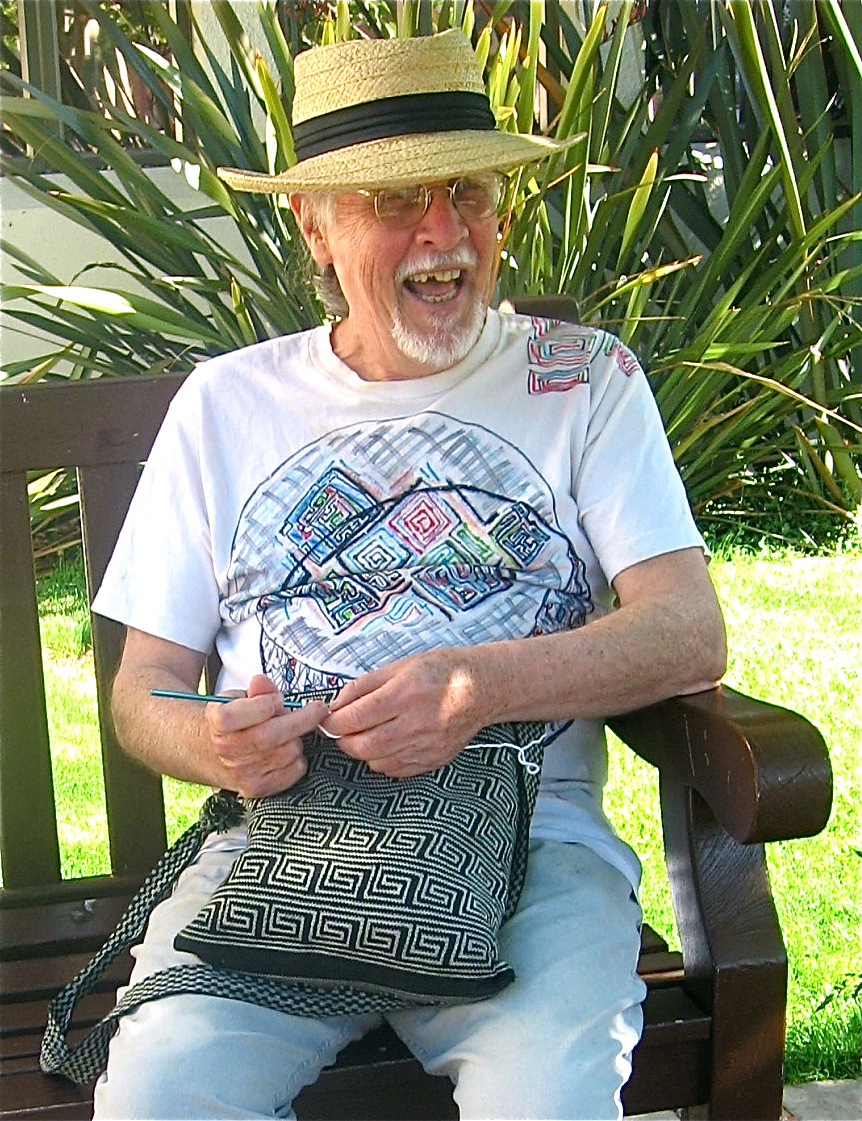
Jan Brown gleefully holds the toilet paper she’d coveted. Photo: Woody Weingarten.

I wished for an instant I was curled up in fetal position, sucking my thumb, in bed at home in San Anselmo.

Instead, I was in Yonkers, a New York City suburb, watching my wife, Nancy Fox, play a concert grand Steinway piano to a nearly empty 300-seat library auditorium following a total publicity failure by the staff.And that misadventure followed a 9-1-1 call for my daughter, Jan Brown, who’d had a diabetic meltdown in a fancy-schmancy deli.

Not quite the 50th birthday celebration for her we’d envisioned.

Toward the rear of the auditorium sat an elderly couple that reminded me of Fred and Ethel Mertz from “I Love Lucy.” My daughter, son, grandson and I scattered around the room, pretending we were part of a mob scene.

“Looks like I’m playing for my family, two new friends and 294 ghosts,” said my wife, a pro.“I was scheduled to play Oscar-winning songs,” Nancy announced, “but if any of you have requests, I’ll play them instead — after I start with the first Academy Award tune, ‘The Continental,’ which has special meeting for me: It was my parents’ song. It was playing the night they met, the same night my father proposed.”

Vigorous applause — robust considering there were only six of us — greeted her finish.

Jan asked for “Sunrise, Sunset,” a mega-sentimental tune from “Fiddler on the Roof,” and the couple followed with requests for Cole Porter songs: “Begin the Beguine” and “Let’s Do It.”

Nancy cheerfully played them — and dozens more.Six people swayed to her hour-long artistry. The ghosts? Well, I couldn’t hear their applause, but I’m positive they gave her a standing ovation, too.

My wife had planned the concert as a surprise gift, intending to dedicate it to Jan. But my disabled daughter had been so excited to see us she’d forgotten to eat breakfast — and then taken her insulin anyway.

Blood sugar tailspin!

The paramedics helped her recover just in time for me to whisk her to the auditorium.

Regrettably, a similar incident occurred days later.Jan’s top birthday wish? No diamonds. No cavier. Just toilet paper that wouldn’t stop up her apartment toilet like the brand she’d been using.

So I drove her to Costco.

But Jan’s blood sugar decided to react badly to meds she’d taken.

Nosedive No. 2!

My daughter eventually got her wish, but the purchase jerked me back to a happier moment in Guasco’s market in San Anselmo.

A day after I’d interviewed Ram Dass, he was in an aisle buying odds and ends. Nancy giggled.“What’s funny?” I asked.

“Well,” she said, pointing to the toilet paper the world-renowned thinker had stuffed under his arm, “that’s the great cosmic equalizer, isn’t it?”

We all chuckled.

Being able to give life’s pitfalls a horselaugh, I’m convinced, is the best medicine.

Heading back home, Nancy and I sailed through airport security. Putting my belt back on, however, it broke. Using one hand to pull my carry-on, the other to keep my

pants from dropping to my knees, I entered every shop that might peddle belts. None stocked anything to fit my size-43 waist.So Nancy and I laughed.

I bought one later, at the other end.

Meanwhile, I also had time to ponder a pair of anecdotes Jan had happily recalled.

“I remember listening — as child lying on a couch in your den — to the tick-tick-tick of your typewriter, and staring at the thousands of books that went up to the ceiling,” she’d said.

“And I remember having the school call home to ask where I was — I was methodically chipping away at ice because there was a dollar frozen in it.”

Her memories moved me.Being a dad can be tough in the best of times. Being the father of a disabled person can be especially difficult, particularly when she lives 2,560 air miles away.

But I don’t plan to trade her in.

Jan’s bright, sensitive and generous with her love and time and money. A caring mom and daughter.

My trip was emotionally draining, mentally draining, physically draining. But worth it. After all, she’ll always be my little girl.

Besides, I was able to bask in her smiles when I bought her some new clothes and a dresser to keep them in.As her great-grandma used to beseech God, “Let her use them in good health.”

Cirque du Soleil’s ‘Amaluna’ rocks — with estrogen

By Woody Weingarten

  Woody’s [rating:3.5]

Miranda (Iulia Mykhailova) discovers her sexuality and rubbery bones on and in “Amaluna” water bowl. Photo: Laurence Labat.

“Storm,” a segment of “Amaluna,” showcases Suren Bozyan and Karyna Konchakivska as God and Goddess of the Wind. Photo: Charles William Pelletier.

Clowns deliver laughs in an “Amaluna” childbirth scene. Photo: Laurence Labat.

The more things change, the proverb screams, the more they stay the same.

Except, maybe, when the change-maker is Cirque du Soleil.

Then it’s mostly different.

In the case of the famed circus’ latest creation, “Amaluna,” in which Tony Award-winning director Diane Paulus gender-bends Shakespeare’s “The Tempest” into a feminist panorama, I could swiftly hear the changes as well as see them.

They shook me out of my comfort zone.I’d grown contented over the years with the Cirque’s signature new-agey, otherworldly stringed melodies. But now, behind AT&T Park in San Francisco, I needed to deal with rhythmic, drum-heavy world music with vibrating overtones of electrified rock chords that, well, rocked.

High energy. Emotion-packed.

And undoubtedly aimed at a new generation of circus-goers.

But for white-haired types such as myself, the music sometimes came in three-stage waves: Loud, louder, too loud.

The show, a women-power fable that blends coming-of-age and royal-romance themes, starts and ends with a dancing scarf that resembles a lithe, floating feminine body. Those moments bookend sundry acts from a 52-member multi-racial cast that, for the first time, is more than 70 percent female — and that even includes a 100 percent estrogen-laden band.Perhaps the most memorable segment is the 15 minutes that spotlight Lara Jacobs as a Balance Goddess.

She creates an eerie but mystical skeleton-like mobile out of 13 palm leaf ribs, using her toes to grasp each delicate piece. Her increasingly labored breathing, seemingly broadcast via a body mic, adds tension to an otherwise quiet, almost meditative slo-mo sequence.

Paulus inspires “Amaluna,” a fabricated word that fuses two that signify mother and moon, with a simple switch of letters, an “a” for an “o.” She transforms the Bard’s Prospero into a female shaman, Prospera (Julie McInes).

And she shows her personal wizardry by turning a youthful Miranda (Iulia Mykhailova) into a romantic partner to Romeo (Evgeny Kurkin).

The director then showcases Mykhailova’s talent as a handstander and contortionist in and out of a bowl that weighs 5,500 pounds when filled with water — and Kurkin’s athletic ability to plunge headfirst down a pole.

Paulus utilizes, too, the superb juggling skills of Victor Kee, who portrays Cali, a half-lizard, half man who momentarily traps Romeo in the bowl.What else can be expected?Typical Cirque spectacles — imaginative and flashy costumes; dancing lights that complement dancing humans; a fast-moving assortment of Valkyries, Amazons and goddesses; and a pair of clowns who do an oblique, sometimes funny number on childbirth that even features an homage to “Brahms Lullaby.”

Most of the music, by the way, is sung in French, not the invented languages for which the circus gained renown.

Cirque du Soleil has produced 32 shows so far. I’ve seen 10 or 11 of them, and “Amaluna” is neither the best nor the worst. Many of its components, however, lingered with me long after I left its big tent.

So did the sensation of having had a melt-in-your-mind treat.And I recalled that if I weren’t particularly impressed with any given component, the chunky woman seated next to me still kept blurting out in amazement, “Oh my God, oh my God.”

The Quebec-based troupe employs a total of 1,300 artists from 50 countries. More than 100 million spectators have watched their animal-free performances in 300 cities, and a few thousand more will catch “Amaluna” in San Jose starting Jan. 22.

It’s not required to have had any familiarity with Willie the Shakes to enjoy “Amaluna,” nor is it necessary to be female to appreciate that the show represents a woman’s prospective. The only requisite is to like colorful, animal-less circus extravaganzas.

“We are such stuff as dreams are made on,” the Bard proclaimed in “The Tempest.”

“Amaluna,” for me, is crammed with dreamy stuff.

“Amaluna” plays in the big top behind AT&T Park in San Francisco through Jan. 12. Night performances, Tuesdays through Saturdays, 8 p.m.; matinees, Fridays and Saturdays, 4:30, and Sundays, 1 and 4:30. General tickets: $50 to $270. Information: (800) 450-1480 or www.cirquedusoleil.com.

Kneehigh puts old love triangle in new light

By Judy Richter

A legendary love triangle comes to vivid life in “Tristan & Yseult,” presented at Berkeley Repertory Theater by Kneehigh, a touring Cornish theatrical company.

Bay Area theatergoers may recall Kneehigh’s previous presentations of  “Brief Encounter” at American Conservatory Theater and “The Wild Bride” at Berkeley Rep, both well received.

This time joint artistic director Emma Rice has reached into Cornish legend to adapt the story of Cornwall’s King Mark (Mike Shepherd), who repels an Irish invasion and kills its leader. He then sends a French visitor, Tristan (Andrew Durand), to fetch the invader’s sister, Yseult (Patrycja Kujawkska), and bring her to Cornwall for the king to marry.

Tristan does as he’s told, but when he meets Yseult, there’s an instant, passionate connection between them. Nevertheless, they go to Cornwall, where she marries the king and comes to care for him, but Tristan is still her true love. Of course, there’s a tragic ending.

This same story inspired Richard Wagner to write “Tristan und Isolde.” In the sound design by Gregory Clarke, orchestral music from that opera highlights some of the more dramatic scenes. Snatches of  “O Fortuna” from Carl Orff’s “Carmina Burana” also are heard, along with country-western tunes. Other music is by Stu Barker.

Designer Bill Mitchell has created the versatile set, which places four musicians on a catwalk beneath a neon sign reading “The Club of the Unloved.” He also outfits the cast in modern clothing, most of it black except for the women’s dresses.

Shepherd, Kneehigh’s founder and joint artistic director, has a commanding stage presence as King Mark. Durand and Kujawkska are beguiling as the two young lovers.

Among the supporting players, Craig Johnson is noteworthy first as the Irish leader and then in the female role of Brangian, Yseult’s handmaiden. Carly Bawden plays Whitehands, who sings with the band before the first and second acts and interacts with the cast during the play itself. Giles King plays Frocin, the king’s aide who reveals Tristan and Yseult’s adultery to King Mark.

At various times, the actors play instruments to augment the musicians. Johnson, for example, plays accordion, while Kujawkska plays violin.

Rice’s direction is wildly imaginative, making for Kneehigh’s welcome return to the Bay Area.


Funny end-of-world play may prompt squirming

By Woody Weingarten

Will (Robert Parsons) introduces himself to his estranged son, Alex (Daniel Petzold), in “A Bright New Boise.” Photo by David Allen.

 Woody’s [rating:3.5]

Charles Dickens referenced the best and worst of times. Samuel D. Hunter prefers focusing on the latter — and on the “end times.”

But he’s funnier than Dickens ever was.

More disturbing, too.

“A Bright New Boise,” Hunter’s dark, edgy comedy about faith and forgiveness, made me fidget in my seat at the Aurora Theatre in Berkeley — even as I laughed aloud.

Pew Research Center studies apparently have determined that 128 million Americans believe Jesus will return by 2050 and that a small group will go to Heaven while the rest of us are left to face chaos and war.

Will, the play’s quixotic protagonist, is trying — like hell — to be one of the elite who’ll be saved in The Rapture.

But he’s having major trouble, perhaps because he thinks he “may be a bad person” with a shadowy past involving an Evangelical church and a boy’s death. His interactions with co-workers at the big-box Hobby Lobby chain store are awkward at best, excruciatingly painful more often.

Robert Parsons plays the lead role exquisitely, an in-your-face guy tormented by both this world and his inability to gain entrance to another.

In contrast, the play’s two women provide gobs of mirth.

Will’s boss, Pauline, is strident, controlling, swears like a stevedore and despises having to do conflict resolution. As inhabited by Gwen Loeb, the character is almost a perpetual laugh machine.

Anna can be hilarious, too.

She’s a timid blonde who, like Will, hides out in the Boise store to gain access to the employee break room after hours.

“I thought I was the only wacko who did this,” she says.

While he blogs his novel in an attempt “to spread God’s word,” underscoring his own fervent Christian beliefs, she constantly reads tedious books on which she wants to superimpose exciting endings.

As Anna, Megan Trout’s rubbery face consistently evokes giggles as she fumbles for words and repositions her body at unfixed points somewhere between clumsy and coyly sexy.

Rounding out the cast are Daniel Petzold as Alex, the brooding, panic-attacked son Will had given up for adoption 17 years before, and Patrick Russell as Leroy, Alex’s brother-protector who gleefully flaunts obscenities on his T-shirts.

Tom Ross, who’s directed 24 productions for Aurora, which he inauguarated with Barbara Oliver in 1992, is at the helm of “A Bright New Boise,” which won a 2011 Obie.

He makes it all work, even for those like me who aren’t one of the 128 million.

Helping Ross achieve a theatrical triumph is a comparatively spare set as well as a marvelous monitor that, when not spewing in-house commercials, goes bonkers and broadcasts grisly medical channel operations.

I found 32-year-old playwright Hunter, a native of northern Idaho who attended a fundamentalist school growing up, adept at taking unusual subject matter and non-stock characters and cobbling together a theatrical work that tugged at both my mind and heart.

His use of Hobby Lobby, a real entity, as a fundamentalist foil also captivated me.

Critics have labeled its founder, David Green, a religious zealot. The Oklahoma City-based company, whose website says it is committed to “honoring the Lord in all we do,” made headlines by initiating a court fight over providing emergency contraception in its employee health-insurance policies — and for its stance against carrying Chanukah or Passover items alongside its Christmas and Easter decorations.

Theatergoers, depending on where their heads are, may find the play’s ending shocking or predictable, anticlimactic or powerful, muddy or clear.

No matter: The gestalt should be worth the price of admission.

“A Bright New Boise” runs at the Aurora Theatre, 2081 Addison St., Berkeley, through Dec. 8. Night performances, Wednesdays through Saturdays, 8 p.m., Tuesdays and Sundays, 7 p.m.; matinees, Sundays, 2 p.m. Tickets: $16-$50. Information: (510) 843-4822 or www.auroratheatre.org.

A new twist on ‘Christmas Carol’

By Judy Richter

“Jacob Marley’s Christmas Carol” puts a different twist on “A Christmas Carol,” the 1843 holiday favorite by Charles Dickens.

Instead of the miserly Ebenezer Scrooge as the central character, playwright Tom Mula focuses on his late business partner, Jacob Marley. Marley has been dead for seven years when his ghost appears on Christmas Eve to warn Scrooge that he needs to change his ways or be eternally condemned.

The play looks at how Marley came to make that appearance and what happened to him and Scrooge thereafter.

In the production by Marin Theatre Company, four actors, often assisted by two stagehands, portray varied characters, but each has a principal character. Khris Lewin is Marley, while Nicholas Pelczar is Scrooge. Stacy Ross plays the Record Keeper, and Rami Margron is the Bogle.

Burdened by the chains of misdeeds that he forged in his life, Marley is called before the Record Keeper, who gives him a chance to redeem himself. He must somehow get the miserly Scrooge to change his ways and find the joy of Christmas.

Marley’s guide for this daunting task is the Bogle, a phantom or goblin.

Marley’s first step is to appear before Scrooge and warn him, a scene that’s similar to the one in Dickens’ tale. This doesn’t work too well, but Marley decides to go back to a time when Scrooge wasn’t so miserly.

Act 2 of this two-act play differs from Dickens’ format with the Ghosts of Christmases Past, Present and Future because Christmas Past emphasizes Marley’s youth. He and Scrooge navigate the present together, but Scrooge is on his own for the future. There’s redemption for both in the end.

To start with, Nina Ball’s bare-bones set features a metal catwalk running diagonally overhead with a ghost light on the stage. (In accord with theatrical tradition, one bare light bulb is left burning on stage when a theater is unoccupied. It’s a safety measure as well as a way to scare off any ghosts.)

Kurt Landisman’s mostly dark lighting is often augmented by the actors’ hand-held flashlights or by spotlights wielded by the actors or stagehands from the sides of the stage. Heidi Leigh Hanson’s basic costumes are the same for all: blue work shirts and jeans with suspenders. Hats and other additions allow them to change character.

Composer Chris Houston’s often chilling sound design is integral to the atmosphere.

Even though the reviewed performance was the final preview, everything went smoothly under the direction of Jon Tracy. All four versatile, actors are excellent.

Publicity for the show says it’s suitable for ages 6 and up, but it might be too scary for some of the younger set. For adults, though, it’s an intriguing look at a yuletide classic.

“Jacob Marley’s Christmas Carol” will continue at Marin Theatre Company, 397 Miller Ave., through Dec. 22. For tickets and information, call 415-388-5208 or visit www.marintheatre.org.


‘Porgy and Bess’ is funkier, brassier, easily appreciated

By Woody Weingarten

Nathaniel Stampley and Alicia Hall Moran portray the title roles in “Porgy and Bess.” Photo by Michael J. Lutch.

Kingsley Legg, in striped suit as Sportin’ Life, is featured in “Porgy and Bess.” Photo by Michael J. Lutch.


Woody’s [rating:5]

“Porgy and Bess” debuted in 1935 to mixed reviews and scattered cries of racism.

It took until 1976 for the controversial jazz-laced, four-hour folk opera to win legitimacy via a Houston staging, and until 2011 for a truncated form, “The Gershwins’ Porgy and Bess,” to become a New York smash and win a Tony.

That more easily appreciated two-act Broadway version now is embedded at the Golden Gate Theater in San Francisco through Dec. 8.

It’s a must-see for anyone who gets off on George Gershwin’s music.Or brother Ira’s lyrics.

Or re-hearing classics such as “Summertime,” “I Got Plenty of Nuttin’” and “A Woman Is a Sometime Thing.”

Or seeing the melodramatic, larger-than-life, tragic characters operas thrive on.

The difference between the 2009 version presented by the San Francisco Opera and this compressed one becomes obvious with the first notes of the overture.

This SHN offering is brassier, funkier.

It swings more.

The vivifying, I suspect, owes a thank-you to slice-‘n’-dice tactics employed by Diedre L. Murray, who adapted the music; Suzan-Lori Parks, who adjusted the book; and Diane Paulus, the director (who won a Tony for “Pippin” and also is responsible for the new Cirque du Soleil show that’s now in San Francisco).

Some still may consider “Porgy” a stereotypical portrait of impoverished blacks that dwells on drugs, knife-fights and killing.

As I watched, I mulled if a truly modernized version set in Harlem or Watts would spur the usual outsized outrage from Al Sharpton or Jessie Jackson. The fallout would be akin to the reaction when Al Jolson purportedly wanted to play Porgy in blackface.

The now-familiar storyline highlights disabled beggar Porgy (Nathaniel Stampley), who liberates Bess (Alicia Hall Moran) from a life of sex and addiction. She’s pursued, however, by her combative ex-lover Crown (Alvin Crawford) and Sportin’ Life (Kingsley Leggs), a dealer who continually tempts her with “happy dust” (cocaine).

Bess, who’s initially ridiculed as “a liquor-guzzling slut,” tries overhauling her life. It’s just not that simple in the fictitious all-black Catfish Row slum of Charleston, South Carolina, in the 1930s.

Drugs are too easy to come by; sexism is rampant.

“These gals,” says Sportin’ Life, “ain’t never gonna understand the ways of us menfolk.

The performers’ voices generally are strong — principally Alicia Hall Moran on “I Loves You, Porgy” (and throughout), Kingsley Leggs on “It Ain’t Necessarily So” and “There’s a Boat Dat’s Leavin’ Soon,” and David Hughey as Nate on “It Takes a Long Pull.”

The 23-piece orchestra behind them is buoyant, even though only three of its instrumentalists were plucked from the Broadway production.

George Gershwin had visited the James Island Gullah community that preserved its African musical traditions, and injected some of it into “Porgy.”

He also used his own interpretations of spirituals, work songs, blues, arias and recitatives — and borrowed from the liturgical music of his Jewish culture, particularly for “It Ain’t Necessarily So.”Other tunes worthy of mention are a lovely, lush duet, “Bess, You Is My Woman Now,” and a rare comedic moment via “I Hates Your Struttin’ Style.”

Both set and props enhance the atmosphere. Their minimalism allows appropriate costuming by ESosa to transport theatergoers quickly into the bigoted Southern landscape.

Often sensual, sexual choreography by Ronald K. Brown helps, too. He leans on Gullah movements but contrasts those with more traditional musical comedy modes.Flaws? Only one jumps out.

Ethnic dialect makes it tough sometimes to understand what’s being said or sung.

But that’s an infrequent, minor irritation.

More lofty criticism was aimed at the producers (who number in double digits) by composer Stephen Sondheim — for being arrogant and depreciating the original creators’ intentions.

He especially bemoaned the new production deemphasizing DuBose Heyward, who co-wrote the lyrics with Ira and created a libretto from his own novel and play, “Porgy.”

But the opening night crowd here — which, unlike the usual San Francisco audience, was layered equally with whites and blacks, straights and gays, young and old — didn’t seem to care about anything other than enjoying what was on stage.

Nor, in the long run, did I.

“The Gershwins’ Porgy and Bess: The Broadway Musical” runs at the SHN Golden Gate Theatre, 1 Taylor St. (at 6th and Market), San Francisco, through Dec. 8. Night performances Tuesdays through Saturdays, 8 p.m.; Matinees, Wednesdays, Saturdays and Sundays, 2 p.m. Tickets: $40 to $210. Information: (888) 746-1799 or shnsf.com.

Stroke survivor exemplifies courageous, upbeat attitude

By Woody Weingarten

Rita Martin, dressed in the reds and pinks she loves. Photo: Woody Weingarten.


Strokes temporarily stole Rita Martin’s speech.

But it’s back, still a bit tentative but good enough so she can be understood easily.

Her courage, on the other hand, never left.

Recovery, she tells me, is “a little, little, little progress at a time. I couldn’t talk, and then I could. I was in a wheelchair, and then I was walking.”

Rita laughs a lot, which makes it difficult for me not to adore her.

Her overall upbeat attitude makes it impossible.

“I laughed in a Tibetan hospital, and in an Indian hospital, after I’d had the strokes,” she tells me. “And when I couldn’t talk for a year and a half, I laughed.”

She labels the date of her strokes, events that occur when blood momentarily stops flowing to the brain, “stroke-iversaries” — and believes “everyone should celebrate them because they show how much you’ve done.”

I’d first met Rita in San Anselmo at a Pine Street Clinic celebration where she’d supplied healthful hors d’oeuvres.

Her professional catering efforts, there and elsewhere, are usually gluten-free, sugar-free and free, in fact, of anything she deems harmful to the body, mind or spirit.

She tells me she learned culinary arts by watching her grandmother “cook for the whole family, when I was three or four, and she’d make little kids out of challah dough and I’d put the eyes on them.”

Rita also does acupuncture.

She’s been licensed since 1986, after having apprenticed at Pine Street five years. But she hopes to expand her practice and do more acutonics, needle-less acupuncture with tuning forks.

My wife has been patronizing the clinic for 18 years, adding Chinese herbs to her Western “slash, burn and poison” treatments when first diagnosed with breast cancer.

She, too, has a positive attitude.

But she was never sure what worked — and didn’t care.

Just as Rita didn’t care how hard she’d have to work to heal.

Despite skepticism from a slew of Western docs who thought “I’d never talk and would only be able to watch TV and say yes or no after years of therapy,” Rita was certain she could get much better much quicker.

She did.

She now sits in my living room sipping green tea.

A glamorous 62-year-old, she’s clad in the flowing reds and pinks she loves, sporting oversized bracelets and silver earrings shaped like butterflies. It’s easy to picture her as a hippie in the ‘60s.

She was, of course.

She always liked helping others, even considered becoming a doctor until she realized it “wouldn’t be much fun.” So she worked in Albany, New York, for Refer Switchboard, aiding “druggies, runaways, alcoholics, people escaping abusive relationships.”

Then she helped start the Washington Park Free Medical Clinic there.

She chats now about living on and off in San Anselmo since 1979 — with some elongated trips to Taiwan, India and Tibet thrown in, literally, for good health.

Her thought processes sometimes don’t make it intact from her brain or heart to her tongue.

She doesn’t get discouraged though.

It wasn’t always that way. She “got really angry because the doctors thought I wouldn’t get better and I knew I could. Then, six months into it, I got really depressed.”

Usually, however, she’d “be stubborn and figure out how to do it, or think how I could do it differently.”

There are “very few things that I can’t do now,” she says.

She sums up her attitude this way: “Sometimes I feel good, sometimes I backslide, then I feel good again, but all the time I feel like I’m getting better.”

And she has no specific advice for other stroke survivors — except that they should “accentuate the positive.”

She touts an optimistic book by her Mill Valley friend, Alison Bonds Shapiro, “Healing into Possibility,” and its companion DVD, “What Now?”

Alison, who also survived two strokes, says “around 700,000 occur in the United States every year.”

Both women emphasize recovery.

On the DVD, Rita notes she can hike more than nine miles a day without using a brace or quad cane.

What’s ahead?

For others, she wants to do “stroke education, where you realize you can get better.” For herself, she wants to heal what’s still faulty — a right leg that doesn’t function fully, a right arm that’s flaccid.

And she offers herself the same maxim she’d advise any recovering person: “Believe change is possible.

“I’m betting she’ll get what she wants.

Oval Office shenanigans in ‘November’

By Judy Richter

By Judy Richter

With the election a mere week away, an intellectually and ethically challenged American president is deeply worried about his chances for re-election in David Mamet’s “November,” presented by Dragon Theatre in Redwood City.

President Charles Smith’s (Peter K. Owen) fears are justified. As pointed out by his chief of staff, Archer Brown (Fred Pitts), the American people hate him, and his campaign has run out of money for last-second TV spots.

Smith decides to extract the money from a hapless, sputtering representative of the National Turkey and Turkey By-Products Manufacturers (Bill Davidovich), which usually pays the president $50,000 to pardon a turkey for Thanksgiving.

In the midst of these machinations, the president summons his ace speech writer, Clarice Bernstein (Stephanie Crowley), to the White House even though she has called in sick. She has just returned from China where she and her female partner adopted a baby girl.

The wheeling and dealing goes back and forth. One of the negotiations involves Bernstein agreeing to write a turkey-pardon speech for the president if he’ll agree to preside over her marriage to her partner. As pointed out by the president and his aide in this 2008 play, same-sex marriage is illegal, but Bernstein is undeterred.

As if all this weren’t enough, an Indian chief, Dwight Grackle (James Devreaux Lewis), barges into the Oval Office after the president insulted him on the phone.

Director Troy Johnson deftly oversees the three principals — Owen as the president, Pitts as the aide andCrowleyas the speech writer. Owen is telegenic and glib enough to at least look presidential, while Pitts is marvelously low-key yet blunt as his aide. Crowleyis believable as the ailing Bernstein, who is quick-witted and tough when trying to achieve her own goal.

On the other hand, Davidovich as the turkey lobbyist and Lewis as the Indian chief overact, and both are too loud for Dragon’s intimate space.

Still, this two-act production is enjoyable not only for its often humorous, even absurd moments but also for its credible hints at how business might sometimes be conducted in Washington, replete with lots of four-letter words.

“November” will continue at the Dragon Theatre, 2120 Broadway St., Redwood City, through Dec. 15. For tickets and information, call (650) 493-2006 or visit www.dragonproductions.net.


MY BEAUTIFUL LAUNDRETTE

By Lee Hartgrave

MY BEAUTIFUL LAUNDRETTE – Post # 3 Not just a Gay Story – it’s a Love Story

There is a Handsome young boy (Omar). He meets up with another young man (Johnny). Omar is Pakistani mixed with British. Johnny (British) is more or less a street person. He’s a down to earth kind of guy that is about to fall into the arms of Omar.


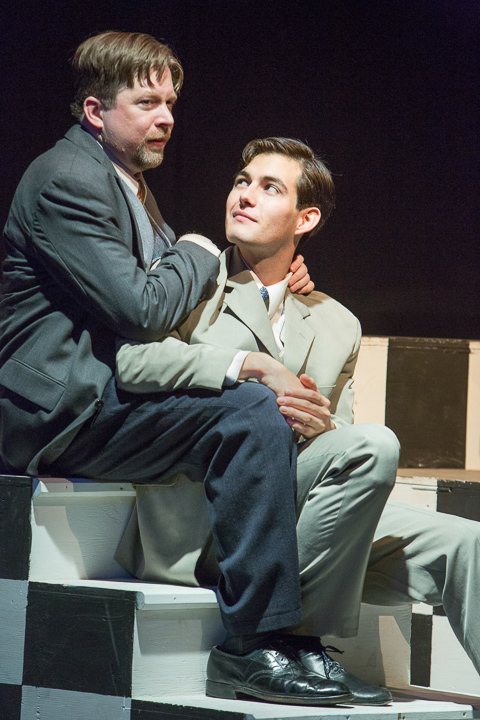
Omar tries to get a business going in his country.  Omar (Javi Harnly), also tries to balance being Pakistani and British at the same time. This is not easy for the young man and his friend (Robert Rushin) – Johnny. Both boys are confused. Having different cultures – is not easy. This is a heated romance. The two boys fall in love. Omar is not quite ready for romance right now – but he heading that way. Omar has lots of things going on in his brain. Can Omar and Johnny fall in love with different cultures?


There is the political points that make it difficult for the boys. There are the Uncles and Fathers that are getting a little suspicious about the young guys . Omar and Johnny try to keep away  away from the relatives. Their strength and fragility is well displayed. The two boys try to cover up their romance. That’s tough!
The subtle humor is dry, and it flows with the young men.

They have a huge transformation to contend with –  (The Launderette.) Omar wants to be a successful business man – and Johnny wants to help out, but seems to be in another world.  The complexities keep Omar moving towards his goal. He pretty much finds what he wants in the end — but the story does not end in a solution for everyone. All have their own lifes to deal with (money and lifestyle). Working Class Johnny is basically in a downtrodden society. But – his oppression does begin to sparkle near the end. Brits and Pakistani’s don’t always blend.


The climax sets off political fireworks. The two boys of different lands unveil themselves. Johnny and Omar go on with their exciting and  genuine love for each other. Life goes on.  Sparks fly. It happens to everyone. Kiss – Kiss!


Fabulous Direction by Andrew Nance.


NOW PLAYING AT THE NEW CONSERVATORY THEATRE ON VAN NESS AVE. ***** (((RATING: FIVE GLASSES OF CHAMPAGNE!!!!! (highest rating) -trademarked-)))


(((Lee Hartgrave has contributed many articles to the San Francisco Chronicle Sunday Datebook and he has produced A long running Arts Segment on PBS KQED)))


Lee Hartgrave – DAILY MAIL

By Lee Hartgrave

IDEATION

SF PLAYHOUSE

Brings a Great Performance

It’s Acting Heaven!

IDEATION is an entrepreneur journey where four people “Ben Euphrat, Jason Kapoor, Carrie Paff*, Mark Anderson Phillips* and Michael Ray Wisely* get together to do business, and make money out of it. Each person is trying to “Up” the next person. What’s really interesting about “Ideation”? The men and one woman that focus on there ideas. What are they going to create? Are they creating a product, service, or what? Well, they do make quite a fuss at putting ideas on a white board. However, they continually fail at the project. One gives feed back, and another puts him down.

One tries to refine. Another feels that he has a better plan. The only woman there, thinks that none of this is going to work. The Brain Storming is like software. It doesn’t get very far. But, they do try to research out numeric possibilities.

The philosophical ideas live in the mind of the creator. The others try to destroy a new recurrence. Yep, it’s just blah, blah, blah — and erase and erase, until the chalk breaks. O.K. lets get to the breakout performances. They have extraordinary intelligence and razor-edge humor. Its notably nuanced. This story is certainly one of Loeb’s best works. His razor sharp writing and the Great Cast give us unimpeachable performances.

I’ve never seen anything like this Stage Play. Its Scope and Grandeur is amazing and magnificent. I’m still thinking about it. Once in a decade an audience gets raw challenges. They sure do it here. The director absolutely knows how to create emotion. This cat-and-mouse -bare-knuckle play keeps you on the edge of your seat. IT’S ELECTRIFYING!

THE PERFORMERS OF THE YEAR ARE: Ben Eukphrat (Scooter), Jason Kapoor (Sandeep), Carrie Paff* (Hannah), Mark Anderson Phillips* (Brock), Michael Ray Wisely* (Ted). Clive Worsley (voice over).

*****

DIRECTOR: “KEEPS SHOW CAPTIVE FROM START TO FINISH!”

SF Playhouse is using “The Tides Theatre” on Sutter Street for this show.

RATING: Five Glasses of Champagne. (highest rating) -trademarked-

(((Lee Hartgrave has contributed many articles to the San Francisco Chronicle Sunday Datebook and he has also produced a long-running Arts Segment on PBS KQED -7 years)