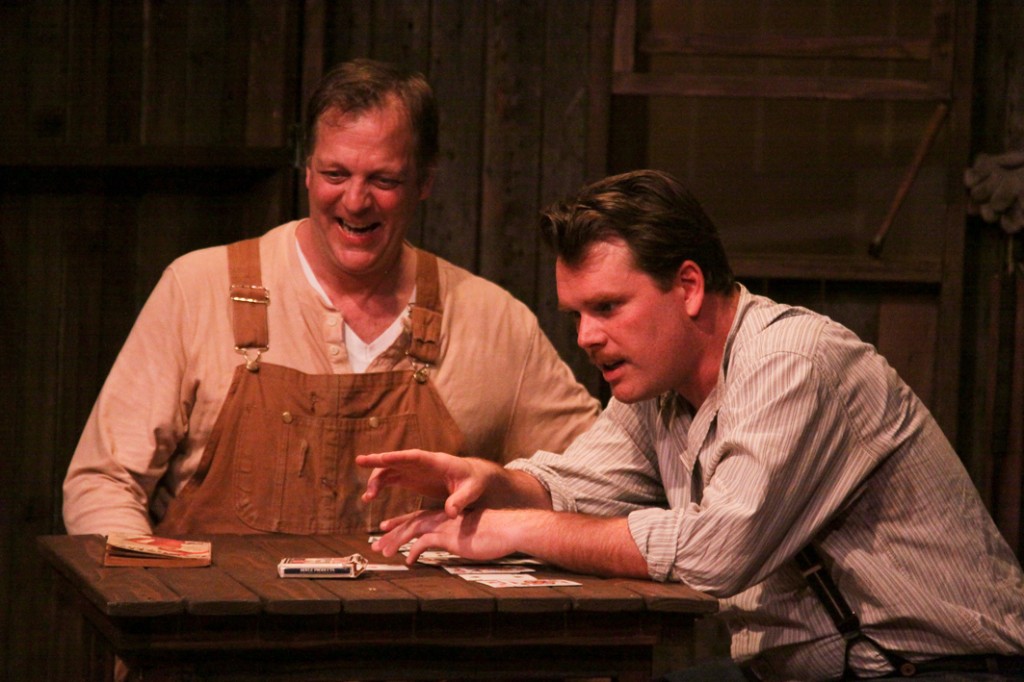
A MAZE fascinates in Just Theatre’s production on Shotgun’s Ashby Stage

By Kedar K. Adour

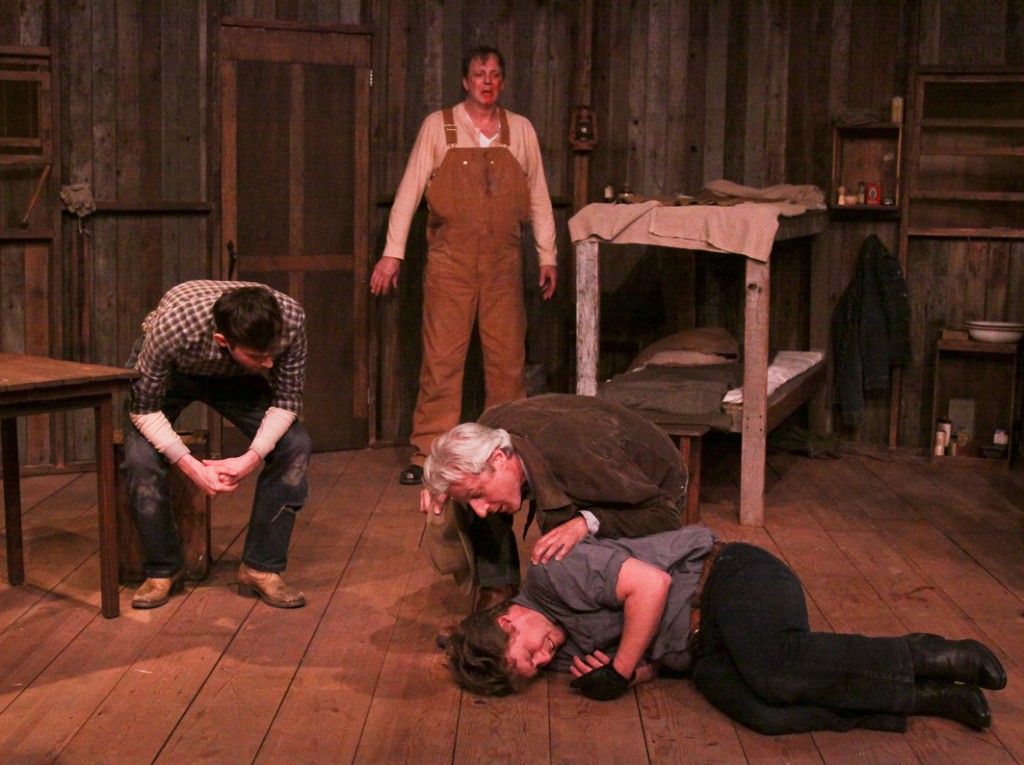
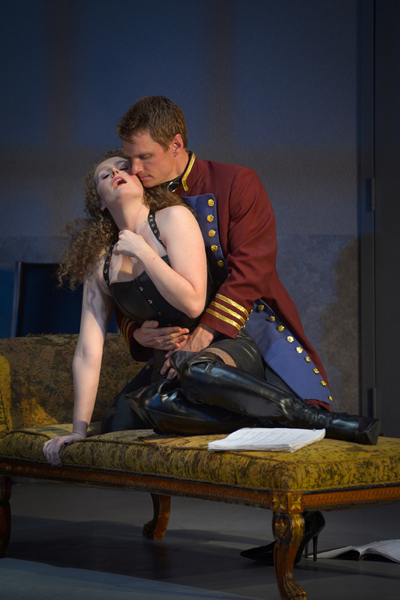
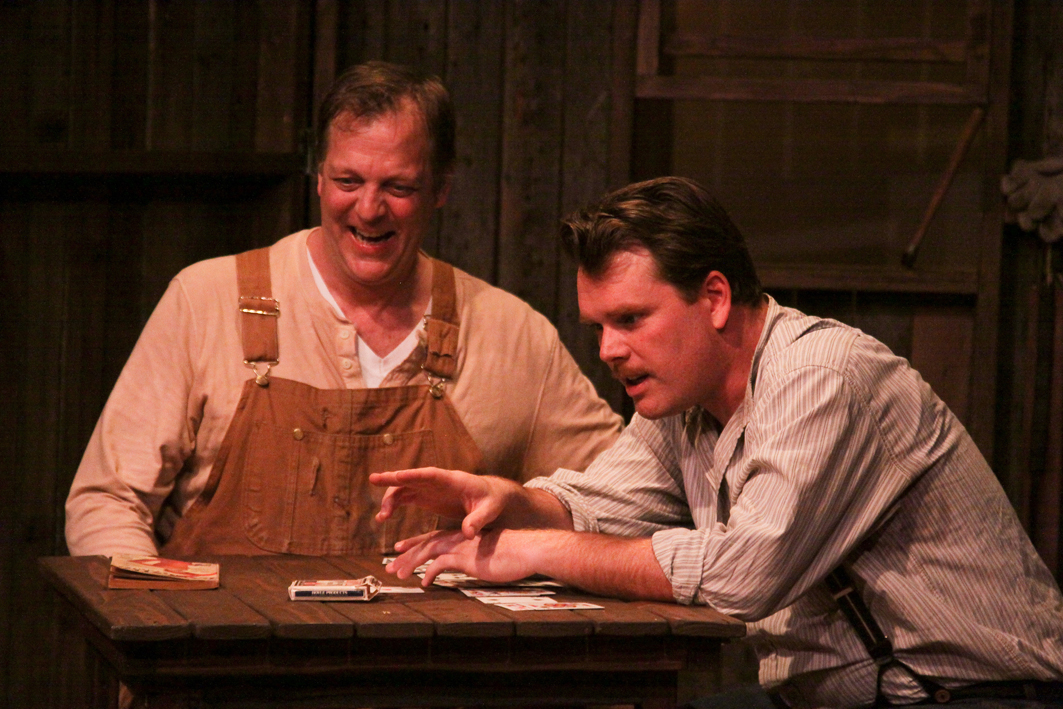
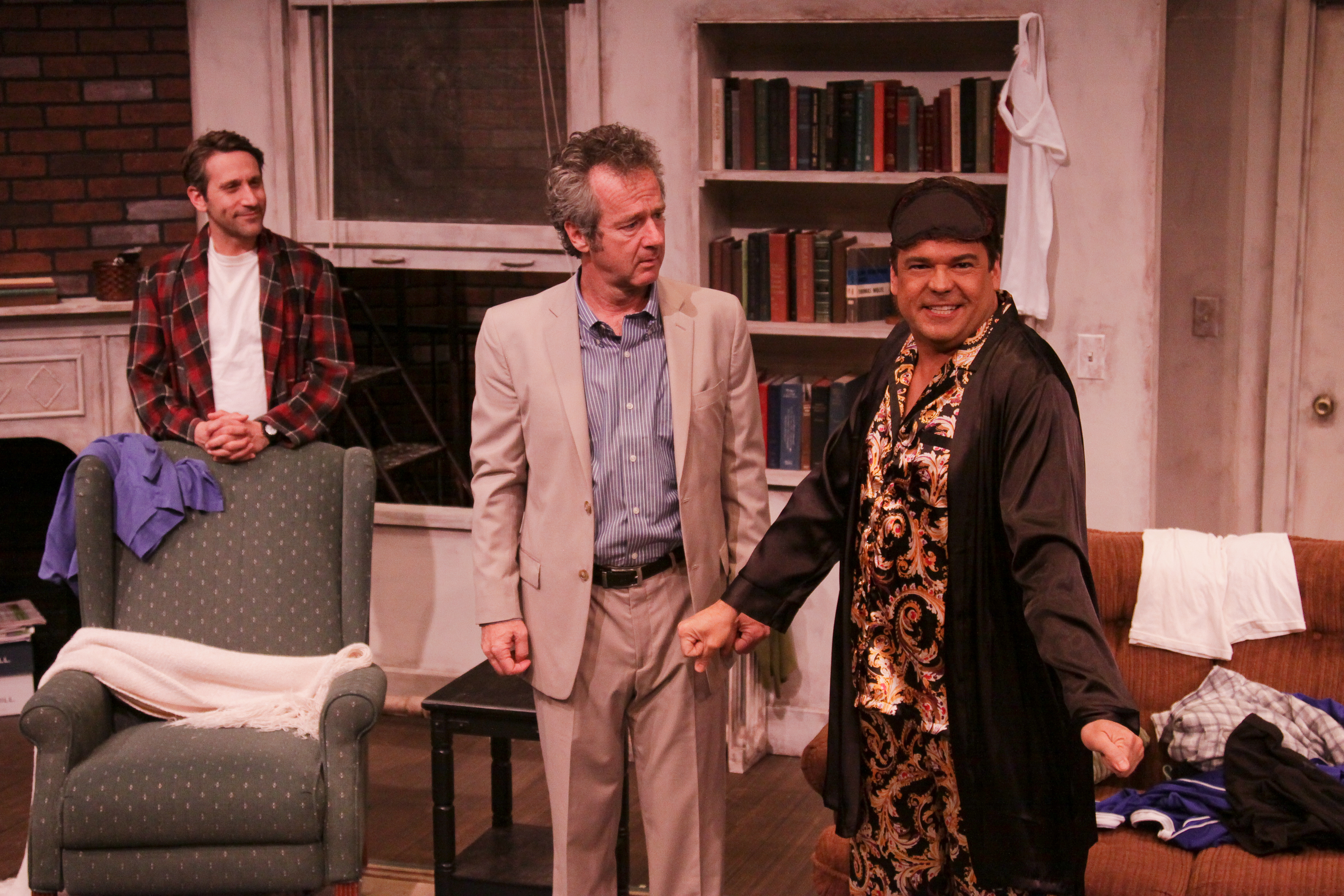
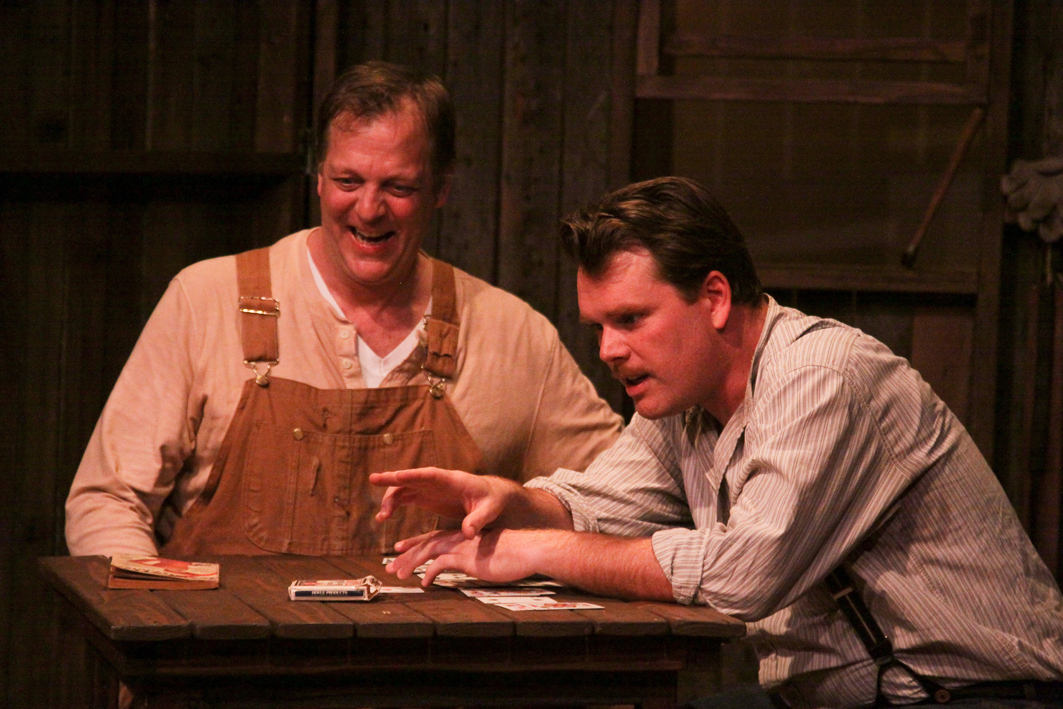
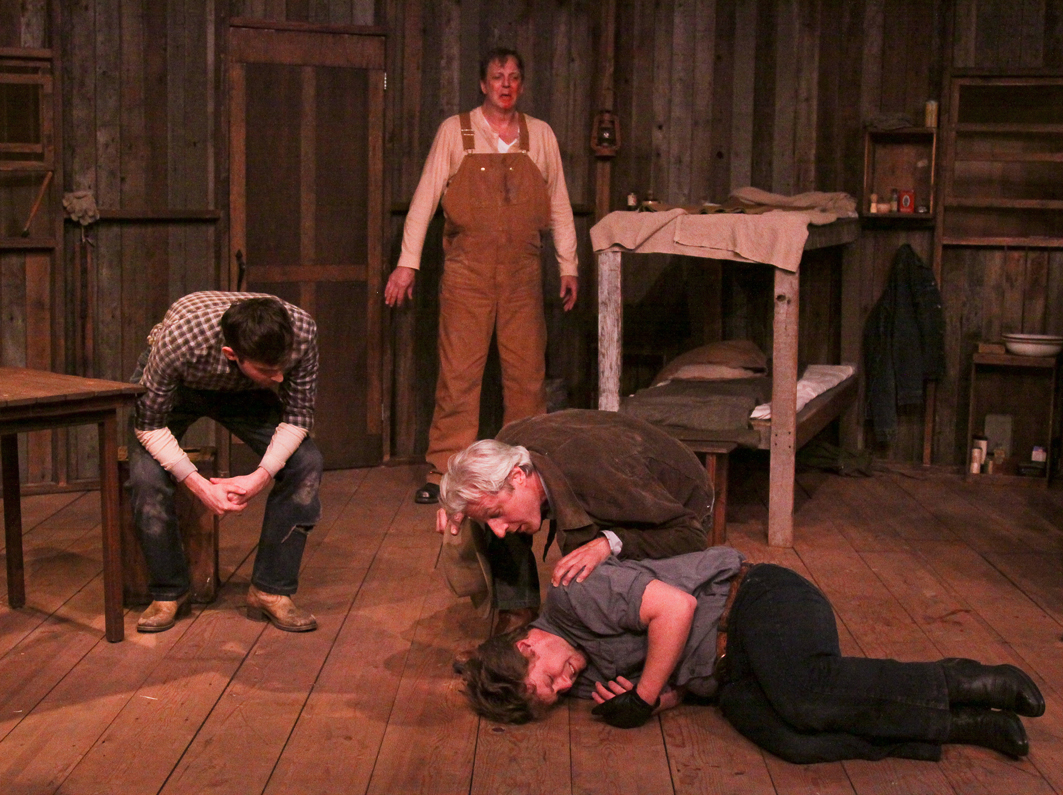
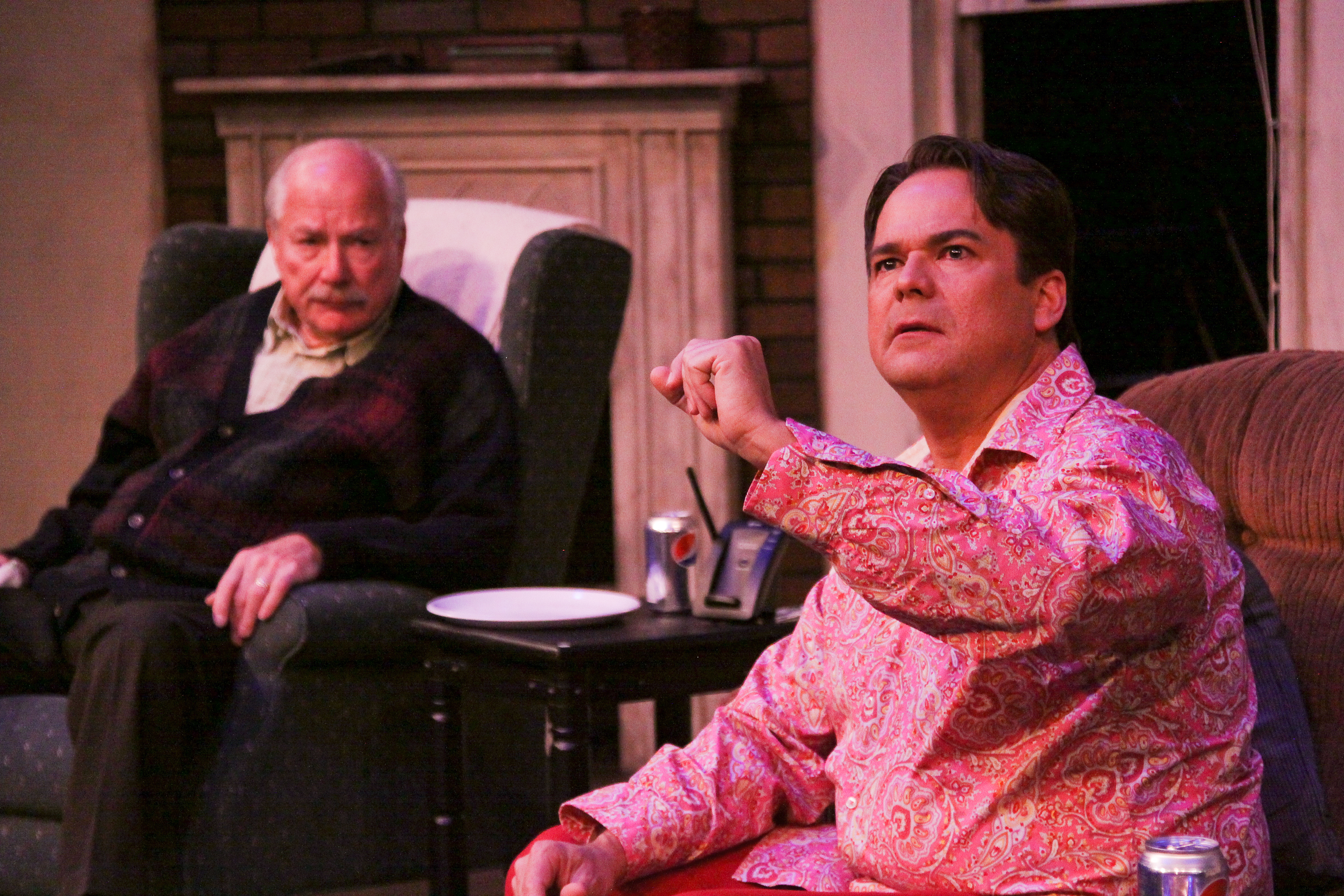
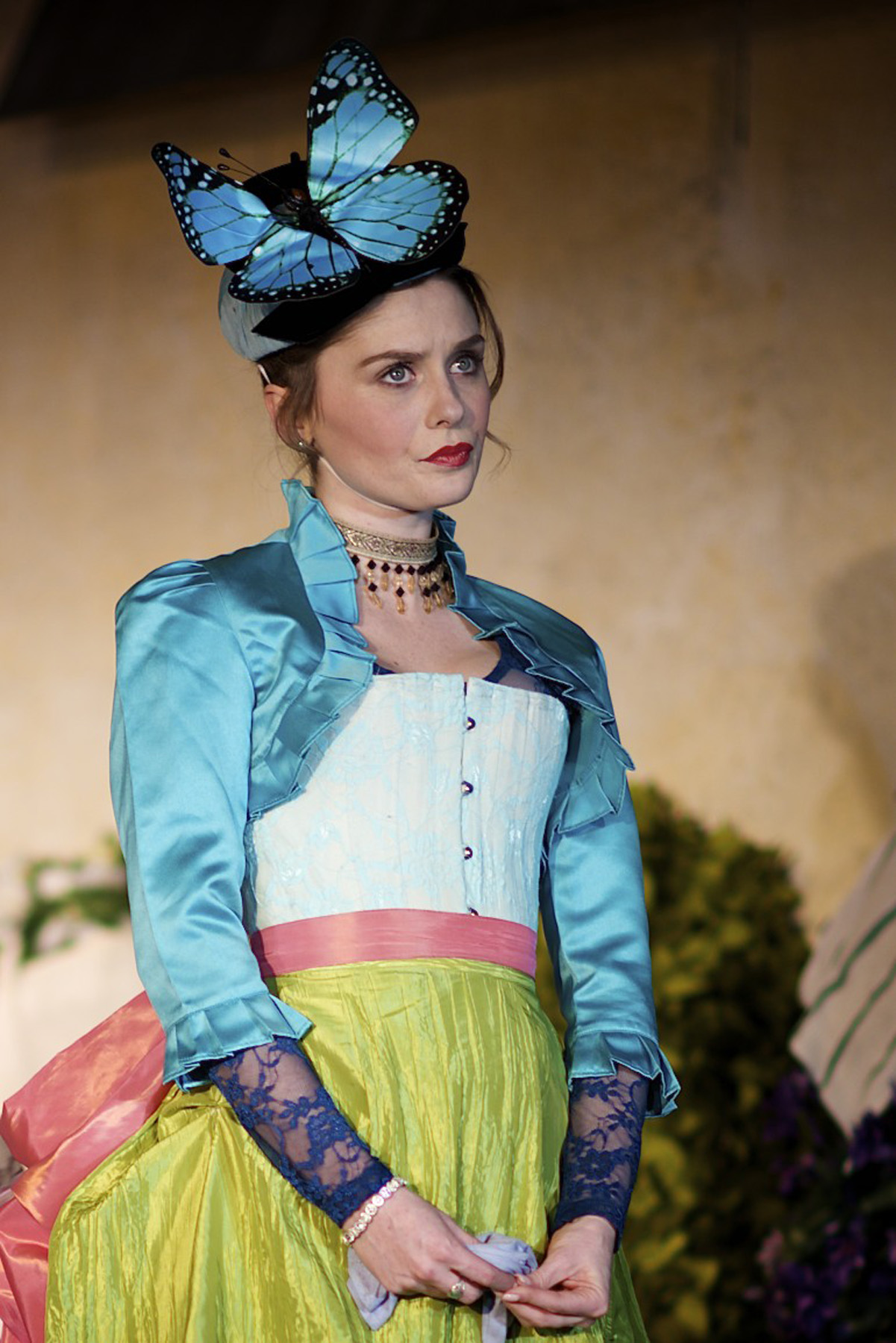
                               The Queen (Janis DeLucia) and The King (Lasse Christiansen) discuss plans for building the maze. Photos by Pak Han

A MAZE: Drama by Rob Handel. Directed by Molly Aaronson-Gelb. Just Theater, Ashby Stage, 1901 Ashby Ave., Berkeley, CA. Two hours, 20 minutes. (510) 214-3780 or www.justtheater.org.

Through March 9, 2014

A MAZE fascinates in Just Theatre’s production on Shotgun’s Ashby Stage.                  [rating:5] (5/5 Stars)

 Bring your thinking cap with you when you go to see A Maze that is being given a second mounting on Shotgun’s Ashby Stage after a critically acclaimed three week run at the out-of the way Live Oak Theatre. Lis Lisle Managing Director at Shotgun astutely recognized that it was a perfect fit to match the eclectic work their company. If you missed it the first time around, as this reviewer did, you now have the chance to enter the labyrinths created by author Rob Handel and ushered to the stage by Molly Aaronson-Gelb.

It certainly was not an easy task to take a non-linear play with 25 plus blackout scenes and three different storylines that inter-mesh over a 10 year period and create an engrossing intelligible evening. All is not perfect with the construction but these are minor faults and can be overlooked. Add to this a storybook King (Lasse Christiansen) who continual builds a labyrinth (a maze of course) to protect his Queen (Janis DeLucia) and daughter from the outside world or is it to keep her imprisoned?

The catalyst for the intertwining stories is Jessica (Frannie Morrison) a 17 year girl who was abducted at age 7 and kept prisoner for nine years. She has walked away from her captor, willing to be interviewed by Kim (Lauren Spencer) a national TV talk-show host who is astounded by Jessica’s desire to be “that famous child who was abducted from the super-market” explicitly suggesting “blame the victim syndrome.”

In quick succession the shift is to the Desert Palms Rehab Center where “Pathetic Fallacy” rock band super-star Paul (Harold Pierce) is being encouraged by his girlfriend and song writer Oksana (Sarah Mosher) to break his habit and to recreate his genius. While there Paul meets and befriends Beeson (played brilliantly by Clive Worsley) a cartoon-artist-author who is forever working on a story that already has over 1500 pages (with lots and lots of crosshatching) and is a cult sensation. The King and Queen of the aforementioned labyrinth are characters in his story.

The three major characters are trapped in their figurative mazes and intricately the mazes interlock with an ending that is a zinger. All this plays out on a fantastic black and white set (Martin Flynn) with lines suggesting multiple maze configurations. Along the way there are intellectual comments about artist having idiosyncratic natures and should we separate the creation from the personal defects of the artist.

Advice: Do not miss this performance two hour and 20 minute (with intermission) that will keep you riveted.

Kedar Adour, MD

Courtesy of  www.theatreworldinternetmagazince.com


Barricelli makes welcome return in ACT’s ‘Napoli!’

By Judy Richter

Italian playwright Eduardo De Filippo puts a human face on the moral quandaries faced by a family in a war-ravaged city in “Napoli!”, presented by American Conservatory Theater.

It’s 1942, the second year that Italyhas been involved in World War II. Allied forces bomb the city almost daily. Food and all other necessities are scarce or unavailable.

After Gennaro Jovine (Marco Barricelli) loses his job as a tram conductor, his wife, Amalia (Seana McKenna), teams up with Errico (Dion Mucciacito), a neighbor, to sell coffee and other goods via the black market in order to support her family.

In one hilarious scene, Gennaro pretends to be dead while Amalia and others mourn over him in order to avoid possible arrest by a wise-to-them Fascist officer, Ciappa (Gregory Wallace). They don’t want Ciappa to discover the contraband that Amalia has hidden in the mattress.

After intermission, Act 2 of this two-hour work takes place 14 months later, after the Allies have landed inItaly. Gennaro, who has gone to war, has been missing for some time and presumed dead. In the meantime, the family has prospered, thanks to Amalia’s entrepreneurship.

Some of her success has come at great cost to others, such as neighbor Riccardo (Anthony Fusco), who owes her so much money for food to feed his family that he is about to lose his house to her.

When Gennaro returns, he has harrowing tales to tell, but no one is interested. They’re more focused on a birthday party for Errico, who has taken a romantic interest in Amalia.

Amalia gets her comeuppance when the Jovines’ youngest daughter (unseen) is seriously ill. The only medicine that can help her is nowhere to be found in Naples until an unlikely person comes forth.

Although the play has humorous moments, it has darker qualities in its depiction of life in wartime and the moral compromises that people make to survive.

ACT is using a new translation by Linda Alper and Beatrice Basso. They also translated the play in 2005 when the Oregon Shakespeare Festival inAshlandpresented it as “Napoli Milionaria!” Alper played Amalia in that production.

Although Amalia is perhaps the principal protagonist, ACT’s production is anchored by Barricelli’s magnetic performance. A longtime favorite in Ashland and ACT and the former artistic director of Shakespeare Santa Cruz, Barricelli makes a most welcome return to the Geary Theater. He commands the stage with his presence and his facility with language.

Most supporting actors in the large cast are noteworthy. Besides Wallace and Fusco, excellent performances come from Nick Gabriel as the Jovines’ young adult son, Amedeo; and Blair Busbee as Maria Rosaria, their somewhat younger daughter. The always dependable Sharon Lockwood plays Adelaide, a kindly neighbor.

Design elements are outstanding, especially Erik Flatmo’s set, (lit by Robert Wierzel), which is transformed from dingy in Act 1 to nicer in Act 2. The same is true of the costumes by Lydia Tanji. Sound by Will McCandless includes realistically loud simulations of a bombing raid.

Director Mark Rucker oversees the action with a sure hand in this well done, thought-provoking production.

It will continue through March 9 at ACT’s Geary Theater, 415 Geary St., San Francisco. For tickets and information, call (415) 749-2228 or visit www.act-sf.org.


NAPOLI! has a split personality at A.C.T.

By Kedar K. Adour

Seana McKenna as Amalia and Marco Barricelli as Gennaro in Napoli! at A.C.T.’s Geary Theater. Photo by Kevin Berne

Napoli! Comedy/Drama by Eduardo de Filippo in a new translation by Beatrice Basso and Linda Alper. Directed by Mark Rucker .  A.C.T.’s Geary Theater (415 Geary Street, San Francisco).  415.749.2228 or www.act-sf.org.   February 12- March 9, 2014.

NAPOLI! has a split personality at A.C.T.      [rating:3] (3/5 stars)

We here in the United States have never suffered the physical and emotional damage of our home land being physically ravaged by war. Italy has not been so fortunate and in World War II Naples was incessantly bombed leading to devastating shortages of every household staple and a black market became rampant. This is the Naples that Eduardo de Filippo has created for the Jovine family and their neighbors that is gracing the boards at A.C.T. It is late 1942 when the War has been raging for two years and the Allies are bombing Naples prior to the invasion.

The family consists of matriarch Amalia (Seana McKenna) her husband Gennaro (Marco Barricelli) and their children, 25 year old son Amedeo (Nick Gabriel), teenage daughter Maria (Blair Busbee) and the unseen 5 year old daughter who becomes a significant part of the storyline late in act 2.  Gennaro, a voluble but genial World War I veteran who has lost his job as a streetcar driver has found some privacy in their restricted quarters by setting up curtains around his corner bed. He is a moralistic honest man and has been given long speeches conveying de Filippo’s philosophy (Filippo played the role initially and in many countries).  Barricelli delivers those lines with quality understated eloquence and is matched by Mckenna’s more dominant and less amiable personae that are written into the script.  She has undertaken the job of keeping the family fed and clothe through black market dealings aided and abetted by handsome Errico (Dion Mucciacito) whose interest is a bit carnal but secretive.

The play is bookended by scenes of coffee taking that is intended as a symbolic ritual of what is good and bad in the lives of the characters. In the early scene the denizens of the neighborhood gather in the Jovine home (set by Erik Flatmo ) to partake of their morning coffee fix made with bootleg coffee. Those denizens are an eclectic group that is populated with stock characters of Italian comedy that are given varying degrees of verisimilitude by the large cast.

Comedy dominates the first act even though Gennaro pontificates as the storyline slowly develops. Local darling Sharon Lockwood lights up the stage with her entrance as neighbor Adeliade with her ditzy niece Assunta (a fine Lisa Kitchen). A jealous competitive black-marketeer tips authorities about the illegal dealings by Amalia. This allows de Fillipo to write a comedia del arte scene that is a highlight of the act . . . especially when the beans (coffe beans of course) are spilled. Former A.C.T. favorite Greg Wallace as Ciappa the local police lieutenant nails the scene.

Act two takes place 14 months later when the Americans and British have “liberated” Naples from Nazi control and Amalia and her clan have prospered to the point of being millionaires with ample supplies for the black market being “available” from the Allies. The drab set is now opulently furnished having been paid for by the ill-gotten money. Without revealing the plot, it is sufficient to say that the comedy of act one is replaced with serious drama. This involves the unseen child who is seriously ill with an unexplained fever that requires a medicine that can only be obtained on the black market. Fortunately Gabriel Marin has been cast as a supplier of goodies for a party being given for Errico’s birthday and his entrance and exits are a joy to watch. The play ends with Gennaro and Amalia sharing a cup of coffee.

All in all the evening seems longer than the 2 hour running time that includes a 15 minute intermission.

Creative Team: Erik Flatmo (scenic designer), Lydia Tanji (costume designer), Robert Wierzel (lighting designer), Will McCandless (sound designer)

Featuring: Marco Barricelli, Seana McKenna, Nick Gabriel, Blair Busbee, Dion Mucciacito, York Walker, Mike Ryan, Anthony Fusco, Sharon Lockwood, Lisa Kitchens, Gabe Marin, Gregory Wallace, Aaron Moreland, Lateefah Holder, Danielle Frimer, Kemiyondo Coutinh, Asher Grodman, Dillon Heape.

Kedar K. Adour, MD

Courtesy of www.theatreworldinternetmagazin.com

Seana McKenna as Amalia and Marco Barricelli as Gennaro in Napoli! at A.C.T.’s Geary Theater. Photo by Kevin Berne

Funny, riveting gender-bender is ‘best play’ in years

By Woody Weingarten

Amidst the massive clutter of their home and lives, transgender Max (Jax Jackson) and Paige (Nancy Opel), his mother, mirror one another in “Hir.” Photo: Jennifer Reiley. Woody’s [rating:5]

 Woody’s [rating:5]

“Hir,” a gender-bending, tragicomic world premiere at the Magic Theatre, is the best Bay Area play I’ve seen this season.

In several seasons, in fact.

And I’ve attended more than a few magnificent shows during that timeframe.

To call “Hir” hilariously riveting would be to understate enormously the impact it had on the opening night San Francisco audience.

Including me.

I don’t have enough superlatives in my word-arsenal with which to praise the writing, direction, acting, set design and costumes.

Describing what’s what may make the play sound bizarre rather than funny. But playwright Taylor Mac keeps the laughter level extremely high.

Niegel Smith is the perfect director for what Mac calls “absurd realism.” Though every gag line draws a laugh, each stammer, brief pause or elongated silence also hits a dramatic bulls-eye.

And Smith’s pacing is spot on.

Paige is the antithesis of the submissive mom that populates so much pop culture. Instead, she’s a tear-down-the-established-routine demon who humiliates her husband with acts of comeuppance that include squirting water into his face as a trainer might to a disobedient kitten.

Nancy Opel portrays her with all the requisite venom. A Tony-nominated actress, she is a comic delight, spewing Mac’s acerbic words like ammo from a Gatling gun.

She informs us the family’s role now — 30 years after building its “starter house” — is to put on shadow-puppet shows and “play dress up.”

The playwright takes dysfunctionality to new heights. Or, perhaps, it might be more accurate to say new lows.

The play, set in a central valley suburb similar to Stockton, where Mac grew up, makes the audience feel good because their fractured families can’t possibly be that screwed up.

Jax Jackson adroitly plays Max, formerly Maxine — a 17-year-old “gender-queer” malcontent who’s been homeschooled and makes Holden Caulfield’s angst look as antiquated and simplistic as something out of a the old-time radio soap opera “One Man’s Family.”

He no longer chooses to be a she or a he but a gender-neutral ze (pronounced zay); in addition, he substitutes hir (pronounced heer) for the pronouns him or her.

A youth whose fantasy is to join an anarchist commune, Max finds his mind somewhere behind the curve of the hormone-triggered gender changes ze has put hir body through with self-medicating experimentation.

He calls himself “transmasculine” and “a fag.” He likes boys. He loves masturbating.

And he thinks he’s “allowed to be selfish because I’m in transition.”

Max goes ballistic about the biblical story of Noah being “transphobic” because only male and female animals were allowed aboard the ark — and because Leonardo da Vinci’s transexuality and that of his self-portrait, the Mona Lisa, aren’t acknowledged.

Actually, it’s not crucial for a theatergoer to “get” all the gender-based phrasing — or even the alphabet soup LGBT has evolved into, LGBTTSQQIAA.

The gist becomes clear through context.

Clear, too, is Mark Anderson Phillips’s performance despite his character barely speaking.

He skillfully portrays Arnold, the stroke-ridden ex-plumber, ex-abuser father who represents a disintegrating culture and who’s typically plopped in front of the Lifetime Channel when Paige and Max go out.

And Ben Euphrat is effectively transparent as Isaac, a Marine vet of the Afghanistan war dishonorably discharged after becoming a meth addict. He may have PTSD (Post-Traumatic Stress Disorder), and vomits profusely, the aftermath of his job of collecting body parts.

Isaac comes back to unrecognizable home and family, and desperately wants to restore them — and himself — to the way everything was when he left.

I missed “The Lily’s Revenge,” Mac’s earlier allegorical play/carnival at the Magic, thinking neither my brain nor my buttocks could handle five acts and five hours no matter how brilliant.

Now I have regrets.

Mac, not incidentally, is a triple threat: Although he’s written 16 full-length plays, he also performs as an actor and singer-songwriter (his most recent outing was as co-star with Mandy Patinkin in an off-Broadway workshop of “The Last Two People on Earth: An Apocalyptic Vaudeville” last December).

While introducing his latest dark, darker, darkest humor showcase to the opening night audience, Loretta Greco, the Magic’s producing artistic director, said, “Buckle your seat belts. You’re in for an incredible ride.”

She wasn’t lying.

“Hir” plays at the Magic Theater, Building D, Fort Mason Center, San Francisco, through March 2. Performances: Sundays and Tuesdays, 7 p.m., Wednesdays through Saturdays, 8 p.m.; matinees, Sundays and Wednesdays, 2:30 p.m. Tickets: $15 to $60. Information: (415) 441-8822 or www.magictheatre.org.

Dazzling, potent play realistically probes school tragedy

By Woody Weingarten

  Woody’s [rating:5]

In “Gidion’s Knot,” Corryn (Jamie J. Jones, right) confronts Heather (Stacy Ross) about a note passed to her son in class. Photo by David Allen.

Uh, oh!

From the first cagey moments of “Gidion’s Knot,” I knew the play would be grueling to process.

I didn’t, however, expect my mouth to drop open, my heart to hurt.

They did anyway.

My pledge: Because the two-woman play is a disturbing cat-and-mouse game and theatrical Rorschach test, viewers will find it virtually impossible to leave the Aurora Theatre in Berkeley unaffected.

Personal baggage will, of course, determine exactly how and what is experienced.

The tension-filled drama starts with an abrasive, in-your-face single mother — a walking open wound — demanding a constrained teacher tell her why she suspended the parent’s troubled son from his fifth-grade class.

The discussion that follows is often awkward.

But it’s also a fascinating examination of personal responsibility and blame, freedom of expression, the failure of our school systems, bullying and embryonic sexuality.

“Gidion’s Knot” is provocative, powerful and guaranteed to force theatergoers to hold their breath for what seems its entire 80 minutes.

The impact of the gut-wrenching, twist-and-turn tragedy comes when the angry, sarcastic mother, herself a professor used to academic probing, keeps pricking and questioning until she learns the truth.

At least her truth.

A working clock on a classroom wall helps maintain the sense of real time.

And the actors’ breathtaking depiction of passion, thoughtfulness and mood swings help keep the action authentic.

Playwright Johnna Adams demands playgoers think for themselves, so she supplies no pinpoint answers to the questions she poses: Are parents or schoolteachers ultimately responsible for pupils’ well-being? Is Gidion a bullying monster or sensitive, poetic victim? Is classmate Jake the bully or an object of affection?

Neither fifth grader appears on stage.

Nor does Seneca, an 11-year-old friend and note-passer described as having a stuffed bra, nose ring, false eyelashes and dyed platinum hair.

Tossed into the mix are references to censorship, freedom of expression, American society’s litigiousness, and our growing national fear of what’s ahead.

Sadly, “Gidion’s Knot” echoes all too many real-life headlines of recent years about individual tragedies caused by taunting, either in person or through social networking.

And, although it doesn’t reference those situations, it can’t block memories of schoolyard massacres.

Tension is director Jon Tracy’s forté, copious enough to make me — and most other seat-holders — uncomfortable.

Intensity prevails.

Unrelentingly, in fact, all the way to the play’s final moments — except for a few snarky quips that let everyone find a smidgeon of relief through nervous laughter.

Part of the unease, by the way, stems from the two characters (and audience) waiting for someone to arrive.

As “Gidion’s Knot” unravels its multi-leveled conflicts and complexities — from an exploration of Greek and Roman military history and epic poetry to a tale of revenge against teachers and disembowelment — it may require a strong stomach.

I could hear erratic gasps in the audience.

Nina Ball’s set is a deceptively cheery contrast through which she’d dragged me into a 20-desk classroom and its reference maps and academic materials in Anytown, USA.

The setting’s so effective I could almost see the portraits of gods tacked onto an invisible wall explored by the distraught mom, who reveals she could best relate to a demon-destroying Hindu god, Shiva.

Destruction just happens to be another underlying theme of “Gidion’s Knot.

So’s the Marquis de Sade.

Then, of course, there’s the metaphoric Gordian Knot, which — legend tells us — Alexander the Great decided to slice rather than untie. The phrase, of course, has become a means of representing having to face an intractable problem.

What’s absent in this dazzling play is artifice — despite the presence of polemics and diatribes.

What’s present is actors whose performances are flawlessly multi-layered, facilitating my feeling their respective pain.

I flinched as the mother asked disingenuously, “This doesn’t have to be adversarial, does it?”

But the sold-out audience was right there as the mother, Corryn Fell (Jamie J. Jones), and teacher, Heather Clark (Stacy Ross), struggled to untangle the web of what really happened.

Where a playgoer travels emotionally and intellectually will determine whether “Gidion’s Knot” is loved or tagged offensive and too harrowing.

I fall in the first niche, glad I was there despite the work required.

The opening night crowd also had no doubt: In unison, it gave it a thunderous standing ovation.

“Gidion’s Knot” runs at the Aurora Theatre, 2081 Addison St., Berkeley, through March 9. Night performances, Wednesdays through Saturdays, 8 p.m., Tuesdays and Sundays, 7 p.m.; matinees, Sundays, 2 p.m. Tickets: $16-$50. Information: www.auroratheatre.orgor (510) 843-4822.

Tim’s Vermeer — Film Review

By Joe Cillo

Tim’s Vermeer

Directed by Teller


This is a film that is going to appeal mainly to people who have a special interest in art history or painting.  It may have some appeal to the museum-going general public, but the audience on the night I attended was sparse.  There is not a lot of action — no, that’s not right.  There is not any action, except the slow process of creating a painting stroke by stroke — sort of like watching ice melt, for those of you on the East Coast.  But that can be very interesting, and it is, but you have to be interested in painting.  If you have ever tried to paint anything with any kind of realistic likeness, you’ll understand what I mean.

This film is slow moving and cerebral.  It is a documentation, a realization, of a theory advanced by artist David Hockney and physicist Charles Falco in 2001 that Renaissance masters like Van Eyck and Vermeer and others across Europe used optical techniques incorporating lenses and mirrors to create their stunningly accurate realistic images.  They did not just eyeball their subjects to realize the kind of microscopic accuracy that characterizes the Dutch Masters style on a painted canvas.  Tim Jenison, an inventor from Texas with no particular ability in art or painting, became familiar with Hockney’s theory and hatched the crazy idea to replicate Jan Vermeer’s studio, materials, and techniques from scratch and recreate one of Vermeer’s masterpieces, The Music Lesson, himself, using the techniques suggested by Hockney and Falco.  The film documents this process with attention to all the minutiae one might find in one of Vermeer’s paintings.

I saw this when I was rather tired after a long, busy weekend, and I started feeling a sense of tedium even though the subject and the process were very interesting.  We get to see shots of mixing paint from pigments, grinding a lens, carving a table leg on a lathe, building a studio, and gradually watching the painting take shape a few strokes at a time over a period of, I think, 213 days.  The result is a flawless replica of a Vermeer masterpiece.  Jenison takes it to David Hockney, who grades it favorably, and there is a discussion of the process and the significance of Jenison’s experiment.

Jenison did not prove that Vermeer used lenses and mirrors in order to paint.  Jenison’s experiment is akin to Thor Heyerdahl’s sailing of Kon-tiki from the shores of Peru to Polynesia.  Heyerdahl’s experiment refuted skeptics who said such a voyage was not possible.  It did not prove that anyone ever did sail such a route in such a vessel, but it opened an avenue of interpretation of other evidence that might have been closed off by dismissal or the presumption of fantastical improbability.  Jenison showed that using only materials and techniques available during Vermeer’s time, he could indeed replicate Vermeer’s achievement as an untrained painter.  This does not show that Vermeer painted this way, because there is no documentation of how Vermeer worked, but coupled with the fact that there is no documentation of Vermeer ever having been trained as an artist, the absence of a drawing beneath the painting that would have served as a guide and which was customary in the work of other artists of that time, and, most tellingly, I think, that some small “mistakes” can be discerned in Vermeer’s image that reflect distortions created by the use of a lens, all give the argument weight and strengthened plausibility.

It is a very interesting film that should be noted by painters, historians, and art students.  It presents a compelling case, but not a final conclusion, and I think it indicates a fruitful direction for further historical research.


“Annie Get Your Gun” by Irving Berlin, Spreckels Performing Arts Center, Rohnert Park CA

By Greg & Suzanne Angeo

Reviewed by Suzanne and Greg Angeo

Members, San Francisco Bay Area Theatre Critics Circle

Photos by Eric Chazankin

Annie Got Her Guy

Considered by many to be one of the best musicals of all time, Annie Get Your Gun premiered on Broadway in 1946 to rave reviews, starring Ethel Merman as the brassy backwoods “little sure-shot” Annie Oakley.  One reviewer of the time said, “No use trying to pick a hit tune…all the tunes are hits.” It was produced by the legendary team of Rogers and Hammerstein with music and lyrics by Irving Berlin, arguably the greatest and most prolific of American composers. The show being presented at Spreckels is based on the successful 1999 revival starring Bernadette Peters, which netted Tony Awards for best lead actress (musical) and best revival. A notable difference between the 1946 and 1999 shows is the removal of three  songs: “Colonel Buffalo Bill”, “I’m a Bad, Bad Man” and “I’m an Indian Too”.  By 1999, it was felt that the songs were insensitive to Native Americans and women; times had changed.

Besides packing fewer tunes, the Annie revival was rewritten into a “show within a show” concept, with the story more firmly centered on the romance between the real-life Annie and her husband Frank Butler. The wider context is the famed Buffalo Bill’s Wild West spectacles of the 1880s. These traveling circus extravaganzas dazzled audiences with their re-enactments of cavalry charges, Indian raids on wagon trains and cowboys out on the range. They featured hundreds of performers on horseback along with stampeding herds of cattle and buffalo. Performed nationwide and before the crowned heads of Europe for decades, Buffalo Bill and his Wild West shows helped shape the nation’s idea of life in the West for generations to come. Sharpshooting daredevils Annie and Frank were two of Buffalo Bill’s best-known and most beloved performers.

In Annie Get Your Gun at Spreckels, Buffalo Bill (the always-wonderful Dwayne Stincelli) has left his buffalos at home. Also missing are the sights and sounds of galloping horses and whooping cowboys, and much of the excitement. The scaled down, intimate feel seems at odds with the Big-Top scope of a show like this. While it’s true the intent is to focus on the love story between Annie (Denise Elia-Yen)  and Frank (Zachary Hasbany), what makes them  so special – the Wild West show – lurks mostly on the sidelines.

Dwayne Stincelli as Buffalo Bill

Elia-Yen shines like the blazing sun as the rough-and-tumble but tenderhearted Annie, with a truly unique and thrilling vocal quality. She is radiant in a part that calls for her to be crude and funny, mellow and sensitive, and everything in between.  Of all the wonderful songs in the show, there is one number in particular where star, cast, crew, director and orchestra all combine in sheer perfection: “Moonshine Lullaby” with the Cowboy Trio. This number could be bottled and sold as an elixir, it’s that good. Other standout performances are the iconic “No Business Like Show Business” and the happy-go-lucky ”I Got the Sun in the Morning”. Hasbany is a towering presence onstage, and not just because of his impressive height. He is magnetic in the role of Butler with a warm, mellow baritone and just the right amount of swagger to sweep Annie off her feet. (Makeup suggestion: A mustache would lend maturity to his very young face.) Hasbany skillfully shows how love transforms Butler’s life. He opens the show with a slow but soaring a cappella version of “There’s No Business Like Show Business” and his sweet dueling duet with Elia-Yen, ”Anything You Can Do”, is a sheer delight.

There’s the requisite secondary romance, a standard in classic musicals, between bright-eyed youngsters Winnie (Brittany Law) and Tommy (Anthony Guzman). Winnie’s vindictive and scheming sister Dolly is played by that powerhouse of versatility, Liz Jahren. Solid performances by Dan Monez as Chief Sitting Bull and Tim Setzer as Charlie Davenport round out the cast.

Choreographer and performer Michella Snyder has staged some very good dance numbers, but at times they lack a certain energy and bounce, and also seem too formal in a few places. A free-wheeling style may be more in keeping with the setting. An inspired burst of tap-dancing, done really well, was a treat to see and drew appreciative applause. Perfect period costumes, especially the ball gowns, were beautifully done by Pamela Enz. Musical Director Janis Wilson did a solid job conducting, and the 17-piece orchestra was in excellent form with a lushly jaunty sound.

Zachary Hasbany, Liz Jahren

Staging and direction is by Sheri Lee Miller in her Spreckels debut. Best known to North Bay audiences for her brilliant, sensitive realization of intimate shows, she has ventured into the realm of stage musicals recently with the hugely successful La Cage Aux Folles at Cinnabar. Annie is a pleasure to watch with a talented cast and unforgettable music, but it needs just a few more nods to its setting within the Wild West shows. After all, the setting is what makes Annie and Frank’s love story so uniquely entertaining.  This could be accomplished with stronger use of sound effects and images alluding to the hundreds of livestock and performers, including Native Americans, and the vast roaring crowds reacting to them.  And while we are supposed to be seeing a show within a show, there are only a couple of places where this is effectively conveyed. Elizabeth Bazzano’s flexible sets served the story well, but more of Spreckels’ marvelous Paradyne projector system could have been used to enhance certain scenes without losing any period authenticity – for example, one scene on a train. And even though the show overall could also use more lively pacing, it’s like a glass of day-old champagne: some of the sparkle may be missing, but it’s still tasty.

Denise Elia-Yen as Annie Oakley


Annie Get Your Gun presented by Spreckels Theatre Company

When: Now through February 23, 2014

7:30 p.m. Thursdays

8:00 p.m. Fridays and Saturdays

2:00 p.m. Saturdays and Sundays

Tickets: $22 to $26 (reserved seating)

Location: Codding Theater, Spreckels Performing Arts Center

5409 Snyder Lane, Rohnert Park CA
Phone: 707-588-3400

Website: www.spreckelsonline.com

Tackling Chekhov, dancer Baryshnikov proves he can act

By Woody Weingarten

 Woody’s [rating:5]

Mikhail Baryshnikov (center), Tymberly Canale (left) and Aaron Mattocks perform in “Man in a Case.” Photo by T. Charles Erickson

“Man in a Case,” the new Mikhail Baryshnikov star turn, melds uncountable elements.

Radiantly.

But the dramatic Berkeley Rep re-invention of two Anton Chekhov short stories is so complex, so augmented with symbolism and stagecraft, I’m sure a single viewing is insufficient to absorb it all.

And, frankly, I suspect I might feel the same after two or three more times in the audience.

“Man in a Case,” which was adapted and co-directed by the dazzling duo behind the Big Dance Theatre, Paul Lazar and Annie-B Parson, fuses movement, theatrics, music and video.

Parson may deserve the most credit.

She alone was responsible for the piece’s choreography, which not only fit Baryshnikov’s dance and acting chops like skintight leggings but lent itself to integrating disparate elements — projections of titles and 1890s Russian characters re-dressed in modern garb, a quintet of TV terminals blinking in unison, infinite paper caricatures wafting from above, a strobe ball rotating ever so gently, accordion melodies blaring in contrast with scratchy old recordings, and a canopied Murphy bed sliding effortlessly into a wall.

Amazingly, like a perfectly practiced drill team, everything works in synch.

And Parson put it all together with a surrealistic cleverness that made me think she might have been channeling Salvador Dali after he’d stumbled upon Marcel Marceau and Spike Jones in the afterlife and convinced them to come back to Earth and pool their talents.

“Man in a Case” spotlights two modern-day hunters who swap poignant stories after initially wielding their microphones like comic weaponry, as if they were doing early morning drive-time radio.

The first — and longer — tale centers on Belikov, an uptight, reclusive Greek teacher who’s feared by his fellow pedagogues — and, indeed, “the whole town.” He falls for a cheery woman but, calamitously, can’t sustain the relationship.

The second story depicts a guy who grieves for his unrequited love, a married woman.

According to Parson, both Baryshnikov protagonists “have preconceived ideas how to live, even if it means living life in a case…of their own construction.”

She also said, in an interview with the Hartford Stage’s senior dramaturg, that even though the title piece is “prose, not a play, it’s eminently actable.”

Baryshnikov, who’d grown up reading Chekhov stories and plays, validates that notion.

And so do the other six actors in the ensemble cast, especially Tymberly Canale, his dance-and-love companion in both segments.

One stagey conceit of “Man in a Case” is showing onstage what normally goes on behind the scenes. It took me a few minutes to adjust to the “transparency,” but once I had, I found it refreshing.

Exactly what were the two co-directors trying to achieve?

Lazar has said, “It’s Chekhov’s unvarnished contemporary quality and his not feeling at an historical distance that we’re going after.”

Mission accomplished.

Baryshnikov, a Latvia native, started studying ballet at age 9. He became the principal dancer of the Kirov Ballet in 1969, and five years later defected from the former Soviet Union to dance with major companies around the world.

His film work has included “The Turning Point” and “White Nights,” and he appeared in “Metamorphosis” on Broadway.

His most famous role, however, may have been in the television series “Sex in the City,” in which he’s dumped by Carrie Bradshaw for Mr. Big.

In 2012, Baryshnikov starred in the Berkeley Rep  production of “In Paris,” a tragic love story that garnered only mixed reviews. He’d sunk $250,000 of his own money into the project.

Although the actor-dancer recently turned 65, he’s been quoted as saying, “I never celebrate my birthdays. I really don’t care.”

He also said: “Your body actually reminds you about your age and your injuries — the body has a stronger memory than your mind.”

Does his body hold up as he effectively makes the leap from one Chekhov short story to the other?

Absolutely.

Last year, Baryshnikov told the Washington Post, “I have been in successful productions sometimes. And I’ve sucked many times, too.”

Hey, Misha, there’s zero suckage this time.

“Man in a Case” plays at the Berkeley Repertory Theatre‘s Roda Theatre, 2015 Addison St., Berkeley, through Feb. 16. Night performances, Tuesdays, Thursdays, Fridays and Saturdays, 8 p.m.; Wednesdays, 7 p.m. Matinees, Sundays, 2 p.m. Tickets: $22.50 to $125, subject to change, (510) 647-2949 or www.berkeleyrep.org.

The Peking Acrobats rate a single word: fabulous

By Woody Weingarten

 Woody’s [rating:5]

A throng of performers balances on a bicycle during the finale of The Peking Acrobats. Photo: Tom Meinhold Photography.

If you’ve seen one acrobatic troupe, you’ve seen ‘em all — except, perhaps, for an occasional act in Cirque du Soleil.

Or every one of The Peking Acrobats.

I caught the latest rendition of the latter at a Cal Performances matinee the other day at Zellerbach Hall in Berkeley.

It was fabulous.

Basing their work on folk traditions that date back to 221 B.C., the youngsters push their balancing and gymnastics beyond anyone’s expectations.

Fabulously.

And the Jigu! Thunder Drums of China company that’s been inserted into the tour for the first time as “special guests” also are fabulous.

The dexterous acrobatic troupe, which first came to the United States in 1986 and currently features performers ranging from 13 to 25, particularly enjoys defying gravity.

And contorting lithe bodies.

And risking youthful life and limb without a net.

Some of the acts are indescribably complex. To be believed, they must be witnessed. Despite seeing them with my own big brown eyes, I still found several unbelievable.

Being human, the acrobats are not perfect. But when they err, they do it again and inevitably get it right.

The showstopper clearly was a young man who put four wine bottles on a tabletop, then carefully balanced the first of eight white chairs on them. After he stacked high the other seven and was almost into the rafters, he performed three handstands, the last on one hand.

Extraordinary. Inspired. Breathtaking.

And fabulous.

His solo was followed by five girls balancing on the same six chairs, stacked not as high but maybe even more treacherously because they were diagonal.

Before the stunning finale, which featured almost a dozen performers perched delicately on a single bicycle, the combination visual-audial cornucopia provided so much more, most of it unique:

A guy who juggled while standing on one leg and while tap dancing on two, a clown who tripled as emcee and tumbler, stunningly choreographed gymnastics and dancing and drumsticks, a young man who stuck four bricks on his head so they could be smashed with an immense hammer, a man held mid-air on the points of four spears, and a lion dance with four dragon-like critters animated by eight males.

Plus, of course, acrobats who jumped from pole to pole, others who danced gracefully on long fabric, females who spun plates while twisting their bodies every which way, foot-jugglers who rotated drums, and a group that playfully juggled hats, hats and more hats.

The center-stage and background music was unusually wide-ranging, from booming synchronized drumming to almost eerie sounds emanating from traditional Chinese instruments such as the erhu, a small bowed instrument with only two strings, and the yangquin, a dulcimer played with bamboo mallets.

Most melodies were unfamiliar, but that didn’t hold true for a medley that included Tony Orlando and Dawn’s “Tie a Yellow Ribbon Round the Ole Oak Tree” and the Beatles’ “Yesterday.”

The audience, which mainly consisted of young children and bald men, presumably fathers of the kids, applauded everything.

I’d say the crowd found The Peking Acrobats, well, fabulous.

“Calm down,” squeals the moderation-safety valve in my head. “This review’s become an over-gush.” But I can’t help myself — individually and collectively, they’re that good.

A cautionary announcement before the two-hour-plus fast-paced show told us not to try the tricks at home.

For me, that message was unnecessary.

I’m neither double-jointed nor willing to risk breaking every bone in my body.

In case you missed “The Peking Acrobats,” Cal Performances offers other excellent choices for families. Try, for example, Aesop Bops!” with David Gonzalez and the Yak Yak Band on April 6. Information: (510) 642-9988 or www.calperfs.berkeley.edu/.

Yankee Tavern at Main Stage West, Sebastopol CA

By Greg & Suzanne Angeo

Reviewed by Suzanne and Greg Angeo

Members, San Francisco Bay Area Theatre Critics Circle (SFBATCC)

 Photos by Elizabeth Craven, Main Stage West


The Truth is Out There

With more than 30 plays under his belt, acclaimed contemporary playwright Steven Dietz has seen his work performed in regional theaters all over the country and the world. Dietz specializes in tense psychological dramas with political and social themes. His dark thriller Yankee Tavern was first performed at the ACT Theatre in Seattle, WA in 2007, and is now being presented as the 2014 season opener at Sebastopol’s Main Stage West.

Set in a tavern near the ruins of the World Trade Center a few years after the 9/11 attacks, the play seeks to raise questions about the “official” explanation of events surrounding the attacks and the towers’ destruction.  The central character Ray (John Craven) is as fond of mysteries as he is of booze. Over the years he’s fallen under the feverish spell of every conspiracy theory and urban legend known to man, endlessly expounding to whoever is within earshot, including talk radio hosts.

From left, Tyler Costin and John Craven

His favorite hangout is the Yankee Tavern. It’s just blocks from Ground Zero and it’s a run-down wreck. On the floors above it are empty, decrepit apartments abandoned by all but the rats, and the ghosts, and Ray, who lives there. Adam (Tyler Costin), the twenty-something proprietor and son of the tavern’s late owner, is trying to sell it and get on with his life. Ray was his father’s best friend, but he’s getting on Adam’s nerves with his crazy stories and mooching of drinks. The final straw comes when Adam’s fiancée Janet (Ilana Niernberger) finds out that Ray has invited scores of dead friends to their wedding. Ray insists that the ghosts will all be there in spirit, wishing them well. Costin, fresh from a starring role in Brigadoon at Spreckels, gives a strong and lively rendering of Adam. Niernberger, who displayed considerable talent performing with Craven in last year’s Mauritius at MSW, was left with not much to do in the role of Janet.

Yankee Tavern is an odd, spotty patchwork of sly humor, suspense and paranoia. The real pleasure of the show is watching Craven tear the place up in a tour-de-force performance as the unkempt, fidgety Ray.  Craven keeps the audience mesmerized; even the smallest gesture is touched with nuance and meaning. At first, Ray seems to be on an earnest quest for the truth. We come to realize it’s the allure, the belief that things “are not as they seem” that keeps Ray hooked.  Until one day.

The tavern has seen tough times since the attacks, with few customers, but there’s one regular. An enigmatic and much-too-quiet fellow, Palmer  (Anthony Abate) suddenly reveals some frightening insider knowledge about the 9/11 attacks that implicates young Adam.  At this point the story’s center of gravity makes a head-spinning shift that could have come straight from the X-Files.

Ilana Niernberger and Anthony Abate

Direction by MSW Artistic Director Elizabeth Craven is brisk and energized, allowing realistic emotional reactions to show through the dialogue. There’s only one scene, in the second act, where perhaps  more tension would have helped. The set design by local legend Paul Gilger is a compact marvel of clean lines and atmospheric backdrops, representing the eerie skeletal remains of the Twin Towers. He said he wanted to convey an otherworldly quality to the tavern and its denizens, and in this he succeeds beautifully.

Even though the ending is a bit muddled and falls off a short cliff with no clear resolution, the story still has its rewards. Yankee Tavern’s appeal lies in the fact that people have always wanted to feel they are part of an exclusive group with special access to the truth. Maybe the truth is never revealed, but that’s almost beside the point. It’s the journey in pursuit of truth that keeps them going, and it’s the fuel that propels the entertaining intrigue of Yankee Tavern.

                Now you know it’s a meaningless question

                To ask if these stories are right

                ‘Cause what matters most is the feeling you get

                 When you’re hypnotized

                                                (from “Hypnotized” by Bob Welch/Fleetwood Mac, 1973)


When: Now through February 23, 2014

8:00 p.m Thursdays, Fridays & Saturdays

5:00 p.m. Sundays

Tickets $15 to $25

Main Stage West

104 North Main Street

Sebastopol, CA 95472

(707) 823-0177

www.mainstagewest.com