San Jose Rep’s ‘Game On’ needs work

By Judy Richter

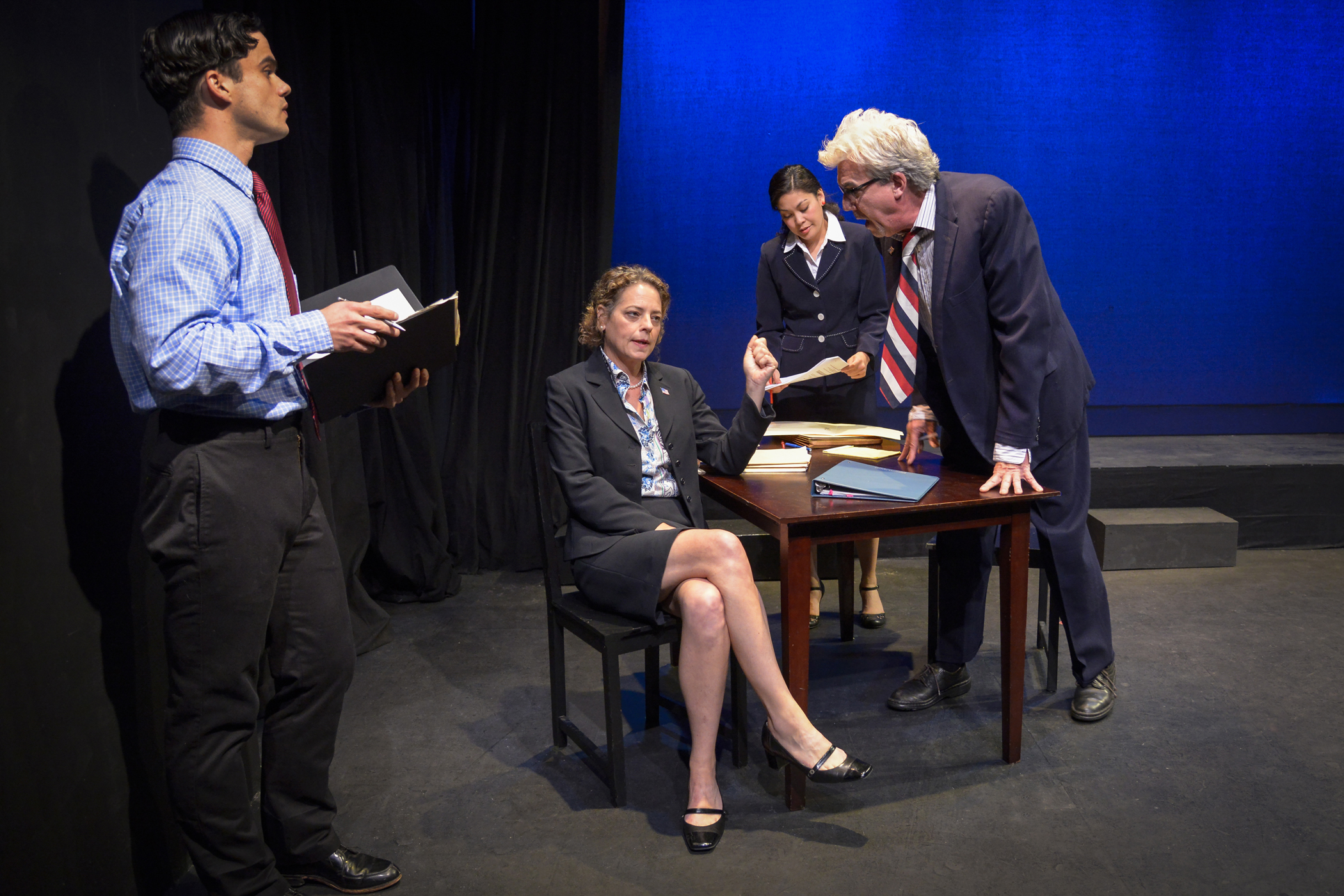
“Game On” serves up a plate of fantasy baseball, Silicon Valley and environmentalism in a world premiere presented by San Jose Repertory Theatre.

Playwrights Dan Hoyle and Tony Taccone combine all these elements through the two main characters, Vinnie (Marco Barricelli) and Alvin (Craig Marker), who share a passion for fantasy baseball and the San Francisco Giants. They’re watching a game in the media room of a Los Altos mansion while hoping to talk with an investor who’ll fund their idea for a new enterprise — insects as a tasty, protein-rich, environmentally friendly food in the United States. Vinnie has even prepared two plates of spring rolls made with the critters.

While they wait, they’re visited by Bob (Mike Ryan), who’s not as innocuous as he seems at first; Glen (Cassidy Brown), the party’s host and an avid environmentalist; and Beth (Nisi Sturgis ), Glen’s wife. Alvin knows Glen and Beth from college.

Barricelli’s Vinnie, a cab driver, is rumpled and not too polished. Marker’sAlvin, an unemployed Wall Street type, is better dressed and smoother. Both have urgent, almost desperate reasons to turn their idea into a money-maker.

Director Rick Lombardo nicely orchestrates the action by the excellent actors despite shortcomings in the script. One is that the arguments between Vinnie and Alvin go on too long. Another shortcoming might be a director’s choice, and that’s toward the end of the 90-minute, intermissionless play, when the two men get involved in a food fight. People in the front rows might be hit with flying bits of rice and lettuce (no bugs, though).

Glen’s enviro-rap is a bit much, too, although his whale imitation is terrific.

The set by John Iacovelli reflects the mansion’s elegance, enhanced by David Lee Cuthbert’s lighting and Lombardo’s sound. Costumes by Denitsa Bliznakova are well suited to the characters.

Hoyle, known as a solo performer, and Taccone, artistic director of Berkeley Repertory Theatre, have a sound premise for the play, but it needs some refining and perhaps refocusing.

“Game On” continues at San Jose Repertory Theatre through April 19. For tickets and information, call (408) 367-7255 or visit www.sjep.com.


TheatreWorks stages ‘Hound of the Baskervilles’ spoof

By Judy Richter

One of Sir Arthur Conan Doyle’s most famous Sherlock Holmes mysteries, “The Hound of the Baskervilles,” comes to hilarious life in a spoof staged by TheatreWorks.

This stage adaptation by Steven Canny and John Nicholson uses only three actors, plus two stagehands, to relate the story of a longtime Baskerville family curse that supposedly involves untimely deaths and a vicious dog that stalks the desolate moors around their remote English home.

It begins when the surviving Baskerville heir, Sir Henry Baskerville (Darren Bridgett), seeks the help of Sherlock Holmes (Ron Campbell) and his colleague, Dr. John Watson (Michael Gene Sullivan), in investigating the recent death of his uncle, the previous family heir. Sir Henry also has an unsigned note warning him not to go to the moors.

Holmes asks Watson to accompany Sir Henry to the Baskerville home in Dartmoor while he remains behind in London. When Sir Henry and Watson arrive in Dartmoor, they encounter several strange people. After Holmes joins them, they solve the mystery, but not without some close calls.

Because all three actors must portray a variety of characters,  they make some lightning-quick costume changes facilitated by costume designer B. Modern.

Andrea Bechert’s scenic design is flexible, aided by Steven B. Mannshardt’s lighting and Cliff Caruthers’ sound. Many staging effects are purposely obvious, such as the fog machines periodically wielded on stage by two stagehands.

Because the three actors are so skilled and because director Robert Kelley paces the action so well, the show is amusing and absorbing throughout most of its two acts. The one superfluous scene comes at the beginning of Act 2, when the actors recap Act 1 at breakneck speed, supposedly to make up for things that some audience members might have missed the first time. Bridgett also has some unnecessary forays into the audience.

Besides the silliness and the story itself, this production features a chance to watch three highly skilled Bay Area actors at work. That in itself is ample reward.

“The Hound of the Baskervilles” will continue at the Mountain View Centerfor the Performing Arts, 500 Castro St., Mountain View, through April 28. For tickets and information, call (650) 463-1960 or visit www.theatreworks.org.

GAME ON hits a three bagger

By Kedar K. Adour

(l-r) Craig Marker and Marco Barricelli

GAME ON: Comedy by Dan Hoyle and Tony Taccone. Directed by Rick Lombardo. San Jose Repertory Theatre, 101 Paseo de San Antonio, San Jose. (408) 367-7255. www.sjrep.com.

Through April 19, 2014

GAME ON hits a three bagger [rating:3] (3 of 5 stars)

Dan Hoyle and Tony Taccone are sort of strange bedfellows when it comes to playwriting. That statement is not intended to denigrate their individual theatrical accomplishments. Taccone is multi-award winning artistic director for Berkeley Rep and Hoyle is an award winning solo performer. Individually they have had their other plays produced garnering good to fair reviews. The story behind how these two got together to write a comedy/farce that combines fantasy baseball, global warming, venture capitalism, high cost of medical care and entomophagy would make fascinating reading.

To spare you the chore of having to look up the pronunciation and meaning of ‘entomophagy’: en·to·moph·a·gy is the practice of eating insects and the word first appeared in the English lexicon in 1975. It will now be recognized in MS Word spell checker. The practice, according to the press notes, is common in most cultures especially in Asia. The insects are an excellent source of protein.

Two men with diametrically opposite personalities are peddling a proposition to a venture capitalist to back the formation of a company fostering entomophagy. With global warming and the scarcity of water upsetting the natural order of the world there will be a need to have alternate sustainable source of protein to replace the reliance on beef. The concept is brainchild of divorced charismatic taxi driver Vinnie (Marco Barricelli) and his cohort pushing the deal is a slick numbers-cruncher Alvin (Craig Marker). The bond between the men is their addiction to fantasy-baseball.      

The local angle for this world premiere is the proximity of Silicon Valley and the intense rivalry between SF Giants and LA Dodgers baseball clubs. The action takes place in an elegant spare room (set by John Iacovelli) of a mansion in Los Altos where a party is underway that includes a billionaire financier. Vinnie has brought along spring rolls filled with insect delicacies. While they are waiting for Alvin to make the pitch (get the baseball reference?) the two erstwhile entrepreneurs indulge in bickering about making trades for players on their fantasy baseball teams. Television projections of a baseball game intermittently are flashed on the back wall.

Barricelli and Marker are two of the most sought after actors in the Bay Area. They do not disappoint with Barricelli giving life to an ebullient Vinnie and Marker’s Alvin keeping him in check with his sincerity.  They are a joy to watch since the roles are antithesis of previous dramatic outings demonstrating their talents in comedy/ farce.

The play starts out as a routine comedy, dabbles in socio-economic themes and personal medical/monetary problems before it ends in all out farce in its 90 minute (no intermission).  Marker’s Alvin has to dissolve into a histrionic panic attack before the dénouement. The intrepid duo is ably supported by Mike Ryan (Bob), Nisi Sturgis (Beth) and Cassidy Brown (Glen) with Brown taking control of the stage in a hysterical if implausible defender of world ecology.

Yes, Vinnie and Alvin do not get their windfall but the ever inventive Vinnie comes up with a scheme that involves ‘over and under’ betting on when individual devastations of global warming will occur. The trip from San Francisco to San Jose was well worth the drive and this reviewer learned about fantasy baseball, venture capitalism, ‘over and under’ betting and finally en•to•moph•a•gy.

CAST: Vinnie, Marco BarriceI1i; Alvin, Craig Marker; Bob, Mike Ryan; Glen, Cassidy Brown; Beth Nisi Sturgis.

Artistic Collaborators: Scenic Designer John lacovelli; Costume Designer Denitsa Bliznakova; Lighting Designer David Lee Cuthbert; Sound Designer Rick Lombardo; Original Music Haddon Kime; Casting Director Kirsten Brandt; Drarnaturg Karen Altree Piemme; Stage Manager Laxmi Kumaran, Assistant Stage Manager Deirdre Rose Holland.

Kedar K. Adour, MD

Courtesy of  www.theatreworldinternetmagazine.com


.


Painting the Clouds with Sunshine a world premiere “Depression Era” musical by 42nd Street Moon

By Kedar K. Adour

Painting the Clouds with Sunshine: Musical Comedy. World Premiere by Greg MacKellan and Mark D. Kaufmann. 42nd Street Moon, the Eureka Theatre, 215 Jackson St, San Francisco, CA 94111. (415) 255-8207 or go to www.42ndstmoon.org. Ends April 20, 2014

Painting the Clouds with Sunshine a world premiere “Depression Era” musical by 42nd Street Moon [rating:5]

42nd Street Moon, famous for resurrecting ‘lost’ musicals for the past 21 years, has mounted a world premiere musical. It is a first for this theatre icon of the Bay Area and they earn accolades for their efforts. It is an evening of song, dance and frivolous fun that brushes away the clouds and adds a star to the firmament.

The show had its genesis with “Sing Before Breakfast: Songs from the Great Talking Picture Musicals”, a CD” by artistic director Greg MacKellen who collaborated with Mark Kaufmann to produce this book musical using lesser known songs of the Great Depression Era. It is a tribute to San Francisco’s deceased Bob Grimes whose collection of sheet music dates back to the 1930’s. Yes, you will recognize some of the songs but they are not the old standards that graced the stage in the well known musicals.

The collaborators have set the time as 1935 and the place Hollywood. If it was not advertised as a world premiere, which it is, it could have been passed off as another ‘lost musical’ brought back to life. The staging, costumes, humor, dancing and the storyline are perfect in keeping with the musical genre of the 1920s through 1940s.

For this show it is 1935, the middle of the Great Depression when the musicals were meant to cheer up the populace who flocked to the theatres to see upbeat fare. It all takes place in and around Hollywood the mecca for striving young starry-eyed dreamers attempting to gain fame and fortune in the movies. One of those young dreamers (she sings and dances) is Alice (Kari Yancy) working in the proverbial Hollywood Boulevard eatery with older, wiser, loveable Willa (Cami Thompson).  Enter ‘no money in his pockets’ handsome George (Galen Murphy-Hoffman) to flip over Alice. Willa has her paramour Gil (John-Elliot Kirk) and both couples have problems getting together adding the needed touch of “true love never runs true” truism.

Add a loveable shady news-stand operator Jake ( Justin Gilman, he doubles as a barman) and quick-with-the-quips smart-mouth Joyce (Nicole Frydman) for the needed humor. For a bit of spice throw in sexy Iris (Allison F. Rich) and a utility actor with multiple roles (Ryan Drummond) and the cast is complete.

The entire cast (with a minor exception) is great in their lead roles and excellent when needed for the ensemble. Staci Arriaga has wisely kept the dancing simple and lively and 42nd Street musical director Dave Dobrusky receives his well-earned applause while on the stage for the entire show (two hours and 20 minute including the intermission). Felicia Lilienthal’s 1930s costumes are a drag queens dream.

All the songs are upbeat. Some you will recognize: “Painting the Clouds With Sunshine”, “Did You Ever See A Dream Walking?”, “You Oughta Be In Pictures”,  “Jeepers, Creepers”,  “Sing You Sinners”,  “Sweeping The Clouds Away.”  A few you will not recognize but are cleverly perfect to carry the story forward and add a smile to your  face: “Breakfast Table Love”, “Livin’ In The Sunlight, Lovin’ In The Moonlight”, “You Hit the Spot”, “Dusty Shoes”, “Gather Lip Rouge While You May”, “Are You Making Any Money?”, “I’m Feathering a Nest”, “There’s A Riot In Havana” and more.

All in all, a charming world premiere with top-notch singers/actors, beautiful girls, handsome men, pleasant dancing, gorgeous costumes, colorful set and Dave Dobrusky. Three cheers and five stars go to Greg MacKellan and Mark D. Kaufmann.

CAST: (Russell James & Rocco) Ryan Drummond; (Iris Langston) Allison F. Rich; (Jake& Barman) Justin Gillman; (George Fenton) Galen Murphy-Hoffman, (Alice Collins) Kari Yancy; (Willa Brennan) Cami Thompson; (Gil) John-Elliott Kirk; (Joyce Aubrey)   Nicole Frydman.

ARTISTIC STAFF: Directed by Mark D. Kaufmann; Music Director: Dave Dobrusky

Choreographer: Stag Arriaga; Stage Manager: Maria Difabbio; Production Manager: Hector Zavala; Set Design: Hector Zavala; Costume Design: Felicia Lilienthal

Lighting Design: Danny Maher; Props: Amy Crumpacker.

Kedar K. Adour, MD

Courtesy of www.theatreworldinternetmagazine.com

Shostakovich Trilogy — San Francisco Ballet Performance Review

By Joe Cillo

Shostakovich Trilogy

San Francisco Ballet Performance

April 8, 2014


The Shostakovich Trilogy is a well conceived, expertly performed dance by the San Francisco Ballet.  It is divided into three segments all set against music by Shostakovich and separated by two intermissions.  The dancers’ movements are smooth, fluid, and graceful throughout this ballet.  Both men and women participate in all three ballets.  The men and women interact.  They touch each other, pick each other up, carry each other.  There is good interaction between the sexes throughout the three ballets.  The sets and costumes are simple, if not minimal.  In the first segment there is a plain gray floor against a gray backdrop.  In the second segment there is a backdrop with some painted imagery, and in the third there are bright red geometric objects suspended above the stage.  This show is not about visual imagery and special effects.  It is all about movement and the dance, and the dancers really show us what they can do.   When you’ve got dancers like these, you don’t need too much else.

The first segment, Symphony #9, is lighthearted and energetic.  As it goes along it turns darker, but generally remains upbeat.  The program notes allude to an atmosphere of dread or angst that is supposed to underlie this superficial gaiety, but I didn’t get it.  Maybe you have to have lived in Stalinist Russia for that to come across.  I noticed the change in mood, but it felt to me more like a sense of tragedy rather than foreboding or fear.  I need to see it again.  One time is not enough to really absorb this ballet.  There is a lot of substance here and the relationship between the dance and the music is rather sophisticated.  A lot of thought went into this, and I think two or three viewings might yield a better sense of it.

The second segment, Chamber Symphony, features three women against one man with small troops of women and men as backups.  The music is profoundly tragic and pervaded by an atmosphere of abysmal despair.   The nature of the relationships between the women and the man is not clear, but you get the feeling that this is not a happy campsite.  The women dance in triplicate much of the time with the lead male, but they do not seem to interact among themselves.  There are interludes where each woman dances in a pair with the man, and these seem problematic.  These dances are emotionally inconclusive, but the whole thing takes place in a pervasive atmosphere of abysmal despair provided by the underlying music.  There is one section where the music is almost funereal, but the couple is still dancing with animation and energy that seems out of sync with the music.  Normally I would think there was something wrong with this.  I like the dancing and the music to complement one another and not create an emotional clash.  But in this case, as explained in the program, part of the import of Shostakovich’s music, and this ballet in particular, reflects a superficial presentation of upbeat optimism and well being in Russian society under Stalin, but the underlying reality is dark, sinister and pervaded with fear.  Therefore the music carries the “real” message while the dancers reflect the pretense of well being.  I would not get this without having it explained to me.  The Russian audiences who lived out their lives in that kind of duality probably did get it.  I think in America, although we do have a lot of hypocrisy and sinister undercurrents in our society, it is not so pervasive and dark and unrelenting as it was under Stalin.  So I don’t think Americans will grasp this spontaneously unless it is explained to them.  The ballet ends enigmatically, but the overarching mood of the piece is one of unmitigated tragedy and despair.

The third ballet, Piano Concerto #1, is a more positive, forceful, high energy display of dance virtuosity.   The principal ballerinas are sexy in their bright red satin bodices that show off their perfect legs to excellent effect.  It is rather abstract in content.  There are no discernible relationships or story line being depicted.  This is a dancers’ ballet and you could feel the dancers’ thrill and pleasure to be performing it, and it was a visual treat to watch.

I wouldn’t mind seeing this Trilogy again.  It was a bit of a challenge, but an enjoyable spectacle that drew upon the capabilities of the high quality dancers and tasteful, imaginative choreography set against interesting, powerful music.  It coursed through a variety of moods and presented an interesting counterpoint between the music and the dance.  I wish I could say more about it, but I don’t think I absorbed everything that was important about this ballet on the first viewing.  I feel like I need another look to really get it, but I give this one a very favorable recommendation.


Finished book and little candy hearts bring writer delight

By Woody Weingarten


Mock-up for book, “Rollercoaster.” Design by Edward Marson; cover photo by Larry Rosenberg.

I can get really excited about little stuff.

So can Nancy Fox, my wife.

A few days back, for instance, she was bouncing on air because she’d had the vintage knives in our San Anselmo kitchen sharpened.

“Unbelievable,” she exclaimed. “They’re like new!”

I loved her enthusiasm.

Almost as much as I’d loved my own ecstasy when I recalled a guilty pleasure from childhood — a bowlful of sliced sweet gherkins and sour cream.

Others may grimace, but I blissed out again.

Big things can also electrify me.

Such as completing tweak No. 8,957 of “Rollercoaster,” my book manuscript that details how a man can survive his partner’s breast cancer.

I finally believe it’s ready for prime time — after years and years of updating and polishing.

Maybe one of you, my steadfast readers, can nurture the project.

If you know a publisher who might be interested, I’d be interested in your giving me name, rank and serial number. If you’re connected to a foundation and think I could be eligible for a grant, send me the details — pronto. If you know a philanthropist who might help buoy thousands and thousands of male caregivers, email, snail-mail, carrier-pigeon or smoke-signal me the info.

“Rollercoaster” is a 47,000-word memoir-chronicle of my wife’s breast cancer 19 years ago — and my role as primary caregiver (and leader of the Marin Man to Man support group for guys with partners in the same sometimes leaky boat).

Fleshed out by essential “how-to” sequences and information on drugs, scientific research and where to get help.

Because I’m more concerned with getting the message out than in making money, I’m willing to donate all royalties to a breast-cancer research organization or relevant nonprofit.

Time’s a-wastin’ — the stats haven’t improved.

More than 2 million U.S. women live with breast cancer, with almost 250,000 new cases diagnosed each year, one every few minutes.

Hundreds of books are aimed at them.

But their male caregivers (husbands, boyfriends, fathers, sons and brothers) typically become a forgotten part of the equation.

And they, too, need propping up.

The few volumes directed at them and still in print are woefully out of date. “Rollercoaster,” in contrast, is current (with references, even, to last month’s New York Times story on a key study of mammograms).

“Rollercoaster” tracks my bumpy yet uplifting journey from the depths of Nancy’s diagnosis to the heights of our climbing the Great Wall of China. It illustrates that most couples can successfully deal with the disease itself, “slash, poison and burn” treatments, fear, and the repercussions of it all — and that there actually can be light at the end of the tunnel.

I must believe in the book or I wouldn’t have tinkered with it 8,957 times.

I’m primed for a “Rollercoaster” hardcover to appear in oncologists’ and radiologists’ offices, in hospitals and libraries, and in the hands of individual caregivers and patients.

But I truly don’t want to change the text anymore — unless Brad Pitt calls me and wants to write an intro (so, if anyone knows how to get to him, tell me).

And I truly reject the idea of papering my walls with rejection notices.

Northern Californian Jack London got 600 of them before publishing anything. And Gertrude Stein submitted poems for 22 years before one was accepted.

I don’t have that kind of patience.

Nor do I want to be published posthumously.

I do want to help all the male caregivers of breast cancer and other life-threatening diseases that need support — while I’m still breathing.

So I guess I’ll just walk my purebred mutt, Kismet, in downtown San Anselmo while waiting for a fairy godmother to arrive with a publisher in tow.

And settle, for the moment, for being thrilled by the little stuff.

Like my wife creating a Seuss-like rhyming treasure hunt last month, with the Big Prize being a small box of tiny candy hearts.

I loved her reverting to her kindergarten-teacher days and getting me to run up and down stairs so many times I decided to forgo my daily exercises.

“Ten clues are written,” she wrote,

“For Valentine’s Day,”

“To celebrate ours”

“In a new, goofy way.”

Yes, being thrilled is a thrill — whether it’s tiny, silly things or big, important stuff.

EVERY FIVE MINUTES features Rod Gnapp at his best

By Kedar K. Adour

Harpo (Jomar Tagatac), and Bozo (Patrick Alparone) prepare to bring Mo (Rod Gnapp) home in EVERY FIVE MINUTES at Magic Theatre through April 20. By Linda McLean, directed by Loretta Greco. Photo: Jennifer Reiley

Every Five Minutes: Drama by Linda McLean and directed by Loretta Greco. Magic Theatre, Fort Mason Center, 2 Marina Blvd., Building D, 3rd Floor, San Francisco, CA 94123.  415.441.8822 or  www.magictheatre.org. March 26- April 20, 2014

EVERY FIVE MINUTES features Rod Gnapp at his best [rating:2] (2/5)

Linda McLean’s latest play Every Five Minutes is being given its world premiere by the Magic Theatre known for its strong commitment to new, innovative and avant-garde theatre. Two years ago they mounted a brilliant production of McLean’s stunning, sharp edged Any Given Day. That play was part of Magic’s annual Virgin Play Series where scripts are in various stages of development are read and critiqued. Author McClean, who is highly respected in her native Scotland and throughout the UK, was experimenting with form. She continues that experimentation with Every Five Minutes but she misses the mark and seems pretentious.

This time the experimentation is depiction of a mind thrown into turmoil after 17 years of incarceration and torture. It is the mind of her major character Mo being given a superlative performance by local icon Rod Gnapp. His unique ability to create believable characters with tortured and often convoluted minds is legendary.  His notable most recent time upon the stage were Buried Child at the Magic and Storefront Church at SF Playhouse. He is at his best again and single-handedly gives credibility to McLean’s and Magic Theatre’s attempt to give credence to the play.

Non-linear plays tax the audience’s ability to make sense of time frame shifts and eventually understand what is happening. To aid the audience in this endeavor the author and director Greco use projections with simple “This Time”, or “This Time, Before” or “This Time and Another Time”, or “This Time but earlier” and later “From the Beginning.” Interspersed with these and other projections are a cacophony of sound and light that jar the senses.

Those blaring sound and lights supposedly are reflections of Mo’s troubled mind. It all begins simply enough when Mo is returned to his home after his hellish incarceration. We learn the convoluted facts in bits and pieces. McLean invents two clowns Bozo (Patrick Alparone) and Harpo (Jomar Tagatac) as figments of  Mo’s mental deterioration. They verbally and physically abuse and assuage Mo brutalized mind.

We eventually learn the time frame of the play and Mo’s relationship to his past by the fact that early on there is the birth of baby Molly to Rachael (Carrie Paff) and Ben (Sean San Jose). When Molly enters late in the play (Shawna Michelle James) she is 17 years old and Mo’s faulty recollection becomes a major crisis.

Patrick Alparone and Jomar Tagatac carry the physical burden of the play with professional style being both insidious with a modicum of humor.  The charming Maggie Mason gives a solid performance as a Census Taker and other ensemble roles. Carrie Paff and Sean San Jose are underutilized in their parts adding little to McLean’s experimentation with decent into madness.

Running time a long, long 90 minutes.

CAST: Rod Gnapp, Mo; Mia Tagano, Sara; Sean San José, Ben; Carrie Paff, Rachel; Patrick Alparone, Bozo; JomarTagatac, Harpo;  Maggie Mason, Census Taker;  Shawna Michelle James, Molly.

CREATIVE TEAM: Set and light design by Eric Southern, costume design by Alex Jaeger, sound design by Sara Huddleston, and innovative video and projection design by  Hana Kim

Kedar K. Adour, MD

Courtesy of www.theatreworldinternetmagazine.com

Harpo (Jomar Tagatac), and Bozo (Patrick Alparone) prepare to bring Mo (Rod Gnapp) home in EVERY FIVE MINUTES at Magic Theatre through April 20. By Linda McLean, directed by Loretta Greco. Photo: Jennifer Reiley


Harpo (Jomar Tagatac) and Bozo (Patrick Alparone) ) in EVERY FIVE MINUTES at Magic Theatre through April 20. By Linda McLean, directed by Loretta Greco. Photo: Jennifer Reiley

SLEUTH another winner at CenterRep in Walnut Creek

By Kedar K. Adour


SLEUTH: Mystery by Anthony Shaffer. Directed by Mark Anderson Phillips. Center REPertory Company, 1601 Civic Drive in downtown Walnut Creek.: Lesher Center for the Arts, Civic Drive at Locust, Walnut Creek.925-943-7469 orwww.centerrep.org

March 28 -April 26, 2014

SLEUTH another winner at CenterRep in Walnut Creek [rating:4] (4/5 stars)

Be advised that the cast members after their well deserved thunderous applause at the curtain call pleaded with the audience not to give away the totally surprise ending but do tell your friends about how much you enjoyed the show. OK, fair enough especially since all is not what appears to be, including the program.

What we do know, and all that you will learn from this reviewer, is that it all begins when an egotistical, successful, both professionally and financially, mystery writer Andrew Wyke (Kit Wilder) inviting his wife’s lover Milo Tindle (Thomas Gorrebeeck) to his country home in Wiltshire, England. His home is a palatial mansion (Michael Locher’s stunning five stars set is worth the price of admission) furnished with paraphernalia reflecting his obsession with playing games.  Kit Wilder gives a magnificent portrayal of Wyke’s supercilious, devious, arrogant, privileged yet personable nature necessary to make the plot line plausible.

Enter handsome, charming, sexy Milo, the son of an Italian immigrant, with only public school education and not very financially secure. Andrew on the surface does not seem to mind his wife’s dalliance since he has a mistress but there is a hint of jealousy about Milo’s good looks and virility.

l-r Kit Wilder as Andrew, Thomas Gorrebeeck as Milo

Since Milo will need money to keep his paramour in the manner she is accustom to living with Andrew, maybe Milo would not be adverse to play a game that would supply Milo with money but require a theft of her jewels. OK. Milo is ‘game” and allows Andrew to set up the game that will appear like a robbery by a man dressed as a clown. (Don’t ask!) The interaction between Milo and Andrew gets weirder and weirder and director Mark Anderson Phillips moves his characters around as if playing a chess game. One might conjecture that the upsetting of the chess board earlier in the act may be symbolic of what is to happen. The first act curtain is a stunning killer with the set in total disarray.

When the curtain rises (actually the lights come up, there is no curtain) the set is again immaculate and all the toys are back in place. The peaceful ambiance is upset when inspector Doppler arrives announcing that Milo Tindle has disappeared and there is information that the last place he visited was Andrew’s mansion. Surprise after clue after clue is discovered and the previous unflappable Andrew is at his wits end.

As the second act continues, there is twist and turns along with the surprises that will leave you befuddled but Anthony Shaffer’s brilliant writing wraps up the evening with all the loose ends tied up.

Running time 1 hour 45 minutes with an intermission.

SLEUTH: By Anthony Shaffer. Directed by Mark Anderson Phillips. 

Cast: Philip Farrar, Inspector Doppler; Harold K. Newman, Detective Sargeant Tarrant; Roger Purnell, Police Constable Higgs; Thomas Gorrebeeck, Milo Tindle; Kit Wilder, Andrew Wyke.

Production staff: Scenic Designer, Michael Locher; Lighting Designer, Kurt Landisman; Costume Designer, Maggie Whitaker; Sound Designer, Theodore Hulsker; Stage Manager, Kathleen J. Parsons; Props Master, Shaun Carroll; Wigs, Judy Disbrow; Fight Director, Kit Wilder.

Kedar K. Adour, MD

38TH HUMANA NEW AMERICAN PLAY FESTIVAL: February 26 –April 6, 2014

By Kedar K. Adour

38TH HUMANA NEW AMERICAN PLAY FESTIVAL: February 26 –April 6, 2014

Actors Theatre of Louisville, 316 West Main Street, Louisville, KY 40202. 502-584-1205, or www.actorstheatre.org.

Reams of accolades could be written about the plethora of fine acting, directing and production values at the Humana New American Play Festival but for these capsule reviews the emphasis is on “the plays the thing.” In reference to the running times please note that none of the plays have an intermission.

It is very appropriate that the sentence above should be used as the header for all the Humana New American Play Festivals. The venue at Actors Theatre of Louisville is composed of three superb performing areas outfitted with all the conceivable technical paraphernalia one can imagine. There is the commodious proscenium arch Pamela Brown Auditorium, the theatre-in-the-round Bingham and the intimate “black-box” Victor Jory thrust stage.  One might wonder about the process used select the space for each play. With one notable exception the venue selection was appropriate.

That one exception is the staging of brownsville song (b-side for tray) (no capitals used in the title) by Kimber Lee and directed by Meredith McDonough of TheatreWorks fame for overseeing their New Works Festivals in Palo Alto. She is now the associate artistic director to Les Waters formerly of Berkeley Rep who is in his second season as artistic director at Actors Theatre.

brownsville song is a small personal confidential play wrapped in socially injustice. Brownsville in Brooklyn is predominately a Black neighborhood with a myriad of social ills and perilous dangers. Living in this milieu is Kimber Lee’s protagonist Tray an intelligent, athletic high schooler, his grandmother Lena and young sister Devine whom he looks after as a surrogate father.

The play is non-linear moving back in forth in time but in doing so does not clearly delineate the relationships and needs a re-write. It begins with Lena’s dynamic monolog trying to give meaning to Tray’s death in a drive-by shooting.

Tray is offered help in preparing an application for a college scholarship by a woman, Merrell, who has been in an alcoholic rehabilitation center. As mentioned in the previous paragraph it is difficult to ascertain that Merrell is Devine’s mother and Tray’s step-mother.

The pathos of the play loses impact being performed on the entire massive stage area. Huge panels move back and forth and up and down with every change of scene. Never-the-less, when the author clarifies the relationships of the characters this play will “have legs” moving on to other venues.

brownsville song (b-side for tray): Drama by Kimber Lee and directed by Meredith McDonough. THE CAST: Lena, Cherene Snow; Devine, Sally Diallo; Tray, John Clarence Stewart; Merrell, Jackie Chung; & Junior/Brooklyn College Student, Joshua Boone.

Performing the SITI Company’s Steel Hammer in the Victor Jory Theatre was a stroke of genius befitting the style of Anne Bogart who combines dance, drama and music into her signature performance pieces. She has commissioned playwrights Kia Corthron, Will Power, Carl Hancock Rux and Regina Taylor to dramatize the story of John Henry who in the 1800s died working on the railroad and was made famous in song.

Interwoven with the dance and drama are music and lyrics of Julie Wolfe performed and recorded by Bang on a Can All-Stars and Trio Medieval. The six member cast headed by Eric Berryman playing John Henry give riveting performances with Berryman portraying the four versions John Henry to perfection. In the stage directions he must run a mile in the two hours upon the stage tiring himself as well as the audience. After one hour the accolade of “riveting” is replaced by “tedious. Judicious editing is needed before it would be ready for a road tour. Running time 2 hours.

Steel Hammer: Performance Piece directed by Anne Bogart with music and lyrics by Julia Wolfe and original text by Kia Corthron, Will Power, Carl Hancock Rux and Regina Taylor with recorded music performed by Bang on a Can All-Stars and Trio Mediaeval performed and created by SITI Company.

STEEL HAMMER WRITTEN AND PERFORMED BY SITI ;THE CAST (in alphabetical order): Akiko Aizawa; Eric Berryman; Patrice Johnson ChevannesGian-Murray Gianino; Barney O’Hanlon; Stephen Duff Webber.

Lucas Hnath’s play The Christians would be appropriate selection for the SF Playhouse as a follow-up on their January staging of Storefront Church by John Patrick Shanley.  (SF Playhouse Artistic Director Bill English was in attendance). This capsule review has a personal flair since my youngest brother is a Pentecostal minister! Be assured that Fundamentalists look with askance at messing with the Bible. Author Hnath writes with authority since he was reared in such a milieu and in his youth gave sermons to the congregation.

Hnath is very even-handed in dealing with his subject matter and leaves the ultimate decision to believe or not to believe up to the audience. The Pastor of a financial secure mega-congregation Fundamentalist church has had a revelation that the accepted Biblical concept of Hell being a place of fire and brimstone where the un-baptized (non-believers) are condemned to eternal damnation is not true.

The first to challenge the Pastor is a black associate pastor Joshua who had been ‘saved’ from a life of non-belief and through rigorous diligent prayer has been elevated to his present position gaining the trust and reverence of the congregation. He is asked to leave Pastor’s church and in doing so takes a significant portion of the congregation with him.

By adding only three other characters to the mix, Hnath clearly defines the financial workings and ingrained beliefs of the church. There is the Elder who outlines the devastation to the financial basis, a young Congregant who sincerely question’s the Pastor’s motivation and the Pastor’s Wife who has faithfully believed in the goodness of her husband but now has severe reservations.

Director Lee Waters simply and elegantly stages the play with four ecclesiastical chairs down stage center and a church choir behind to add verisimilitude to the surroundings. The main characters all use hand held microphones even when talking to one another giving an aura of didactism yet the superb actors give depth to their lines and their questions will become your questions. All this takes place in 80 minutes and is ready to go on the road.

The Christians: Drama by Lucas Hnath an directed by Les WatersTHE CAST: Pastor, Andrew Garman; Associate Pastor, Larry Powell; Elder, Richard Hensel; Congregant, Emily Donahoe; Wife, Linda Powell.

 Partners by Dorothy Fortenberry is a modern day pot-boiler in the mode of a TV soap-opera. It takes place in early 2012 one year after same-sex marriage (Marriage Equality Act) act was passed in New York State. The author may wish to revise the play after reading “Same-Sex Marriage — A Prescription for Better Health” by G. Gonzales in N Engl J Med 2014;370:1373-1376.

The play is really two stories that could individually be interesting but as written intertwining the frailties of a straight marriage and advantages/disadvantages of gay marriage leaves each  subject superficially explored and at times banal.

Clare, an aspiring chef and husband Paul a well paid law firm technological worker had written there own marriage vows without the traditional “love, honor and obey” clause. Gay, underemployed (no health insurance) Ezra is Clare’s potential business partner planning to enter the booming food truck business. Brady, his boyfriend, is an under paid teacher/bread-winner thus making daily living problematic.

Clare gets a bundle of money from a medical class action lawsuit. Think of the axiom about money not solving problems. Clare and Paul have a falling out. She also does not tell Ezra that she has the money to finally get the food truck up and running. Inexplicably she donates most of the money to groups supporting legalization of same-sex marriage. Don’t ask why. There are spurts of cogent dialog with most of the humor being garnered by Ezra’s gay demeanor. Conclusion: Partners is not ready for prime time. Running time 105 minutes.

Partners: Comedy/Drama by Dorothy Fortenberry and directed by Lila Neugebauer

THE CAST: Clare, an aspiring chef, Annie Purcell; Paul, her husband, David Ross; Ezra, Clare’s best friend and business partner, Kassey Mahaffy; Brady, Ezra’s boyfriend, Leroy McClain.

Last but hardly least the Humana Festival has brought back Jordan Harrison for the fifth time with The Grown-Up. He is no stranger to San Francisco where his plays Maple and Vine, Finn in the Underworld and Act a Lady were performed at A.C.T, BerkeleyRep and the New Conservatory Theatre Center respectively.

In The Grown-Up Harrison spins a magical semi-autobiographical tale as seen through the eyes of 10 year old Kai who has been told by his grandfather that the glass door knob on the linen closet once was the eye of a pirate ship’s maidenhead. Placing that glass door knob on any door will lead you into magical worlds. You guessed it,  Kai takes the glass door knob, places it on various doors and he has a journey through his future life ending with his burial.

The journey as written by Harrison is carried forth by a cast of six playing multiple roles in a 70 minute romp that includes charming vignettes as Kai races through life emphasizing Alfred North Whitehead’s concept of relative time. There surely will be some rewrites before this play makes a successful run through professional and community theaters in the years to come.

The Grown-Up: Comedy by Jordan Harrison and directed by Ken Rus Schmoll

THE CAST: Kai, Matthew Stadelmann; Brooke Bloom;  Paul Niebanck; Tiffany Villarin; Chris Murray; David Ryan Smith.


Kedar K. Adour, MD

Courtesy of www.theatrworldinternetmagazine.com

Droll, life-affirming monologist merits a look-see

By Woody Weingarten

 Woody’s [rating:4/5]

Charlie Varon adopts multiple identities, including the title character, in “Feisty Old Jew.” Photo: Myra Levy.

Charlie Varon changes his voice and face and characters as fast as Miley Cyrus can twerk.

In “Feisty Old Jew,” his new one-man show at The Marsh in San Francisco, he portrays twentysomething surfers and members of a retirement home breakfast club.

But easily his most memorable character is the cranky Bernie to which the title refers.

Varon being 55 didn’t stop me from totally accepting him in the mind and body of a gutsy 83-year-old determined to go out fighting.

The plot of the comic monologue involves a mega-rich Indian techie reared in California, his best-selling author sister and a white surfer who pick up hitchhiking Bernie in their Tesla, haul him across the Golden Gate Bridge, and watch him try to ride a wave near Bolinas — the outgrowth of an 800-to-1 bet that could net him $400,000.

It’s a droll theatrical exercise grounded in reality, yet encompassing multiple touches of exaggeration that made me smile again and again,

And I was not the least thrown by its surprising, fantastical wind-up.

A Jewish background isn’t necessary to enjoy the show, because it’s more about the changing human and cultural landscape of the Bay Area and the aging process than Jewishness.

Take that as gospel from this feisty old Jew (even though I don’t hate yoga studios or medical marijuana outlets as Bernie does).

Yes, he can seem to be the ultimate curmudgeon, especially during descriptions that indicate he despises young people in general and Tony Bennett in particular (for singing with Lady Gaga).

But Varon insists the play’s “about a city in flux…about what I see when I step out of our theater and walk down Valencia Street — the hipsters, the techies, the restaurants serving truffle butter and pink aioli. When I moved to the Mission District in 1978, my rent was $70 a month. Now people pay $70 a month just for lattes.”

The life-affirming show was developed, like other Varon works at The Marsh over 23 years, with director-friend David Ford.

And with additional heavy lifting from Varon’s life partner, Myra Levy.

The program guide credits no craftspeople for costumes, props, sound effects or lighting — because, as usual, Varon relies solely on his rubbery face, gift for mimicry and ability to write impressively descriptive passages and poetic prose.

This tour de force is similar to previous Varon outings I’ve seen — “Rush Limbaugh in Night School,” “Ralph Nader Is Missing!” and “Rabbi Sam” — in which he narrated tales through numerous characters, all of whom he ingeniously portrayed.

This one is different, though, because there will be future links — he’s working on an entire series of vignettes about geezers.

Indeed, because “Feisty Old Jew” runs only 45 minutes long, Varon added several minutes by performing a portion of “The Fish Sisters,” a work-in-progress featuring Selma, an 86-year-old prankster who’s time-traveled to age 11, peeking through a keyhole at a naked woman dubbed Queen Esther.

The first complete reading of that piece — a two-hour “tale of mischief” — was scheduled to take place March 9.

The night I caught “Feisty,” it was preceded by a dramatic extract of “The Disappearance of Alfred Lafee,” written and performed by Peter L. Stein, ex-TV producer-writer, documentarian, actor and director of the San Francisco Jewish Film Festival who, Varon explained, “is finding his legs as a solo performer.”

Stein told me later that he’s been working on it for two years, and expects at least six more months of tweaking — with assistance from Ford, Varon’s director.

But “Lafee” is already enthralling as it uncovers a painfully true story about the secret life of a closeted 22-year-old San Francisco rabbi murdered in 1923.

If Stein’s piece still needs work, the lone problem with an evening with Varon is that street parking near The Marsh borders on impossible (although space normally is available at the nearby New Mission Bartlett Garage).

I’m 117 percent confident, however, that seeing “Feisty Old Jew” is worth the trouble.

“Feisty Old Jew” is scheduled to run at The Marsh, 1062 Valencia St. (at 22nd St.), San Francisco, through May 4. Performances, Saturdays at 8 p.m., Sundays at 2 or 7 p.m. Tickets: $25 to $100. Information: www.themarsh.org or (415) 282-3055.