INDIAN INK is beautifully staged at A.C.T.

By Kedar K. Adour

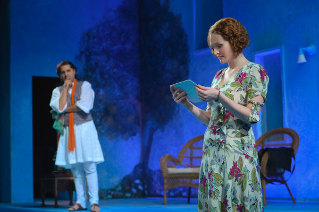
Free-spirited English poet Flora Crewe (Brenda Meaney) reflects on a painting by Nirad Das (Firdous Bamji), an Indian artist who is fascinated with London in Indian Ink, Tom Stoppard’s epic romance that weaves decades, continents, and cultures. Photo by Kevin Berne.

Indian Ink by Tom Stoppard. Directed by Carey Perloff. American Conservatory Theater (ACT), 415 Geary St., San Francisco, CA. (415) 749-2228 or www.act-sf.org.

January 14 – February 8, 2015

INDIAN INK is beautifully staged at A.C.T. [RATING:4]

American Conservatory Theater’s (A.C.T.) artistic director Carey Perloff continues her unabashed love affair with Tom Stoppard with the production of Indian Ink in association with Roundabout Theatre Company. Like the fictional poet Flora Crew (Brenda Meany), the major character in the play, she has found an intellectual soul mate in Stoppard. The theatrical love affair between Stoppard and Perloff is abundantly apparent in Perloff’s brilliant direction of the play. Such intricate direction is absolutely necessary to make the always verbose Stoppard palatable to diverse audiences.  However three hours of a Stoppard play can and does wear thin.

Like Stoppard’s Tony Award winning Arcadia the action of the play shifts between two time frames, often with scenes from both eras intercutting each other. Initially it is the 1980s England where Flora’s sister Nell (Danielle Frimer) is sharing Floras letters with Eldon Pike (Anthony Fusco) an American biographer. Pike’s fascination with the unfinished portrait and its unknown painter piques his inquisitive nature allowing Stoppard to move the action back and forth in time filling in the background with nary a sentence of exposition.

The play originated as a 1991 radio play In the Native State for BBC with the stage version opening in 1995 in London. It had its American premiere (where else?) at A.C.T. in 1999. Since that time Stoppard and Perloff  have re-worked the script and it received a sold out production in New York by the Roundabout Theatre.

Flora is a free-spirited British poet who arrives in Jummapur, India controlled by a Rajah (Rajeev Varma) with the tacit consent of the British Colonial office. She is here to give a lecture to the Theosophical Society and to recuperate from an unexplained illness. During that lecture Das has created a pencil sketch of Flora and upon presenting it to her he expresses his great interest in London and desire to have a British personality. This allows Stoppard to insert references to the Bloomsbury Group and other well-known 1930s luminaries. Flora then consents to allow Das to paint her portrait, not in the manner of a British artist but as an Indian painter.

As the play progresses other characters are introduced and references to Indian inequities under British rule are expertly inserted in the dialog as love blossoms between Flora and Das. Mystery concerning the portrait and an ancient priceless miniature painting of a nude given to Flora by a Raja play a pivotal role in story line. However the storyline is just a vehicle for Stoppard to demonstrate his intellectualism.

The play is handsomely staged, acted and directed. I quote and fully agree: “Neil Patel’s pristine scenery, subtly lit by Robert Wiertzel, enables the large cast to fluidly negotiate the play’s two worlds with minimal props. Candice Donnelly’s gowns for ‘ Brenda Meaney’ are breathtaking, but she has also dressed the other actors to period perfection.” However, to this reviewer and guest the running time of three hours, including the intermission, detracted from a beautiful love story unfolding at a time of cataclysmal upheaval in India.

CAST:  Flora Crewe, Brenda Meaney; Coomaraswami, Ajay Naidu; Nazrul, Vandit Bhatt; Eleanor Swan, Roberta Maxwell; Eldon Pike, Anthony Fusco; Amish Das, Pej Vandat; Nirad Das, Firdous Bamji; David Durance, Philip Mills; Rajah/Politician, Rajeev Varma; Dilip, Kenneth De Abrew; Resident, Mike Ryan; Englishwoman, Mary Baird; Englishman, Dan Hiatt; Nell, Danielle Frimer; Eric, Glenn Stott.

CREATIVE TEAM: Tom Stoppard, Playwright; Carey Perloff, Director; John Carrafa, Choreographer; Neil Patel, Scenic Designer; Robert Wierzel, Lighting Designer; Candice Donnelly, Costume Designer; Dan Moses Schreier, Composer and Sound Designer; Janet Foster, CSA, Casting; Dick Daley, Stage Manager; Megan McClintock, Assistant Stage Manager

Kedar K. Adour, MD

Courtesy of www.theatreworldinternetmagazine.com

Free-spirited English poet Flora Crewe (Brenda Meaney) reflects on a painting by Nirad Das (Firdous Bamji), an Indian artist who is fascinated with London in Indian Ink, Tom Stoppard’s epic romance that weaves decades, continents, and cultures. Photo by Kevin Berne.
The Man Who Knew Too Much: Alan Turing and the Invention of the Computer – Book Review

By Joe Cillo

Summary/Abstract

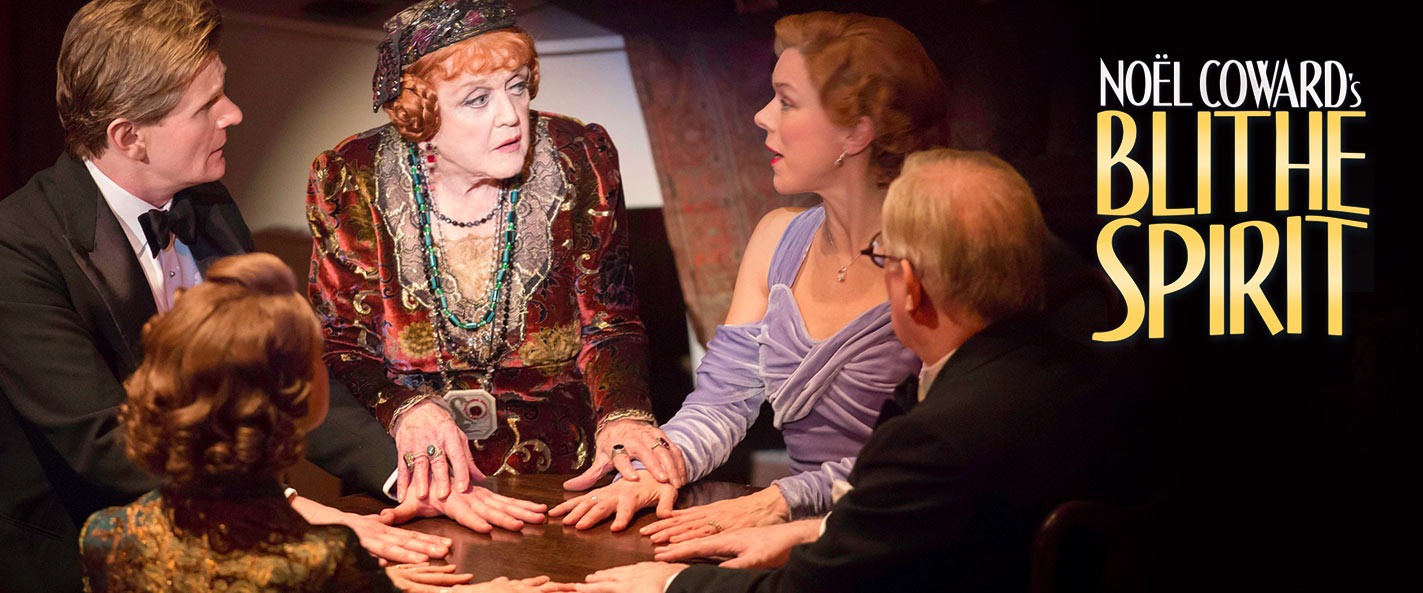
Michael Ferguson, in reviewing two recent biographies of Alan Turing’s life, concludes that to answer the enigma at the heart of Alan Turing’s death, you have to get inside the complex head of the great mathematician.

His book review entitled ”The Man Who Knew Too Much: Alan Turing and the Invention of the Computer’, by David Leavitt and ‘Alan Turing, the Enigma’, by Alan Hodges”, recently published in the, ‘Journal of Homosexuality’, considers the circumstances of Turing’s death on June 7, 1954.

An apple was found near Turing’s deathbed, out of which several bites had been taken. Froth around his mouth was consistent with cyanide poisoning, but according to sources cited by Michael Ferguson, the apple was never analysed. It has therefore never been definitively confirmed that it had been laced with poison, although there was both potassium cyanide and cyanide solution in Alan Turing’s house.

………………………………..

Read complete article here as PDF:

Alan Turing December 2009

ACT stages new version of ‘Indian Ink’

By Judy Richter

At the heart of Tom Stoppard’s “Indian Ink”  is a cross-cultural relationship between an English poet and an Indian artist.

Presented by American Conservatory Theater under the direction of artistic director Carey Perloff, it’s an often fascinating story told in both the 1930s and the 1980s.

The poet is Flora Crewe (Brenda Meaney), who is visiting India in 1930. The artist is Nirad Das (Firdous Bamji), who meets her at a social event and shyly presents her with a quick sketch that he has made of her. Before long, he is painting her portrait while she writes a poem on the veranda of her lodgings.

She relates her most of her experiences through letters to her sister, Eleanor Swan (Roberta Maxwell), in England. Fifty years later, Eleanor is sharing those letters with Flora’s biographer, Eldon Pike (Anthony Fusco). Later, Eleanor shares more information with Nirad’s son, Anish Das (Pej Vahdat), who in turn shares other information with her.

An undercurrent to Flora’s experiences in India is British control of the country. Hence, she meets other English people, such as a minor official, David Durance (Philip Mills), whose attraction to her is not mutual except for friendship.

The action seamlessly moves between time periods thanks to Perloff’s fluid staging and the all-purpose set by Neil Patel. Sometimes exquisite lighting by Robert Wierzel helps to establish time, place and mood. Costumes by Candice Donnelly, along with music and sound by Dan Moses Schreier, also enhance the production.

Running almost three hours, the intriguing two-act play offers plenty of food for thought. The political aspects of how Indians relate to the British colonialists may be somewhat unfamiliar to American audiences, but the program offers helpful background on both the politics and Indian culture.

The production features almost consistently excellent acting, especially by Meaney as Flora and Maxwell as Eleanor, but the accents of many of the Indian characters are often difficult to understand. Bamji as the artist has a distracting habit of shifting from foot to foot.

ACT staged the American premiere of “Indian Ink” in 1999. Playwright Stoppard has since revised it in collaboration with Perloff, who recently directed it inNew York City.

I didn’t see the 1999 production, so I can’t make comparisons. However, the play bears some structural similarities to Stoppard’s “Arcadia,” which ACT successfully staged in 1995 and 2013. “Arcadia” works better if only because the dialogue is more understandable and the through-line smoother.

Still, the overall play and production of  “Indian Ink” are well done.


A standing ovation for Angela Lansbury and cast in BLITHE SPIRIT

By Kedar K. Adour

Sandra Shipley as Mrs. Bradman, Charles Edwards as Charles Condomine, Susan Louise O’Connor as Edith, Angela Lansbury as Madame Arcati, Charlotte Parry as Ruth Condomine and Simon Jones as Dr. Bradman in the North American tour of
Noël Coward’s BLITHE SPIRIT.
PHOTO BY JOAN MARCUS

BLITHE SPIRIT: Comedy/Farce by Noel Coward. Directed by Michael Blakemore . SHN Golden Gate Theater, 1 Taylor Street at Market, San Francisco. 888-746-1799 or www.shnsf.com.

January 20-February 1, 2015

A standing ovation for Angela Lansbury and cast in BLITHE SPIRIT [RATING:5]

Famed playwright Noel Coward is British to the nth degree and his plays are mostly drawing room comedies about the upper crust of Britain’s society of the 1930-40s. His sharp, acerbic, glib wit requires a light touch, ensemble acting with a delicate balance between the characters. For these reasons theater groups in the United States do not often successfully perform his plays.

In 2012 California Shakespeare Theatre (CalShakes) produced a memorable brilliant production of Blithe Spirit with actors rounded up from A.C.T.’s stable of performers. This reviewer suggested that it was the definitive staging. That honor has been replaced by Michael Blakemore’s staging with Angela Lansbury and a combined British and American cast that received a standing ovation last night at the Golden Gate Theatre.

It was a brilliant move to resurrect this 70 year old drawing room comedy with stage and screen icon Angela Lansbury as the inimitable Madame Arcati who brings to protoplasmic life Elvira who had passed over to the “other side.” Lansbury received a (another) Tony Award for the 2009 Broadway production and played to sold out audiences in the 2012 London production. The present National Tour is the London staging. Charles Edwards and Jemima Rooper from the London cast are recreating the roles of Charles Condimine and Elvira.

Noel Coward wrote the play in one week during a visit in Wales where he had gone to escape the German Blitz of 1941. It opened one month later and ran for 1,997 performances.  It is a delightful comedy-fantasy-farce set in pre-war1937. Charles Condomine, a twice-married novelist living with his 2nd wife Ruth in an elegant English Manor home (Set by Simon Higlett) is doing research for a new mystery book. He arranges for Madame Arcati (Angela Lansbury)the  local spiritual medium and suspected charlatan, to perform a séance. Dr. and Mrs. Bradman (Simon Jones and Sandra Shipley), having shared a pre-séance dinner served by klutzy maid Edith (diminutive, hilarious Susan Louise O’Connor), remain for the séance expecting a bit of fun at Madame Arcati’s expense.

While in a trance during the séance Madam Arcati unwittingly conjures ups the ghost of Charles’ dead wife Elvira. Only Charles can see and converse with Elvira and the fun begins. Conniving Elvira has ulterior motives. The major one is that she wants Charles for herself in the ‘other world’.  The fact that he is married to Ruth is no obstacle to her machinations. Eventually both Charles and Ruth want Elvira to return to her rightful place. . . away from their home and back to the netherworld. Unfortunately Madame Arcati is unable to oblige the Condemines.

The fact that only Charles can see Elvira allows Coward to write some witty bits of dialog between Charles and Elvira that are misinterpreted by Ruth who becomes hysterically distraught. Things go from bad to worse when the selfish and spoiled Elvira, with murder in her heart, decides to sabotage Charles’s marriage to Ruth. Hilarious wildness ensues with surprising plot twists and disastrous results that keep the audience enthralled. Charles Edwards, Charlotte Parry and Jemima Rooper are pitch-perfect in their acting, dialog and physical interaction.

The main character is not Madame Arcati, although actors covet playing the role that is designed to steal scenes. Angela Lansbury is perfect for the part and director Blakemore has created stage action for her that bring down the house. An example is the ritual prancing she performs in preparation for her trance that is stylistic and farcical bringing gales of laughter and applause.  Blakemore’s directional skills carry over to every actor with some of the best reserved for Susan Louise O’Connor’s performance as Edith.

The richly appointed setting of the play designed by Simon Higlett is a book-lined drawing room, with fireplace and ubiquitous wide French doors with billowing sheer curtains. What happens to that tidy set in the final scene is shocking. Not to be outdone by the acting, directing and sets are Katherine Roth’s costume designs and Martin Pakledinaz specific costumes for Lansbury’s Madame Arcati that earn their own accolades.

The play is performed in two acts with written projections informing us where and when each scene takes place. Running time is two hours and 30 minutes including a 15 minute intermission. This is a must see play.

Cast: Angela Lansbury as Madame Arcati; Charles Edwards as Charles Condomine; Jemima Rooper as Elvira; Charlotte Parry as Ruth Condomine; Simon Jones as Dr. Bradman; Susan Louise O’Connor as Edith and Sandra Shipley as Mrs. Bradman.

Creative Staff: Simon Higlett, scenic and costume designs;  (Lansbury’s costume designs are by Martin Pakledinaz); Mark Jonathan, lighting design;  Ben and Max Ringham, sound design; John Atherlay, stage manager.. 

Kedar Adour, MD

Courtesy of www.theatreworldinternetmagzzine.com


Ruhl’s ‘Eurydice’ moves slowly at Palo Alto Players

By Judy Richter


Playwright Sarah Ruhl gives the classic story of Orpheus and Eurydice a new interpretation in “Eurydice,” presented by Palo Alto Players.

Rather than focus on musician Orpheus’s efforts to retrieve his deceased wife, Eurydice, from the underworld, Ruhl makes Eurydice the center of attention. In Ruhl’s version, Eurydice (Sarah Moser) reunites with her father (Scott Solomon), who has been trying to contact her. Father is a character invented by Ruhl.

Orpheus (Wes Gabrillo) goes to the underworld to bring his wife back. However, the Nasty Interesting Man/Child (Evan Michael Schumacher), who rules there, tells him she will follow him back to the upper world, but if he looks back, she’ll die again.

Director Jeffrey Lo has assembled a solid cast, which also includes Maureen O’Neill, Monica Ho and Monica Cappuccini as the Chorus of Stones in the underworld. He also has a good design team with the set by Janny Coté, lighting by Nick Kumamoto, costumes by Tanya Finkelstein and sound by Jeff Grafton.

However, neither strong acting nor first-rate designs can overcome the production’s slow pace and the plot’s lack of compelling interest, thus making the 90 minutes without intermission seem much longer.

It’s a disappointment after Ruhl’s more successful plays, such as “Dear Elizabeth,” “Dead Man’s Cell Phone” and “The Clean House.”

“Eurydice” will continue through Feb. 1 at the Lucie Stern Theater, 1305 Middlefield Road, Palo Alto. For tickets and information, call (650) 329-8583 or visit www.paplayers.org.


Dreams die hard in ‘2 Pianos, 4 Hands’

By Judy Richter

Becoming a truly great classical musician requires extraordinary talent and dedication. Without both of the latter, one’s dream of greatness won’t come true.

That’s the hard lesson learned by young Ted (Darren Dunstan) and Richard (Christopher Tocco) in “2 Pianos 4 Hands,” the autobiographical play with music by Ted Dykstra and Richard Greenblatt, presented by TheatreWorks.

Directed by Tom Frey, the two-act work follows the boys’ journey from their first piano lessons through harsh assessments when they’re about to embark upon higher training.

The two actors play all of the other characters, both male and female. Most of those other characters are parents or teachers, some more competent than others. The two also play smatterings of music ranging from Bach, Beethoven, Mozart and others to Rodgers & Hart, Billy Joel and John Lennon.

The first few minutes go slowly as the formally clad musicians (costumes by Noah Marin) get settled at the two Steinway grand pianos that dominate the stage, along with two large suspended picture frames, on the set by Steve Lucas, who also designed the lighting.

Things pick up after that as Ted and Richard are about 9 years old when they learn basics such as scales, chords and rhythms. This act is highlighted by their disastrous appearance in a duet contest. It carries them through age 12.

Act 2, which continues through age 17, features more advanced lessons and parental conflicts. Finally the bitter truth surfaces, and both young men have to settle for far less than they had hoped.

Besides being talented actors, the men in this show must be accomplished pianists. Dunstan and Tocco fill the bill on both.

Although they specifically deal with classical piano, the play’s themes could apply to other types of music, especially classical, as well as other arts and even sports, where only the most gifted and talented have a chance of reaching the top.

By extension, the themes could work in other professions and aspects of life. Hence, the play makes for a satisfying evening of theater and music.

“2 Pianos, 4 Hands” continues through Feb. 15 at the Mountain View Center for the Performing Arts, 500 Castro St., Mountain View. For tickets and information, call (650) 463-1960 or visit www.theatreworks.org.


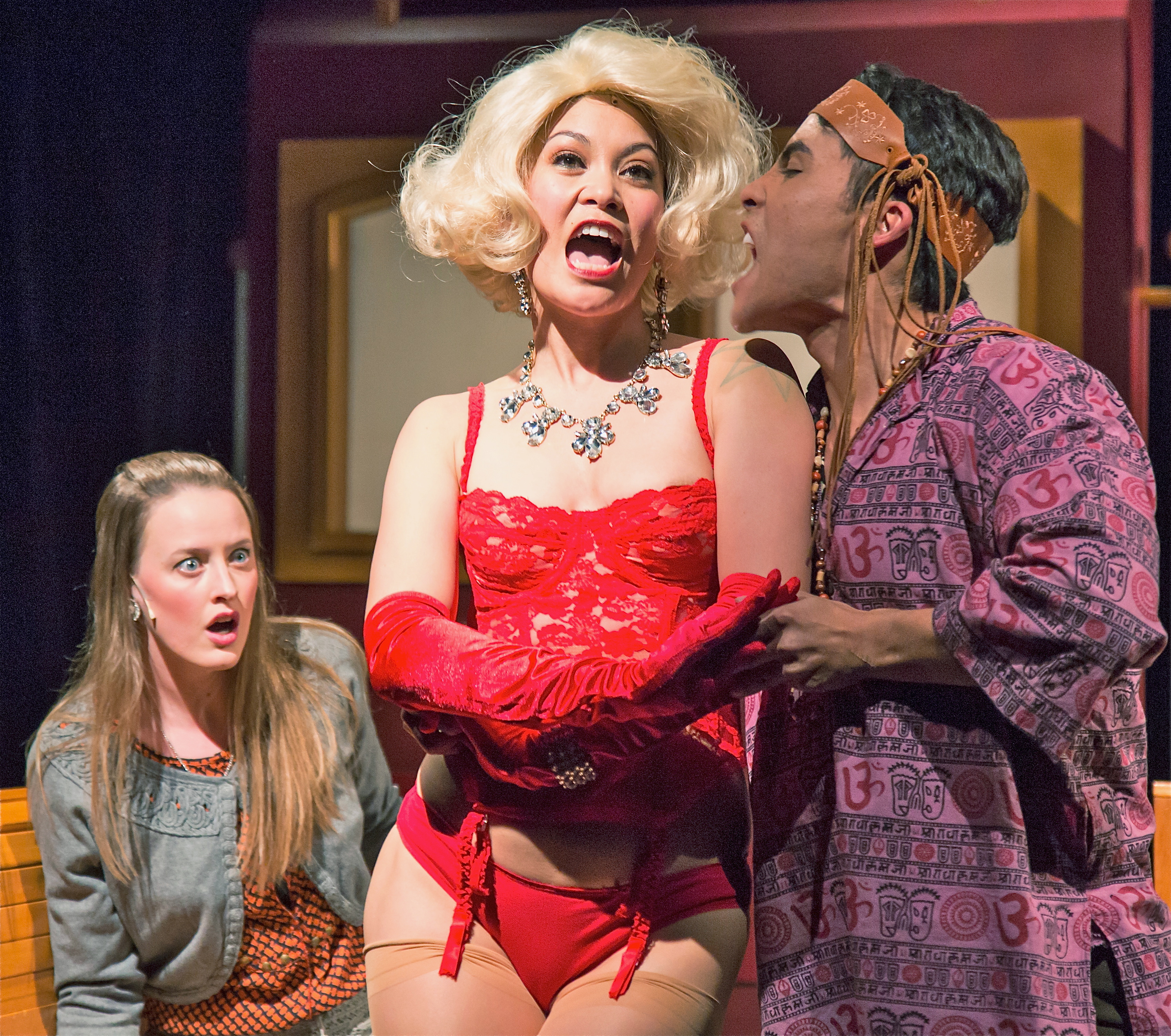
‘Cable Car Nymphomaniac’ is fresh, funny musical comedy

By Woody Weingarten

[Woody’s [rating: 5]

“Cable Car Nympho” features (from left) Courtney Merrell, Rinabeth Apostol and Alex Rodriguez. Photo by Kevin Bronk.

Let anyone refer to “sex, drugs and rock ‘n’ roll” in the past and I’d probably think of the Grateful Dead.

That may be dead thinking now.

In the future, I’m likely to think instead of “The Cable Car Nymphomaniac,” a clever, bawdy musical comedy by the new FOGG Theatre troupe in San Francisco.

It’s that good. That fresh. That funny.

Its sex component was inspired by real events: In 1964, ex-dance instructor and Michigan transplant Gloria Sykes hit her head on a pole when her cable car lurched. Her suit against San Francisco five years later claimed the accident had caused a “demonic sex urge” that forced her have relations with more than 100 guys. The jury awarded $50,000.

Drugs in the show aren’t prevalent, merely a couple of joints (including one hand-me-down laced with slapstick).

And while the wide-ranging music is unlikely to fascinate Deadheads and is hardly integral to the storyline, its absence would greatly have diminished my enjoyment.

Sex, drugs and rock ‘n’ roll indeed, just not your garden variety.

The situation lends itself to exaggeration, for sure, and being an easy target for parody. So it may surprise that the overriding theme of “Nympho” has less to do with sexuality per se than how a torpid housewife rouses to make her own choices.

(Although a major sub-text is that females are still being vilified for being sexual in the 21st century.)

I must admit, however, that “Nympho” left me a little flustered.

Praising virtually everybody connected with a production isn’t my usual critical style.

But consider, for instance, Tony Asaro.

He’s one of three FOGG founders, and doubles as its artistic director. Here he also deserves major credit for extraordinarily bright and sometimes salacious lyrics (“I’m the bourbon that melts your ice” and “adjust your slacks ‘cause here comes Gloria”).

He’s also composed 17 inventive melodies that gambol from hard rock to doo-wop to dissonance.

At the same time, Kirsten Guenther’s scythe-sharp book keeps the nearly two-hour, intermission-less show thrusting forward.

Director-choreographer Terry Berliner’s ingenuity becomes visible especially via a whimsical tango lesson and when comical angels flap their wings.

Berliner, who utilizes ensemble members in both male and female roles, clearly plays to his seven-member cast’s strengths.

Particularly David Naughton as Bruce, an uptight lawyer trapped in an outmoded morality; Steven Ennis, who excels in several cartoon-like, rubberfaced light-in-the-loafers roles; and Alex Rodriqguez, who wrings guffaws from super-seductive Eduardo and a mega-cheery plastic-ware peddler.

None of the other actor-singers are slouches either.

Take the company’s executive director, Carey McCray, for instance, who portrays hard-edged Esther, Bruce’s intern who contemptuously observes that “there is a system and it works as long as a woman knows her place.”

And who then roars, “Men fix the world — women fix lunch.”

Or Rinabeth Apostol as Gloria, the young woman saddled with constant male vibrations, someone who allegedly “sends out a carnal SOS.” Or Courtney Merrell as Bruce’s wife, Bryce, a gal desperately seeking herself. Or Hayley Lovgren, who energetically fills out the ensemble.

By the way, I found all the singing voices two octaves above adequate.

Supported effectively by Robert Michael Moreno’s keyboard and his four musical cohorts.

Oops! Almost forgot Jeff Rowlings.

His ingenious set design turns three cable car images and four wooden benches into about 217 stagecraft sensations.

I’d also be remiss if I ignored the costuming of Wes Crain, who jauntily contrasts Gloria’s ditzy glitziness with a fortune cookie-spouting guru’s over-the-topness.

FOGG, an acronym for Focus on Golden Gate, wants to examine the Bay Area’s history, communities, heroes, concerns and ideologies. So yes, “Cable Car Nymphomaniac” is indeed San Francisco-centric, including a lyric asserting that Gloria “gets around — from Laurel Heights to Union Square.”

But the locale’s only a backdrop.

I can easily see the musical doing well with sophisticated audiences in New York, St. Louis, London — actually, anywhere people would enjoy originality, wit and assorted music.

If a problem exists with the show, it’s that Asaro and company have set an incredibly high bar for their next production.

And the one after that.

And…

“The Cable Car Nymphomaniac” will run at Z Below, 470 Florida St., San Francisco, through Feb. 8. Night performances, Wednesday through Saturday, 8 p.m. Matinees, Saturdays and Sundays, 2 p.m. Tickets: $25-$30. Information: (866) 811-4111 or www.foggtheatre.org.

Contact Woody Weingarten at voodee@sbcglobal.net or check out his blog at www.vitalitypress.com/

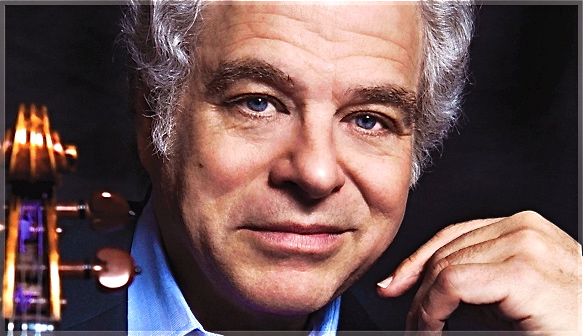
Virtuoso Itzhak Perlman charms San Francisco crowd with violin, humor

By Woody Weingarten

[Woody’s [rating: 5]

Itzhak Perlman

“Perfect. Perfect. Absolutely perfect.”

That’s how an elderly guy in my row at Davies Symphony Hall in San Francisco described the Itzhak Perlman violin recital we’d just experienced.

“That was transcendent,” said a nearby woman. “A real privilege to hear one of the true musical geniuses of our time.”

I felt compelled to merely nod assent.

Frankly, I’ve lost count of how many times I’ve been charmed by the master musician.

I do know, however, that it’s been every time I’ve seen him — dating back to when the 69-year-old’s hair was dark instead of silver.

I’m such a fan I even watched him act as a KQED-TV pledge-drive pitchman the night before, peddling SmorgasBorge, a multi-DVD set that showcased the best of the late classical pianist-clown Victor Borge.

At Davies, most music lovers were as rapt as I, many of them pushing forward as far as possible in their seats, hoping to hear even a smidgeon better.

It was truly breathtaking to be in a totally silent hall while Perlman played, accompanied by his frequent collaborator, pianist Rohan de Silva.

Every tone could be experienced delicately.

That particular evening, not a single throat-clearing or cough occurred during any of the Beethoven, Grieg and Ravel sonatas he stroked. Scores of attendees showed their respect by controlling their bodily needs.

Until the various movements ended.

Then, cacophony.

Spellbinding, too, was Perlman relaxing his hands in his lap during solo piano passages. His Soil Stradivarius jutted straight out from his chin, appearing to be as natural an extension of his body as one of his arms.

The musician’s work is so consistently exquisite I often can’t pick a favorite piece or segment. But that night I did revel in the third movement of the Ravel, with Perlman stretching beautifully from pizzicato purity to bowing as fast as a bullet train racing into Tokyo station.

I also loved the diversity of his encore, nine short pieces with an emphasis on original compositions, adaptations and translations by Fritz Kreisler.

With a couple of Jascha Heifetz quickies tossed in for good measure.

The half-hour encore ranged from Prokofiev’s “The Love for Three Oranges,” to John Williams’ “Schindler’s List” theme that Perlman had played for the film, to lesser known music by lesser known dead composers (including one the violinist claimed everyone should know because ‘he got a lot of likes on Facebook”).

During the recital’s final segment, Perlman, who’d been wordless during the pre-programmed material, displayed great warmth and likeability — and an even greater sense of humor.

He drew laughs with self-deprecating one-liners and you-had-to-be-there references to “unknown” composers and compositions, and by twice shaking off de Silva like a pitcher rejecting a sign his catcher had flashed him.

After his bows, I overheard a conversation at Davies that went like this:

“Have you seen him before?” “Yes.” “Is he always this jaw-dropping?” “Yes.”

Perlman, who contracted polio at age 4, learned to walk on crutches. He still uses them, but most often rides an electric scooter onto a stage.

He did that at Davies.

The violin virtuoso’s been quoted as saying, “There are people who are…finished products at a young age. I wasn’t, thank God.”

Upcoming soloists at Davies, Grove Street (between Van Ness and Franklin), San Francisco, will include “Organ Recital with Paul Jacobs” on Jan. 25, “András Schiff in Recital” on Feb. 15, “András Schiff Plays Beethoven” on Feb. 22, and “Patti LuPone: Far Away Places” on Feb. 23. Information: (415) 864-6400 or www.sfsymphony.org.

 Contact Woody Weingarten at voodee@sbcglobal.net or check out his blog at www.vitalitypress.com/

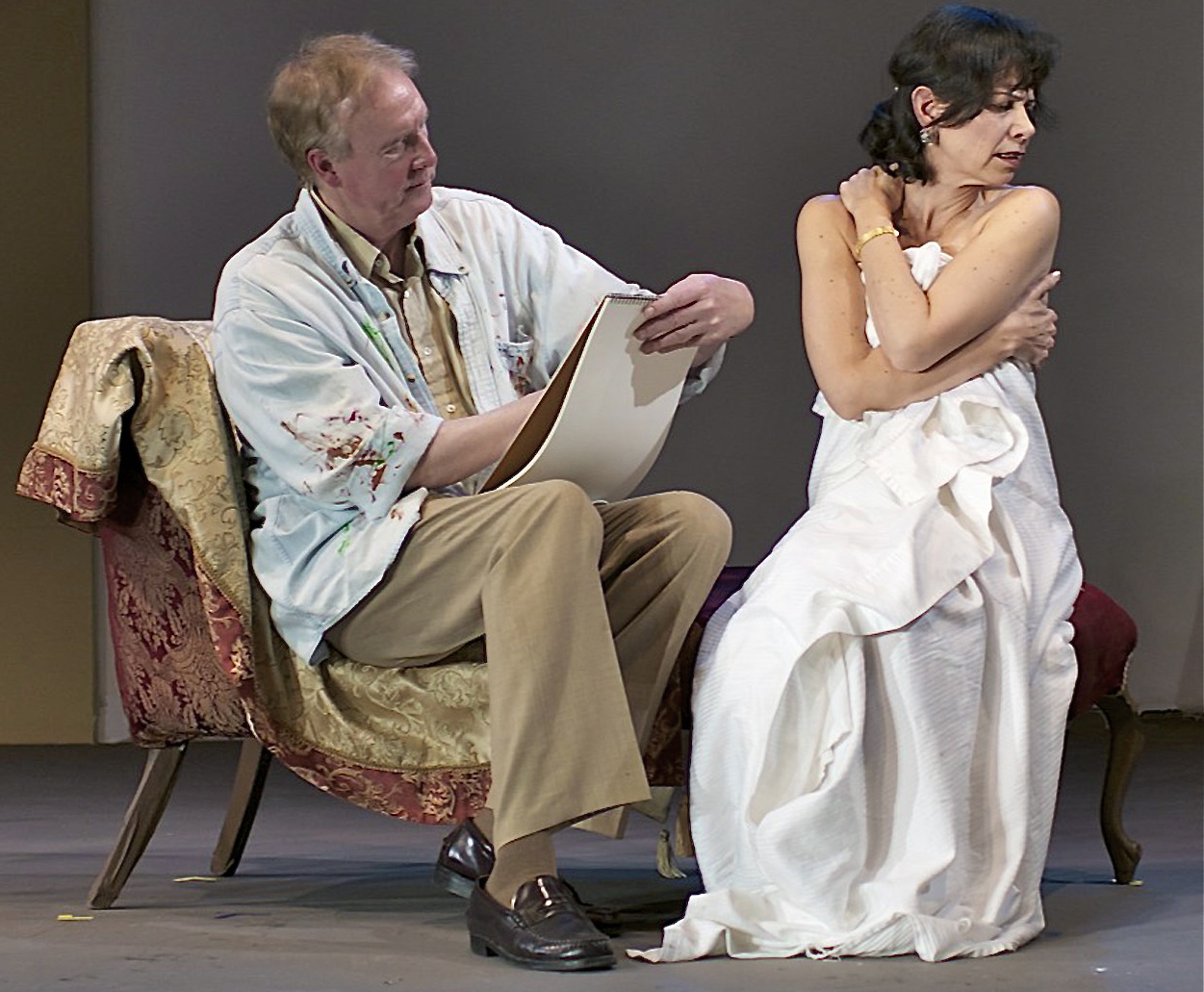
Community theater’s ‘Impressionism’ is witty peek at art and life

By Woody Weingarten

[Woody’s [rating: 3.5]

Tom Reilly (as Thomas Buckle) and Mary Ann Rodgers (as Katharine Keenan) flesh out a flashback in “Impressionism.” Photo by Robin Jackson.

What might you get if you’d locked Noël Coward and Neil Simon in a room with Margaret Mead after they’d toured Tanzania?

A witty comedy tinged with a hint of sadness.

“Impressionism,” actually written by Michael Jacobs, is embedded at The Barn in the Marin Art & Garden Center in Ross, where I watched standoffish New York City art gallery owner Katharine Keenan (played by Mary Ann Rodgers) and burned out photojournalist Thomas Buckle (Tom Reilly) take eight scenes and 80 minutes to become whole.

But their journey often amused me.

Even though Katherine couldn’t bring herself to sell the gallery’s paintings, and Thomas couldn’t let himself snap pictures.

Even though each permanently hid out in the gallery because of life’s wounds — hers from a series of failed relationships, his from seeing too much of the world’s underbelly.

Director Billie Cox, fastidiously peeling back the pair of human onions, nimbly helped me learn who they were by utilizing flashbacks that shifted not only time but place.

And by brilliantly using “invisible” paintings.

The two lead actors give top-drawer performances, surely not equal to those of Jeremy Irons and Joan Allen in the play’s 2009 Broadway debut but way beyond acceptable for community theater.

Much of the play’s dialogue is sharp.

Katherine snarkily revealed a warped world-view by exclaiming that men, whom she refers to as “you people,” exist only “to knock me over.”

More seriously, she ruled about art that “getting it accurate isn’t as important as getting somebody to feel something.”

Thomas, correspondingly, described the self-imposed constraints on his photographic art this way: “I won’t take pictures of anything that [won’t elicit] true joy.”

And the two adversary-friends playfully debated whether life is Impressionism or Realism.

Nobody wins.

But nobody loses either.

Before the opening night performance Cox had primed me and other critics by explaining that the show may only contain “one-act but it’s about the second act of our lives.”

The main conceit of “Impressionism” is that Katharine has employed Thomas for two years and — shades of Scheherazade — he regularly entertains her with stories about the coffee he brings her each morning.

Though the play is officially labeled a romantic comedy, Jacobs, a writer and producer whose work has been featured on Broadway, TV and in film, has put so many obstacles in the duo’s path — much like potholes in many real African roadways — it can sometimes mean a bumpy ride.

It’s certainly a different breed of big African cat than Cox’s last outing at the home of the Ross Valley Players.

That was “Twentieth Century,” which I called a “shamelessly silly…time-machine homage to Broadway creatures of the night-lights.”

In “Impressionism,” the protagonists are informed by artwork masterfully projected onto the gallery’s rear wall. And scenes are connected by both blackouts and slideshows of paintings most likely familiar to even non-art lovers.

Empty frames on the set walls bothered me a bit, however. I was never sure if they were meant to be symbolic, and I found the device distracting.

“Impressionism” probably shouldn’t be summed up by the following exchange:

Katherine — “I don’t understand anything.” Thomas — “Neither do I.”

Nor could a revitalized Katherine be allowed to condense everything into, “What if I wanted to…be ravished in a chair once in a while?”

But she might summarize the show by observing, of both art and life, “You can’t get it when it’s right in front of you — you have to step back…you have to step back to see it other than splotches.”

“Impressionism” is definitely more than the sum of its splotches.

“Impressionism” runs at The Barn Theatre, Marin Art & Garden Center, 30 Sir Francis Drake Blvd., Ross, through Feb. 15. Night performances, Thursdays, 7:30 p.m.; Fridays and Saturdays, 8 p.m. Matinees, Sundays, 2 p.m. Tickets: $14 to $29. Information: (415) 456-9555 or www.rossvalleyplayers.com.

Contact Woody Weingarten at voodee@sbcglobal.net or check out his blog at www.vitalitypress.com


Late: A Cowboy Song takes us on a bumpy ride at Custom Made

By Kedar K. Adour, Uncategorized

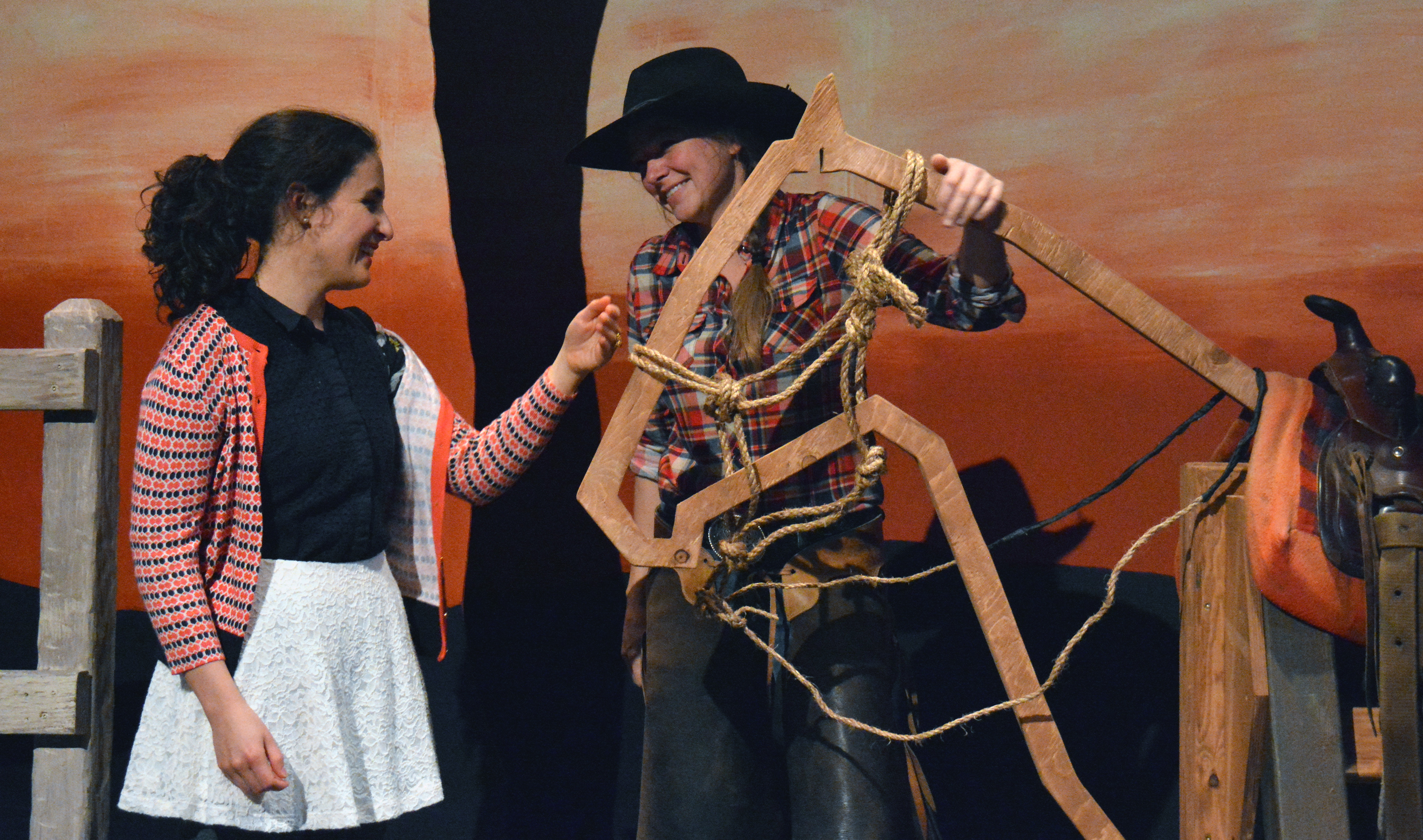
(Left) Mary (Marie Leigh) meets Red (Lauren Preston) and “The Horse’ in Late: A Cowboy Song at Custom Made

Late: A Cowboy Song: Comedy by Sarah Ruhl. Directed by Ariel Craft.  Custom Made Theatre at Gough Street Playhouse, 1629 Gough Street in San Francisco. (510) 207-5774, www.custommade.org. January 8 – February 1, 2015

Late: A Cowboy Song takes us on a bumpy ride at Custom Made [rating:2]

For theatre aficionados seeing plays written early in respected playwrights’ careers may be appreciated to compare it with their later works. Late: A Cowboy Song was written by Sarah Ruhl relatively early in her career and as staged by Custom Made Theatre is given a bumpy ride. While there are hints of potential greatness it does not foreshadow the quality of her two plays In the Next Room or The Vibrator Play and The Clean House that were Pulitzer Prize finalists. Custom Made’s first plays of 2014-2015 season (Vonnegut’s Slaughter House Five and Albee’s Three Tall Women) were solid productions earning well deserved accolades. For multiple reasons accolades are few for Late: A Cowboy Song that seems longer than its uninterrupted 84 minute running time.

First, the play is obtuse and feminist Ruhl is basically interested in exploring gender identification in both physical and naming aspects. She also surrounds that major theme with poetic passages of love in song, the intricate problems of marriage, the effect of art’s ability to transform as well a brief exploration of Henri Bergson’s Theory of Relative Time. Secondly, on opening night both my guest and I could not understand the words to (apparently) poetic songs with original music by the talented Liz Ryder. Third, despite the attractive backdrop of a Western sunset, the jumbled multi-area set (Erik LaDue) obstructed the continuity of the 25 or more short scenes. Fourth, the direction of the cast seemed disjointed and lastly one member of the three member cast appeared uncomfortable with the sometimes intricate dialog.

The three characters are Mary (Maria Leigh) who is always late, her husband Crick (Brian Martin) who is fascinated by art and Red (Lauren Preston) a lady cowboy, not to be confused with a cowgirl. (Think gender identification). The gender problem becomes amplified when Mary and Crick’s baby is born with indeterminate sexual appendages and they (actual Mary decides) to raise “her” as a girl, give her a non-gender specific name of Blue and allow the child to decide his/her gender later in life.

Mary and Crick live in Pittsburg where Mary meets Red who lives on the outskirts. Red, dresses in male cowboy attire (costume by Brooke Jennings), plays the guitar and teaches Mary how to ride a horse. Friendship between Red and Mary blossoms into love driving a wedge between Crick and Mary. Conflict leads to violence; relative time is explored in a single scene and as Mary and Crick part Red and Mary relatively ride off into the sunset.

 CAST: Mary – Maria Leigh; Crick – Brian Martin; Red – Lauren Preston.

CREATIVE STAFF: Cat Howser (Stage Managemer/Prop Design); Erik LaDue (Scenic Design); Brooke Jennings (Costume Design); Liz Ryder (Original Score, Sound Design); Colin Johnson (Lighting Design); Stewart Lyle (Technical Director); Jon Bailey, Fight Choreography.

Kedar K. Adour, MD

Courtesy of www.theatreworldinternetmagazine.com