
MMTC’s musical ‘Cabaret’ in Novato comes as close to ideal as possible

By Woody Weingarten

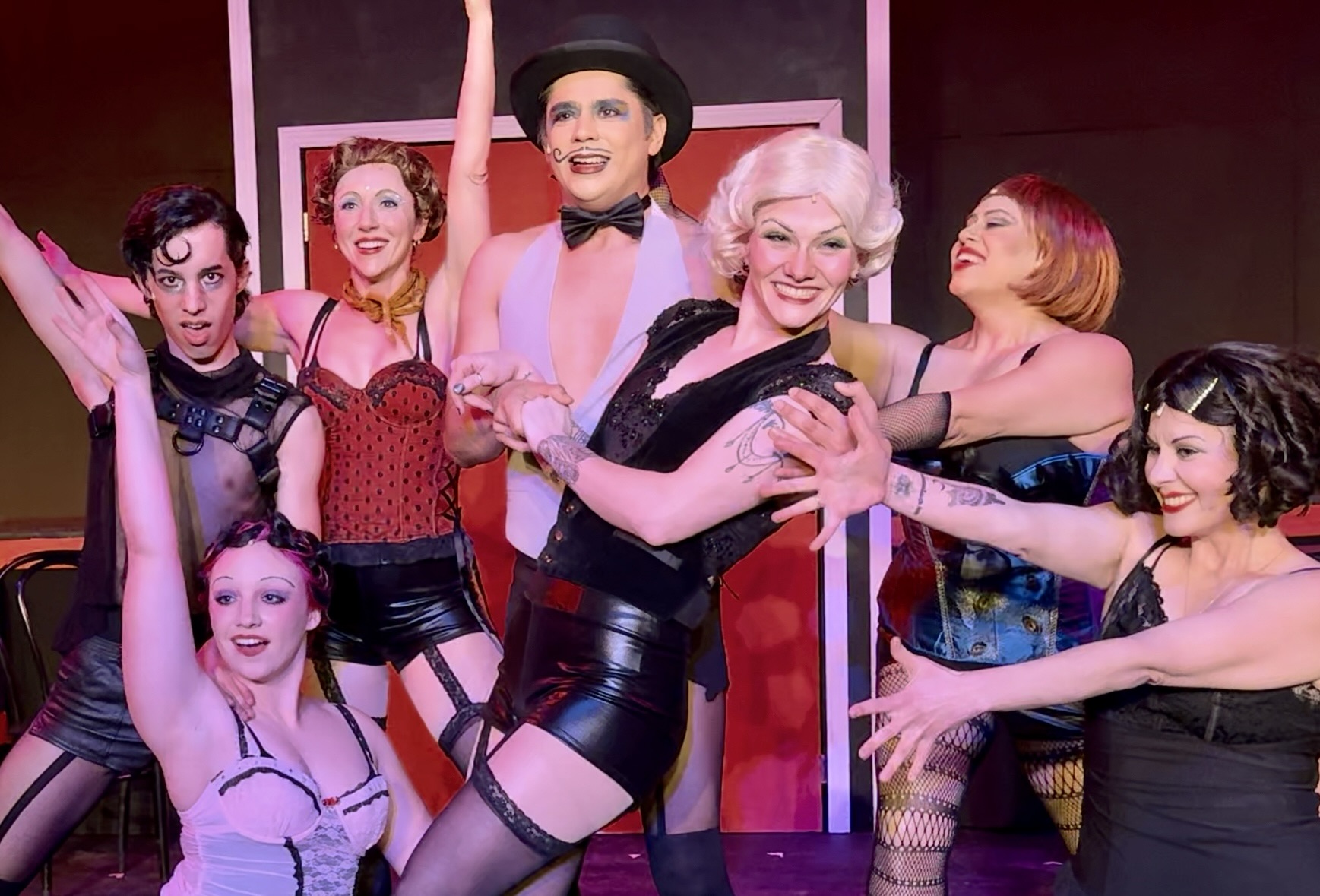
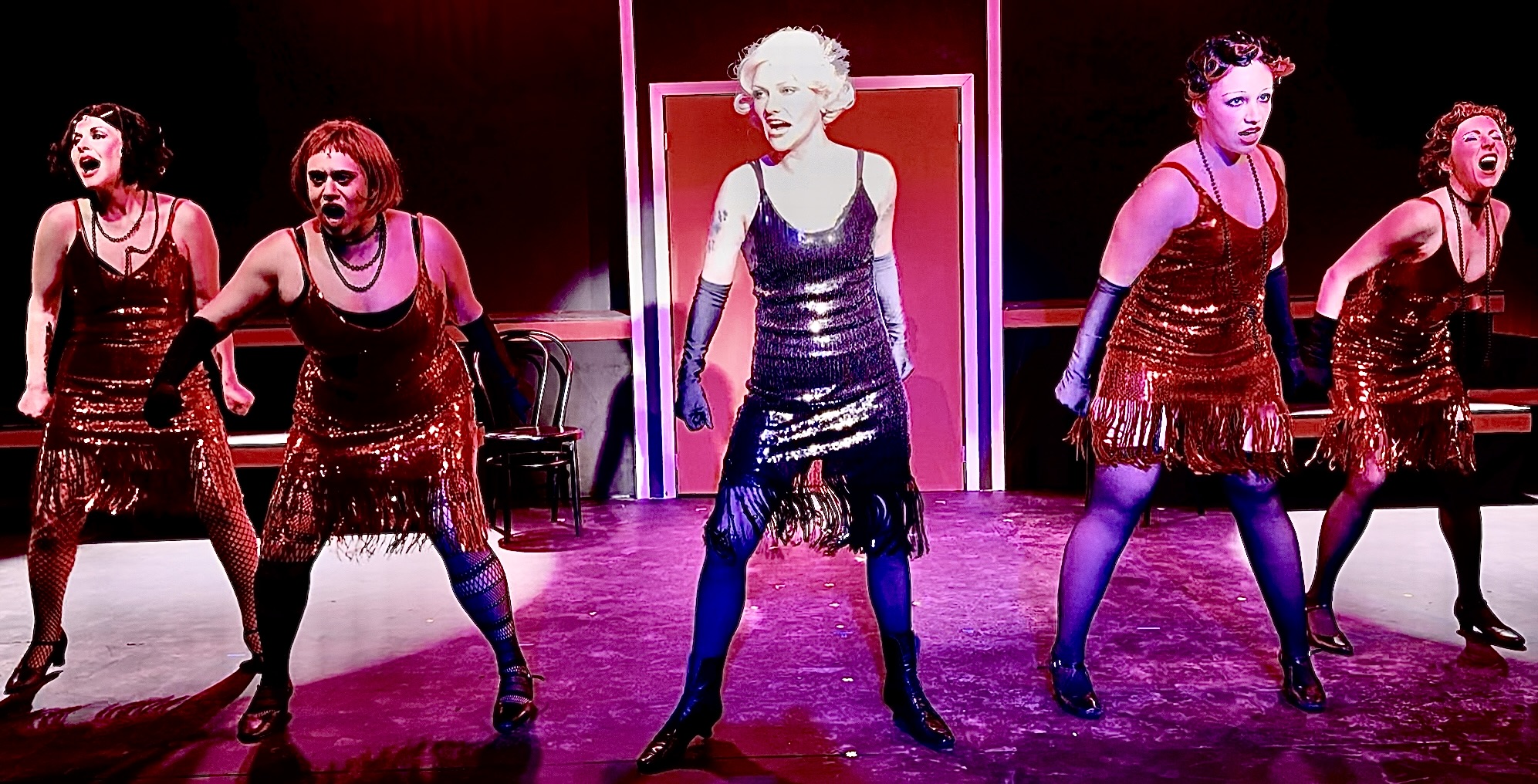
Evvy Calstrom-March (center, as Sally Bowles) and Stephen Kanaski (also center, as the Emcee) star in Cabaret. (All photos by Katie Wickes)

By WOODY WEINGARTEN

There’s no perfect show, no perfect production. But the Marin Musical Theatre Company’s interpretation of Cabaret comes within a hair’s breadth of reaching those pinnacles.

The best Bay Area theatrical work of the year, perhaps the season, it stars Evvy Calstrom-March as chanteuse Sally Bowles, the main draw in Berlin’s shabby Kit Kat Club, circa the Roaring Twenties and the rise of Hitler.

Calstrom-March is a joy to watch every second she’s on stage at the Novato Theatre Company (which presented Cabaret). She’s a quadruple threat: vocals that might make many a Broadway starlet jealous; dancing that puts a capital “L” in limber; dramatic acting chops that make you feel with her; and a rubberized face that can deliver comic expressions with ease.

Also completely watchable is Stephen Kanaski, the Emcee, who changes costumes as often as kids check out their smart phones, and who leers and sneers with the best of them — even though actor/singer Joel Grey originally “owned” the role.

Choreography by Katie Wickes — who also seamlessly co-directed the show with Jenny Boynton — derivatively reminds theatergoers of Bob Fosse at his peak with an underlay of classic Jerome Robbins (and that’s not a bad thing). She staged and rehearsed each of the four nightclub dancers so well they seemed to fill the spotlights as if there were two or three times that many hoofers.

Superlative costumes by Krista Lee and Andria Nyland ranged from a military uniform to glitzy, skimpy burlesque outfits to “ordinary clothing” that blended so well it became invisible so they didn’t distract from the plotline.

A trio of instrumentalists, led by music director Daniel Savio just off the stage, doesn’t miss a proverbial beat and couldn’t have supported the cast better with its bouncy jazz rhythms suitable to the era.

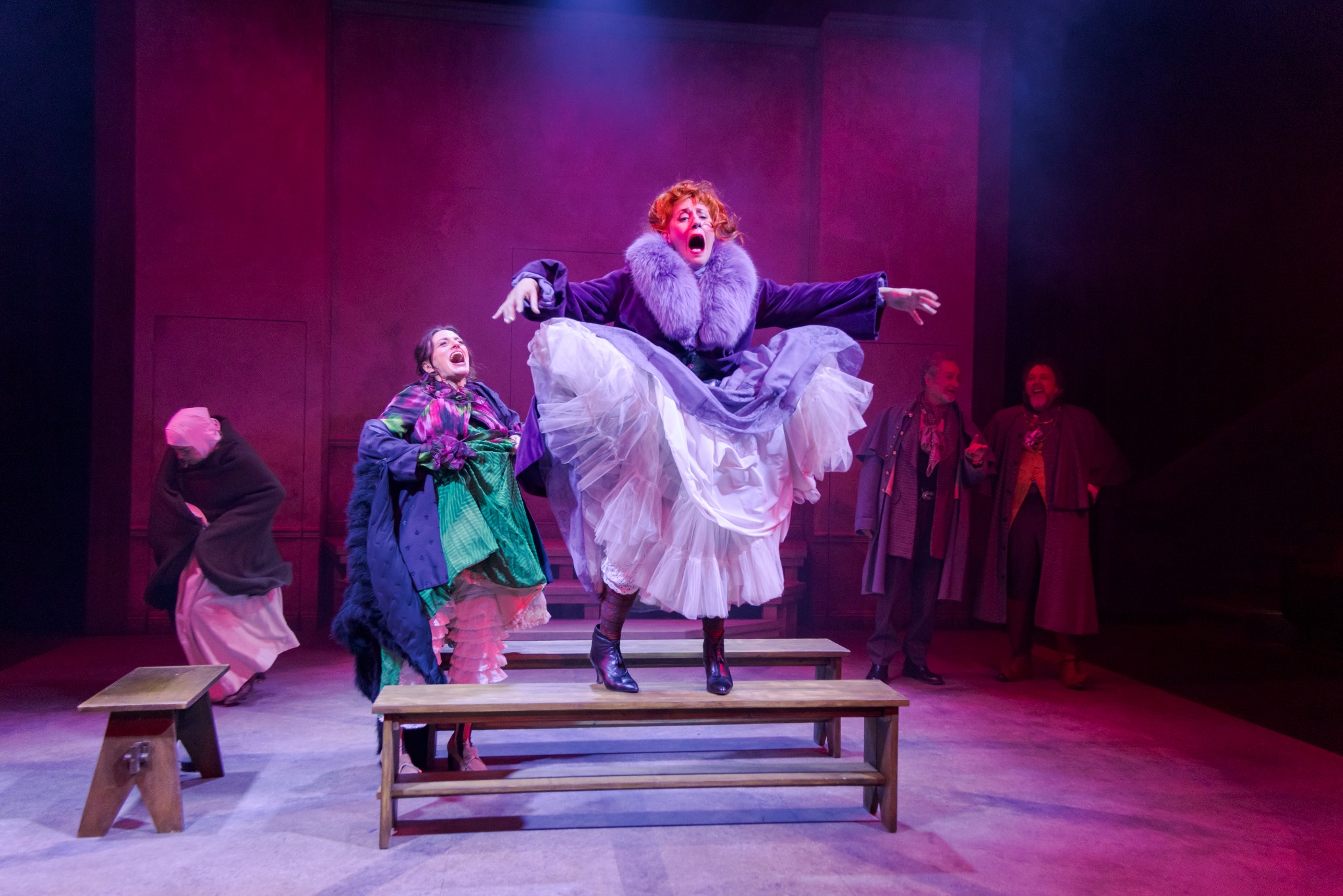
Others worth lauding include Daniela Innocenti Beem, who smoothly injects landlady Fraulein Schneider (who feels pressured by the political upheaval to not marry the Jewish fruit peddler she loves) with humor and pathos and a voice that won’t quit, and Michael Lister, who portrays Ernst, a Nazi smuggler, with appropriate sleaze.

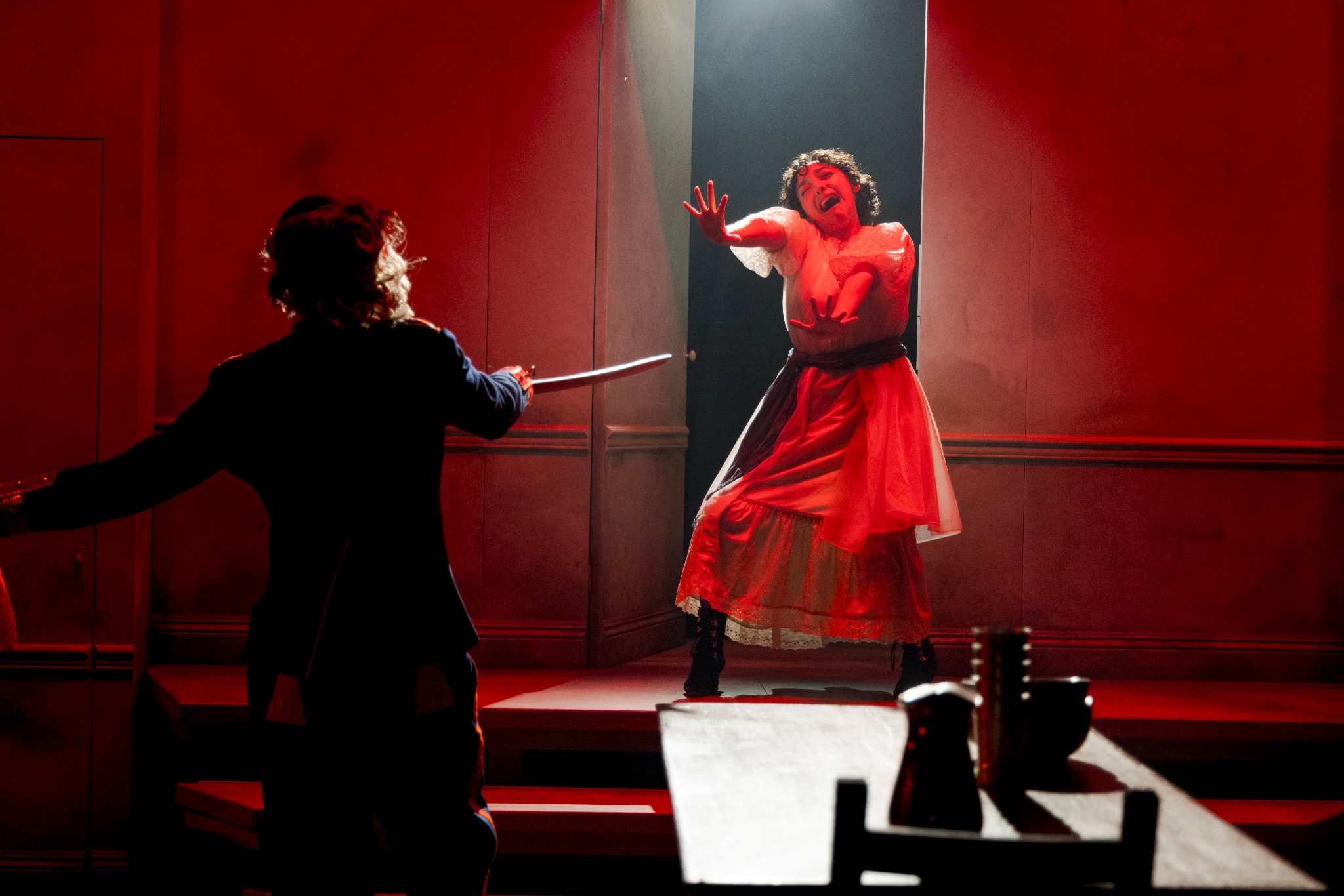
Cabaret, as most theatergoers know, is a rough-edged tragic double-love story engraved on a backdrop of Nazism. Today, the 1966 musical again acts as a red-flag metaphor suggesting that extreme nationalism, racism, Antisemitism, anti-LGBTQ+ism, and blindness to burgeoning authoritarianism can imperil our frail democracy.

Fräulein Schneider (Daniela Innocenti Beem), a landlady, cozies up to Jewish fruit peddler, Herr Shultz (Jere Torkelsen).

The Marin Musical Theatre Company (MMTC) show isn’t for everyone, certainly — despite the production’s overall superb quality and the show’s Tony award-winning history. MAGA devotees probably won’t like it just because. And anyone who can’t handle its cornucopia of heavy sexuality, debauchery, homophobia, immorality, hedonism, prostitution, and drugs most likely will stay home.

Sally Bowles (Evvy Calstrom-March, center) and Kit Kat Club girls come on strong.

Regardless, classic Broadway music by John Kander and lyrics by Fred Ebb, a team that also spawned another Great White Way blockbuster, Chicago, remain a perfect fit. Several of the tunes, in fact, can be sung or hummed or whistled as you leave the theater, an endeavor that’s almost as dead as the proverbial dodo if you think about more modern musicals.

Joel Grey, not incidentally, gets cited online by Wickes and Boynton, in lieu of a production prologue, by reprinting an op-ed he wrote for the New York Times last November.

In it, he sounds an alarm about “the dangers of apathy” and distraction — as he simultaneously warns us about being seduced by a sense that we are facing dark times but “they won’t really affect our own day-to-day lives.”

That sense, he notes, echoes “the tragically shortsighted assessment of so many European Jews in the 1920s and ‘30s.”

The MMTC/Novato Theatre Company co-production of Cabaret will play at the Novato Theatre Company, 5420 Nave Drive, Novato, through April 13. Tickets: $35 to $50. Info: 415-883-4498 or info@marinmusicals.org.

Sherwood “Woody” Weingarten, a longtime member of the San Francisco Bay Area Theater Critics Circle and the author of four books, can be contacted by email at voodee@sbcglobal.net or on his websites, https://woodyweingarten.com and https://vitalitypress.com.


Behind the scenes of ‘Jaws,’ three actors bare their teeth

By Woody Weingarten

Actor Richard Dreyfuss (Dylan James Pereira, front) gestures while the other main performers in the film Jaws, Roy Scheider (Nathan Luft-Runner, left) and Robert Shaw (Matt Cadigan), look on in a dramedy at the Left Edge Theatre, The Shark Is Broken. (Photo by Dana Hunt)

By WOODY WEINGARTEN

The Shark Is Broken may be billed as a comedy but might better be viewed as a drama peppered with laughs.

The 95-minute play details the real-life, repugnant interactions of actors Richard Dreyfuss (Dylan James Pereira), Robert Shaw (Matt Cadigan), and Roy Scheider (Nathan Luft-Runner) off and on the set of Steven Spielberg’s 1975 cinematic blockbuster, Jaws.

Tensions spring from shooting delays caused by pre-CGI and AI mechanical devices — intended to power the threatening shark — conking out. Add to that a feud between a young Dreyfuss and an aging Shaw (known as much for his Shakespearean roles and his writing as for his Hollywood work) that sets a troublesome tone throughout.

Scheider, a more stoic, professorial type, can’t elude Shaw’s negativity either. When he bemoans the two-month ocean shoot in Martha’s Vineyard as “a long time to be stuck together,” Shaw one-ups him: “It’s an eternity.”

Many scenes in the Dana Hunt-directed play replicate precisely what happened. At least that’s what Ian Shaw, the actor’s son, would have us believe. It was he who co-wrote the play with Joseph Nixon (never shrinking from repeatedly depicting his dad as a stumbling drunk).

The Shaw character, who alludes to his own father killing himself when the actor was 12, is fully cognizant of his shortcomings and how they affect others. He refers to priding himself for being able to act at all after “a tidal wave of booze” and notes that he can find himself “with a drink in my hand as a reward for not drinking.”

Trying to cozy up to the British actor, and hopefully eliminating an avalanche of putdowns, Dreyfuss brings his elder joy by looking for and finding two hidden bottles of booze. But he also dumps the contents of yet another bottle, an action that transforms a war of words into more physical combat.

Much of the play’s humor is pitch black, with sarcasm being the main coin of the theatrical realm. Early on, the panic attack-prone Dreyfuss fears for his career because the film they’re in could end up being like Planet of the Apes“without the monkeys.”

In brazen contrast while alone in the show’s funniest moments later, he presents a mocking imitation of Shaw.


Starring in The Shark Is Broken are (from left) Dylan James Pereira, Nathan Luft-Runner, and Matt Cadigan. (Photo by Dana Hunt)

Together, the three characters touch on a gamut of subjects: father-son relationships, philosophical and scientific journeys of the mind and mouth, and pointed references to Nixon (“tricky Dickie”), the Silent Majority, and Nobel Prize-winning dramatist Harold Pinter,

To pass the time, they gamble on cards and a British coin-flip game — and almost constantly refer to their previous hits, as well as films that crashed and burned, and other actors.

They also debate their billing and who is the film’s star, their egos never letting them think for an instant that it’s the animatronic shark.

Just before their final scene, in both reel and real life, Shaw indicate he doesn’t think much of Jaws and goes on to trash Spielberg’s next unnamed project that will become E.T. — the Extra-Terrestrial with one pejorative word, aliens, and then predicts that the film industry in the future will be limited to churning out “sequels and rewrites and sequels.”

Snarkily, he also says, “Do you really think anybody is going to be talking about this in 50 years?”

The Shark Is Broken will play at the Left Edge Theatre of the California Theatre, 528 7th St., Santa Rosa, through April 11. Tickets: $22 to $33. Info: 707-664-play or https://leftedgetheatre.com.

Sherwood “Woody” Weingarten, a longtime member of the San Francisco Bay Area Theater Critics Circle and the author of four books, can be contacted by email at voodee@sbcglobal.net or on his websites, https://woodyweingarten.com and https://vitalitypress.com.

Ross Valley Players musical comedy ‘Pet Lingerie’ a tech spoof with some laughs

By Woody Weingarten

Did you ever dream up a get-rich-quick app idea? Three wannabes do just that in “Pet Lingerie,” an original musical comedy playing in Ross.

Presented by the Ross Valley Players, the two-act show, which takes clever potshots at technology in general and crowdfunding in particular, can be summed up in a single word: Silly.

Did writers Fred Raker and Bruce Tallerman (who met in Hollywood, writing for TV) expect that every one of their rapid-fire verbal gags would draw laughs? It turns out that the 105-minute play develops a rhythm something like this: Funny gag, laugh-out-loud gag, a bomb, funny gag, lol gag, a bomb, ad infinitum.

However, audience laughter and sporadic applause nonetheless pummel the rafters of the Barn Theatre at the Marin Art and Garden Center, where the show runs through April 6.

“Pet Lingerie” takes place in the Airport Suites Hotel in Terre Haute, Indiana, where muffler peddler Ruben Mondello (Landers Markwick), ex-plumber Frank Pincus (Robin Schild) and yoga devotee Frances Ulrich (Vicki Victoria) try to learn from marketing maven Gary Panko (Laszlo Horner) how to kickstart their products.

L-R, Vicki Victoria and Robin Schild portray aspiring entrepreneurs in Ross Valley Players’ premiere “Pet Lingerie” at the Barn Theatre in Ross through April 6. (Robin Jackson via Bay City News)

His three-day workshops may be too intense for some participants, but there are no refunds — “mental breakdowns are no exceptions.”

Their brainstorms are, to say the least, innovative: how to tell whether orgasms are fake; how to smother a toilet flush with recorded operatic arias; and how to get “sweet revenge” via “FU” cookies and bird-flipping mitts.

Panko’s own apps are no less imaginative: They include a flak jacket that dispenses coffee through a tube and, of course, pet garments.

Supporting characters add to the madcap mirth. Silvana Concino (Natalie Buck-Bauer) portrays a sexy but angry Italian flight attendant jettisoned by Panko, her lover; Susan Night (Annejelika “AJ” Ong Cortez) plays a tribute band singer craving Broadway lights. And Rabbi Moshe Ben-Hogan (Dan Schwager) is a playwright who’s long been blocked.

Also: There’s Ron Talbot, who guides a pope puppet that doubles as a giggle-getter and center of a morality play within the play.

A sample of the show’s humor: “We had sex before there was sexting” and “I always thought we’d tie the knot, but you turned out to be a bot.” And, from old chestnuts: “Why’d the Florida chicken cross the road? … to avoid becoming an early bird dinner.”

As for the music, no one’s likely to leave the theater whistling the tunes composed by Tallerman. Still, Buck-Bauer as Silvana, Markwick as Ruben, and Schild as Frank all showcase impressive singing voices.

Gary Stanford Jr., responsible for the show’s cutesy low-tech choreography, also directs “Pet Lingerie,” which has a delightfully droll twist at its tail. And Valera Coble’s winning costumes contrast bright and colorful garb with an orthodox rabbi’s all-black attire.

“Pet Lingerie,” a Ross Valley Players New Works production, was selected from more than 70 other previously unproduced plays by living Bay Area writers. While RVP New Works have smaller budgets, shorter runs and less elaborate sets than some of the company’s other shows, they often take more creative chances.

Here, for example, are offbeat but endearing concepts as a retired tradesman who still carries a plunger with him, an idea man who hides under the covers wearing a virtual-reality headset, and a non-traditional Partridge Family Tribute Band.

And even if RVP New Works are imperfect, they deserve support. It’s exciting and brave to stage original plays with topical themes.

Ross Valley Players “Pet Lingerie” runs through April 6 in the Barn Theatre at the Marin Art and Garden Center, 30 Sir Francis Drake Blvd., Ross. Tickets are $20-$35 at rossvalleyplayers.com.

This article was first published on LocalNewsMatters.org, a nonprofit site supported by Bay City News Foundation http://www.baycitynews.org/contact/.  


Sherwood “Woody” Weingarten, a longtime member of the San Francisco Bay Area Theater Critics Circle and the author of four books, can be contacted by email at voodee@sbcglobal.net or on his websites, https://woodyweingarten.com and https://vitalitypress.com.

Mrs. Krishnan’s Party

By Joseph Cillo


More Than a Show—It’s a Celebration

The thing about a good party is, you don’t always know what you’re walking into. You might get an awkward silence. You might get lukewarm spinach dip. Or—if you’re lucky—you might find yourself wrapped up in something unexpected, like a room full of strangers laughing together over a bubbling pot of dahl. Mrs. Krishnan’s Party, now at Marin Theatre, is that kind of lucky.

This isn’t a play where you sit back quietly in the dark, politely ignoring the person rustling candy wrappers two rows over. It’s a full-on, feet-on-the-table, hands-in-the-cooking-pot kind of night. Marin Theatre’s Boyer Main Stage has been transformed into the cluttered backroom of a convenience store, with audience members seated right in the thick of it. And your level of participation? Well, that depends on how adventurous you’re feeling.

Want to stay in the safe zone? You can. But if you sit in the “Cheeky Seats,” be prepared: you may end up cooking, dancing, or suddenly finding yourself in an impromptu comedy duo—no rehearsal required. It’s immersive theater at its most unpredictable, which means no two performances are ever the same.

And what a party it is. Even before the story begins, the atmosphere buzzes with energy. Guests are handed colorful gauze scarves, garlands, and leis to wear. Balloons are passed around and, when the moment strikes, sent soaring into the air like we’re all in on some giant, joy-filled secret. It’s the kind of immersive experience that doesn’t just break the fourth wall—it dances on top of it.

At the heart of it all is Mrs. Krishnan, played with warmth and spark by Kalyani Nagarajan, a woman hoping for a quiet evening in her store’s back room. But James—a university student with DJ dreams, played by Justin Rogers—has other plans. He kicks off the show, welcoming guests and organizing a surprise Onam celebration in her honor. James sets the tone as the party’s emcee and master of ceremonies, drawing the audience into the spirit of the evening with high energy and improvisational flair. While Mrs. Krishnan tries to keep things grounded, James leans into the chaos, creating space for connection, laughter, and joy.

Nagarajan brings infectious energy and expressive physicality to the role, embodying Mrs. Krishnan’s warmth, exasperation, and joy with every glance and gesture. Her thick Indian accent can sometimes make dialogue tricky to catch, but her face, her body language, and her impeccable comedic timing do a lot of the talking. You might miss a word here or there, but you’ll never miss the meaning. She carries the performance with such a vibrant presence that Mrs. Krishnan doesn’t feel like a character—she feels like the host of the best dinner party in town.

And speaking of dinner—yes, there’s food. Throughout the show, a pot of dahl simmers gently onstage, filling the space with warm, comforting aromas. And then, as the night winds down, the cast serves it to the audience. No plastic-wrapped intermission snacks here—just a simple, shared meal that turns an already communal experience into something even more intimate.

The script shifts each night, responding to audience interaction. Someone might be invited to help with the cooking. Another might suddenly be part of a spontaneous skit. A bit of improv here, a dance break there—this production thrives on unpredictability.

And yes, there’s dancing. One moment Mrs. Krishnan is stirring dahl and cracking jokes; the next, she’s leading a dance from atop a table, sweeping everyone into celebration. Between the music, movement, and moments of unrehearsed connection, the play becomes less of a performance and more of a shared experience—one you don’t just watch, but feel part of.

What truly sets Mrs. Krishnan’s Party apart is how it lingers. As the lights came up, no one rushed to the exits. We stayed. We ate together. A small, simple gesture—but one that brought everything full circle. The play ends, but the party continues.

Playwrights Jacob Rajan and Justin Lewis, co-founders of New Zealand’s Indian Ink Theatre Company, have created something uniquely heartfelt—part storytelling, part improv, part social experiment in joyful human connection. John Verryt’s cluttered, lived-in set and Jane Hakaraia’s warm, inviting lighting make the space feel less like a theater and more like someone’s kitchen on a festival day.

If you’re in the mood for something different—something surprising, genuine, and irresistibly fun—Mrs. Krishnan’s Party is worth pulling up a chair for. And if you leave a little hungrier than when you arrived, well—don’t worry. They’ve got that covered too.


Performances & Tickets

Mrs. Krishnan’s Party runs through March 30 at Marin Theatre, 397 Miller Avenue, Mill Valley. Tickets range from $47–$97, plus a $6 handling fee per total order. Visit MarinTheatre.org or call 415-388-5208 for availability and ticket purchases.

This is a short run, so get your tix now!

Push / Pull

By Joseph Cillo


A Play That’ll Work You Over Like a Bad Personal Trainer

Central Works opens its 2025 season with Push/Pull, a play so packed with intensity and gym lingo, you might leave the theater feeling sore. Written by Harry Davis, this production takes a deep dive into the fine line between self-improvement and self-destruction—a line so fine, it might as well be written in protein powder.

Clark, our protagonist, is in rough shape—emotionally, not physically (yet). After a tough breakup and a stint in a mental health facility, he reconnects with his childhood buddy Nolan, who’s now an amateur bodybuilder with the kind of dedication usually reserved for medieval monks or tax auditors. Nolan offers to turn Clark into a muscle-bound marvel, provided Clark helps him win his Pro Card. What ensues is equal parts bro-bonding, existential unraveling, and enough posing routines to make a peacock self-conscious.

Under the direction of Gary Graves, Push/Pull finds its rhythm in the push-pull (see what I did there?) of these two men’s ambitions. The intimate setting at the Berkeley City Club means you can see every muscle twitch and every drop of sweat (hopefully stage sweat, but no guarantees). It’s the kind of play that makes you think deep thoughts, like: What drives us to reinvent ourselves? Can we ever really escape who we are? And do I need to start lifting weights?

Andre Amarotico plays Clark with the kind of quiet desperation that sneaks up on you, while Matthew Kropschot’s Nolan is the embodiment of a guy who truly believes discipline can fix everything. Together, they create a chemistry that feels like two guys stuck in an elevator, each convinced the other one has the key.

Davis’ writing is smart, funny, and sneakily profound. The dialogue snaps like a weight belt in need of replacement, and the themes hit as hard as a deadlift gone wrong. There’s a rhythm to the words that makes you feel like you’re watching two people spar, except instead of punches, they’re throwing doubts, fears, and occasional flexes.

Visually, the play delivers the goods—sharp lighting, well-timed sound cues, and a general sense that if you sat too close, you might get drafted into an impromptu push-up contest. The whole thing is beautifully staged, making the audience feel like voyeurs at the gym, watching two men lift more than just weights.

Central Works has done it again—taking a topic you didn’t know you needed to see on stage and making it riveting. If you’ve ever wrestled with the idea of self-worth, ambition, or whether you should be drinking more raw eggs, Push/Pull is for you.

Ticket Information

  • Performances Through March 30
  • Berkeley City Club, 2315 Durant Ave, Berkeley, CA
  • Showtimes
    • Thurs & Fri: 8 PM
    • Sat: 7 PM
    • Sun: 5 PM
  • Tickets
    • Fri–Sun: $35–$45
    • Thurs: Pay-What-You-Can
    • Sliding scale tickets ($20–$45) available at noon on the day of the show
  • How to Get Tickets

Stretch first.


Play in Santa Rosa crammed with gags, sexuality, insightful opinions

By Woody Weingarten

Clyde (Shanay Howell) weaponizes a kitchen knife in comedy at the 6th St. Playhouse. (All photos by Eric Chazankin.)

By Woody Weingarten

Clyde’s, at the 6th St. Playhouse in Santa Rosa through March 23, is a sneaky little devil of a play.

Sandwiched between frequent effervescent sight and verbal gags and a generous helping of street slang mixed with overt sexuality, you can discover layers of caustic but insightful opinions.

The Pennsylvania greasy spoon of the title is a work haven for ex-cons, most of whom regret the reason for their incarceration and yearn for a second chance to become more fully realized human beings.

How do the felons aim to achieve that? Believe it or not, by creating the perfect gourmet sandwich — onstage — despite the truckdriver clientele preferring simple turkey on rye.

Love, anger. Teasing, testiness. Thoughtfulness, spite. All are menu ingredients.

Added in are pinches of racial inequities and pain.

And sporadic munching by the six-member cast.

Light throwaway lines like “Now you’re disrespecting the lettuce” and “Don’t say that — she can hear through walls” are precursors to serious tidbits such as “I can’t walk down the street without feeling like everyone’s hating on me” and “Just ‘cause you left prison, don’t think you’re outta prison.”

Shanay Howell instills in sandwich shop-owner Clyde more piss and vinegar than you might imagine, all the while popping her eyes, pouting her mouth, and exaggeratedly strutting flirtatiously so viewers can’t help but laugh.

Nate Musser portrays Jason, a homeless dude dotted with white supremacy face and arm tattoos whose vitriol knows no limits but who can also draw humor from slapstick postures and soften like room-temperature butter when a scene calls for that attitude.

Jason (Nate Musser) rests his head on chest of Montrellous, who gives him a healing hug.

And Tajai Jaxon Britten re-creates Montrellous, resident philosopher with a sonorous voice and a Zen attitude, as someone to emulate.

Meanwhile, director Marty Pistone resembles a conductor timing multiple instruments to end on the same micro-dot — in this parallel case, when characters excitedly talk over each other and then stop abruptly.

Intermittent music, mainly staccato drumbeats orchestrated by sound designer Laurynn Malilay during the blackouts between frequent brief scenes, acts as a perfect accompaniment.

The set designed by Bruce Lackovic also deserves praise for seamlessly blending real and simulated kitchen equipment.

Cast of Clyde’s are tickled by blurb in a local newspaper.

Have you ever stumbled on a hole-in-the-wall that can dish out melt-in-your-mouth food? Or a place that could satisfy your food-for-thought cravings? Whether or not your answer is “yes,” you might want to taste-test Clyde’s.

Not every performance of the fast-paced 90-minute play by two-time Pulitzer Prize winner Lynn Nottage, is sold out. That, truly, is a shame.

Clyde’s will play on the Monroe Stage of the 6th St. Playhouse, 52 W. 6th St., Santa Rosa, through March 23. Tickets: $29 to $47.95. Info: 707-523-4185 or https://6thstreetplayhouse.com.

Sherwood “Woody” Weingarten, a longtime member of the San Francisco Bay Area Theater Critics Circle, can be contacted by email at voodee@sbcglobal.netor on his websites,

DOOMERS

By Joseph Cillo


A Sharp, Funny, and Terrifying Look at AI’s Future

If you’ve ever wanted to watch a bunch of brilliant, self-important tech types tear each other apart while sitting close enough to dodge the metaphorical (and maybe literal) shrapnel, DOOMERS is your show. Matthew Gasda’s latest play, staged in the intimate Pallas Gallery, doesn’t just invite you into the world of an imploding AI company—it plunks you right down in the middle of it, where you can feel the heat from the egos and the existential dread in real time.

And when we say intimate, we mean intimate. No cushy separation between actors and audience, no towering set pieces—just a rug marking the boundaries of the battlefield. The actors are working with about as much personal space as you’d get on a packed subway car, which makes it all the more thrilling when tensions flare. There were moments when you could practically see the wheels turning in their heads—half from character motivation, half from trying not to trip over our feet.

Act 1: The War Room – Enter the Mad Genius

We open in the offices of MindMesh, where Seth, the freshly booted, maybe-brilliant, maybe-certifiable CEO, is huddled with his loyalists, trying to figure out whether to fight, flee, or burn it all down. Seth sees himself as the only one who can properly birth Artificial General Intelligence (AGI) into the world, and his disciples range from true believers to those just hoping not to go down with the ship. It’s a fast, funny, and deeply unsettling portrait of ambition unhinged, as Seth works the room like a cornered chess grandmaster who still thinks he’s five moves ahead.

Act 2: The Boardroom – Meet the “Responsible” Adults

Over in the corporate boardroom, the so-called “AI doomers” are trying to steer the company—and possibly humanity—away from the abyss. Or are they? Turns out, their definitions of responsibility and ethics vary widely, and as the discussions wear on, it becomes clear that just because Seth is gone doesn’t mean the danger is. Backstabbing, grandstanding, and a bombshell revelation about Seth’s next move turn this act into a slow-burning ethical minefield, leaving the audience to wonder whether these people have humanity’s best interests in mind—or just their own.

A Production That Blurs the Line Between AI and Theater

One of the more unusual aspects of DOOMERS is how artificial intelligence was integrated into its creative process. The playbill lists ChatGPT and Claude—two AI language models—as official dramaturgs, a role typically reserved for human researchers who assist with script development, thematic refinement, and historical context.

While AI tools are increasingly used in creative writing and editing, it’s rare for them to receive formal credit in a live theater production. Given that DOOMERS itself explores AI’s role in shaping the future, this could be a meta-commentary, an artistic experiment, or simply a nod to the evolving relationship between technology and the arts. Regardless, it raises intriguing questions about authorship and collaboration—how much of the script was influenced by AI, and what does it mean for the future of theater when machines contribute to storytelling?

An Outstanding Ensemble Cast

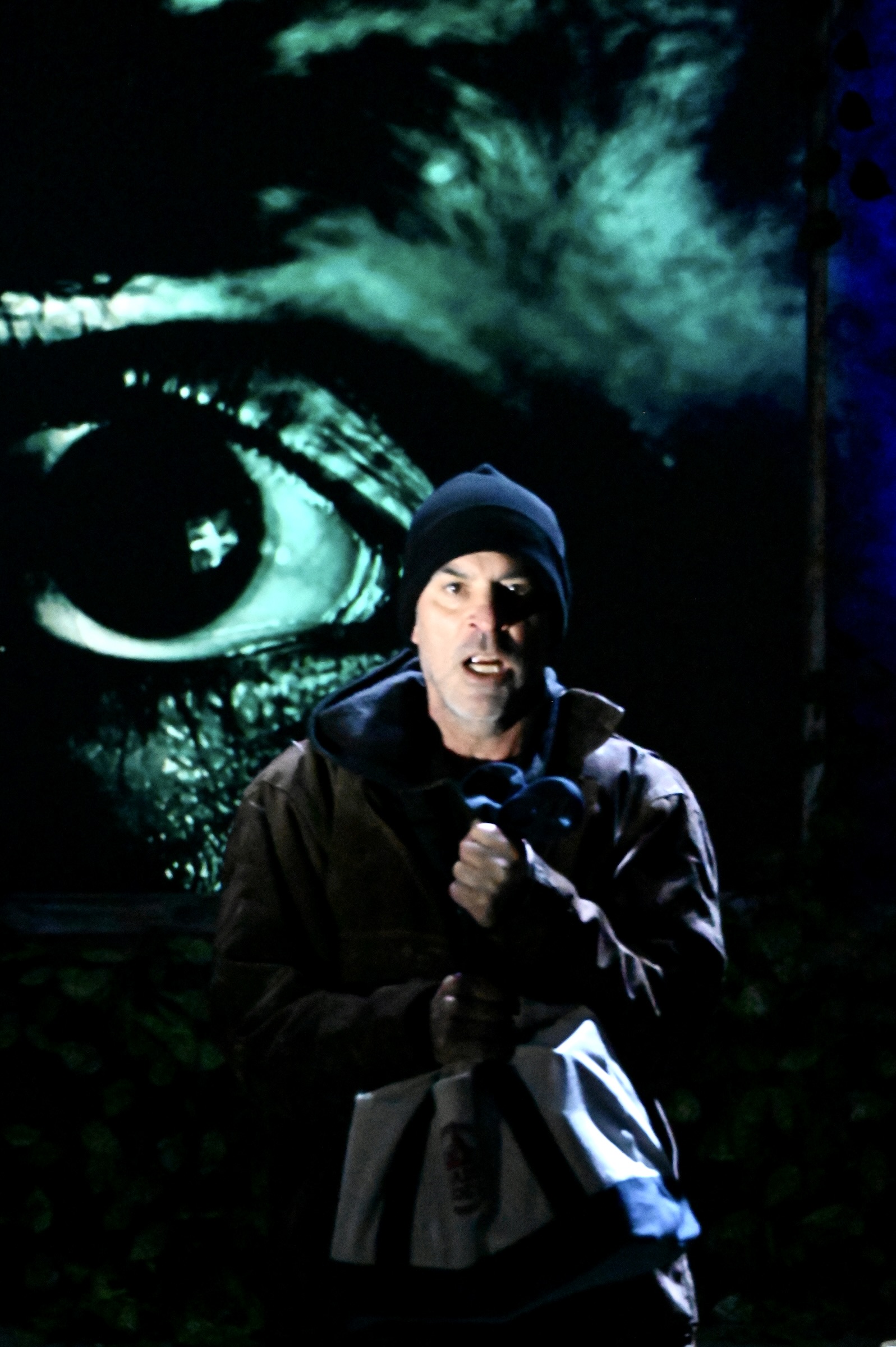
Photo credits Ash Baker.

The performances are uniformly strong, with Sam Hyrkin delivering a compelling mix of arrogance and desperation as Seth. Emily Keyishian’s Myra and Arup Chakrabarti’s Sanjay provide a sharp counterbalance, navigating the chaos Seth leaves behind. The full cast includes:

  • Seth – Sam Hyrkin
  • Jeff – Tommy Harkness
  • Myra – Emily Keyishian
  • Sanjay – Arup Chakrabarti
  • Alina – Emily Anderson
  • Mei – Gabi Maalihan
  • Richard – Evan Sokol
  • Charlie – Elliot Gross
  • Harriet – Anna Connelly
  • Eli – Alex Trono

Each actor brings a distinct energy to the ensemble, ensuring that DOOMERS never feels like a lecture on AI ethics but rather a fast-moving, tension-filled human drama.

The Takeaway? You’d Be a Fool to Miss This One

Gasda’s dialogue crackles with the kind of sharp wit and brutal insight that makes you both laugh and wince. The extreme proximity inside the intimate Pallas Gallery only intensifies the experience—you’re not just watching a power struggle, you’re practically in it. There’s no escape from the tension, no leaning back in your seat—you’re close enough to feel the microexpressions, the nervous twitches, the moments of triumph and collapse.

Director Ash Baker keeps the pacing taut, letting the existential horror sneak in between barbed one-liners and philosophical sparring. By the time the lights go down, you’re left wondering not just about AI’s future, but about the very human mess of egos, ambition, and self-delusion that’s driving it.

The Intimate Pallas Gallery – 1111 Geary Blvd, San Francisco, CA 94109

Reserve tickets: Jacob Donaldson (jacobmpdonaldson@gmail.com)

Ticket Prices:

  • General Admission: $30
  • Premium Seating: $50

Remaining performances run through March 22.


Harvey

By Joseph Cillo


A Rip-Roaring, Rabbit-Loving Romp: Harvey Brings the Laughs and a Little Magic

Now, folks, there are plays that make you think, and then there are plays that make you smile, and Harvey does a fine job of the latter. Pittsburg Theatre Company’s take on Mary Chase’s Pulitzer Prize-winning classic is a warm, witty, and downright delightful production that invites audiences to leave their skepticism at the door and embrace the improbable—namely, a six-foot, one-and-a-half-inch-tall invisible rabbit named Harvey.

From the moment you see the production’s striking promotional artwork—a silhouette of a sharply dressed figure, only instead of a human head, it’s a rabbit—you know you’re in for something playful yet sophisticated. This clever visual sets the tone for a show that balances humor with heart, whimsy with wit.

At the heart of this well-paced comedy is Kirk Waller as Elwood P. Dowd, a man whose unwavering politeness and gentle nature make him instantly likable. Waller plays the role with an effortless charm, as if he were born to spend his days tipping his hat to an imaginary best friend. Suzanne Ochs as his long-suffering sister Veta Louise Simmons gives a sharp and hilarious performance, exasperated to no end as she tries to navigate the chaos that her brother’s unusual friendship causes. Skylar Clouse as Myrtle Mae Simmons, determined to escape social ruin, brings just the right mix of desperation and comedic energy.

The supporting cast is top-notch, with Brad Verla as Dr. Chumley, Phillip Leyva as Dr. Sanderson, and Mary Katherine Patterson as Nurse Kelly rounding out the ensemble with standout performances. Each brings their own flair to the production, ensuring that every moment is packed with humor, tension, or outright absurdity.

Visually, the production shines. Director and producer Dianna Schepers has orchestrated a show that feels both polished and heartfelt. The set design and sound, also by Schepers, transport the audience seamlessly between the Dowd home and Chumley’s Rest, capturing the play’s timeless whimsy. Jana McDowell’s costume design is a perfect fit for the era, and Mike Morris’ lighting design keeps the show feeling dynamic without distraction.

Adding to the production’s charm is the work of the stage crew and volunteers, including the talented students from Pittsburg High School’s Stagecraft class. It’s clear that this is a community-driven show in the best sense—full of heart, collaboration, and an appreciation for the magic of live theater.

A Note on Pookas and Harvey’s Whimsical Legacy

In Irish folklore, a pooka (púca) is a mischievous spirit that can bring good or bad fortune, often appearing in animal forms, like a rabbit or horse. Harvey embodies this tradition as an unseen but ever-present companion, guiding Elwood P. Dowd’s life in whimsical and mysterious ways. His presence, real or imagined, challenges those around him to reconsider what is “normal” and embrace kindness, imagination, and a touch of the fantastical. The play leaves it delightfully ambiguous—perhaps Harvey is just a figment of Elwood’s worldview, or maybe, just maybe, the six-foot-tall rabbit is more real than anyone dares to admit.At the end of the day, Harvey is the kind of play that reminds us life is better when we leave a little room for the unexpected—especially if the unexpected happens to be a well-mannered, invisible rabbit. If you get a chance to see this production, take it. You might just find yourself raising a toast to the unseen, the unconventional, and the utterly delightful.

How to Get Tickets

Performances of Harvey run from February 28 to March 9, 2025, at the California Theatre in Pittsburg, CA.

Tickets are priced at $22-$30 and can be purchased online at www.tickets831.com or by calling 925-427-1611.

Better yet, consider becoming a season ticket subscriber and enjoy Pittsburg Theatre Company’s full 2025 season, which includes Harvey, Chicago, and The 25th Annual Putnam County Spelling Bee.