Head of Passes: A modern day parable of The Book of Job

By Kedar K. Adour

Sullivan Jones (The Angel) and Cheryl Lynn Bruce (Shelah) perform in Tarell Alvin McCraney’s Head of Passes, a poignant and poetic new play about the journey of family and faith, trial and tribulation at Berkeley Rep. Photo courtesy of kevinberne.com

Head of Passes: Drama by Tarell Alvin McCraney. Directed by Tina Landau. Berkeley Rep. Berkeley Rep’s Thrust Stage, 2925 Addison St., Berkeley. (510) 647-2949 or www.berkeleyrep.org. April 10 –May 24, 2015.

Head of Passes: A modern day parable of The Book of Job [rating:4]

Tarell Alvin McCraney burst on to the Bay Area theatrical scene five years ago when his trilogy The Brother and Sister Plays received spectacular productions at three different theatres.  Those plays explore life in the mythical Louisiana Bayou town of San Pere. They begot life at the Marin Theatre Company with their stunning production of In the Red and Brown Water before the baton for Part Two, The Brothers Size, was passed on to the Magic Theatre receiving a muscular standing ovation production under Octavio Solis’s direction. Part Three: Marcus: The Secret of Sweet, was handed over to A.C.T. who mounted a flashy stirring staging but did not match the muscular productions of Parts One and Two.

Berkeley Rep Stage receives the honors with his return to the Bay Area for Head of Passes as a co-production with New York’s Public Theatre. McCraney again sets his characters in the Louisiana Bayou in the mouth of the Mississippi called ‘the head of passes” where the land is below sea level and is ever shifting because of floods and tidal surges. In The Brother and Sister Plays it is hurricane Katrina that wreaks havoc and it seems a foregone conclusion that McCraney is setting us up for a similar disaster before the play ends.

The inspiration for the play is the Biblical “Book of Job” and was commissioned by Chicago’s Steppenwolf theatre where it was staged in 2010. The concept of Faith again takes center stage with the protagonist Shelah (Cheryl Lynn Bruce), an elderly widowed Black woman questioning, nay accepting God’s creation of death and destruction of her family and home.

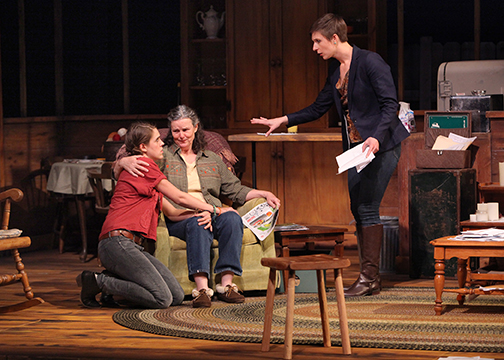
(l to r) Cheryl Lynn Bruce (Shelah), Brian Tyree Henry (Spencer), and Francois Battiste (Aubrey)

The family consists of adult children Aubrey (Francois Battiste), and Spencer (Brian Tyree Henry) who are preparing a birthday party for her that is intended to be a surprise. Aiding in that endeavor is a preacher, Creaker (Michael Shepperd) and his son Crier (Jonathan Burke). Non-family uninvited persons include friend Mae (Kimberly Scott) and Shelah’s white doctor Dr. Anderson (James Carpenter). There is “The Angel” (Sullivan Jones), dressed in an elegant black suit and bow tie who wanders in and out of the action. He is seen only by Shelah. Also uninvited is the mysterious volatile sister Cookie (Nikkole Salter) whose arrival is antecedent to the climatic ending of act one.

 As in the Book of Job, when Job’s offspring are having a party a mighty wind sweeps in and collapses the house, killing Job’s beloved children, so it is with Shelah’s home and family. The set (G. W. Skip Mercier) and its fantastic destruction from wind and rising water almost over shadow the brilliant acting and tight direction by Tina Landau who kept the play in check.

Cheryl Lynn Bruce who created the role in its original production is a force of nature when, she like King Lear, rails against the elements questioning God in her 20 minute monolog in the second act. Yet through all this questioning she maintains her faith. Francois Battiste’s range of emotion from the love of his mother to hate for his half-sister Cookie can be felt across the apron of the thrust stage. James Carpenter brings compassion to the role as the doctor especially when he is forced to bring the news to Shelah of the death of her entire family.

To this reviewer there are two caveats; one being the ill-defined reason for the animosity between Cookie and Audrey and the other is the extended final monolog that could be trimmed to create a more powerful ending. Never-the-less this play is highly recommended with a running time two hours with an intermission.

Cast: Francois Battiste (Aubrey), Cheryl Lynn Bruce (Shelah), Jonathan Burke (Crier), James Carpenter (Dr. Anderson), Brian Tyree Henry (Spencer), Sullivan Jones (The Angel), Nikkole Salter (Cookie), Kimberly Scott (Mae), and Michael A. Shepperd (Creaker)

Creative team: Directed by Tina Landau, G, W. Skip Mercier (scenic designer), Toni-Leslie James (costume designer), Scott Zielinski (lighting designer), and Rob Milburn and Michael Bodeen (sound designers)

Kedar K. Adour, MD

Courtesy of www.theatreworldinternetmagazine.com

Sullivan Jones (The Angel) and Cheryl Lynn Bruce (Shelah) perform in Tarell Alvin McCraney’s Head of Passes, a poignant and poetic new play about the journey of family and faith, trial and tribulation at Berkeley Rep. Photo courtesy of kevinberne.com

(l to r) Cheryl Lynn Bruce (Shelah), Brian Tyree Henry (Spencer), and Francois Battiste (Aubrey) perform in Tarell Alvin McCraney’s Head of Passes, a poignant and poetic new play about the journey of family and faith, trial and tribulation.

Was Brahms Really a Misogynist?

By Joe Cillo

Was Brahms Really a Misogynist?


This first began as a review of Bob Greenberg’s video presentation Brahms, The Ladies, and the Trick Rocking Chair (2015a) in his Scandalous Overtures series, but I realized that I needed to go beyond Greenberg’s presentation, because he is relying on well known biographical sources that are taken to be authoritative, but which are biased, misinformed, and seriously misrepresent Brahms, his life, and his attitude toward women.

Greenberg’s presentation on Brahms sex life and his attitude toward women amounts to a moralizing tirade that is offensive for its sanctimonious presumptuousness, its patronizing condescension, and its utter ignorance of the evolution in sexual culture from the nineteenth century to our own time.  He reminded me of one of those television evangelists championing marriage, monogamy and sexual asceticism.  The lesson suggested by Greenberg’s talk is: “Thank God we live in a time when people are so much better than they were in Brahms’ time, and, my haven’t we improved our sexual culture since way back when!”  But it is all nonsense.

First of all he declares that Brahms was a “misogynist.”  This is a key point that echoes Swafford’s (1997) biography.

As he approached puberty, Brahms was steeped in an atmosphere where the deepest intimacies between men and women were a matter of ceaseless and shameful transaction.  That sense of human relations haunted him for life.  He felt intimacy as a threat, female sexuality as a threat.  To preserve yourself, look away, get away! Even before puberty his relations with women were subverted: “You expect me to honor them as you do!”  All his life Brahms would sustain a taste for whores and a deep-lying misogyny.” (Swafford, 1997, p. 30)

‘Misogyny’ is a term Swafford likes to use in his book and Greenberg has accepted it without thinking too much about it.  You can see from this quote that Swafford has a romanticized, elevated, very modern middle class conception of sex that has no understanding of the coarseness and roughness of a low class waterfront brothel.  Some people find the association between a composer of Brahms’ stature and the sordid, seedy, brothels where Brahms came of age in his preteens so repugnant that they try to deny that it even happened [See Styra Avins (1997), p.3; Hofmann (1986)].  Swafford (2001) does a very convincing job of dispelling this lame attempt at revisionist history and I am not going to rehash it.  Greenberg accepts Swafford  and the traditional view that Brahms came of age and performed on the piano in these rough waterfront brothels in Hamburg.  There seems to be plenty of good evidence that this was indeed the case, and I don’t feel a need to take up this epistemological aspect of the matter.

What I object to is Greenberg’s and Swafford’s (and Schauffler’s) claim that this background in Brahms early life: being introduced to sex in a brothel at an early age, was abusive, led to lifelong misogyny, ruined his relationships with women, and was the reason Brahms never married.  These claims are totally false and there is plenty of evidence to refute them.  Greenberg presents much of it himself.  Brahms sex education in the brothels of Hamburg undoubtedly influenced his future sex life, his preference for whores, and did present an alternative sexual adjustment to modern middle class monogamous marriage, which became his established lifestyle.  That is not necessarily a bad thing, and it certainly does not amount to misogyny by any stretch of the imagination.

Schauffler offers this amateurish and somewhat fantastical analysis.

Let us briefly summarize:  Brahms’ early environment and life caused a psychopathic condition which probably made him impotent to all but women of a low class.  This probably defeated his projects for marriage with one respectable woman after another.  He explained these defeats by rationalization, salved his wounded pride with the healing balsam of wit, and grew expert in evading the embarrassing advances of his lady admirers.  (Schauffler, 1972, p. 283)

Greenberg follows Schauffler and Swafford in asserting that Brahms early experiences in the Hamburg brothels “Twisted his sexual psyche for the rest of his life.”  “Messed him up for life.” “Screwed up his attitude toward women for the rest of his life.” (Greenberg 2015a&b)  But Greenberg’s own presentation of Brahms relationship with Clara Schumann in this same video series (Greenberg, 2015b) provides a stark refutation of all of that hyperbolic nonsense.  Brahms relationship with Clara Schumann was a long, close, emotionally and psychologically rich relationship that was quite literally the emotional mainstay of Brahms’ life.  True, he chose not to marry Clara, and the relationship was conflicted, but it was a long way from Who’s Afraid of Virginia Woolf?

Swafford tells us, “Brahms felt intimacy as a threat.” (Swafford, 1997, p. 30)  But Brahms had many well documented relationships of profound intimacy and seriousness.  If you simply listen to his music, you can see that this statement is baseless.  How could Brahms write music of such profound depth and emotional richness if he experienced intimacy as a threat?  Brahms wrote volumes of music that is extremely tender and intimate.  Listening to Brahms’ music one hears a very complex man.  Brahms’ music has rage and vehemence, turmoil and contention, regret and grief, profound reflection and sadness, harshness and tenderness — and sometimes a lively good spirit.  Swafford’s statement is not credible and indicates a desire to impose a disparaging moral interpretation on Brahms’ life that has nothing to do with the reality he experienced.

He felt female sexuality as a threat?  Why don’t we ask the whores about that?  They would know best.  But Swafford has not done that.  Swafford is ignorant and a prude and is presenting a distorted image of Brahms that reflects his own biases and sexual conservatism

The simple facts are that Brahms insisted all his life that he played in rough waterfront taverns, that he was abused by prostitutes, that the experience left a “deep shadow on his mind,” that it wrecked his relations with women—and that it ultimately strengthened him. (Swafford, 2001, p. 275)

The word “abuse” is not Brahms word.  It is an interpretation by Swafford, as is the conclusion that it “wrecked his relations with women.”  In fact, it did not wreck his relations with women.  Besides his long relationship with Clara Schumann, Brahms had numerous liaisons and relationship of various kinds with women, among the documented are: Luise Meyer-Dustmann, (Avins, p. 246)  Ottilie Ebner (Avins, pp. 425-26), Bertha Porubsky (Avins, pp. 202-207), Agathe von Spiebold, to whom he was briefly engaged (Avins, p. 173f; Gal, 1963, pp. 94-95).  If you look at Brahms letters to his many female friends and lovers, it is plain and clear that Brahms felt love, passion, warmth, and deep good will toward his many women.

This quote from a memoir Agathe von Siebold wrote many years later does not evince misogyny on the part of Brahms or an inability to be intimate.

I think I may say that from that time until the present, a golden light has been cast on my life, and that even now, in my late old age, something of the radiance of that unforgettable time has remained.  I loved Johannes Brahms very much, and for a short time, he loved me.  (Avins, p. 173)

He had a relationship with Elizabeth von Stockhausen whom he came to know when she was sixteen.  Brahms taught her piano and found himself falling in love with her from which he reportedly withdrew.  She married a man named Heinrich von Herzogenberg a few years later, and Brahms continued a fairly close relationship with both of them.  Elizabeth became a long time musical confidant and critic for Brahms.

Hermine Spies was a much younger woman with whom Brahms was preoccupied for several years during his early fifties.  (Neunzig, 2003, p.102; Avins, 1997, p.603, 637, 647) She once wrote Brahms describing a frolic she had with two other men on a beach, and Brahms responded with pointed and suggestive jealousy.

Dear very esteemed, or esteemed and very dear Fraulein!

Eight pages I wrote you yesterday, but I cannot send them off, they are a pure and unadulterated E flat minor chord, so sad, and by the way replete with poisonous envy of cellists and poets, and how well off they are! . . .

Greetings to your slaves or friends, whose elongated shapes must surely be getting tiresome — a change is definitely needed there!  And that might as well be provided by your poor, complaining

Outsider!  (Avins, 1997, pp. 647-48)

Gal mistakenly claims that Brahms was celibate and lonely (Gal, 1963, p.88).  The first is certainly not true, as the above letter, for one, suggests.  Schauffler reports, “‘He was highly sexed,'” Professor Kahn tells me.  And this is confirmed by many of his other living friends.” (Schauffler, 1972, p. 284)  Although Brahms lived alone, he was not isolated.  Swafford tells us, “Brahms remained a lone wolf in the midst of friends and fame, as happy living alone in his Karlgasse rooms as out in company.” (Swafford, 1997, p. 427)  If Brahms was lonely, I think it came from a feeling of being misunderstood by the people around him, even his closest friends.

In Bonn, Clara invited young Max Kalbeck, who had come on Brahms’ recommendation to consult with her about editing Robert’s letters, to return to Frankfurt with them and stay over to celebrate Johannes’s forty-seventh birthday.  At home on May 7, she played the new Opus 79 Rhapsodies for the assembled guests.  Brahms had been in a foul  mood throughout the visit, and Clara asked Kalbeck if he knew why.  The young man had no idea.  Suddenly Clara’s eyes filled with tears.  ‘Would you believe,’ she said to Brahms’ future biographer, ‘that in spite of our long and intimate friendship Johannes has never told me anything about what excites him or upsets him?   He is just as much of a riddle, I could almost say as much of a stranger, as he was to me twenty-five years ago. (Swafford, 1997, p. 459)

Being married to Clara would not have helped this.  In fact, it might have made it worse.  And notice that Clara called her friendship with Brahms “intimate,” contradicting Swafford.

Schauffler reports another early relationship with a female almost in passing that made me pause and wonder.  In 1847, when Brahms would have been fourteen, he was invited by one, Adolph Giesemann, to spend a long sojourn in the country about sixty miles outside of Hamburg in Winsen.  There he taught Giesemann’s little daughter on the piano, came to love the woodlands and meadows of the countryside, conducted a men’s chorus, and

Mr. Charles Muller of New York tells me that his mother, Matilde Kock, then a lass of thirteen, used to spend many hours of this vacation playing four-hand duets with Hannes. (Schauffler, 1972, p. 38)

What about that?  This is a fourteen year old boy who had been socialized and sexualized in the rough Hamburg brothels spending long hours sitting side by side a thirteen year old girl at the piano playing four-hand duets.  Would you let your thirteen year old daughter sit that long leg to leg next to a boy like Brahms?

Swafford gives a different version of this relationship that makes Giesemann’s daughter, Lieschen, the thirteen year old piano companion and does not mention Matilde Kock (Swafford, 1997, pp. 34-5).  I am inclined to give more credence to Schauffler’s account — even though it is third hand — because Schauffler impresses me as striving for facts and authenticity, whereas Swafford, although a much more polished scholar and writer, is attempting to craft an image of Brahms consistent with his conservative moral and social biases.  Schauffler traveled widely over many years searching out people who knew Brahms, interviewed them, ferreted out documents.  His anecdotes are sometimes hearsay by third parties and many years removed from the events.  But he had a real passion for discovering the unknown facts about Brahms life and strived to authenticate everything as best he could.  He might have made some mistakes, but I think he had an honest heart.  I don’t feel that way about Swafford.  Opposite the title page of Schauffler’s book is an 1894 photograph of Brahms with his arm around eighteen year old Henrietta Hemala: a very unmisogynistic late portrait.

The many whores with whom Brahms consorted are not documented, but it is quite likely that Brahms liked many of them very much.  I would surmise that collectively they were as important as any of the women who are well documented, but they left no writings and were not involved in music.  I found the following reports in Schauffler.

Brahms found what solace he could in his venal loves of the moment.  In general, it may be safely asserted that servants, provided they were simple enough daughters of simple enough people, were the prostitutes’ only rivals for his sexual interest.

Mr. Oscar Ullmann of New York, who in his youth used to know Brahms well in Ischl, tells me that a very pretty girl working for concert manager Kugel was a favorite with the Master.  She told my informant what a passionate but awkward lover Brahms was.  (Schauffler, 1972, p. 277)

Before he had lived long in Vienna, Brahms knew most of the daughters of joy by name, and when he walked up the Kärnthnerstrasse they would greet him with affectionate enthusiasm as “Herr Doktor!”  If hard pressed, they would seek him out in some cafe, and he would always cheerfully give them two gulden, or more if they needed it.

A now celebrated musician has told me that in his youth Brahms recommended a certain public woman to him; and when he looked her up, she could not find words enough in praise of Herr Doktor, who had, she bore witness, treated her with the indulgent tenderness of a father.

“After a concert,” Frau Prof. Brüll tells me, “our party set out for a cafe.  Brahms gave me his arm and we met some streetwalkers, who hailed him with enthusiasm, embarrassing him very much.”  (Schauffler, 1972, p. 259)

How do you get misogyny out of all of this?  The only thing that Greenberg has to support his viewpoint is that Brahms didn’t marry; he preferred to live alone; he preferred the company of men; and he liked whores for sex.  So does that mean he didn’t like Women?  People who call Brahms a “misogynist” simply do not approve of his personal life.  The label says more about them that it does about Brahms.

Greenberg tells us about a trick rocking chair Brahms had in his living room that he invited unsuspecting women to sit in which would then throw them into embarrassing poses at which Brahms would laugh with uproarious, sadistic glee.  Greenberg takes this as telling evidence that Brahms did not like women.  The women that he perched in that chair were probably not his favorites, and the rocking chair served as a useful device for keeping these unwanted women away from him, but he did it with some good humor, albeit a little rough.

The rocking chair is a mischievous, childish, mildly sadistic device that gave Brahms a chance to mock the modesty and prudishness of middle class women who invaded his space, and it also served to keep these awful women that he despised, and who might have had designs on him, at a distance.  It is very unlikely that his prostitute friends would have been upset by the chair (but they never visited his residence).  They probably would have shared in the laugh.

Abraham Lincoln had some similarities in his character to Brahms.  He preferred the company of males.  He was noticeably uncomfortable around women and tended to avoid them.  He was very unhappily married to a woman who was mentally ill (Ferguson, 2010).  Lincoln was actually much more negative in his orientation and attitude toward women than Brahms, but no one calls Lincoln a misogynist.  Actually this pattern exemplified by Brahms and Lincoln was very typical for the nineteenth century male.  The sexes were more segregated in their social roles and same sex companionship was much more the norm and much more emotionally rich than it is today, especially for males (Ferguson, 2008).

Brahms’ attitude toward women was not any more negative than anyone else’s in nineteenth century Germany.  In fact, Brahms was probably more positive and nuanced than most.  It should be kept in mind that over the span of Brahms’ life women did not have the vote in Germany.  Germany did not even become unified as a nation state until 1871, well into Brahms life.  Married women did not have property rights.  They could not enter the university.  Their legal rights and social possibilities were unimaginably restricted by today’s standards.  Social agitation for women’s rights was only beginning to coalesce toward the end of Brahms’ life.  We can sit in our armchairs and pass judgment on the entire nineteenth century, but it is a meaningless exercise in arrogance.  People have to be understood and evaluated in the context of their own time and culture.

Edward M. Clarke, in the 1870s, studied the education of girls and women, arguing for greater equality between the sexes in educational opportunity.  His observations about Germany were that urban girls of the middle and upper classes were educated in schools until about the age of 15 or 16, then if they were educated any further, it would take place at home, perhaps with tutors.  However, peasant girls were not educated at all.

German peasant girls and women work in the field and shop with and like men. None who have seen their stout and brawny arms can doubt the force with which they wield the hoe and axe. I once saw, in the streets of Coblentz, a woman and a donkey yoked to the same cart, while a man, with a whip in his hand, drove the team. The bystanders did not seem to look upon the moving group as if it were an unusual spectacle. The donkey appeared to be the most intelligent and refined of the three. The sight symbolized the physical force and infamous degradation of the lower classes of women in Europe.  (Clarke, 1875, p. 178-79)

Brahms is starting to look better and better all the time.  What does ‘misogyny’ mean in a cultural climate such as nineteenth century Europe?

Brahms’ life, experiences, and attitudes were very typical for his time and culture.  He was not at all anomalous in his sexuality.  Brothels were readily available everywhere in the nineteenth century and men, especially, were sexualized from an early age.  Same sex relations were commonplace and close, affectionate ties between males was the rule, not the exception.  It was not at all unusual for men to prefer the association of other men over women in the nineteenth century, and indeed, many men today share that preference.

I suppose I should interpose a parenthetical comment on the other pressing question which Greenberg made the subject of another presentation in his video series that deals with Johannes Brahms and Clara Schumann:  Did they, or didn’t they? (Greenberg 2015b)  The short answer is: I don’t know.  But it is pretty clear that sex was not the center of this relationship.  Whether it might have been important in the early phase, or episodically, who knows?   But I agree with Avins that this is not the most interesting question to ask about Brahms and Clara (Avins, 1997, p. 757).  Avins, after long and careful study, thinks that the relationship was platonic.  Many others have concurred.  But the evidence is very incomplete and could be misleading.  Clara Schumann also had another significant relationship with Joseph Joachim alongside her relationship with Brahms at the time her last child, Felix was born.   She chose Brahms, Joachim and Mathilde Hartmann to be godparents to the new baby.  Avins notes that many take the fact of the choice of Brahms to be godfather to the boy as evidence that he was the father, but Avins thinks that the child’s having three godparents casts doubt on that.  (Avins, 1997, p. 760)  But the three godparents could also suggest that Clara wasn’t sure who the father was.  We don’t really know what might have gone on in these matters.

The argument I would give for Clara and Brahms’ relationship being platonic is of a different character than what is usually put forward.  I would point out that since Brahms’ sexual preference was for whores and brothels, he didn’t need Clara for sex, and therefore did not press the issue with her, and probably avoided it with her.  Perhaps he explored it with her in the early going and decided that Clara was no match for a St. Pauli girl, and left off with it.  Brahms having an established sexual alternative meant that a nonsexual relationship with Clara was tolerable and perhaps even desirable.  The interesting question that I would ask is to what extent was Clara cognizant of Brahms’ real sex life, and to what extent did Brahms share his adventures in the brothels with her?  If Brahms compartmentalized, that is, kept his sex life strictly separate from his relationships with his music women, then that argues for a platonic attachment to Clara.  Whereas if Brahms told Clara about his whoring adventures with relish, that would suggest a strong sexual component to the relationship.  The former seems the most likely to me.

How much Clara knew about Brahms sex life is less clear.  Brahms, though reserved, does not appear to have been secretive about it, and people do talk.  Something must have gotten back to Clara, but she might not have known the full proportions of it, and she may have been disinclined to probe into it.  She seems wise enough not to have made an issue of it, although many letters were deliberately destroyed, so the full story will probably never be known.

The view that Brahms’ impetuous ardour would have been irresistible for her does not ring true for the mother of seven who was keenly aware of the proprieties, who had borne more children than she had wanted, and who prided herself above all on knowing her duty and fulfilling it conscientiously (Avins, 1997, p. 759)

We can only go on what we have, and there is nothing that conclusively points to an ongoing sexual relationship between Johannes Brahms and Clara Schumann.

In my opinion, a more likely possibility for a sexual liaison, or at least a strong interest, is Brahms’ attachment to Clara’s oldest daughter, Julie.  Brahms was quite distressed when the news came that Julie was to be married, and this anguish caught Clara by surprise — another example of how Clara was out of touch with the emotional life of Brahms in matters relating to sex and romantic attachments (Avins, 1997, p. 394, 759 for more details).  It is always fair game to wonder and speculate about such matters in a person’s life, but it is also true that people tend to imagine more than actually happens, and not everything that actually happens is of great significance, although Brahms’ reaction to Julie’s marriage was reportedly strong.

Schauffler states that from the age of twenty-four Brahms was financially capable of supporting a marriage, but he felt that Brahms was not well suited to marriage, and judged it a plus for Brahms’ work as a composer and for his peace of mind that he did not marry. (Schauffler, 1972, p. 73)  Brahms recognized this as an important need himself to further his creative accomplishments, and in an 1887 letter to Freifrau von Heldberg he expressed this very frankly.

I dislike speaking of myself and my peculiarities.  The confession is plain:  I  need absolute solitude, not only in order to accomplish what I am capable of, but also, quite generally, to think about my vocation. . . But just now, with a new and major work sitting finished before me, I really do take some pleasure in it and have to say to myself:  I would not have written it had I enjoyed life ever so splendidly on the Rhine and in Berchtesgaden. (Brahms to Freifrau von Heldberg August 11, 1887, Avins p. 645)

Schauffler does relate an incident, though, that reveals the negative side of Brahms’ feelings toward women.  It was told to him by Max Friedlander about a birthday dinner for Brahms where some heavy drinking took place.  It should be noted that one aspect of the brothel culture that Brahms did not carry with him into his adult life was its promotion of heavy drinking.  Although Brahms was not sympathetic to the temperance movement which was gaining strength in his later years (Avins, p. 636), as an adult he drank very little, although there were exceptions.  And this birthday dinner was one of them.  It was his birthday and the champagne was good.

Brahms grew more and more silent, but nobody noticed anything curious about him.  The talk turned on a beautiful woman whom we all knew.  Still the Master was silent — until someone pressed him for his opinion.  That was a moment which I shall never forget!  Abruptly his harsh voice broke into a horrible, coarse tirade against this lady, broadening out to include women in general, and actually ended by applying to them all an incredible, unspeakable epithet — a word so vile that I have never been able to repeat it, even to my wife. (Schauffler, 1972, p. 224)

Later, after some coffee and a walk in the park, Friedlander and Brahms discussed the incident.

‘Look here,’ he demanded abruptly, ‘how were you brought up?’  So I told him of my childhood in the rather poor Silesian home with the six brothers and sisters of us; how devotedly my parents were attached to one another, how tenderly we were guarded from everything ugly and painful, and so on.

Suddenly Brahms burst with violence into my reminiscences, making a furiously angry scene in the middle of the Prater.  His eyes grew bloodshot.  The veins in his forehead stood out.  His hair and beard seemed to bristle.

‘And you,’ he cried menacingly, ‘you who have been reared in cotton wool;  you who have been protected from everything coarse — you tell me I should have the same respect, the same exalted homage for women that you have!’ (I had not, of course, put this into words, but his sensitive soul had caught my unuttered reproaches.) ‘You expect that of a man cursed with a childhood like mine!’

Then with bitter passion he recounted his poverty-stricken youth in the wretched slums of Hamburg; how as a shaver of nine, he was already a fairly competent pianist; and how his father would drag him from bed to play for dancing and accompany obscene songs in the most depraved dives of the St. Pauli quarter.

‘Do you know those places?’ he asked.  ‘Only from the outside.’  ‘Then you can’t have the least idea of what they are really like.  And in those days they were still worse.  They were filled with the lowest sort of public women — the so-called “Singing Girls.”  When the sailing ships made port after months of continuous voyaging, the sailors would rush out of them like beasts of prey, looking for women.  And these half-clad girls to make the men still wilder, used to take me on their laps between dances, kiss and caress and excite me.  That was my first impression of the love of women.  And you expect me to honour them as you do!’  It was long before his anger simmered down and we left the park. (Schauffler, 1972, pp. 225-26)

For the purpose of this discussion we will take Friedlander’s report at face value and not question its veracity or any bias that may be distorting it — which, I think, is a generous assumption.  What does it show about Brahms?

This is Brahms’ response to Friedlander, Swafford, Greenberg, Schauffler, and all the other saintly would-be biographers.  “Who the hell do you think you are to tell me I should hold women in the same high esteem that you do?”  Brahms knew a different side of women, a different type of woman than the middle class women who came to him for piano lessons.  The whores in the brothels didn’t play the piano and didn’t want piano lessons.  They didn’t care about his piano rhapsodies or his string quartets.  They wanted something else.  And, if you notice, the women Brahms despised were the middle class women, such as the one that touched off the tirade at the dinner party, not the whores.  But Greenberg thinks if you like whores and you don’t like prudish middle class women, then you are a misogynist.  A drunken rant against women does not make Brahms a misogynist.  It just means he is in a bad mood.  Misogyny is about the big picture; it is about pervasive trends and patterns of behavior, and in Brahms’ case the big picture regarding women, while mixed, is decidedly positive.

‘Misogyny’ is a term with a simple definition, but it does not really describe anybody.  It is used rather to tar someone whose behavior or lifestyle one disapproves of.   Misogyny is bad.  We aren’t supposed to be misogynistic in this enlightened day and age.  So if you can stick that label on someone, that means they’re a bad person and you are justified in disliking them, hating them, dismissing them, and inflicting all sorts of abuse on them.  The simplistic use of ‘misogyny’ that equates any negative feeling toward women with a general, implacable hatred can be used to vilify almost anybody.  All males have ambivalent feelings about women and all men have episodes in their lives where they might have behaved better toward particular women.  Relations between the sexes are inherently conflicted and have many sharp edges.  This doesn’t mean that we are mortal enemies, or that we don’t like each other in principle.  Even women could be labeled as misogynists.  ‘Misogyny’ is one of these terms we use to marginalize people we don’t like and want to transform into social outcasts.  It is an oversimplification that should be abandoned.

Avins, to her credit, noticed that

Amidst all the speculation as to why Brahms never married, virtually no attention has been paid to the unhappy marriage he was continual witness to as he was growing up. (Avins, 1997, p. 334)

Avins also notes that Brahms’ brother, Fritz, also never married.  This is a much more promising approach to understanding Brahms’ avoidance of marriage than anything that might have happened in the Hamburg brothels.  His parents were his primary role model for marriage.  If their marriage was something that looked good and inspiring to the young Brahms, (in the way Friedlander’s parents did to him) that ambition would have survived the dissoluteness of the brothels.  If indeed the brothels were so awful and the experiences there so abusive and disagreeable, Brahms would have had all the more reason to gravitate toward marriage as a glowing salvation.  He had plenty of opportunities and plenty of encouragement in his adult life to do that.  But he didn’t.  Instead he disparaged marriage, repudiated it, and kept the whores.  Brahms’ life, and his experiences with women, sex, and marriage confirm that his experience in the brothels represented his authentic, egosyntonic self.  He rejected and despised the prudishness and sexual conservatism of the middle class society into which he emerged as an adult.   His heart remained true to his roots in those Hamburg brothels.  That is the judgment that is so hard for people like Greenberg, Swafford, Avins, Gal, and Schauffler to swallow.  They chorus that there must be something wrong with Brahms!  Brahms is damaged; Brahms is screwed up; Brahms is defective!  All because he didn’t get married.  The whores must have done this to him, those bad girls!  What is wrong with these people?  Let Brahms be Brahms.  If Brahms accomplishments have any bearing on the matter, then maybe people should not get married.

But they don’t even give his parents so much as a glance. Yet this is really the key to understanding Brahms’ lifelong aversion to marriage, not the brothels.  If they did look at his parents’ marriage, they might have to face the discomfiting truth that marriage is not all that good for most people, that marriage screws up a lot of people for life, as well as a lot of children, and there are a lot of advantages to whores in the eyes of many men.

[In 1864] he returned to Hamburg to find his family in disastrous discord.  His parents had come to a bitter parting of the ways, his father insisting he could no longer live with an aged wife and the ailing daughter he viewed as a malingerer (she suffered from migraine headaches).  The events leading to this crisis are impossible to sort out in detail, given the surviving facts.  .  .  The current difficulty was nothing new.  Life in the Brahms household had been troubled for a very long time, as witnessed by the details of the letter Christiane Brahms wrote to Johannes just before her death (Letter 191), and had now come to a terrible climax. By July, Johann Jakob had left his family and stopped supporting his 73 year old wife, who was becoming blind.  She too was forced to move.  Brother Fritz and sister Elise never forgave their father; to Clara’s astonishment, Brahms had some understanding for him, as indeed he did for all the parties involved, and he tried to reconcile his parents.  When that failed, he urged the family to remain on speaking terms (in vain), acted as go-between when that too failed, and did his utmost to provide money for mother, father, and sister.  As a consequence, the next few years were the leanest ones of his life, as there were now separate households to pay for.  (Avins, 1997, p. 297-98)

Nothing to recommend marriage in any of this.

The 1864 letter Avins mentions (no 191, Avins, 1997, pp. 311-17) from Brahms’ mother to himself is a long, melancholy litany detailing her side of the marriage to Brahms’ father from beginning to end.  If you want to understand why Brahms feared marriage, take a look at this. I won’t quote it because there is too much, but it is clear that Brahms’ did not have an appealing example of marriage to inspire him or model himself on from his parents, and this had much more to do with his avoidance of marriage than his cavorting with the whores.

Swafford tells us that when Brahms’ parents married, his father was twenty-four and his mother forty-one. (Swafford, 1997, p. 13f.)  Brahms was born in the red-light district of Hamburg in 1833.  Swafford alludes to accumulated incompatibilities in the marriage of Brahms’ parents, which he doesn’t specify, but attributes to their difference in age (again demonstrating his ignorance and superficiality in understanding human relations).  One thing that everyone (except Avins and Hofmann) agrees on, but no one seems to grasp the significance of, is the fact that it was Brahms’ father who took the young boy to the brothels and got him the job playing the piano for the revelers.  This implies that his father must have been familiar with these establishments.  I doubt if they were answering a want ad.  This means that Johann Jakob knew the environment that he was taking his young son into, the kind of activities he would be exposed to, the kind of experiences he was likely to have, and he didn’t seem to have a problem with it.  This may additionally have been a partial reflection on his marriage to Brahms’ mother, Christiane.  The young boy, Hannes, absorbed this, and made a good strong identification with his father and with his father’s sexual pattern.  As an adult, he preferred whores and shunned marriage, very much in keeping with the example set by his father.  Don’t blame it on the whores.

To be sure, Brahms had a lot of negative feelings toward women; he tended to disparage them, avoided their company, and this is evident in his personal relationships, including with Clara.  He once confessed to being prejudiced against women pianists.  “I have a powerful prejudice against women pianists and anxiously avoid listening to them.” (Avins, p. 502)  However, he did ask Clara to play through all of his songs prior to their publication “and say a word to me about them.”  (Avins, 1997, 509)  Brahms behavior toward women shows inner conflict and contradictory trends, but not implacable hatred.

It is patently mistaken to attempt to trace this back to the Hamburg brothels. The kind of attitude toward women that we see in Brahms was very typical for nineteenth century Europe (and America).  The label  ‘misogyny’ distorts and simplifies it to the point where it becomes mendacious.  I would further speculate that the negative feelings Brahms expressed at times toward women went back primarily to his mother, rather than the whores in the brothels.  From an early age Brahms likely sympathized with his father, identified with his father, and perhaps took his father’s part and held his mother responsible for the ills in their marriage.  That is speculative.  But it is certainly not fear of sexuality as Swafford tries to insist.

The stain of Hamburg prostitutes continued to taint all his response to women.  He feared their sexuality, and like many self-protective, solitary men, feared even more the sexual and emotional power women wielded over him. (Swafford, 1997, p. 323)

Brahms was not afraid of sex.  Gal tells us that “Brahms was and remained a worshipper of feminine beauty, easily set afire but apparently just as easily cooled off.” (p. 94)  And as we noted earlier Schauffler reported from numerous sources that Brahms was highly sexed.  Some of his hostility toward women was born of attraction coupled with fear.  A temptation that is regarded as dangerous can provoke a hostile response in a person.  But the fear is not of sex.  His penchant for whores disproves that.  The fear is of being enmeshed in the kind of morass that his family was mired in, and that wrecked his father’s life.

You can’t underestimate the influence of his father, Johan Jakob, on Brahms.  Brahms saw his father’s dissatisfaction with his marriage from a very early age, and he also saw the satisfaction his father took in the brothels and in other sexual liaisons outside of his marriage.  His father clearly wanted Brahms to be sexualized in the brothels at a very early age, rather than saving himself for marriage.  And it took root.  Brahms was sympathetic to his father.  He did not despise him or repudiate him.  In letters as an adult he addressed him as “Beloved Father, ” “Dearest Father.” (Avins, 1997, pp. 333, 345, 347, 399, etc.)  He had an especially warm relationship with his father with good communication.  He enthusiastically endorsed his father’s remarriage in 1865 following his mother’s death and supported him financially as well (Avins, 1997, pp. 333f.).  He took the good in his father’s example, namely, the whores and the brothels, and rejected the bad: marriage.

The attempt by Greenberg, Swafford and the other biographers to blame the shape of Brahms personal life on his early experiences in the brothels of Hamburg is misguided and yields a distorted image of Brahms that is out of sync with the reality that he himself experienced and felt.  These biographers are men who are deeply committed to marriage and sexual conservatism as the normative lifestyle for people, and Brahms was an adamant dissenter from that social tide.  Greenberg, Swafford, and Schauffler are much more threatened by Brahms than Brahms was by sex.  This is why it is necessary to discredit Brahms, to label him a ‘misogynist’, a psychological misfit, a damaged victim of childhood abuse, etc.  Brahms had a hard childhood, to be sure, and he had a lot of negative feelings toward women.  But he was also resilient and flexible and he was able to respond above his prejudicial dispositions to individual people, and his relations with women, while conflicted and adumbrated in some respects, are warm, often passionate, and overwhelmingly constructive.  The attempt by these biographers to simplify Brahms, or to bring him into line with the moral prejudices or our own time, or to dismiss him with some facile label that carries within it a negative moral judgment, is offensive and intellectually dishonest.


References


Avins, Styra, Ed. (1997)  Johannes Brahms: Life and Letters.  Oxford, New York:  Oxford University Press.

Clarke, Edward H. (1875)   Sex in Education: Or, a Fair Chance for Girls.  Boston:  James R. Osgood & Company.

Ferguson, Michael (2010)  Was Abraham Lincoln Gay?  Journal of Homosexuality.  Vol. 57, No. 9, pp. 1124-1157.

Ferguson, Michael ( 2008)  Book Review.  Picturing Men:  A Century of Male Relationships in Everyday American Photography, by John Ibson.  Chicago:  University of Chicago Press.  2002.  Journal of Homosexuality  Vol. 55, No. 2, pp. 319-323.

Gal, Hans (1963)  Johannes Brahms:  His Work and Personality.  Translated from the German by Joseph Stein.  New York:  Alfred Knopf.

Greenberg, Robert (2015b)  Brahms, the Ladies, and the Trick Rocking Chair.  Video presentation in the Ora.tv series Scandalous Overtures.  http://www.ora.tv/scandalousovertures/johannes-brahms-brahms-ladies-trick-rocking-chair-0_4vxpe6o87dy8    March 3, 2015.

Greenberg, Robert (2015a)  Johannes Brahms and Clara Schumann: Did They or Didn’t They?.  Video presentation in the Ora.tv series Scandalous Overtures.  http://www.ora.tv/scandalousovertures/johannes-brahms–clara-schumann–0_5gjeid2yimd9  January 29, 2015

Hofmann, Kurt (1986)  Johannes Brahms und Hamburg.  2nd Revised Edition.  Reinbek.

Neunzig, Hans A. (1973 [2003]) Brahms. Translated by Mike Mitchell.  London:  Haus Publishing.

Schauffler, Robert Haven (1933 [1972]) The Unknown Brahms: His Life, Character, and Works; Based on New Material. Westport, CT:  Greenwood Press.

Swafford, Jan (1997)  Johannes Brahms:  A Biography.  New York:  Vintage/Random House.

Swafford, Jan (2001)  Did the Young Brahms Play Piano in Waterfront Bars?  19th Century Music 24/3, pp. 268-275.

Astonishing aspects in ‘Head of Passes’ at Berkeley Rep

By Judy Richter

People who live in the southernmost part of Louisiana have a precarious existence as three passages of the Mississippi River create swamps and cause the land to shift constantly.

Nevertheless, Shelah Reynolds (Cheryl Lynn Bruce), a longtime black resident, clings to her home even as it and her life literally and figuratively begin crashing in on her in “Head of Passes,” presented by Berkeley Repertory Theatre.

Tarell Alvin McCraney named his play after this coastal area, which often experiences severe storms and hurricanes.

“Head of Passes” takes place during a heavy rainstorm as Shelah’s family and friends gather to celebrate her birthday. The party was arranged by her sons, Aubrey (Francois Battiste) and Spencer (Brian Tyree Henry). Joining them are old friends Mae (Kimberly Scott) and Creaker (Michael A. Shepperd), along with Creaker’s teenage son, Crier (Jonathan Burke). Their good-natured banter reflects their long friendships as well as their love for Shelah.

Her stepdaughter, the edgy, troubled Cookie (Nikkole Salter), makes a brief appearance before rushing off.

A surprise guest is her white physician, Dr. Anderson (James Carpenter). He’s the only one who knows she’s seriously ill, but she wants to be the one to tell the others.

The only other character is the Angel (Sullivan Jones), whom only Shelah can see because he’s the angel of death. He, like the other actors, does well in a challenging role.

Symbolically, the living room sprouts one leak after another as more is revealed about Shelah’s situation. Much of the house collapses at the end of Act 1.

Act 2 begins the next morning, when Shelah’s friends arrive and deliver one piece of tragic news after another. After she orders them to leave, she launches into a lengthy prayer-monologue bewailing her sorrows and regrets.

It’s an astonishing performance that holds the audience rapt. Under Tina Landau’s direction, Bruce paces this scene well, building Shelah’s lamentations, then easing off before going too far.

Also astonishing is the set designed by G.W. Skip Mercier and built by a Berkeley Rep crew that had to incorporate not only water but also beams and other structural elements that could collapse without injuring anyone.

Credit for the other designs goes to Scott Zielinski for lighting, Rob Milburn and Michael Bodeen for sound and Toni-Leslie James for costumes.

Running about two hours with one intermission, “Head of Passes” is the work of a most promising young playwright and an engrossing theatrical experience.

It runs through May 24 on Berkeley Rep’s Thrust Stage, 2025 Addison St., Berkeley. For tickets and information, call (510- 647-2949 or visit www.berkeleyrep.org.


Love brightens life in ‘Let There Be Love’ at ACT

By Judy Richter

A sick, bitter old black man has one last love in life, Lillie, his radiogram, or combination radio and record player, on which he plays Nat King Cole records.

Otherwise, Alfred (Carl Lumbly) is estranged from everything and everyone in Kwame Kwei-Armah’s “Let There Be Love,” presented by American Conservatory Theater. His life begins to change for the better when his two adult daughters arrange for a young home health aide, Maria (Greta Wohlrabe), to look in on him and try to help him.

Like Alfred, Maria is an immigrant. She recently arrived  in London from Poland, while he emigrated from the West Indies several decades earlier. Among the people he dislikes are immigrants who arrived later than he. Therefore, he doesn’t take kindly to this white woman at first, but her persistence and genuine interest in him break the ice.

Alfred has a prickly relationship with his younger daughter, Gemma (Donnetta Lavinia Grays). He’s downright nasty to her, and she reciprocates. She becomes even more angry with him when he allows Maria to move into his home after learning that her unfaithful boyfriend abuses her.

As Alfred’s health continues to deteriorate, Maria engineers a plan that allows him to reconnect with his roots, apologize to his ex-wife and reconcile with Gemma while finding renewed energy and a more optimistic outlook.

Playwright Kwei-Armah raises thorny issues like racism, family relations, medical care, homophobia and death with dignity while also creating three believable characters.

As directed by Maria Mileaf, all three actors successfully navigate their characters’ emotional journeys. Lumbly is especially effective as Alfred.

Lighting by Russell H. Champa reflects Alfred’s changing outlook and Maria’s influence as his living room (set by Daniel Ostling) becomes progressively brighter. Costumes by Lydia Tanji and sound by Bart Fasbender add to the ambience. The choreography is by Stephen Buescher.

Taking place in the present, the two-act play runs about two hours with one intermission. It’s a challenging yet rewarding experience.

“Let There Be Love” runs through May 3 at ACT’s Geary Theater, 415 Geary St., San Francisco. For tickets and information, call (415) 749-2228 or visit www.act-sf.org.

Max Understood explores Autism in musical drama

By Kedar K. Adour

MAX UNDERSTOOD: Musical Drama. Book by Nancy Carlin. Music by Michael Rasbury. Lyrics by Nancy Carlin & Michael Rasbury. Directed by David Schweizer. The Paul Dresher Ensemble, in co-production with Fort Mason Center @ Fort Mason Center, Cowell Theater , San Francisco.

April 15 – April 26, 2015 Max Understood explores Autism in musical drama [rating:2]

Theatre functions on many levels other than to entertain. At times it is designed to forward social and political agenda (agitprop) and often to dramatize medical/psychological disabilities. Three striking examples of the latter include Larry Kramer’s The Normal Heart and Tony Kushner’s Angels in America (HIV), the musical Next to Normal  by Brian Yorkey and Tom Kitt (Bipolar Disease) and most recently The Curious Incident of the Dog in the Night-Time Simon Stephens’ adaptation of the novel with the same name (Asperger’s Disease).

The classification of Asperger’s disease has been removed from our medical lexicon and it is now listed as a degree  of Autism Spectrum Disorder (ASD) that now affects one in 68 individuals. To disseminate knowledge and unify research/treatment, April has been designated as ASD Awareness month and Max Understood is the latest “disability drama” with the major character a seven year old autistic boy named Max (Jonah Broscow).

The concept for this musical play had its beginning seven years ago and has had three workshop productions including a re-tooling at the Eugene O’Neill National Music Theater Conference in 2008 and an Off-Broadway outing in 2009. The present production is labelled as its world premiere co-produced by the Paul Dresher Ensemble, Fort Mason Center and the Behavioral Intervention for Autism group. Coinciding with this two week run is an installation of “Sound Maze for Max” at an adjacent venue.

Three of the major symptoms of autism are non-verbal relationship with people, repetitive physical activity and peculiar toy habits. These signs of ASD are dramatically, non-verbally portrayed in the opening scenes with Max standing against a white wall with his favorite toy, a Pegasus doll, performing continuous hand motions before his frustrating lack of interaction with his Mom (Elisa Youssef) and Dad (Teddy Spencer) are conveyed in song.

After these initial forays into characterization of the family unit, he leaves the protective mantle of home/family and Max’s foray into the outside world begins. First up are a group of unfriendly children before he is rescued by Munc (Jackson Davis) a working class gardener/philosopher with a leaf-blower. Munc’s introduction on the stage is a highlight of spectacular use of projections, lights and sound.

The play is handsomely mounted with a rotating steeply raked geometric elevated central stage used effectively for the scene changes that are taking place  in actual time and in the phantasy of Max’s mind.

Pictured (l to r) Hayley Lovgren and Jonah Broscow; Max helps Pegasus hang out the laundry and fly. Photo: Mark Palmer

Two of those phantasies include a live Pegasus and a mermaid, both bathed in beautifully orchestrated light and music. All the action is interspersed with Mom and Dad circling the revolving platform searching for Max who is unable to respond to their calls and his non-verbal the interaction  with the outside world continues.

The eleven year old fifth grader Jonah Broscow has a show stopper with his recitation of all the U.S. Presidents during his foray with the dumpster diving Albert (Jeremy Kahn) who nails the rap song “Rushed Up” with a projection of Mount Rushmore on center stage.

Pictured (l to r) Teddy Spencer, Hayley Lovgren, Jonah Broscow, Jeremy Kahn, Elise Youssef, Alyssa Rhoney; Abercrombie models/Presidents of the US get “Rushed Up” Photo: Mark Palmer

With the exception of the two mentioned songs the eclectic music is non-memorable but the actors put their hearts into their roles and the direction by David Schweizer is admirable. Running time is 75 minutes without intermission.

CAST:  Elise Youssef as Mom, Teddy Spencer as Dad, Jonah Broscow as Max, with Jeremy Kahn as Albert, Alyssa Rhoney as Fin, Jackson Davis as Munc and Hayley Lovgren as Peg.

CREATIVE STAFF: Direction by David Schweizer; Music director Jennifer Reason; Scenic design by Alexander V. Nichols; Lighting design by David Robertson; Projection design by Alexander V. Nichols and Micah J. Stieglitz; Costume design by Beaver Bauer and  Deborah M. Bauer; Choreography by Mary Beth Cavanaugh; Sound design by The Norman Conquest; Stage management Kevin Johnson.

Kedar K. Adour, MD

Courtesy of www.theatreworldinternetmagazine.com.

Pictured (l to r) Hayley Lovgren and Jonah Broscow; Max helps Pegasus hang out the laundry and fly. Photo: Mark Palmer

Pictured (l to r) Teddy Spencer, Hayley Lovgren, Jonah Broscow, Jeremy Kahn, Elise Youssef, Alyssa Rhoney; Abercrombie models/Presidents of the US get “Rushed Up” Photo: Mark Palmer

LET THERE BE LOVE a ‘must see’ show at A.C.T.

By Kedar K. Adour

Carl Lumbly as Alfred, a cantankerous and aging West Indian immigrant, in Kwame Kwei-Armah’s intimate family drama, Let There Be Love, playing at A.C.T.’s Geary Theater through May 3, 2015. Photo by Kevin Berne.

Let There Be Love: Family Drama by Kwame Kwei-Armah. Directed by Maria Mileaf. American Conservatory (A.C.T.)Theater, 415 Geary St., S.F. (415) 749-2228 or www.act-sf.org. April 15 – May 3, 2015

LET THERE BE LOVE a ‘must see’ show at A.C.T. [Rating:5]

In 1957 Britain’s Arnold Wesker (now Sir Arnold) wrote a play titled The Kitchen that gave birth to the term “kitchen sink drama.” That spawned a myriad of plays of that genre that slowly lost favor with playwrights and today it is difficult to find such well written plays with classical beginning, middle and end (dénouement). Woven into the structure of Wesker’s plays are themes of self-discovery, love, confrontation of death and social/political disillusionment.  British born playwright Kwame Kwei-Armah can doff Wesker’s mantle with his latest play Let There Be Love receiving standing ovation production at the American Conservative Theatre (A.C.T.).

Just as Wesker’s kitchen plays unfolded in his world at the time they were written, so does Kwei-Armah’s Let There Be Love. The time is ‘Now’ and the place is London. There are two protagonists. The aging black Alfred (Carl Lumbly  who arrived in London in 1963 from his native Grenada and young white Marie (Greta Wohirabe) a part-time care giver newly arrived from Poland. Both have emigrated to seek a better life. A third character is Gemma (Donnetta Lavinia Grays) Alfred’s disenfranchised 35 year old daughter who refuses to be a sounding board, often responding with vitriol, to the irascible Alfred who has as undefined medical illness.

All the action takes place in the living room of Alfred’s home within a time frame of several months. The sparks between Alfred and Gemma explode in the first scene when he learns that his daughters have arranged for a caretaker to look in on him a few hours a week. The unseen daughter has married a white man and he refers to her children as “half-breeds” especially when he is smoking marijuana. This obviously is not conducive to genial family relationships.

With the dramatic entrance of Marie the play builds in well-defined incidents with fits-and-starts between Alfred and Marie ending in a predicable but plausible friendship. Although Alfred has denied Gemma’s request to move in with him, he eventually invites Marie, who is being abused by her boyfriend, to do so and he becomes her mentor and she his confidant.

Woven into the script are the songs of Nat King Cole that are played on a “state of art” radio-record player that were ubiquitous in the 60s. The songs, as well as the gramophone, add a touch of nostalgia as they dove-tail into the storyline when we learn that Alfred has terminal cancer and he is reading a book Final Exit that is a primer on gracefully ending one’s own life.

One could quibble about some inconsistencies in the plot but there is only praise for the tour-de-force acting of Carl Lumbly who has been a mainstay on Bay Area stages for the past few years. In this production his demeanor is a direct opposite of his brilliantly underplayed role in Tree at SF Playhouse.  Greta Wohirabe’s debut at A.C.T. is memorable. The Bay Area and beyond will have the pleasure of seeing her in multiple venues this coming summer. Donnetta Lavinia Grays as Gemma is a dynamic force in her confrontations with the vitriolic Alfred.

Maria Mileaf’s direction appropriately varies the pace keeping all the parts in balance including moving Lumbly around in a wheel chair. Running time is two hours and 10 minutes. Highly recommended. CAST: Carl Lumbly, Donnetta Lavinia Grays and Greta Wohirabe

CREATIVE TEAM: Maria Mileaf (director); Dan Ostling (set design); Russell Champa (lighting design); Lydia Tanji (costume design); Bart Fasbender (sound design).

Kedar K. Adour, MD Courtesy of www.theatreworldinternetmagazine.com  


Carl Lumbly as Alfred, a cantankerous and aging West Indian immigrant, in Kwame Kwei-Armah’s intimate family drama, Let There Be Love, playing at A.C.T.’s Geary Theater through May 3, 2015. Photo by Kevin Berne.

Antigonick ‘spellbinds’ the audience at Shotgun Players

By Kedar K. Adour

Foreground Left to Right: Parker Murphy as Nick and Rami Margron* as Antigone. Background: Kevin Clarke* as Kreon, David Sinaiko as The Chorus

ANTIGONICK: A translation of Sophokles’ Antigone by Anne Carson. Co-directed by Mark Jackson & Hope Mohr. Shotgun Players, Ashby Stage, 1901 Ashby Ave., Berkeley. (510) 841-6500. www.shotgunplayers.org. EXTENDED to May 3, 2015!

Antigonick ‘spellbinds’ the audience at Shotgun Players. [rating:4]

The multitalented Anne Carson (world-class poet, classicist and MacArthur “genius” fellowship winner) in 2012 wrote a new truncated translation of the Greek masterpiece “Antigone.” With her collaborator Robert Currie they published a beautiful book on hand-inked pages with impressionistic drawings by Bianca Stone. The Shotgun Players under the guidance of the ever inventive director Mark Jackson have used that book (script) to mount the present version exploding on the Ashby Stage. Jackson shares the accolades with co-director Hope Mohr who choreographed the play creating stunning dance movements that are integral to and expand the text.

The words are exiguous but as delivered by a superlative cast carries more meaning than reams of text. After a very raucous introduction by Antigone (Rami Margron) and her sister Ismene (Monique Jenkinson) outlining the basic conflict within the play the Chorus of old Theban men compressed into one portrayed by the superlative David Sinaiko begins his commentary on the action.

Antigone is engaged to marry Haimon (Kenny Toll) the son of Kreon (Kevin Clarke) the King of Thebes. Antigone and Ismene’s two brothers have slain each other fighting on opposite sides of the conflict for control of Thebes. Kreon believes that one brother is a traitor and refuses to bury him. Antigone convinces Ismene that it is familial duty to bury their brother. Thus the conflict between personal duties versus the will of the State is established leading to the inexorable death to members of both families.

Rather than explore the ethical questions ingrained in Sophocles’ play, the author allows each protagonist to express and justify their view points with non-judgmental commentary by the Chorus. It is the powerful modernistic dancing, staging and dramatic music that intensifies the 75 minute tour de force performance piece.

The title of the play is an idiosyncratic conceit by the author who has created a non-speaking part for “Nick” who remains on stage throughout the play and “measures things.” The most obvious measurement is of time . . . as in the “nick of time.” He is dressed in white, using stylistic measured movements that intermingle with actors giving questionable significance to his purpose.

All this plays out on a bare set resembling a curved highly polished wall of a skateboard arena. This may be symbolic of the characters inability to escape the confines of their intellectual and physical entrapment. 

The physicality of the direction by Jackson and Mohr is extremely demanding and all members of the cast perform admirably. However, there are times when that physicality overshadows some very significant dialog. On the Sunday matinee of this performance there was very, very appreciative applause but did not gain a standing ovation.

CAST: Kevin Clarke, Kreon; Monique Jenkinson, Ismene / Eurydike; Rami Margron, Antigone / Teiresias; Parker Murphy, Nick; David Sinaiko, Chorus; Kenny Toll, Haimon / Guard /Messenger; Megan Trout, Understudy for Ismene / Eurydike (Performing March 19 – 21) & Antigone / Teiresias ; Soren Santos, Understudy for Haimon / Guard / Messenger & Nick

PRODUCTION TEAM: Nina Ball, Set Design; Christina Bauer, Production Assistant; Stephanie Buchner, Light Design; Christine Crook, Costume Design; Theodore J.H. Hulsker, Sound Design; Mark Jackson, Co-Director; Anne Kendall, Technical Director; Hope Mohr, Co-Director; Kirsten Royston, Properties Design; Katherine Bickford, Stage Manager.

Kedar K. Adour, MD

Courtesy of www.theatreworldinternetmagazine.com

Foreground Left to Right: Parker Murphy as Nick and Rami Margron* as Antigone. Background: Kevin Clarke* as Kreon, David Sinaiko as The Chorus

New S.F. troupe morphs tortured souls into softer beings

By Woody Weingarten

[Woody’s [rating: 5]

Paul Ulloa (Danny) and Kimberley Roberts (Roberta) star in “Danny and the Deep Blue Sea.” Photo by Sharon Rimando.

“Danny and the Deep Blue Sea” would merit a rave review were the theatrical company decades old.

But it deserves special acclaim because the two-character, two-act drama is Flynn Spirit Productions’ first outing.

Let’s say, six stars out of five.

Paul Ulloa and Charlotte Garwood, who named their new venture after their son, Flynn, have said they “want to bring risk-taking and [emotionally] moving theater to audiences and artists.”

They’ve fully met both prongs of that goal.

From the git-go.

Ulloa gets maximum credit because he effectively doubles as the play’s star, assuming the violence-prone title role opposite Kimberley Roberts’ power as Roberta, a divorced mother tormented by the ever-present image of an ugly sexual encounter with a family member.

Both tattooed characters in their mid-30s are foul-mouthed, angry, father-hating, tortured souls — the epitome of self-loathing.

Both seek compassion and forgiveness.

And both shout a lot — almost eardrum-splittingly — in the 20-minute first act, which is as intense as anything I’ve seen on a Bay Area stage in many a moon.

Playwright John Patrick Shanley and director Estelle Piper turn down the decibel count a notch for Act 2, which is nearly twice as long — and soften the would-be lovers into something approximating likability.

That let me breathe normally again.

And be grateful for experiencing something fresh, crisp and improbably believable in the 48-seat Phoenix Theater, high up in a building just off Union Square in San Francisco.

What had drawn me there was the playwright, John Patrick Shanley, who’d written two other plays I admired, “Doubt” and “Moonstruck.”

It wasn’t the fact that Danny, a possible killer known to his fellow truck drivers as “The Beast,” believes his inner pain (“everything hurts all the time”) will lead to a heart attack, or that unemployed Roberta thinks she’s nuts, desires punishment and fantasizes about being blissful in jail, and has relegated care of her 17-year-old son to her parents.

It wasn’t that either’s desperate craving for tenderness, for happiness, for love, may appear too rapidly.

Or that they both are momentarily naked.

And it certainly wasn’t that the set reminded me of a seedy neighborhood bar in the Bronx where, on my first newspaper job, I’d frequently guzzled tap beer with locals.

In any case, I’m glad I could watch two downtrodden theatrical caterpillars morph into butterflies.

Despite Danny undoubtedly remaining, as Roberta labels him, “a caveman.”

“Danny and the Deep Blue Sea” runs at the Phoenix Theatre, 414 Mason St. (between Geary and Post), Suite 601, San Francisco, through May 3. Night performances, 8 p.m. Fridays and Saturdays. Matinees, 3 p.m. Sundays. Tickets: $30. Information: www.eventbrite.com.  or (510) 843-4822.

Contact Woody Weingarten at voodee@sbcglobal.net or at www.vitalitypress.com

Aurora stages Pulitzer-winning play on Southern bias, conflicts

By Woody Weingarten

[Woody’s [rating: 2.5]

In “Talley’s Folly,” Sally (played by Lauren English) has trouble explaining her past to Matt (Rolf Saxon). Photo by David Allen.

She’s in a dual struggle — to transcend prejudices of her redneck family and to deflect ridiculing of her singsong name, Sally Talle.

He’s in an uphill battle to conquer his fears of remaining an underdog and misfit.

And to neutralize her anxiety about being adversely linked with him.

They’re an unlikely pair of walking wounded, unlikely to triumph over her kin’s biases.

Whether they eventually can is the puzzlement of “Talley’s Folly,” a two-character drama that won a Pulitzer Prize for drama in 1980 and is currently being revived by the Aurora Theatre Company in Berkeley.

I found the new, 97-minute production much like life itself — sometimes electrifying and fast-moving, sometimes sluggish enough to be doze-worthy.

It also made me remember a classic Yogi Berra phrase: It’s déjà vu all over again.

“Talley’s Folly” focuses on circa-World War II differences in religion and class — and on a prickly intimacy achieved through verbal and physical dances of love on the Fourth of July, 1944.

And because it’s replete with a glut of references to barefaced anti-Semitism, it repeatedly jerked me forward to scary 2015 headlines from Europe.

Sally’s family was once one of the two wealthiest in Lebanon, Missouri, a community that happens to be prolific playwright Lanford Wilson’s real hometown.

So the Talleys had severe expectations of her — the gentile princess.

Matt Friedman, a Lithuanian-born Jewish accountant from St. Louis, arrives unexpectedly after a year away — to persuade Sally, a nurse’s aide once fired as a Christian Sunday School teacher, that he loves her and that she should escape with him.

He’s disregarded her not answering his letters.

They verbally fence in her family’s rundown boathouse (the physical folly of the title). They talk and talk and talk, and finally swap secrets (which, in my opinion, dovetail a little too easily).

Insults become part of the mix.

She accuses him, for instance, of not having “the perception God gave lettuce.”

He in turn knocks her family (particularly brother Buddy, who apparently can’t see him as anything but a semi-human outsider/Communist-socialist/traitor).

Lauren English plays Sally with Southern drawl and demeanor intact, opposite Rolf Saxon, who’s utterly convincing as the urbane Matt.

“Talley’s Folly” is a serious play laced sporadically with humor.

Especially funny is Matt’s rambling opening monologue to the audience (which he repeats at breakneck speed).

Imitations of Humphrey Bogart and a repugnant German likewise evoke amusement.

For most of the play, though, Sally and Matt are both awkward, “private people” trapped in their histories and what she might have called their Sunday best.

It’s as if they were pimply teenagers at ages 31 and 42.

And they essentially resemble one of his verbalized thoughts: Because people are like eggs, they must be careful not to bump into each other too hard.

The play was directed by Joy Carlin, a Bay Area theatrical hall-of-famer who portrayed Sally in the 1979 American Conservatory Theater production of “Fifth of July,” the last part of Wilson’s trilogy, which the Aurora will reprise from April 23 through May 17.

Although “Talley’s Folly” — which acts as a prequel within that trilogy — is filled with conflicts, it’s almost action-less.

Which makes Carlin’s task of injecting life nearly impossible.

She actually does amazing well considering the loquacious raw material Wilson provides.

“Talley’s Folly” runs at Harry’s UpStage at the Aurora Theatre, 2081 Addison St., Berkeley, through June 7. Night performances, Tuesdays, 7 p.m.; Wednesdays through Saturdays, 8 p.m. Matinees, Sundays, 2 p.m. Tickets: $30-35. Information: www.auroratheatre.org or (510) 843-4822.

 Contact Woody Weingarten at voodee@sbcglobal.net or at www.vitalitypress.com

The Dawn of Human Culture — Book Review

By Joe Cillo

The Dawn of Human Culture:  A Bold New Theory on what sparked the “Big Bang” of Human Consciousness.  By Richard G.  Klein and Blake Edgar.  New York:  John Wiley & Sons.  2002.


This is the best overview of the archeological perspective on human evolution that I have seen.  I have not seen them all, but I have followed developments in this field for at least forty years.  Reading about the different fossils and different archeological finds and different human ancestors in isolation can be confusing.  It is hard to tell the relationships between one ancient ancestor and another.  It is hard to keep the chronology in mind.  It is not clear what came from what or how and when developments took place.  This book straightens a lot of that out.  It is a clearly written, readable, interesting, well organized presentation, well illustrated with many drawings, charts, and maps that powerfully enhance the text.

The dawn of culture doesn’t really break until the last chapter.  Most of the book is just setting the stage for the dawn of culture.  But that is very OK, because it underlines how long it took to get to the place where what we think of as human culture could appear, and it emphasizes through most of human evolution there was no “culture” as we think of it.  People have been making tools out of stone for about 2.5 million years, but if culture means representing ideas to one’s fellow creatures, thinking beyond day to day survival, that did not exist until very recently, say about 50,000 years ago.

It appears to have been a quantum behavioral and psychological leap.  There was no gradual evolution toward “culture.”  It seems to have exploded with modern humans after about 50-60,000 years ago, and within a relatively short time spread to the far corners of the earth.  This seems to call out for an explanation since the ways of life, technology, economy, social organization, and relationship to the natural world remained relatively stable in human ancestor populations for eons prior.  Human anatomy has been stable for about 200,000 years.  Brian Sykes tells us that all living humans can be traced to a single woman living in East Africa about 150,000, years ago, and all non-African modern humans can be traced through another East African woman about 50,000 years later.  (Sykes, 2001, pp. 276-78)  So modern humans, homo sapiens sapiens, have been established as a species for at least 150,000 years.  But culture did not appear until about 100,000 years into that span.  What took so long?  And when it did appear, it came in a flood.  It was around that time that modern humans began to migrate out of Africa and displace all of the proto-human ancestor populations like the Neanderthals, homo erectus, and perhaps others in the Middle East, Europe, and Asia.  Technology dramatically changed.  Stone tools developed much greater variety and sophistication.  Beads and jewelry appeared.  The first sculptures and figurines were made.  Cave painters began painting magnificent murals on the walls of caves starting at least 32,000 years ago.  What was the spark that lit this fire?

Klein and Edgar think it had to do with a genetic mutation that altered brain function and/or anatomy.  They cite a 2001 paper by Lai, et al.  (Lai, et al, 2001) that claims to have discovered a gene that plays a role in language development.  Were such a gene to be missing or mutated in non-human hominids, it could explain why humans have spoken languages and non-human hominids didn’t.  If that were a gene that mutated in a small human population 50,000 or so years ago and allowed people to develop spoken languages, it could have been the point at which modern humans leaped into the Late Stone Age.   The problem with it is that it is putting a lot on one gene.  This kind of theory is going to be hard to validate from fossils.  The human brain reached nearly its full size by 600,000 years ago.  The Neanderthals actually had larger brains that we do.  So size isn’t everything.  Klein and Edgar think that a genetic modification altered the organization of the brain that allowed for the development of spoken languages.  Spoken languages are considered to be closely linked to the development of “culture.”  Spoken languages powerfully change social relations between people, facilitate organization, enable human beings to develop ideas, modify behaviors, make corrections, improve things, “advance.”  The Neanderthals lived in Europe and the Middle East for at least 200,000 years.  But their technology and way of life did not change very much over that vast time period.  Once modern humans set the cultural snowball rolling it has been growing and accelerating at an increasing pace ever since, to the point where we now completely dominate the globe and are on the verge of destroying it, ourselves, and everything else.  Human intelligence and human culture may turn out to be a failed evolutionary experiment.

I don’t have an opinion on what sparked the advent of human culture.  Klein and Edgar’s hypothesis is speculative.  It could have some plausibility, but the arguments are inconclusive.  The real value of this book, aside from wrestling with the issue of how human culture originated, is its clear, comprehensive, well organized, well illustrated exposition of the evolution of the human species from the fossil record, how that record was assembled, and the issues and controversies that accompanied its growth.  This book makes it all much more comprehensible than anything else I have seen to date.


Notes


Lai, Cecelia S. L.; Fisher, Simon E.; Hurst, Jane A.; Vargha-Khadem, Faraneh; Monaco, Anthony P. (2001)  A forkhead-domain gene is mutated in a severe speech and language disorder.  Nature 413: 519-23.

Sykes, Brian (2001)  The Seven Daughters of Eve:  The Science that Reveals our Genetic Ancestry.  New York & London:  W.W. Norton.