Falstaff by Giuseppe Verdi, Cinnabar Theater, Petaluma CA

By Greg & Suzanne Angeo

Reviewed by Suzanne and Greg Angeo

Members, San Francisco Bay Area Theatre Critics Circle

Jo Vincent Parks

Cinnabar’s Production of “Falstaff” a Pleasure to See and Hear

“Falstaff” is Verdi’s last opera, based upon Shakespeare’s “Merry Wives of Windsor” with some snippets from “Henry IV”. It recounts the escapades of Sir John Falstaff, a well-upholstered knight all too fond of the pleasures of the table. It’s a comic tale of romance, deception and how completely our egos can blind us to our limitations.

Cinnabar’s production offers a warm and endearing performance in the title role by Jo Vincent Parks, a good resonant baritone. His Falstaff is the kind of guy you’d like to sit down and have a beer with. Falstaff, by all rights, should be seen as a scoundrel for scheming to get money by seducing married ladies. But since his chances of succeeding are just about zero due to his outsized girth, somehow his bad intentions seem only clownish, and thus, forgiven. Everybody knows this but him. He is defined by his big belly (“my paunch proclaims me”) and even bigger ego. With Parks, he comes off more like a loveable, beer-swilling teddy bear than a swindler.

Aurelie Veruni and Scott Joiner

The ladies he’s pursuing are played with generous measures of charm by Eileen Morris as Alice and Kim Anderman as Meg. Their voices, both rich sopranos, are exquisite, as is their comic timing. There are other opportunities for showcasing some extraordinary vocal talent. Scott Joiner as Fenton, the one true love of Alice’s own daughter Nannetta, reveals a beautiful tenor voice. Nannetta is performed by the wonderful Aurelie Veruni, who has great chemistry with Joiner. The giddy flower shop lady, Mrs., Quickly, is played with mad abandon by Krista Wigle in a delightful performance enhanced by her lovely voice. William Neely as Alice’s sly and wary husband delivers a noteworthy performance.

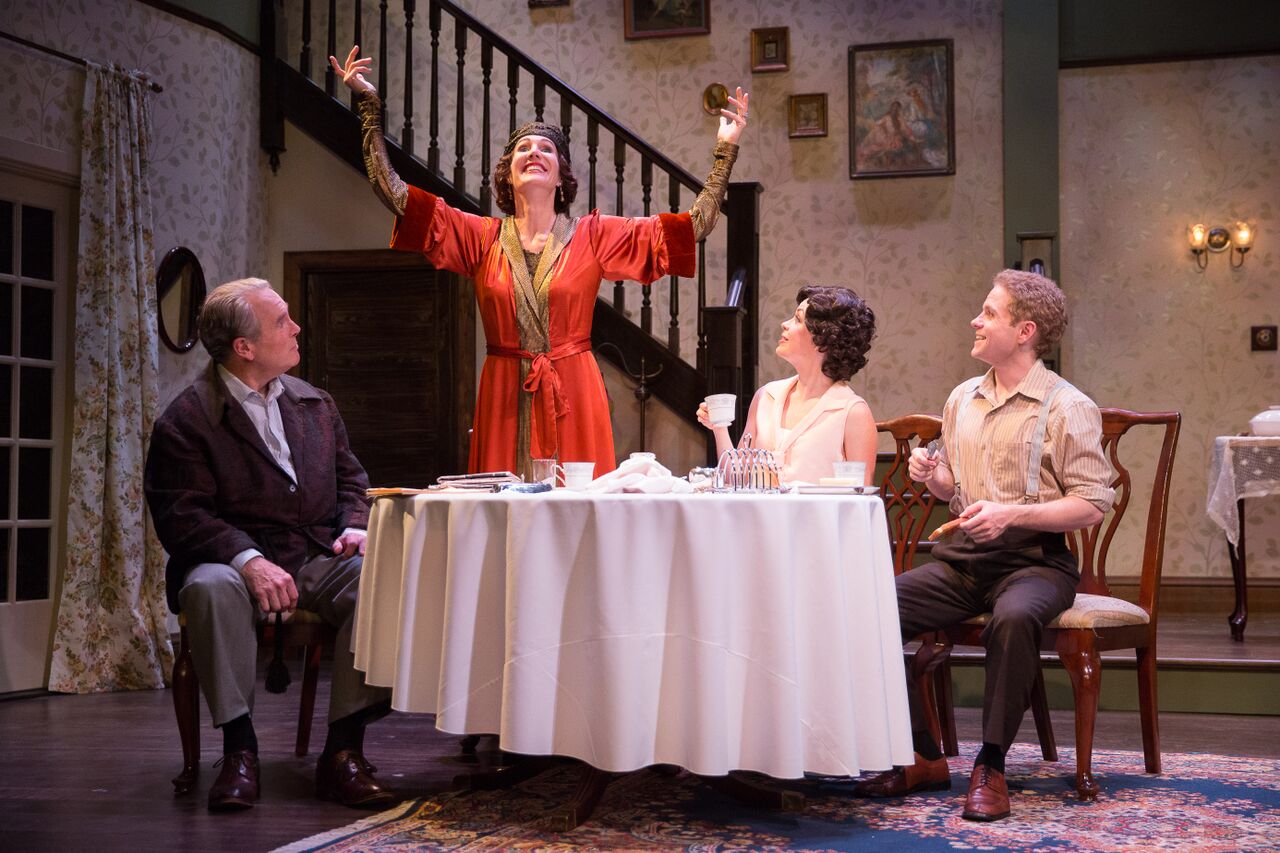
Under Elly Lichenstein’snimble stage direction, the setting is moved from Elizabethan times to the 1950s, a device used in the Metropolitan Opera’s presentation a couple of years ago. It’s a move that is not entirely as successful as Cinnabar’s recent presentation of a jazz-age “Marriage of Figaro”. The costumes are fabulous with those gaudy neon colors, and there’s a nod to the era when Falstaff’s underlings come in with a case of – what else? – Falstaff beer. But In the first few scenes, the story is a bit hard to follow. Relationships and the characters’ intentions are not established until later on. Some of the actors’ performances lack the spontaneity that makes them believable.

Eileen Morris

Even so, the last scene and finale emerge as pure fairytale enchantment that could be right out of “A Midsummer Night’s Dream”. The flawless music direction by the always-brilliant Mary Chun (an SFBATCC 2015 award-winner) guides a spot-on orchestra of twelve. Overall, this may not be not one of Cinnabar’s better operas, but it’s a very enjoyable and entertaining family production.

When: Now through June 28, 2015

8 p.m. Fridays and Saturdays

2 p.m. Sundays

Tickets: $25 to $40

Location: Cinnabar Theater

3333 Petaluma Blvd North, Petaluma CA
Phone:
707-763-8920

Website: www.cinnabartheater.org


‘Choir Boy’ is a powerful drama in Marin buoyed by spirituals

By Woody Weingarten

Pharus (Jelani Alladin, left) and his teacher, Mr. Pendleton (Charles Shaw Robinson), share a connective moment in “Choir Boy.” Photo by Kevin Berne.

Headmaster Marrow (Ken Robinson, left) admonishes his nephew, Bobby (Dimitri Woods), in “Choir Boy.” Photo by Kevin Berne.

Choir members (from left) Anthony (Jaysen Wright), David (Forest Van Dyke) and Pharus (Jelani Alladin) meet for their first practice in “Choir Boy.” Photo by Kevin Berne.

[Woody’s [rating: 5]

I can’t remember ever feeling as white as when I saw “Choir Boy,” the new Marin Theatre Company drama.

The play, which provides scaffolding for the notion of tolerance, is incredibly powerful.

And incredibly black.

Playwright Tarell Alvin McCraney immediately sets the tone with a black prep school commencement where the words “sissy” and “nigger” are hurled at a gay student.

I thought I’d been color-blind all my life.

I’d banded on civil rights issues in the early ‘60s with militant black attorney Paul Zuber and self-styled radical lawyer Paul Kunstler.

Earlier, I’d joined my father in welcoming into our home in a New York suburb what then were called Negroes. I’d enjoyed rhythmic, bluesy “race records” spun by “Moondog” (deejay Alan Freed) and spirituals by Mahalia Jackson and less famous African American artists. I’d been moved beyond belief by Billie Holiday wailing “Strange Fruit,” a musical lamentation for a lynching.

I thought I’d earned my liberal stripes.

In 100 “in-your-face” minutes, “Choir Boy” showed me I’ve been practically delusional.

Being Caucasian inevitably precludes a total understanding of the black condition.

“Choir Boy” is markedly pertinent today, when city after city in the United States face sharper racial divides than in decades.

During rehearsal of the show, director Kent Gash told his actors: “No play happens in a vacuum…As we have seen in recent events in Baltimore, African American male lives are at risk. It’s hard not to feel like an endangered species sometimes.”

But “Choir Boy” is more than more an eye-opener — it’s a masterpiece.

I’ve seen four previous plays by MacArthur “genius” grant winner McCraney — April’s “Head of Passes” at the Berkeley Rep, and each part of his “Brother/Sisters Plays” trilogy at the MTC, A.C.T. and Magic Theatre.

Each was extraordinary. Each was formidable.

This drama is better still.

Craney seems to be growing exponentially as a playwright as he matures (he’s only 34 now).

“Choir Boy,” a coming-of-age story but so much more, pits a gifted homosexual scholarship recipient, Pharus, against Bobby, a student with current and historic family ties to the Charles R. Drew Prep School for Boys.

That fictional school is based on real black history.

Before desegregation, about 100 such schools existed in the United States (only four remain today), which I hadn’t known.

Jelani Alladin instills vitality and reality in Pharus, a young man caught between a desire to be accepted and one of being himself, a theme that’s also reflected in other characters, particularly David, a conflicted, wannabe pastor played by Forest Van Dyke.

Pharus contrasts sharply with Bobby, hot-headedly portrayed by Dimitri Woods as a privileged rebel.

The play, which premiered in London in 2012, is not without periodic injections of humor. But it’s the anguish and poignancy that are unforgettable.

And mind-blowing.

Each of the seven “Choir Boy” cast members is superb, with each of the six black performers layering individualized vocal chops onto their thespian skills.

Ken Robinson, who plays Headmaster Marrow, a rule-oriented man steeped in tradition, has the richest, deepest voice.

None of the others are vocal slouches, though.

Spirituals — both familiar (such as “Sometimes I Feel Like a Motherless Child” and “Wade in the Water”) and not — are sprinkled throughout.

They definitely buoy the drama.

Were the originals uplifting and freeing, or did various slave songs include “coded messages”? A cerebral onstage debate may feel like a distraction from the plot yet is a meaningful connection to black history.

So’s the performance of the sole white in the all-male cast, Charles Shaw Robinson, who’s believable as Mr. Pendleton, a compassionate teacher who’d marched with Martin Luther King Jr. and participated in countless sit-ins.

You probably know somebody just like him.

Rotimi Agbabiaka, as Junior Davis, Bobby’s enabler and sidekick in delinquency, is responsible for most of the humor (though the Pharus character has his share).

And filling out the cast is Jaysen Wright as Anthony (“AJ”), a sensitive athlete-scholar.

The play, it should be noted, includes full-frontal nudity.

Alladin — in a post-play “talk-back” response to a question — explained it well: “The nudity is more than about being naked. It’s a moment when the audience is being asked, ‘Are you comfortable in your skin?’”

Most significantly, the play shows that African American men, like all others, are not one-dimensional, not stereotypes, but complex human beings.

It’s a lesson I’m unlikely to forget.

“Choir Boy” plays at the Marin Theatre Company, 397 Miller Ave., Mill Valley, through June 28. Night performances, 7 p.m. Sundays; 7:30 p.m. Wednesdays; 8 p.m. Tuesdays, Thursdays, Fridays and Saturdays. Matinees, 1 p.m. Thursdays; 2 p.m., Saturdays and Sundays. Tickets: $10 to $55. Information: (415) 388-5208 or marintheatre.org.

Contact Woody Weingarten at www.vitalitypress.com/ or voodee@sbcglobal.net


The Trojans — San Francisco Opera Performance — Review

By Joe Cillo

The Trojans

By Hector Berlioz

San Francisco Opera Performance

June 20, 2015


This is actually two operas and performing them together creates a mammoth production.  The Capture of Troy occupies the first two acts.  Acts three through five make up The Trojans at Carthage.  The two operas are really distinct despite the fact that the composer, Hector Berlioz, conceived of them as a unified whole.  When the opera was first performed at the Theatre Lyrique in Paris, they would only do the second part, The Trojans in Carthage — and they cut it down quite a bit.  Berlioz never saw The Fall of Troy performed.  Thomas May’s offers a lengthy and informative discussion of the history of this opera’s composition and performance in the program.  It is very good and I highly recommend it.  May tells us,

the lack of a definitive full-scale production when Les Troyens was new to the world caused even more long-lasting damage than Berlioz had pessimistically foreseen.   The division and cutting of the work perversely underscored the notion that Berlioz had written a sort of heroic “ruin” that lacked coherence and integral construction. . . Worse, distorted perceptions of Les Troyens encouraged stereotypes of the composer as a washed up Romantic revolutionary who had lost his fire and reverted to a more “conservative” approach.  (p. 39)

I am largely in agreement with this assessment.  This monstrosity is unwieldy and it does lack internal coherence.  What is consistent is that the males end up ignominiously deserting the scene at the end of each opera, and the females end up dead.  There is very little that connects The Fall of Troy to The Trojans in Carthage except that some of the same characters are used.  But it is two very different, very loosely related stories.  Neither opera is very well written and putting them together on the same program subjects the audience to a long, punishing evening.

I always try to say something positive, if I can, and in this opera what is positive is the music.  The music score is outstanding, and it considerably raised my estimation of Berlioz as a composer.  It makes it all the more poignant that this music composer of the first rank had no talent as a dramatist or as a storyteller.  The Trojan War has a vast wealth of dramatic possibilities, and yet the best Berlioz can get out of it is dull, slow moving, repetitious, and interminably long.  He seems to avoid anything truly dramatic on stage and relates the real drama and conflict in the story line through narratives in soliloquies.  The romance between Aeneas and Dido in The Trojans in Carthage is juvenile and melodramatic.  Berlioz knew nothing about love relationships.  The character of Dido is particularly incoherent and ad hoc.  She starts out as a queen beloved by all of her people and ends up this embittered, venomous, vengeful, suicidal woman — nothing like a queen at all.  How could she have ever been a queen, let alone a queen of such capable leadership?  She is a totally cartoonish, unconvincing character.

It doesn’t help that the sets were unimaginative, the lighting was uninteresting, and the costumes were from the nineteenth century.  They had the Trojan soldiers in nineteenth century military uniforms carrying nineteenth century swords.  Some of them were even carrying long rifles and muskets.  Since when did the Trojans carry rifles in 1200 BC?  In Act 5 two soldiers shared a cigarette.  Was it the Trojans’ own brand, or did they import them from Greece?

Act 4 started with a ballet segment that was well conceived and beautifully done.  No vocal music during the ballet, only orchestral accompaniment.  The structure of Act 4 was two ballet segments alternating with two vocal segments.  The ballet segments were very well imagined and well executed and could work as standalone ballet pieces were they to be excised from this opera.  The choreographers, Lynne Page and Gemma Payne did an excellent job along with the dancers, and the orchestral score was very well suited to the dance.   It made me think that this whole idea of the Trojan War could be recast as a ballet, and it would be much leaner and much more interesting than this long, cumbersome opera.  It is unfortunate that Berlioz’s score was crafted for this dreary, undramatic opera.  Maybe there is a creative composer and a choreographer out there who could adapt it into much more dynamic and aesthetically pleasing ballet.

By the middle of the first act I was wondering if I should sit through all five hours of this.  I couldn’t think of a good enough reason not to, such is the state of my life right now, so I stayed and watched the whole thing.  It was akin to long flight on an airplane, where it is mildly uncomfortable and you are looking forward to it ending.  If Berlioz had been able to collaborate with someone who had ability in theatrics he might have produced a great opera.  Unfortunately, this is a mediocre work, but with a first rate sound track.

‘Love and Information’ inaugurates ACT’s new Strand Theater

By Judy Richter

American Conservatory Theater has introduced its new theater, the Strand, with an intriguing production of  Caryl Churchill’s enigmatic “Love and Information.”

The Strand actually isn’t new. It’s an extensively renovated 98-year-old movie theater that had been closed for 12 years and had fallen into major disrepair.

ACT bought it in 2012 and undertook a renovation and restoration project that preserved many of its historic features while incorporating the latest in technology and amenities for a total cost of $34.4 million.

The result is the mainstage 283-seat Toni Rembe Theater plus the 140-seat Rueff with its flexible seating for performances, education programs and other special events.

Located across from UN Plaza convenient to BART and SF Muni lines, this theater is in San Francisco’s fast-evolving mid-Market neighborhood where tech companies like Twitter have moved in.

Thus this play seems like an apt choice to open this theater because even in this high-tech age, people still hunger for information and love.

Like so many high-tech innovations, the play breaks with convention. Thus audiences might have a hard time figuring everything out, but it’s so well done that one can just go along while remaining closely attentive.

Running about 90 minutes without intermission, the play has 57 non-related vignettes with no story arc and no connection between scenes. Some scenes are mere seconds, while the longest is just over five minutes.

In most of the vignettes, the characters are seeking some love or some sort of information, sometimes both. Humor and poignancy abound.

The cast of six women and six men of various ages and races creates 140 characters. Most vignettes have only two speaking characters.

Shona Tucker and Sharon Lockwood have the first vignette, “Secret,” in which one woman begs another to tell her something.

In another vignette, two middle-aged men played by Anthony Fusco and Dan Hiatt have dinner together and reminisce about the relationship they once shared.

Others in the versatile, talented cast include Joel Bernard, Cindy Goldfield, Joe Holt, Rafael Jordan, Christina Liang, Leo Marks, Dominique Salerno and Mia Tagano.

Because playwright Churchill doesn’t specify locations or provide stage directions in this 2012 play, each producer and director can make their own choices.

In this case, director Casey Stangl makes San Francisco the primary location. Settings include Union Square as well as BART, Muni and the fountain across from the theater.

Robert Brill’s scenic design features Micah J. Stieglitz’s projections on a large upstage screen along with simple, easily moved furniture. C. Andrew Mayer’s sound design, complete with BART noises, contributes to the ambiance, along with Lap Chi Chu’s lighting design and Jessie Amoroso’s costumes.

“Love and Information” is indeed an unusual play, but it holds one’s attention and interest thanks both to Churchill’s writing and to the talents of the actors and artistic team using the Strand’s resources.

It will continue through Aug. 9 at ACT’s Strand Theater, 1127 Market St., San Francisco. For tickets and information, call (415) 749-2228 or visit www.act-sf.org.


LOVE AND INFORMATION inaugurates A.C.T.’s Strand Theater with a winner.

By Kedar K. Adour

Ensemble of Love and Information at A.C.T. Strand Theatre

LOVE AND INFORMATION: A Theatrical Event by Caryl Churchill. Directed by Casey Stang. A.C.T.’s  Strand Theater, 1127 Market Street, San Francisco, CA 94103. 415-749-2228 or www.actasf.org.

June13–August 9, 2015

LOVE AND INFORMATION inaugurates A.C.T.’s  Strand Theater with a winner. [rating:5]

It is befitting that the initial production to grace the stage of A.C.T.’s  Strand Theater is a truly a new form of theatrical writing. The ‘play’ is Caryl Churchill’s latest opus Love and Information that has, of course, a beginning and an end but does not follow any of the Aristotelian or modern guidelines of playwriting. There are the 47 scenes unrelated to one and other with an occasional unidentified character silently walking in and out of a scene(s). Nor is a single character identified. 

In fact the PR material states that each scene has a title but does not necessarily describe the content. Churchill allows the director to stage each scene in any order desired and with the freedom to remove a scene.  How then should a theater critic review the “play?”   In the words of my editor, “Be a reviewer and not a critic.”

 Director Casey Stang who has impressive curriculum vitae is an admirer of Churchill’s work having directed Cloud Nine at the Guthrie Theatre and other venues. Stang has elected to engage 12 actors of various ethnic backgrounds to play all 100 plus roles using projections on the huge screen dominating rear stage. The number of each scene is flashed on that screen and sparse furniture is deftly moved on and off stage as necessary without interrupting the flow of the action. There is also a myriad of slick costume changes.

Churchill explores love in many manifestations from the young to the old with forays into male/female homosexual as well as heterosexual relationships. There are no judgmental implications in matters of love or information. Churchill’s writing just succinctly chronicles the events.

Information takes the forefront in the opening scene where two women are having a conversation with one having a secret that she does not wish to share. From this simple interpersonal sharing of information there are forays in television, cell phones, Facebook and Twitter and the loss of privacy with modern technology. A devastating scene is a brief interchange between two detectives, one white, one black who are interrogating a prisoner.

After seeing this theatrical event you are forced to make your own decisions of what is right and what is wrong. Churchill does not tip her hand and expertly demonstrates “this is how it is.”  Selecting individual scenes for discussion becomes a very personal choice. A brief request by one actor to another, “Look at me!” conveys more information than reams of dialog.

There is a great deal of humor, both satirical and unexpected, allowing the evening to be well balanced. When one actor insists he has had a conversation with God he receives a question, “Does he have a regional accent?” The seriousness of having pain is defused with an analysis of the word meaning: “If pain has meaning what is the meaning of meaning?”

Virtual reality, classified information, climate change, the significance of a red rose, control over the TV remote, the lack of ability to say “I’m sorry” and the loss of social intercourse can be found. All are there but be assured there is much, much more. It all ends with a ‘selfie’ of the cast making the performance a not to be missed evening.

CAST: Joel Bernard, Anthony Fusco, Cindy Goldfield, Dan Hiatt, Joe Holt, Rafael Jordan, Sharon Lockwood, Leo Marks, Stefanée Martin, Dominique Salerno, Mia Tagano and Shona Tucker.

CREATIVE TEAM: Robert Brill (set design); Lap Chi Chu (lighting design);Jessie Amoroso (costume design); Andrew Mayer (sound design); Micah J. Stieglitz (projection designer).

Kedar K. Adour, MD

Courtesy of www.theatreworldinternetmagazine.com.

‘Chinglish’ explores East-West differences

By Judy Richter

Although China and the United States have been trying to conduct more business with each other, cultural differences can still get in the way.

That’s what the central character discovers in David Henry Hwang’s “Chinglish,” presented by Palo Alto Players.

Daniel Cavanaugh (Chris Mahle) runs a family-owned sign company in Cleveland and is trying to land the sign contract for a new cultural center in Guiyang, China. Officials there want to avoid embarrassing English translations such as “deformed man’s toilet” on signs for restrooms for the disabled.

Because Daniel has never been toChina and doesn’t speak Mandarin, he hires a consultant, Peter Timms (Michael T. McCune), an Englishman who has spent several years in China and knows the language and customs.

His knowledge comes in handy during Daniel’s first meeting with Minister Cai Guoliang (Jeffrey Sun) and Vice Minister Xi Yan (Joyce F. Liu) because their interpreter isn’t  always accurate in either her English or her Mandarin translations. English supertitles show the differences and aid the audience throughout the two-hour (one intermission) play.

Daniel soon learns that there’s much he doesn’t understand, especially when he, a married man, becomes involved in an ill-advised affair with a married woman.

The play is loaded with hilarious moments, many of them from miscommunications and botched translations.

Perhaps the most amusing scene occurs in the second act when Daniel again makes his pitch to Chinese officials. They listen politely until he tells them that he formerly worked for a firm whose financial misdeeds roiled the U.S. economy. Even though he assures them that he wasn’t involved in any wrongdoing, they’re excited and impressed that he knew some of the chief culprits.

Lily Tung Crystal is making her directoral debut with this production, but she has appeared in the play elsewhere and lived in China for nearly a decade. Thus she directs with a sure hand and with respect for cultural aspects of the play. She also is fortunate to have a skilled cast in which all of the actors except Mahle as Daniel speak Mandarin.

The cast also includes Dianna Hua Chung, Isabel Anne To and Phil Wong, each playing several characters.

The set by Kuo-Hao Lo (lit by Nick Kumamoto) revolves, facilitating scene changes. The character-appropriate costumes are by Y. Sharon Peng, the sound by Jeff Grafton.

Playwright Hwang is perhaps best known for his Tony-winning “M. Butterfly,” which also looked at cultural differences between the East and West. His 2011 “Chinglish” is far more humorous, but there are serious undertones, too, making for a rewarding theatrical experience.

It will continue through June 28 in the Lucie Stern Theater, 1305 Middlefield Road, Palo Alto. For tickets and information, call (650) 329-0891 or visit www.paplayers.org.


Choir Boy

By Kedar K. Adour

Choir Boy Ensemble at Marin Theatre Company

CHOIR BOY: Drama by Tarell Alvin McCraney. Marin Theatre Company (MTC), 397 Mill Avenue, Mill Valley, CA, 415-388-5208 or www.marintheatre.org.  Extended to July 5.2015

CHOIR BOY explodes on the MTC stage. [Rating:4]

Tarell Alvin McCraney made an impressive debut in the Bay Area theatrical scene in 2010 when his trilogy The Brother and Sister Plays received spectacular productions at three different theatres. It began at the Marin Theatre Company (MTC) with their stunning production of In the Red and Brown Water before the baton for Part Two, The Brothers Size, was passed on to the Magic Theatre and part Three, Marcus: The Secret of Sweet, was handed over to A.C.T. Berkeley Rep received the early 2015 honors in the Bay Area to produce Head of Passes.

McCraney is back at the Marin Theatre with his latest opus Choir Boy. He has left the bayous of the Mississippi Delta and selected the Drew Preparatory Boarding School for black, mostly scholarship boys as his venue. It saw light of day at the prestigious Royal Court Theatre in London is 2012 before arriving at the Manhattan Theatre club in New York in 2013. Since that time it has had multiple productions in the U.S. receiving mostly rave reviews.

For this Bay Area production, Marin Theatre has brought along members from the Washington, D.C Studio Theatre production. These include director Kent Gash, music director Darius Smith, set designer Jason Sherwood and cast members Jelani Alladin and Jaysen Wright.

Religion plays an important part of McCraney’s plays and so it is with this multi-scene two hour Choir Boy.  The basic storyline revolves around two students vying for leadership of the schools highly regarded choir. The honor to lead the choir is in question with rivalry between gay Pharus Young (Jelani Alladin) and hot-head Bobby Marrow (Dimitri Woods) nephew to the Head Master Marrow (Ken Robinson). Between individual scenes there are a cappella gospel songs, beautifully sung either as solos or as a group by the members of the choir.

In this milieu McCraney explores love, hate, ambition, school-honor code and parent/children relationships. Although the cast, with one exception is African-American, the truisms and conflicts seem universal with a few specific to race.

Beginning with the conflict between the homosexual Pharus and macho Bobby the other characters are given verisimilitude by their individual dialog and interpersonal reactions. Junior Davis (Rotimi Agbabiaka) is Bobby’s close buddy and AJ (Jaysen Wright) a heterosexual athlete is a true friend and roommate to Pharus. Rounding out the student class is introverted David (Forest Van Dyke) who is trying to find his way and true identity. McCraney uses the device of one-sided telephone conversations between the students and unseen parents in a partially successful attempt to explore parental pressure on the youngsters.

The Headmaster is also under pressure to raise funds for the school and even after 30 years in the job does not understand that sex and love are rampant in an all-male prep-school environment. That theme leads to explosive sexual demeanor and at the same time includes non-sexual male bonding. Flamboyant Pharus has accepted his proclivities and is proud ability to lead the school’s choir.

All the cast give dynamic individualistic performances that fit like pieces of a jigsaw puzzle. This is enhanced by Ken Gash’s powerful staging, enhanced by Kurt Landisman’s atmospheric lighting and Darius Smith’s brilliant musical direction of the a cappella gospel music.

Recommendation: A strong ‘should see’. Running time 120 minutes without intermission.

CAST: Rotimi Agbabiaka, Jetani Alladin, Charles Robinson, Ken Robinson, Forest Van Dyke, Dimitri Woods and Jaysen Wright.

ARTISTIC CREW: Directed by Kent Gash; Scenic Designer Jason Sherwood; Lighting Designer Kurt Landisman; Costume Designer Callie Floor; Music Director Darius Smith; Sound  Designer/Assistant Music Director Chris Houston; Stage Manager Sean McStravick; Properties Artisan Kirsten Royston.

Kedar K. Adour, MD

Courtesy of www.theatreworldinternetmagazine.com.


“Choir Boy” is a Masterpiece at Marin Theatre Company!

By Flora Lynn Isaacson

Choir Boy is a Masterpiece at Marin Theatre Company! 

Marin Theatre Company closes out its 48th Season with a Bay Area premiere of Choir Boy by Tarell Alvin McCraney, the celebrated American Playwright of the Brother/Sister Plays Trilogy and Head of Passes.  Kent Gash, who previously directed the San Francisco Bay Area Theatre Critic Circle’s award-winning production of August Wilson’s Seven Guitars at MTC, powerfully directs this exceptionally beautiful piece of theatre.  This is pure theatre magic! 

Choir Boy takes place at the Charles R. Drew Prep School, an institution devoted to the development of extraordinary young black men.  This play is a series of vignettes focusing on Pharus Jonathan Young (Jelani Alladin), a talented singer at the school.  Pharus, a scholarship student, is ambitious and has worked hard to become the leader of the school’s famous gospel choir, but he’s also not inclined to hide his natural flamboyance and has to decide how to deal with gay slurs from his classmates.

Director Kent Gash has created an ensemble of performers who work as a unit while each actor manages to maintain his individuality.  The primary conflict is between Pharus and Bobby Marrow (Dimitri Woods), member of a prominent family and nephew of Headmaster Marrow (Ken Robinson), while Pharus’ main defender is his roommate Anthony Justin “AJ” James (Jaysen Wright). 

Filling out the cast are two more students Bobby’s friend Junior Davis (Rotimi Agbabiaka) and Pharus’ serious friend David Heard (Forest Van Dyke).  The Headmaster enlists Mr. Pendleton(Charles Shaw Robinson), a retired Caucasian faculty member, to help the singers work together and think through their difficulties. 

Jelani Alladin succeeds in portraying the different sides of Pharus: a young man who wants to be loved and accepted but who understands the need to follow the rules.  Dimitri Woods successfully shows Bobby’s frustration, at not getting the respect to which he feels entitled, without becoming a villain.  Headmaster Marrow, as portrayed by Ken Robinson, sympathetically shows how the Headmaster is occasionally in over his head, and Charles Shaw Robinson adds some comic relief as Mr. Pendleton, who emerges gradually from being less shy and becoming more authoritative. 

McCraney incorporates acappella gospel songs between the scenes, sung brilliantly by his five young leads, directed by Darius Smith and Sound Designer/Assistant Music Director Chris Houston. 

The boys’ sharp prep-school uniforms are designed by Callie Floor and Scenic Designer Jason Sherwood’s stately set is circled by portraits of great African-American leaders.  Lighting Designer Kurt Landisman’s effective lighting enhances the mood.  

Choir Boy is at the top of my list of shows not to be missed!

FLORA LYNN ISAACSON


Photos by Kevin Berne and Ed Smith

Choir Boy began June 9 and has extended its run through July 5 at Marin Theatre Company, 397 Miller Avenue, Mill Valley. 

Performances:
Tuesdays, Thursdays, Fridays, and Saturdays 8:00 pm Wednesdays 7:30 pm
Sundays 7:00 pm

Matinees: Sundays 2:00 pm; Thursday, June 18th at 1:00 pm; and Saturday June 27th at 2:00 pm

For tickets, contact Marin Theatre Company at 415-388-5208 or online at boxoffice@marintheatre.org.

Coming up at Marin Theatre Company, to start their new Season, will be The Oldest Boy by Sarah Ruhl from September 10 through October 4, 2015.


Two Women — San Francisco Opera Performance — Review

By Joe Cillo

Two Women

By Marco Tutino

San Francisco Opera Performance

June 13, 2015


This was one of the best opera performances I have seen.  It was a modern opera — if you call World War 2 modern.  It was imaginatively staged, using modern video and lighting techniques, and the music was suited to the story line and worked.

It was set in Italy in the midst of the Second World War right at the moment of the Allied invasion and the subsequent fall of Mussolini.   But the war and politics serve as a backdrop.  The opera is about the universal miseries of war visited upon a civilian population: displacements, deprivations, disruptions, separations, deaths, rapes, duplicities, betrayals, constant fear, and the eternal struggle to develop and maintain personal relationships and pursue love in the midst of upheaval and turmoil.  It was a well told story that held my interest all the way through from beginning to end.

I studied the synopsis provided by the San Francisco Opera beforehand.  I went through it three times.  The synopsis sounded confusing and complex.  I was afraid I wasn’t going to be able to follow the opera because there are a lot of characters, they are on the move all the time, settings are changing, and even revisiting previous locations, as well as relationships that keep changing and evolving.   But the performance told the story very clearly and logically.  Video and visual displays were used very effectively to set each scene in its temporal and geographical context.  It was straightforward and clearly presented.  I was surprised.  It was really good.  The sets were imaginative and visually pleasing.  The lighting and special effects were just right and powerfully enhancing.  It was all together a top quality production.

Before the performance and during intermission repeating video sequences were shown that provided visual footage of the war in Italy at the time and the military operations that were going on.  I found this very helpful for setting the background of the performance and was very glad they did it.

The story was based on a novel by the name of La Ciociara, by Alberto Moravia.   I haven’t read the novel and there doesn’t seem to be a recently published English translation of it.  I happened to sit next to a gentleman who had read the novel a number of times and loved it, and he said it was the reason he wanted to see the opera.  He felt that the opera was a faithful representation of the novel, although he said the ending was different, which I had suspected.

The ending did not make any sense and was the only part of this opera that really failed — which to me, is pretty good for an opera.  I regard opera as the most conservative of all the art forms, and therefore do not expect to agree with the philosophical viewpoints expressed.  In this case it is an enigmatic finish that makes nonsense out of the character of Rosetta.  After the gang rape of the two women by the Moroccan soldiers an estrangement seems to appear between the mother and the daughter that is not adequately explored.  It seems to have to do with differing reactions of the two to the rape.  The daughter, Rosetta, seems to find it liberating in a sexual sense, and she begins asserting this new found independence from her mother through some rather casual sexual adventures, to which her mother strongly objected.  Rosetta reappears at the very end and derides the naivete and foolishness of Michele to her mother, but then, informed of his death, she is devastated and falls prostrate to the ground in a depressed stupor as the curtain falls — the news of Michele’s death apparently suffocating the sexual rebellion and affording a kind of reconciliation between the two women.

But it’s crazy.   One moment Rosetta is telling her mother what a naive fool she considers Michele to be, and as soon as she finds out he is dead, she practically dies herself.  Rosetta was never that attached to Michele.  He was her mother’s obsession, not hers.  Of course she liked him and bore some attachment to him, but the reaction depicted in the performance is far out of proportion to the emotional temperature of that relationship.  I don’t know how the book ends.  If I ever read it, I’ll revise this, but trying to turn Michele into some sort of Christ-like Savior, a model of goodness and hope, just doesn’t fit with the rest of the story, with the characters of the women, or with the character of Michele.  It’s like the director of the performance didn’t know what to do about the ending.  He didn’t understand the characters and how events had changed them internally, and so he couldn’t see a way for them to go forward.  So he invented this foolish reconciliation through the death of goodness and innocence and put that on the stage.  It was a big mistake.

I think a different director could do something more interesting with the ending of this story.  In fact, the more I think about it, the more it seems to me that this story is about the death of innocence, pacificism, and simpleminded goodness, and nothing illustrates that better than the atrocities of war and the gang rape of women by conquering soldiers.  It is a somewhat negative commentary on human nature and the darkness within the human heart.  Michele, the romantic dreamer, is killed off by the conniving, insecure, duplicitous Giovanni.  The gang rape of the two women by the soldiers serves as a sexual awakening for the young daughter and she begins to assert her independence from the sexual conservatism of her mother.  The director does not seem to be comfortable with this outcome and tried to turn it into a morality play that would sit better with his conservative American audience by bringing Michele back from the dead to beat down the rebellious Rosetta, turning the dead Michele into a kind of Christ-like Savior of the young girl from sin.  No. No. No.  Sorry.  It doesn’t work.  That’s not what happened here.

But aside from this confusing, ill thought out, bizarre ending, the opera is pretty good.  It is a well presented, interesting story, a timely topic, visually engaging, and musically satisfying.   If the ending were more coherent and consistent with the rest of the import of the opera, it could be one of the greatest operas.

Cleanliness and Fragrances — Reviews and Essay

By Joe Cillo

Cleanliness and Fragrances — Review Essay


Fragrance Reviews begin at the end of this essay. 


Because of the savour of thy good ointments thy name is an ointment poured forth, therefore do the virgins love thee.      Song of Songs 1:30

Who is this that cometh out of the wilderness like pillars of smoke, perfumed with myrrh and frankincense, with all powders of the merchant?   Song of Songs 3:6


Most people, throughout most of history, in most times and places, most of the time, stunk.  Left unattended the human body will stink to high heaven in a very short time.  It is eminently natural to stink.  It is said that the Mongol army could not launch a surprise attack because it was possible to smell them from twenty miles away.  They prided themselves on never bathing.  They were barbarians.  The Mongols did not torture people to death, unlike most civilized societies of their time (Weatherford, pp. 115-16).  The Romans and most other civilized societies made torture a public spectacle to entertain and intimidate their citizenry.  They were sadistic.  What made the Romans civilized and the Mongols barbarians was that the Romans took baths and the Mongols stunk.  The Mongols believed that a person’s body odor was part of their soul (Weatherford, p. 12) , and this probably was part of the reason they refused to bathe — in addition to the scarcity of water on the Central Asian steppe.

It is the practice of bathing, the attendance on personal hygiene, the mitigation of offensive odor from the body, rather than moral superiority, that distinguishes civilized people from uncivilized.  Not stinking, or actually smelling good, is the mark of civilization.  One of the most commendable achievements of modern capitalism is that it has made people smell better.

In former times the practice of bathing was much less common and human body odor was ubiquitous, although attitudes toward body odor and bathing are highly variable from culture to culture (Ashenburg, Introduction).  The ancient Egyptians were known for being fastidious about bathing and personal cleanliness (Ashenburg, p. 6).  They were one of the earliest civilizations.

It was Christian hatred of the body that brought about the demise of the Roman public baths and ushered in a long era of despising and devaluing bodily cleanliness and sanitation (Ashenburg, p. 58f.)  From the 16th to the 18th centuries it was not unusual for people to go for a year or more without ever bathing.  Even the aristocracy was noted for rank malodor (Ashenburg, Ch. 4).  Queen Elizabeth I bathed once a month “whether she needed it or not” (Ashenburg, p. 99).  If the queen only bathed once a month, imagine what the rest of the people were like.  It was a different time.

This long era of filth and stink in the western world began to recede in the last half of the eighteenth century and accelerated in the nineteenth, especially with the advent of running water in the home.

As cities expanded, and people worked close to one another in crowded offices and factories, they grew unhappily aware of the smells produced by their own bodies and those of others.  The arrival of women in the work world accelerated this new sensitivity.  The fastidiousness that had first surfaced, tentatively, in late eighteenth-century Europe was becoming an American obsession.  At the same time, prosperity was at an all time high.  People could afford the products that would enable them to live in a smell-less zone, a safe place where they would neither “offend” nor be “offended.” (Ashenburg, p. 244)

Advertising campaigns in the 1930s and 40s promoted deodorant, shampoo, and razors to women, and later sanitary napkins (Ashenburg, p. 5).  A major industry has been built in the twentieth century around suppressing natural body odor and replacing it with something supposedly better.

My own attitude is that one should have to get pretty close to another person in order to smell their body.  Smell is intimate, and one’s personal body odor should be largely private.  If you can smell a person from more than a few feet away (and that includes perfume, or anything), that person is not civilized and is out of place in a modern society.

“the slovenly folk, who have been going on the theory that they can take a bath or leave it, are to be brought to their senses,” (NYT, July 10, 1927.  Ashenburg, p. 255)

“Odors are unnecessary and those that have them are violating rules of courtesy.” (Ashenburg, p. 254; quoting Hadida, 1932, pp. 98-104)

“Smelling someone’s real body or allowing your own body to be smelled has become an intrusion, a breach of a crucial boundary.”  (Ashenburg, p.271)

San Luis Obispo, CA, law bans people from the library for having offensive odor.  This provision was part of a list of disruptive behaviors prohibited from the library.  (Los Angeles Times, March 5, 2005.  Ashenburg, p. 273)

Why not make scentless the modern ideal, since ever greater cleanliness seems to be the American way?  There is a lot to be said for that, and the only argument I would make against it is that people have always smelled, and so we are accustomed to our bodies emitting odors and to perceiving the odors of others.  If we are going to smell, why not smell good rather than offensive?  Scentless in my view is too conservative and carries the war on body odor to an untenable extreme.  The aesthetic I advocate is that body odor should be minimal and not intrusive or attention seeking, pleasing if possible, but at least minimally offensive.

The word ‘perfume’ comes from the Latin per fumum meaning “through smoke.”  (Morris, p. 16)  The earliest perfumes were likely the burning of wood or meat to offer a pleasant savor to the gods.  Burning incense to the gods was a widespread practice in the ancient world. (1 Kings 11:8, Ezekiel 6:13)  The sweet smell of the incense was judged to be pleasing to the gods and the rising smoke and fragrance would carry aloft the prayers of the people and provide a pleasing presentation to the deities.  In the thirtieth chapter of Exodus God commands Aaron to build an altar and burn incense on it.

Of shittim wood shalt thou make it. . . And Aaron shall burn thereon sweet incense every morning: when he dresseth the lamps he shall burn incense upon it.  And when Aaron lighteth the lamps at even, he shall burn incense upon it, a perpetual incense before the Lord throughout your generations.  Exodus 30: 1-8

Of the three gifts that the wise men brought to the baby Jesus, two of them were fragrances.  In a world where obnoxious smells were the rule, pleasing fragrances were valued on a par with gold.

There is archeological evidence of a thriving perfume industry on the island of Cyprus as early as 2000 BC.  Perfumes have been found in Egyptian graves going back to 3000 BC.  (The Scotsman: Scotland on Sunday, September 21, 2014)

A pleasing fragrance, a sweet savor, was thought to be better than the ordinary rancidness of daily life and thus worthy of presentation to the gods.  So also in perfuming the body one gains favor and elevates oneself in the noses of one’s peers and especially in one’s estimation of oneself.  One gains in self confidence and self esteem knowing that one’s fragrance is apt to make one pleasing and attractive to others.  A pleasing fragrance is a sign of cultivation, sophistication, aristocracy.

The European tendency to be more accepting of the stink of everyday life is a cultural difference which I regard as somewhat primitive.  You have to keep in mind that the smells that come off of our bodies are the result of bacteria and fungi inhabiting our skin and orifices and these organisms can be pernicious. They can create infections, irritations, illnesses.  They can cause your teeth to rot and fall out.  The odor that we perceive is only the first indication of their presence in significant numbers and the impact they are beginning to have on our bodies and health.  Body odor tells us that it is time to wash off the bacteria before things get worse.  Modern hygiene has made us healthier and lengthened our lives — not to mention improved the aesthetic quality of our personal interactions.

The modern perfume industry began in the eighteenth century, mainly in France and Germany, with the return of bathing.  As people bathed their bodies they found it pleasant to anoint themselves with fragrant waters and oils.  The spread of the use of fragrance grew in conjunction with the development of porcelain ceramics and glass which were used to make containers for these fragrant concoctions, because they would not react with the fragrant oils and extracts in the perfumes.  (Morris, 1999, pp. 74-82)

This nascent perfume industry, catering as it did to the aristocracy, was nearly obliterated in the French Revolution.  However, Napoleon Bonaparte, who came to power in 1804, was a dandy, who was very conscientious about bathing and hygiene, even on military campaigns, and he revived the perfume industry in France, giving it generous support and encouragement (Morris, 1999, pp. 84-87).  The discovery of chemical solvents in the 1830s that allowed for the extraction of exotic scents from many flowers and plants that had never been possible before, led to an explosion of perfume manufacturing.  Many of the major perfume houses that exist today got their start in the nineteenth century.  It was the growth and rising affluence of the middle class and the increasing attention to bathing and hygiene that fostered this prodigious growth of the perfume industry.

Today the fragrance industry is a multibillion dollar worldwide behemoth that employs sophisticated technology, marketing, and huge budgets for product research and development.  The Perfect Scent by Chandler Burr is an excellent inside look at this modern industry.  I am not going to go into surveying it here.  I think this is long enough already.  But Burr is an excellent, knowledgeable writer whose books are readable and very interesting.

I want to make one more philosophical foray into aesthetics and taste before I leave you to peruse my reviews of individual fragrances.  Ashenburg gives an unwarranted amount of space to Sissel Tolaas, who runs a research lab in Berlin devoted to scent (Ashenburg, 2007, pp. 271-74).  Among other projects, the lab is building an archive of scent which includes over 7000 aromas neatly labeled and catalogued.  Tolaas hopes to develop a vocabulary of fragrance that will allow us to describe and discuss fragrances in words for which for which our current linguistic capability is dearth.  These are laudable projects and I do wish her success in these efforts and I remain interested in her progress.  Where I differ with Tolaas and the slant that Ashenburg gives to her, is her aesthetic.  It is best illustrated by an anecdote that she relates herself:

Once at the Berlin Film Festival I wore a beautiful evening dress and put on a smell which was the absolute contrast — the smell of garbage and the stench of dogshit!  And people were completely confused because the way I looked and the way I smelled had nothing to do with each other.  And I had the most fun time in my life!  In this case the purpose of smell was to say “leave me alone.”

Normally the role of smell in our society is to say “come to me!” but I did the opposite and I succeeded.  Maybe at some point we will have smells for different purposes, the “stay alone” smell, “come halfway” smell, “come close” smell.  What’s wrong with that?!”  ( Tolaas, Huffington Post, September 24, 2013)

What’s wrong with it is that you don’t need smell to communicate those intentions, and Tolass was sending out a very mixed message by her appealing dress on the one hand and her offensive odor on the other.  The point was to create confusion in people and thus draw attention to herself.  She was at an event where everyone would be dressed fashionably and thus dress alone may not have been sufficient to make a distinguishing splash, so she doused herself in stink in order to make herself stand out from the crowd.  A kind of grandstanding with odor and dress.  There is also a hostile, contemptuous element in it.  It’s childish.

My view is that smells are mostly offensive, probably 80 percent, ranging from the mild to the disgusting.  The evolutionary purpose of smell was primarily to warn us of danger and secondarily to help us find something to eat.  In civilized societies the role of smell in meeting these needs has been minimized and thus smell has been freed from its primary function of perceiving hazard to offering the possibility of aesthetic enhancement, in the same way that clothing has gone beyond simply protecting us from the elements to making a personal statement about ourselves in society.  Deliberately wearing a fragrance to make oneself stink in public is either a reflection of low self esteem and the anticipation of rejection, or a childish, sassy provocation.

Luca Turin has a somewhat different sensibility and aesthetic.  But he is French and Italian.  He tells us

France is a country of smells. . . The idea that things should be slightly dirty, overripe, slightly fecal is everywhere in France.  They like rotten cheese and dirty sheets and unwashed women  (Burr, 2003, p. 3-4).

I noticed that in many of the fragrances that Turin favors and praises.  They sort of stink.  He thinks it is sophisticated to like these somewhat offensive smells.  I think it is civilization turned on its head.  One might question whether Turin speaks for the whole kingdom of France, but his comments are echoed by Henry Miller writing in Paris in the 1930s

That’s the first thing that strikes an American woman about Europe — that it’s unsanitary. (Miller, p. 137)

Chandler Burr rightly calls Luca Turin the “Emperor of Scent.”  Turin probably knows as much as anyone alive about scent, its history and the contemporary industry of scent.  In addition he has an extraordinarily discerning and well trained nose for grasping the ingredients and building blocks of a fragrance.  In presenting these fragrance reviews here I don’t claim anywhere near the skill and sophistication that Turin has to offer.  He is the unquestioned master.  His perception of odors is unmatched and his ability to analyze the compositions of perfumes are far more precise than my own.  I am totally untrained in the language of fragrance and the building blocks of modern perfumes.  Everything I have picked up on my own, with gaps and limitations.  The differences I have with Turin are in taste.   What one chooses to wear, in both clothing and in fragrance, has to do with personality and style and the image one wishes to project in the world.  In this we have substantial differences, and this is reflected in our respective evaluations of perfumes.  It is also true that perfumes can smell differently on different person’s bodies.  That might also be a source of difference in some evaluations.  Turin’s Perfume Guide is the standard classic on this subject.  Anyone who is with more than a passing interest in perfumes should have it.  I used it to help select some of the fragrances to sample.  I did not consult it in formulating my evaluations.  My evaluations and comments on the fragrances are my own.

Every fragrance listed here I have used on my body.  Most of the time I bought small samples and wore them for a couple of days.  In many cases one day was enough.  My comments are generally spare, mostly little more than a reaction.  In rare cases I have changed my mind after a second try.  Usually I know right away whether I like something or not.  However, perfumes change on the body after some time wearing them.  Some perfumes might start out good and then slide downhill after a couple of hours.  Less often they will start out somewhat negative and then evolve in a pleasing way later on.  All of the fragrances that I tried are marketed as “Men’s” or “Unisex.”  There are women’s fragrances that I like, but since I haven’t worn them or tested them myself, I didn’t think it was appropriate to include them in this list.

I also tried a number of “essential oils” in an effort to sharpen my powers of discernment of the components of a fragrance.  I don’t know that it helped all that much, but I listed my comments on the essential oils as well.

After some debate I decided to list the fragrances in alphabetical order.  This posed some problems because some fragrances are known by the perfume house that created them, but many are known by their trade names, with the name of the manufacturer being less well known.  I have tried to list them by the manufacturer, but some that are better known by their trade name may be listed that way.  If you are looking for something and you don’t find it by the manufacturer, try looking for it by the commercial trade name.

A key to the entries.  If a fragrance has a + after it, that means I like it.  If you see ++, then it means it is on my shopping list, or I may have bought a bottle of it already.  The vast majority of commercial fragrances I do not like and would not wear.  So these reviews are overwhelmingly negative.

Chandler Burr’s estimation of the typical commercial masculine fragrance is as follows:

The surefire formula for making a bestselling masculine seems simply to be mixing together enough dihydromyrcenol (laundry detergent) with the smell of metal garbage can to choke a horse, then topping that with the scent of cryogenically frozen citrus peel dusted with DDT and a whiff of recycled plastic.  Chrome is fit, at 10 percent dilution, for controlling weeds on your lawn.  Aramis makes a fine garage floor sterilizer.  But following a plan of simply pumping out some metallic doesn’t always work.  All sorts of things that smelled of the effluent of arms manufacturing plants were put on the shelves every year and, for some reason, refused to sell.  (Burr, 2007, p. 151)

I’m not as caustic as that, but I understand where he is coming from.  However, what I do like, I like a lot, and I admire expert perfumers who are able to create interesting, unique fragrances that have a pleasing effect.  I plan to update this list from time to time as I try new samples.


References


Ashenburg, Katherine (2007)  The Dirt on Clean:  An Unsanitized History.  New York:  North Point Press.

Burr, Chandler (2003)  The Emperor of Scent:  A True Story of Perfume and Obsession.  New York:  Random House.

Burr, Chandler (2007)  The Perfect Scent:  A Year inside the Perfume Industry in Paris and New York.  New York:  Picador/ Henry Holt.

Hadida, Sophie (1932)  Manners for Millions:  A Correct Code for Pleasing Personal Habits for Everyday Men and Women.  New York: Doubleday, Duran & Co.

Miller, Henry (1961)  Tropic of Cancer.  New York:  Grove Press.

Morris, Edwin T.  (1999)  Scents of Time:  Perfume from Ancient Egypt to the 21st Century.  New York, Boston, London:  Metropolitan Museum of Art, Bulfinch Press/Little, Brown & Co.

Turin, Luca and Sanchez, Tania (2009)  Perfumes:  The A-Z Guide.  New York and London:  Penguin Books.

Weatherford, Jack (2004)  Genghis Khan and the Making of the Modern World.  New York:  Three Rivers Press.


The Fragrances


A*Men by Thierry Mugler      Smells like the Wysteria incense my dad used to burn.  But also has a strong vanilla fragrance that becomes dominant.  Very durable.  Too sweet and perfumey for me.  Womanish.  A woman could wear this.


Agonist  Black Amber           Rather light, grassy, hint of vanilla, some wysteria if applied more heavily, vaguely pleasant, not strong, not durable


Agonist  Dark Saphir           Fresh, Soapy, clean, little bit smoky, pleasant, not bad, durable    +     Second time better, more smoky, incense, pungent, good  ++

Agonist Infidels      Smoky, herbal, kind of biting.  Nice.


Amouage Ciel Man          Citrus, lime, fresh, clean, something slightly dark, not strong, not durable


Amouage Epic        Nothing


Amouage Gold      Detergent, stinking, offensive


Amouage Honour         Spicy, smoky, fresh, clean  very durable   + +


Amouage    Journey Man          smoky, spicy, pungent, clean, rather nice.  Softens later on but still retains its spicy character.  Very durable.  Excellent.   ++


Amouage   Jubilation   XXV  Mens        smoky, moderate, durable   + +


Amouage Lyric      Detergent, chemicals, durable


Amouage Memoir     Fresh & light at first, smoky, can’t make up my mind.  Second try:  Negative.


Amouage  Opus VIII               Rancid, watery, rotting vegetables, foul,  not strong, fortunately not durable, threw it out


Amouage Puro  Nejma    Fruity, rich, dark, pungent  Durable   Excellent     + +


Amouage Silver      Moth balls, offensive, choking


Andy Tauer  Lonestar Memories     Stinks  chemicals  detergent  very durable


Anise   — Smells like licorice, but better than licorice.  It has a sweetness and a smokiness, rather pungent.  Very pleasant and fresh.  Could wear it alone.  Fairly durable.  I only used a very little bit.


07-31-14   Tried a bit of anise w a little bit of lime oil on top.  At first it smelled a little rancid, then got itself under control.  The lime seems to freshen and brighten the anise, but the lime disappears quickly, but then occasionally reappears from time to time.  Anise is much stronger and more durable than the lime.  Good mix.


Anubis  Papillon Artisan Perfume          Musky, woody, little spicy, fairly strong, not bad, not durable


Armani    Acqui di Gio — watery, somewhat offensive, very durable, definitely a no


Armani        Light, fresh, little bit spicy, not durable.  So light hardly noticeable.  Don’t really like it.


Armani /Prive  Ambre Soie    Light incense, Pleasant,  not long lasting    +


Aspen         Very nice.  Fresh, woodsy, clean, slightly bitter, but pleasantly so.  The opposite of sweet powdery, perfumey.  Has a kind of tang, but not citrus.  Very interesting.


Bogner Wood Man            Light, pleasant, slightly perfumey.  Not much.


Bulgari Pour Homme —  Light, watery, little bit detergent.  Don’t like it.  Very durable.


Bulgari Aqua Marine Pour Homme          Clean, fresh, watery.  Not offensive but not compelling either.  Fairly durable.


Burberry  Brit — Spicy  >  Old Spice Lite    durable  not bad


Burberry London — Grassy, citrus, light OK, but not much


Burberry  Touch —  Grassy, pungent, watery.  Don’t care for it.


Burberry Weekend            Fresh and clean, little bit grassy, little bit spicy.  Maybe a little bit soapy, but that fades.  Durable.  Rather fresh and pleasant.  Not all that bad.   +


By       Dolce Gabana       Sweet, perfumey, light, slightly watery, little bit sickening.  Not distinctive.  Unfortunately rather durable.  Threw it out.


Calvin Klein  Obsession —  Spicy > Old Spice but light,  OK usable, but not impressive


Canati  — Sweet, musty, pungent > mothballs   don’t like it


Calvin by Calvin Klein           Light, fresh, kind of spicy, reminiscent of new carpet.  Durability only moderate


Carrot seed — Essential oil.  grassy, waxy, little bit sharp, herbal.  Not strong, not durable.


Cuiron Helmut Lang     Nothing.  Couldn’t smell it.  Very indistinct, no character.  Later becomes watery and gains strength.  Very unimpressive.


Cedarwood —  Essential oil.  Heavy, musky, woody.  Without the sweetness and freshness of real cedar.  Not very durable.


Clove bud —  Essential oil.  Smells just like cloves.  Spicy, pungent.  Lovely.


CB I hate Perfumes  Lavender Tea Absolute            Fairly strong  Long lingering   +


Compagnia del Indie  Vetyver       light pleasant   not long lasting


Carven  Vetiver            Nothing much.  OK.


Charvet Cuvee Speciale      Stinks and is durable.  Double negative.


Charvet Cuvee Special         Stinks


Comme de Garcons Avignon    Incense, Smoky, very strong, pungent,  use sparingly  very durable  gets better  ++   Bought larger sample  Very strong, pungent, very durable, Too much.   Sweet.  Threw it out.


Courduroy by Zith        Sweet, perfumy, womanish.  Fairly durable


Clive Christen   X for Men      A little too sweet.  Durable


Clive Christian No. 1 for him          Grassy, stinky.  Nothing.  Short-lived.


Creed Vetyver              Nothing special


Creed Green Irish Tweed —  Grassy, Fresh, clean, later spicy.  Durable.  Nice one.  ++


Creed Royal Water      Grassy, little bit spicy, very light.  Not durable. Unimpressive


D & G Masculine         Spicy, some citrus, rather pungent, little musky,  pleasing, becomes sweeter after a while, somewhat oppressive, quite durable.  I’m giving it a   + but I don’t wear it very much because it’s after effect is so strong and lingering and frankly rubs me the wrong way.  It is much better when you first put it on.  If it would disappear after a couple of hours, I would be much more inclined to wear it.  It makes a good impression, but then hangs around too long.  +


Dark Blue by Hugo      Sort of stinks, sweat plus baby powder,  not durable, fortunately


Davidoff  Hot Water —   Sweet, sickening, threw it out


Davidoff  Cool Water — Spicy, fresh, little bit pungent,  pretty good


Davidoff Cool Water    Edt         Very light, fresh, hint of pine, unimpressive


Declaration by Cartier         Sweet, syrupy, perfumey, sickening, offensive.  Strong, enduring.  After 3 hours had to wash it off, but it still lingered.


Dior Homme         Very light, fresh, little grassy, powdery, womanish, next to nothing, powdery smell becomes stronger.


Donna Karan Fuel Original        Not bad, Nothing special


Dunhill Black           Little grassy, musky, fresh, light,  not impressive, not durable.


English Pear and wild flower — Essential oil.  Strongly soapy, choking,  grows more intense.  Very durable.


Egyptian Musk — Essential oil.  Fresh and clean.  Little bit soapy.  Very light.  Hardly smell it.  Emerges later.  Watery, clean.  Somewhat durable, but fades.


Escada Pour Homme Light Silver Edition      Clean, fresh, slightly smoky,   Not real strong.  Moderately durable  Pleasant.  +


Etro  Messe de Minuit       Smoky, pungent, durable   excellent  + +


Exceptional —    Grassy, light, insubstantial.  Not impressed


Fennel — Essential oil.  Pungent, sharp, spicy, clean > anise.  Later becomes sort of toasty, but sweet.  Durable.


Frank No. 1    Frank Los Angeles         Fresh, clean, herbal, fruit > grape juice? little bit smoky.  Nice.  Not strong.  Not durable.  Unimpressive.


Frankincense — Essential oil.  Light, clean, woodsy, not much.  At first I could hardly smell it at all.  After about half an hour a beautiful smoky, wood fragrance emerges.  It is not strong, but it is marvelous.  An exhilarating surprise.


French Lavender —  Essential oil.  Fresh, clean, musky, very light at first but grows stronger and lasts all day.  Becomes spicy, little bit smoky.  Very pleasant.


Frederic Malle Musc Ravageur edp      Urine plus Vanilla


Fueguia 1833   Darwin    Fresh, clean, woodsy > pine,  nice,  good one   fairly durable   ++  I’m going to get this one.  Excellent.


Fueguia  1833     Otro Peoma de los Dones   Musky, dusky, rotting leaves, not much


Fueguia 1833    Pulperia         Grassy, pungent, sharp, smoky, different, not bad, sort of fresh and clean, interesting, not real durable  +


Givenchy Eau de Vetyver        Musty  Durable


Grey Flannel    Musky, pungent, little bit grassy, decomposing vegetation, Little bit stinking, little bit shit, musty, Smells like a horse barn, but without the sweetness of hay.  There is a vague medicinal quality, but it is very remote.  Becomes somewhat soapy.  Don’t really like this, but it is wearable.

Gucci Pour Homme  (2003)   Smoky, pungent, strong, but not overwhelming, use sparingly, durable.  Very good one.  Discontinued.  Has become expensive on the secondary market.   ++

Guerlain  Apres L’Ondee   Edt   Very fresh and clean, kind of spicy, earthy.  Little bit sweet.  Maybe a hint of citrus.  Well balanced.  Sort of womanish.  The sweetness seems to grow, but does not become too much.  The earthiness holds it in check.  I wouldn’t buy it, but it is very pleasant.  Fairly durable.  Luca Turin likes this one.  +


Guerlain  Bois  D’Armenie           Vanilla  Pleasant, sweet


Guerlain  Derby            Grassy, fresh, very light, hint of pine, not much


Guerlain  Jicky   EDP        Grassy, little bit pine, clean, light, unimpressive


Guerlain  Mitsouko   EDP       Musky >  Patchouli  Fresh, not strong, not impressive


Guerlain  Mitsouko   Edt        Little bit Pine, Little bit Musky, little bit horseshit, not real strong, not to my taste


Geurlain Sous le Vent        Stinks


Guerlain Vetyver          Stinks


Halston Z12  New bottle 08-14    Little grassy, little musky, little rough like sandpaper, not sweet, powdery, flowery, or perfumey at all.  Totally unwomanish.  Not real strong.  There’s a freshness to it.  Clean smelling but not soapy.  As it goes on becomes stronger and more pungent.  The freshness and lightness disappears.  I like it rather less after an hour or so.  Becomes detergent-like.  Astringent.   Very durable and exceedingly strong.  I don’t like this.  I think I am going to throw it out.


Helmut Lang Cuiron       Almost nonexistent.  Very light.  Pleasant.  Practically nothing.


Hermessence Poivre Samarchande    Nothing


Hermessence Vetiver Tonka    Light grassy, fresh, not durable


Histoires Parfums  1740     Woodsy, herbal, rotting vegetation, strong, not durable


Histoires Parfums 1899      Little spicy, maybe citrus, little musky,  not strong. Later spicy vanilla.  Pleasant.  Just a whisper.  Not strong, but has some durability.


Histoires Parfums  Vidi          Watery, soapy, little herbal, light.  Herbal grows stronger and later dominates.  Little bit spicy or smoky.  Durable.  Interesting mix, but too soapy for me.


Hyssop — Essential oil.  Turpentine, Eucalyptus, pungent.  Later softens, less astringent, vaguely sweet.  Rather nice.


Intoxicated  Killian   Little spicy, maple syrup, pancakes, not strong, not durable


Jean Paul Gautier Le Male —  Vanilla, womanish  don’t like it


Jo Malone Ambr & Lavender     Nothing special


Jo Malone  Lime Basil & Mandarin   Fruity, lime, clean, little bit sweet, on the light side, not impressed


Juniper — Essential oil.  Woodsy, musky, fresh, reminiscent of pine, but the muskiness and woodsiness give it a different character


Kinski  Eau de Toilette      chemicals, sweat, mildly offensive, vaguely fresh  durable


Kinski       Eau de Toilette            grassy, soapy, musky, hint of pine, rather pungent, not offensive, but not to my taste, after a while somewhat fresh, watery, not bad as a change of pace, fairly durable   Second try.  Do not like this.  Rancid.  Grassy.  Offensive.


Knize Ten    Grassy, little bit shit, or decomposing vegetation.  Pungent shit smell grows stronger with time.  Fortunately not real durable.


L’Art de la Guerre  Jovoy   Clean, minty, perhaps a little musky, not strong, not durable.  Not much.


Lanvin  Vetyver    Light, pleasant


Le Labo   Santl 33        Little grassy, little watery, little musky, fresh, not strong, not durable


L’occitane Vetyver      Light, almost nonexistent


Lubin Idole Edt         Nothing


Lubin   Korrigan       Musky, incense, rotting leaves, not strong, becomes softer, sweet, finally kind of powdery, womanish, durable.


MEMO    Quartieer Latin      Little bit sweet, flowery, musky, not strong.


MDCI Ambre Topkapi      Light  Citrus, Fresh  Not much


Mohave Ghost   Byredo Parfums    Herbal, little watery, little musky, light, not distinctive


Montale Dark Aoud          chemicals, detergent, but clean smelling   durable


Moroccan Myrrh — Essential oil.  Sweet, spicy, extremely light.  Can hardly smell it.  Later it emerges.  Sweet.  Maybe a little herbal.  Pleasant.   Fairly durable.


Narciso Rodriguez Musc for Him    Oily, grassy,  not much


Oakmoss — Essential oil. Musky, decaying vegetation, leaves, little bit watery.  Very light at first.  Pungent.  Does not emerge.  Not durable.  Very minimal.


Odin    10  Roam     Vanilla, sweet, musky, perfumey, not strong, not durable


Odin Tanoke         Grassy, charcoal, pungent  +


Old Spice    Spicy, somewhat smoky, subdued sweetness which emerges later on, pungent, clean and fresh, fairly durable.  One of my all time favorites.  Cheap, but very distinctive.  ++


Oregano — Essential oil.  smells like oregano, musty, heavy.  Not real durable.  Unimpressive.


Oriental Kush —  Essential oil.  Heavy, flowery, incense, sweet, kind of womanish.


Ormonde  Jayne Isfarkand   Very light, non existent


Oud  — Essential oil. Musky, dusky, little bit watery.  Not real strong.  Increases somewhat with time and becomes perhaps a little more pleasant.  Woody.


Parfum d’Empire Ambre Russe        Smoky, pungent, very durable   Excellent  + +


Parfum d’Empire    Fougere Bengale        Syrupy, little but smoky, not impressed


Paris LA   Lab on Fire       Citrus, lime, fresh, bright, little watery, maybe mint.  Becomes somewhat more watery, and sweeter, mild powder, but retains the citrus element.  Not particularly durable.  Nice but weak.


Pi by Givenchy      Very sweet, womanish, cheap, tacky, tasteless woman, vanilla.  Over much.  Can’t stand it.  Threw it out.


Prada Pour Homme            Spicy, little bit sweet, reminiscent of baby powder, but not offensive, very light, not durable, unimpressive


Profumum Eccelso          Light Pleasant  not durable or distinctive


Profumium Fumidus         Smells like rotting potato skins, then later turns smoky.  Not half bad.  Very durable.


Profumum  Olibdanum       Grassy  Musky  mildly offensive


Puig  Vetyver               Nothing  Unimpressive


Ramon  Monegal    Agar  Musk          fresh, light, grassy, watery, pleasant, not strong, very durable, don’t like it


Robert Piguet  Vintage Bandit  Edt   Grassy, motor oil, little bit shit, mildly offensive, not strong, not durable.


Rosemary — Essential oil.  Pungent > Turpentine or Eucalyptus, can feel in sinuses.  Not durable.  Not strong.


Rosewood — Essential oil.  At first nothing.  Couldn’t smell it.  Applied a moderate amount.  Once it is on the skin the scent begins to emerge.  A little bit pine, a little bit woody.  Fresh and clean.  Not real strong.  Seems to develop after a while.  Slight sweet smell emerges freshened by the woodiness.  Hint of anise could be left over from yesterday although I washed my neck well this morning.  Overall, nice, subtle.  Not a strong impact.


Salvatore Ferragamo Subtil Pour Homme        Fresh, clean, light, a little grassy.  Not durable.  Nothing special.


Salvador Dali  Purple Light         Mothballs, disinfectant.   Fairly durable.


Santal Carmin   Atelier Cologne     Smoky, incense, wysteria, very light at first.  Grows stronger and becomes somewhat powdery.  Pleasant, but too sweet and womanish for me.


Sassafras —  Essential oil.  When I was a kid, sometimes when we visited my cousin we would walk up on the wooded hill behind the town where he lived.  We would pull up sassafras saplings and cut the roots off them and bring them home to boil and make tea.  The tea was awful.  But the smell of the sassafras roots was wonderful.  It was a sweet, pungent, clean, woody fragrance.  This oil is nothing like that. It is like someone took that sassafras fragrance and painted over it with a translucent gray paint.  It is very muted and subdued compared to real sassafras.  It is reminiscent of pine and shoe leather.  It is clean, but not very strong, not real durable, and nothing like real sassafras which is exhilarating.


Serge Lutens    Ambre Sultan          Smoky,  incense, vanilla, little bit pungent, kind of sweet, womanish, at first I liked it but turned against it.  Arabie is better


Serge Lutens   Arabie     Strong, pungent, spicy, hint maple syrup, hint of leaves, pretty good.  Fairly durable +


08-08-14  A dark, rich, pungent fragrance.  Strong tea.  Maybe Anise covered w maple syrup or marmalade, a hint of apricot or pomegranate, something vaguely fruity, but way in the background, not pronounced.  Compelling.  Interesting.  Wonderful.  ++   A couple of websites that had this for sale called it “Arabie for Women.”  It does not say “for women” on the box it came in or on the label on the bottle.  I regard it as a masculine fragrance because of its depth, complexity, and richness, although I suppose a woman could wear it.  It would be sexy and alluring on a woman.


06-01-15    It has become one of my favorites.


Serge Lutens   Chergui    Musky, herbal, not strong, quickly gives way to soft powder.  Not durable.  Womanish.


Serge Lutens  De Profundis      Musty grassy repugnant


Serge Lutens    Enscense et Lavande      Light, fresh, clean.  Turns smoky.  Not very durable  +


Serge Lutens Fourreau Noir        Smoky, rather strong,  very durable  compliment from a girl   ++


Serge Lutens  Gris Clair        Smoky quality that grows   +

Sergei Lutens Muscs Kublai Khan        Musky like dust not durable


Serpentine   Comme des Garcons       Medicinal, alcohol, little grassy, not much.


Sexiest Scent on the Planet Ever    Tuesdays      Musky, spicy, cloves, hint of mint.  Later on becomes smoky, clove scent grows, > incense.  Fairly durable.  I wouldn’t call this sexual but it is very good.  ++


Simply Belle (free sample)   Fresh, clean, watery, hint of smoke, little bit soapy.  Not bad.  I usually don’t like this kind of a fragrance, but I don’t mind this.  Soapiness increases as we go along — a negative.  Fairly durable.  +


S-Perfumes   S-ex      Fresh, clean, musky, woodsy, rather light,  vague hint of sweetness or flowers, hint of something herbal: maybe coriander, nutmeg, patchouli?   Grows stronger, rather spicy, interesting. +


Tauer  L’air du desert Moroccan            Pungent, not bad


Terre D’Hermes        Grassy, fresh, very light.  You have to use a goodly amount.  It does linger, becomes somewhat pungent.  Not half bad.

Tom Ford  Bois Morcaine       Light, grassy not much


Tom Ford Grey Vetiver — Grassy, light, not much, hardly noticeable


Tom Ford   Patchouli Absolu    Pungent, smoky, woodsy, strong, very nice, durable.  ++


Tom Ford   Private Blend Tobacco Vanilla         Strong vanilla odor  sweet  womanish    fairly durable


True Lavender —  Essential oil.  Clean, herbal, little medicinal, somewhat pungent.  Evolves into smooth, polished blend.  Spicy, slightly sweet.  Very nice.


Une Nuit Magnetique  Different Company      Flowery plus rotting vegetation.  Sweet shit.  Interesting mix.  The sweetness is not overly so and held in check by the earthiness.  The whole thing is not very strong.  Not durable.  Rather weak.


Une Rose de Kandahar  Tauer          Floral, little bit smoky, little bit sweet.  Nice  Not strong. Turns powdery, but still retains some smokiness.  Not durable.


White Amber — Essential oil.  Practically nothing.  Musky, little watery.  Can hardly smell it.  Becomes more decisively watery.  Unimpressive.  Not durable.


Wit   Parfums Delrae            Clean, somewhat choking,  > moth balls, detergent, musky.  softens later, becomes less astringent, somewhat powdery.  Not terribly appealing, very durable.  Lasts all day.


Versace Blue Jeans   Very light, little bit sweet, little bit powdery,  little bit musky, not impressed.  Later, increasingly sweet and powdery.  Womanish.  Dislike.  Moderately durable     Threw it out.


Yves Saint Laurent Body Kouros      Smoky, but a little too sweet,  durable


Yves Saint Laurent La Nuit de la Homme — Smoky, spicy, rather light, not impressive