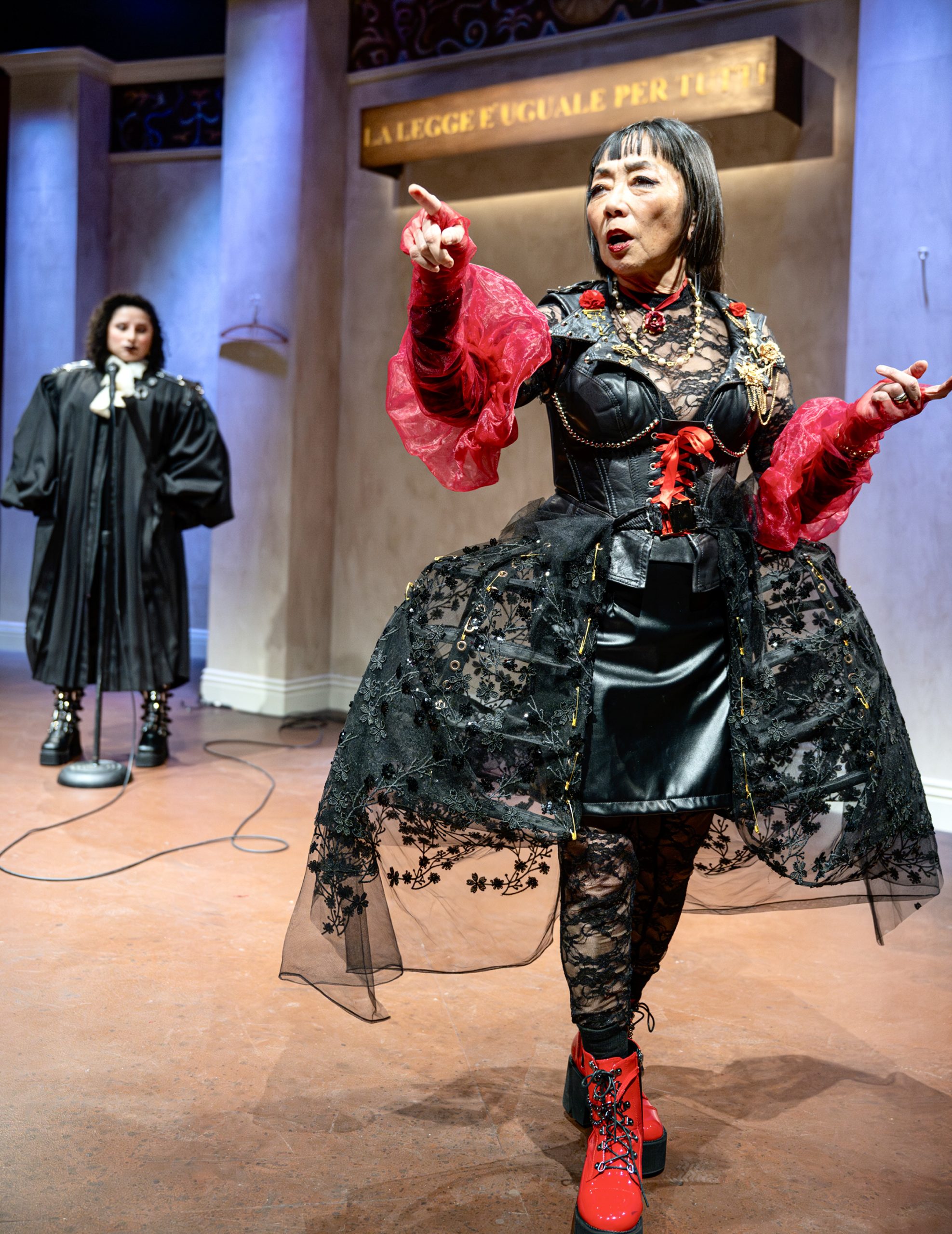
DOOMERS

By Joseph Cillo


A Sharp, Funny, and Terrifying Look at AI’s Future

If you’ve ever wanted to watch a bunch of brilliant, self-important tech types tear each other apart while sitting close enough to dodge the metaphorical (and maybe literal) shrapnel, DOOMERS is your show. Matthew Gasda’s latest play, staged in the intimate Pallas Gallery, doesn’t just invite you into the world of an imploding AI company—it plunks you right down in the middle of it, where you can feel the heat from the egos and the existential dread in real time.

And when we say intimate, we mean intimate. No cushy separation between actors and audience, no towering set pieces—just a rug marking the boundaries of the battlefield. The actors are working with about as much personal space as you’d get on a packed subway car, which makes it all the more thrilling when tensions flare. There were moments when you could practically see the wheels turning in their heads—half from character motivation, half from trying not to trip over our feet.

Act 1: The War Room – Enter the Mad Genius

We open in the offices of MindMesh, where Seth, the freshly booted, maybe-brilliant, maybe-certifiable CEO, is huddled with his loyalists, trying to figure out whether to fight, flee, or burn it all down. Seth sees himself as the only one who can properly birth Artificial General Intelligence (AGI) into the world, and his disciples range from true believers to those just hoping not to go down with the ship. It’s a fast, funny, and deeply unsettling portrait of ambition unhinged, as Seth works the room like a cornered chess grandmaster who still thinks he’s five moves ahead.

Act 2: The Boardroom – Meet the “Responsible” Adults

Over in the corporate boardroom, the so-called “AI doomers” are trying to steer the company—and possibly humanity—away from the abyss. Or are they? Turns out, their definitions of responsibility and ethics vary widely, and as the discussions wear on, it becomes clear that just because Seth is gone doesn’t mean the danger is. Backstabbing, grandstanding, and a bombshell revelation about Seth’s next move turn this act into a slow-burning ethical minefield, leaving the audience to wonder whether these people have humanity’s best interests in mind—or just their own.

A Production That Blurs the Line Between AI and Theater

One of the more unusual aspects of DOOMERS is how artificial intelligence was integrated into its creative process. The playbill lists ChatGPT and Claude—two AI language models—as official dramaturgs, a role typically reserved for human researchers who assist with script development, thematic refinement, and historical context.

While AI tools are increasingly used in creative writing and editing, it’s rare for them to receive formal credit in a live theater production. Given that DOOMERS itself explores AI’s role in shaping the future, this could be a meta-commentary, an artistic experiment, or simply a nod to the evolving relationship between technology and the arts. Regardless, it raises intriguing questions about authorship and collaboration—how much of the script was influenced by AI, and what does it mean for the future of theater when machines contribute to storytelling?

An Outstanding Ensemble Cast

Photo credits Ash Baker.

The performances are uniformly strong, with Sam Hyrkin delivering a compelling mix of arrogance and desperation as Seth. Emily Keyishian’s Myra and Arup Chakrabarti’s Sanjay provide a sharp counterbalance, navigating the chaos Seth leaves behind. The full cast includes:

  • Seth – Sam Hyrkin
  • Jeff – Tommy Harkness
  • Myra – Emily Keyishian
  • Sanjay – Arup Chakrabarti
  • Alina – Emily Anderson
  • Mei – Gabi Maalihan
  • Richard – Evan Sokol
  • Charlie – Elliot Gross
  • Harriet – Anna Connelly
  • Eli – Alex Trono

Each actor brings a distinct energy to the ensemble, ensuring that DOOMERS never feels like a lecture on AI ethics but rather a fast-moving, tension-filled human drama.

The Takeaway? You’d Be a Fool to Miss This One

Gasda’s dialogue crackles with the kind of sharp wit and brutal insight that makes you both laugh and wince. The extreme proximity inside the intimate Pallas Gallery only intensifies the experience—you’re not just watching a power struggle, you’re practically in it. There’s no escape from the tension, no leaning back in your seat—you’re close enough to feel the microexpressions, the nervous twitches, the moments of triumph and collapse.

Director Ash Baker keeps the pacing taut, letting the existential horror sneak in between barbed one-liners and philosophical sparring. By the time the lights go down, you’re left wondering not just about AI’s future, but about the very human mess of egos, ambition, and self-delusion that’s driving it.

The Intimate Pallas Gallery – 1111 Geary Blvd, San Francisco, CA 94109

Reserve tickets: Jacob Donaldson (jacobmpdonaldson@gmail.com)

Ticket Prices:

  • General Admission: $30
  • Premium Seating: $50

Remaining performances run through March 22.


Harvey

By Joseph Cillo


A Rip-Roaring, Rabbit-Loving Romp: Harvey Brings the Laughs and a Little Magic

Now, folks, there are plays that make you think, and then there are plays that make you smile, and Harvey does a fine job of the latter. Pittsburg Theatre Company’s take on Mary Chase’s Pulitzer Prize-winning classic is a warm, witty, and downright delightful production that invites audiences to leave their skepticism at the door and embrace the improbable—namely, a six-foot, one-and-a-half-inch-tall invisible rabbit named Harvey.

From the moment you see the production’s striking promotional artwork—a silhouette of a sharply dressed figure, only instead of a human head, it’s a rabbit—you know you’re in for something playful yet sophisticated. This clever visual sets the tone for a show that balances humor with heart, whimsy with wit.

At the heart of this well-paced comedy is Kirk Waller as Elwood P. Dowd, a man whose unwavering politeness and gentle nature make him instantly likable. Waller plays the role with an effortless charm, as if he were born to spend his days tipping his hat to an imaginary best friend. Suzanne Ochs as his long-suffering sister Veta Louise Simmons gives a sharp and hilarious performance, exasperated to no end as she tries to navigate the chaos that her brother’s unusual friendship causes. Skylar Clouse as Myrtle Mae Simmons, determined to escape social ruin, brings just the right mix of desperation and comedic energy.

The supporting cast is top-notch, with Brad Verla as Dr. Chumley, Phillip Leyva as Dr. Sanderson, and Mary Katherine Patterson as Nurse Kelly rounding out the ensemble with standout performances. Each brings their own flair to the production, ensuring that every moment is packed with humor, tension, or outright absurdity.

Visually, the production shines. Director and producer Dianna Schepers has orchestrated a show that feels both polished and heartfelt. The set design and sound, also by Schepers, transport the audience seamlessly between the Dowd home and Chumley’s Rest, capturing the play’s timeless whimsy. Jana McDowell’s costume design is a perfect fit for the era, and Mike Morris’ lighting design keeps the show feeling dynamic without distraction.

Adding to the production’s charm is the work of the stage crew and volunteers, including the talented students from Pittsburg High School’s Stagecraft class. It’s clear that this is a community-driven show in the best sense—full of heart, collaboration, and an appreciation for the magic of live theater.

A Note on Pookas and Harvey’s Whimsical Legacy

In Irish folklore, a pooka (púca) is a mischievous spirit that can bring good or bad fortune, often appearing in animal forms, like a rabbit or horse. Harvey embodies this tradition as an unseen but ever-present companion, guiding Elwood P. Dowd’s life in whimsical and mysterious ways. His presence, real or imagined, challenges those around him to reconsider what is “normal” and embrace kindness, imagination, and a touch of the fantastical. The play leaves it delightfully ambiguous—perhaps Harvey is just a figment of Elwood’s worldview, or maybe, just maybe, the six-foot-tall rabbit is more real than anyone dares to admit.At the end of the day, Harvey is the kind of play that reminds us life is better when we leave a little room for the unexpected—especially if the unexpected happens to be a well-mannered, invisible rabbit. If you get a chance to see this production, take it. You might just find yourself raising a toast to the unseen, the unconventional, and the utterly delightful.

How to Get Tickets

Performances of Harvey run from February 28 to March 9, 2025, at the California Theatre in Pittsburg, CA.

Tickets are priced at $22-$30 and can be purchased online at www.tickets831.com or by calling 925-427-1611.

Better yet, consider becoming a season ticket subscriber and enjoy Pittsburg Theatre Company’s full 2025 season, which includes Harvey, Chicago, and The 25th Annual Putnam County Spelling Bee.

The Angel Next Door at Meadow Brook Theatre, Rochester Hills MI

By Greg & Suzanne Angeo


Reviewed by Suzanne Angeo (Member, American Theatre Critics Association)

and Greg Angeo (Member Emeritus, San Francisco Bay Area Theatre Critics Circle)


Photos courtesy of Sean Carter Photography

Phil Powers, Mary Robin Roth, Chris Stinson, Olivia Ursu, David Aron Damane, Cheryl Turski


A Sparkling Valentine to the Theatre


The Angel Next Door (also known as Theater People) was adapted by noted American playwright Paul Slade Smith from a classic play by Ferenc Molnar called Play at the Castle.  It premiered in September 2023 at the North Coast Repertory Theatre in Solana Beach CA. Meadow Brook Theatre is one of the first to produce this version of the show, and it’s easy to see it ending up on Broadway. An uproarious comedy with a sweet surprise and a small act of heroism lurking at its heart, it takes off like a shiny new rocket and never comes down.

The time: 1948, the place: Newport, Rhode Island. We see a sprawling set, furnished like a huge, luxurious bedroom in one of those so-called “cottages” with glorious views of the ocean. Enter Charlotte (Charley) and Arthur Sanders, a married couple in their golden years who happen to be legendary playwrights. They also happen to be a bit down on their luck, but have written a brand-new original script for what they hope will be a hit Broadway show.  Tagging along is their young novelist friend, Oliver Adams, who wrote the story upon which the play is based. Oliver says his book, “The Angel Next Door” is all about his fiancée, and insists that’s just what she is…so pure and simple, lovely in every way.

Phil Powers, Chris Stinson, Mary Robin Roth

It turns out his “Angel” is the beautiful actress Margot Bell, who as luck would have it, is staying in the adjoining room. Charley and Arthur are over the moon that Ollie and Margot are engaged. They introduced the young couple at a party over a year ago. Now that Ollie has written his book, they have written their play with Margot in mind, and planned on offering the part to her during their stay. Trouble is, Ollie has been exaggerating a bit, as they soon find out. There are complications. And the walls, it seems, are very thin. To Ollie’s dismay, it becomes obvious Margot is, um, “entertaining” a handsome Broadway star in her room. In a stroke of genius, Charley comes up with a secret plan to save the day. Will the ruse work? Will Oliver be happy again? What follows is one of the best and funniest shows at MBT in recent memory, and that’s really saying something.

The script is top notch and the casting is impeccable. MBT veterans Mary Robin Roth as Charley, and Phil Powers as Arthur, have crackling chemistry between them, matching the snappy dialogue. Not to be outdone, Cheryl Turski as the surly housekeeper Olga nearly steals the show every time she’s onstage, with her uncertain accent and inhospitable hospitality. The innocent and romantic Ollie is played with winsome charm by Chris Stinson. He carries most of the emotional burden in the show with delicate finesse, balancing his comedy chops and dramatic skills. Then we have the lovely love of Ollie’s life, Margot, played with giddy panache by the equally lovely Olivia Ursu. She exudes a Betty Grable-like glamour tempered with goofy earnestness. Her amorous companion Victor, a hammy theatrical baritone, is played by the intensely charismatic David Aron Damane. He commandeers the stage like a Howard Keel type (think Kiss Me, Kate).

Mary Robin Roth, Olivia Ursu


In a show about the theatre, it’s vital to have great stagecraft, and Angel doesn’t disappoint, with lighting by Neil Koivu and scenic design by Donna Beagle. Charley and Margot get to wear some pretty gorgeous duds when dress-up time comes along, courtesy of costume designer Marley Boone. And also a great director – Travis Walter’s love for the theatre is apparent in big and small ways. From the broad physical comedy to the tenderly poignant, this is one of his strongest, and best efforts in recent years.

Impressive cast, excellent script, nonstop laughs…is there any reason NOT to see The Angel Next Door?


Recommended for audience members in high school and up

When: Now through March 9, 2025

Tickets $39 to $48    

Where: Meadow Brook Theatre at Wilson Hall

Oakland University

378 Meadow Brook Rd

Rochester Hills, MI 48309

(248) 377-3300

www.mbtheatre.com

This production is made possible through the generous support of the Michigan Arts and Cultural Council, the National Endowment for the Arts, the Fred and Barbara Erb Family Foundation, the Shubert Foundation and the Meadow Brook Theatre Guild.

Meadow Brook Theatre is a professional theatre located on the campus of Oakland University in Rochester, Michigan. MBT is a nonprofit cultural institution serving southeast Michigan for more than 58 years.

Waste

By Joseph Cillo


Scandal, Politics, and Power Plays

Once deemed too scandalous for the stage, Waste, Harley Granville-Barker’s 1906 political drama, is back—and it still packs a punch. Running through March 2 at Marin Theatre, this revival, directed by former A.C.T. Artistic Director Carey Perloff, wrestles with ambition, scandal, and downfall in a way that feels eerily familiar.

At its core, Waste follows Henry Trebell (played by Marin Theatre Artistic Director Lance Gardner), a fiercely ambitious politician on the brink of reshaping England’s education system by stripping the church’s influence from public schools. Trebell is relentless, methodical, and principled—until his private life implodes. A careless affair with neglected socialite Amy O’Connell (Liz Sklar) leads to an unintended pregnancy and a botched abortion, triggering a scandal that shatters his career overnight.

The production leans into stark minimalism, with scenic designer Arnel Sancianco crafting an austere, almost clinical setting—a fitting backdrop for the ruthless world of politics. Trebell’s so-called allies, including Lord Horsham (Daniel Cantor) and Midlands politician Blackborough (Mike Ryan), waste no time in cutting him loose the moment he becomes a liability.

There’s no denying Waste’s intellectual heft. But it’s a play where talk dominates action, and that won’t be for everyone. The opening act’s 30-minute seduction scene—more verbal chess match than sizzling romance—unfolds at a deliberate pace, testing the patience of modern audiences. From there, the drama becomes a series of high-minded debates on power, ethics, and governance as men in suits coldly discuss Trebell’s fate.

Despite this, the cast delivers performances that keep the energy from stagnating. Gardner brings gravity to Trebell’s unraveling, while Sklar’s Amy is more than just a plot device—she’s a woman caught in a system designed to discard her. Anthony Fusco commands the stage as Charles Cantelupe, the church’s mouthpiece, while Jomar Tagatac’s Dr. Wedgecroft injects rare moments of warmth. Leontyne Mbele-Mbong, as Trebell’s sister Frances, brings a quiet but powerful emotional undercurrent to the tragedy.Christine Adaire’s dialect coaching and Maggie Whitaker’s period-accurate costumes add polish, but Waste never quite shakes its sense of detachment. The weighty discussions unfold in crisp, measured tones—high drama for the mind, but not always the heart. It’s an intriguing study of how political and social norms evolve, but don’t expect a pulse-racing spectacle.

What was once a career-ending scandal—adultery and abortion—is now part of daily news cycles, making Waste feel both historically distant and oddly relevant. Fans of period dramas rich in political and philosophical debates will relish the experience. For others, its slow-burn intensity and verbose style may be more of a test than a treat.

One unexpected highlight? Marin Theatre’s lobby display. Jason Sheldrick’s sculptural installation on banned plays, along with striking artwork by Erica Deeman and Maeve O’Sullivan, adds an extra layer of depth to the evening—well worth arriving early to take in.

To Experience:
Waste
Marin Theatre, 397 Miller Ave., Mill Valley
Through March 2; 7:30 pm Wednesdays – Saturdays; 2 pm weekends
Tickets: $10 – $85
Info: (415) 388-5208 MarinTheatre

Reviewed by
Mary Buttaro
Mary Buttaro
Performing Arts Reviewer
+

Waste packs 1906 society’s ills into play paralleling today’s woes

By Woody Weingarten

Amy O’Connell (Liz Sklar) and Henry Trebell (Lance Gardner) contemplate an affair in Marin Theatre’s Waste. Photo by Chris Hardy.


By WOODY WEINGARTEN

It’s practically impossible to get away with cramming an excess of philosophical discussions into one drama.

Like abortion, adultery, misogyny, reproductive rights, scandal, suicide, public education, corruption and back-stabbing politics, and church and state morality.

But Carey Perloff, who for years was artistic director at the American Conservatory Theatre, has used a shoehorn to slide all of them into a 119-year-old British play almost seamlessly. She makes sure the accents hold; facial expressions, body language, and timing remain on target; lines sprinkled here and there to elicit laughter do so; and wave-like high and low vocal pitches preclude audience members nodding off.

The director/adaptor apparently could do little, however, about taking playwright Harley Granville-Barker’s 2½ talky hours (plus intermission) to slothfully reach the presumptive climax, which is predictable and therefore anti-climactic.

Waste is both the one-word title and descriptive reference point in the text to a multiplicity of subjects (including the brittleness of human lives).

Lance Gardner, Marin Theatre’s artistic director, paints a flawless onstage portrait of the heavily flawed main character, Henry Trebell, a politician who faces a series of emotional and real hurdles while hoping to eviscerate (“disestablish”) the Church of England.

Gardner, a Shakespearean-quality actor, hasn’t acted in years but must have ridden a theatrical bicycle — his ability to memorize roughly 4,672 lines in conjunction with the audience’s standing-ovation seem to demand he continue his sterling dual roles offstage and on.

Lord Horsham (Daniel Cantor) listens to Justin O’Connell (Joseph O’Malley) as Henry Trebell(Lance Gardner) enters the room and Charles Cantelupe (Anthony Fusco) looks on in Waste. Photo by Chris Hardy.
He is supported by a nine-member cast that’s professional in every way: stiffly 
Edwardian when appropriate; chewing up the scenery when it’s called for; using 
extreme mugging or body language to convey attitude.

Kudos particularly belong to Liz Sklar (who plays Amy O’Connell, a fragile, conflicted woman on the prowl who repeatedly talks about her “right to choose”); Joseph O’Malley (sharply doubling as Walter Kent, Henry’s scaredy cat secretary, and Justin, Amy’s cuckolded husband); Anthony Fusco (Charles Cantelupe, a blustering church leader); Jomar Tagatac (Dr. Wedgecroft, confidant and friend to Henry, whom the medicine man calls a “visionary”); and Daniel Cantor (Lord Horsham, the cigar-puffing, incoming prime minister).

Noteworthy, too, is the singular angled set, Arnel Sancianco’s large cube with elongated horizontal openings on two sides, perhaps a visual reference to the many dualities in the text.

Waste was banned immediately after its 1906 debut because it deals with adultery and abortion. It was not produced again until three decades later — in a watered-down version. Its themes, however, are parallel to many of today’s dilemmas, and surely Perloff was happy to direct the original narrative for that very reason.

If your buttocks can handle the slow pacing and the fact that any hint of action takes place offstage, and if your mind has the capacity to permanently switch to on, go. If not, there are many mindless Family Feud, Law and Order, and Blue Bloods reruns waiting on your flat screen at home.

Waste plays at Marin Theatre, 397 Miller Ave., Mill Valley, through March 2. Tickets: $30 to $85. Info: 415-388-5208 or MarinTheatre.org.

Sherwood “Woody” Weingarten, a longtime member of the San Francisco Bay Area Theater Critics Circle, can be contacted by email at voodee@sbcglobal.net or on his websites, https://woodyweingarten.com and https://vitalitypress.com

Left Edge Theatre’s ‘Motherf– with the Hat’ is funny, heartrending

By Woody Weingarten

“That ain’t my hat,” he growls, and gets fired up to do battle—with her, the owner of the headgear and his own inner demons.

The difference between Romeo and Juliet and the star-crossed Puerto Rican lovers in Stephen Adly Guirgis’ “The Motherf—- with the Hat,” onstage in a Left Edge Theatre production in Santa Rosa, is that Shakespeare’s tragedy focuses on unadulterated young love, while “Mother” is seen through a prism of love desecrated by drugs, alcohol and sexual cheating.

“Motherf—-,” which packs a wallop, is devilishly funny in the first act (an early scene has Jackie sniffing their hand-me-down bed to find smells of betrayal). Yet it’s a poignant and heartrending unfunny drama in the second (“We’re broken,” insists Veronica).

This tragicomedy can’t help but make you think. Each of the dysfunctional, multidimensional

characters—all perhaps difficult to relate to for those who didn’t grow up with their kind of people or toyed with their kind of twisted morality—has complex depth, despite the torrent of f-bombs.

L-R, Danny Bañales and Mercedes Murphy appear in Left Edge Theatre’s “The Motherf—- with the Hat” onstage in Santa Rosa through Feb. 22, 2025. (Courtesy Dana Hunt/Left Edge Theatre via Bay City News)

They lie while craving honesty. All swear with abandon and relish sex as if it were the only life-force worth considering. All the while, they’re on mostly futile quests for loving relationships.

The play offers philosophical tidbits while spewing language of the streets. Yet there’s still room for a line like, “It’s funny how a person can be more than one thing, ain’t it?” Or for a woman to describe her man as having “a PhD in self-loathing” or to say about herself, “I’ve got about 10 minutes more of gravity before it all comes crashing down.”

Directed by Serena Elize Flores, The Left Edge cast is notable.

Danny Bañales artfully, and with deft slapstick, plays Jackie, a parolee alcoholic who struggles physically and mentally. Mercedes Murphy passionately portrays Veronica as someone who can’t help going past the red lines society has imposed on her. Isiah Carter is robust as Ralph D, the sensitive, 12-step sponsor who befriends Jackie. Grace Kent as Victoria, Ralph D’s frustrated wife, is filled with dichotomies. Sergio Diaz is Jackie’s gay, sex-addicted cousin Julio, a guy hell-bent on proving his manhood.

The 105-minute (plus-intermission) show is a rarity. It features fleeting male nudity and avoids female nudity. But its mainstay is naked emotion. In the final analysis, that’s nothing to laugh at.

“The Motherf—- with the Hat” continues through Feb. 22 at Left Edge Theatre, 528 Seventh St., Santa Rosa. Tickets are $33 to $44 at leftedgetheatre.com.  

This article was first published on LocalNewsMatters.org, a nonprofit site supported by Bay City News Foundation http://www.baycitynews.org/contact/.

Sherwood “Woody” Weingarten, a longtime member of the San Francisco Bay Area Theater Critics Circle, can be contacted by email at voodee@sbcglobal.net or on his websites, https://woodyweingarten.com and https://vitalitypress.com

Exotic Deadly: or the MSG Play

By Joseph Cillo


Theatrical Umami Bomb

Folks, if you’ve ever worried that your Chinese takeout is secretly brainwashing you, Exotic Deadly: Or The MSG Play might just blow your mind—or at least your taste buds. Keiko Green’s raucous, time-hopping, anime-fueled comedy, now at San Francisco Playhouse through March 8, takes a deep dive into one of America’s strangest food myths. And let me tell you, this show is as wild as a 3 a.m. ramen binge.

It’s 1999. Ami, a Japanese American high schooler with a knack for awkwardness (played with hilarious sincerity by Ana Ming Bostwick-Singer), finds out that her family played a role in creating MSG—the much-maligned seasoning that has fueled urban legends. Her quest to clear her family’s name takes a surreal turn when a mysterious and effortlessly cool new girl from Japan arrives. What unfolds is a hilariously chaotic and deeply resonant journey through teenage anxieties, family legacies, and, yes, the unexpected magic of instant ramen.

This cast? They’ve got chops (and not just the kind you eat). James Aaron Oh, Nicole Tung, Phil Wong, and Edric Young flip between characters faster than a late-night channel surfer, bringing the play’s rollercoaster of chaos to life. Director Jesca Prudencio keeps the energy high, the comedy sharp, and the sentiment sneaky—just when you think you’re watching a goofy teen adventure, bam, you’re contemplating identity, history, and why people think MSG is some kind of chemical boogeyman.

Visually, this thing is a feast. Heather Kenyon’s set design spins between school hallways and anime dreamscapes, Michael Oesch’s lighting zips from fluorescent to fantastical, and Kathleen Qiu’s costumes serve up vintage 90s nostalgia with a side of comic-book flair. It’s like someone took a Saturday morning cartoon, a sci-fi flick, and a coming-of-age drama, tossed them in a wok, and cranked the heat to high.

But here’s the real kicker: this play has bite. Green’s script is whip-smart, poking at cultural anxieties, generational misunderstandings, and the weird stuff we believe just because someone once told us to. (MSG bad? Says who? Probably the same guy who thinks gum stays in your stomach for seven years.)

Playing through March 8, 2025
San Francisco Playhouse, 450 Post Street, San Francisco
Tickets: $35-$135 | Get Tickets | Call 415-677-9596 to purchase by phone.

New! Audio Described Performance

For blind and visually impaired audience members, San Francisco Playhouse is offering live audio description and a haptic access tour on Sunday, March 2nd at 2 P.M.

So, should you see Exotic Deadly? Let’s put it this way: If you like your theater fast, funny, and just a little off-kilter (in the best way possible), grab your ticket before they vanish like a bowl of late-night ramen.

6th Street Playhouse’s ‘Groundhog Day: The Musical’ is whimsical fun

By Woody Weingarten

“Groundhog Day: the Musical” is a well-acted whimsical romp…
“Groundhog Day: the Musical” is a well-directed whimsical romp…
“Groundhog Day: the Musical” is a well-written whimsical romp…
…despite its intentional time-loop repetition.

The 6th St. Playhouse production in Santa Rosa is decidedly edgier, darker and more sexualized than the smash 1993 film starring Bill Murray about a nasty weatherman assigned to cover Groundhog Day in Punxsutawney, Pennsylvania, who finds his humanity after getting trapped in a time warp.

Nelson Brown plays weatherman Phil Connors in 6th Street Playhouse’s “Groundhog Day: The Musical.” (Photo by Eric Chazankin/Courtesy 6th Street Playhouse)

Nelson Brown, who alternates in the Phil Connors lead role with Garet Waterhouse, absolutely owns the stage. His frantic physical-comedy chops are extraordinary, and his voice is potent, too. Michelle Pagano as Rita Hanson, his female foil, plays her part much straighter, but has exquisite vocal cords.

Nelson Brown plays weatherman Phil Connors and Michelle Pagano is Rita Hanson in 6th Street Playhouse’s “Groundhog Day: The Musical.” (Photo by Eric Chazankin/Courtesy 6th Street Playhouse)

Ted Smith, who portrays insurance peddler Ned Ryerson, surprises with a soulful voice in his only solo, the plaintive “Night Will Come.”

A multi-racial chorus of singers in all shapes and sizes acquits itself well by starting and finishing together all the time.

Laughter from the audience occasionally drowns out a line or two, with the heartiest guffaws stemming from clever use of a vehicle that redefines minivan; three raucous drunks in a jeep; small dolls that stand in for a groundhog, a newborn, and a pooch.

But there’s a plethora of other gags. Director David Lear not only draws every possible chuckle from them, but he also creates awesome abbreviated, strobe-enhanced scenes and ensures music and lyrics by Tim Minchin and book by Danny Rubin are skillfully delivered.

The production successfully utilizes projections of falling snow and a speedway, and other highlights include cast members marching up the aisles of the cozy theater, a magnificent upbeat eight-person tap dance choreographed by Karen Miles, and a backstage seven-piece orchestra of live musicians led by Lucas Sherman.

Flaws? The first act is a bit sluggish. Occasional lyrics are muffled. Not much to gripe about.

Multiple words can define “Groundhog Day: The Musical.” Try one of these: bouncy, goofy, fun.
Multiple words can define “Groundhog Day: The Musical.” Try one of these: bouncy, edgy, fun.
Multiple words can define “Groundhog Day: The Musical.” Try one of these: bouncy, amusing, fun.

“Groundhog Day: The Musical” continues through Feb. 23 at 6th Street Playhouse, 52 W. Sixth St., Santa Rosa. Tickets are $29 to $55.95 at 6thstreetplayhouse.com.

This article was first published on LocalNewsMatters.org, a nonprofit site supported by Bay City News Foundation http://www.baycitynews.org/contact/


Sherwood “Woody” Weingarten, a longtime member of the San Francisco Bay Area Theater Critics Circle, can be contacted by email at voodee@sbcglobal.netor on his websites, https://woodyweingarten.com and https://vitalitypress.com