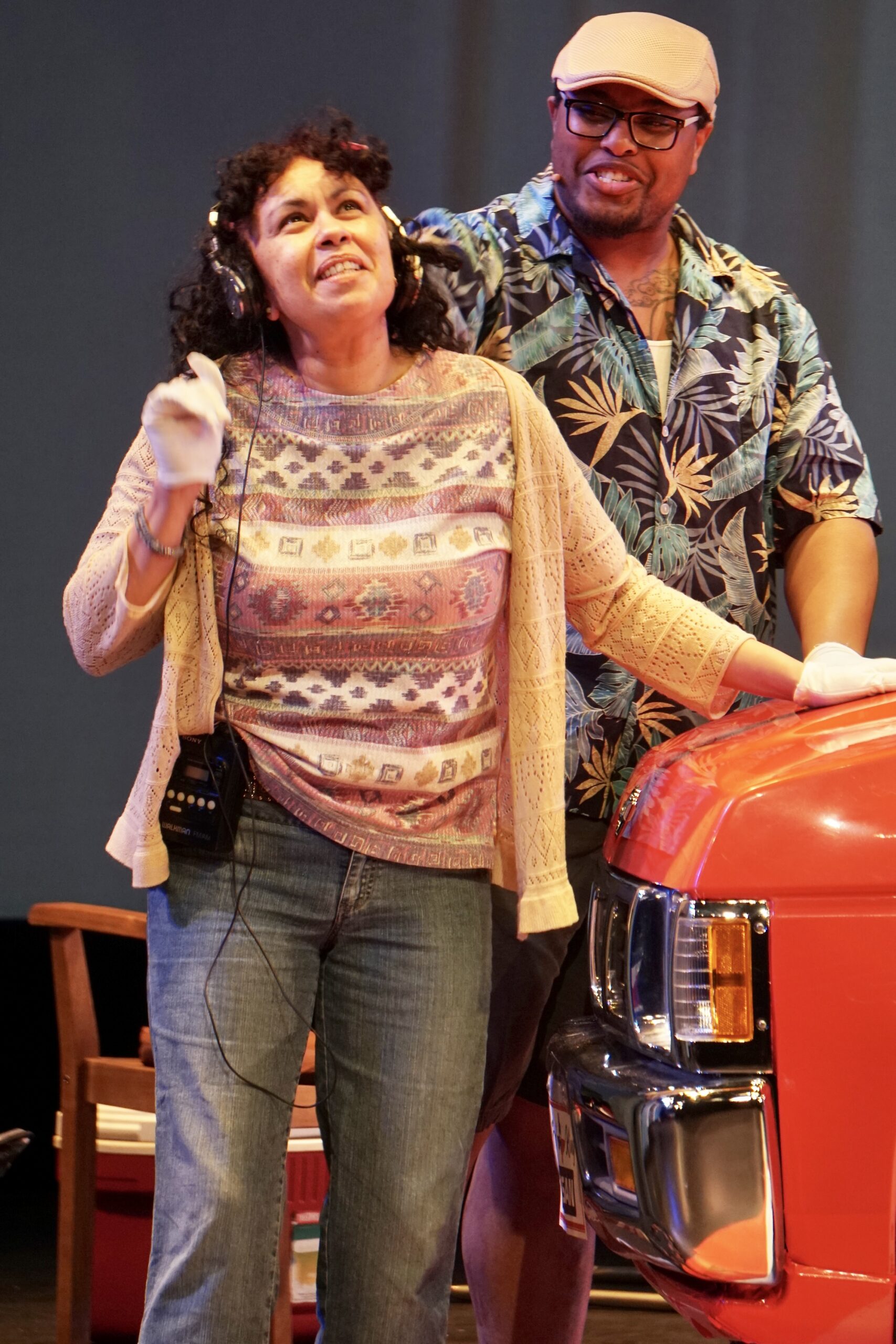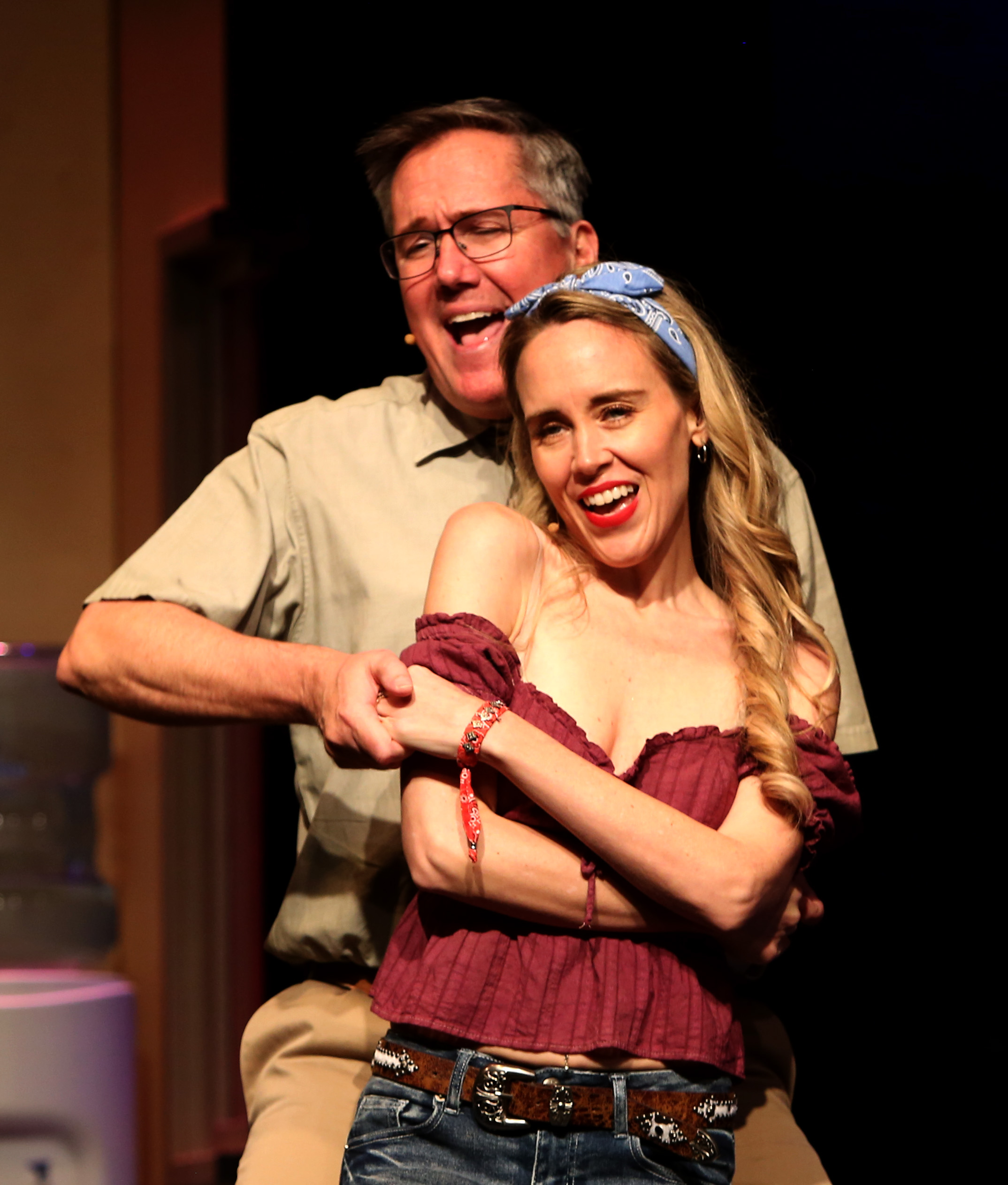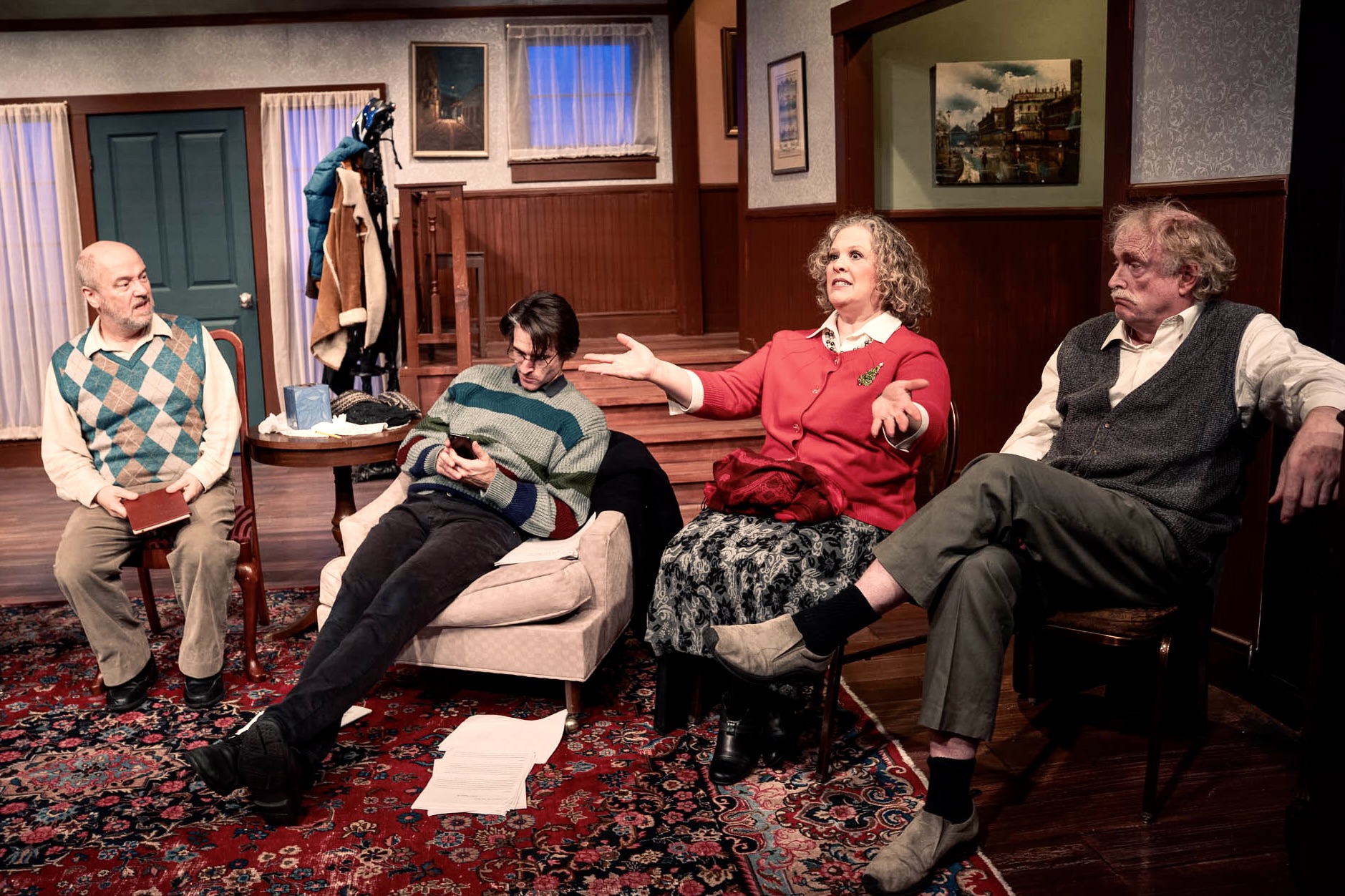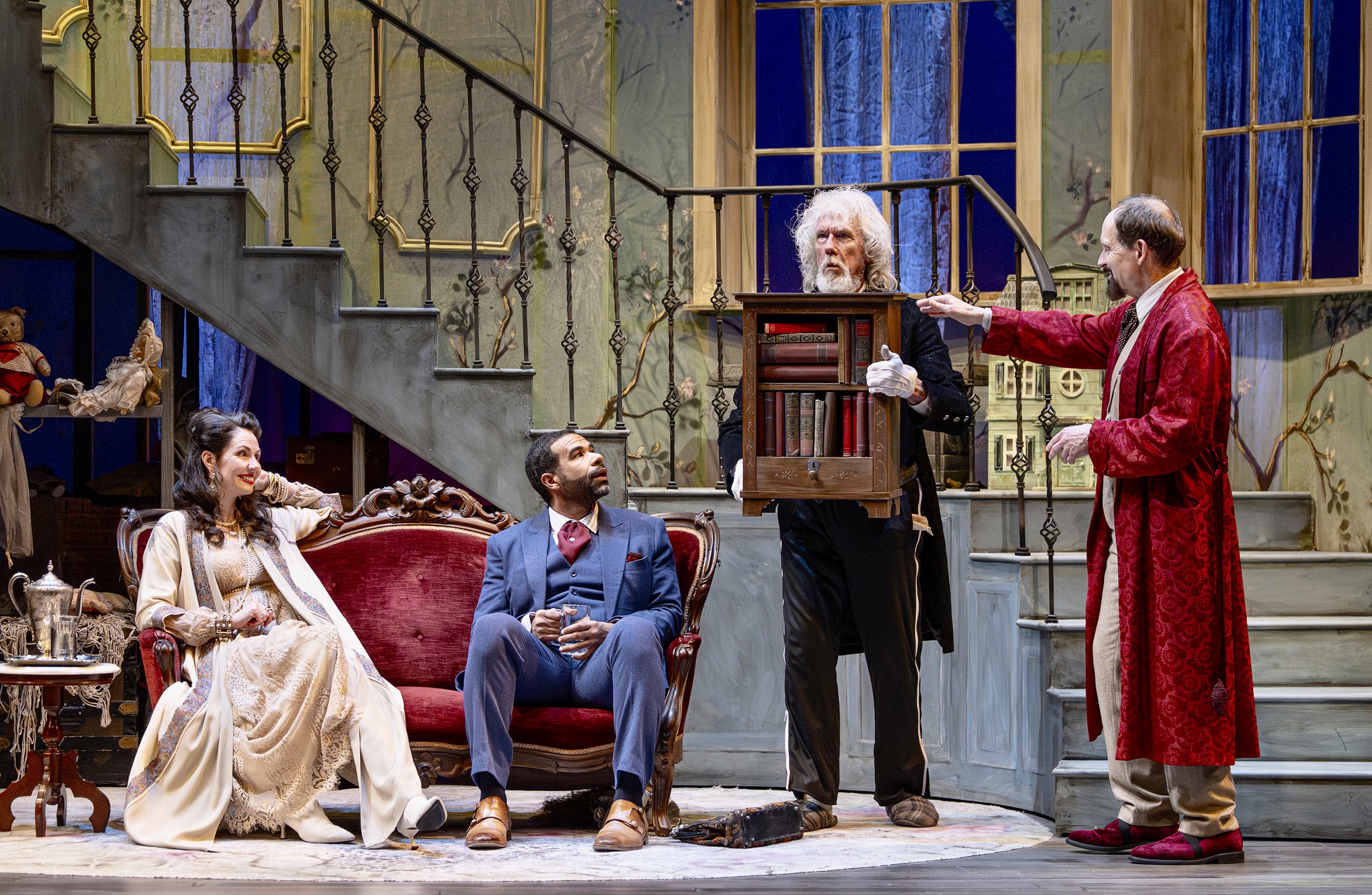
Masquers’ ‘Catch Me If You Can: The Musical’ is funny, bittersweet 

By Woody Weingarten No Comments

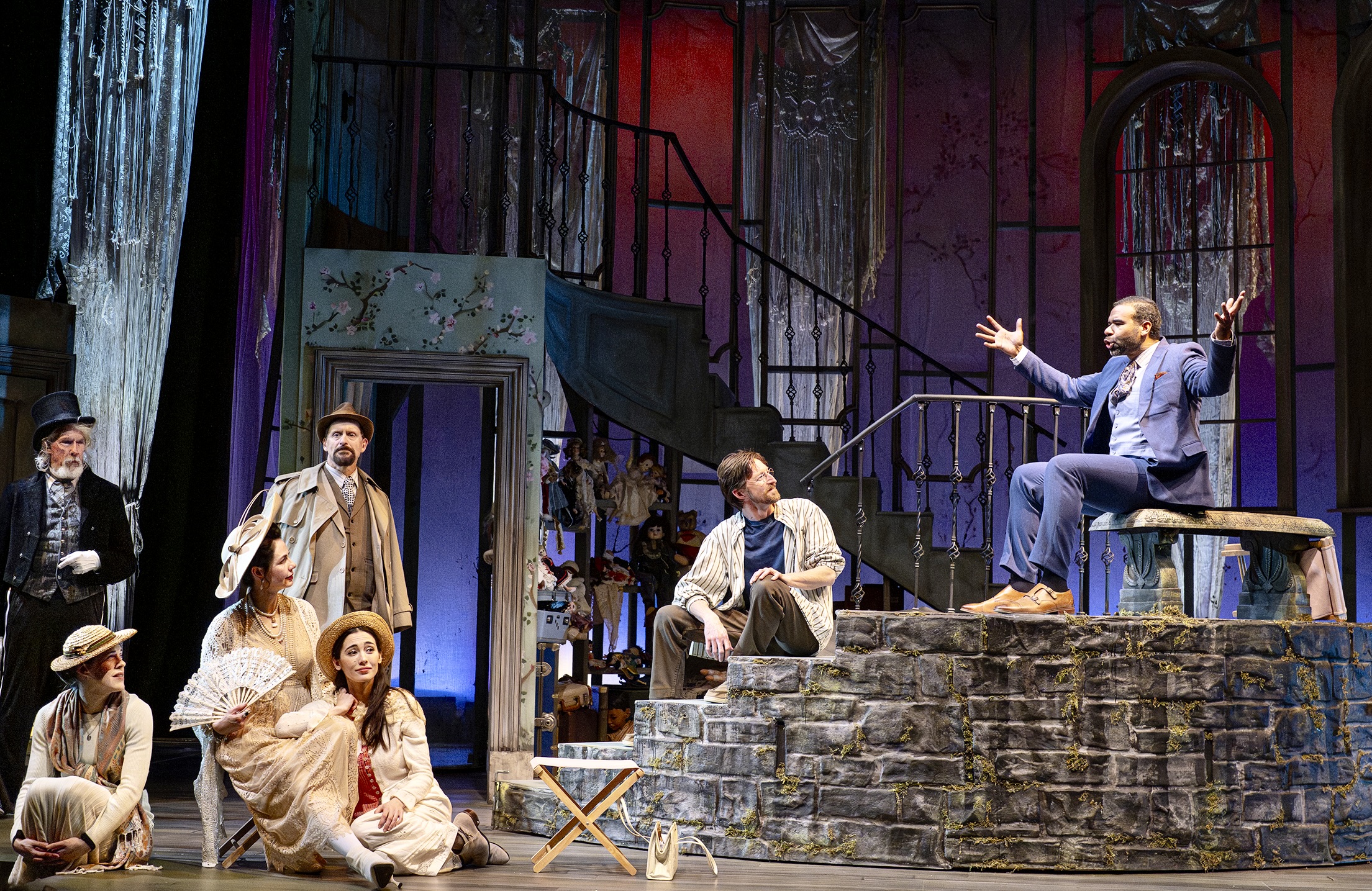
In many shows, a director’s work is invisible. Here in Point Richmond, it is visible to theater buffs because director Enrico Banson, along with choreographer Katherine Cooper and costume designer Tammara Noleen, have superbly reinvented what was a too-long tale. Now it’s a fast-paced, bouncy musical-comedy that well might keep a smile on your face throughout its 18 musical numbers and two acts.

After tapping your toes, though, you also may leave the theater with a serious aftertaste from some bittersweet themes: father-son relationships, identity, crime and punishment, and redemption.

Banson is also responsible for the projections seamlessly inserted as a backdrop; unlike those in shows trying too hard to be artsy, these images are simple and appropriate to the storyline. A few snippets are real TV clips from the 1960s, the show’s setting. Better yet, some gems are cinematic scenes that were shot beforehand.

“Catch Me If You Can: The Musical,” with score by Marc Shaiman and Scott Wittman and book by Terrence McNally, steals the best lines and scenes from the movie and leaves much of the sluggish stuff behind.

Danila Burshteyn, who has a strong, resounding voice and a perfect countenance, plays Frank Abagnale Jr. in a leading role nearly as captivating and demanding as the Emcee in “Cabaret.”

Burshteyn is the complete singer-actor combo. But, like DiCaprio, being years older than his character, he doesn’t quite impeccably replicate a brash 16-year-old runaway and forger with dreams of stealing millions of dollars before he’s 21.

Abagnale, a comic book reader who struggles with loneliness and a futile yearning to bond with his father, a dapper con man who hands down criminal skills to his son, starts his life of crime by improvising the role of a substitute teacher. Then, pretending, he successfully becomes an airline pilot, doctor, lawyer, everything but an Indian chief. Interestingly, the story stems from a memoir written by the real-life Abagnale.

The framework for the show has Junior spilling his checkered story in a television studio with a flashing applause sign that pulls the Masquers audience into the action. Instead of remorse, he arrogantly claims that he “did it in style.”

Nicole Stanley, who charmingly portrays the momentary love of his life, Brenda Strong, stops the show with her amazingly powerful voice.

Nelson Brown plays FBI agent Carl Hanratty in Masquers Playhouse’s ‘Catch Me If You Can: The Musical.” (Mike Padua via Bay City News)

Nelson Brown as FBI agent Carl Hanratty, who’s frustratingly chasing master counterfeiter Abagnale Jr., fills out the top-billing slate. Brown has exquisite comic timing but is fittingly detached; the character admits that he’s “never been cool.”

Brown occasionally spews dialogue so quickly; it’s a little hard to hear every word. And the show’s sound is difficult at times, muffling some performers. Also, the seven-piece band at the side of the stage led by music director Camden Daly on keyboards now and then gets so loud, it drowns out the often-sardonic lyrics. Mostly, though, the band provides jazzy, upbeat rhythms that ultimately may be forgettable but in the moment are ear-candy.

At nearly 150 minutes (plus intermission), this version of “Catch Me If You Can: The Musical” may play havoc with your bottom. But despite its drawbacks, it would be a shame for anyone who likes upbeat song-and-dance shows to miss it.

Catch Me If You Can: The Musical” runs through Dec. 7 at Masquers Playhouse, 105 Park Place, Point Richmond. Tickets are $30- $35 at masquers.org.


This article was first published on LocalNewsMatters.org, a nonprofit site supported by Bay City News Foundation http://www.baycitynews.org/contact/.


Contact Sherwood “Woody” Weingarten, a member of the San Francisco Bay Area Theater Critics Circle and author, at voodee@sbcglobal.net, https://woodyweingarten.com or https://vitalitypress.com

Dancer-illusionists are spectacular, magical, and mind-blowing at Zellerbach in Berkeley

By Woody Weingarten No Comments

Costumes in Momix show are extraordinary. Photo by Sharen Bradford.


By WOODY WEINGARTEN

Momix, a troupe of dancer-illusionists, simply can’t be reviewed like one would an ordinary company of hoofers, or, for that matter, even some exceptionally first-rate ones.

This group was so much better — perhaps because it was so different, so fresh.

At times, the eight celestial, acrobatic performers became movable pawns in artistic director Moses Pendleton’s absurdist Alice, their newest traveling show at Zellerbach Hall in Berkeley. They could disappear and reappear into and out of lighting effects and projections. They could slyly, whimsically exaggerate dance moves as avant garde recorded jazz, rock, and choral music also captured the audience’s toe-tapping attention. And they could get embedded in mind-blowing, quirky choreography and costumes.

The performance was salted with somewhat subtle humor, via odd arm and leg movements and imaginative heads of critters and babies, via hidden wires that shot performers into the air, and via costumes that rapidly changed characters from this to that to the next thing.

The show also contained understated sexuality.

It’s unlikely most of the crowd had ever seen anything like the 105-minute, two-act Cal Performances Bay Area premiere, even from Momix, which has matured in its sophistication and its ability to create illusions over the years. The performance had a plethora of slick smoke-and-mirrors, minus the smoke.

Pick a descriptive word; these all fit — spectacular, amazing, magical, unique.Come to think of it, fantastic, with its multiple meanings, might be the most on the nose moniker.

The book Alice’s Adventures in Wonderland was the inspiration for the 23-number wonderment, with Act 1 carrying a “Down the Rabbit Hole” label and Act II being tagged “Through the Looking Glass.”

The spectacle was too superb to have only one show-stopper — it had three, the best of which spotlighted male performers toying athletically with extra-large mirrors that marvelously distorted reality.

Even if the last time you’d read Lewis Carroll’s stories was 20 or 30 years ago, you would immediately remember and recognize references to such classic figures as the Mad Hatter and the Cheshire Cat (even though their identities here were somewhat fluid).

Exercise balls become dance props in Momix. Photo by Sharen Bradford.

One don’t-miss moment, another of the show-stoppers, was a synchronized bit that proved massive exercise balls could become extraordinary props.

Missing the red aerial silks of “The Mad Queen of Hearts” would have been a shame. The segment might have reminded you of a Cirque du Soleil act but with even more striking beauty and pizzazz.

Also, “Advice from a Blue Caterpiller” provided some charming, light-hearted moves that you most likely haven’t witnessed before.

So, with all those visual vignettes in mind, this sentence becomes incredibly easy to write: Next time Momix appears in the Bay Area, go!

Other dance performances coming up at Zellerbach that are certainly worth checking out are the Mark Morris Dance Group’s “Moon” from Jan. 23 to Jan. 25 and “Graham 100,” the Martha Graham Dance Company’s anniversary year celebration on Feb. 14 and 15.  

Sherwood “Woody” Weingarten, a longtime voting member of the San Francisco Bay Area Theater Critics Circle and the author of four books, can be contacted by email at voodee@sbcglobal.net or on his websites, https://woodyweingarten.com and https://vitalitypress.com.


Manual Cinema’s The 4th Witch at Cal Performances!

By Jo Tomalin No Comments

Review by Jo Tomalin
For All Events 


image of set

Cal Performances: Manual Cinema’s The 4th Witch
Photo: Courtesy of Manual Cinema /artists


Manual Cinema, an Emmy Award-winning performance collective, design studio, and film production company from Chicago, performed their latest show, The 4th Witch on November 22nd 2025 at Zellerbach Hall presented by Cal Performances, Berkeley, USA.

The 4th Witch is an immediately immersive experience that incorporates, shadow play, shadow puppets, actors in silhouette, live music and sound. Told without words, the story is about a young girl whose home and family are taken away from her during wartime by General Macbeth and she needs to fend for herself. Running to a forest she finds refuge and sanctuary for a while – and discovers through her dreams that she is the newest apprentice to the three witches from Shakespeare’s Macbeth.

Manual Cinema’s shows are always fascinating and The 4th Witch is highly accomplished in its visual storytelling with the integration of shadow puppets and actors in silhouette. Using a row of several old school overhead projectors and hundreds of flat page size hand made shadow puppets, the puppeteers transition into silhouette characters on the large screen above in a flash! This makes it possible for the finely crafted paper shadow play characters to suddenly move realistically in short scenes, to take the story forward in an almost animated way. The live blending of these techniques is astoundingly precise, imaginative and breathtaking!

Image of actor in silhouetteCal Performances: Manual Cinema
Photo Credit: Katie Doyle

Music and sound effects underscore the show throughout and are a vital element of the storytelling, composed by Ben Kauffman who is also co-artistic director of Manual Cinema. Three musicians play live throughout the show: Erica Kremer: cello and vocals; Lucy Little: violin and vocals; Alicia Walter: keys, guitar and vocals. These bold music and sound effect choices complete the story by adding to the atmosphere, drama and intrigue. The sophisticated music score and outstanding musicians are a perfect match for the wondrous concept, puppet design and direction by co-deviser and co-artistic director Drew Dir, and the impressive cast: Leah Casey: Witch, puppeteer; Kara Davidson: Witch, puppeteer; Sarah Fornace: Girl, puppeteer, co-deviser, co-artistic director; Julia Miller: Lead Witch, puppeteer, co-deviser, silhouette masks, co-artistic director; Jeffrey Paschal: Macbeth, puppeteer.

In concert with shadow play techniques in other parts of the world, puppeteers and musicians are all in full view of the audience throughout the show. Therefore, we can not only watch the shadow play story above the stage on a huge screen – but also see the many shadow puppets creating evocative imagery carefully placed on projectors by the puppeteers on the stage. It’s so fascinating when actors quickly move into place donning a hint of a costume or mask that evokes each live character through their silhouette! The movement quality of the paper characters and silhouetted actor characters is finely tuned and realistic, with great attention to detail to create both human and shadow puppet gestures, posture and angles of the head to communicate the wordless story. The color palette of The 4th Witch is very interesting – in black and white and in between tones, plus a few strategic choices of red and green, all appropriate to the story and its setting.

With lead commissioning support from Spoleto Festival, USA and co-commissioning support from Cal Performances, ArtsEmerson (Boston MA). The 4th Witch is also part of Cal Performances’Illuminations: “Exile & Sanctuaryprogramming for the 2025–26 season.

The 4th Witch is a sixty five minute show without intermission that is a richly visual, intense, sensory feast of inspired artistry and vibrant storytelling from Manual Cinema. 5 Stars! Do not miss it!


More Information:
Cal Performances
https://calperformances.org/

Manual Cinema
https://manualcinema.com/

He’s Fairfax’s king of K-drama: At 77, superfan logs 15,000 hours of Korean TV, gets to hug IU

By Woody Weingarten No Comments

Zev Rattet of Marin County shares a hug with Korean actress and influencer IU during a backstage visit on her “2024 IU Hereh World Tour” stop in Oakland, July 30, 2024. The 77-year-old Rattet is a K-drama superfan who earned the nickname “Grandpa Uaena” for his fixation with IU and her talent, and his story has been amplified on Korean media. (Framegrab from video via Zev Does KDrama/YouTube)


by WOODY WEINGARTEN, Bay City News

ZEV RATTET is a 77-year-old Marin County guy so passionate about K-dramasthat he’s seen 15,000 hours of that voguish Korean genre, a variant of U.S. TV’s limited series.

Watching has earned him, in addition to more than occasional bleary eyes, a big hug from IU, a 32-year-old K-pop queen with 35 million Instagram followers, and a free trip to Seoul, the 9-million-person capital of South Korea.

Zev Rattet in a partial framegrab from video talks about his favorite K-dramas of 2025. At 77, the Marin County retiree runs his own YouTube channel dedicated to Korean television dramas. (Zev Does KDrama/YouTube)

The white-haired Rattet, who cherishes the slightly reverent title IU’s official fan club bestowed on him, “Uaena Grandpa,” has in effect become a mascot whose fixation with the singer-actress and her talent has been retold and retold on Korean media. He impishly explains that Bernadette, his French wife of 43 years, “banned” photos of her from the main floor of their Fairfax home. “She thinks I’m going to run away with IU, but I just think of her as a granddaughter.

Uaena, the name of IU’s official fancafé, basically translates as “you love me,” and IU, singer-actor Lee Ji-eun’s stage name, means “I and you,” which symbolizes the closeness she wants to create with her audiences.

Rattet, a computer programmer who retired in 2018, a year after he started becoming a devotee of K-drama, has turned into a non-stop storyteller — charming, breezy, light-hearted. Some of his brief monologues and videos meander playfully, filled with not only run-on sentences but run-on paragraphs.

“I noticed IU a year and a half into watching, in a K-drama called ‘Hotel del Luna,’” he begins an interview with Local News Matters. “She was the star. I fell in love with her character, so I started looking for dramas she was in. In one, ‘You Are the Best,’ in episode 36 of a 56-hour drama, she sings toward the end of the story. I loved her music.”

Lee Ji-eun (IU) and Yeo Jin-goo in a scene from the South Korean fantasy romance drama series “Hotel del Luna.” (GTist via Bay City News)

Because of that, he searched out other K-dramas with her singing and soon became the oldest fanboy in Uaena. Those actions eventually brought him Korean celebrity — along with his YouTube channel, Zev Does Kdrama, which features videos of “the hug,” of him gushing about IU and her work, of scenes from K-drama, of him being interviewed, and of him cooking Korean dishes — plus a shot of the back of a hoodie that reads “I love IU … and my wife.”

Meeting his idol

After Rattet started posting “something every day, to keep IU in everybody’s consciousness,” her fans and staff kept telling her to check him out. She made contact, inviting him to sit way up front when her tour took her to Oakland. “She sent me an invite online,” he relates. “I dressed the same way I was dressed when she ‘discovered me.’ All through the concert, people waved at me because they recognized me from my channel. Backstage, she hugged me, something the Korean people normally don’t do. She was so gracious, so warm, so humble. She embodies qualities, like being kind, that I really admire. Meeting her was one of the high points of my life.”

Bernadette Rattet, IU and Zev Rattet, an IU fan nicknamed “Grandpa Uaena,” pose for a photo in Oakland on Tuesday, July 30, 2024. Rattet and his wife met IU during her “2024 IU Hereh World Tour” stop in Oakland. (Zev Rattet via Bay City News)

Korean officials clearly were interested in publicizing the cross-cultural aspects of Rattet’s enthusiasm. Last year, they offered him “a roundtrip business class ticket to Korea by the Ministry of Culture, Sports and Tourism (to join) a subgroup with people from all over the world. It was great.”

Rattet became curious about Asian shows on Netflixin 2017, initially watching Japanese films. “But I didn’t feel connected,” he says, “so then I tried Chinese, but they reminded me of American TV. Then I found Korean, which were emotionally honest and culturally engaging. The quality of acting, the production, the story, and the music were all spectacular.

“‘Oh, My Ghost’ was the first one. I was hooked almost immediately. Every time I watched one, I wanted to watch another. I usually describe them as a 16-hour movie, although the length varies. But each story is complete, with an opportunity for character development. I’m closing in on 400 now; I crossed the 300 mark a year ago. That totals 5,600 hours, but I re-watch each one an average of two or three times, which makes it 15,000 hours. My wife’s on her 143rd, approximately 2,300 hours.”

They’re not all dramas, he notes, despite the K-drama rubric. “I also watch comedies, thrillers, rom-coms.” He views Korean movies as well, and, just for variety, popular animated American films that feature a female action trio, K-pop Demon Hunters.

Endless stories, boundless enthusiasm

Rattet never seems to get bored by his mainstay, K-drama, which we can’t say about his checkered occupational life. Before becoming a programmer, he was a daily newspaper reporter, a training materials designer, president of a software company in Kentfield, an insurance agent, and founder of a publishing company.

A former hippie who’d overcome childhood polio, Rattet describes his life as “non-standard.”

Nowadays, only because he can’t watch K-drama 24/7 on each of 365 days annually, he fills out his retirement by “taking bicycle rides, cooking on what I call Wok Wednesday, having Friday neighborhood get-togethers in my driveway, going on walks with my wife, and spending an hour every day doing something for my channel. And I go to gym every Saturday with my wife and watch K-drama while exercising. I had a knee replacement a few years ago, but I have no serious illness. I expect to live to 114.”

Park Bo-gum and Lee Ji-eun (IU) in a scene from the Netflix K-drama series “When Life Gives You Tangerines.” (Netflix via Bay City News)

Right now, Rattet’s immersed in “When Life Gives You Tangerines,” a new K-drama on Netflix starring IU in two mother-and-daughter roles.

He sighs, after watching her, remembering another character trait of IU’s he found he liked some time ago.

“I have to mirror her humbleness,” he says.

This article was first published on LocalNewsMatters.org, a nonprofit site supported by Bay City News Foundation http://www.baycitynews.org/contact/


Sherwood “Woody” Weingarten, a longtime voting member of the San Francisco Bay Area Theater Critics Circle and the author of four books, can be contacted by email at voodee@sbcglobal.net or on his websites, https://woodyweingarten.com and https://vitalitypress.com.


Sunday in the Park with George

By Joseph Cillo No Comments


Theatrical Tour de Force

From the opening hush to the final chords, Shotgun Players’ Sunday in the Park with George unfolds as a fully realized theatrical experience. The production gathers itself with intention — moment by moment, layer by layer — the way a painting slowly sharpens into view. Characters step forward, the music warms, the design begins to breathe, and suddenly the whole world onstage has taken shape around you.

What You’re Seeing: A Brief History Behind the Painting & the Musical

Georges Seurat painted A Sunday Afternoon on the Island of La Grande Jatte in 1884–86, using a revolutionary technique of tiny dots of pure color placed side by side so the viewer’s eye—not the brush—would blend them. This meticulous pointillist method demanded precision, patience, and an almost architectural approach to art.

Stephen Sondheim and James Lapine built their musical on that idea: Act I imagines Seurat creating the painting; Act II jumps a century forward to a modern artist wrestling with innovation, technology, and the pressure to make something meaningful.

Shotgun Players’ production echoes this lineage—crafted detail by detail, moment by moment—much like Seurat building an image from countless deliberate choices.

What rises from this steady build is performance with purpose, music with lift, and staging that doesn’t simply present the material but animates it. This Sunday moves with confidence and clarity — a tour de force assembled through detail, rhythm, and heart.

The story spans two eras: Georges Seurat creating his masterpiece in 1884, and a modern artist navigating the pressures of contemporary creation. Across time, the musical traces what it takes to make something that lasts.

A Sunday worth spending — tender, attentive, and beautifully crafted.

A George Worth Watching — and a Dot Who Brings the Spark
Kevin Singer, gives George an interior pulse — a man who sees the world in pieces, then tries to assemble a whole out of the fragments. His stillness draws focus; his concentration shapes the stage.

Marah Sotelo’s Dot brings the momentum. Her wit, warmth, and grounded immediacy infuse Act I with emotional clarity. She makes every scene count.

Kevin Singer and Marah Sotelo deliver a George and Dot you genuinely care about.

Together, their dynamic creates the kind of tension that feels lived rather than staged — two lives moving at different tempos, brushing past and circling back.

An Ensemble That Colors the World
The ensemble fills in the world with well-placed strokes. Lucy Swinson, William Broshnan, Laura Domingo, Kevin Rebulián, and Alex Rodriguez each contribute beats that land cleanly — flashes of character, humor, and rhythm that animate the park and give the stage its texture.

This production paints with intention — every detail earns its place.

Their collective work creates a picture in motion.

Music That Lifts the Story
David Möschler leads a small orchestra that plays with warmth, shape, and balance. The music fits the contours of the storytelling, supporting the performers while giving the score room to breathe.

One of the best-sounding small-theater Sondheim ensembles in the Bay Area.

The sound has presence without weight — a musical world fully in sync with the dramatic one.

Design That Draws You In
Nina Ball’s scenic design, Sophia Craven’s lighting, and Madeline Berger’s costumes work together to guide the eye naturally. The space shifts like the brushstrokes of a living canvas: soft hues, quiet transitions, clean silhouettes.

The design choices expand the world without calling attention to themselves.

A Unique Feature: Onstage Seating

Shotgun Players onstage seating diagram. Audience members may sit within Seurat’s landscape.

The onstage seating option deepens the experience. Audience members sit inside the perimeter of the painting, giving certain scenes a front-row intimacy and others a surprising sense of shared space. This proximity reinforces the production’s theme of stepping into the act of creation itself.

Act II: A Shift in Time That Finds Its Mark
The move to the modern era in Act II lands with clarity and lift. Imri Tate brings humor and heart as Marie, and the production handles the shift in style and tempo with a sure hand.

A production that listens as much as it sings

Connections across the century emerge naturally, through tone and rhythm rather than explanation.

A Production in Conversation With Its Audience
Susannah Martin’s direction leans into relationships — the small gestures, the pauses, the glances that say what words don’t. The production’s strength comes from this attention: scenes breathe, characters listen, and the larger themes grow organically from the smallest moments.

Sondheim, distilled and alive.

The result is a story that feels fully inhabited rather than interpreted.

Final Thoughts
Sunday in the Park with George endures because its questions endure:
What does it take to make something true?
What does it cost?
And what remains after the work is done?

Shotgun Players leans into those questions with a balance of clarity and heart. The production builds its world with care, lets emotion rise on its own timing, and trusts the final image to speak plainly.

When the last words arrive —
White. A blank page or canvas… so many possibilities.
— the moment feels earned.

Quiet boldness, beautifully executed.

A vivid, resonant, and fully realized production.
A Sunday worth spending.


TO SEE

Shotgun Players
The Ashby Stage
, 1901 Ashby Ave., Berkeley

Dates: Now through January 25, 2026
Run time: Approx. 2 hours 50 minutes, including intermission

Tickets:
shotgunplayers.org/show/sunday

Box Office: (510) 841-6500

Accessibility: Onstage seating available.
ASL-interpreted and audio-described performances listed on the show page.


Joe Cillo banner

Authorship & Creative Statement

Each review is created through my proprietary FocusLens℠ method—an original editorial process shaped by firsthand experience, critical insight, and structured narrative design. Original photography, graphics, director quotes, and animated elements are incorporated to enhance reader engagement and visual impact. State-of-the-art scaffolding systems support organization and phrasing, but every sentence and decision reflects my own voice and judgment. These are not AI-generated reviews—they are authored, shaped, and published by me.

The Monkey King Dazzles at San Francisco Opera

By Jo Tomalin

Review by Jo Tomalin
ForAllEvents.com
11/22/25

The Monkey King Dazzles at San Francisco Opera World Premiere

Kang Wang as the Monkey King with members of the San Francisco Opera Chorus in Huang Ruo and David Henry Hwang's "The Monkey King."Photo: Cory Weaver/San Francisco Opera

Kang Wang as the Monkey King with members of the San Francisco Opera Chorus in Huang Ruo and David Henry Hwang’s “The Monkey King.”
Photo: Cory Weaver/San Francisco Opera


There is something very special happening in San Francisco! The San Francisco Opera World Premiere of The Monkey King runs November 14-30, 2025,  and there is still time to catch it if you haven’t yet seen it! An extraordinary group of artists and creatives have assembled and brought the much loved 400 year old epic story of The Monkey King to the War Memorial Opera House stage as an opera. The story is inspired by the novel called Journey to the West by Wu Cheng’en. Sung in English and Mandarin with English and Chinese supertitles, the two act opera The Monkey King is composed by Huang Ruo, libretto by David Henry Hwang. Directed by Diane Paulus with puppetry and set design by Basil Twist, and costume design by Anita Yavich. Carolyn Kuan conducts the brilliant San Francisco Opera Orchestra, Chorus and cast. This is an unmissable opera!

The Prologue sets the tone visually and musically for what we are about to see. An exquisite floating tear drop gently lifts Guanyin, in long gossamer white robes across the stage high in the air while she sings beautifully. She is all goodness and encourages people to be calm and patient. The ethereal Guanyin is played by soprano Mei Gui Zhang in an extraordinary role in an extraordinary setting and Zhang as Guanyin returns several times in a highlight performance. The lighting (by lighting designer Ayumo “Poe” Saegusa) changes ever so slightly and groups of the superb San Francisco Opera Chorus (led by Chorus director John Keene) begin to show through on different levels which evokes another time and place. It’s a stunningly beautiful start to this opera.

Next, we meet the eponymous Monkey King, impeccably played by tenor Kang Wang who has such command of a wide range of facial expressions, emotions and mischievous subtext with agile physicality – while singing beguilingly in an outstanding performance.

Ruo’s melodic music is filmic and drives the story adding atmosphere such as rippling fast rhythms of expectation and intrigue or increasingly vibrant loud punctuations for battles. Instrumental sections in between arias are well timed for the audience to take in the visual atmosphere. Hwang’s libretto is relatable and modern including everyday phrases and words that keep us in the moment and surprise.

Joo Won Kang as Lord Erlang (center) with Christopher Jackson as King of the North, Chester Pidduck as King of the South, Jonathan Smucker as King of the East, and William O'Neill as King of the West in Huang Ruo and David Henry Hwang's "The Monkey King."Photo: Cory Weaver/San Francisco Opera

Joo Won Kang as Lord Erlang (center) with Christopher Jackson as King of the North, Chester Pidduck as King of the South, Jonathan Smucker as King of the East, and William O’Neill as King of the West in Huang Ruo and David Henry Hwang’s “The Monkey King.”
Photo: Cory Weaver/San Francisco Opera

Monkey King is irate because he has been imprisoned in a cave for five hundred years and wants to burst out of this prison. At this point, the story (his Journey to the West) does not happen because we are taken back in flashbacks to the beginning with Monkey’s birth from a stone and his journey as a troublesome monkey causing unrest everywhere he goes. 

In a series of vivid scenes with characters singing dynamic and pensive arias Monkey arrives in different places meeting the Jade Emperor, Supreme Sage Laojun and several nobles and kings who soon discover Monkey’s bad manners and each in turn says they must discipline this undisciplined one. The cast of soloists in each kingdom and land are exceptional in voice and emotive characterization: Master Subhuti/Buddha (Bass-Baritone Jusung Gabriel Park), Dragon King Ao Guang (Baritone Joo Won Kang), Crab General and Venus Star (Mezzo-Soprano Hongni Wu), Jade Emperor (Tenor Konu Kim), Supreme Sage Laojun (Bass Peixin Chen), Lord Erlang (Baritone Joo Won Kang), King of the North (Tenor Christopher Jackson), King of the South (Tenor Saint Louis Missouri), King of the East (Tenor Jonathan Smucker), King of the West (Bass-Baritone William O”Neill), Lord Erlang Dancer (Marcos Vedovetto).

The Monkey King puppet in Huang Ruo and David Henry Hwang's "The Monkey King."

The Monkey King puppet in Huang Ruo and David Henry Hwang’s “The Monkey King.” Photo: Cory Weaver/San Francisco Opera

Richly theatrical in its visual storytelling, Twist creates outstanding mystical and imaginative locations with curtains that rise, fall, exit to the left and right in rapid succession, transporting us to an underwater realm with giant floaty jelly fish and projections with bubbles, to an ostentatious world in a gloriously surreal nightclub scene – and much more. Yavich populates these worlds and realms with equally impressive costumes that are as bold as they are intricate and colorful. Twist and Yavich are a formidable creative design team.

Twist’s puppet direction and set designs are original, effective and each is revealed and completely unexpected in look and feel. The amount of puppetry in this opera is perfect and exquisitely used to add dimension and humor, such as when swelling the ranks of the tribe of monkeys with human to miniature size monkeys; and especially as the Monkey King (who is triple cast: singer, puppet, dancer). This casting allows for visceral acrobatic moments by the puppet and dancer timed with Kang Wang’s masterful character performance, so we see a monkey King puppet flying or jumping with perfectly timed moments when Huiwang Zhang as the Monkey King dancer appears with exuberant turns, spritely jumps and fast changes of levels – matching Kang’s posture and stances – so the flow from Kang to dancer is seamless (choreography by Ann Yee). A highly creative scene with several white heavenly horses is a breathtaking master stroke! And the Mountain of Fruits scene, with the famous peach tree, is visually abstract and beautiful. The Monkey King is a magical sensory feast indeed!

More Information + Tickets:

San Francisco Opera
https://www.sfopera.com/


‘Wait Until Dark,’ Ross drama about a blind woman in danger, stays intense

By Woody Weingarten


Susan (Tina Traboulsi), who’s blind, listens to ex-cop Carlino (Rob Garcia) lie about his crooked motives in Wait Until Dark. Photo by Robin Jackson.


By WOODY WEINGARTEN

Wait  Until Dark, a theatrical thriller that’ll run through Dec. 14, proves that nothing can replace live theater. You’re not in front of a two-dimensional movie screen but, instead, you’re right there, close to the characters, close to the scary action, possibly gripping the edge of your seat until the suspenseful drama ends. You’re watching a play that’s often dimly lit or totally blacked out on purpose, nervously expecting the main character, who’s blind, to suddenly be attacked or killed.

The audience at the Barn in Ross, packed with white-haired ladies at a matinee, is kept in the dark, so to speak, as long and as much as the protagonist is.

Superb direction by Carl Jordan and solid acting by a cast of six Ross Valley Players keep the intensity going throughout, overcoming a complicated, dated 2013 script that’s a rewrite of the original 1966 Broadway version.

Jordan ensures that the play’s stereotypical characters aren’t quite caricatures but that their pawn-like movements from the pens of writer Frederick Knott and adaptor Jeffrey Hatcher are followed.

In contrast, Tina Traboulsi is so realistic as Susan, a newlywed who hasn’t adjusted yet to sightlessness caused by an auto accident, you might feel a desire to reach across the stage to keep her from stumbling over furniture that was moved, to protect her from the danger of three intruders who separately enter her apartment without her knowledge, permission, or desire.

Sporadic humor, almost all of it intended, may break through the tension from time to time,

A leather-gloved Roat (David L. Yen) leaves no fingerprints while searching for a valuable doll. Photo by Robin Jackson.

although Susan’s paranoia starts early and builds geometrically as each character enters the stage. She, naturally, suspects everyone, including her husband, of lying to her or plotting something even more evil.

Rob Garcia portrays Carlino, an ex-con, ex-cop involved in a non-theoretical conspiracy with just enough likability to make his otherwise menacing demeanor tolerable.

Portraying a snarly, leather-gloved criminal, whom Susan and you may both believe wouldn’t blink at the need to dispose of someone in his way, is David L. Yen as Roat.

David Abrams inhabits the personality of Mike, who may not be so dead-set on killing — or getting caught.

Coco Brown and Diora Silin, who alternate each performance of Gloria, play a troubled teen who repeatedly drops into Susan’s basement apartment to avoid a mom who entertains a string of men, and Benjamin Vasquez (Susan’s disappearing hubby, Sam) fill out the cast of the murder mystery.

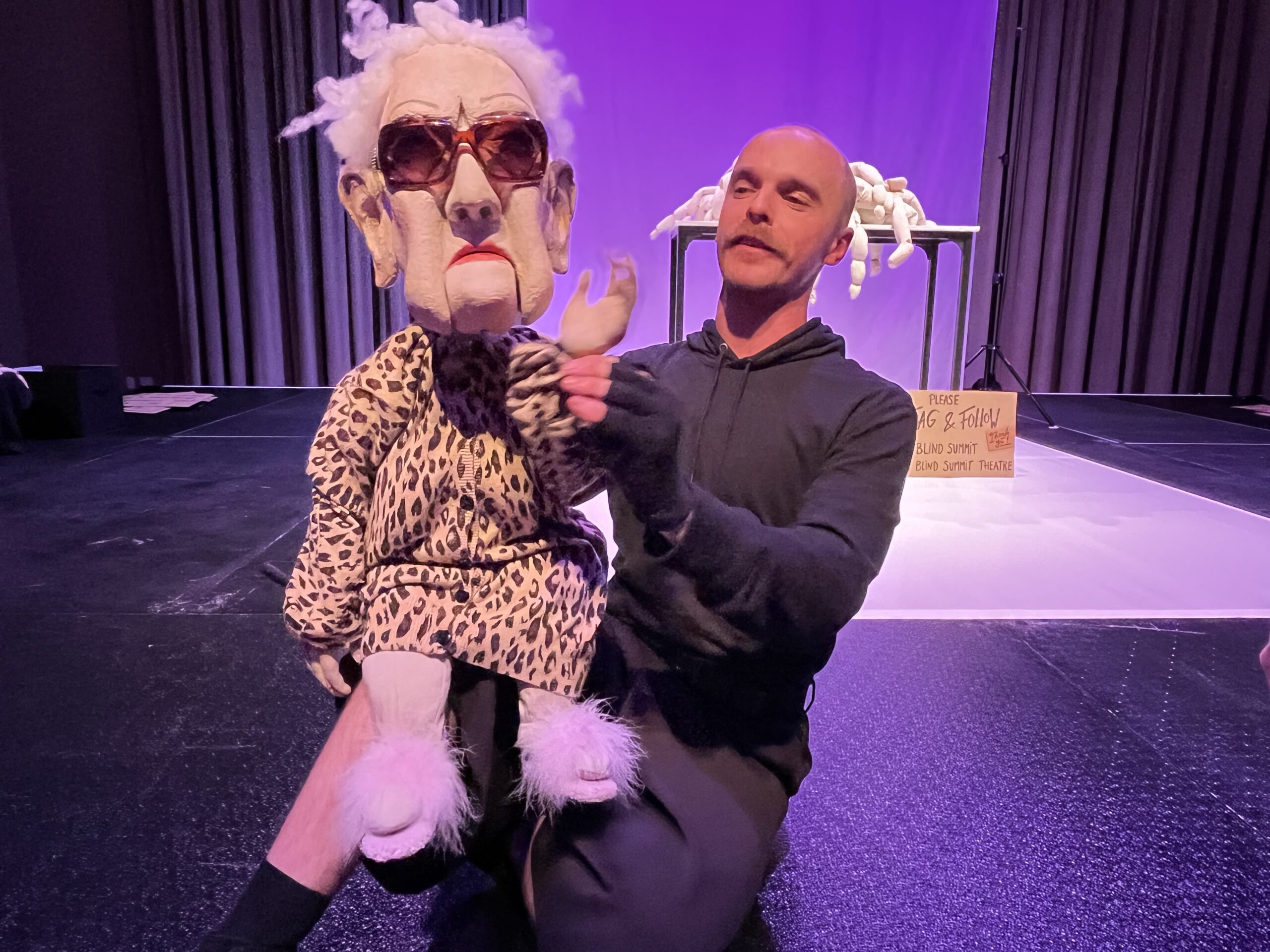
A mysterious doll with something valuable hidden in it becomes the taut focal point of the climax of Wait Until Dark, which was made into a 1967 movie starring Audrey Hepburn and Alan Arkin with different plot points.

It takes almost no time for costumes and furniture that could have existed in the World War II era to quickly pull the audience into the basement digs in Greenwich Village. Gifted sound cues by Billie Cox and equally perfect lighting designed by Frank Sarubbi pinpoint a noir atmosphere that cinematic classics from director Alfred Hitchcock and Hollywood power couple Humphrey Bogart and Lauren Bacall honed.

The plotline may take place in 1944, with occasional references to such past-their-sell-date items as malt-flavored milk mix Ovaltine and radio soap opera heroine Helen Trent, but two hours of intensity in Ross are definitely here and now.

Wait Until Dark will play in the Barn at the Marin Art and Garden Center, 30 Sir Francis Drake Blvd., Ross, through Dec. 14. Tickets: $30 to $45. Info: 415-456-9555 or www.rossvalleyplayers.com.

Sherwood “Woody” Weingarten, a longtime voting member of the San Francisco Bay Area Theater Critics Circle and the author of four books, can be contacted by email at voodee@sbcglobal.net or on his websites, https://woodyweingarten.com and https://vitalitypress.com.

Wait Until Dark

By Joseph Cillo


This taut, atmospheric thriller grips from first shadow to final blackout.

A gripping, meticulously crafted production of Frederick Knott’s classic thriller that has held audiences breathless for decades. Under the steady, sure-handed direction of Carl Jordan, this staging leans into the story’s psychological tension and delivers the kind of slow-burn suspense that only live theatre can conjure. It’s smart, sharp, and performed with an immediacy that keeps you leaning forward from start to finish.


Story Line
Set in a modest Greenwich Village apartment in the 1960s, the story follows Susy Hendrix, a recently blinded woman who becomes entangled in a dangerous criminal scheme involving a doll stuffed with contraband. As three con men manipulate their way into her home under false identities, Susy must piece together the truth using her instincts, her wits, and her heightened awareness of sound.

The play’s signature twist — plunging the stage into complete darkness as Susy turns the tables — remains one of the great theatrical coups of the last century. And here, RVP executes it with precision that lands exactly as intended: a collective audience gasp, followed by stillness you can feel.


On Stage
Tina Traboulsi gives a standout performance as Susy Hendrix, grounding the role with subtlety, stamina, and a deep emotional thread. She builds the character moment by moment — listening, feeling the room, and recalibrating her world through sound — creating an authenticity that drives the entire production.

Tina Traboulsi builds Susy’s world through sound, instinct, and sheer will.

Opposite her, David Yen is chillingly effective as Roat, the mastermind criminal whose calm, predatory presence gives the play its edge. Without raising his voice, he conveys danger with the smallest turns of phrase.

David Yen’s Roat is cool as a straight razor and twice as dangerous.

David Abrams (Mike) and Rob Garcia (Carlino) offer strong contrasts as the uneasy criminal pair — one smooth and sympathetic, the other blunt and opportunistic — giving the production texture and momentum. Young actors Coco Brown and Diora Silin alternate as Gloria, bringing spark and attitude to a role that is vital to Susy’s evolution.

Photo Credit: Robin Jackson

Themes & Takeaway
At its core, Wait Until Dark remains compelling because it’s not just about suspense — it’s about unexpected courage. Susy’s shift from vulnerability to active, strategic control underscores the story’s belief that strength can emerge in darkness, both literal and emotional.

This is why we go to live theatre — tension you can feel in your bones.

In an era dominated by digital effects, this production is a refreshing reminder that timing, presence, and craft still create the most memorable thrills.

Technical Brilliance
Tom O’Brien’s apartment set creates a fully realized home that becomes the battleground for the escalating tension. Frank Sarubbi’s lighting design sculpts the atmosphere with precision — gradually dimming the world until shadows become characters in their own right. Billie Cox’s sound design enriches Susy’s sensory universe, while Valera Coble’s costumes and Dhyanis’s props complete a cohesive visual environment. Nic Moore’s fight choreography ensures the climactic struggle feels both believable and intense.

When the lights go out, the entire house seems to stop breathing.

Director Carl Jordan weaves these artistic elements together with confident pacing, creating a production that honors the original play while giving it fresh vitality.

Final Notes
The Barn Theatre — tucked into the Marin Art & Garden Center — is an ideal venue for this production. Intimate, well-tuned acoustically, and responsive to silence, it heightens every moment of tension.

A confident, razor-sharp opener to RVP’s 96th season.

Dates, Locations, Tickets
November 14 – December 14, 2025

Performances
Thursdays–Saturdays at 7:30 p.m.
Sundays at 2:00 p.m.
(No shows November 27–28; special 2:00 p.m. matinee on Saturday, November 29)

The Barn Theatre
Marin Art & Garden Center
30 Sir Francis Drake Blvd, Ross

Tickets
Starting at $30
Available at: rossvalleyplayers.com


Joe Cillo banner

Authorship & Creative Statement

Each review is created through my proprietary FocusLens℠ method—an original editorial process shaped by firsthand experience, critical insight, and structured narrative design. Original photography, graphics, director quotes, and animated elements are incorporated to enhance reader engagement and visual impact. State-of-the-art scaffolding systems support organization and phrasing, but every sentence and decision reflects my own voice and judgment. These are not AI-generated reviews—they are authored, shaped, and published by me.

Belly-shakingly funny ‘Bootycandy’ explores growing up black and gay

By Woody Weingarten

Dana Hunt (center) discusses with Tajai Britten (left) and Jonathen Blue his possibility of gay sex. Photo by David Minard. 


By WOODY WEINGARTEN

Perhaps unexpectedly, since the play’s about growing up black and gay, whites in the audience of Bootycandy made up a plurality. But it made no difference. Boisterous laughter frequently erupted from every seat during the opening weekend matinee at the California Theatre of Santa Rosa.

The comedy, which details homosexual intimacy, employs f-bombs and nearly every other curse word you’ve ever heard. It’s belly-shakingly funny.

The top-notch, five-member cast, four of whom are dark-skinned, delivers about 1,738 laughs in less than two hours on the Left Edge Theatre stage (don’t count; you’d probably miss a bunch of gags that way). But, in addition to multiple over-the-top slapstick segments, the audience gets to see black culture through some serious lenses based on a dozen autobiographical sketches playwright Robert O’Hara theatrically threaded.

It takes some time, though, for the Big Reveal to tie the sketches together and transform what initially seems disjointed into something complex but a good deal more linear. In keeping with the offbeatness of the show, no backdrop exists for the actors to play off ­­(or is necessary for the bawdy coming-of-age story) but scene changes are brought to life by substituting chairs, costumes, and props.

Tajal Britten skillfully portrays Sutter, O’Hara’s alter ego, who grows from an awkward kid obsessed with Michael Jackson into a semi-mature playwright. Jonathen Blue, meanwhile, stops the show with an exaggerated, hysterical portrait of a minister who passionately preaches about supposedly wayward choirboys.

Jonathan Blue (right ) provides big laughs in ‘Bootycandy.’ Photo by  David Minard. 

Dana Hunt, Lexus Fletcher and Shanay Howell, who each deserve an award for superlative clowning, fill out the ensemble cast in multiple roles that range from a pudgy male rape victim to a lesbian named Genitalia who goes through a “non-commitment ceremony” that spotlights such smart lines as “wherever you go, I will not follow.”

Director Serena Elize Flores makes sure the sometimes subversive and provocative two-act play zips along so fast that audience members leave with the sensation that it’s much shorter than it actually is.

Because the plotline is thin, the vignettes risk being labeled stereotypical and racist. That viewpoint, however, discounts the text also containing more than a few wonderfully crafted, expository lines like “All chocolate cakes ain’t the same.”

Although the playwright has adeptly fleshed out his male characters, he was somewhat stingy with the women’s personalities.

Bootycandy begins with a dude clad only in white briefs and white socks. It ends with a touching moment with an Alzheimer’s-afflicted octogenarian grandma craving baby back ribs, a poignancy that’s diluted because it’s followed too closely by a wonderfully comic dance performed by the actors after their bows.

Bluenoses and children should stay home. Most everybody else should see this show.

Bootycandy will play at the Left Edge Theatre stage in The California, 528 7th St., Santa Rosa, through Nov. 23. Tickets: $22 to $44. Info: (707) 664-7529 or info@leftedgetheatre.com.

Sherwood “Woody” Weingarten, a longtime voting member of the San Francisco Bay Area Theater Critics Circle and the author of four books, can be contacted by email at voodee@sbcglobal.net or on his websites, https://woodyweingarten.com and https://vitalitypress.com.

Burnout Paradise at Stanford’s Bing Studio is Dynamic + Creative!

By Jo Tomalin

Review by Jo Tomalin
11/12/25
ForAllEvents.com

Burnout Paradise by Pony Cam

image of actors on stage

Burnout Paradise by Pony Cam at Bing Studio in Stanford, CA on November 12, 2025. Photo Credit Matthew W. Huang

Burnout Paradise has arrived in town and is a must see show – the intriguing title is evocative of many things and so is the experience! Presented by Stanford Live at the Bing Studio in Stanford, California, Burnout Paradise runs November 12-15, 2025.

This is inspired programming by Stanford Live – and it’s a welcome palate cleanse from our daily tasks. Instead get yourself to the theatre to see others do their tasks! The creative theatre company Pony Cam from Australia is an award-winning experimental collective of five theatre makers. Burnout Paradise is created by Pony Cam Collective: Claire Bird, Ava Campbell, William Strom, Dominic Weintraub, and Hugo Williams; Produced by Dans Maree Sheehan for Parrot Ox.

Formed in 2019, Pony Cam has created several shows on wide ranging themes such as a food drama, an apocalyptic fantasia set inside a teenage dystopia and a large-scale community-led intergenerational collaboration. The cast of Burnout Paradise comprises Laura Aldous, Claire Bird, William Strom, Dominic Weintraub, and Hugo Williams.

As an ensemble creating their own original work Pony Cam Collective’s ideas are fresh and edgy with underlying reflections of society challenging audiences to question their conventional ways. Pony Cam’s latest show, Burnout Paradise is a unique experience for all in the theatre as it disrupts the performance space (and the audience space) in such a way that is completely unexpected and truly wonderful!

The stage is set with four treadmills each with a cardboard sign on the front: Survival, Admin, Performance and Leisure. These topics are common to us all and relatable, but it is the way each topic is explored and how their numerous tasks are carried out that is the structure of this show. The performers arrive and have their To Do list of “deadly tedious tasks” ready and they challenge each other to complete everything in their lists 100% while running on treadmills! Yes, these performers get their steps in mightily, bravely – and hilariously!

image of actors on stage

Burnout Paradise by Pony Cam at Bing Studio in Stanford, CA on November 12, 2025. Photo Credit Matthew W. Huang

While Claire, William, Dominic and Hugo run ferociously forwards, backwards and sideways while doing household tasks, theatre company office work, performing their own skills and leisure activities, Laura is the warm and friendly host who is also the time keeper and makes sure everything happens. Laura comes around offering beverages on a tray and periodically updates a chart with miles run by each runner. The runners valiantly prepare vegetables, type forms, act, dance or do a Rubric’s cube, to name but a very few of the things they need to accomplish – as a race against time, energy, their minds and spirits.

It’s suddenly busy and gets a bit frantic, is it mayhem? Maybe, but it’s absolutely brilliant and the audience help out here and there, melting the conventional stage and audience division in the most creative way. Make no mistake, it is the afore mentioned structure of this piece by Pony Cam that is the art in Burnout Paradise and what may look chaotic or silly is highly imaginative gutsy stuff and was very well received by the audience at the performance I attended on 11/12/25.

The sixty five minute show is entertaining, physical and interactive, challenging us to consider how we spend our time on this planet – and Burnout Paradise creates a delicious complicity with everyone in the shared space. This is a dynamic rethinking of theatre! Highly Recommended 5 Stars!

More Information:

Stanford Live
https://live.stanford.edu/ 

Pony Cam
https://ponycam.co/