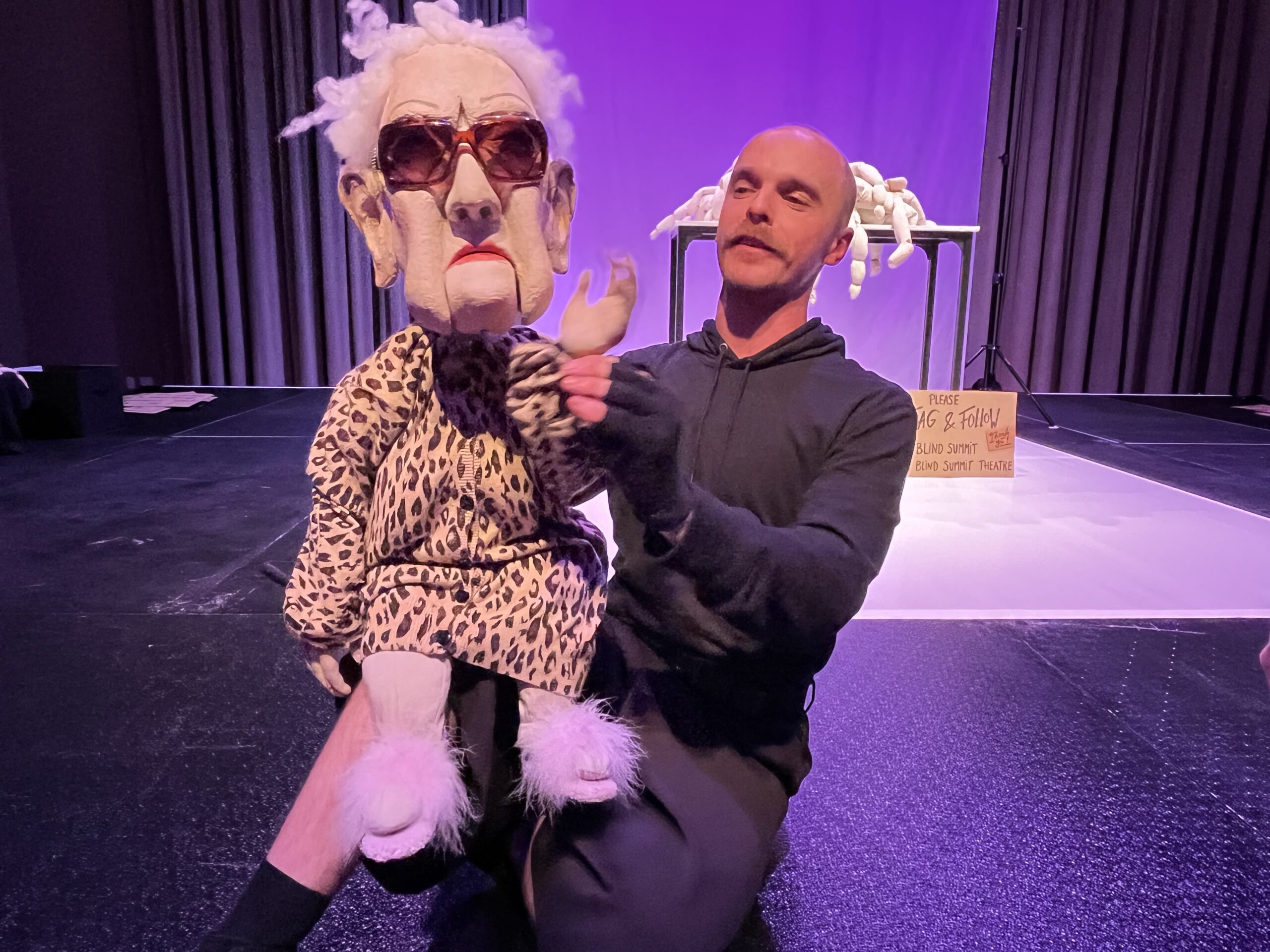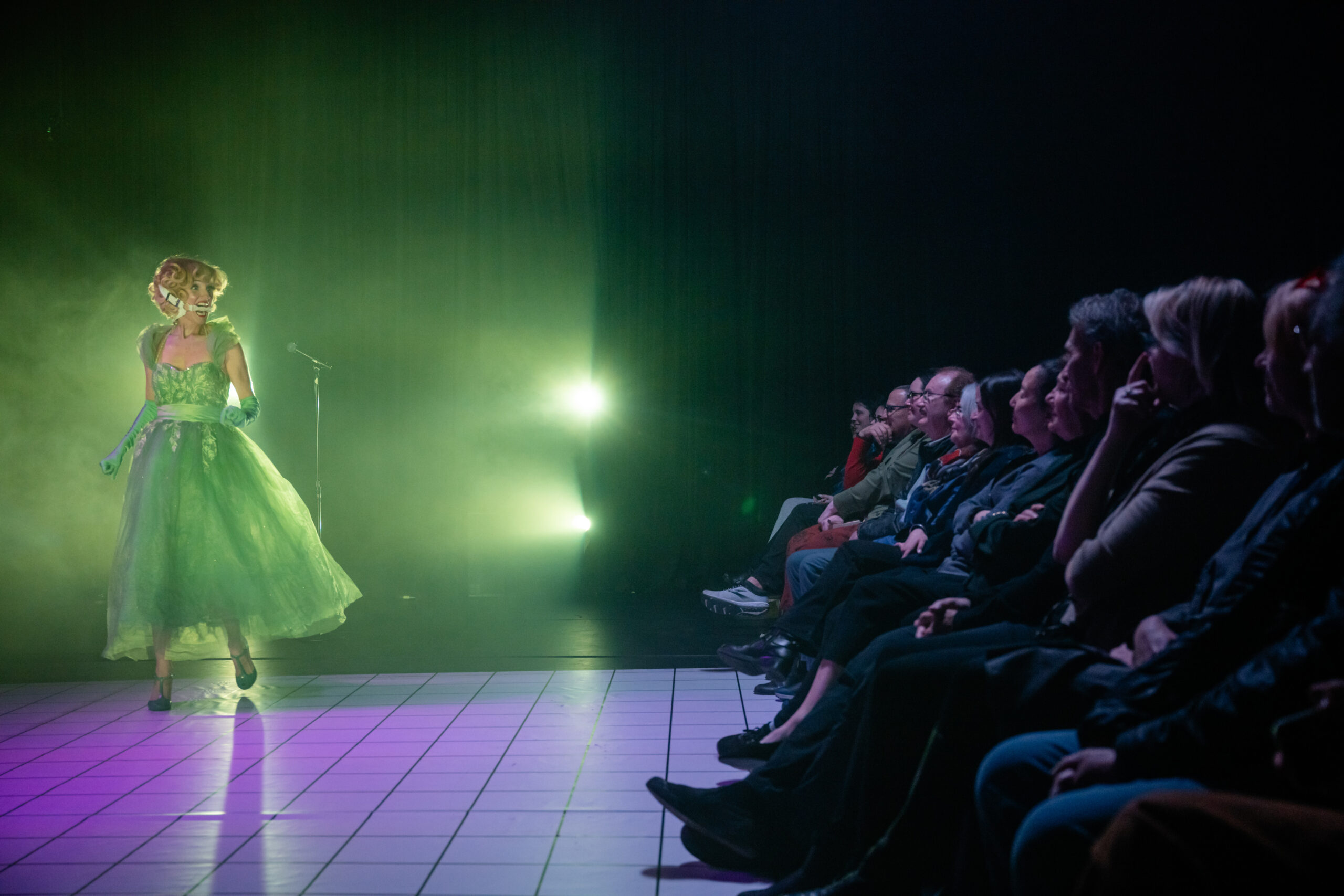
Puppeteer Dale Wylde and Tina from Blind Summit Theatre (photo: Jo Tomalin)
The Sex Lives of Puppets by Blind Summit Theatre from the UK performed February 18 to Saturday, February 21, 2026 at The Studio, Bing Hall presented by Stanford Live at Stanford, California.
The energetic and hugely entertaining one hour forty five minute show comprises a series of vignettes andinterviews told through puppets animated by four Blind Summit Theatre company puppeteers: Mark Down, Isobel Griffiths, Dale Wylde, Elliot Liburd. Down is also Artistic Director of Blind Summit, whose idea is behind this original show, written and directed by Down and Ben Keaton.
At least a dozen puppets of all ages and types share their innermost thoughts – their personalities are so real that they are instantly relatable! A couple, Meryl and Jeremy talk to us about sexual well being. Four puppeteers work the two approximately one yard tall puppet characters with one manipulating an arm and the head with mouth that opens as the puppeteer speaks, and another puppeteer works the other arm.Beautifully designed puppet people (puppet design by Down) sit on a platform of a high table and we see the puppeteers behind throughout. The faces, eyes, mouths and physical posture are exquisitely designed and the puppeteers lend their voices and bring them to life. The range of emotions and personalities is interesting and no two are alike, so the show moves along with a variety of topics and opinions about sex!
While watching each puppet is mesmerizing watching the puppeteers is equally fascinating. They each commit completely to the characters and their own facial features and intent focus on their puppet bringsthem to life magically. This is puppetry at its best with high level skills of creativity, acting, voice work and puppetry coordination animating these inanimate objects into an emotional life. Each character is individual with costumes varying from a leopard skin pattern cardigan to a black pleather jacket and a royal blue suit. In between each scene the ensemble present the title and names of interviewees with zippy cardboard signs!
The writing by Down and Keaton is smart, witty and real combined with their direction that emphasizes excellent timing and finessed physical gestures to the audience throughout the approximately ten scenes. In fact, a highlight is when the pairs interact briefly with their partner with spicy encouragement or juicy laughter! The puppeteers switch characters quickly and they all demonstrate a variety of voices and believable accents from British to Irish and American.
These puppets have fun and so do we! Suki, the actress is dramatic and sensuous in a wonderfully visceral scene. Two men share secrets of living in a care home in a revealingly poignant scene and the effusivefinancier Dimitri shares his secret sauce of life with delicate partner Robin. At times characters evoke people in our lives, which is a bit scary! Highly Recommended!
A guitar. A glance. A pub ceiling lit by hanging whiskey bottles.
When I walked into Berkeley Playhouse, I looked up before I looked at the stage.
Whiskey bottles hung from the ceiling, catching the light like amber constellations. Below them, musicians were already in place — tuning, testing, beginning. The room didn’t feel like it was about to start. It felt like it had already begun.
Then a guitar line slipped into the air. I felt myself lean forward.
Guy repairs vacuum cleaners by day and sings on Dublin streets by night. His songs carry the echo of a recent heartbreak. He performs them as though he’s still deciding how much of himself to reveal.
Then Girl hears him. She doesn’t applaud politely — she listens.
She sits at the piano and complements his melody — completing phrases he leaves suspended, filling emotional spaces he hasn’t quite dared to name. I could feel the shift the moment her notes joined his.
In Once, music isn’t background. It’s oxygen.
What begins as encouragement becomes collaboration.
They rehearse. A violin joins. A drum answers. One musician becomes several. A band forms right in front of us. Together they prepare for a recording session in London — an opportunity that feels both exciting and fragile.
As the music deepens, so does their connection — layered, restrained, unmistakable.
Both carry responsibilities. Both sense possibility.
That tension hums beneath every harmony.
Midway through a duet, I stopped observing and simply listened. The theater felt suspended — two voices aligning, two lives quietly pivoting.
No spectacle. Just something true.
From Indie Film to Stage
This story began as the 2007 film written and directed by John Carney, starring musicians Glen Hansard and Markéta Irglová. The song “Falling Slowly” went on to win the Academy Award.
The stage adaptation, with a book by Enda Walsh, carried that intimacy to Broadway and won 8 Tony Awards, including Best Musical.
What remains constant is the heartbeat: music as turning point.
Why This Production Works
Director Josh Marx lets the story breathe. Music Director Michael Patrick Wiles keeps the sound alive and immediate. Choreographer Erin Rose Solorio shapes movement that feels discovered rather than arranged.
What struck me particularly was the ensemble.
This is a large cast of musician-actors — and they are uniformly strong at both. They don’t switch between “acting” and “playing.” They live in both simultaneously. A character delivers a line and flows directly into a fiddle phrase. Someone crosses the stage and becomes percussion. Storytelling and musicianship move as one.
That dual fluency elevates the evening. Energy circulates constantly. Transitions feel organic, almost inevitable.
Sitting beneath those hanging whiskey bottles, I felt surrounded by collaboration — not theatrical display, but shared creation.
Some connections arrive quietly — and rearrange everything.
By the final moments, I wasn’t watching a romance conclude. I was watching two people step into clarity — shaped by the music they created together.
I walked out feeling as though I’d been allowed to witness something private.
A song can open a door. What you do next is the story..
How to See It / Get Tickets
Julia Morgan Theater 2640 College Ave Berkeley, CA
February 20 – March 15 Approx. 2 hours 30 minutes (including intermission)
Reserve early for immersive seating and weekend performances.
Authorship & Creative Statement
Each review is created through my proprietary FocusLens℠ method—an original editorial process shaped by firsthand experience, critical insight, and structured narrative design. Original photography, graphics, director quotes, and animated elements are incorporated to enhance reader engagement and visual impact. State-of-the-art scaffolding systems support organization and phrasing, but every sentence and decision reflects my own voice and judgment. These are not AI-generated reviews—they are authored, shaped, and published by me.
Birders observe a pair of mute swans during a field trip to The Ponds at Las Gallinas Sanitary District in San Rafael. The monthly nature walks are organized by the Marin Audubon Society and are open to the public. (Rosina Wilson via Bay City News)
WORLD-FAMOUS FAIRFAX WRITER Anne Lamott turned “bird by bird” into a stylish phrase 32 years ago. Metaphorically, it suggested that folks should tackle major issues one step at a time.
First, imagine the birders identifying a duck through their binoculars, then a Cedar Waxwing, then a hawk. Before long, they’ve found 45 to 50 species in a morning’s trek, including many migrants — birds that “don’t really belong there.”
Mark Clark leads birders on a walk at The Ponds on Sept. 4, 2025. The Novato retiree started bird watching 18 years ago and has been leading the nature excursions each first Thursday of the month since September 2024. (John Dahl via Bay City News)
That picture comes from Mark Clark, Novato retiree who started bird watching 18 years ago and has been leading the walks at The Ponds each first Thursday of the month since September 2024.
He specializes in making the trips educational, convivial, and fun. “It’s really a mix of ornithology and the banter of the Jungle Cruise at Disneyland,” he says.
“We’re learning how birds get by on a daily basis, and we’re carrying on the tradition of the Audubon Society of counting birds instead of a century ago when people shot them,” he carries on.
“We usually introduce a topic, such as breeding behaviors, set up scopes in the first pond, the nature pond, and see what’s there. I always bring a scope, and there’s always one or two more. We then move on to the second viewing point. There are usually one or two other experts who chime in and are good about finding birds.”
Good for beginners
The Las Gallinas walks interlock with the overall mission of the Audubon Society, which, according to its website, is to “conserve and restore natural ecosystems, focusing on birds, other wildlife and their habitats for benefit of humanity and the Earth’s biological diversity.”
Alison Pence, a Corte Madera resident and a Marin Audubon board member who’s enjoyed the walk multiple times, reports that Clark is particularly “good with beginners. He’s friendly and tells good jokes.” When informed how she’s described him, he quips, “I am friendly — and handsome.”
Clark retired three years ago after working in hospice for a decade. Before that, he taught theater at Marin Community College and elsewhere, which helps bring “a theatrical flair” to the walks.
The list “for The Ponds is 254 species,” he says, “and I believe I’ve seen them all.”
Some of the more than 250 species of birds that can be found at The Ponds at Las Gallinas Sanitary District in San Rafael. Top: A snowy egret, with “golden slippers” on Feb. 17, 2024. Bottom: A red-tailed hawk perches on a tree branch, April 28, 2016. (Rosina Wilson via Bay City News)
The Las Gallinas walks draw as many as 25 participants monthly, about half of them beginners, including many elderly. “It’s a terrific walk for beginners,” Clark explains, “because it’s flat and the birds are easy to see. After Point Reyes, it’s the second richest birding area in Marin County and certainly easier to access.”
Rosina Wilson, who lives in Marinwood, not far from what she says was once called The Bird Ponds, is part of the ever-growing senior tsunami in Marin County. “Most of us seniors walk slowly,” she points out. “Many of us use canes or walking sticks. I use a pair of trekking poles, which help me keep my balance and give me upper-body exercise and allow me to walk faster.”
“We don’t walk very fast, don’t rush,” Clark elaborates. “People who come late can catch up.”
A workout for the ages
Wilson contends that “this type of activity is a great brain-training tool. Learning the names of birds … plus their field marks (how you recognize them and differentiate them from similar species) can really give the mind an active workout while the body is enjoying the physical workout.”
Rosina Wilson, a Marinwood senior, takes part in a Feb. 5, 2026, walk at The Ponds. Every visit is different, she says, with a different cast of characters each time the seasons change. (Christina Gerber via Bay City News)
In truth, the age range is quite wide, she says. Though she’s walked with many folks in their 80s, she’s also viewed “a two-year-old walking, a little boy who even had his own binoculars. He was adorable.”
Wilson’s been a participant for years and, in fact, often walks there “on my own and with friends.” Every visit, whether expert-led or solo, she indicates, “is different, and there’s a different cast of characters each time the seasons change. In the winter, there’s a huge number of species of migrants, especially ducks, and we see many types of raptors, including hawks, falcons, and the occasional eagle.”
She’s also spotted other wildlife — “whole families of otters, muskrats, deer, coyotes and foxes.”
Pence, meanwhile, also enjoys Marin Audubon’s other regular field trip, at the Rodeo Lagoon in the Marin Headlands, with leaders William Legge and David Wiechers. Those outings, unlike the ones at The Ponds, are not recommended for beginners, are limited to 15 hikers, and require registration (which opens 10 days before any given walk). Field trips at either location are free to Audubon members and the public, but donations are appreciated.
Asked to pick one highlight from walks she’s been on, Pence cites a trek at Las Gallinas where she “saw a rail, a shy bird that came out of hiding. It was foraging. You don’t get to see them very often.”
Sherwood “Woody” Weingarten, a longtime voting member of the San Francisco Bay Area Theater Critics Circle, can be contacted by email at voodee@sbcglobal.net or on his websites, https://woodyweingarten.comand https://vitalitypress.com. His books include Rollercoaster: How a man can survive his partner’s breast cancer, aimed at male caregivers; MysteryDates — How to keep the sizzle in your relationship; The Roving I, a compilation of 70 of his newspaper columns; and Grampy and His Fairyzona Playmates, a whimsical fantasy intended for 6- to 10-year-olds that he co-authored with his then 8-year-old granddaughter.
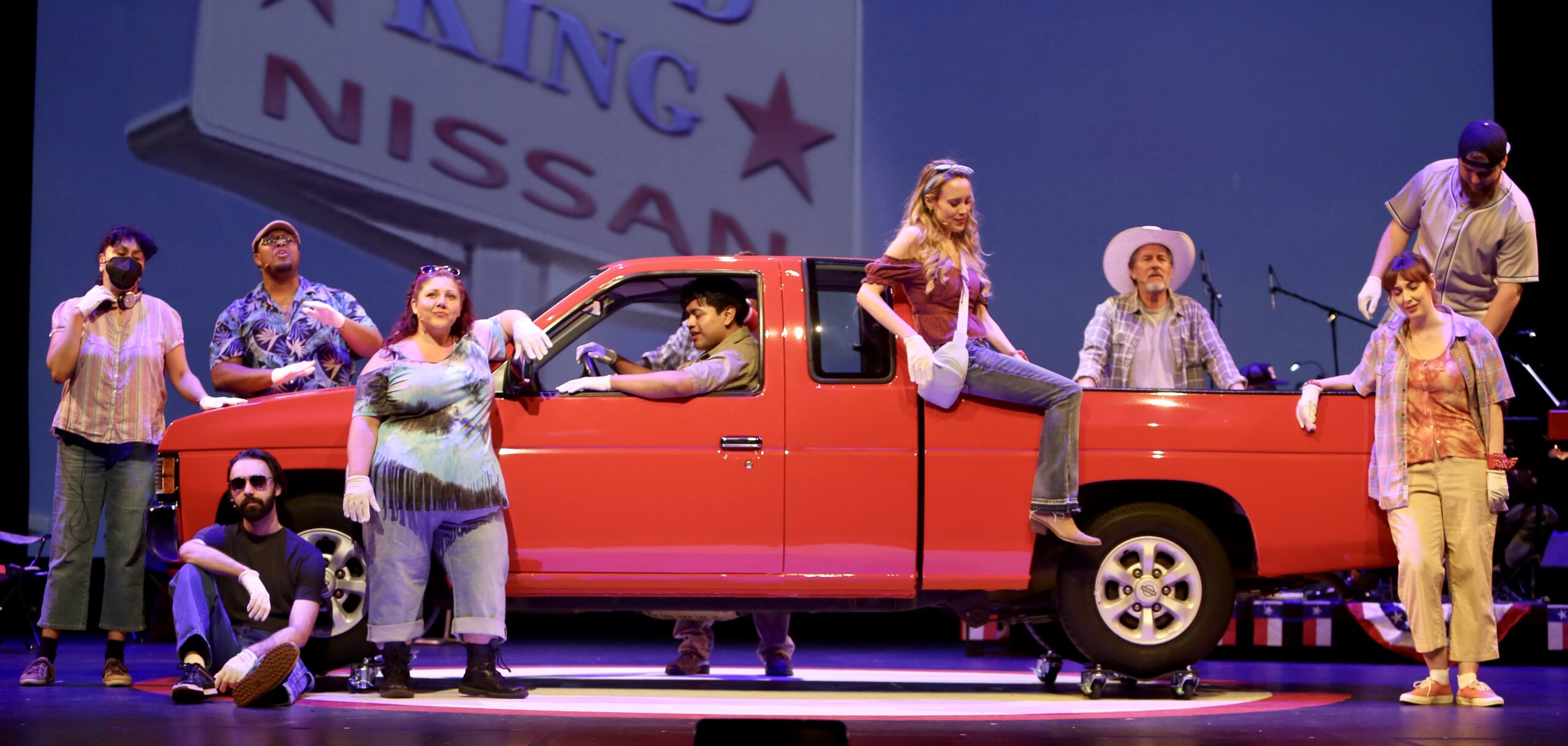
Cast of Hands on a Hardbody appear with Nissan pickup truck that’s the focus of the Rohnert Park show. Photo by Jeff Thomas.
By WOODY WEINGARTEN
Hands on a Hardbody, which plays in Rohnert Park through March 1, virtually demands that audience members root for their favorite character.
The country-rock musical pits each of 10 needy Texans against the other nine in a cruel endurance contest that screws with participants bodies and minds. The stated goal: To be the last man/woman standing in a competition to determine who can keep one hand on a hardbody pickup truck longer than the rest.
The storyline, by Doug Wright, is based on the real-life saga of a Longview auto dealer’s annual promotion in excessive summer heat from 1992 to 2005. The competition — which actually ended because of a contestant’s suicide — shallow dives into the inner life of those snagged on the underbelly of society, part of the working class that’s often crushed by big corporations and incompetent, uncaring politicians.
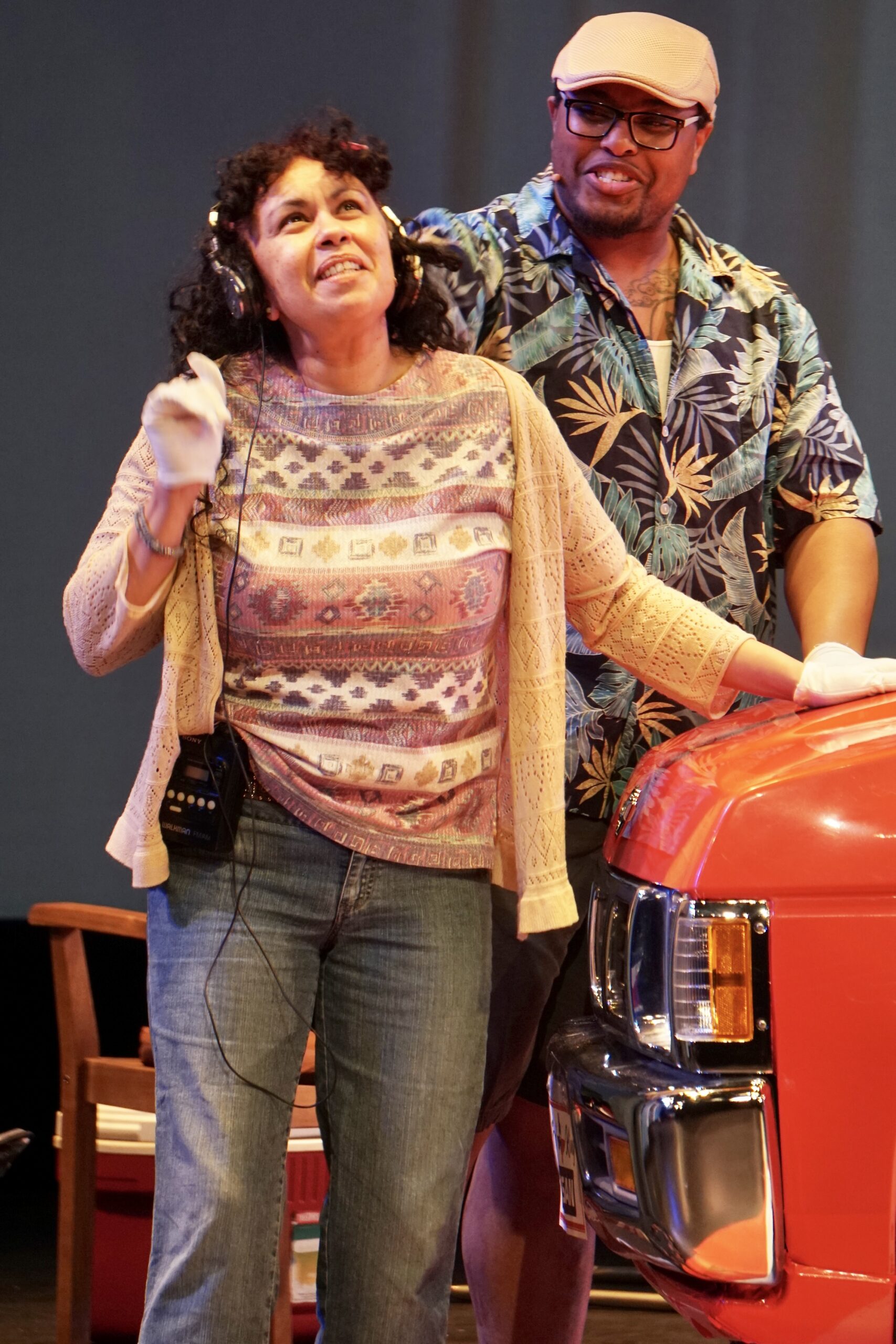
Serena Elize Flores, playing Norma, is the show-stopper. Looking on as she sings is Malik Charles D. Wade I (Ronald). Photo by Lauren Heney.
Theatergoers get a batch of characters to root for. They can sympathize, for instance, with Norma, a fervent Christian who apparently has multiple church congregations praying for her to win. She’s portrayed by Serena Elize Flores, who stops the show with a booming gospel tune, “Joy of the Lord,” showing off what’s easily the best voice on stage. The cast — 16 actors of different shapes, sizes, ethnicities, and vocal abilities —makes the number even better by rhythmically pounding on the truck with white cotton gloves they’re ordered to wear.
But maybe a viewer can better relate to Chris (played by Jake Druzgala), an ex-Marine with survivor guilt who poignantly sings “Stronger,” a melody about needing to be macho while in the service but being vulnerable afterwards. He’s clearly now in a war with Post Traumatic Stress Disorder (PTSD).
Or perhaps sensitive observers might feel sorry for one half of a couple, J.D. Drew (Larry Williams), who’s the oldest participant, a dude forced to retire without a pension by an injury he got falling off an oil rig, or his wife, Virginia (Julianne Bretan), who J.D.’s taken for granted despite her taking care of him. They add another emotional moment in “Alone with Me.”
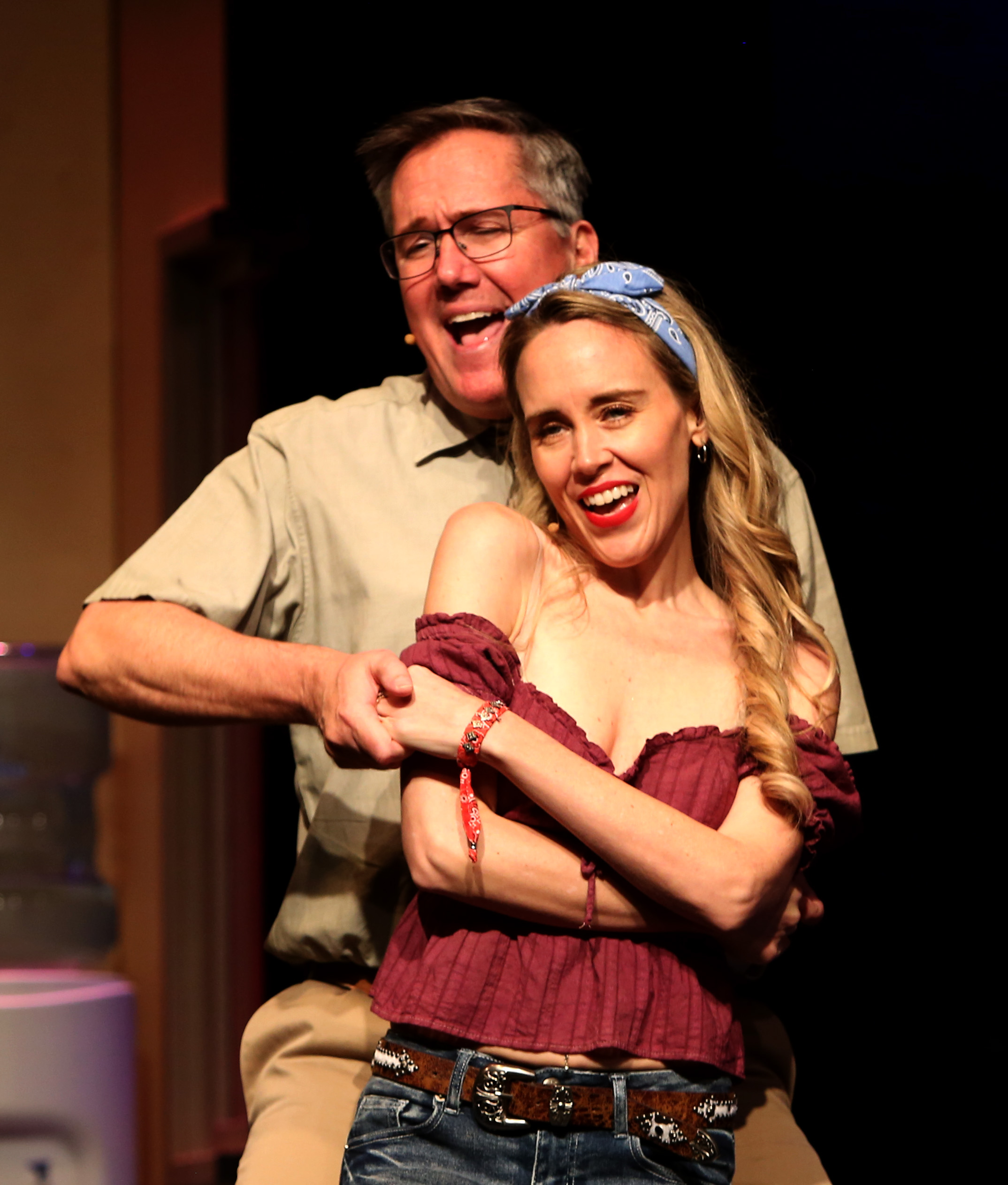
Mark Bradbury (Mike) puts the moves on Katie Kelley (Heather). Photo by Jeff Thomas.
Compassion might also be given Ronald (Malik Charles D. Wade I), a big, black guy who thinks devouring candy bars will somehow be a winning strategy; Jesus (Maick Poroj), a veterinary student who quietly rails against prejudice and wants to sell the truck so he can pay his tuition; or Heather (Katie Kelly), who gulps down speed pills given her by the somewhat lecherous dealership manager to ensure a fixed victory.
Direction by Sheri Lee Miller makes sure the 2½-hour run-time moves swiftly, and that person after person’s self-explorations are tight and the whole enchilada isn’t choppy. She also underscores the humor that’s sprinkled throughout, keeping the show from descending into sentimental tragedy.
A shiny cherry red Nissan truck on a center-stage turntable might itself by the way be considered a character. It swirls and moves forward and backward and symbolizes a chance for the winner to make a 180-degree life change from down-on-your-luck to light-at-the-end-of-the-tunnel.
The playwright, 63-year-old Doug Wright, may well believe his tale is more relevant today than when it arrived on Broadway in 2013 since he has contended that “our economic tumult has brought age-old fissures of race, class, and income inequality to the fore.”
Hands on a Hardbody certainly offers plenty to chew on. It covers, if superficially, the major disappearance of the American dream, the destruction of the U.S. healthcare system, and the hardship of the blue-collar class in general.
But every now and then, the text spits out a distracting behind-the-times reference. Such as when it refers to Desert Storm in current terms, or it lists the then-spanking new truck at only $22,000.
The basically plotless show — reminiscent of A Chorus Line or Sondheim — features southern rock, gospel, country, and Delta blues. It is, according to music director Lucas Sherman, who’s onstage at Spreckels on keyboards, backed by a violinist, guitarist, bass-player and drummer — “gritty at times and beautiful the rest of the time.” Gritty, of course, wins more often.
Trey Anastasio, lead guitarist of the rock band Phish, co-wrote the music with Amanda Green, who also did the lyrics.
Everyone involved worked on making sure that Hands on a Hardbody, in effect stuck in place by the musical’s arc, doesn’t remain static. They break the story’s theme by having contestants leave the truck to move upstage and sing (without being thrown out of the contest). Characters constantly and gracefully slip ‘n’ slide in front of and behind each other while still touching the hardbody. And Karen Miles’ choreography is wonderfully silly in spite of having most of her dance creations needing to be limited — one-handed.
It’s a show that sounds vastly heavier in a review than it is. It’s extremely likable. And the more a theatergoer thinks about it after leaving, the more that person’s apt to like it even more.
Hands on a Hardbody will play in the Nellie W. Codding Theater of the Spreckels Arts Center, 5409 Snyder Lane, Rohnert Park, through March 1. Tickets: $16 to $44. Info: www.spreckelsonline.com or 707-588-3400.
Sherwood “Woody” Weingarten, a longtime voting member of the San Francisco Bay Area Theater Critics Circle, can be contacted by email at voodee@sbcglobal.net or on his websites, https://woodyweingarten.comand https://vitalitypress.com. His books include Rollercoaster: How a man can survive his partner’s breast cancer, aimed at male caregivers; MysteryDates — How to keep the sizzle in your relationship; The Roving I, a compilation of 70 of his newspaper columns; and Grampy and His Fairyzona Playmates, a whimsical fantasy intended for 6- to 10-year-olds that he co-authored with his then 8-year-old granddaughter.
“Not just the best play to open on Broadway so far this season, but also the most important.”
– The New York Times [March 2019]
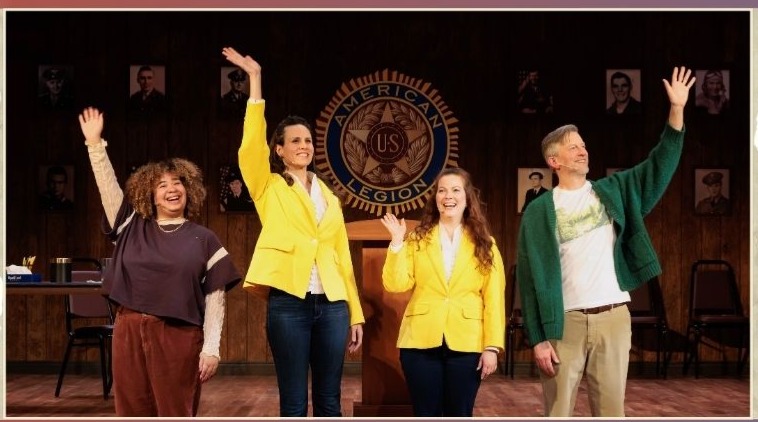
Does the Constitution really protect all citizens? Should it be abolished and rewritten? Whose interests does it represent? These and other questions are asked, and answered, in a lively and often comic whirlwind of a show. The 90 minutes pass quickly with no intermission, so plan ahead. Did you fall asleep in high school civics? This could be the one civics class you wish you had taken.
Crafted by noted American playwright Heidi Schreck, “What the Constitution Means to Me” is a true account of her experiences traveling the country at age 15, giving speeches in the American Legion’s National Oratorical Contest. The prize money she won for her compelling speeches, on her family’s personal and historic connection to the Constitution, financed her college education.
Premiering on Broadway in March 2019, “Constitution” emerged as the Pulitzer Prize finalist for that year and received two Tony award nominations, including for Best Play. Schreck performed the lead role as herself at age 15, supported by two other characters – one called Legionnaire and the other Debater. There are many surprises and “Oh wow” moments that are at times exhilarating, at other times disturbing. Told from a feminist perspective, it addresses the women’s suffrage movement, citizenship, slavery, civil rights and abortion rights. Special emphasis is placed on the 14th and 9th Amendments with fascinating information revealed. Thought experiments are presented that can challenge our preconceived notions of who we are as individuals, and as a nation.
Continuing its 59th season, “Constitution” at MBT utilizes what’s known as Environmental Theatre, with plenty of audience interaction, laughter, cheers and boos, and much excitement both onstage and in the auditorium. Dani Cochrane and Cheryl Turski alternate in the role of Heidi. On a recent Sunday matinee, Turski (“The Angel Next Door”) fills the bill perfectly with a spontaneous and limber delivery, in both comedy and tragedy. Timothy Goodwin (“Catch Me If You Can”) supports Turski as Legionnaire, but comes into his own as Mike, a gentle and sympathetic character. Gracie Walch (in her MBT debut) as Debater, appears later in the show to offer a vigorous counterpoint to Turski’s Heidi and instigate some of the most dynamic reactions from the audience. Bonus: pocket copies of the Constitution were passed out to each member of the audience!
The smooth pacing and compelling subject matter hold your attention from start to finish. For director Travis Walter, it’s personal. The history of our country has fascinated him since he was a boy, and he has said directing this show “is a unique challenge”. His guided movements of the three characters around the stage offer clever transitions that scene changes would normally provide, keeping the interest flowing. The simple set by Ben Hirschfield, designed to replicate a typical American Legion hall, is the perfect backdrop to the unfolding story.
Granted, this show may not be for everyone. It’s intense, provocative and engaging. It presents riveting true stories from the playwright’s own personal family history that highlight the Constitution’s glorious benefits, and also its dangerous flaws. If you’re looking for mindless escapism, this sure isn’t it. But if you want to experience, and confront head-on, the incredibly vital issues that have faced the United States ever since its founding document was drafted, and that continue today, this show is a must-see.
Please note new 7:30 PM evening start times for this season!
When: Now through March 8, 2026
Tickets $40 to $48
Where: Meadow Brook Theatre at Wilson Hall
Oakland University
378 Meadow Brook Rd
Rochester Hills, MI 48309
(248) 377-3300
www.mbtheatre.com
This production is made possible through the generous support of the Fred and Barbara Erb Family Foundation, the Shubert Foundation and the Meadow Brook Theatre Guild.
Meadow Brook Theatre is a professional theatre located on the campus of Oakland University in Rochester, Michigan. MBT is a nonprofit cultural institution serving southeast Michigan for 59 years.
A seduction built on illusion — and the cost of believing it.
M. Butterfly at San Francisco Playhouse begins with elegance and ends somewhere far more exposed.
A French diplomat in Beijing meets a Chinese opera singer of striking poise. The early encounters feel refined, almost ceremonial. Words are measured. Gestures restrained. Desire moves politely at first.
Then something deeper takes hold.
What unfolds becomes a meditation on longing — on the stories we construct about who we are and how powerfully we want them confirmed.
Love, illusion, politics, self-mythology — the play absorbs all of it and reshapes it for the stage.
Illusion doesn’t announce itself. It arrives dressed as destiny.
Historical Context: The Real Case Behind The Play
The drama draws from the real-life relationship between French diplomat Bernard Boursicot and Beijing opera performer Shi Pei Pu.
Their decades-long affair and later espionage trial revealed layers of deception, belief, and identity performance that stunned international observers.
Fascinating dynamic Dean Linnard portrays Rene Gallimard with finely calibrated restraint. His transformation happens gradually. Shoulders square. Confidence grows. The character’s romantic self-image expands with each encounter. Linnard allows us to see a man quietly rehearsing his own importance.
Opposite him, Edric Young gives Song Liling a composed, watchful elegance. The performance feels deliberate and controlled without ever feeling distant. A glance lingers just long enough. A phrase lands softly, then settles. Young sustains a layered presence — alluring, intelligent, and fully aware — that keeps tension alive even in stillness.
Their dynamic anchors the evening.
Desire shapes perception — and perception reshapes truth.
Mesmerizing experience Directed by Bridgette Loriaux, the production leans into physical storytelling. Movement and proximity carry meaning. The choreography of intimacy feels intentional, reflecting Loriaux’s movement background and steady hand.
This is grown-up theater.
Two nude scenes unfold with composure and dramatic clarity. They underscore vulnerability rather than provoke reaction. Illusion gives way to exposure — literal and emotional. The staging treats these moments with gravity and discipline, reinforcing the play’s central inquiry into identity and belief.
Scenes breathe. Silence carries weight. Political tension and personal longing weave tightly together. By the final revelation, the room grows quiet in a way that feels earned.
When illusion falls away, what remains is the story we chose to believe.
Involving production San Francisco Playhouse delivers a disciplined staging centered on performance. Lighting and scenic design frame intimacy and interrogation with clarity. The ensemble supports the central arc with tonal balance, moving fluidly between romantic suggestion and political reckoning.
The pacing builds deliberately, almost imperceptibly at first, until the emotional stakes stand fully revealed.
What it adds up to M. Butterfly explores ego, desire, and belief with unsettling precision. Its power lies in watching how a cherished narrative gathers strength — how repetition becomes conviction, how conviction becomes identity.
This production leans into that progression. It draws you in gently, almost courteously, and then begins removing layers. By the end, what remains feels stark and human.
You leave carrying more than plot. You carry the recognition that illusion rarely feels false while you’re inside it. It feels persuasive. It feels flattering. It feels like love.
How to see it / Get tickets San Francisco Playhouse 450 Post Street, San Francisco
February 5 – March 14
Tickets: $52–$145 sfplayhouse.org 415-677-9596
Approximately 2 hours, 35 minutes, including one 15-minute intermission
Authorship & Creative Statement
Each review is created through my proprietary FocusLens℠ method—an original editorial process shaped by firsthand experience, critical insight, and structured narrative design. Original photography, graphics, director quotes, and animated elements are incorporated to enhance reader engagement and visual impact. State-of-the-art scaffolding systems support organization and phrasing, but every sentence and decision reflects my own voice and judgment. These are not AI-generated reviews—they are authored, shaped, and published by me.
Conrad Cady, Tyler Null, Alicia von Kugelgen and Simon Patton are excellent in Masquers Playhouse’s production of Improbable Fiction.” (Mike Padua via Bay City News)
By WOODY WEINGARTEN
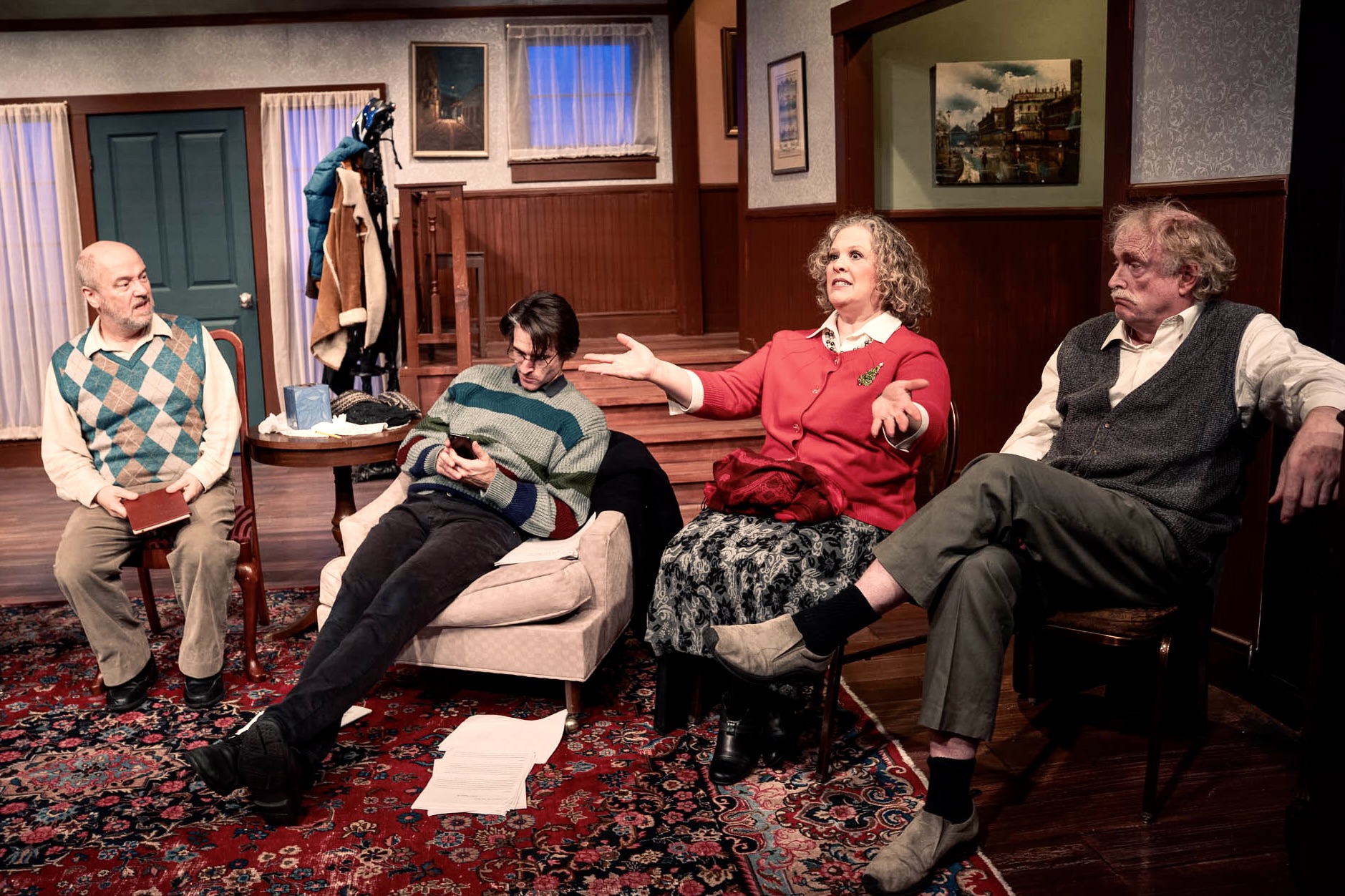
Arnold, a disoriented wannabe writer, suddenly finds several hunters in his living room trolling for aliens from outer space in Masquers Playhouse’s production of Alan Ayckbourn’s “Improbable Fiction” onstage in Point Richmond.
Played deftly by C. Conrad Cady, Arnold’s jumpy, overheated befuddlement hit the audience’s collective funny-bone so hard and long, their laughter drowned out more than a few of the next lines.
The first act of this farce — about a do-it-yourself writer’s group whose members talk more about writing than doing it — starts slowly. While audiences may momentarily worry about reacting well to the British humor, they should watch out: the pace quickly becomes frenetic. Then, Act 2 incites laughter immediately. With physical and verbal slapstick antics and quick-change costuming, it demands out-loud laughs as Arnold finds himself in the middle of a collaborative story.
Also very funny are Simon Patton as Brevis, who writes the book for musicals and whose comic crabbiness is so inflated it surpasses Lewis Black’s nasty/funny attitude; Tyler Null as Clem, who garbles one word after another, concocts conspiracy stories and adopts a noir detective persona as an alter ego; and Anna Kosiarek as Vivvi, a horny woman whose hangdog expressions are reminiscent of Stan Laurel.
None of the members, however, have a greater burning desire to finish their projects than Grace (played by Alicia von Kugelgen), who for years has been futilely trying to write a kids’ book about Doblin the Goblin to accompany her drawings.
Indeed, only Arnold has completed anything, and that’s been in the form of instruction manuals.
Masquers Playhouse, an amazing intimate community theater, consistently stages musicals and plays like this 2 ¼-quarter hour comedy that’s so tightly directed by Angela Mason. Here, the actors are superb, even when being intentionally hammy.
Equally excellent are the light and sound design by Michael O’Brien and dazzling, imaginative costumes by Ava Byrd.
Sir Alan Ayckbourn improbably has written and produced more than 90 plays, 10 of which have landed on Broadway, but he spends the bulk of his time directing. At a Masquers opening-week matinee, his delightful “Improbable Fiction” received an almost unanimous standing ovation. It was merited.
“Improbable Fiction” continues through March 1 at Masquers’ Playhouse, 105 Park Place, Point Richmond. Tickets are $15 to $35 at masquers.org.
Sherwood “Woody” Weingarten, a longtime voting member of the San Francisco Bay Area Theater Critics Circle, can be contacted by email atvoodee@sbcglobal.net or on his websites, https://woodyweingarten.comand https://vitalitypress.com. His books include Rollercoaster: How a man can survive his partner’s breast cancer, aimed at male caregivers; MysteryDates — How to keep the sizzle in your relationship; The Roving I, a compilation of 70 of his newspaper columns; and Grampy and His Fairyzona Playmates, a whimsical fantasy intended for 6- to 10-year-olds that he co-authored with his then 8-year-old granddaughter.
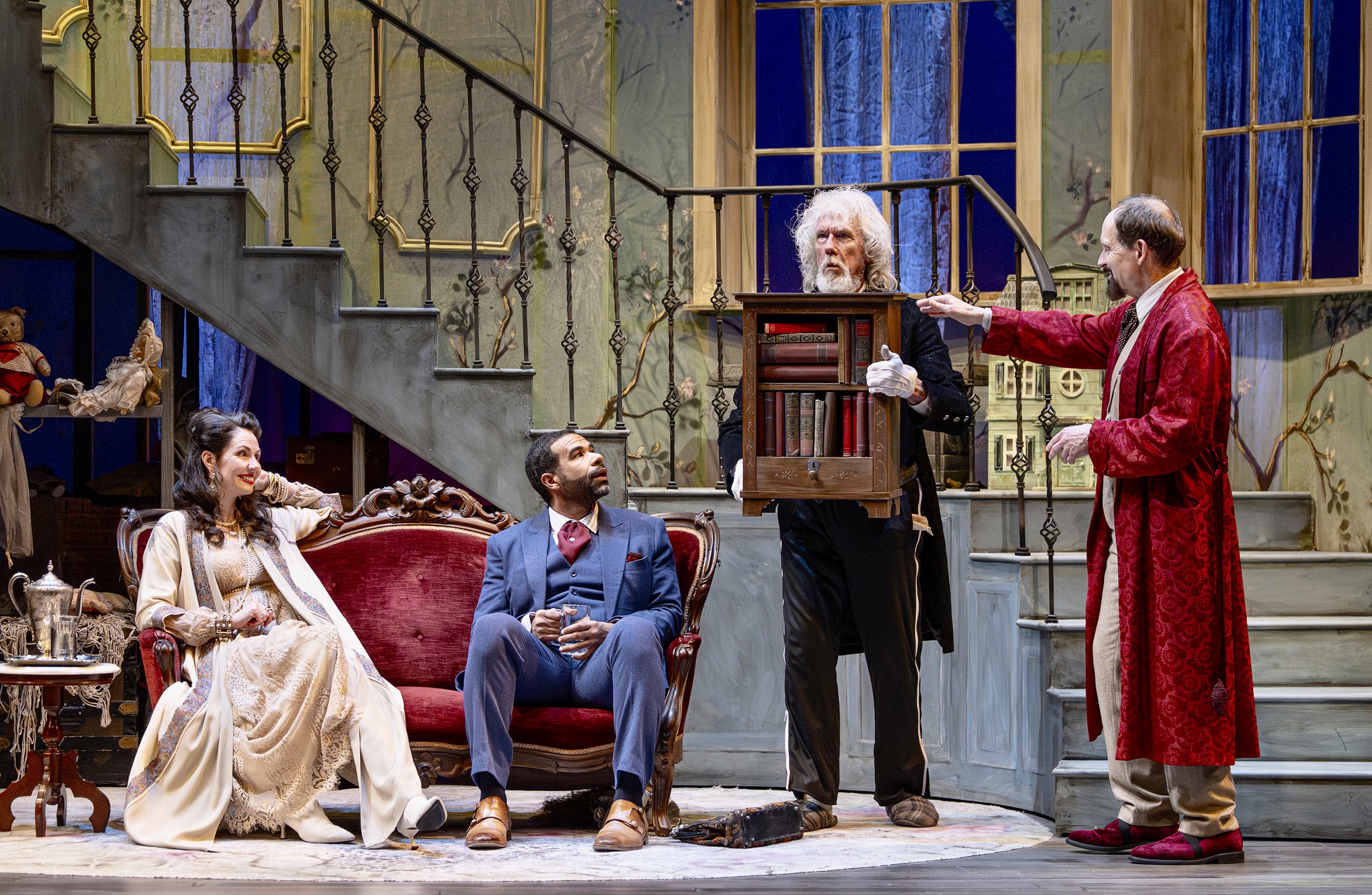
A zoned-out servant, Firs, clutches 100-year-old bookcase to show it off to cast of The Cherry Orchard. Photo by David Allen.
By WOODY WEINGARTEN
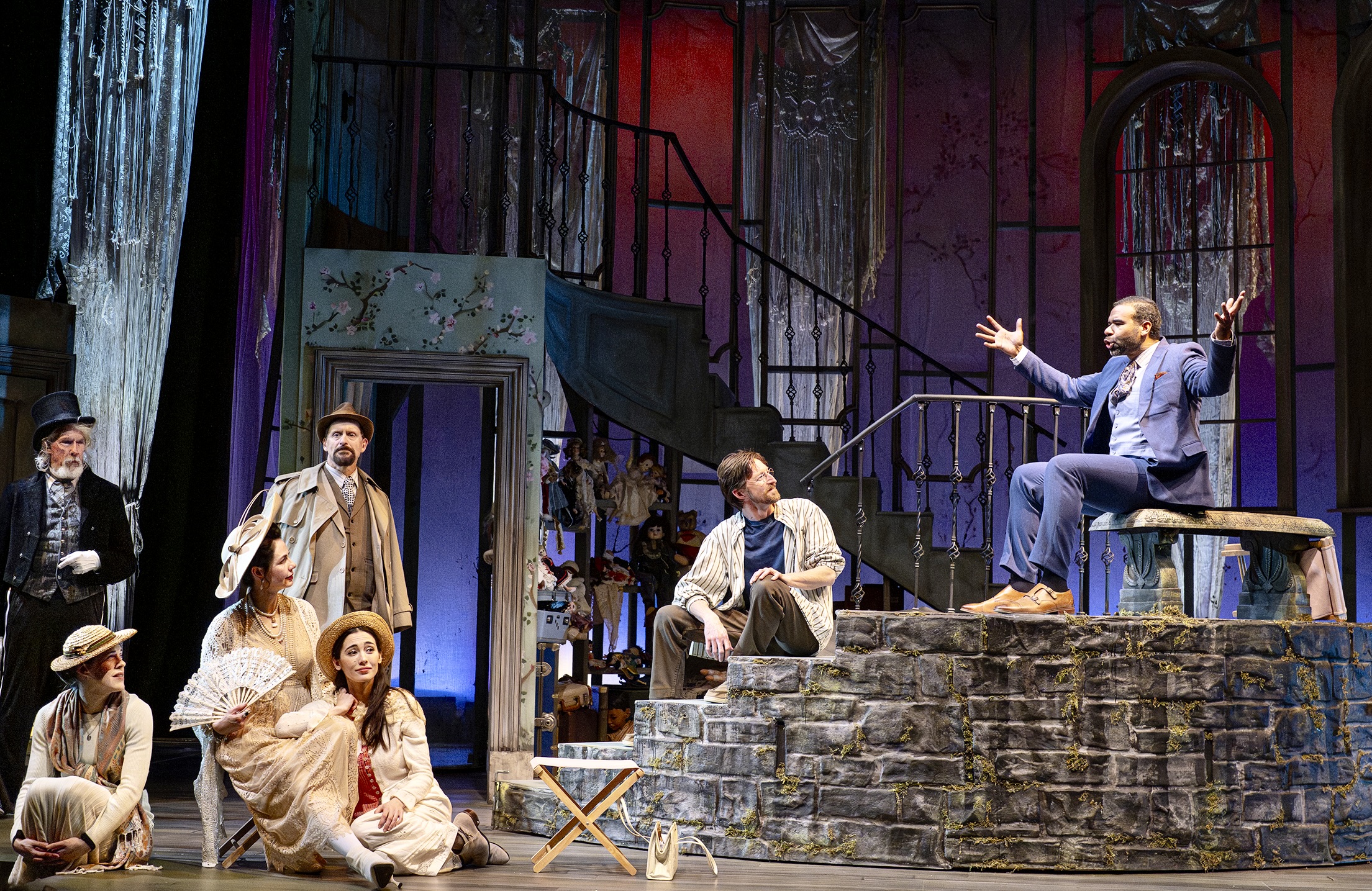
Nina Ball’s classy set for Marin Theatre’s The Cherry Orchard is exceptional, fully capturing the sense of an aristocratic, past-its-sell-date Russian estate.
Lydia Tanji’s costumes for the almost three-hour modern-language comedy are delightful, some comic, some gorgeously reinforcing the sense of powerless, turn-of-the-20th-century characters all dressed up with nowhere to go.
Superlative is the direction of the two-act classic Anton Chekhov play by Carey Perloff, who helmed the American Conservatory Theatre for 26 years, carefully extracting both comic and tragic emotions from an energetic, top-notch cast that’s mercurial yet predictable.
Bay Area actors with familiar faces — Howard Swain, Liz Sklar, Anthony Fusco, and Lance Gardner, for example — are inspiring, often briskly moving the 1904 modern-language play along with subtle eye or mouth movements or silences that brilliantly flesh out a fading upper-crust. For pure theatrical pleasure, check out Swain as Firs, an aged butler who’s ultimately abandoned after being in everyone’s face; Sklar as Liubóv, a frivolous, ineffectual “loose woman” who’s clueless about how to overcome a debilitating family debt; and Fusco as Gáyev, Liubóv’s brother, who revels in prattling but is often shut down.
Lopákhin (right) excitedly holds attention of cast in The Cherry Orchard. Photo by David Allen.
Tour de force becomes the appropriate label for Gardner, the theater company’s executive artistic director who cloaks himself in the persona of status- and money-hungry Lopákhin, who thinks the orchard, which “is mentioned in the encyclopedia,” should be cut down and developed as vacation housing. Gardner’s verbal pauses demand attention. So do his statements like “I’m rich. I’ve got lots of money,” contrasted with his unrelenting belief that he’s still just a poor schnook from the country. The actor, in fact, quietly draws scrutiny even before the play opens as he sleeps center-stage on a divan with an open book on his chest.
For those looking for comedy, The Cherry Orchard provides plenty of over-the-top clowning and pratfalls, as well as sly verbal humor and running gags, not to mention mock-violence that might have been lifted right out of a zany Three Stooges playbook or a Road Runner cartoon.
For those seeking drama, the production delivers sufficient riveting themes — such as grieving over a child, multiple references to slavery, and class differences at a time when society’s underpinnings are shaky and the Russian Revolution waits in the wings. Illicit relationships cause ripples, and cherry blossoms and a 100-year-old bookcase and a slew of broken dolls, all symbolic, help create a thought-provoking atmosphere.
Descriptive phrases are common. One character, for example, accuses another of being “like an animal that eats everything in its path.”
Oddly juxtaposed are a female, dressed as if she stepped out of a Nickelodeon telecast, who does card tricks and a guy who does ventriloquy.
One downside is that the farce starts off frenzied while introducing too many characters at once. It’s parallel to many Russian novels where, despite accompanying graphics of family trees, it takes a while to unravel who’s related to whom.
Once you figure out who’s connected to whom, however, the play’s easy to relate to, especially its political undercurrents that resemble today’s, including obsessions with a new world order and either begging for or stockpiling money.
Compassion was Chekhov’s hallmark, according to dramaturg Michael Paller. “He never judged his characters one way or the other.” But we can.
Perloff, a press release reports, says the play, which she’d commissioned Paul Schmidt to translate, is “about why change is crucial and why we always resist it. It’s…full of narcissistic characters who are sure they’re the star of their own story, but fail to realize the damage they’re causing to the people around them.”
Know anybody like that?
The Cherry Orchard will play at the Marin Theater, 397 Miller Ave., Mill Valley, through Feb. 22. Tickets: $15 to $89 (plus $6 handling fee per order). Info: 415-388-5200 or www.marintheatre.org
Sherwood “Woody” Weingarten, a longtime voting member of the San Francisco Bay Area Theater Critics Circle, can be contacted by email at voodee@sbcglobal.net or on his websites, https://woodyweingarten.comand https://vitalitypress.com. His books include Rollercoaster: How a man can survive his partner’s breast cancer, aimed at male caregivers; MysteryDates — How to keep the sizzle in your relationship; The Roving I, a compilation of 70 of his newspaper columns; and Grampy and His Fairyzona Playmates, a whimsical fantasy intended for 6- to 10-year-olds that he co-authored with his then 8-year-old granddaughter.
And now for something very different:
a shared, immersive journey of movement, sound and attention
Let the Wind Sweep Through transports us into a shared, immersive world shaped by movement, sound, and collective attention. From the opening moments, the experience gathers us physically and emotionally, inviting us to stay present as the evening unfolds around us.
What You’re Seeing
Inspired by *The Conference of Birds*, the 12th-century Sufi poem by Attar of Nishapur, this production approaches theatre as spiritual exploration. The ancient story of seekers traveling together toward understanding finds contemporary expression through physical theatre, aerial movement, puppetry, and live music—experienced through the body and the senses.
The performance stage establishes immediacy right away. With seating on 3 sides, the audience surrounds the action, creating an immersive, up-close environment. Performers move within feet of us, close enough for breath, focus, and intention to register. The room itself participates, shaping how attention flows and how connection forms.
Aerials start the show. From the opening lift, the vertical movement establishes a connective spine for the evening. The aerial work returns throughout the performance, offering lift, suspension, and continuity as individual moments link into a single, flowing journey.
Aerials initiate the action and carry us forward.
Movement is the primary language. The ensemble shifts between solo gestures and flock-like formations, shaping patterns that suggest searching, alignment and shared momentum. Repetition builds rhythm and familiarity, allowing meaning to accumulate through motion and presence. Puppetry and visual motifs add texture and discovery, keeping the experience fluid and alive.
The live music is perfectly matched to this unusual theatrical setting. In such close proximity, sound shapes the room alongside movement. The music breathes with the performers and with us, guiding pace and atmosphere while remaining fully integrated into the action.
A 10-minute intermission arrives as a natural pause. The break offers time to reflect and reset before the journey continues, supporting the thoughtful pacing of the evening and the sense of shared travel.
What I enjoyed most was how welcoming the experience felt. Rooted in Sufi spiritual ideas of seeking, surrender, and collective journey, the production stays grounded in the present moment. Each audience member connects through sensation, movement and shared awareness, carrying away what resonates most strongly.
The evening unfolds as a lived experience. Attention sharpens. Time loosens. Shared focus in the room actively shapes what unfolds.
Let the Wind Sweep Through shows how theatre comes alive when it leans into connection—between performers, audience, music and space—carrying us together through an experience shaped by presence, openness and intention.
The evening unfolds as a shared journey.
How to See It / Get Tickets
Marin Shakespeare Theatre, San Rafael 514 Fourth Street, San Rafael, CA 94901
February 6–15 • Fridays & Saturdays at 7:00 pm • Sundays at 2:00 pm
Approximately 100 minutes, including one 10-minute intermission
3-sided, immersive staging with close audience proximity Wheelchair-accessible venue; gender-neutral restrooms.
Authorship & Creative Statement
Each review is created through my proprietary FocusLens℠ method—an original editorial process shaped by firsthand experience, critical insight, and structured narrative design. Original photography, graphics, director quotes, and animated elements are incorporated to enhance reader engagement and visual impact. State-of-the-art scaffolding systems support organization and phrasing, but every sentence and decision reflects my own voice and judgment. These are not AI-generated reviews—they are authored, shaped, and published by me.
Batshit Solo Show with Leah Shelton (Photo Credit: Brandon Patoc)
Leah Shelton performs Batshit, a one person show, also created by Shelton and directed by Ursula Martinez at The Studio, Bing Concert Hall presented by Stanford Live, Stanford, California, February 4 to February 7 2026. Written by Shelton and Christine Shelton in collaboration with Martinez, Batshit is a dynamic exploration of mental health diagnosis inspired by their grandmother Gwen’s story.
Shelton arrives in a flouncy turquoise prom dress reminiscent of the 60s then does a song and dance numberand tells a joke or two. Throughout the show she creatively transforms several times into both abstract forms and characters as she leads us through a poignant story. We get to know Gwen through Leah asthisethnographic memory album unfolds. Whether she is holding an axe or a microphone Leah is a force of nature!
From Perth, Australia, Gwen’s psychiatric reports appear on a screen upstage with searing details questioned by Leah Shelton. How was the population diagnosed? Or misdiagnosed decades ago? And what about these days? Shelton is a self described psycho-siren with substantial dance and theatrical movement training who successfully melds it with a mission to create “stylized, guttural, renegade feminist work soaked in cult references and dark humour.”
What sets Batshit apart is the very creative way that Shelton tells, crafts and performs this story, with a variety of visuals, voiceovers, video, characters and images so that the fifty minute story is entertaining, enlightening and builds to an unexpected moving and joyously innovative final scene.
There are so many moments that stand out as they flash by! Highlights are when Shelton is swallowed by the cushions of the chaise in an outstanding physical scene on the Stylish set by Shelton with Freddy Komp, including a retro TV on stage that not only shows fascinating black and white clips of familiar TV shows but also projects the actual audience – plusunforgettable interviews from past decades of people in the street being asked whether their life is dull! All these elements add up to the deliciously imaginative, visual and physical storytelling imagery Shelton and Martinez create in Batshit.
A program note says that Shelton hopes that this story will resonate with others to tell their own stories on these topics with the goal of improving things. Exiting the theatre, I heard people doing exactly that, which shows the power of theatre. Make no mistake, we are on a journey – Leah’s and Gwen’s journey – where Shelton shares her innovative humor and poignant zaniness to make a point about an important topic, 5 Stars!