
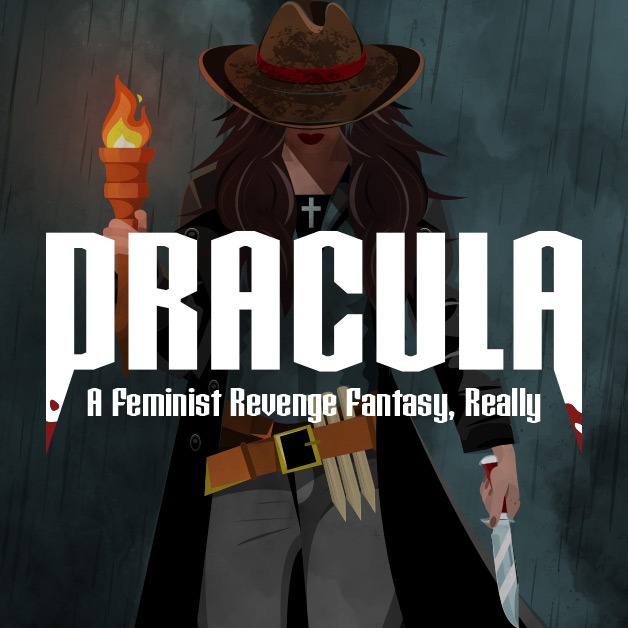
A seduction built on performance — and the danger of mistaking charm for truth.
Dracula: A Feminist Revenge Fantasy, Really moves between gothic satire and theatrical provocation, pulling dark comedy and social critique into the mix along the way. The evening rarely settles into a single identity for very long.
One moment it feels playful and theatrical. The next, confrontational, seductive, absurd, or unexpectedly sharp. That instability becomes part of the experience itself, and honestly, it often feels like different sections of the audience are watching entirely different plays.
Not every audience member experiences the same Dracula tonight.
Kate Hamill’s adaptation has no interest in preserving the seductive mythology surrounding Dracula. This version strips away romance almost immediately. Dracula is not tragic; he is practiced — socially fluent and charming in the way dangerous people often are before anyone decides to call them dangerous.
That idea hangs over nearly every scene. A charismatic outsider enters a rigid Victorian world. Desire follows almost immediately. Attention shifts. Power reorganizes itself around attraction, manipulation, and social performance. What begins as gothic fantasy gradually evolves into something more contemporary — a story about influence, complicity, and who society chooses to protect.
What unfolds becomes less about vampires and more about the stories people tell themselves — the identities they project and the narratives they desperately want confirmed. Seduction rarely announces itself as danger. It arrives looking confident. Desired. Invited.
Fascinating dynamic
Johnny Moreno plays Dracula with enough effortless charisma to explain why everyone keeps allowing him space inside the story. Moreno avoids exaggerated villainy and instead leans into something more recognizable: confidence weaponized as charm. His performance works best in stillness. A glance lingers slightly too long. A smile settles carefully into place. Even moments of apparent ease carry traces of calculation underneath them.
Across from him, Susi Damilano grounds the evening as Van Helsing — not merely as Dracula’s opponent, but as a relentless adversary who refuses intimidation, refuses seduction, and ultimately succeeds by seeing the monster clearly long before others do. Her restraint gives the show stability whenever things threaten to spiral too far into chaos.
Meanwhile, Stacy Ross pushes Renfield toward something delightfully unstable, matching the constantly shifting tone. Together, these performances anchor the evening.
Danger rarely arrives looking dangerous.
Mesmerizing experience
Director Bill English stages the evening with constant physical momentum. Bodies circle Dracula cautiously before drifting back toward him again as if pulled by gravity. Conversations feel choreographed around shifting control rather than realism.
At times, the show almost slips into dance. Movements repeat rhythmically. Characters advance and retreat with choreographed precision. Seduction, confrontation, and fear are expressed physically long before dialogue confirms them. Entire scenes unfold with a flowing, dance-like quality that gives the staging much of its tension and beauty.
The choreography becomes emotional architecture. Smoke drifts through scenes almost like a living presence. Lighting abruptly shifts from seductive warmth to nightmare intensity. Illusions appear unexpectedly. Blood effects punctuate scenes with sudden shock, while sound and movement continuously reshape the emotional temperature of the room.
At times, the experience feels less like realism and more like an elaborate theatrical séance unfolding in front of the audience.
You can feel the audience negotiating with the play in real time.
Visually, the staging creates striking stage pictures. Red arches frame scenes almost like warning signs. Blood appears suddenly against white fabric. Lighting stretches moments into something halfway between nightmare and satire.
At one point, it becomes obvious the room is laughing for completely different reasons. Some viewers seem energized by the show’s certainty. Others appear less comfortable with how directly it pushes its themes. That tension becomes impossible to ignore — and honestly, far more interesting than if everyone simply agreed with each other.
What it adds up to
What lingers afterward is not whether every scene works perfectly. It’s that the evening refuses neutrality.
The play can be experienced several ways at once: as sharp feminist reclamation, as theatrical provocation, or as a deliberately messy cultural argument staged through vampire mythology. Depending on the moment, all three interpretations feel valid.
It begins feeling like a vampire story and ends feeling like something much closer to home.
You leave carrying more than plot. You leave thinking about how easily persuasion works — and how willingly people surrender to narratives that flatter them while they are inside them.
By the end, Dracula no longer feels supernatural.
That may be what makes him unsettling.
How to see it / Get tickets
San Francisco Playhouse
450 Post Street, San Francisco
May 14 – June 27
Tickets: $52–$145
415-677-9596
Includes intermission

“`