Berkeley’s Shotgun Players cover wide swath of subject matter in challenging play, ‘The Motion’

By Woody Weingarten


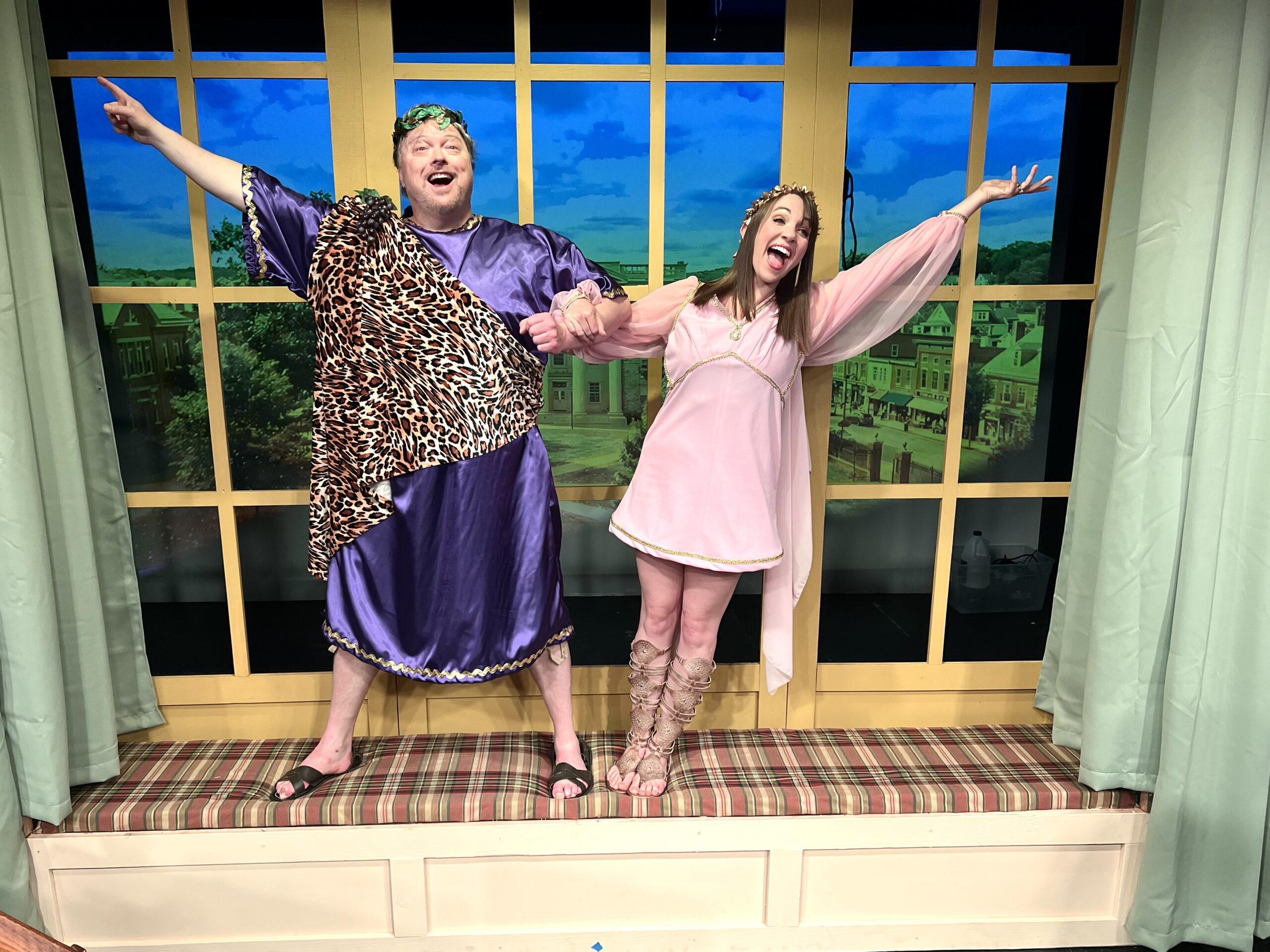
Gabrielle Maalihan and David Siniako are awestruck as they enter a new universe in “The Motion.” All photos by Jay Yamada.


By WOODY WEINGARTEN

The Motion, a new sci-fi dramedy, provides laughable and challenging theater while occasionally making audience members believe their brains are about to explode.

In a good way.

Obie-winning playwright Christopher Chen crams about eight tons of material into 105 intermission-less minutes at the Ashby Theater in Berkeley. He explores, for example, morality, memory, identity, emotions, science, and animal welfare vs. animal rights.

Oh yeah, and love.

What’s dubbed a “metatheatrical sci-fi fable” is a five-character production with each of the Shotgun Players’ actors trying to out-superb the others as they try to figure out what it means to be human. The backdrop, the first of several universes that are explored, is a debate stage.

Dr. Alan James (played by David Siniako), “a humane doctor,” implies that critters have souls. To buoy his support of a ban on animal-testing, he describes in gory detail the vivisection of a bunny.

Dr. Sarah Matthis (Erin Mei-Ling Stuart) counters with facts, leading with the notion that 44% of testing does “no harm to animals of any kind” and attempts to show that most experimentation is on lower forms. “Fish are used to study cancer,” she reports, and “worms are used to test Alzheimer’s.” She declares that animals are sentient creatures that shouldn’t be mere tools in scientific research by humans. Along the way, she quotes 18th century philosopher Immanuel Kant and cites an illustration of not knowing who to toss overboard when there are five people in a lifeboat that safely holds only four.

Matthis’ alternately cocky and insecure anti-ban partner, Prof. Neel Serrano (Soren Santos), believes the key to settling the debate is by determining how to eliminate suffering. A ban, he warns, might “halt most medical experimentation in its tracks”

Gabrielle Maalihan and Soren Santos provide a love undercurrent.

Prof. Lily Chan (Gabrielle Maalihan), perhaps the most susceptible to emotions and thereby the most vulnerable debater, admits at one point that she has “this thing where I can’t allow myself to be happy.” In a crisis, she simply feels “so helpless.”

Moderator Jack Donovan (Erin Gould) futilely tries to keep the lid on the debate, circling back to the initial question when everything starts flying off the rails, with participants either talking over each other or flirting. He gets to deliver many — but by no means all — of the laugh-lines.

James, white-bearded, distinguished, and nattily attired, tries swapping one-upmanship lines and concepts with Sarrano, but ends up angrily blurting out, “Please stop interrupting me.”

After loud claps of thunder and blinding lightning flashes, the four debaters are transported to an alternate world in which they are momentarily trapped behind invisible walls. Reading each other’s thoughts, a concept that frightens all of them, is but a first step in a journey that leads to them evolving in other places where they learn to live in the present with AI as a sidekick.

To make the presentation immersive, audience members get to vote on how the debate affected them.

Playwright Chen is popular in the Bay Area. His works have been produced and developed by such companies as the American Conservatory Theater, Berkeley Rep, Magic Theatre, and SFPlayhouse,

Erin Mei-Ling Stuart (left), Gabrielle Maalihan (center) and David Siniako brave a bitter-cold snowstorm.

Artistic director Patrick Dooley founded the Shotgun Players in 1992 in, the website says, the basement of a pizza parlor with “20 eager actors and a bucket of black paint.” Their aim: “to make great, affordable theater.” In the following 12 years, the players performed in 44 different spaces before finding their permanent home on Ashby Avenue in Berkeley.

In a post-show conversation after an opening week matinee of the world premiere, audience members cheerfully dove deeper into the morality issues — politely debating one another and, now and then, ignoring TDooley, who was moderating the half-hour bonus.

During the conversation, he suggested that perhaps the audience might want to consider what the play’s characters and they, as well, have learned about themselves. In the program, he advises theatergoers to retain “a spirit of thoughtfulness and wonder. Stay open. Stay curious.”

Both he and Chen make it virtually impossible to do otherwise.

The Motion will run through Oct. 12 at the Ashby Stage, 1901 Ashby Ave., Berkeley. Tickets: $23 to $80. Info: 510-841-6500, ext. 303, or boxoffice@shotgunplayers.org.

Sherwood “Woody” Weingarten, a longtime voting member of the San Francisco Bay Area Theater Critics Circle and the author of four books, can be contacted by email at voodee@sbcglobal.net or on his websites, https://woodyweingarten.com and https://vitalitypress.com.

9 to 5 The Musical

By Joseph Cillo


Funny… but true?

A Season Opener with Spark
Dolly Parton’s 9 to 5 is the first show of Novato Theater Company’s 105th season, and it’s a lively start. The production grows stronger as it moves along, ending with the kind of sparkle and punch that leaves an audience smiling.

But First, the Plot/Storyline
Based on the hit 1980 movie, 9 to 5 The Musical drops us into a late-1970s office where three very different women—Violet, the overlooked office manager; Judy, the nervous newcomer finding her footing after a divorce; and Doralee, the vivacious secretary battling her boss’s unwanted advances—band together against their “sexist, egotistical, lying, hypocritical bigot” of a boss, Franklin Hart Jr. What begins as daydreamed revenge turns into a wild reality when the women take matters into their own hands, kidnap Hart, and transform the workplace into one where productivity soars, fairness rules, and friendship flourishes. It’s a comic fantasy with just enough bite to feel pointed even today.


A Story with Staying Power
9 to 5 has an interesting history. The story began in 1980 as a hit Hollywood comedy starring Jane Fonda, Lily Tomlin, Dolly Parton, and Dabney Coleman. The film struck a cultural chord, tackling sexism in the workplace with humor and heart, while Parton’s theme song became a number-one single, winning Grammys and securing a place in pop culture. The popularity of the film was strong enough to inspire a five-season television sitcom during the 1980s, though it never quite matched the original’s impact. Nearly three decades later, the story found new life on stage. Dolly Parton expanded her famous anthem into a full score for 9 to 5: The Musical, which premiered in Los Angeles in 2008 before opening on Broadway the following year. The show earned multiple Tony nominations and went on to tour nationally, with audiences embracing its mix of comedy, empowerment, and high-energy music. The tale’s staying power was confirmed in 2019 when a West End revival brought the show to London’s Savoy Theatre, where it played to enthusiastic houses. From film to TV to stage, 9 to 5 has proved remarkably adaptable, reflecting both its timeless humor and the enduring resonance of its message about equality and solidarity in the workplace.

Direction, Music & Choreography
Director Larry Williams keeps the pace brisk and the tone fresh. He balances the broad comedy with just enough heart so the characters never become caricatures. Choreographer Marilyn Izdebski’s dances sparkle with energy and humor, while Nick Brown’s music direction ensures the powerhouse score fills the intimate Novato space with Dolly Parton joy.

A Personal Note
For me, the pleasure was watching the show gather steam. Early on, the cast was warming into their roles; but as the evening progressed, the energy deepened, the timing sharpened, and the performances lifted. By the second act, they were squarely in the flow, carrying the audience with them to a satisfying finish.

Bethany Cox, Andrea “Andee” Thorpe & Lauren Sutton-Beattie

Photo Credit: Marilyn Izdebski

Standout Performances
Andrea Thorpe, as Violet, makes her NTC debut in a dream role and delivers it with polish and passion. Lauren Sutton-Beattie gives Judy a blend of vulnerability and strength, winning over the audience in every scene. Bethany Cox is a delight as Doralee—witty, charming, and with a country twang that Dolly herself would tip her hat to. And as the dastardly Franklin Hart, Pat Barr leans into the villainy with just enough over-the-top bravado to make his eventual comeuppance delicious. The supporting players—Amy Dietz as Roz (hilariously unhinged), Nick Kealy as Joe (sweetly earnest), and the rest of the ensemble—round out a cast that works together like a well-oiled IBM Selectric.

Final Word
As much as 9 to 5 is a romp of workplace comedy, it also carries a thread of empowerment that still resonates. This production embraces both sides—the laughter and the message—while showcasing the growing strength of its cast as the evening unfolds. By curtain call, Novato Theater Company has delivered a season opener that feels fresh, fun, and rewarding, the kind of community theater experience that leaves you glad you were there. Don’t wait until 5 o’clock—get your tickets now.

The message still resonates and bites.

To Go
9 to 5 The Musical
When: September 19–October 12, 2025
Where: Novato Theater Company, 5420 Nave Drive, Novato
Performances: Fridays 7:30 pm; Saturdays 7:30 pm (Sept. 20, 27 & Oct. 11), plus Sat. matinee Oct. 4 at 2:00 pm; Sundays 2:00 pm; Preview Thursday, Sept. 18 at 7:30 pm
Tickets: General Admission $37; Student/Youth $25
Info: NovatoTheaterCompany.org or tickets@novatotheatercompany

★★★★★

Authorship & Creative Statement

Each review is created through my proprietary FocusLens℠ method—an original editorial process shaped by firsthand experience, critical insight, and structured narrative design. Original photography, graphics, director quotes, and animated elements are incorporated to enhance reader engagement and visual impact. State-of-the-art scaffolding systems support organization and phrasing, but every sentence and decision reflects my own voice and judgment. These are not AI-generated reviews—they are authored, shaped, and published by me.

“The Prince of Egypt” at Avon Players, Rochester Hills MI

By Greg & Suzanne Angeo

Reviewed by Suzanne Angeo (American Theatre Critics Association), and Greg Angeo (Member Emeritus, San Francisco Bay Area Theatre Critics Circle)

Ensemble cast


“Prince” Makes a Start for the Promised Land

“The Prince of Egypt”, a Metro Detroit premiere presented by Avon Players to kick off their 2025-2026 season, is a lightweight family-friendly musical. It was adapted for the stage by “Wicked” composer Stephen Schwartz , with book by Philip LaZebnik, from the 1998 DreamWorks animated film. It’s a reimagining of the familiar story of the life of Moses and his journey from the bullrushes to Prince of Egypt to leader of Israel, and the many miracles in between. It had its debut in Mountain View CA in October 2017, and opened in London’s West End in October 2020. Schwartz, who wrote the music for the DreamWorks film, also wrote the new music for the adaptation, bringing over five songs from the film.

You won’t see any camels or actual chariots, but there is a great musical score with many memorable numbers, courtesy of the excellent 11-piece orchestra directed by Matt Kush: “Deliver Us”; “Dance to the Day”; “Through Heaven’s Eyes”; “Never in a Million Years”; and “When You Believe”, which won Schwartz an Academy Award.

Emily Brown

What really makes the show is the truly amazing lighting and projection effects by director JD Deierlein that smoothly transition us from scene to scene, transforming the stage from temple and palace interiors, to the river Nile, to the pyramids and deserts. Not to be missed is the “Burning Bush” encountered by Moses that’s really hard to beat for sheer stagecraft wizardry.

All of the main cast members have strong vocal talents that do justice to the score and make “The Prince of Egypt” well worth seeing. Drew Gale offers an amiable Moses with a fine voice (“Footprints on the Sand”, “For the Rest of My Life”). Moses’ wife Tzipporah is played by Kionna Dailey with (at times) restrained energy and a superb voice (“Dance to the Day”). Other bright spots: the standout performances by Lori Smith as Moses’ sister Miriam, and Adam Wager as Ramses.  The rest of the key cast members include Matthew Cason as Aaron, Ryan Gigliotti as Pharaoh Seti, Katherine Whitton as Ramses’ wife Nefertari, Scott Wickson as Jethro, and RJ Miller-Zelinko as high priest Hotep.

Lori Smith, Drew Gale, Kionna Dailey

Those of you who have seen the film already know, but for those first-timers, keep in mind that the script takes broad artistic liberties with biblical events. It presents a brotherly relationship between Moses and Ramses that simply did not exist (if they even knew each other), and softens the brutality of some of the curses that befell the Egyptians when Pharaoh refused to let the Hebrews leave.

“The Prince of Egypt” alternates between exhilarating (great music, dramatic lighting, vivid special effects) and frustrating (flaws in the script, lack of key character development, and questionable costumes – like Ramses wearing a karate uniform). But this is an impressive show nonetheless, very much enjoyed by the audience and ideal for family outings.


Now through September 27, 2025

Tickets $32.00

Avon Playhouse

1185 Washington Rd

Rochester Hills, MI 48306

(248) 608-9077

 www.avonplayers.org

Avon Players Theatre is a registered 501(c)3 non-profit organization


Comic drama at Masquers Playhouse deep dives into race, sex, sanity, and gun control

By Woody Weingarten

Wine leads to the release of some inner Big Scary Animals at the Masquers Playhouse. From left are Kim Saunders (Rhonda), Joseph Walters (Donald), David Zubiria (Clark), and Duane Lawrence (Marcus). Photo by Mike Padua.


By WOODY WEINGARTEN

It’s easy to forget that human beings are critters — unless you’re seated in the Masquers Playhouse in Point Richmond watching Big, Scary Animals. Then you can’t ignore our baser behaviors and instincts.

If you have any sense of humor at all, you’re apt to spend much of the 90-minute comic drama by Matt Lyle laughing out loud at the dialogue and feral antics of four Homo sapiens, Until the playwright’s “truth bombs” abruptly smack you between the eyes.

The hidden biases and contradictions of each character either ooze or explode in unexpected ways at unexpected moments.

The plotline is simplistic and predictable: A middle-aged, straight white couple relocates to Dallas in 2015, “a simpler time,” to be closer to their granddaughter. But they’ve unintentionally bought into a “gayborhood.”.

Midway through, all hell breaks loose when a polite dinner conversation with their gay black and Latino next-door neighbors deep dive into sensitive subjects — race, sex, sanity, the N- and C- words, and gun control, among others. Director Gabriel A. Ross milks all the bathos possible while ensuring that no potential laugh-line is downplayed.

The entire ensemble cast is superlative, with Kim Saunders standing out as Rhonda, a naïve Christian “cracker” whose inner big, scary animal can be triggered by a single action and a single glass of wine, and David Zbiria as Clark, a flaming, hysterically funny, Latino homosexual whose common sense eventually erases his emotional spasms. Duane Lawrence inhabits the character of Marcus, a serious black college professor whose secrets are bursting to be revealed, paralleling the inner angst and problematic memories of Joseph Walters as Donald, whose wife repeatedly labels him as stupid.

Consoling Joseph Walters (Donald, center) are Kim Saunders (Rhonda) and Tristan Rodriguez (Ronnie). Photo by Mike Padua.

Two others — Natalie Ford as Sophia, a 20ish black “slut” who tries to use her psych-major tools at inappropriate times, and Tristan Rodriguez as Ronnie, the straight couple’s “troubled” son who’s gently being seduced by Sophia — do the most with under-developed roles.

The audience at a Sunday matinee rocked the small theater with laughter and expressed its consummate pleasure during a 30-minute Talk-Back session afterward. One theatergoer summed up the show this way: “It was heavy butreally funny.” Another said, “My eyes are still wet.”

The director, meanwhile, said he thought one takeaway from the provocative show should be, “There’s a good chance that you have something in common with the person you despise.”

Big, Scary Animals will run at the Masquers Playhouse, 105 Park Place, Point Richmond, through Sept. 28. Tickets: $30 to $35. Information: 510-232-3888 or info@masquers.org.

Sherwood “Woody” Weingarten, a longtime voting member of the San Francisco Bay Area Theater Critics Circle and the author of four books, can be contacted by email at voodee@sbcglobal.net or on his websites, https://woodyweingarten.com and https://vitalitypress.com.

Tartuffe

By Joseph Cillo


Groovy Spin on Molière’s Satire

Ross Valley Players kicks off its 96th season with a fresh interpretation of Tartuffe at the Barn Theatre in Ross. Under Adrian Elfenbaum’s direction, Molière’s 17th-century satire of hypocrisy lands in late-1960s Southern California—an era awash in paisleys, flower power, and cultural upheaval. Richard Wilbur’s sparkling verse translation finds fresh energy in this groovy setting, where mod fashion and psychedelic flair sharpen both the comedy and the bite.

An unusual 5-act structure — a comedy built as a symphony of folly.

Unlike most modern 2-act evenings, Tartuffe moves in 5 deliberate steps, with intermission arriving after Act 3—a natural pause, just as Tartuffe has wormed his way deepest into the household. Each act raises the stakes until the family teeters on collapse:

  • Act 1: Orgon brings home Tartuffe, hailed as a saint by him, a fraud by everyone else.

  • Act 2: Orgon orders his daughter Mariane to marry Tartuffe, sidelining Valere.

  • Act 3: Tartuffe makes a play for Elmire; Orgon, blinded, disinherits his son and signs over the estate. Curtain — and intermission.

  • Act 4: Elmire stages the reveal; Orgon hides and hears Tartuffe’s brazen hypocrisy firsthand.

  • Act 5: The tables turn—Tartuffe is exposed and justice restores the household.

The cast leans into this arc with gusto.

Steve Price’s Tartuffe is pious self-deprecation on the surface, lust underneath.

Price, who also produced, plays Tartuffe less as a silver-tongued seducer and more as a man dripping with false humility, forever bowing and scraping while his eyes are fixed on Elmire. The oily charm is subdued; what comes through is the mix of sanctimonious self-abasement and a barely concealed desire for Orgon’s wife. It’s an interpretation that underscores Tartuffe’s hypocrisy, though it sometimes left me wishing for more of the sly persuasiveness that would explain Orgon’s blind devotion.

Douglas Nolan (Orgon) is hilariously blinkered—the dad who’ll ignore a marching band in his living room if Tartuffe tells him to close his eyes. Stephanie Hunt (Elmire) is witty, grounded, and finally triumphant in the pivotal unmasking scene. Emily Anderson (Dorine) nearly steals the show with razor timing, while Chloris Li (Mariane) and Eliot Hall (Valere) keep the lovers’ subplot afloat with charm.

Photo Credit:Robin Jackson

This is a big cast, each carrying a heavy line load, and the delivery throughout the evening was crisp and professional. What took many by surprise was that the dialogue was spoken entirely in rhyme. It gives the play a buoyant rhythm and often lands a laugh, but it can also make some passages harder to follow.

Molière’s timeless warning: blind faith in false prophets can upend families and societies alike.

That’s the sting that gives Tartuffe staying power. Still, for me the evening was more intriguing than fully enjoyable. The verse kept me at a distance, the characters felt more like caricatures than people to believe in, and the sudden happy ending—famously revised by Molière to appease royal censors—lands as a contrived resolution. But that is the play itself, not the production, and others may find more delight in its clever rhymes and exaggerated characters.

Ross Valley Players offers a Tartuffe that is solidly staged and thoughtfully reimagined. Nearly 400 years on, the play’s mix of satire and farce still sparks discussion. In the Barn’s intimate setting, this production gives audiences a chance to see why Molière’s classic continues to endure—even if its style and conclusions may divide opinion.

Runs through October 12, 2025, at the Barn Theatre in Ross. Tickets $45 (discounts for members and youth under 18). RossValleyPlayers.com • 415-456-9555

★★★★★

Authorship & Creative Statement

Each review is created through my proprietary FocusLens℠ method—an original editorial process shaped by firsthand experience, critical insight, and structured narrative design. Original photography, graphics, director quotes, and animated elements are incorporated to enhance reader engagement and visual impact. State-of-the-art scaffolding systems support organization and phrasing, but every sentence and decision reflects my own voice and judgment. These are not AI-generated reviews—they are authored, shaped, and published by me.

Ladies of Broadway

By Joseph Cillo


Pure Broadway Brilliance in Sonoma

Transcendence Theatre Company has matured beautifully into its new venue at the Field of Dreams, creating a uniquely Sonoma experience. This is not just a show — it’s a total night out. Dining al fresco, socializing with family and friends, enjoying food and drink under the Wine Country sky, and then being swept away by truly professional singers, dancers, and musicians in a Broadway-caliber performance. It’s a powerhouse combination that simply isn’t available anywhere else.

Following on the heels of their sold-out Beautiful – The Carole King Musical, TTC has brought back its audience-favorite Ladies of Broadway for a triumphant run at Sonoma’s Field of Dreams. I attended opening night, and the evening was nothing short of magical.

7 powerhouse performers — Terry Burrell (Dreamgirls, Into the Woods), Galyana Castillo (Sweeney Todd, Waitress), Diane J. Findlay (Hello, Dolly!, Sister Act), Kate Marilley (Beetlejuice, Billy Elliot), Vasthy Mompoint (The Prom, Mary Poppins), Kristin Piro (Spamalot, An American in Paris), and Libby Servais (Wicked, Lysistrata Jones) — lit up the Sonoma night sky with extraordinary voices and presence.

Photo Credit: Transcendence Theatre Company

From Golden Age classics such as Hello, Dolly!, Sweet Charity, and Gypsy to modern mega-hits like Wicked, Chicago, and Sister Act, the show offered both nostalgia and fresh energy. Each actress not only delivered showstopping numbers but also shared personal stories — moments that gave the evening a sense of intimacy and honesty. At times, it felt reminiscent of A Chorus Line, where performers reveal themselves through song and story, allowing the audience to glimpse the person behind the voice. For me, as someone from New York, the geographical references woven into their stories resonated especially strongly, grounding the night in both Broadway’s past and present.

Transcendence has clearly settled into its new home at the Field of Dreams. Everything runs smooth as silk — from the staging and sound design to the seamless transitions and overall flow of the evening. It takes time for any company to fine-tune a new performance venue, but Transcendence is now there — firing on all cylinders. The result is a confidence and polish that radiates from the stage to the audience.

What impressed most was the synergy. Whether it was Burrell’s commanding gravitas, Servais’s crystalline vocals, or Mompoint’s irresistible charm, each performer shone individually while blending seamlessly into a dynamic ensemble. The audience responded with cheers, laughter, and more than a few standing ovations.

More than a revue, Ladies of Broadway is a heartfelt tribute to the legends who paved the way and a joyful reminder of Broadway’s continuing vitality. On a perfect late-summer evening in Sonoma, it was easy to believe that the lights of Broadway shine just as brightly under the Wine Country stars.

Highly recommended — catch it while you can!


Tickets & Information

Ladies of Broadway runs through September 14, 2025, at the Field of Dreams in Sonoma. Tickets and details are available at Transcendence Theatre Company or by calling the box office at (877) 424-1414

★★★★★

Authorship & Creative Statement

Each review is created through my proprietary FocusLens℠ method—an original editorial process shaped by firsthand experience, critical insight, and structured narrative design. Original photography, graphics, director quotes, and animated elements are incorporated to enhance reader engagement and visual impact. State-of-the-art scaffolding systems support organization and phrasing, but every sentence and decision reflects my own voice and judgment. These are not AI-generated reviews—they are authored, shaped, and published by me.

Eureka Day: Laugh louder and longer than ever before in a theater

By Woody Weingarten

Don (Howard Swain, center) reacts to livestream comments projected above in Eureka Day at the Marin Theatre while (from left) Suzanne (Lisa Anne Porter), Carina (Leontyne Mbele-Mbong), Eli (Teddy Spencer), and Meiko (Charisse Loriaux) look on. Photo by David Allen.


By WOODY WEINGARTEN

To call Robert F. Kennedy Jr.’s Thursday appearance before the Senate Finance Committee’s three-hour hearing contentious would be a monumental understatement.

Multiple Democrat and Republican senators charged him with making non-logical, false, and misleading claims about vaccines. The Secretary of Health and Human Services futilely struggled to pull answers out of his back pocket.

Humor: Absent.

Eureka Day, a play that also tackles the chasm between vax and not vax, uses satire to make you laugh louder and longer than you’ve ever done before in a theater during a single scene.

Laughter: Infectious.

Also contagious in the 105-minute play is a 15-student outbreak of mumps that ultimately triggers a debate about whether to mandate vaccinations at a private, progressive Berkeley elementary school where white privilege blankets the place.

A five-member executive committee keeps trying to reach a mandatory consensus when consensus is light years away.

The fast-paced comedy, which debuted in 2018 at the Aurora Theatre in Berkeley, is being partnered by that company at the Marin Theater in Mill Valley — despite the Aurora having to cancel its current East Bay season because of a money drain.

The Marin production’s being directed masterfully by Josh Costello, Aurora’s artistic director who also held the reins for the original version.

A caveat: The hilarious scene, featuring livestream comments projected on the rear wall of the set, is abruptly followed by an incredibly heavy change of pace (even though it’s sandwiched by many other moments that are less funny yet still quite amusing).

Each of the five main actors in the ensemble cast is phenomenal.

Howard Swain, who’s transcended so many roles in so many Bay Area venues that if you blink, you might find he’s already booked for 17 more, becomes Don, school executive committee leader with tangled white hair and white beard who desperately quashes potential squabbles. On occasion, he’ll read an indecipherable bit of prose or poetry to the others in a hopeful but valueless teaching moment.

Swain is in the minority, a performer who wasn’t plucked out of the original for this rendition. Ditto Leontyne Mbele-Mbong (Carina).

Eli (Teddy Spencer) embraces Meiko (Charisse Loriaux) amid emotional and intellectual turmoil. Photo by David Allen.

But the other three main characters — Charisse Loriaux (Meiko), Lisa Anne Porter (Suzanne), and Teddy Spencer (Eli) — are all vets of the original show. Clearly, the time between the first production and the revival hasn’t in the least diminished their mastery of their parts. Their range of emotions, their skill at showing feelings with a nuanced look or gesture, their ability to have learned about four zillion words from the script without blowing any, all that may have honed their chops.

One lady leaving the first row could be overheard to put it succinctly: “The cast is perfect!”

Another perfect fit is the jazz between scenes (unless, of course, you’re as anti-jazz as one character is anti-vax).

Eureka Day, which won the 2025 Tony for best revival for its Broadway run, has been performed in Austria, South Australia, and the United Kingdom.

The playwright, Jonathan Spector, a Berkeley boy, has made a few changes since his first effort. However, he’s kept everyone on stage skirting issues and being afraid of saying anything that another exec committee member might take offense at — and he’s inserted tons of swearing and characters interrupting and talking over each other like most real folks do.

That noisy writing strategy might resemble David Mamet’s style but Spector’s is funnier.

Eureka Day will run at the Marin Theatre, 397 Miller Ave., Mill Valley, through Sept. 21. Tickets: $38 to $89 (plus $6 handling fee). Info: 415-388-5208 or www.marintheatre.org.

Sherwood “Woody” Weingarten, a longtime voting member of the San Francisco Bay Area Theater Critics Circle and the author of four books, can be contacted by email at voodee@sbcglobal.net or on his websites, https://woodyweingarten.com and https://vitalitypress.com.

Eureka Day

By Joseph Cillo


Satire with a Sharp Edge

Jonathan Spector’s Eureka Day was prescient when it premiered in Berkeley in 2018. In 2025, it feels uncanny. Just as Marin Theatre opens its revival, Florida’s Surgeon General has announced plans to eliminate all vaccine mandates, including for schools. What once seemed like satirical exaggeration now plays like a headline. The result is eerie, funny, and unsettling all at once.

At Marin Theatre, in partnership with Aurora Theatre Company, Eureka Day returns under director Josh Costello, who directed the World Premiere in 2018 at Aurora Theatre Company and now helms this Marin Theatre production. The play’s premise is simple: a private Berkeley school prides itself on inclusivity and consensus until a mumps outbreak throws the vaccine debate into overdrive. Idealism collapses, social media erupts, and the parents’ progressive bubble pops.


Lisa Anne Porter (Suzanne), Leontyne Mbele-Mbong (Carina), Howard Swain (Don), Teddy Spencer (Eli), and Kelsey Sloan (Winter)
Photo Credit: David Allen

Lisa Anne Porter (Suzanne) is perfectly opinionated — and perfectly awful in the way only a self-assured parent can be. Howard Swain (Don) nails the role of the procedurally accommodating figure, forever eager to keep every voice at the table. Together, they embody the comedy and tragedy of consensus culture run amok.

The rest of the ensemble matches that precision. Charisse Loriaux (Meiko) begins with calm authority that steadily unravels under pressure. Teddy Spencer (Eli) brings wry detachment, a cool counterpoint to the chaos. Kelsey Sloan (Winter), in her Marin debut, blends in seamlessly with crisp timing. And Leontyne Mbele-Mbong (Carina) lends steady poise, grounding the turmoil with quiet strength.

In some ways, the play is a comedic commentary on everyone being politically correct and trying to please everyone — an impossible task!


Costello shapes the action like a pressure cooker, none more so than the infamous “Zoom meltdown” scene. Equal parts hilarious and horrifying, it echoes countless school-board meetings and neighborhood threads. Scenic designer Richard Olmsted and costume designer Maggie Whittaker nail Bay Area chic, while Teddy Hulsker’s projections and Ray Archie’s sound design make the digital noise uncomfortably real.

Eureka Day is funny, biting, and alarmingly current. Spector’s satire dares us to laugh at dysfunction even as today’s headlines remind us how close we are to the edge.

sharp, timely, painfully funny


To See Eureka Day
Marin Theatre, Mill Valley
August 28 – September 21, 2025 (Opening September 2)
Tickets: marintheatre.org or (415) 388-5208
Prices: $38 – $89 (+$6 fee per order)

★★★★★

Authorship & Creative Statement

Each review is created through my proprietary FocusLens℠ method—an original editorial process shaped by firsthand experience, critical insight, and structured narrative design. Original photography, graphics, director quotes, and animated elements are incorporated to enhance reader engagement and visual impact. State-of-the-art scaffolding systems support organization and phrasing, but every sentence and decision reflects my own voice and judgment. These are not AI-generated reviews—they are authored, shaped, and published by me.

6th Street Playhouse’s ‘A Chorus Line’ bridges gap between 1975 and today

By Joe Cillo, Woody Weingarten

6th Street Playhouse’s “A Chorus Line” continues through Sept. 28 in Santa Rosa. (Photo by Eric Chazankin via Bay City News)


By Woody Weingarten, Bay City News

If you think the half-century-old dramatic musical “A Chorus Line” might be a little stale by now, think again.

The current 6th Street Playhouse production proves that the show, which goes behind the scenes at intense auditions for a musical, is as effervescent, touching and funny today as it was in its 1975 debut and record-breaking 8,137 Broadway performances that followed.

Bottom line: The Santa Rosa show, onstage through Sept. 28, is good entertainment for geezers and Gen-Zers alike.

Yes, parts of the storyline don’t have the same impact now, including some “big reveal” moments by characters whose backstories involve coming out of the closet or suffering abuse as a child.

But the classic tunes by Marvin Hamlisch and lyrics by Edward Kleban (the songs ar bouncy and/or heartbreaking) could fit the voices of Audra McDonald or Taylor Swift.

The large multi-ethnic cast of performers with varied body types does better than OK with vigorous unison singing and synchronized dancing. Choreographer Hannah Woolfenden nicely coordinates the diverse group.

Director Lorenzo Alviso makes sure the timing is near-perfect, emulating original triple-threat director Michael Bennett, who conceived and choreographed the Pulitzer Prize, Tony and Obie-winning show.

The two-hour show begins with the company messing up requisite dance steps for laughs and voicing anxiety about making the cut in “I Hope I Get It.” It’s quickly followed by “I Can Do That,” a tricky novelty number by Mike (Diego Rodriguez), who displays great dancing chops.

Tracy Hinman’s eye-catching costumes and Noah Hewitt’s mood-changing lighting choices are notable. The seven-piece band in the pit under the direction of Ginger Beavers successfully captures the characters’ moods, only occasionally playing a bit loud, muffling a vocal or two.

Monique Borses plays Cassie in 6th Street Playhouse’s “A Chorus Line.” (Photo by Eric Chazankin via Bay City News)


Special solos include “The Music and the Mirror” sung poignantly by Cassie (Monique Barses); “What I Did for Love” and “Nothing” by Diana (Reilly Milton); and the angst-filled “Dance: Ten; Looks: Three by Val (Anna Vorperian).

Kudos also go to Sashas Holton, an understudy, as Sheila.

Tajai Jaxon Britten is consistent as Zach, the troubled director who must select four males and four females, from twice that number who are trying out.

If there’s a flaw in the production, it’s that it’s difficult to keep track of the numerous characters, a carryover from the original book by James Kirkwood and Nicholas Dante.

Imperfections, however, shouldn’t keep patrons from thoroughly enjoying this classic show. It has the trademark tall, movable mirrors at the back of the stage; slapstick bits like the wannabe who relates his childhood difficulties hiding frequent erections; and, of course, the delightful tap, ballet and jazzy dancing that characterize every chorus line.

6th Street Playhouse’s “A Chorus Line” runs through Sept. 28 at 52 W. 6th St., Santa Rosa. Tickets are $33 to $55.95 at 6thstreetplayhouse.com. 

This article was first published on LocalNewsMatters.org, a nonprofit site supported by Bay City News Foundation http://www.baycitynews.org/contact/

Sherwood “Woody” Weingarten, a longtime voting member of the San Francisco Bay Area Theater Critics Circle and the author of four books, can be contacted by email at voodee@sbcglobal.net or on his websites, https://woodyweingarten.com and https://vitalitypress.com.

Featherbaby

By Joseph Cillo


Surreality with Bite

World premieres are always unpredictable. David Templeton’s Featherbaby takes that truth and runs with it — or rather, flies with it. This is a play told largely through the mind of Featherbaby, a rambunctious, foul-mouthed Amazon parrot who narrates, manipulates, and disrupts the lives of the humans around it.

The central tension comes when Angie, a quirky crime-scene photographer, brings Mason, a reserved puzzle competitor, into her world. Featherbaby does not approve.

Feeling threatened and territorial, the parrot wages war on Mason, biting (literally drawing blood), cursing, and scheming to sabotage the relationship. It’s needy, vulgar, and aggressively manipulative — not, from my perspective, an attractive character at all. But that is the point: this is a parrot with personality to spare, and the play’s drama and comedy spring from its relentless, often unsettling behavior.

At Spreckels, the title role alternates between Gina Alvarado and Matthew Cadigan. On the night I attended, it was Alvarado’s turn. She threw herself into the part with fearless commitment. At times her performance tipped toward the theatrical extreme, but always with conviction. She made the parrot magnetic and disturbing in equal measure, pulling the audience into a surreal but oddly familiar emotional tug-of-war.

Mercedes Murphy, Gina Alvarado, Nate Musser

Photo Credit: Jeff Thomas

The other characters — Mercedes Murphy as Angie and Nate Musser as Mason — provide the human framework. Yet in many ways they function as enablers, allowing Featherbaby’s bad behavior to dominate. Director Skylar Evans leans into this imbalance, crafting a production where the bird’s chaos drives the arc from conflict to an unexpected, if uneasy, connection between Featherbaby and Mason.

The design team reinforces this off-kilter world. Eddy Hansen’s lighting and set sketch out an environment where reality blurs into imagination, while Jessica Johnson’s sound design sharpens every moment of comic violence or tenderness.

Featherbaby is not cozy theater. It’s messy, bold, and occasionally vulgar. But that’s exactly its strength. Templeton has written a play that dares to put an unlikeable character at the center and challenges the audience to wrestle with it. And with Gina Alvarado’s performance, Featherbaby becomes hard to forget.


Featherbaby — needy, vulgar, manipulative … memorable.

And if one talking parrot isn’t enough, click here to experience another.

To See Featherbaby
Spreckels Performing Arts Center, Rohnert Park
August 29 – September 14, 2025
Fridays & Saturdays at 7:30 p.m.; Sundays at 2:00 p.m.; additional matinee Saturday, September 13 at 2:00 p.m.
Tickets: spreckelsonline.com or (707) 588-3400
Prices: $14 – $34

★★★★★

Authorship & Creative Statement

Each review is created through my proprietary FocusLens℠ method—an original editorial process shaped by firsthand experience, critical insight, and structured narrative design. Original photography, graphics, director quotes, and animated elements are incorporated to enhance reader engagement and visual impact. State-of-the-art scaffolding systems support organization and phrasing, but every sentence and decision reflects my own voice and judgment. These are not AI-generated reviews—they are authored, shaped, and published by me.