Tosca: a review by Victor Cordell

By Victor Cordell

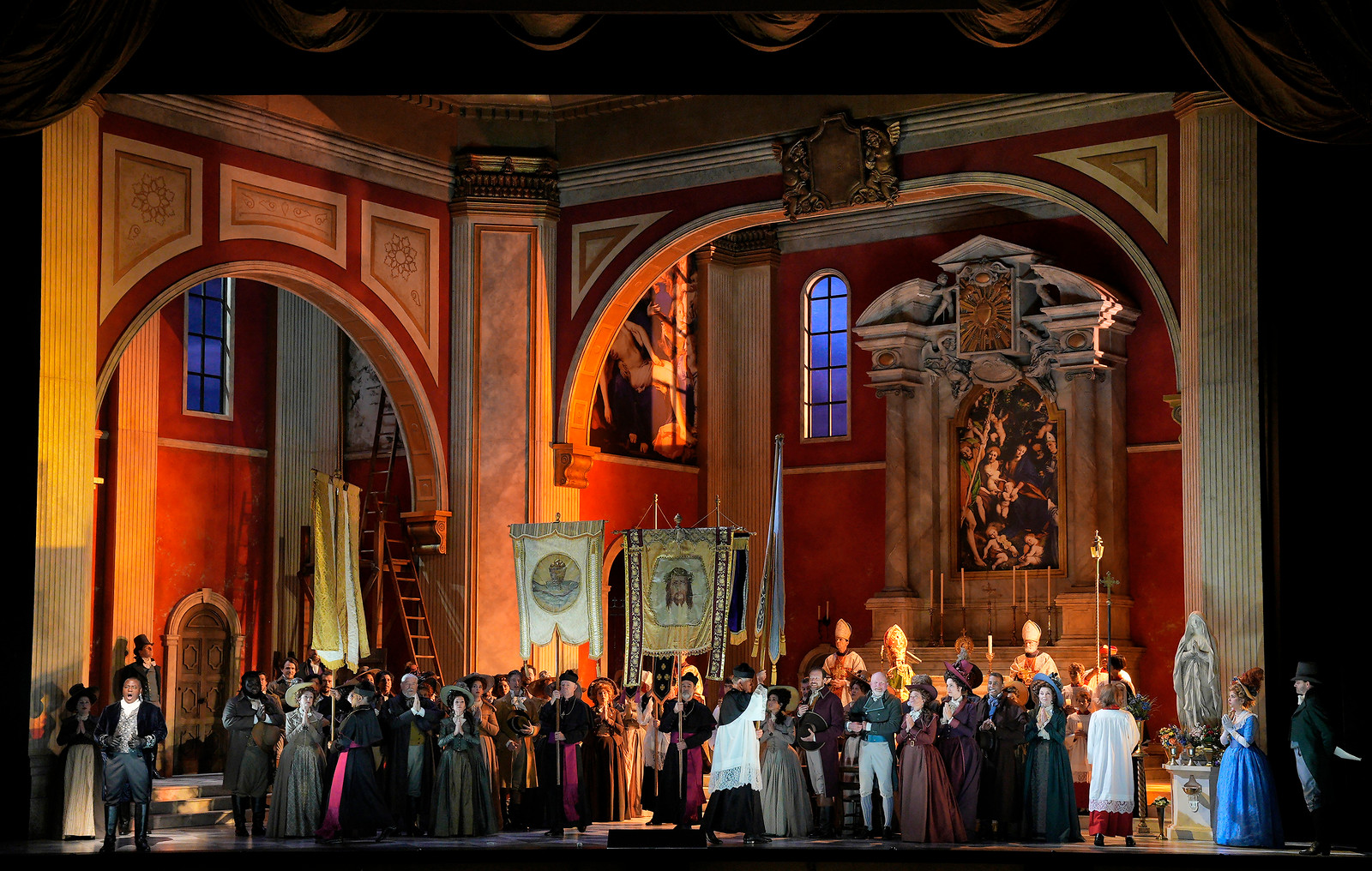
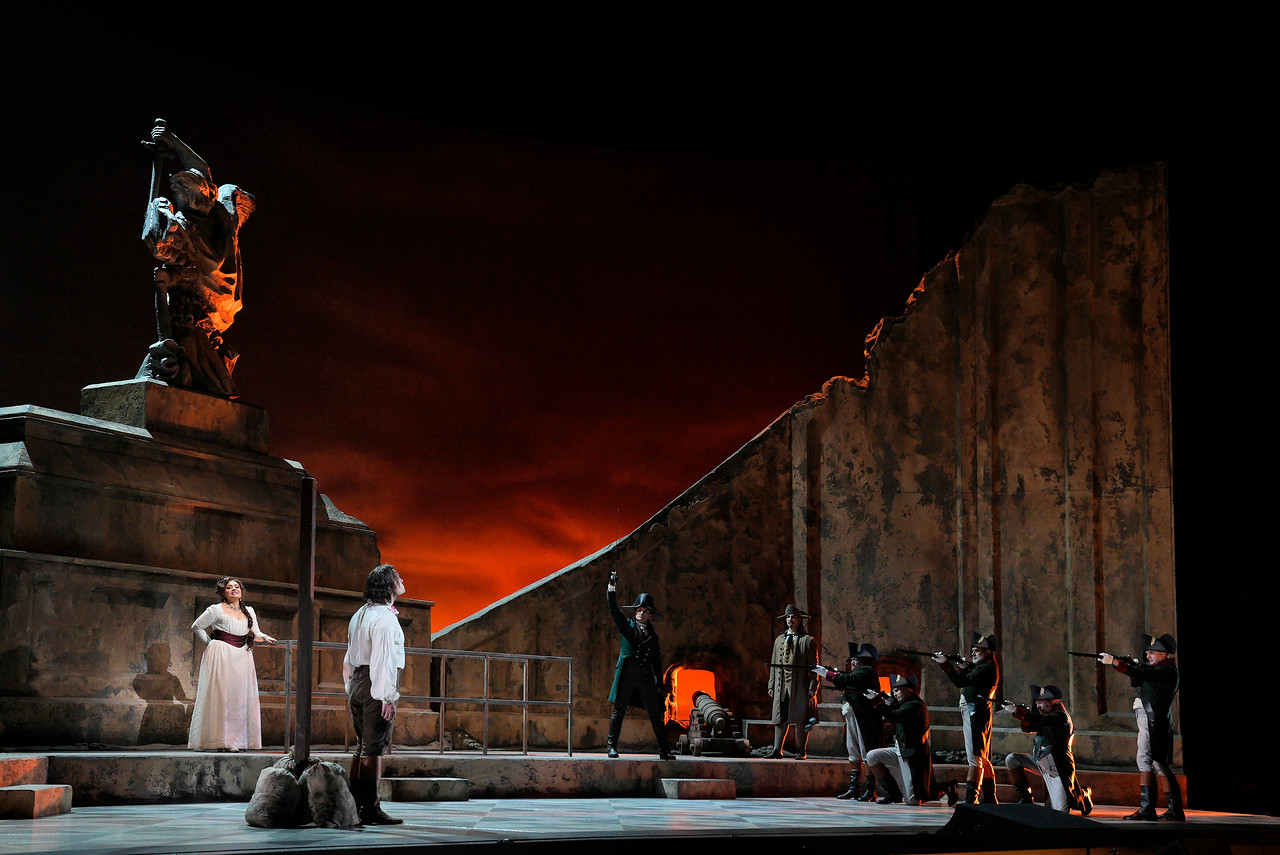
Alfred Walker as Scarpia (lower left) and chorus. All photos by Cory Weaver.

Has any other opera been so strongly associated with the birth and rebirth of a grand opera house and its resident company?  From its inception by founder Gaetano Merola, San Francisco Opera has had a love affair with the works of Giacomo Puccini.  To debut the opening of the War Memorial Opera House in 1932; to reopen in 1997 after the renovation necessitated by the Loma Prieta earthquake; and to mark its return to audiences in 2021 after the pandemic hiatus, the company has turned to the same Puccini masterpiece, the dark and glorious “Tosca.”

The audience was enthralled just to be back in the opera house, appreciative that the company and government authorities found protocols to permit the return to live performance.  Although no social distancing requirements applied, the audience was fully vaccinated and fully masked, substantially eliminating the risk of Covid-19 transmission.

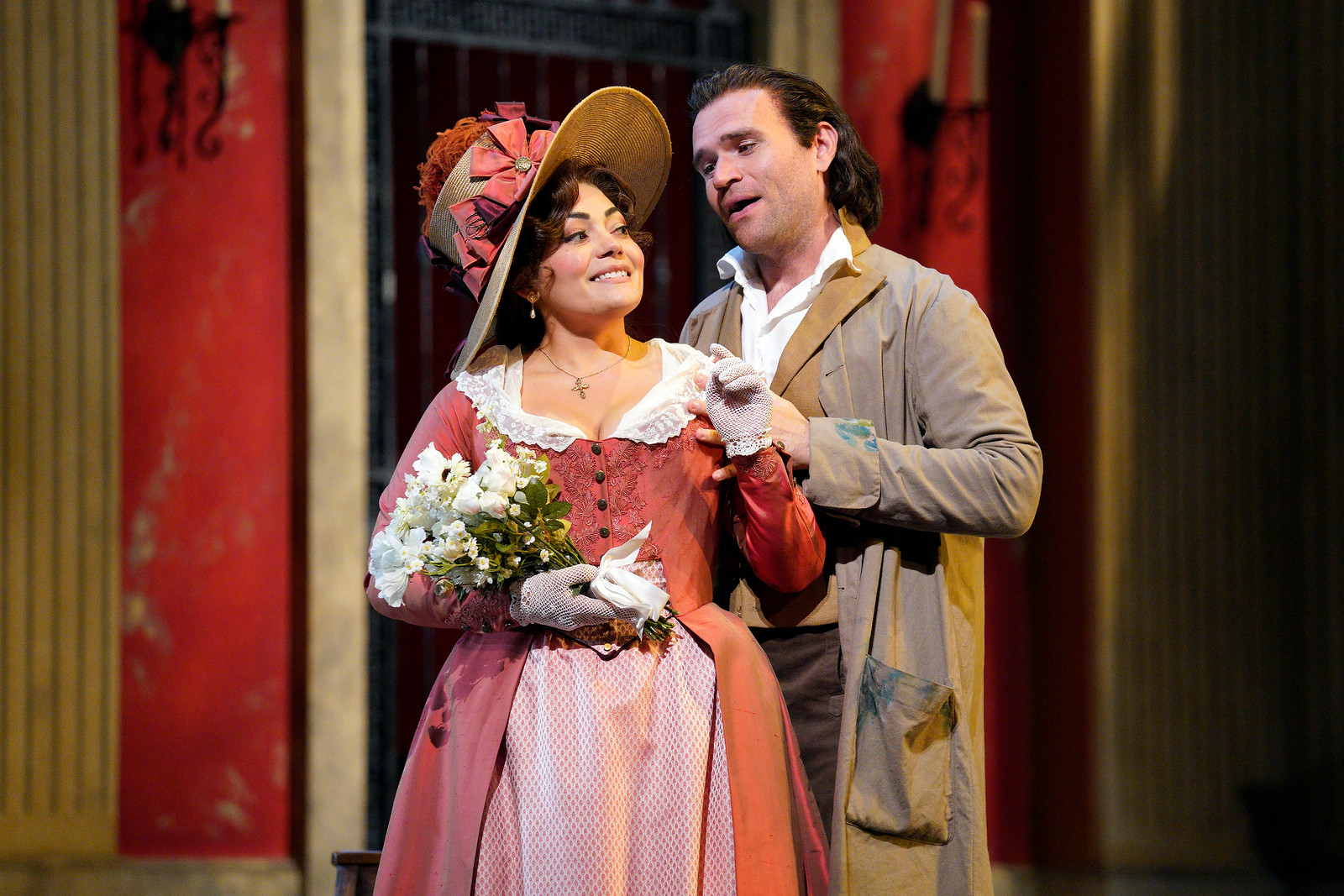
Ailyn Peréz as Tosca, Michael Fabiano as Cavaradossi.

As expected, the company offers a strong rendering of this classic, albeit, as a remount of its stellar 2018 production. Per the composer’s intent, it takes place in Rome during the Napoleanic Era, lavishly staged with independent sets for each of the three acts.  Though impressive, the visuals offer nothing new to SFO regulars.  But the artists are new, and this season opener marks the conducting debut of Eun Sun Kim in her role as Music Director of San Francisco Opera.

What is it about “Tosca” that endows it with near universal appeal?  There have been naysayers who find the action and music of verismo to be too violent and vulgar, but they are now few.  To begin with, this is a mature and confident Puccini in the follow up to his equally renowned “La Boheme.”  The opera’s dissonant, ominous opening salvo of the Scarpia theme announces the tragedy to come, while the ensuing score resounds with rich melody, haunting leitmotifs, and several memorable “greatest hits” arias.

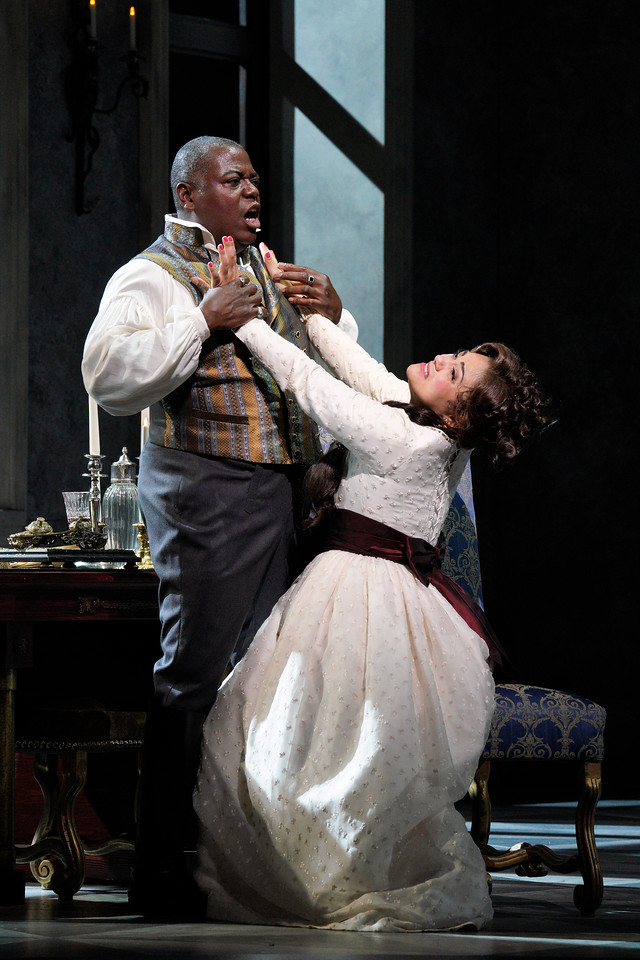
Alfred Walker as Scarpia, Ailyn Peréz as Tosca.

To complement the music, “Tosca” possesses intense drama anchored, nay, dominated by three archetypal characters.  Ailyn Peréz plays the title role of Floria Tosca, a great singer who lives for art and love.  This character offers unusually broad scope for interpretation, and Peréz uses her natural youth and charm to make Tosca delightfully coquettish, inducing uncommon and welcomed levity into Act 1.  Michael Fabiano plays her lover, the courageous hero Mario Cavaradossi, a painter in a church, surreptitiously involved in a political movement revolting against Rome’s current government.  Finally, the antagonist is Scarpia, whose very name resonates with evil.  As Chief of Police, his pursuit of enemies of the state comes with the territory, but his methods are foul.  For one, he looks to gain sexual favors from Tosca in return for releasing Cavaradossi from arrest and probable execution.  Alfred Walker’s facility for an ambiguous countenance allows him to depict Scarpia’s unctuous allure as well as his callousness and depravity.

Conductor Kim exacts full measure from the 68-piece orchestra, which fills the house with rich sound. Although the overall production satisfies extremely, the one weakness is that the principals do not always compete well with the orchestra.  That is not the case with Fabiano, who is always clearly audible and even overpowers with controlled anguish when called upon.  His nicely-tuned vibrato shows well in the beautiful Act 1 love letter to Tosca and Mary Magdalena, “Recondita armonia.”  At the end, he brings the house down with his mournful rendition of the fabulous “E lucevan le stelle,” as he contemplates death by firing squad.  This beloved aria’s distinctive quality comes in part from the lead-in melody being carried by an evocative oboe, while the tenor provides counter support until given his turn.

Ailyn Peréz as Tosca, Michael Fabiano as Cavaradossi.

Peréz possesses a beautifully lyric voice that sometimes gets lost at lower volumes.  Conversely, when singing forte, her voice turns dramatic and penetrates with ease.  Happily, she conquers her signature aria “Vissi d’arte” to a quieted house in Act 2, tenderly and with great confidence as she pleads with Scarpia to free her from the misery that he has caused.  She and Fabiano deliver both power and beauty in their final duet.  Noteworthy is that while Puccini included rare full or partial duets, he avoided the artifice of large ensemble numbers in this opera.

Scarpia’s most significant vocal moment is shared with the chorus in the booming Act 1 conclusion, “Te Deum (Tosca)” with his expressive repetition of the heroine’s name against the chorus’s religious praise to God.  Walker’s tonality is pleasant, but more commanding power would deliver the plaintive emotion of the piece better.  Otherwise, he does demonstrate his character’s dominance and rage quite well.

“Tosca,” composed by Giacomo Puccini with libretto by Giuseppe Giacoso and Luigi Illica is produced by San Francisco Opera and appears at War Memorial Opera House, 301 Van Ness Ave., San Francisco, CA through September 5, 2021.

test3 — 27 Aug 2021

By Peter Robinson

Lorem ipsum dolor sit amet, consectetur adipiscing elit, sed do eiusmod tempor incididunt ut labore et dolore magna aliqua. Ut enim ad minim veniam, quis nostrud exercitation ullamco laboris nisi ut aliquip ex ea commodo consequat. Duis aute irure dolor in reprehenderit in voluptate velit esse cillum dolore eu fugiat nulla pariatur. Excepteur sint occaecat cupidatat non proident, sunt in culpa qui officia deserunt mollit anim id est laborum.

Test – 1 27 Aug 2021

By Peter Robinson

Lorem ipsum dolor sit amet, consectetur adipiscing elit, sed do eiusmod tempor incididunt ut labore et dolore magna aliqua. Ut enim ad minim veniam, quis nostrud exercitation ullamco laboris nisi ut aliquip ex ea commodo consequat. Duis aute irure dolor in reprehenderit in voluptate velit esse cillum dolore eu fugiat nulla pariatur. Excepteur sint occaecat cupidatat non proident, sunt in culpa qui officia deserunt mollit anim id est laborum.

Eugene Onegin: a review by Victor Cordell

By Victor Cordell

Lucas Meachem (Eugene Onegin), dancers and Wise Fool New Mexico. Production photos by Curtis Brown.

The indelible mark of the Russian soul is stamped on the operas of even the most Europeanized of 19th century Russian composers. Tchaikovsky’s “Eugene Onegin” falls in that camp with its pathos revealed in rich, melodious music. Not to mention that it competes perhaps with Mussorgsky’s “Boris Godunov” as Russia’s most important opera, both for its artistry and its cultural connectedness. Santa Fe Opera has overcome Covid obstacles to produce a vivid and highly rewarding production of this significant work.

The opera derives from Pushkin’s novel of the same name, a revered literary masterpiece. The narrative, composed entirely in verse, reveals a panoply of social themes including love, honor, social hierarchy, and convention.

Sara Jakubiak (Tatyana) and Lucas Meachem (Eugene Onegin).

Tchaikovsky’s musicality characterizes the Romantic Era, with emotional melodies supported by lush (not having used that word in my last three reviews, I’m now entitled!) orchestration that stands on its own thanks to the composer’s inestimable talent with instrumental composition. Haunting leitmotifs and beautifully turned musical phrases occur throughout, though at times they seem a bit repetitive. Whole passages introduced by Lensky’s aria and Tatyana’s letter scene in Act 1 recur repeatedly.

The plot line deals with the tragic side of romance, but as with librettos of many other operas, significant moments sometimes occur with little prior development. Nonetheless, “Eugene Onegin” not only represents the greatness of Russian opera but is one of the fine representatives of the whole operatic idiom.

Sara Jakubiak (Tatyana).

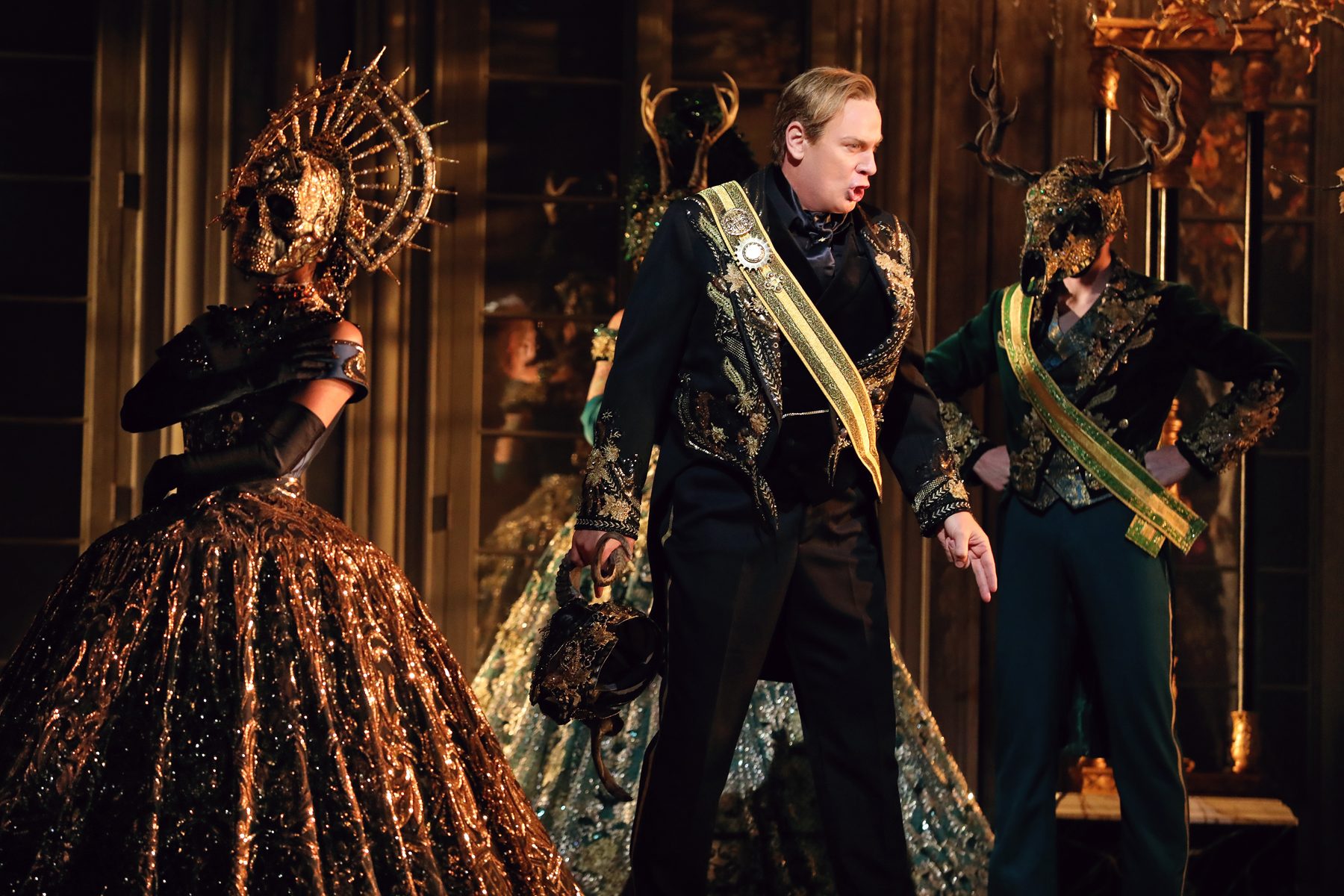
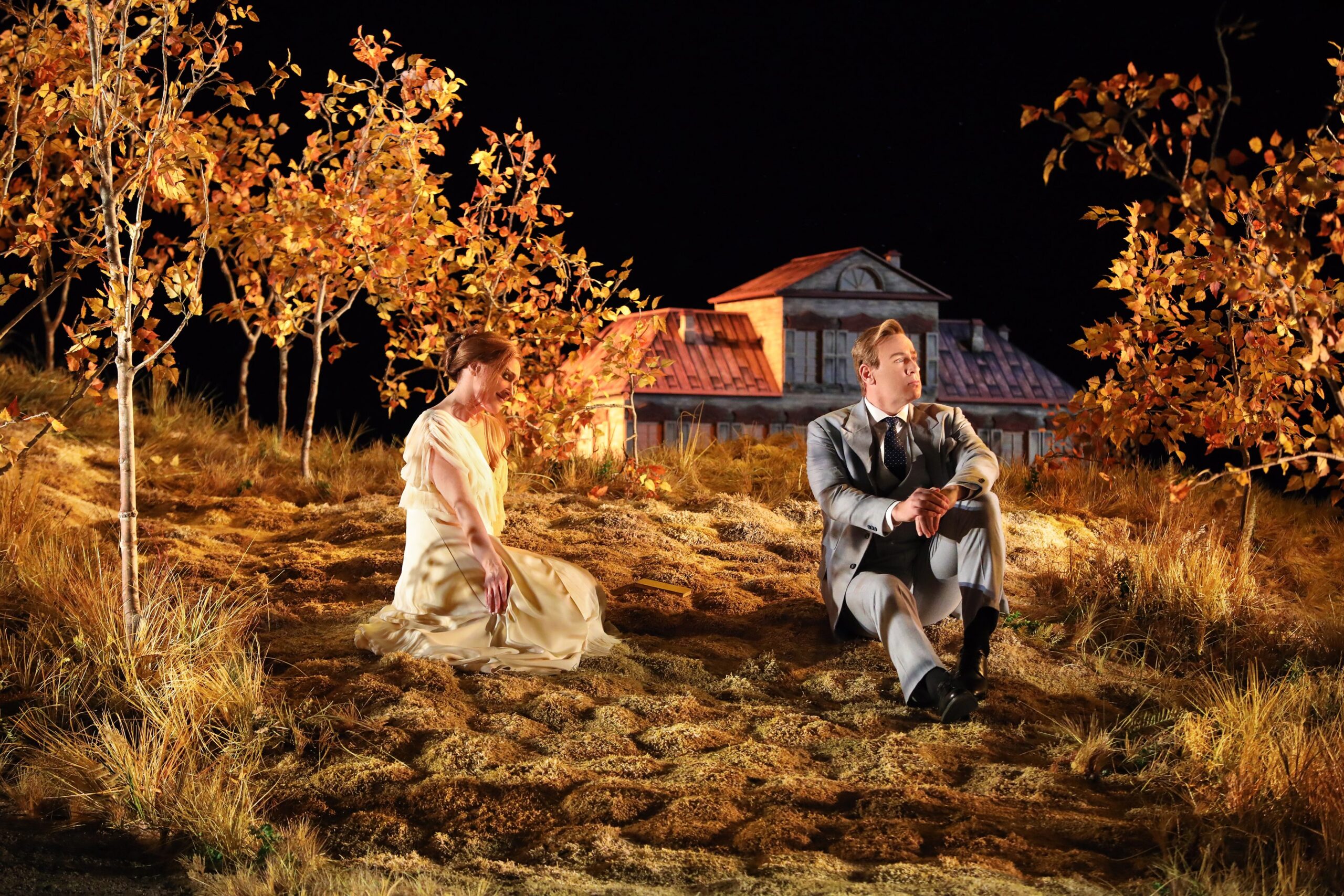
Director Alessandro Talevi marshals the creative team to give a look that blends traditional and modern elements. Contemporary set design generally calls for each venue in an opera to be separately represented, yet, oddly, Tchaikovsky’s stage concept called for no scene changes, embracing visual simplicity. The versatility of Gary McCann’s formal interior derives from moveable furnishings, while a steeply raked exterior to the rear adds appealing contrast carpeted with golden fall colors. Costumes of the principals are traditional. Those of the dancers and spirit animals are gaudy, colorful, and highly sequined with full face-and-headress covers, some with Dia de los Muertos themes that would certainly be foreign to Russians.

The title character Onegin acts as the antagonist in the story by engaging in a senseless duel with a dear friend and in rejecting Tatyana’s love overtures. Despite the opera’s title, she is the central character in Act 1, dominating the stage and commanding the emotional involvement of the audience. She also exercises control over Onegin in the final sequence of the opera.

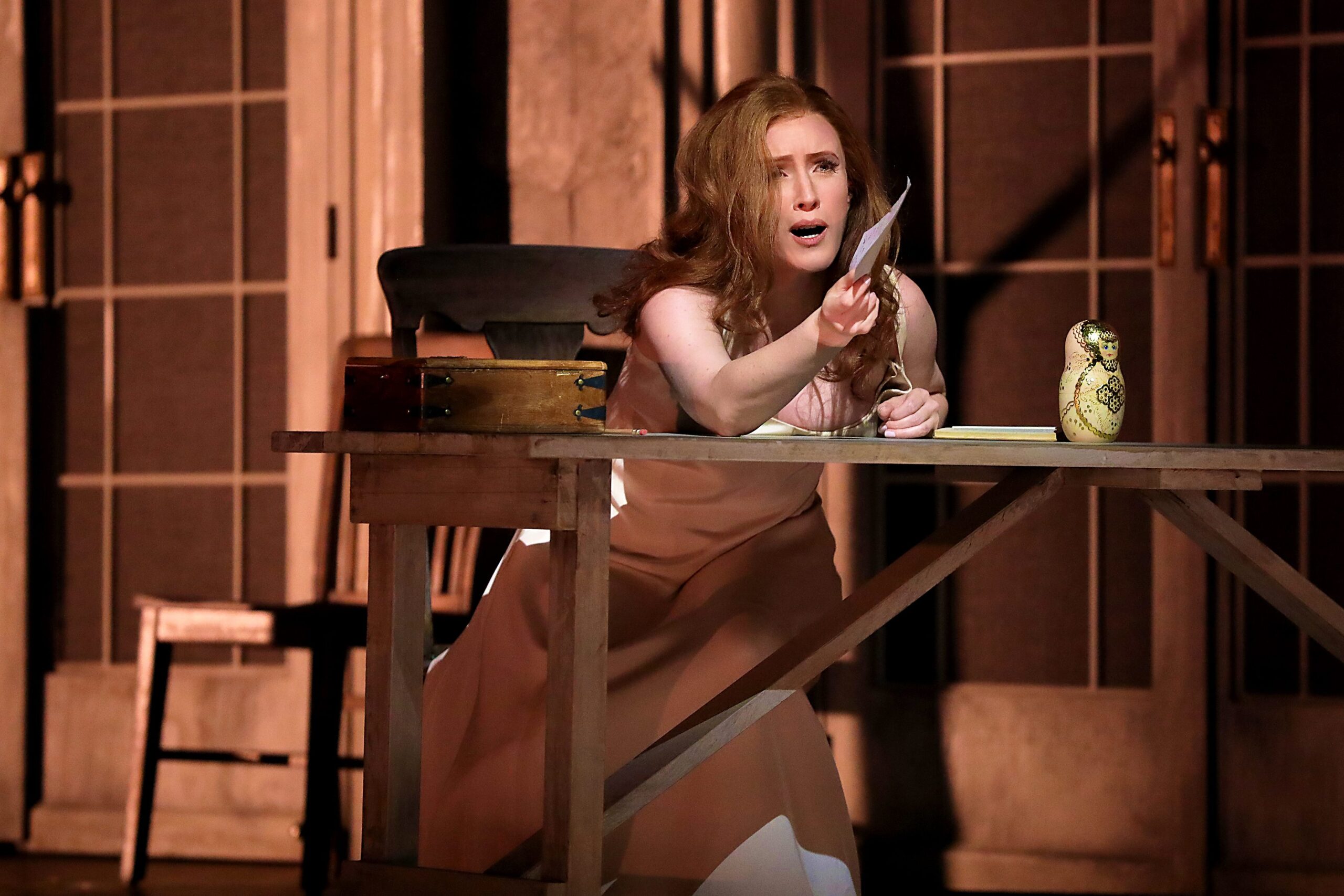
Tatyana is performed by Sara Jakubiak, who shimmers with dark vocal hues and rich tremolo. Rising to the occasion, she delivers the 13-minute letter scene soliloquy in which she pours her heart out to Onegin on paper, demonstrating total command and conviction. In this pivotal aria, the motifs and the insistent and incessant chases between flute and other wind instruments contribute to an ethereal delight.

Dovlet Nurgeldiyev (Lensky) and Lucas Meachem (Eugene Onegin).

Onegin exemplifies the idle rich and all that they represent. The arrogance and lack of empathy that they embody are well captured by baritone Lucas Meacham. Tatyana’s attraction to him is indicative of the draw that men of power and place possess despite their character shortcomings. Onegin’s crassness shows through in his pathetic excuses for rejecting Tatyana’s early advances in contrast with his slavish infatuation when she becomes a princess. Meanwhile, Jakubiak transitions convincingly from the naïve, rustic ingenue to a noble’s wife.
Meacham is a dynamic force as Onegin, displaying power, agility, and tone. In the final duet between Onegin and Tatyana, both Meacham and Jakubiak demonstrate consummate emotion, vocal fireworks, and control.

Lensky, sung by Dovlet Nurgeldiyev, is given some of the finest music in the opera. His aria, leading into the duel with Onegin, is among the most memorable. Harking dolefully back on his life and love for Tatyana’s sister Olga and foreboding a tragic end, his lustrous and pure tenor voice is wondrous.

Santa Fe Opera overcame many Covid-19 related obstacles to put on this fine production. While losing their initial castings for the two key roles because of visa restrictions, their replacements could not have been finer. Because of staging restrictions, the rousing Polonaise is danced in the round by the Wise Fool New Mexico dancers rather than as a stage-filling formal couples dance as would be true to the music’s roots. Contemporary dance movements also distinguish the pageantry, but the dancers lacked the precision necessary for a performance of this importance.

This image has an empty alt attribute; its file name is santa-fe-opera.webp

Magnificent 2,000 seat Santa Fe Opera House, from outside Orchestra Right. Among stunning features, note open sides, suspension for roof, curved acoustic arc ceiling to direct sound, baffles (seven white vertical features on poles) to diffuse wind.

Finally, there is an only-at-Santa-Fe-Opera-House modification. Public health restrictions determined that the chorus could not appear on stage. For those who are not familiar, the stunning opera house is open to nature on the sides, so temporary seating for the chorus was built outside of the orchestra-left seating, facing the audience from the side. I can’t speak for those in other locations, but from my seat on the center-left aisle, the sound of the chorus has never been more immediate and thrilling. Incidentally, choristers are “apprentices” who are accomplished artists that often sing principal roles in this and other opera companies. Thanks to Santa Fe Opera for finding a way to bring their wonderful opera productions back to their astounding edifice.

“Eugene Onegin” composed by Pyotr Tchaikovsky with libretto by Konstantin Shilovsky after the novel of the same name by Alexander Pushkin is produced by Santa Fe Opera and plays at Santa Fe Opera House, 301 Opera Drive, Santa Fe, NM through August 26, 2021.

A Midsummer Night’s Dream: a review by Victor Cordell

By Victor Cordell

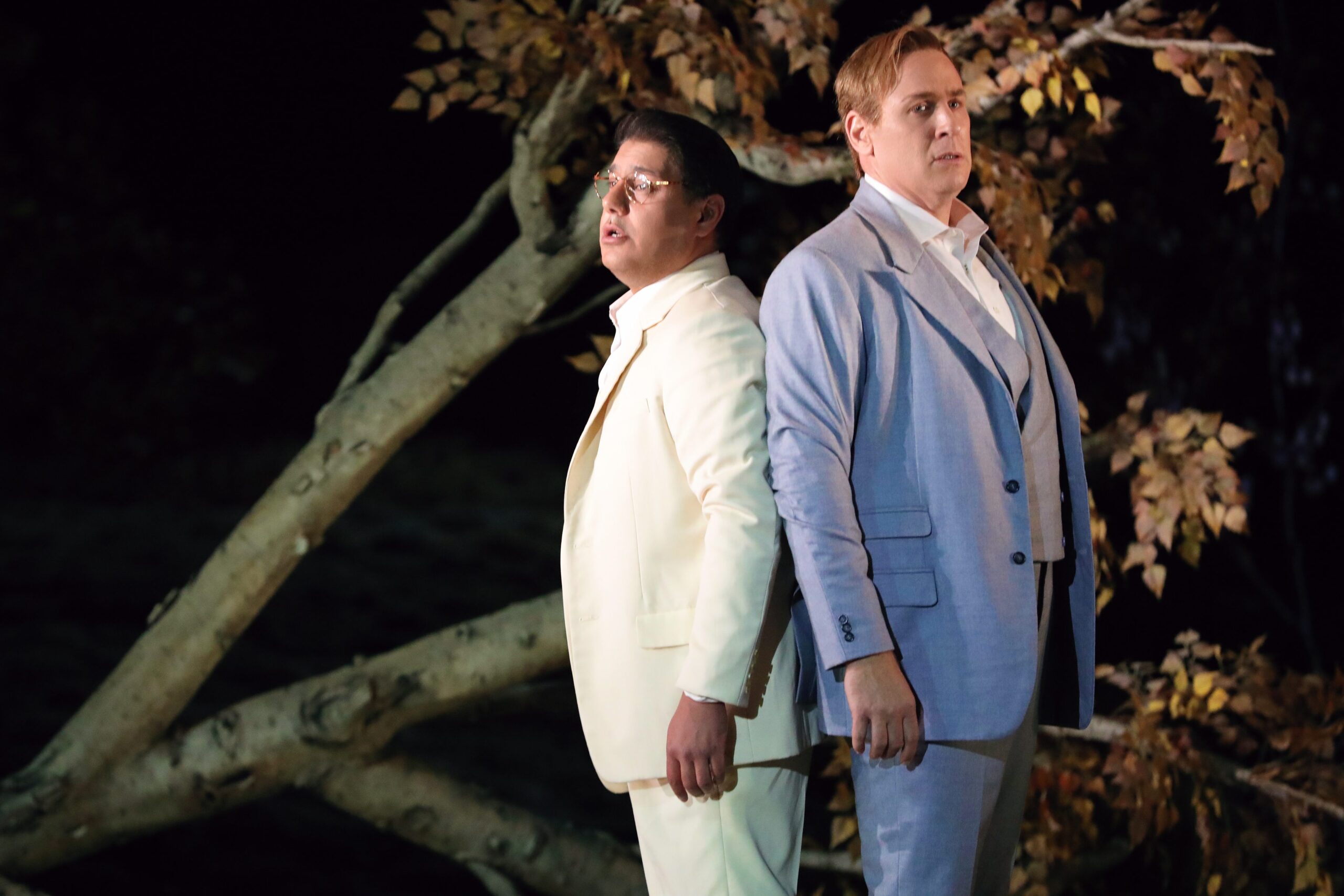
Nicholas Brownlee (Bottom), Matthew Grills (Snout), Patrick Carfizzi (Starveling), Brenton Ryan (Flute), Kevin Burdette (Quince). All photos by Curtis Brown.

William Shakespeare has served as inspiration to myriad artistic accomplishments. His plays act as the basis for numerous operas, most notably those of Shakespeare admirer Giuseppe Verdi who composed “Otello,” “Falstaff,” and “MacBeth.” Other successes include Gounod’s “Romeo and Juliet” and Thomas’s “Hamlet.” But unique in the canon is Benjamin Britten’s “A Midsummer Night’s Dream.” Although the play is condensed by half and otherwise edited, this opera is the only one that is in the repertoire and preserves the Bard’s own words in his own language. Santa Fe Opera acquits itself well with a delightful rendition of this complex, overstuffed, but eternally charming literary masterpiece set to opera. A lion’s share of credit for its success goes to auteur Netia Jones, who not only directs, but designs scenery, projections, and costumes.

Shakespeare’s frequent conceits include mistaken identities, confused love matches, supernatural interventions, play-within-a-play, and multiple plot lines, but “A Midsummer Night’s Dream” embraces them all, and more. Several threads are interspersed and overlapping throughout the narrative that may cause confusion to the uninitiated.

Erin Morley (Tytania), Dancers (Fairies).

Britten’s music is in the modern idiom without a hummable aria to be found, but it is very listenable. Given the various threads of the story, he assigns different instrumentations and styles to each. The craftsmen are introduced with the earthiness of low trombone slurs and boomps. The fairie royals awaken to low strings moaning, but otherwise, the fairie world is one of high pitched pizzacatos largely delivered on period instruments such as the celeste and glockenspiel as well as percussion.

The story takes place in the Athenian forest. The role of the forest is portrayed by a single fake tree, growing out of a grand piano – of course! But because of the Santa Fe Opera House’s unique ability to drop the back wall to reveal the beautiful New Mexico mesas behind, a real woods is viewed early in the opera.  The largely black and white set is simple, but the use of it is complex. Several trap doors are employed to various effects; artists make their entrances rising up from below and behind the stage; and active projections cover a large “obsidian disk” and the stage floor.

For those who vaguely remember their high school reading of the play, the emphasis of the craftsmen’s rehearsal and performance of the play-within-the-play may surprise. In this production, that is quite fortunate, because one of the highlight roles goes to Bottom, and bass-baritone Nicholas Brownlee clearly stands out in a large and high quality cast. His voice exudes both power and warm resonance. Plus, he acquits himself agreeably as an actor with his self-serving bumptiousness, as he even demands to act both Pyramus and Thisby in the craftsmen’s drama. In the comic elements, SFO favorite, the versatile Kevin Burdette as Quince displays burlesque-like chops that prompt some of the biggest laughs. Yet, except for the Romeo-and-Juliet-like death scene (played for laughs!) which signifies that true love never runs smooth (!), this whole diversion does not connect well to the overall exposition.

Teresa Perotta (Helena), Duke Kim (Lysander), Michael J. Hawk (Demetrius), Adanya Dunn (Hermia).

The motivation of the fairies’s narrative is a marital spat. Their Queen Tytania is performed by Erin Morley, whose voice sounded cloaked at the beginning, but who then delivered nicely on the high notes and the coloratura passages. King Oberon is Iestyn Davies who conquers the challenging countertenor voicing. Oberon enlists Puck to secure a magical flower juice that will induce Tytania to love him again. However, Puck botches his assignment, and she awakens from the potion to face Bottom as a donkey (or ass – get it?) rather than Oberon, so her love is humorously misdirected.

Choreographer Reed Luplau plays the non-singing Puck, and is the second stand out. Bedecked in an eye-catching lime green outfit, he slithers on the ground and often drops from the tree, when the audience doesn’t even know he’s there. It’s magic! The love potion he administers is represented as blotches of India ink. Luplau’s dancers, who also slither in reptilian fashion, and pop in and out of manholes like prairie dogs, wear striking costumes of ice white covered with black blotches that add to the black and white color theme. The dancers’ black face masks fit the costumery completely. They also act as a reminder of the raging pandemic with the new delta variant that induces their use by non-principals in the company.

With mention of the pandemic, this is as good a time as any to commend the Santa Fe Opera for offering this wonderful summer season to a socially distanced audience, which appears to be at its restricted capacity. Thanks to the audience as well for the seemingly total compliance of masking requirements within the gates of the House and during the performances.

Reed Luplau (Puck).

Finally, onto perhaps the central and most remembered plot line concerning four young lovers. They are all performed by apprentices – sopranos Teresa Perotta and Adanya Dunn, tenor Duke Kim, and baritone Michael J. Hawk. Each sings admirably, and their voices meld beautifully in their lyrics-challenged, but musically pretty quartet. The latter three are wonderfully lyrical, but Perotta’s dramatic voice as the scorned, yet caring and forgiving Helena is the most memorable.

Hermia’s father insists that she marry Demitrius, but she loves Lysander, who she runs away with. Helena, loved by neither man, becomes a magnet to both when Puck again errs in administering the love potion. But all is eventually righted, and to borrow from the title of another Shakespeare comedy – “all’s well that ends well.”

“A Midsummer Night’s Dream,” composed by Benjamin Britten with libretto by the composer and Peter Pears after the play of the same name by William Shakespeare is produced by Santa Fe Opera and plays at Santa Fe Opera House, 301 Opera Drive, Santa Fe, NM through August 25, 2021.

The Lord of Cries: a review by Victor Cordell

By Victor Cordell


Jarrett Ott (John Seward on left), Anthony Roth Costanzo (Dionysus in center wearing gold) Matt Boehler (Van Helsing on right). Photos by Curtis Brown.

John Corigliano’s first opera “The Ghosts of Versailles” was such a daunting and unpleasant experience that he vowed never to write opera again. That commission from the Metropolitan Opera premiered 30 years ago. However, his life partner, opera composer Mark Adamo, persuaded him to reconsider when Adamo offered to write the libretto. The felicitous result is “The Lord of Cries,” commissioned by Santa Fe Opera. The company has delivered a stellar production of the exciting opera with a cast of exceptional voices.

The Three Odd Sisters – Leah Brzyski (Agave), Rachel Blaustein (Autonoe), Megan Moore (Ino)

“The Lord of Cries” is an unusual melange of two literary works written two millennia apart. The more recent is Bram Stoker’s “Dracula,” which has been used as the basis for operas before, but none have entered the repertoire. Adamo concludes that Stoker must have known the other contributing piece, Euripides’s “The Bacchae.” Despite their divergent natures, the two share commonalities that are unlikely to be random. “The Bacchae”’s Dionysus exerts religious control over Thebes. “Dracula” antagonist Dr. John Seward exercises life control over the inmates of the Carfax Asylum as well as ownership of Carfax Abbey. Dionysus and Dracula both use disguise and are supported by violent women – the Bacchantes for the former and the Three Odd Sisters for the latter. Finally, in each source, a character in a crazed mental state mistakenly parades a decapitated head, not realizing it is someone dear to them.

The story of the present opera takes place in Victorian London at the fearsome time of Jack the Ripper. In Adam Rigg’s somewhat simple scenic design, back walls are aflush in pink-orange, and the stage is studded with lampposts, reflective of the era. Rather than traditional black, they are of the same coloration as the walls, creating a less conflicting canvas for Chrisi Karvonides-Dushenko’s varied and often distinctive costumes.  Adam Larsen’s projections enhance the backdrops and provide revelatory lupine shadows in the denouement.

Distinguished countertenor Anthony Roth Constanzo is Dionysus, who travels over time and space and becomes Dracul, The Count. He intends to reclaim the glade on which stands Carfax Abbey, now under the control of Seward. Dracul vows to punish those who do not accept his ownership over the property. This role was written for Constanzo’s voice, and it couldn’t be a finer fit. His range and versatility of voicings with considerable dark edge is remarkable, and he is adept in handling the androgonous nature of his characters.

Kathryn Henry (Lucy Harker), Jarrett Ott (John Seward), David Portillo (Jonathan Harker), Matt Boehler (Van Helsing).

As Dracul’s obstacle, Seward is obstinate. Jerrett Ott portrays and sings Seward with equal authority. Decisive and demanding in his public persona, he repeatedly defies demands to forfeit the property to Dracul, despite evidence of a deed of ownership that the stranger holds. A long soliloquy reveals Seward’s insecurities and his passion for Lucy, wife of inmate and childhood friend Jonathan Harker, who has learned that Dracul is coming. The doctor’s role also calls for great vocal range, and the baritone conveys rich tone and powerful emotion.

Vocals are demanding throughout the cast, with most artists required to be both lyrical and highly emotional, and an appropriate tremulousness occurs in the voices of several. Kathryn Henry, a member of the Apprentice Program, was a late stand-in to take on the important role of Lucy, and her performance is indicative of how outstanding the apprentices (misnamed?) are. She is equally adept at the mellifluous and the harshly dramatic voice in her ecstasy duet with Seward and her screaming soliloquy. David Portillo, the tenor playing Jonathan, captures the character’s terrified mindset with high pitched howling.

A controversial element in “The Lord of Cries” is the use of a narrator, orated with gravitas by Kevin Burdette. Many feel that telling what has happened rather than showing it weakens drama, but that is not always true. In the Victorian era of backstreet murders, newspapers spread the word (and the fear), so the use of a “reporter” in these circumstances works well. And there are plenty of bristling moments in the sung portions otherwise.

Robert Stahley (Captain).

Overall, the vocals are captivating without being memorable except for their shrillness. The ominous orchestral music excites. Rather than provide countermelody or a continuous flow of thematic musicality, the orchestra amplifies emotions with great crescendos and emphasizes the harshness with shimmering, screeching, and clacking that work well in the horror idiom.

The plot line is clever and interesting, and this is an eminently enjoyable opera. Nonetheless, the story is somewhat convoluted and often jumps to new developments without sufficient preparation. Major cuts would be welcomed. The shipboard scene concerned with Dracul’s arrival in London is unnecessary. Seward’s well-delivered introspection could be abbreviated as could a couple of two-character scenes which are also quite repetitive and slow the action. And though a matter of taste, the gore and horror could be more accentuated to make it more chilling.

“Lord of Cries” composed by John Conigliaro with libretto by Mark Adamo is produced by Santa Fe Opera and plays at Santa Fe Opera House, 301 Opera Drive, Santa Fe, NM through August 17, 2021.

I Do! I Do!: a review by Victor Cordell

By Victor Cordell

Many entertainments succeed by drawing on the audience’s inside knowledge of the subject matter.  The musical “I Do!  I Do!” covers familiar ground that is nearly universal in most places and times.  The vignettes from 60 years of marriage include that unforgettable first night; gender roles; pregnancy and the challenges in rearing children; how people change over time, and often in opposite directions; the special highs of being a couple; infidelity, disinterest, and reconciliation; and ultimately, shared dotage.  Whew!  Woodminster Summer Musicals has mounted a pleasing production of this bittersweet confection.

These days of Covid have prompted special cautions for the return of theater.  In this case, the company’s venue offers special comfort for the audience.  The spacious Woodminster Amphitheater in the Oakland Hills’ Joachin Miller Park provides more than ample room for social distancing in an outdoor setting.  Plus, attendees can picnic in the park or have food and drink al fresco from the limited concessions stand or brought from home.

The musical itself also fits the safety needs of the company almost as well as possible.  Played on a single set, it is a two-hander, thus limiting the number of performer contacts on stage.  Musical accompaniment is two pianos at opposite ends of the huge stage, with a conductor in the pit.  But amongst these minimalistic elements, Kevin Stanford’s numerous and oft changing props and Lisa Danz’s costume coordination give visual variety and relevance to scenes representing various time periods.

Leslie Ivy as Agnes, Gary Stanford, Jr. as Michael.

The backstory of the musical starts in World War II Netherlands.  Author of the source material, Jan de Hartog, wrote the play “The Fourposter” while hiding in his homeland from the Nazis.  The detailed mileposts of a marriage’s long journey are clearly not based on personal experience, because he was still a bachelor at the time of its writing.  But the story was picked up by composer Harvey Schmidt and lyricist Tom Jones, the team who in 1960 had written what would become the longest running stage musical ever, “The Fantasticks.”  In 1966, their “I Do! I Do!” would commence an award-winning, 18-month run on Broadway.

Veterans of Bay Area stages Gary Stanford, Jr. as Michael and Leslie Ivy as Agnes make up the cast for this production.  They are well matched as a pair and manage the dramatic and comedic aspects with skill.

The songs are largely upbeat and support the plotline.  Although the show isn’t studded with memorable tunes, the jaunty opening title song lilts and sets up the narrative.  Perhaps the actors weren’t warmed up or had first night jitters, but that number and those immediately following are not as strong as they should be.  Later, in pieces that call for powerful vocals, Ms. Ivy settles in and shows her stuff.  Mr. Stanford reveals a mid-range sweet spot, but his solos never quite hit the mark.  However, in harmonies, his voice mixes extremely well with Ivy’s, and they excel when singing together.  In addition, his dancing is definitely an asset.  Like a power forward with the moves of point guard, he is remarkably light on his feet – nimble, quick, and graceful.

The show stopper is the beautiful, yet schmaltzy, “My Cup Runneth Over,” which became a Top 10 pop record single in 1967.  Sung as a duet in the show, the pair capture the essence of the song nicely.  But the most fun number is another duet, “Nobody’s Perfect.”  A lengthy piece that centers on each spouse enumerating the faults of the other, it is largely delivered in patter-talk.  It is hilarious and the couple ace this one.

Following on is another fractious, and this time, gasp-inducing song.  Michael has become a successful writer, whose novels are uninspiring to Agnes, a stay-at-home wife.  With an inflated sense of ego, he fancies himself a chick magnet, while not appreciating that his admirers at literary talks don’t see the side of him that only a wife suffers.  His self-indulgent anthem “A Well Known Fact” argues that a man only gets better with age, while a woman goes to pot, not winning him the gold medal in the diplomatic race.

Although the conflict songs are played for laughs, the clashes around them are serious.  The actors perform their best in these animated, hostile moments.  In all, the musical and the actors find a good balance between lightheartedness and dysfunction.  The years pass by quickly.

“I Do! I Do!,”  composed by Harvey Schmidt with lyrics by Tom Jones, is produced by Woodminster Summer Musicals and plays on its stage at 3540 Sanborn Drive, Oakland, CA through August 22, 2021.

Eliogabalo: a review by Victor Cordell

By Victor Cordell

Randall Scotting as Eliogabalo.

Perhaps unique among performed operas, Francesco Cavalli’s 1667 “Eliogabalo”’s world premiere was delayed – by over three centuries – until 1999 to be precise.  Why, one might ask?  Interestingly, an aficionado today can evaluate an opera simply on its own merits, mindful of how appealing it is within its own idiom.  But at the time of its composition, an opera is judged largely within its context.

For instance, while “Madama Butterfly” is one of the most beloved operas in the repertoire, the contemporary detractors argued that Puccini had not advanced his oeuvre sufficiently beyond “La Boheme” and “Tosca.”  Most contemporary opera lovers will appreciate “Butterfly” independent of its place in history.

Jean-Paul Jones as Lenia, Nathan Stark as Nerbulone.

In Cavalli’s case, he was the most successful composer of his era in the field of small orchestra opera with 38 operas to his credit before his composition of “Eliogabalo.”  But his musical style for this work was deemed passé for the tastes of the Venetian audience of 1667 – an issue that bears little meaning in the 21st century.  The composer would be pleased to observe that this historical oddity has now benefitted by performances from nearly a dozen companies. West Edge Opera’s delightful rendition with well-sung beautiful music, bawdy humor, orgyistic eye-candy production numbers, and an edge of tragedy validates the work’s delayed recognition.

The libretto is loosely based on the life of a teenage Roman emperor who reigned from 218 to 222.  Though officially Antoninus, he became known in death as Elagabalus, named after the God he worshipped.  In his brief life, he defied and debauched all religious and sexual conventions.   What’s more, his incompetence was matched perhaps only by his tyranny.  The emperor lived by the notion that “the law does not pertain to me” and didn’t really care about his people, stating that “he who does not follow me blindly is guilty.”   Does this resonate with frightening currency?

Nikki Einfeld as Gemmira, Matheus Coura as Giuliano, Aura Veruni as Eritea.

A charismatic Randall Scotting aptly portrays the self-indulgent, sexually ravenous title character.  The countertenor is himself a massive contradiction.  Scotting physically commands the stage having a Samson-like appearance with hunky muscularity.  Thus, his lilting, high voice seems anomalous.  Though his voice is profound, as is common with countertenor voicing, it doesn’t project the power of other voice types.

Eliogabalo’s main quarry is Gemmira, who is otherwise spoken for, but that doesn’t deter the predator.  The evasive maiden is played by Nikki Einfeld whose silky lyric soprano voice features well in arias and blends beautifully in several ensemble numbers.

But the liveliness in the production comes largely from secondary characters.  Cavalli adopts the older, unfiltered maid/nurse meme in Eliogabalo’s enabler, Lenia, who is played in drag by Jean-Paul Jones.  As it happens, Jones is not only an opera singer but also a professional drag queen.  Remarkably, his squawk-box, false alto voice is well controlled, and he switches back and forth to a sonorous baritone with humor and ease.  Director Mark Streshinsky has given Jones liberty to go campy and off script, and the results are hilarious.

Lenia’s sometime partner-in-crime is the henchman-looking harem master Nerbulone.  He also ad libs, including dropping into the audience to solicit additions to the harem, and like Lenia, he occasionally lapses from Italian to English with great comic effect.  Nathan Stark plays the role with great verve, and his baritone range is rich and pleasant.  But while he hit his notes in the low bass end, his power is depleted there, perhaps because of the outdoor acoustics.

Nikki Einfeld as Gemmira, Randall Scotting as Eliogabalo.

Cavalli’s medium of farcical dramedies set in ancient times was common when he was active.  The lasciviousness of “Eliogabalo” was maybe a bit extreme for its time, but the West Edge audience supported it completely.  The baroque score is surprisingly melodious and engaging with many charming arias and small ensembles.  Conductor Adam Pearl’s orchestra of seven includes period instruments and delivers a remarkably full and mellow sound. Kudos to the other principals Derek Chester, Aura Veruni, Mateus Koura, Shawnette Sulker, and Jonathan Smucker, whose voices and acting added to the overall enjoyment.

The look of Evan Streshinsky’s spare set is thematically appropriate, comprised of a huge, tilted bed and eight vertical panels.  All appear to be in a tufted red latex look, like straight out of a cheap honeymoon motel room.  But against that canvas is a recurring spectacle of writhing semi-naked and ninja-like dancers that provide the visual pop.

 West Edge Opera has once again shown its skill and daring in its 2021 Festival.  This third and final offering of the season is a welcomed addition that is delivered with great professionalism and flair.  Although the opera has been trimmed somewhat, at two hours and forty-five minutes, it could benefit from further cuts.

“Eliogabalo,” composed by Francesco Cavalli with libretto attributed to Aurelio Aureli is produced by West Edge Opera and plays at Bruns Amphitheater, 100 California Shakespeare Theater Way, Orinda, CA through August 8, 2021.

James Dunn Successfully Stages “The Pirates of Penzance” at RVP

By Flora Lynn Isaacson

Director James Dunn wanted us to have some fun!  He feels that summer is a perfect time for silliness.  He achieves this with his remarkable production of Gilbert and Sullivan’s (1879) The Pirates of Penzance. 

Before the curtain is even raised, the stage is set with 8 old-fashioned footlights and box seats on either side of the stage, fronted by a red-velvet curtain.  The time and place is toward the end of Victoria’s reign.  

When the curtain is raised for Act 1, it is on a rocky shore on the coast of Cornwall.  Act 2 takes place in a Ruined Chapel by Moonlight. 

As the story goes, Frederic (Cordell Wesselink) was apprentice to a group of pirates, due to an error by his guardian, Ruth (Christina Jaqua), who came along as the ship’s mate, because, you see, “pirates” sounds very much like “pilots.”  The members of this “pirate” band, led by the Pirate King (Philip Percy Williams) are brave, but their sensitive side prevents them from being completely successful – as should be for plundering pirates.  


At the age of 21, Frederic seeks the freedom to discover the non-pirate-side of life and very quickly falls in love with Mabel (Joni DeGabriele), who travels with her own troupe of 3 sisters.  Their father, Major-General Stanley (Norman A. Hall), seeks to protect his daughters from the pirates; allegiances are tested, and the police enter the fray before all is resolved by the final curtain.  

Once the curtain is raised, the atmosphere is set with Ron Krempetz’, Scenic Artist Dyhanisbrilliant set design and construction (by Michael Walraven), as well as the costumes by Michael A. Berg and Jan Koprowski and choreography by Sandra Tanner (which is excellent with every movement, adding another dimension).  The effective lighting design was by Ellen Brooks.  Music Director Paul Smith beautifully handles the accompaniment.  

Standout performances, worth the price of admission, include truly memorable performances by Norman A. Hall as Major-General Stanley; and Philip Percy Williams (who gives a broad, flamboyant, and charismatic performance as the pirate king with a richly-strong voice.  He is also accomplished at comedy, especially with the physical bits that make this show such a delight. ) Also, it’s hard to imagine a better voice than Joni DeGabriele’s beautiful soprano voice for the sweet and fetching role of Mabel. Christina Jaqua uses her wonderfully expressive face to show us the faithful Ruth, who after living with the pirates for a decade-and-a-half, is ready to choose one for her own. 

There are 22 actors whose performances are handled masterfully by James Dunn.  His wonderful direction keeps things going at a very fast pace, and he achieved his wish for us to leave this performance with both a laugh and a smile. 

Performances of The Pirates of Penzance have been running since July 16 and will go through August 16, at The Barn, home of the Ross Valley Players, 30 Sir Francis Drake Blvd., Ross. 

Regular performances are Thursdays 7:30 p.m., Fridays 8:00 p.m., Saturdays 8:00 p.m., and Sunday Matinees are at 2:00 p.m.  For tickets, go online to www.rossvalleyplayers.com or call 415/456-9555, ext. 3.

Photography by Robin Jackson

Coming up next to start the 86th Season of Ross Valley Players will be Glorious!  the true story of Florence Foster Jenkins, the worst singer in the world, by Peter Quilter, directed by Billie Cox, from September 18 through October 18, 2015.

 FLORA LYNN ISAACSON


Elizabeth Cree: a review by Victor Cordell

By Victor Cordell

Keith Phares as John Cree.

Murder!  Mayhem!  Ghoulish entertainment for the lower classes!  Terror in the night on the foggy, shabby back streets of Victorian London!  It sounds like the makings of a Gothic suspense novel.  But an opera?  With a canvas that is the amalgam of a 19th century English music hall milieu, a courtroom trial, and serial murders, it hardly seems likely.  Of significant works intended for the opera house, only Alban Berg’s “Lulu” comes close to being as lurid.

Keith Phares as John Cree, Katy Pracht as Elizabeth Cree.

In “Elizabeth Cree,” the eminent Pulitzer Prize winning team, composer Kevin Puts and librettist Mark Campbell, have crafted a score and a darkly comic libretto with Gothic atmosphere that is absolutely riveting.  West Edge Opera’s stellar new production at its wonderful outdoor venue channels the creepiness of the events even at a broad daylight matinee.

The opera is loosely based on fact.  Elizabeth Cree suffered a hard scrapple upbringing with a mother who badly abused Elizabeth’s genitals as punishment for the girl’s having been raped.   However, she rose from the bowels of society to take on as a performer with music hall troupe.  Later, she met and married John Cree, a literary critic and failed writer but with a comfortable income from his family.  John would be implicated in a series of Jack the Ripper like murders but would die from a dose of poison administered by Elizabeth, who would be tried for his murder.

Samuel Faustine as Dan Leno, Joe Meyers as Little Victor Farrell, Leslie Katter as Aveline Mortimer, Christopher Job as Uncle.

Like the company producing it, the opera is edgy in every way.  The plot line is delivered briskly in a series of 29 vignettes that move back and forth in place and time.  At one point Elizabeth reveals her unhappy childhood and at another her sexual frigidity.  Vaudevillian-like music hall entertainers in silly costumes amuse us.  Real-life luminaries Karl Marx and George Gissing are encountered at the reading room of the British Museum, also frequented by John Cree, and are interrogated on the witness stand of the trial.  Most vividly, we see the scenes of the swarthy, rakishly handsome John Cree enacting and describing in gory detail the bloody, precise vivisection of the murder victims.

The composer’s dizzying score engages throughout with the same rapid movement as the scenes.  The orchestra tinkles and tingles and screeches and pounds like a punch in the gut.  It soars as Cree contemplates impaling the next victim.  But at the same time, the music allows for a variety of lyrical vocalizations which are delivered with consummate skill.

Samuel Faustine as Dan Leno, Katy Pracht as Elizabeth Cree.

Mezzo Katy Pracht soars as Elizabeth with a mellow voice and full vibrato, conveying a panoply of enigmatic emotions from her lost innocence to her deadly scheming.  But her murderous character is mundane when contrasted to her male counterparts.  Pracht’s real-life husband, Keith Phares, portrays the sinister John Cree with flair.  His silky, rounded baritone includes a lilting high end and warm vibrato.  Finally, Samuel Faustine is the brassy and gaudy comedian Dan Leno, the head of the music hall performers.  His versatile tenor voice includes a well-controlled countertenorish high end that is put to great use in low volume passages.

This opera may not have the gravity of Verdi or Mozart works.  However, the score is multifaceted, fitting, and eminently listenable.  Not to mention, the libretto is clever in structure; gripping and engaging; and as propulsive as the music.  To top it off, there is an element of suspense with an intriguing denouement.  The West Edge production touch is a perfect fit to this delightful opera.

“Elizabeth Cree,” composed by Kevin Puts, with libretto by Mark Campbell, is produced by West Edge Opera and plays at Bruns Amphitheater, 100 California Shakespeare Theater Way, Orinda, CA through August 7, 2021.