SF Playhouse Gives Camelot A New Look

By Flora Lynn Isaacson

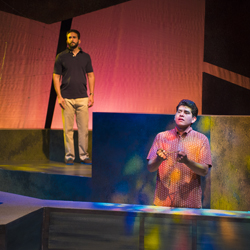
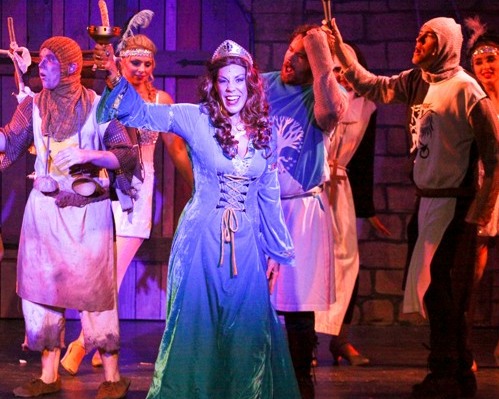
Guenevere (Monique Hafen) in Camelot at SF Playhouse

Artistic Director Bill English and Producing Director Susi Damilano bring a triumphant conclusion to their 10th season now in their new venue with an award-winning cast for Camelot (1960) by Alan J. Lerner (book and lyrics) and Frederick Loewe (music), directed by Bill English together with Music Director Dave Dobrusky.

The Camelot cast features four award-winning actors, Wilson Jermaine Heredia as Lancelot who won a Tony Award for his performance on Broadway in Rent; and Johnny Moreno (Arthur), Monique Hafen (Guenevere) and Charles Dean (Merlin/Pelinore) – all three winners of BATCC for Best Actors in a Musical for last summer’s SF Playhouse hit, My Fair Lady.

The SF Playhouse Director Bill English has chosen to push Camelot into the dark ages before the time of shining armor, when Europe was deeply buried in the ignorance and fear of the dark ages when Arthur’s ideas of justice and democracy were truly revolutionary.  Camelot is the timeless and powerful love triangle between the legendary King Arthur, his Queen Guenevere and his best friend, Lancelot in a much grittier version than earlier productions.

The cast and direction of Camelot are uniformly professional.  Nina Ball’s set is a masterpiece with effective use of moving set pieces on a revolving stage and a cyclorama that creates a feeling of a magical kingdom.  Abra Berman’s costumes are both impressive and imaginative.  Battles which were written to be peformed offstage now occur onstage and Miguel Martinez’s fight choreography is cleverly staged. Under his outstanding leadership, Bill English chalks up another success with Camelot equal to last year’s My Fair Lady.

Camelot runs at SF Playhouse July 16-September 14, 2013. Performances are Tuesday-Thursday at 7 p.m.; Friday-Saturday at 8 p.m.; and Saturday at 3 p.m. SF Playhouse is located at 450 Post Street (2nd Floor of Kensington Park Hotel b/n Powell and Mason), San Francisco. For tickets, call 415-677-9596 or go online at www.sfplayhouse.org.

Coming up next at SF Playhouse will be the World Premiere Sandbox Series featuring Grounded by George Brant and directed by Susannah Martin and starring Lauren English, August 15-September 7, 2013 at the A.C.T. Costume Shop, 1119 Market Street (at 7th St.), San Francisco. Performances will be Thursday-Saturday at 8 p.m. For tickets, call 415-677-9596 or go online at www.sfplayhouse.org.

Flora Lynn Isaacson


Solo storyteller adds actress, band — and still is funny

By Woody Weingarten

Josh Kornbluth emotes about his childhood, egged on by Amy Resnick. Photo: Heather McAlister.


Josh Kornbluth’s been making me laugh aloud for more than 20 years.

But he is changing.

In 1992, he was a bald, bespectacled chubby monologist in his 30s whose intelligence and offbeat sense of humor tickled me.

And made me think.

Today, he’s a bald, bespectacled chubby guy whose intelligence and offbeat sense of humor tickles me. And makes me think.

But he’s 54, graying at the temples.

And, in a colossal departure from his string of one-man shows, he leans on actress Amy Resnick (who does mock French and Valley Girl accents and uses a huge shawl to convert herself into God) and a four-piece band.

It’s easy to see, though, that Kornbluth’s new material at the Ashby Stage in Berkeley is infinitely more mature than previous introspections, interweaving themes without the scruffy seams he used to display.

“Sea of Reeds,” like its title, is multi-layered.

It’s a 90-minute-plus comedy that sporadically reveals Kornbluth’s earnestness and complexity — and leads playgoers to what promotional materials alternately call “the Promised Land of paradox” and “a story of faith and procrastination.”

It’s his latest exercise in cerebral self-pleasuring.

Yet his storytelling skills make it impossible not to enjoy the impressive flip side — his thorny wit.

The writer-performer draws chortles from unlikely places: having his violin ripped off by a Jewish/Hispanic street gang, childhood Red Christmases (his folks having been devotees of Marx — Karl more than Groucho), Exodus (the Bible book, not the Leon Uris novel) and the Dead Sea (“a good place to visit if you’re a scroll”).

He draws his biggest LOLs, however, from a risqué, slapstick oboe lesson designed by a spellbinding young temptress at camp, Monique.

Conversely, he bemoans his youthful inability to make a “leap of faith” off a diving board at an amusement park in suburban New Yawk.

The lifelong atheist segues into his decision to have an adult bar mitzvah two years ago in Israel atop a water tower in the desert — an outgrowth of an idea nurtured by his rabbi-friend, Menachem Creditor of Berkeley’s Congregation Netivot Shalom.

That mentor had paved the way for Kornbluth to reconcile his Communist upbringing with his cultural Jewishness by defining God with a catchall phrase, “the collective potential of the human imagination.”

But despite Hebrew terms and phrases being translated immediately, almost as if they were in parentheses, “Sea of Reeds” may be too sectarian for non-Jews.

And too Jewish for many Jews.

Some may flinch, too, when he dismembers his designated Torah portion, utilizing exaggerated body motions and fiery word-pictures to depict its violence and murder.

For those willing to remain open, his twin searches — for proficiency with his instrument and for faith — will make it all worthwhile.

Kornbluth, a Princeton dropout who’s been labeled “Berkeley’s favorite intellectual and provocateur” and who formerly stressed being a luckless bumbler, indicates his director and friend, David Dower has helped him grow — while structuring the chaos of the comedian-playwright’s improvisations.

“Sea of Reeds” was commissioned by the Shotgun Players, which co-produced the show with Jonathan Reinis (who just won a Tony for the Broadway revival of “Pippin”). Like Kornbluth’s previous efforts, it superimposes silliness onto soul-searching.

I’ve seen almost all his creations.

I became something of an addict-stalker after his first big stage hit, “Red Diaper Baby,” where I first noticed his addiction to red socks (shades of Garrison Keillor).

“Haiku Tunnel,” about being an incompetent legal assistant, solidified my high regard.

So did “Love & Taxes,” about the fiscal implications of not reporting royalties to the IRS, and “Ben Franklin Unplugged,” about his affinity for the historical figure he resembles.

In “Sea of Reeds,” Kornbluth uses an especially piquant line: ‘This is how rabbis roll.”

Well, this stretch is how he rolls these days — and I applaud it. Again he’s made me cogitate all sorts of stuff. And I still find him funny.

“Sea of Reeds” runs at the Ashby Stage, 1901 Ashby St., Berkeley, through Aug. 18. Show times, 7 p.m. Wednesdays and Thursdays; 8 p.m. Fridays and Saturdays, 5 p.m. Sundays. Tickets: $20 to $35. Information: (510) 841-6500 or www.shotgunplayers.org.

Symphony offers potpourri of pleasure, future goodies

By Woody Weingarten

Kenny Loggins

Jessye Norman


I have a couple of highbrow friends who braved all four parts of Wagner’s Ring cycle a while back in San Francisco.

And then they had the stamina to sit through the whole thing again in Manhattan.

Frankly, I wouldn’t endure that on a bet.

I also know some lowbrow folks who’ve been on pins and needles waiting for the next “American Idol” or “Keeping Up with the Kardashians” reality show.

Not my druthers.

On the third hand, I and my middlebrow colleagues agree we’ll attend carefully selected symphony, ballet and opera events, Shakespearean festivals, art-museum openings and the like, as well as pop this ‘n’ that — and, as a rule, thoroughly enjoy our cherry-picking.

Which brings me to the San Francisco Symphony and its recent variegated concert in tribute to John Goldman, who has relinquished the symphony’s presidency after 11 years.  

Pieces by Ravel, Tchaikovsky, Rachmaninoff, Gershwin, Stephen Schwartz and Rodgers and Hammerstein, and guest performers Jean-Yves Thibaudet, Gil Shaham, Lisa Vroman and Kenny Loggins (in a “surprise” appearance) have all ranked among Goldman’s favorites.

The result? A potpourri of pleasure.

Said he to an appreciative audience, “You can tell I have eclectic tastes — some would call it weird.”

But it wasn’t a weird night at all, merely another extraordinary one.

Many uncommon nights can be expected in the near future — such as an orchestra-less concert with Jessye Norman Aug. 9 at Davies Symphony Hall in San Francisco.

She’ll sing a collection of songs, in the first half, by George Gershwin, Harold Arlen, Rodgers and Hammerstein, Kurt Well, Leonard Bernstein and Duke Ellington. After intermission, she’ll perform homages to Nina Simone, Lena Horne, Odetta and Ella Fitzgerald.

The soprano, who’ll be backed by pianist Mark Markham, rescheduled from July 31 because she wanted to sing instead at a U.S. Congress ceremony for the 50th anniversary of the March on Washington.

Other future San Francisco Symphony goodies will include “Disney in Concert: Magical Music from the Movies,” a Sunday afternoon pops event July 28; a “Jerry Garcia Symphonic Celebration” featuring Allman Brothers and Gov’t Mule vocalist/guitarist Warren Haynes; and the new season’s “Opening Night Gala” with Audra McDonald on Sept. 3.

The night of the Goldman tribute, Michael Tilson Thomas led the orchestra. Brilliantly. And the guest artists radiated talent as they played and sang.

The truth is, MTT and the SFS provide the extraordinary so often it’s become what’s anticipated. Certainly it’s what I always expect.

One glance at the diverse pops-loving folks jamming Davies — many decked out, some in chinos and jeans — proved the musicians had collectively fashioned one thing this balmy June evening: Fun.

That was especially palpable in the final piece of the evening, which found Tilson Thomas trying “to bring all these musical worlds together” as the symphony intermingled passages from Beethoven’s 5th with Loggins’ vigorous vocal of Chuck Berry’s 1956 rhythm ‘n’ blues smash, “Roll Over Beethoven.”

The pop hit’s lyrics, ironically, suggest R&B should replace classical music, a concept the Davies crowd would never accept.

Loggins also drew untamed applause when he performed the raucous “Everything’s Gonna Be Alright” and the more pensive “Return to Pooh Corner.”

But the crowd was equally delighted with classical strains.

My own favorite was the excerpts from Ravel’s “Piano Concerto in G major,” with Jean-Yves Thibaudet displaying finger gymnastics with both soft and percussive segments.

Gil Shaham’s violin skills headed my wife’s list. His mastery of Tchaikovsky’s finale from “Violin Concerto in D major, Opus 35” was immediately clear, his confidence in full evidence as he fiercely stroked his instrument.

Lisa Vroman, a Broadway veteran with a striking voice, drew the biggest laughs with her rendition of “Honey Bun,” from Rodgers and Hammerstein’s “South Pacific” — her high-stepping and white sailor suit comically augmented by a chunky male accomplice in fright wig, grass skirt, mock-coconut bra and spats.

Vroman also delivered a couple of Schwartz tunes from his score of “Wicked,” with resident conductor Donato Cabrera on the podium, following her quick-change into a shimmering turquoise gown.

MTT, as is customary, was at the top of his game, whether leading the finale from Rachmaninoff’s “Symphony No. 2 in E minor, Opus 27” or Gershwin’s sprightly “Walking the Dog.”

Tilson Thomas drew chuckles when he dedicated the latter to concertgoers who have dogs and then added he wasn’t ignoring “those of you who have lemurs — we love them, too.”

Speaking of pooches, I spied two: a small Spaniel service dog on a leash inside the theater, and a smaller Chihuahua in the arms of a homeless woman beggar just outside.

Were there any hiccup in the concert itself, it came when the nearly 100-member strong San Francisco Symphony Chorus, under the leadership of Ragnar Bohlin, presented excerpts from the soundtrack of “2001: A Space Odyssey” — that is to say, György Ligeti’s “Lux aeterna.”

That piece — though exquisitely performed — is definitely weird. To me, it emphasizes eeriness and what seems like hollow, metallic echoes.

Before the event, The Martini Brothers entertained in the lobby with dance tunes. Eight or nine couples gleefully strutted their stuff as many onlookers stared — and one wag talked about taking what she called “a tour of some of the finest facial surgery in the Bay Area.”

San Francisco Symphony concerts take place at Davies Hall, Grove Street (between Van Ness and Franklin), San Francisco. Information and tickets: (415) 864-6400 or www.sfsymphony.org.

Kyd’s Play Strictly for Grownups

By Joe Cillo

Celebrating its “four-and-twentieth” season, Marin Shakespeare Company has reached even farther into theatrical history and come up with a pre-Shakespearean hit, Thomas Kyd’s “The Spanish Tragedy.”
Kyd’s play was packing playhouses by the time Shakespeare arrived in London, and “Spanish Tragedy” was revived over and over, even after The Bard began producing his own work. He certainly would have seen it at least once, and dramatic evidence suggests he borrowed from it here and there.
Shakespeare’s “Hamlet,” for instance, is rooted in the young prince’s vow to avenge his father’s death, a vow inspired by the father’s angry ghost. In “The “Spanish Tragedy,” it is the father who’s bent on getting revenge for his murdered son. Revenge is a character that lingers onstage in company with the ghost of another murder victim. (Revenge looks and sounds not at all as you might expect.)
The ghost’s former love — now a bereaved young woman — could almost stand in for Ophelia, and “Tragedy’s” smarmy, sneaky young nobleman could double for Iago, the villain in “Othello.” To top off the resemblances, Kyd even scripted a play-within-a-play as payback for the guilty parties, and as in Shakespearean plays to follow, the bodies begin to pile up.
Director Leslie Schisgall Currier has revived this gory old favorite, set it in a multi-level castle and cut it down to a manageable two hours and forty minutes’ playing time. The action begins with a tolling bell and a long funeral march of white-masked mourners. The deceased follows the march, describing the foul deeds that have made him a ghost. Ghost stays visible throughout the play, accompanied by Revenge.
The Duke of Castille, the King’s brother, describes the battle and shows off its most famous prisoner, Balthazar, Prince of Portugal. Horatio has helped apprehend him, though the Duke’s son, Lorenzo, claims that he was the real nabber. Lorenzo’s sister, Bellimperia, captures Balthazar’s attention, and in no time, speculations begin that a marriage between the two would cement peace between their nations. The young lady, however, had been the sweetheart of Don Andrea, now the Ghost pacing the battlements. She is not available, though her servant vows that the lady’s affections have recently turned to Horatio. This information enrages Balthazar; Horatio’s too much in his way.
But despite all the royalty represented onstage, the most complex character in “The Spanish Tragedy” is the judge, Hieronimo. When he finds his beloved son murdered, Hieronomo’s reaction is similar to King Lear’s over the corpse of his daughter, Cordelia. Justice now equals revenge.
In this large, outdoor performance space, trained voices enhance the show. Julian Lopez-Morillas is superb as Hieronomo, commanding the stage with a big voice and big emotions. Scott Coopwood, as the Duke of Castille has a similar presence, as does Jack Powell as the Viceroy of Portugal. Both Elena Wright in the role of Bellimperia and Jessica Powell as Hieronimo’s wife, Isabella, have roles with heavy vocal demands. Erik Johnson plays the ill-fated Horatio, and in three widely varying roles, Steve Price, who grew up on the Peninsula, portrays a Portuguese nobleman, a petitioner and a hangman. In a last-minute substitution on opening night, Liam Hughes took over the role of Balthazar. Twenty-five additional cast members round out this generously-sized production.
“The Spanish Tragedy” will play at the Forest Meadows Amphitheatre on the Dominican University campus until August 11 and in repertory with “A Comedy of Errors” after July 27. Friday, Saturday and Sunday evening performances are at 8 PM, with Sunday matinees at 4 PM. For tickets, directions and more information, call 499-4488.
As with all outdoor performances, dress for the weather and bring extra layers as the theatre gets cooler after dark. Picnics are welcome.

DAMN YANKEES hits a three-bagger at Foothill Summer Musicals

By Kedar K. Adour

Washington Senators coach “Van Buren” (left, Richard Lewis) with the Washington Senators in DAMN YANKEES at Foothill Music Theatre,
playing July 26 – Aug 18, 2013 in the  Smithwick Theatre, Foothill College. Photo by David Allen

DAMN YANKEES: Musical.  Book by George Abbott and Douglass Wallop.  Music and lyrics by Richard Adler and Jerry Ross and based on the novel “The Year the Yankees Lost the Pennant” by Douglass Wallop.  Directed by Tom Gough.  Foothill Music Theatre and the Foothill College Theatre Arts Department.  Smithwick Theatre,  Foothill College 12345 El Monte Road, Los Altos Hills, CA 94022.  650-949-7360 or  www.foothillmusicals.com .   Through August 18, 2013.

DAMN YANKEES hits a three-bagger at Foothill Summer Musicals

Last year the era of Jay Manley summer musicals at Foothill College came to a close as he moved on to helm the Mountain Musical and other venues.  His departure left a gap. With this year’s production of Damn Yankees, using a baseball term, that gap has been ably filled by experienced director Tom Gough assisted by a talented artistic and technical staff.

Damn Yankees is a fun show that ran for over 1000 performances on Broadway in 1955. In the intervening years it has had many professional mountings and has become a mainstay for local theatres around the country.  It has a breezy dynamic script with rousing songs interspersed with love ballads; vivacious Bob Fosse directed dance numbers and a plethora of humor. In the original production Ray Walston as “Mr. Applegate” and Gwen Verdon as “Lola” put their individual stamp on their roles and the show went on to win seven Tony Awards.

The story is fantasy fun with a delightful twist on the Faust legend. Aging baseball fanatic Joe Boyd (fine baritone Matt Tipton) is upset that his favorite team, the Washington Senators, is not in contention to win their division that includes the hated (Damn) Yankees. His avid addiction is verified when faithful wife Meg (Mary Melnick) and the ensemble sing “Six Months Out of Every Year” to throw in the first pitch to start the evening. What would Joe do to have his team win the pennant? He sells his soul to the devil Mr. Applegate (Jeff Clarke) and becomes a star all-around player Joe Hardy (Daniel Mitchell).  Apple gate, against his better judgment gives Joe an opt-out clause. Old Joe and young Joe sing a charming duet “Goodbye Old Girl” to Meg before a quick scene change to the baseball locker room.

If you don’t have the ability of being a top notch team what do you need? You need “Heart” and full bodied manager Benny Van Buren (absolutely perfect Richard Lewis) leads the male ensemble making them believers. They become more believing when Joe Hardy enters hitting the practice balls out of the park.   Contentious news reporter Gloria Thorpe (professional voiced Caitlin Lawrence-Papp) labels Joe as “Shoeless Joe from Hannibal, MO.”  And the Senators are off to the races climbing toward first place.

Hey there has got to be conflict and that shows up after Joe reflects in song “A Man Doesn’t Know” what he has until he’s lost it.  Applegate summons up the 150 year old Lola (Jen Wheatonfox) who was the ugliest girl in Rhode Island and has sold her soul for sexual beauty. With her powers of “A Little Brains, A Little Talent” (with an emphasis on the latter) she takes on the job of seducing our hero Joe Hardy singing and dancing “Whatever Lola Wants.”

The first act ends with the rousing dance by Lola and Dance Corps giving their all in “Who’s Got the Pain?”

It is a long first act with a 20 minute intermission before the ballplayers return for another hilarious ensemble number “The Game.”  Jeff Clarke nails his irreverent solo number “Those Were the Good Old Days” backed up by the ensemble dancers in front of a flaming red silk backdrop. Shortly after the applause dies down choreographer Katie O’Brien gets to show her ability using classic Fosse dance moves in the stunning production number “Two Lost Souls.”

The production numbers interspersed throughout the story are classic musical comedy fare and director Gough keeps the action moving

The devil Mr. Applegate (Jeff Clarke) calls in his sexy siren Lola (Jen Wheatonfox)

despite some technical glitches that include problems with the amplification. Daniel Mitchell with the physical appearance and strong tenor voice is almost perfect for the part of Joe Hardy. Wheatonfox is beautiful, has a grand interpretive soprano voice, but lacks the physical stature and dancing ability to carry-off the demanding role of Lola. She is further undercut by atrocious costumes (Janis Bergmann). For this reason, Damn Yankee’s just misses a home run. Running time 2 hours and 40 minutes including the intermission.

Kedar K. Adour, MD

Courtesy of www.theatreinternetmagazine.com


National Theatre, London & Punchdrunk

By Jo Tomalin
Above: Laure Bachelot (Mary). Photo by Pari

Review by Jo Tomalin

Laure Bachelot (Mary) and Omar Gordon (William).
Photo by Pari

  The Drowned Man: A Hollywood Fable – London’s Cult Hit

The Drowned Man: A Hollywood Fable is the latest cult hit sweeping London. This creative play is co-produced by the award-winning Punchdrunk, a company known for its immersive theatre, and Britain’s renowned world-class National Theatre. Directed by Felix Barrett and Maxine Doyle, the run started in June 2013, gathered momentum fast and will continue to the end of December, 2013, so you can still catch it if you visit London.

Inspired by Büchner’s fractured masterpiece Woyzeck, the story follows a couple (Wendy and Marshall)  through their imagination of a desolate Hollywood movie set in the Temple Studios, located near Paddington Station.

Fionn Cox-Davies (Marshall) and Sophie Bortolussi (Wendy).
Photo by Pari

This is a promenade performance where the audience is part of the event walking around as actors appear in fleeting moments of dramatic emotion and disappear just as fast. What is different in this production is that every audience member has to wear a gray Venetian style mask throughout the two to three hour evening – only permitted to take it off as they enter the bar for a break or when they exit the studios. This is unusual and it not only makes a natural separation between the actors playing characters, but it also looks eerily daunting as you look out at the sea of masked faces watching emotive scenes voyeuristically.

Jane Leaney (Dolores Grey).
Photo by Pari

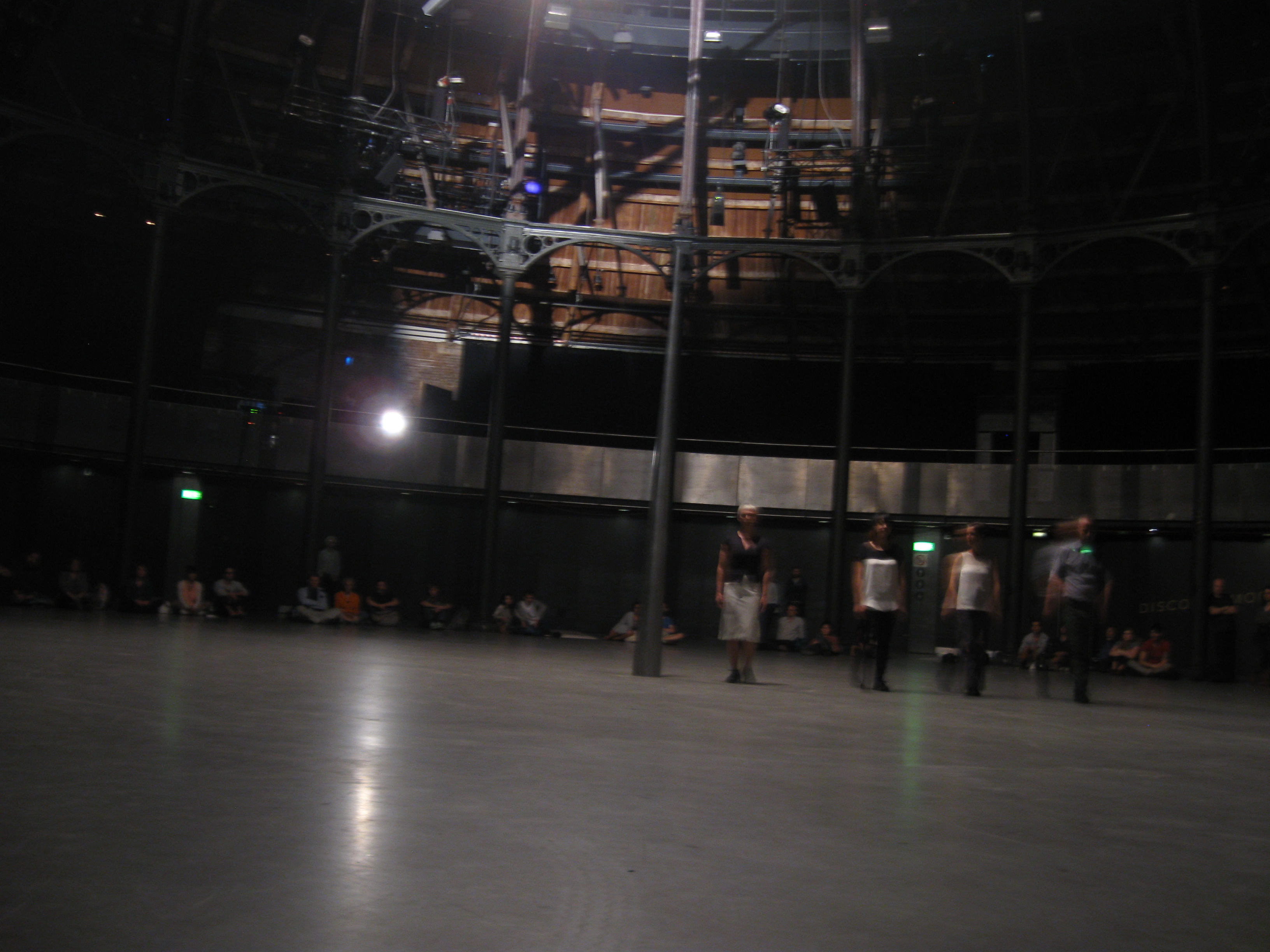
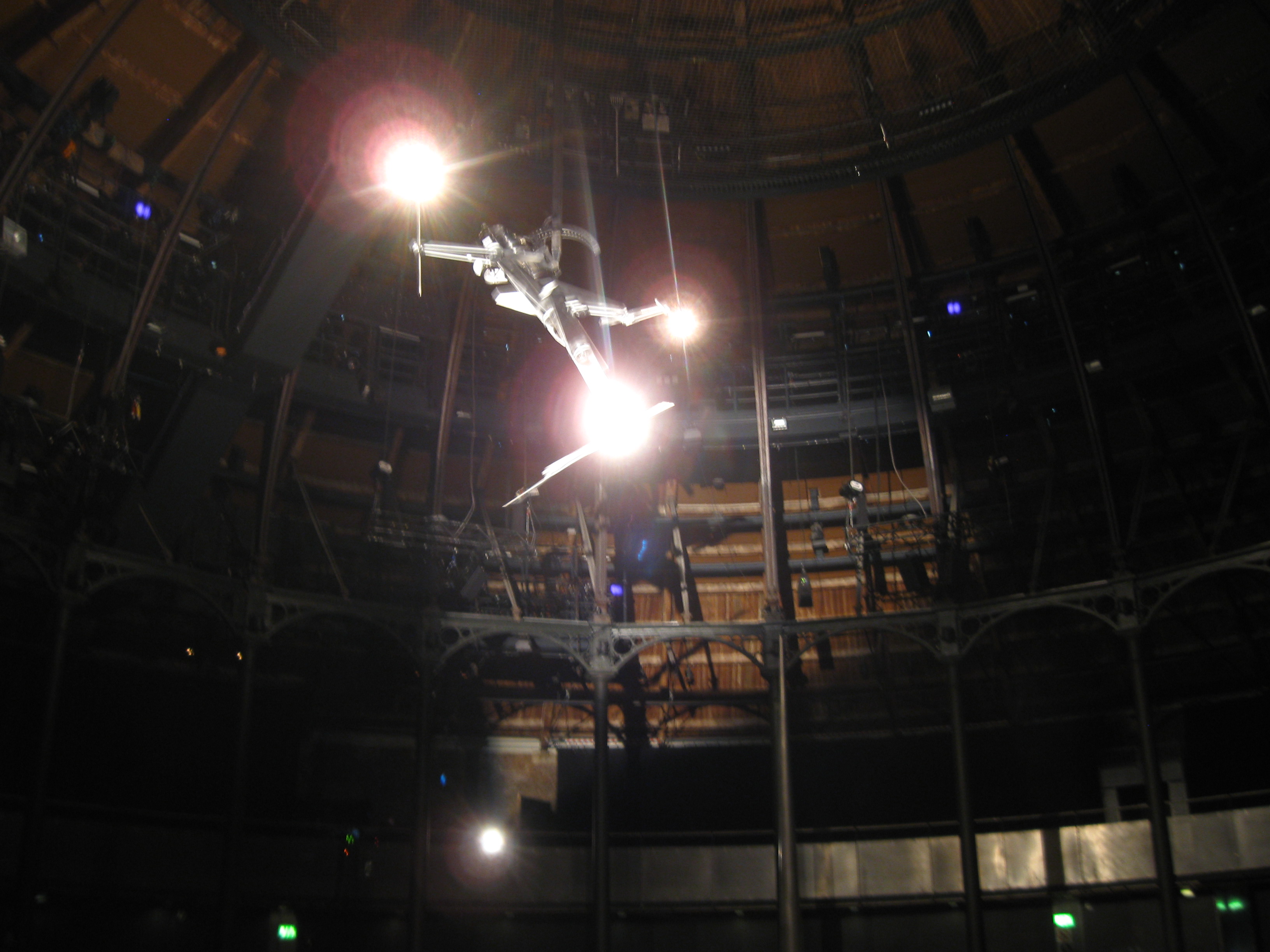
Punchdrunk’s Temple Studios inhabit four immense floors of a now disused warehouse in Paddington. Each floor is a vast set that transcends into a netherworld-like environment that engulfs, surprises, jolts and excites. The lower floors are more like abstract art installations with eerie lighting design by Mike Gunning, vibrant pulsating soundscapes by Magnus Fiennes and Stephen Dobbie, and various objets and materials. Walking through the many doors, alleys then crossing large dark expanses on the lower levels is unnerving at first, yet the upper floors are full of remarkably designed and derelect movie sets to explore. Throughout the floors of Temple Studios the large cast of multi-talented actors are living their characters’ visceral, mortal moments on these retro movie sets, beautifully costumed by Jack Galloway.

Among the painstakingly detailed sets designed by Livi Vaughan and Beatrice Minns are small airstream shape caravans/actor trailers, abandoned production offices, a costumer’s studio with an unhappy actress, memorabilia, seedy motel rooms, a barber shop, a café, a bar with a male singer in sequined drag, a chapel, and a desert.

Sophie Bortolussi (Wendy).
Photo by Pari

While there is no set schedule of scenes to see, the deal is to be free to explore at will – alone – “to make your own movie” and when you find a character or two, observe and follow to see what they do next – or not. Most of the excellent fine tuned action is silent, physical or danced (choreography by Maxine Doyle), peppered with a rare song or spoken dialogue.

As the audience wanders around they may witness a happy couple, a visceral love triangle, deceit, sadness and more – however, the evening ends on an exhilarating tone with a clever twist.

This production is unique and brilliant. The moments experienced by participants often stay for days – but do not expect a linear story. In fact, if you go forget all of this, take the advice of Felix Barrett, Punchdrunk’s founder and separate from your friends to discover your own movie.

Don’t project or expect what may happen – or you will be disappointed. Just go and be, explore, enter every door – and like the actors at Temple Studios, live in the moment.


More information:

Trailer: The Drowned Man: A Hollywood Fable
http://www.youtube.com/watch?v=DZKNNMombV8

Punchdrunk Company: http://punchdrunk.com

National Theatre, London: http://www.nationaltheatre.org.uk/


Jo Tomalin Reviews: Dance & Theatre Performances

Jo Tomalin, Ph.D.
More Reviews by Jo Tomalin
TWITTER @JoTomalin

50 SHADES! The Musical redefines the three Rs.

By Kedar K. Adour

ADDED NOTE:  Kendell Hinds replaces Victor Sho for this performance and the following week.

50 SHADES! THE MUSICAL (The Original Parody of the “50 Shades of Grey” phenomenon). Marines’ Memorial Theatre, 609 Sutter Street, San Francisco, CA. For tickets visit www.shnsf.com or call SHN Audience Services at 888-746-1799.

Plays through July 28,2013 with ADDED PERFORMANCES due to popular demand Saturdays at 3 p.m. and Sundays at 6:30 p.m.

50 SHADES! The Musical redefines the three Rs.

In the days of one room school houses (meaning gentler times) the three Rs refer to Reading, (w)Righting and (a)Rithmatic.  For the three Rs to describe the musical 50 Shades! The Musical you must use Raunchy, Risqué and Ribald and for good measure you could add Trashy and Tacky. The dialog, songs and dances fit all those adjectives but the uproarious response of the opening night audience suggests it is wonderful. All the seats remained filled after the intermission.

The show is a parody of the novel “50 Shades of Grey” written by E. L. James that describes in explicit detail BDSM (Bondage, Dominance, Sadism and Masochism) practices through the exploits of Christian Grey (Chris Grace), a rich, handsome well hung tycoon, and Anastasia Steele (Amber Nicole Petty), an innocent virginal college student. Whips, chains and handcuffs play a prominent role in their dominant-submissive relationship.

In this parody the whips, chains and handcuffs are all there but Christian in this show a rotund, short Asian with a wicked sense of timing, a great singing voice but the red spandex wrestling outfit reveals less than gigantic private parts. A cod piece would have helped but that would have diluted the parody?

It all begins with a trio of women (Jessica Kemock, Emily Eden and Spencer Rose) at their book club meeting finally deciding ton review “50 Shades of Grey.” As they discuss passages from the book the characters come to life in song and dance. The nine member cast, with the exception of Christian and Anastasia double in other roles. One of the funniest is Nick Semar as Jose the sexy and persistent Mexican who is hot for Anastasia’s body.  The dance group of Matthew Nolan, Caroline Reade and Victor Sho do not have much to do but they do it with energy. They are the ‘eye candy’ with beautiful bodies especially Reade as the “Inner Goddess” dominatrix, bare chested Kendell Hinds (replacing Nigerian Victor Sho for one week) with six-pack abs and tall handsome ladies’ man Mathew Nolan.

The lyrics are bawdy and delicious with the music being played by an onstage three piece band of electric-piano, guitar and drums. The song titles are only partially suggestive of their “mommy porn” but you will get the idea what they convey especially “There is a Hole in Me” (that has to be filled), “Red Room of Pain” and “How Much Can I Take?” Not content with parody of ‘the’ book, the authors also take swipes at “Phantom of the Opera” (“Follow Me Into the Night) and “Le Miz” (“50 Shades”).

The finale combining “How Much Can I Take” and “Hole Inside of Me” and riotous curtain call led to an uproar of appreciation from the audience. All this compressed into  90 minutes including the 15 minute intermission to allow the audience to visit the refreshment bar and point out to each other this point or that just in case they missed the innuendos. Actually innuendos were few and far between with in-your-face dialog and lyrics.

It may not be for the couple from Des Moines or the residents of San Francisco Retirement Home but the denizens of San Francisco will flock to the show.Kedar K. Adour, MD

Courtesy of www.theatreworldinternetmagazine.com.

Raunchy spoof of ’50 Shades of Grey’ vibrates with laughs

By Woody Weingarten


Their fantasies come alive as three female book club members scrutinize “50 Shades.” Photo: Clifford Roles.

Seconds after the musical comedy’s second tune ignited, I was positive I wasn’t the show’s target demographic.

I was decades too ancient and absolutely the wrong gender to get off on the sophomoric parody, “50 Shades! The Musical!”

Clearly I wasn’t a 20- or 30-something woman with a hyperactive libido given to shrieks of joy and raucous laughter at the less than subtle, salacious lyrics and text of the cartoonish show.

(I’d pre-assessed what was ahead by seeing a theater crowd unusual for San Francisco: heterosexual, mostly female.)

To make matters worse, I hadn’t read Word One of the runaway best-selling E L James novel, “Fifty Shades of Grey,” which the production was burlesquing.

Yet, despite my apparent mismatch with both characters and audience, I found the show funny more often than not.The book  — 32 million copies sold in the United States, and counting — and its two sequels center on sexual novice Anastasia Steele’s erogenous explorations with super-wealthy Christian Grey, a “beautiful, brilliant and intimidating” man “tormented by demons and consumed by the need to control.”

“50 Shades! The Musical!” — written in effect by a “committee” of half a dozen men and women — focuses on what three ladies reading the first novel fantasize about.

It’s somewhat more than a revue, less than a full-blown musical.And considering that the concoction is aimed at the so-called weaker sex, it’s surprising comic Chris Grace, as a pot-bellied Grey, steals the show through exaggerated gestures and body movements (and an over-the-top rendition of “I Don’t Make Love”).

Amber Petty, as the virginal Anastasia Steele, and seven others ably reinforce his labors.

(Petty, not incidentally, can hold a note with the best of ‘em, and draws thunderous applause early on for “There’s a Hole Inside of Me.”)

Director Al Samuels deserves major plaudits for successfully integrating tons of slapstick with outrageous mock-eroticism.

Choreographers Joanna Greer and Brad Landers merit praise as well, their spoofs being the antithesis of what theatergoers normally expect.A robust three-piece band, featuring musical director/pianist Dan Reitz, bassist Christopher Ditton and drummer Douglas Levin, keeps everything amped up.No one gets credit for the set, and that’s a good thing because there really isn’t one — a makeshift couch and end table are basically it.

The opening night audience was oddly noisy before the show, but quickly channeled their energy into hoots, hollers and howls — and frequent laughter. But the musical presented me with a problem because of what goes on (simulated, ad infinitum sex acts and voluminous use of vulgar language).It leaves me with nothing to quote.

Promotional materials insist the musical “is not for those under the age of 19, but does not cross boundaries that would make general audiences squirm.”

I didn’t see anyone squirming, cringing or leaving the theater.

But one befuddled male could be heard to comment, “I don’t get it. It’s midway between pure raunchiness and pure porno.”A movie based on the book will be released in about a year. That guy may skip it.

But hordes of women most likely will turn it into a box-office smash.

“50 Shades! The Musical” runs at the Marines’ Memorial Theatre, 609 Sutter St., San Francisco, through July 28. Performances: Wednesday and Thursday, 8 p.m.; Friday and Saturday, 6:30 and 9:30 p.m.; Sunday, 6:30 p.m. Matinees, Saturday and Sunday, 3 p.m. Tickets: $30 to $65, (888) 746-1799 or www.shnsf.com. Info: www.50ShadesMusical.com.

Swimming Through Life Together—The Dixie Swim Club at RVP

By Flora Lynn Isaacson

Flora Lynn [rating:5] (5/5 stars)

Jayme Catalano as Jeri Neal, Pamela Ciochetti as Dinah, Stephanie Ahlberg as Sheree, Hilda Roe as Lexie in The Dixie Swim Club

For their sixth and final production of the 2012-2013 season, Ross Valley Players presents The Dixie Swim Club, a comedy about friendship between women that lasts a lifetime. The play was written by Jessie Jones, Nicholas Hope and Jamie Wooten, (the writer and producer for many seasons for “The Golden Girls”) and is directed by long time RVP member, Linda Dunn.

The Dixie Swim Club tells the story of five southern women whose friendship began many years ago on their high school swim team.  Every August, they get together for a long weekend to renew those relationships.  Free from husbands, kids and jobs, they meet at the same beach cottage on North Carolina’s Outer Banks to do what girlfriends do best—laugh, gossip and snoop into each other’s lives.  The story focuses on four of those weekends spanning 33 years.

The characters include Sheree (Stephanie Saunders Ahlberg), the spunky team captain; Dinah (Pamela Ciochetti), the wisecracking over achiever; Lexie (Hilda L. Roe), a pampered, outspoken southern belle determined to hold onto her looks and youth as long as possible—she appears with a different style hairdo every time we see her and she enjoys being married over and over again; the self deprecating and bitter Vernadette (Floriana Alessandria) who brings down the house with laughter at each appearance; and finally, Jeri Neal (Jayme Catalano), the naïve, eager to please member whose change in direction takes the group by surprise early on in the play.

Linda Dunn, serving as director, strikes the perfect tone with The Dixie Swim Club giving each cast member the freedom to relax a little bit on stage and truly realize the character they are playing.

The audience will enjoy eavesdropping on these unforgettable women as they advance in years and seeing how the friendship evolves. The Dixie Swim Club runs July 19-August 18, 2013, Thursday at 7:30 p.m.; Friday-Saturday at 8 p.m. and Sunday matinees at 2 p.m. All performances take place at the Barn Theatre, home of the Ross Valley Players, 30 Sir Francis Drake Blvd., Ross. Buy tickets online at rossvalleyplayers.com or call 415-456-9555.

Coming up next at Ross Valley Players to begin their 84th season will be Chapter Two by Neil Simon and directed by James Nelson, September 13-October 13, 2013.

Flora Lynn Isaacson


CAMELOT rides into San Francisco on Harley motorcycles!

By Kedar K. Adour

Kedar [rating:5] (5/5 stars)

Lancelot (Wilson Jermaine Heredia*), King Arthur (Johnny Moreno*) and Guenevere (Monique Hafen*) at Knighting Ceremony Photos by Jessica Palopoli.

CAMELOT: Musical. Book and lyrics by Alan Jay Lerner.Music by Frederick Loewe. Based on “Once and Future King” by T.H. White. Directed by Bill English. Music director Dave Dobrusky. July 16 – September 14, 2013.

CAMELOT rides into San Francisco on Harley motorcycles!

We aficionados (with synonyms of connoisseurs, devotees, enthusiasts, fanatics) of the SF Playhouse are mostly inured to seeing volatile productions of the under-belly of society parade the boards of their theatre. They have done it again with an ‘in your face’ staging of the musical Camelot. If any of their productions can be summarized with Harold Ross’s 1925 quote from “The New Yorker”, “It has announced that it is not edited [produced] for the old lady in Dubuque” , this staging of the once (and hopefully future) uplifting King Arthur/Round Table/Camelot story is it.

Last year Bill English’s re-imagination of My Fair Lady at their former intimate Sutter Street Theatre was a success and played to substantial crowds throughout the summer. It seems that the “summer musical” has become a standard for SF Playhouse to catch the vacation crowds that swarm San Francisco. This year they are in the substantially larger venue (up from 99 to 265 seats) that has a huge stage with a plethora of technical equipment. For Camelot Nina Ball has created a massive set using two or three turntables, an integrated rear stage screen for impressive projects and to hide the (count them) eight piece orchestra under SF favorite Dave Dobrusky. The well-known and acclaimed title of Camelot will surely attract crowds.

Those crowds will be overwhelmed with the colossal staging but they will not be humming the charming tunes associated with the musical but rather be shaking their heads as many were on opening night. Although there was appreciative applause at the curtain, the usual spontaneous standing ovation was absent.

Wilson Jermaine Heredia* as Lancelot prepares to battle knights

It was absent for good reason despite a spectacular performance by Wilson Jermaine Heredia as Lancelot. Heredia is a Tony and Oliver Award winner for his role as Angel in the Broadway and London productions of Rent.  Director English, using some of  his own words, has created knights in the mold of grungy (costumes by Abra Berman) bikers (Ken Brill, Rudy Guerrero, Robert Moreno, George P. Scott), Guenevere (Monique Hafen) as an angry Goth princess, King Arthur (Johnny Moreno) as a day-dreaming dolt and Mordred as a potential to play Richard III. Charles Dean a Bay Area favorite who brought the house down with his role as Doolittle in My Fair Lady is cast as both the magician Merlyn and Arthur’s confidant Pelinore.  Sadly, the only distinction in those characterizations is a change of costume.

There is much to like about this twisted version of what should be a romantic escapist evening that includes excellent singing voices (with exception of Johnny Moreno’s limited range), eye-catching projections, energetic acting and exuberant fight scenes staged by Heredia. The marvelous score and lyrics are still enchanting and include “Camelot”, “Follow Me”, “The lusty Month of May”, “How to Handle a Woman”, “Before I gaze at You Again”, “If Ever I Should Leave You”,  and “I loved You Once In Silence.”

Running time 2 hours and 40 minutes including the intermission.

Kedar K. Adour, MD

Courtesy of  www.theatreworldinternetmagaine.com