A WINTER’S TALE a ‘double header’ at CalShakes

By Kedar K. Adour

A WINTER’S TALE by William Shakespeare. Directed by Patricia McGregor. CalShakes, Bruns Amphitheater, 100 California Shakespeare Theater Way, Orinda. (510) 548-9666. www.calshakes.org.

September 25 –October 20, 2013

A WINTER’S TALE a ‘double header’ at CalShakes

When was the last time you saw a Shakespearean play produced as it was written?  Difficult question to answer? In modern times the Bard’s plays have tread the boards as “concept” performances and those concept performances have ranged from brilliant to outrageous and all descriptions in between. Then there are concept performances by Patricia McGregor that defy description and CalShakes’ production of the preposterous A Winter’s Tale fits in between with a touch of brilliance and an outrageous second act.

In Shakespeare’s time “a winter’s tale” suggests “an old wife’s tale’ and what you hear is hardly true and often embellished.  The play is divided into two parts with 16 years intervening. The first locale is King Leontes’s court in Sicily infused with high drama and the second the carefree land of Bohemia depicted by a May Pole with multicolored ribbons.  This being the end of the regular baseball season referring to the play as a ‘double-header” seems appropriate. 

Before the play begins director Patricia McGregor (her sister Paloma is listed as movement director) has members of the cast warm-up the audience with a juggling act and audience participation. Center stage is dominated by a psychedelic three level tower and stage right a small version a recreational trailer. The trailer may symbolize that we are going to be taken for a ride. 

Omozé idehenre, Margo Hall and L. Peter Callender

Before we take that ride to Bohemia drama unfolds when King Leontes (L. Peter Callender) and his wife Hermione (Omoze Idehenre) have entertained his best friend King Polixenes of Bohemia (Aldo  Billingslea) for the past nine  months. Leontes accuses Hermoine of making him a cuckold with Polixenes being the father of her unborn child.  No matter how earnestly Paulina (Margo Hall)  Hermoine’s lady-in-waiting defends the Queen, Leontes’ rage increases. Margo Hall matches Callendar’s histrionics line for line creating a dynamic confrontation. The female child is born and rejected.  Hermoine and the child Mamillius (Akili Moore alternating with Zion Richardson) heir to the throne die of broken hearts. The female child is whisked away by the courtiers and is rescued by a poor shepherd (Callender) and his son (Margo Hall). Eight cast members play double roles and are part of the ensemble. End of act one.

In the intervening 16 years the babe, now named Perdita (Tristan Cunningham) has blossomed into a beauty and has fallen in love with Florizel (Tyee Tilghman), Polixenes’ son and heir to his throne. True love never runs smoothly. The Prince Florizel cannot marry the commoner Perdita.

Before all gets resolved and the statue of Hermione mystically comes to life (after all the play is listed as a romance) Shakespeare introduces a rogue Autolycus (Christopher Michael Rivera) who is a peddler and a pick-pocket who becomes instrumental in the resolution of the play. Although Callender and Hall give yeoman performances, Rivera is the spark that keeps the story interesting.

Director McGregor has given the cast free range and the acting is extremely broad best described as emoting.  This Shakespeare play is often remembered as the one that includes a bear in the cast. The tall imposing Aldo Billingslea plays the bear with aplomb as he chases a hapless courtier off the stage to devour him.

All in all the drama, romance, redemption and staging make this a tongue-in-cheek evening worth seeing. Running time of this truncated production is 2 hours and 30 minutes.

Kedar K. Adour, MD

Courtesy of www.theatreworldinternetmagazine.com

 
Omozé idehenre as Hermione, Margo Hall as Paulina, and L. Peter Callender as Leontes in Cal Shakes’ A Winter’s Tale by William Shakespeare, directed by Patricia McGregor; photo by Kevin Berne.

ownerBuilt

By Mill Valley Film Festival
[rating=1]

Animation | Theatercast | Documentary  | History
US, 2013, English, 49 minutes, color

description
Aural performance remade into an animated movie. combining theater, animation and storytelling. Based on actual accounts of events occurring on New Orleans’ Danziger Bridge September 4, 2005. Storyteller/narrator Noel reanimates the events of the past through a staged performance of Hurricane Katrina’s devastating effects on his home and community. Katrina and the ensuing aftermath destroyed Noel’s community, neighborhood and home. But he is rebuilding, and as he rebuilds, he tries to evoke the memories of what was, through the enlistment of his personal archives. His memories are complicated by the tragic Danziger Bridge events. As Noel reflects back on what has been lost, the story he tells about his neighborhood is affected by the story of innocent people attempting to cross a bridge in search of safe haven, and for Noel their plight clarifies the questions that arose in the aftermath of Katrina.


contributors
director Lawrence Andrews
producer Lawrence Andrews
screenwriter Lawrence Andrews
cinematographer Lawrence Andrews
editor Lawrence Andrews

summary review
An earnest effort to recast an oral performance into a movie format. Animation crude, visuals muddled, references obscure, sound murky. Doesn’t work.

ratings
script/story [rating=4]
animation [rating=1]
cinematography [rating=1]
technical quality [rating=1]
afterglow [rating=0]
[rating=0]
Overall [rating=1]

 
video

see imDB info here
ownerBuilt


Collapse

By Mill Valley Film Festival
[rating=2]

Dance | Drama | Allegory
US, 2013, English, 97 minutes, black & white

description
After 15 years away, Thorson (played by Russell Murphy, former San Francisco Ballet principal dancer) returns to the ballet company where audiences once flocked to see him. He has choreographed a ballet for troubled times but it’s not going to be easy to finance new work with funds for the arts drying up. As his original scheme collapses and he loses heart, a new experience, both transcendent and terrifying, seizes him.


contributors
director Rob Nilsson
cast Russell Murphy, William Martin, Anita Paciotti, Michelle Anton Allen, Dan da Silva
producers Rob Nilsson, Michelle Anton Allen
screenwriter Rob Nilsson
cinematographer Deniz Demirer
editors Stuart Sloan, Drow Millar, Deniz Demirer, Gustavo Ochoa

summary review
Interesting technically with its black and white, noire approach, extreme angles and close-ups. Becomes a mish-mash of pretentious avant images and muddled ending. A failed effort.

ratings
script/story [rating=3]
acting [rating=6]
cinematography [rating=8]
technical quality [rating=8]
afterglow [rating=1]
[rating=0]
Overall [rating=2]


trailer

BURIED CHILD

By Joe Cillo

Reviewed by Jeffrey R Smith of the San Francisco Bay Area Theatre Critics Circle

The Magic Theatre, which was once home to playwright-in-residence Sam Shepard, is presently staging a “Legacy Revival” of what is arguably his greatest opus: BURIED CHILD.

If you can temporarily transcend your sensitive understanding, liberal guilt and human compassion for a wacked-out dysfunction family, then you can laugh until to reopen your liposuction scars watching this superbly crafted comedy.

This is a hyperbolic parody of a dysfunctional family: a total shipwreck of a family: beyond therapy, possibly beyond industrial strength psycho-therapeutic drugs and beyond shock treatments from even a Van de Graaff Generator.

It is a stygian comedy about five people who are only identified as a family because they happen to share similar DNA strands.

The patriarch, Dodge, is addicted to prescription drugs, cheap whiskey and television; he has abandoned the battlefield, or cornfield, of life and now reclines on a moldering living room couch.

The matriarch, Halie, still has a functioning endocrine system—although winding down from the warp drive of earlier years—and she is making the most of it with the pastor of her church: Father Dewis.

Tilden has retreated from the jarring realities of the outer world in lives deeply submerged beneath the sutures of his sagittal crest; rarely is he cognizant of such external stimuli as people; he is bereft of both audio processing and cognitions.

Brother Bradley, who shortened his leg with a Homelite, is weak but vicious; however, take away his prosthetic and he is a lamb chop: as weak as Samson after a coif.

Grandson Vince is the canopic jar: the living vessel of the toasted family’s ashes; genetically predisposed to settle-in to the family paradigm of booze, television and the couch; self-determination is merely an abstraction to Vince.

The nearest brush anyone in the personae dramatis has with sanity is Shelly: Vince’s girlfriend; and even she finds herself temporarily drawn into the family flame although she has the sense to pull the chocks when the action cranks up.

Rod Gnapp, is no stranger the Magic Theatre (Remember Cintra Wilson’s TRIPLE X LOVE ACT? That was Rod playing Artie Jay Mitchell).

Rod Gnapp plays Dodge as if he were Dodge.

Having seen Rod on Bay Area Stages for the last 25 years, one could easily say that this is his finest hour; this is an award winning performance.

You may have missed Led Zepplin at Knebworth or Hendrix at Monterey; but don’t miss Rod Gnapp at the Magic.

Denise Balthrop Cassidy, as Halie, is simply a riot; she gives her character a determined air: still trying to wrangle dignity and sensual enjoyment from the smoldering ruins of her life; she is both dauntless and deluded.

Elaina Garrity, as Shelly, is able to do some amazing but convincing transitions.

Arriving at the farm, she has well founded trepidations but within a few hours she is tormenting Bradley as if she were one of the family; her primal release and gleeful unleashing of her shadow self is both credible and remarkably affected.

Just as deftly, she puts the Genie back in the bottle and makes a timely exit to the world of light and the living.

James Wagner, as Tilden, is fried—maybe deep fried or stir fried—hard to tell.

Picture a direct high altitude lightning strike to your iPad; what 70,000 volts can do to your semi-conductor collection, is what life at the farm has done to Tilden’s neurons and James plays it to its zombie best.

The whole show is simply the best of the best—from the Klieg lights down to the set design.

For a delightful, safe excursion into the netherworld of rural, corn-fed and carrot-fueled insanity, you want to see BURIED CHILD.

For tickets call the box office at 415 441-8822 or visit the Magic Theatre website.

Zaytoun

By Mill Valley Film Festival
[rating=6]

Adventure | Drama | Thriller War
UK, Israel, Hebrew, Arabic, 2012, English, 110 minutes, color

description
Beirut, 1982. During the 1982 Lebanon War, an Israeli fighter pilot, Yoni, is shot down over Beirut and captured by the Palestine Liberation Organization. Fahed, a precocious young Palestinian refugee who is angered by the death of his father in an Israeli air attack, agrees to help Yoni escape and lead him out of the city if Yoni will get him over the border and back to his family’s ancestral village. As they embark on a hazardous road trip across the war-ravaged country, Yoni and Fahed move from suspicion and mutual antagonism to a tentative camaraderie as they make their way closer to the place they both call home.


contributors
cast Stephen Dorff, Abdallah El Akal,  Ali Suliman
director Eran Riklis
producers Fred Ritzenberg, Gareth Unwin
screenwriter Nadir Rizq
cinematographer Dan Laustsen
editor Herve Schneid

summary review
The film starts out strong but devolves fairly rapidly into a sentimental, road buddy tale. Not possible as reality so best to enjoy it as a feel-good, fable of enemies growing to endure/like love each other.

ratings
script/story [rating=4]
acting [rating=8]
cinematography [rating=8]
technical quality [rating=8]
afterglow [rating=4]
[rating=0]
Overall [rating=6]


trailer

see imDB info here

Zaytoun


Beside Still Waters

By Mill Valley Film Festival
[rating=5]

Drama , US, 2013, English, 76 minutes, color

description
Daniel Thatcher, a young romantic, recently lost both parents in a car accident. No friends came to the funeral: now he’s losing the family home. The weekend before he moves out, Daniel hosts a memorial celebration and insists his friends attend. He also invites his ex-girlfriend, Olivia, hoping to rekindle their old romance. Things quickly take a turn for the worse as no one shares Daniel’s good old days nostalgia. And when Olivia finally arrives, she brings her new fiancé. As the night progresses, the house brings out the adolescence in everyone. What follows is an evening full of drinking and dancing. Laughter and secrets. Sex, drugs, mischief and regret.

Next day everyone faces the revelations of the night before, including Daniel, who finally confronts his friends about their absence at his parents’ funeral. Again, Daniel finds himself alone and brokenhearted. He has to let go of the past, to mourn, forgive. In doing so, Daniel begins to see that the flaws in the people he loves intertwine with their beauty. As everyone leaves the house for the last time, childhood memories come flooding back, and Daniel is left with the hope that the friendships of his past will become the family of his future.


contributors
director Chris Lowell
cast Beck Bennett, Will Brill, Brett Dalton, Erin Darke, Ryan Eggold, Jessy Hodges, Britt Lower, Reid Scott
producers Jason Potash, Paul Finkel, Chris Lowell, Mohit Narang, Steven Gorel
screenwriter Chris Lowell, Mohit Narang
cinematographer Tim Naylor
editor Nick Houy

summary review
The stage is set for an interesting exploration of ongoing friendship over time but the players and characterizations do not ring true. Might he better and more interesting as a sitcom.

ratings
script/story [rating=5]
acting [rating=7]
cinematography [rating=8]
technical quality [rating=8]
afterglow [rating=3]
[rating=0]
Overall [rating=5]


http://www.youtube.com/watch?v=lUPf64iVs24

imDB info here
Beside Still Waters


Labayen Dance Company: Fall 2013 Season

By Jo Tomalin

(Above) Daiane Lopes da Silva in En-GULF-ed Photo by Richard Baranyai

Review by Jo Tomalin

Sandrine Cassini & Victor Talledos in Stitched by Enrico Labayen
Photo by Andrew Faulkner

Rich Offerings from Labayen Dance/SF

Award winning Labayen Dance Company’s Fall 2013 Season opened in September at San Francisco’s ODC Theater with an array of eleven pieces, including four premiere works and several revivals.

This company is an important part of the San Francisco Bay Area dance scene because Enrico Labayen is not only a prolific choreographer but he is also a notable teacher developing new dancers and a generous mentor to several up and coming choreographers.  Each season it is evident that they have been hard at work creating new work.

Premiere Stitched, with choreography by Labayen , music by WuMan, and costumes by Ismael Acosta is a balletic piece with modern motifs danced by the accomplished Sandrine Cassini & Victor Talledos.  Their partnering is exemplary – they interact beautifully and really do seem to care about each other. Cassini en pointe with the strong Talledos – they both leap, stretch, support and mirror the other effortlessly. This is a solid piece to join the company repertoire.


Victor Talledos, Jaidah Terry and Ismael Acosta in Door Ajar
Photo by Andrew Faulkner

Door Ajar Choreographed by Labayen and re-staged by Michelle Lohmar presented the ensemble of eight dancers in vibrant lime green costumes with black edging, gauze midriffs and black strappy tops (Costumes Design by Ismael Acosta). The dramatic Lighting by Jose Ma. Francos (Lighting Design for the entire program) plus the variable soundscape music (melodic to scratchy or buzzy bee violin) by Forbidden Fruit created an evocative insect-like atmosphere.  The ensemble dances were completely in unison, sharp and agile with precise footwork – well finished off – in their surprising movements.  Smaller groups performed very fast turns to arabesques with beautifully angled arms and hands – or transitioned smoothly to languid music and movement. An exciting fleshed out dance piece.

Labayen Dance ensemble in Door Ajar
Photo by Anandha Ray

Hunger, a premiere choreographed by Laura Bernasconi is an athletic, intense male duo wearing black and white shorts and sleeveless T shirts with detailed necklines by Acosta. Through a series of balances and pirouettes a relationship evolves from this physical storytelling. They support each other with outstretched arms then “converse” with dynamic leaps in this strong, tender and warm piece set to Gabriel Goldberg’s live singing and melodic music.

Victor Talledos’ Secrets Like These danced by Leda Pennell is an interesting piece set to Diana Krall’s jazzy music. This is a well-structured dance very well performed by Pennell. She balances against a chair, then she skips with slinky movements punctuated with fouettés.  Talledos enters briefly at the start providing the opportunity for some flirty moments.  Secrets… is an appealing piece with a quick and witty ending.

Ismael Acosta in Kiss My Arp
Photo by Anandha Ray

Kiss my arp choreographed by Labayen is a premiere of a muscular solo dance with Ismael Acosta to pulsating electronic music by Andrea Parker.  Acosta demonstrates a range of skilled and supple movement starting with a body building look, intense twists, falls, fast yoga and then dance positions that works well with the music. His interesting costume – designed by Acosta himself – included leather body straps and black speedo.  This was the most daring piece of the evening and it was very well received by the audience. Therefore, it is worthy of more choreographic development.

Laura Bernasconi in Spirit of Intention “Anima San a In Corpore Sano”
Photo by Anandha Ray

Spirit of Intention, is a Work in Progress choreographed by Anandha Ray & Laura Bernasconi. Beautifully danced by Bernasconi, this is a beguiling and interesting dance based on eastern influences. Bernasconi is dressed in a grand costume with a feather headdress, beaded bodice and long pleated skirt gathered up in an abstract look. The eerie music is paired with the dancer’s hands and fingers in fibrous rhythms – then modern belly dance and turning movement to syncopated cello with laughter and breathing sounds. Sometimes bird-like, Bernasconi is always fluid with the music – a mysterious and fascinating dance.

Suzanne Saltmarsh in Labayen’s Is This Perhaps Death
Photo by Anandha Ray

Other pieces in the program were Labayen’s politically charged en-GULF-ed sensitively danced by Daiane Lopes da Silva, Bernasconi’s Nourishment danced by her and Acosta with grace, humor and strength in their relationship, Labayen’s lyrical Is This Perhaps Death?  featuring Suzanne Saltmarsh, Labayen’s FRIDA: A Broken Column set to a collage of wistful piano, guitar, flute and cello music danced emotively by da Silva & Diane Mateo, and Labayen’s recently premiered and refined Tears – a loving memory to his sister – superbly danced by the ensemble to Goldberg’s original music performed live.

Labayen Dance Company always shares a freshness of spirit and depth of thoughts and ideas in their programs. Look out for their next program early in 2014.

More information:
Labayen Dance Company: http://www.labayendancecompany.com


Jo Tomalin Reviews: Dance & Theatre Performances

Jo Tomalin, Ph.D.
More Reviews by Jo Tomalin
TWITTER @JoTomalin

Salinger — Film Review

By Joe Cillo

Salinger

Directed by Shane Salerno


This is an outstanding documentary about the life of J. D. Salinger.  I was impressed with how comprehensive it is.  They packed a lot into two hours.  Having said that, there was only scanty information about Salinger’s own childhood, family background, and years growing up.  They did point out that Salinger’s family was well to do, that he grew up in Manhattan, that he was kicked out of numerous prep schools, that he went to a military school, and so forth, but his relationships with his immediate family members are not explored in great depth, particularly his sister, Doris, who is barely mentioned, although they did remark that his mother approved of everything he did, which I think was an important antecedent of the indefatigable self confidence he had in himself and in his writing.  The significance of this lack of exploration of his childhood and developmental years within his birth family is that the film emphasizes his experience in the military during World War 2 as being a crucial influence on his later writing, and perhaps on his character as well.  I was surprised at how extensive and significant his military experience was.  He landed in France on D-Day.  That was his initiation into combat.  He was one of the first to enter the concentration camp at Dachau.  He was an intelligence officer who interrogated prisoners and ex-Nazis after the war.  He was hospitalized for PTSD.  The film does make a compelling case that the war experience strongly influenced the stories A Perfect Day for Bananafish and For Esmé — with Love and Squalor.  It also documents that Salinger was working on The Catcher in the Rye during the campaign against the Germans.  I am not so convinced that The Catcher in the Rye has as strong a relationship to his war experience, nor his subsequent writing about the Glass family.  I think one has to look into his childhood and his experience growing up in the upper middle class American society that he came from for this.  I was surprised to hear about his first marriage to a young Nazi woman, Sylvia Welter, whom he interrogated after the war — very contrary to military rules at the time.  The marriage did not last long.  He brought her back to the United States, introduced her to his family, and shortly thereafter broke up with her.  Whatever became of her?

I was glad they included the interviews with his daughter, Margaret, and with Joyce Maynard.  However, there is not a word from his son, Matthew, who differs markedly with his sister Margaret’s account of their family and of their father.  Salinger’s asceticism in only obliquely alluded to, but the film does indicate that this was manifest in his character from an early age.  (See my article in the Journal of Homosexuality for a more extensive analysis of the sexual aspects of The Catcher in the Rye.1)

The film offers extensive interviews with people who knew Salinger, who worked with him, who were interested in him and wanted to know him.  The film tends to be honorific in its approach, which is OK, I guess.  Countless people of his own generation, and still today, resonate with his characters and their sense of alienation and loneliness.  Personally, my view of Salinger has evolved over the years.  I do not regard his as favorably as I once did.  I think I understand him better now, and I see his limitations as a human being much more clearly — and they bear a relationship to his writing and the messages it communicates.

What really got my attention was the list of forthcoming publications at the very end of the film.  They are due to start appearing beginning in 2015 through 2020.  The titles and subject matter look fascinating.  Salinger was indeed writing during all those years of seclusion in New Hampshire, and the books are due to be opened and the contents proclaimed on the housetops.  When they are you’ll be seeing more reviews here.  This film is an excellent overview of Salinger’s life, full of interesting interviews, well documented, highly informative, and offering a positive, almost deferential attitude toward Salinger and his work.  While it does not do everything, it does more than I expected about a person whom it has been very hard to find out anything concrete for nearly half a century.


1.  Ferguson, Michael (2010)  Book Review of The Catcher in the RyeJournal of Homosexuality 57: 810-818.

An Abundance of Autumn Shows to Enjoy in SF

By Linda Ayres-Frederick

 By Linda Ayres-Frederick

The fall is here and with it the new season of theatre to enjoy from new work to older chestnuts interpreted afresh.

In the mood for a rock-musical? The Tony and Pulitzer Prize-winning Next to Normal plays at Gough Street Playhouse produced by Custom Made Theatre with a cast that brings out the best in both script and lyrics. CMT’s Artistic Director Brian Katz keeps the pace moving on Erik LaDue’s cleverly functional set, remarkably lit by Maxx Kurzunski. Stellar performances abound in the challenging emotional life of the Goodman family that Tom Kitt (Music) and Brian Yorkey (Book & Lyrics) examine. A tale of how one suburban family copes with mental illness (specifically bi-polar disorder) encompasses each family member’s coping mechanisms plus the doctors and friend involved. Life itself is the antagonist who has dealt the challenge. With Musical direction by Armando Fox assisted by Mark Dietrich, actor/singers  Lisa-Marie Newton, Danny Gould, LaMont Ridgell, Mackenzie Cala, Jordon Bridges and Perry Aliado all rise to the occasion. Next to Normal plays Thurs – Sat at 8pm Sundays at 7pm through Oct 27, 1620 Gough (at Bush) SF 94109. Up next: the West Coast Premiere of Peter/Wendy opening Nov. 19. Tickets:  www.custommade.org or info@custommade.org.

 Bay One Acts Festival 2013 has two programs playing at The Tides Theatre. Featuring the work of Bay Area Playwrights, Program One’s six plays include work of Tracy Held Potter, Sam Leichter, Daniel Hollowy, Bennett Fisher, William Bivins and a devised piece based on T.S. Eliot’s Love Song of Alfred J. Prufock by Allison Combs. Program Two (which this reviewer saw) features work by seven other playwrights. Nancy Cooper Frank’s Inexpressibly Blue takes on perennial cheer versus the darker view of aging while Ignacio Zulueta’s 3 Sisters Watching Three Sisters cleverly mirrors the Chekhov classic. Jeff Carter’s Pinteresque Break of Day shows two maternally dependent brothers faced with the challenge of what to do with their mother’s recent remains.  Daniel Hirsch’s Shooter examines the psyches of three now incarcerated perpetrators of shootings.  Lauren Gunderson’s Two Pigeons Talk Politics humorously gives two birds’ eyes views of the human dilemma.  In Michael Phillis’ Babes two Moms try their damnedest to remain politically correct giving their infant son his first lesson on procreation. Megan Cohen’s My Year takes us through the surprise party for a very reluctant Birthday celebrant.

Kudos to BOA for offering their audience different voices, perspectives and journeys that resonate no matter what time or place they are set in. For tickets and schedule playing through Oct 5 at 533 Sutter Street, SF  www.bayoneacts.org or www.brownpapertickets.com

The Magic Theatre’s revival of Sam Shepard’s Buried Child is worth the trip to Ft. Mason just to see Rod Gnapp as patriarch Dodge, Denise Balthrop Cassidy as wife Halie and Lawrence Radecker’s Father Dewis. Family secrets are revealed in this dark American classic that premiered here in 1978. Loretta Greco directs. Plays through Oct 13. www.magictheatre.org

 Coming up:

 Free Reading: Sunday, Oct 6, 7pm. Joy Cutler’s hilarious new play Pardon My Invasion at the Phoenix Theatre, 414 Mason Street, (at Geary) SF. Strong Language Advisory. www.phoenixtheatresf.org.

Vanya and Sonia and Masha and Spike at Berkeley Rep is Christopher Durang at his best.

By Kedar K. Adour

The cast of Vanya and Sonia and Masha and Spike, this year’s Tony Award winner for Best Play, pose for a “family portrait.” (l to r) Anthony Fusco (Vanya), Caroline Kaplan (Nina), Lorri Holt (Masha), Mark Junek (Spike), Sharon Lockwood (Sonia), and Heather Alicia Simms (Cassandra). All Photos courtesy of kevinberne.com

VANYA AND SONIA AND MASHA AND SPIKE: Comedy by Christopher Durang. Directedby  Richard E.T. White. Berkeley Repertory Theatre, Rhoda Theatre, 2015 Addison Street @ Shattuck, Berkeley, CA 94704. (510) 647-2949 orwww.berkeleyrep.org.

September 20 – October 20, 2013

Vanya and Sonia and Masha and Spike at Berkeley Rep is Christopher Durang at his best.

Berkeley Rep has won the prize (if there is one to be offered) for being the first to bring the 2013 Tony Award winning Vanya and Sonia and Masha and Spike to the Bay Area. Be assured it will be back because Custom Made Theatre Company helmed by Brian Katz has a love affair with Christopher Durang’s plays but there may competition with SF Playhouse who will surely make a bid for the next production.

Durang’s plays seem to fit the mood of San Francisco playgoers. His plays skewer sacred institutions such as with Sister Mary Ignatius Explains It All for You (Catholic Church), Beyond Therapy (psychoanalysis) and The Marriage of Bette and Boo (marriage and family). This time around he sort of pays homage to Chekov with this side splitting play that is being given a superb production by an outstanding cast and seasoned director.

Not only has he taken the names of his characters from the depressing Uncle Vanya he imports an ingénue named Nina from The Seagull. It will help if you are familiar with Chekov’s work and also with Snow White and the Seven Dwarfs, Greek Mythology and Maggie Smith’s Oscar award winning role in California Suiteand a few other theatre and movie references. Familiarity is not necessary because this play will have you in hysterics.

(l to r) Sharon Lockwood (Sonia), Heather Alicia Simms (Cassandra), and Anthony Fusco (Vanya)

It all begins with Vanya (Anthony Fusco) enjoying a cup of coffee in the sun room of a Buck’s County mansion (fantastic set by Kent Dorsey) that he shares with his bi-polar sister (adopted) Masha (Sharon Lockwood). They have been burdened with taking care of their senescent parents who had required extended care as they aged into dementia. Those parents, who were local thespian admirers of Chekov, gave them Chekhovian names.  The third child Sonia is a famous movie actress playing in exploitative films. While Vanya and Masha have spent their later years tied to the homestead where the excitement of any day was watching a Blue Heron eat frogs in the pond outside the sun room, Sonia (Lorri Holt) has travelled the world and has been married 5 times. Housekeeper Cassandra (Heather Alicia Simms) true to her namesake can portend the future . . . well most of the time, and practices voodoo.

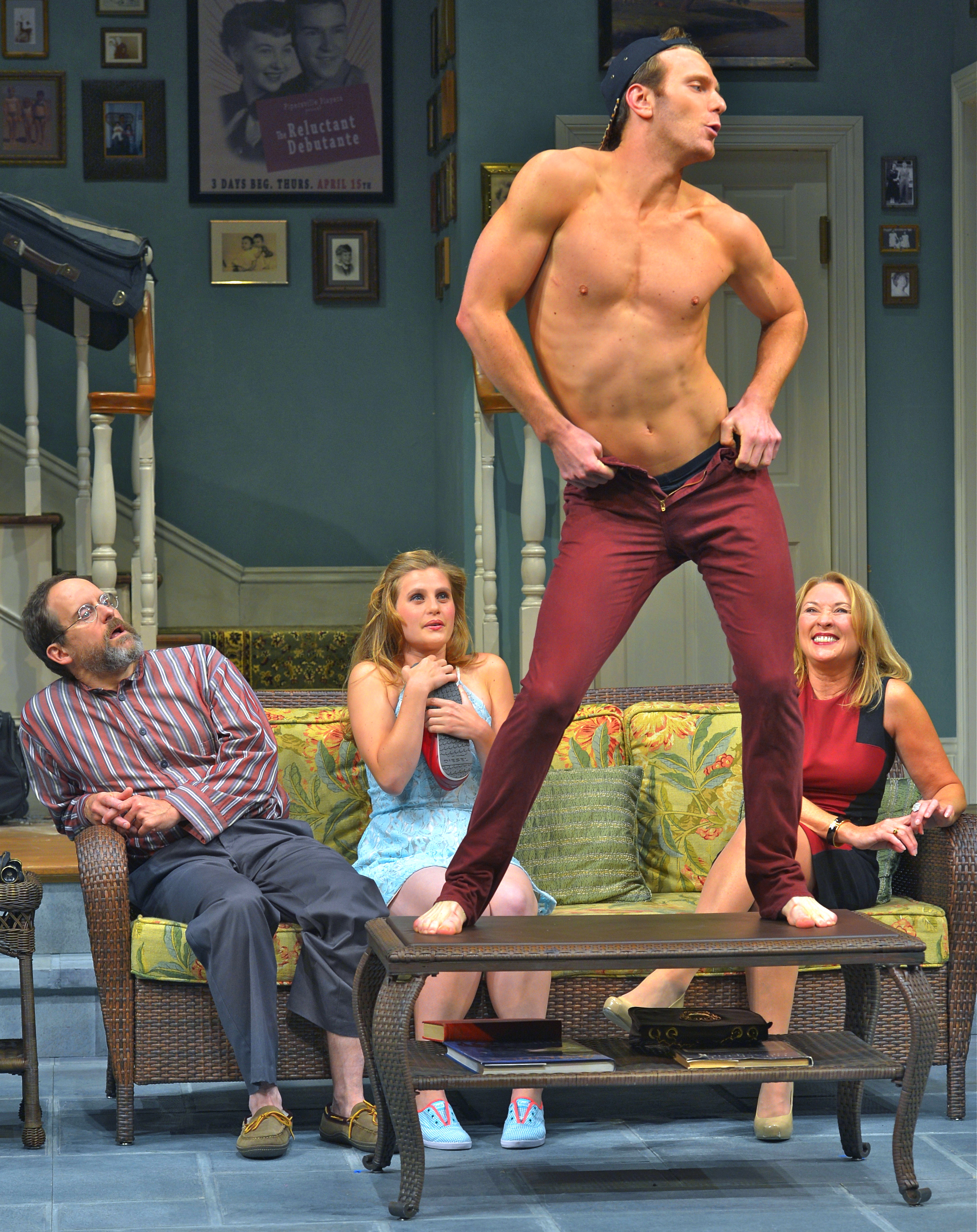
Sonia arrives with her 20 something year old boy-toy Spike (Mark Junek) who prefers to be undressed to dressed,to attend a neighbor’s movie-themed  masquerade party and to sell the house. Sonia will attend the party as Snow White insisting that her retinue be the dwarfs with the exception of Spike as Prince Charming.  Nina, who is visiting relatives who live across the pond enters with Spike and is reluctantly given an invitation to the party.

Anthony Fusco (Vanya), Lorri Holt (Masha), and Mark Junek (Spike)

Durang with his disparate and sometimes desperate characters has set the stage for a total romp that should not be missed. Local luminaries Anthony Fusco, Lorri Holt and Sharon Lockwood are absolutely superb with each getting their time to shine upon the stage.Lockwood’s transformation from unhappy depressed 52 year old into a glamorous “Maggie Smith” wannabe in a sequined dress will have you applauding. Lorri Holt’s take charge woman who expects homage is pitch-perfect. Anthony Fusco gets his turn in the second act with his diatribe against everything technologic bemoaning the loss of “charming humanity”  and social intercourse of the 50s is a solo performance worth a Tony. The audience broke out with thunderous applause.

Heather Alicia Simms who understudied the role of Cassandra in the Broadway show that included David Hyde Pierce, Kristine Nielsen and Sigourney Weaver brings a new meaning to hysterical with her shenanigans. And then there is Mike Junek with six-pack abs, a mobile body to die for (mentally coveted by gay Vanya) unbelievably bouncing around. Last but not least is the beautiful, charming and disarming Caroline Kaplan playing the star struck youngsters with verisimilitude.

There is not a single dull moment in this 2 hour and 45 minute evening (includes an intermission) and Berkeley Rep should bring director Richard E. T. White around more often.

Kedar K. Adour, MD

Courtesy of www.theatreworldinternetmagazine.com.