Geoff Hoyle’s one-man ‘Geezer’ provides laughs, pathos

By Woody Weingarten

Woody’s [rating:5] 

Geoff Hoyle wields invisible cigarette in “Geezer.” Photo: Patti Meyer.

Geoff Hoyle portrayed Mr. Sniff in the Pickle Family Circus in San Francisco, Zazu in The Lion Kingon Broadway, and a bevy of other characters I’ve cherished.

Now he’s portraying Geoff Hoyle.At least a carnival-mirror version of him (and his anxieties about death lingering in the wings).

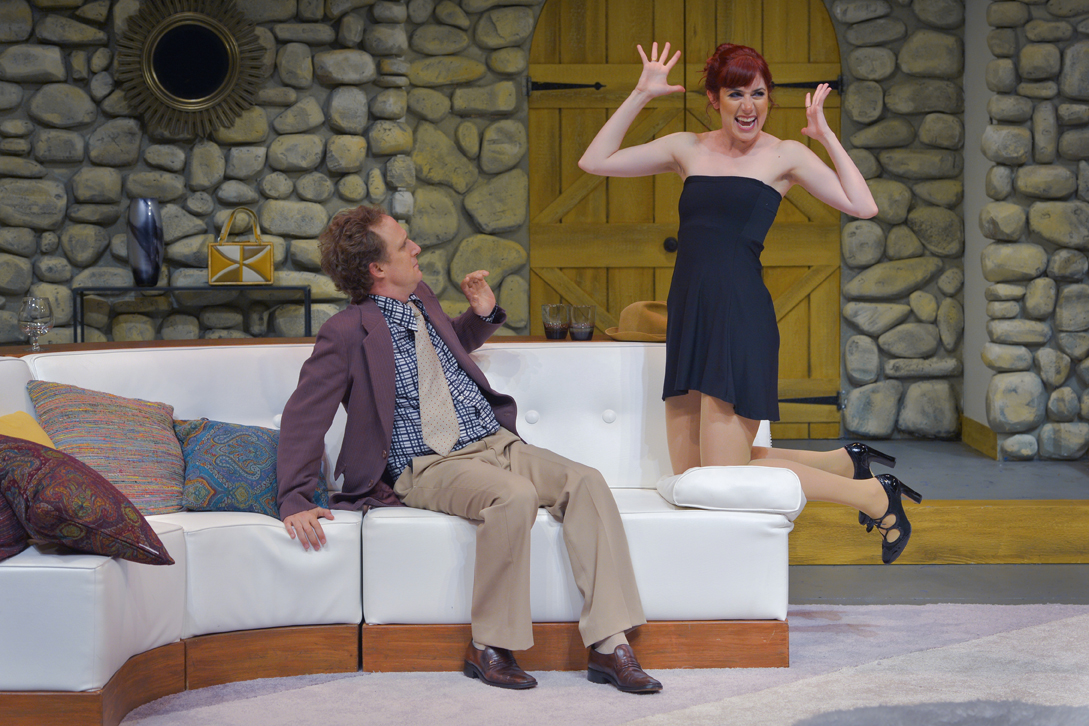
His autobiographical solo show, Geezer, is again entrenched at The Marsh, an intimate San Francisco theater. In it, he combines mime, vaudeville, English music hall comedy — and transforms into a rubber-faced, rubber-bodied, one-man sound machine.

His lithe movements and physical one-liners are masterfully choreographed.

I smiled. I chuckled. I laughed out loud.

Clad in dark slacks and a red shirt, Hoyle friskily pulls elongated invisible hairs from his ear, nostril and chest before playing “Disease: The Video Game,” which becomes an organ recital that includes varicose veins, an enlarged prostate, gingivitis, degenerating spinal discs, diminishing eyesight, osteoporosis, arthritis and dementia.

But, believe it or don’t, he morphs all that into hilarity — even when proclaiming, “Warning: Your warranty expires in 90 days.”

“Is it death we fear,” he eventually ponders, “or just decline?”

But Hoyle’s body is so agile that he belies his 67 years — except for those moments when he whips out a hanky and wipes his sweaty brow and face. His mental agility lets him turn on a dime from skillful comedy to pathos-packed explorations of serious topics such as mortality.

And the death of his English typesetter father at age 60.

Hoyle, in fact, offers a breathholding moment in which one of his hands becomes his father’s, the other his own. The resultant clasp and bonding are pure poignancy.

His more comic instant personality transplants take the form of a blonde bombshell Latin teacher, an aging Minotaur yanked from Greek mythology, a squirrel in a school play, a metaphorical sparrow, and a whimsical glimpse at unrealized characters from a London sitcom and “Masterpiece Theater.”

The showstopper for me, though, was his interpretation of his belly becoming cat-like. My laughter, my wife’s and the crowd’s shook the rafters and then some. Printed words are inadequate to do justice to the sequence; a video might, however, since you then could see and appreciate it.

Hoyle, who studied in Paris with Marcel Marceau’s teacher, Étienne Decroux, also can make an audience squirm — as when he shows his own discomfort during a visit from his adult kids.

“Sit down,” he tells them, “so I can embarrass myself in front of you.”

Also a bit too close for comfort for geezers such as me is his railing against nursing homes. He focuses on the fictitious “Elderado, the elder commune,” drawing huge laughs along the way from a couple of antique jokes.

To wit: “Last night my wife asked me to go upstairs and make love. I said I didn’t know if I could do both.”

This 90-minute show is a re-run of one that debuted at The Marsh in San Francisco in March 2011. It’s still directed by David Ford, who also helped Brian Copeland and Charlie Varon develop their performance art.

But Hoyle is unique.

He can transform a wooden chair — believably — into the prow of a torpedo-endangered ship caught in a storm, a hospital bed and a walker.

Although he was born in Britain, he’s spent most of his life in America — emboldened by two years working with Ed, “the fourth of my artistic fathers” and a short tenure at a commune in the Ozark Mountains.

All his experiences appear to be fodder for his imagination. Boxing and stroking his shadow, for example.

But he covers each post-birth stage of life, his elastic face capturing each phase flawlessly.

Hoyle, who often makes invisible cigarettes real with his expert mime work, infrequently breaks the fourth theatrical wall and interacts with the audience. On one occasion, he asked my wife to tickle him. She was flummoxed, not knowing if he really meant for her to do it. He then mugged derision, which brought yet another laugh from the audience.

His tour de force — which deserves the standing ovation it draws — is often like attending a master class in mime and minimalism.

What Hoyle evokes is so strong that several people could found doubled over at any given point, and the convulsions of a few more turned their glee into pig-like snorts.

The show should be a must for anyone who cares about the aging process, most certainly any man or woman who’s noticed that first wrinkle.

Geoff Hoyle’s “Geezer” plays at The Marsh, 1062 Valencia St. (at 22nd), San Francisco, through Oct. 26. Performances: 8 p.m. Wednesdays and Thursdays, 5 p.m. Saturdays. Tickets: $25 to $50, (415) 282-3055 or (415) 826-5750 or www.themarsh.org.

Teenage girl discovers poetic messages in ‘I and You’

By Uncategorized

By Judy Richter

It’s only natural that a teenage girl would be alarmed when a strange boy suddenly enters her bedroom. Even when Anthony (Devion McArthur) explains that he’s there to work on an English class assignment with her, Caroline (Jessica Lynn Carroll) remains wary.

That’s how Lauren Gunderson’s intriguing “I and You” opens in its world premiere at Marin Theatre Company.

Caroline has a chronic liver condition that has kept her homebound for most of her life. She knows she could die if she doesn’t get a liver transplant, but she seems reasonably well resigned to what might lie ahead. Moreover, she remains optimistic and has dreams for the future.

In contrast to the frail white Caroline, Anthony is a tall black basketball player. They’re supposed to prepare a presentation analyzing the use of the pronouns “I” and “you” in Walt Whitman’s “Song of Myself.” All of this is news to Caroline, who’s not familiar with the poem. She has to become knowledgeable in a hurry because the assignment is due the next day.

Caroline’s mother is nowhere to be seen, but Anthony assures Caroline that her mother sent him up to her room. Later, Caroline texts her mom to ask for a Coke for Anthony.

During the course of a long session that extends late into the night, Caroline gradually warms up to Anthony and becomes excited about “Song of Myself.” She sees that in some ways it speaks directly to her. She also opens up to Anthony, revealing that for all her bravado, she’s afraid.

Sensitively directed by Sarah Rasmussen, “I and You” is mainly Caroline’s story with Anthony apparently there to unwittingly guide her to a better emotional place. The surprise ending helps to make that point.

Running about 85 minutes without intermission, the play has a few slow spots. For the most part, though, it moves along, thanks to the two actors, who are quite believable as teenagers. Carroll’s Caroline may be a bit too believable with rapid speech that can typify teenage girls but that can be hard to understand at times.

Michael Locher’s set features an array of interesting photos on the walls. Caroline reveals that she took most of them with her smart phone. The set also features simple, inexpensive furniture that could be indicative of her family’s financial situation.

The lighting is by Wen-Ling Liao with costumes by Maggie Whitaker and sound and music by Will McCandless.

The MTC production of “I and You” is part of a rolling world premiere under the auspices of the National New Play Network. This alliance of not-for-profit theater companies fosters the development of new American plays. With a rolling world premiere, at least three companies agree to stage the play within a 12-month period. “I and You” is slated for additional productions in Maryland and Indiana.

If the MTC production is any indication, the play is likely to be snapped up by other companies, too. It’s an audience pleaser.

“I and You” will continue through Nov. 3 at Marin Theatre Company, 397 Miller Ave., MillValley. For tickets and information, call (415) 388-5208 or visit www.marintheatre.org.


Comedy with Chekhov links is likely to make you laugh

By Woody Weingarten

Woody’s [rating:5] 

Mark Junek does reverse striptease in the role of Spike as (from left) Anthony Fusco (Vanya), Caroline Kaplan (Nina), and Lorri Holt (Masha) watch in “Vanya and Sonia and Masha and Spike.” Photo courtesy kevinberne.com.

“Vanya and Sonia and Masha and Spike” is more fun than a horse-drawn cart of Anton Chekhov characters.
Frankly, I’ve always chortled at the Russian’s more piquant stuff. Never guffawed. “Vanya,” in contrast, made me laugh aloud. You’re likely to as well.

A lot more than once.

No, I didn’t wet myself. But it was a close call during the Berkeley Rep production of the comedy that won this year’s Tony Award as best play.

The Big Apple run starred Sigourney Weaver and David Hyde Pierce. I can visualize their performances as two of the three title siblings named after Chekhov characters.

But director Richard E.T. White conducts his ensemble of actors as if it were a jazz sextet, staging one solo riff after another to extract loud laughter from the audience as easily as a teenager might Google just about anything.Witness, for instance, the brilliance of Mark Junek’s physical antics when his character, the twentysomething boy-toy Spike, does a reverse strip tease.

Or Sharon Lockwood’s breakout as Sonia, imitating Maggie Smith emoting in a screechy British voice on the way to the Oscars (while prancing in a tiara and blue gown on which no more sequins would fit).

Or Heather Alicia Simms’ star turn as Cassandra, a voodoo pi

n-pricking prognosticator, or Anthony Fusco’s Old World passivity as the bearded Vanya.Nor should the other performers be ignored. Both are top drawer, Lorri Holt as narcissistic B-movie star Masha (“I just feel old and vulnerable”) and Caroline Kaplan as wannabe actress Nina, who’s attracted to Spike (“He is so attractive — except for his personality, of course”).

Playwright Christopher Durang’s wit and cleverness can be as swift-paced as a Louis C.K. standup routine, and as omnipresent as his allusions to Shakespeare, the Beatles and Disney’s seven dwarfs.

Durang even spoofs his own reverence for his favorite 19th Century playwright.“If everyone took anti-depressants, Chekhov would have had nothing to write about,” intones one character. “I hope you’re not going to make Chekhov references all day,” pleads another.But the seriousness that lies underneath is countered by the buffoonery that’s pervasive.

Indeed, “Vanya” is an homage, with frequent references to “Three Sisters,” “The Cherry Orchard” and “Uncle Vanya” but if you’ve never seen or read anything by Chekhov you’ll still enjoy the banter, set pieces and character development — not to mention the marvelous costuming by Debra Beaver Bauer (look particularly for the dwarfs), note-perfect sound design by Rob Milburn and Michael Bodeen, and the lone set by Kent Dorsey that replicates an upscale country home in Bucks County, Pennsylvania, where Durang actually lives.

Durang’s characters are skillfully drawn. Sonia and Vanya feel their lives have passed them by, having spent 15 years caring for their Alzheimer’s-plagued parents.

She’s never reconciled her being adopted, and is usually sad and angry, a throwaway spinster who “can’t do anything right.” He laments his life, too, and relishes raving about the glories of yesteryear and the dreadfulness of today’s culture.

Like much of Chekhov’s work, “Vanya” emphasizes people and relationships rather than plot — with everyone working in unison to make sure the audience feels the play is much shorter than its two hours plus.

And when the characters become stagehands and move furniture between scenes, their actions appear to be seamless part of the play.Durang, who is gay, has had a history of dealing with homosexuality, Roman Catholic dogma and child abuse in his previous work (which included “Sister Mary Ignatius Explains It All for You” and “Beyond Therapy”).This one skips the dogma and abuse.

Samuel Beckett, creator of “Waiting for Godot,” is known as the father of the Theater of the Absurd. In a sense, Durang might be considered his stepchild, romping in the same playground although his humor and personages are less abstract, more grounded, more rooted in reality.

Despite all the mugging and over-the-topness.

“Who’d you recommend this show to?” my wife asked me as we left the theater, continuing a verbal game we’ve played for years.

“Everyone,” I replied — “without hesitation.”

“Vanya and Sonia and Masha and Spike” plays at the Berkeley Repertory’s Roda Theatre, 2015 Addison St., Berkeley, through Oct. 25. Night performances, Tuesdays, Thursdays, Fridays and Saturdays, 8 p.m.; Wednesdays and Sundays, 7 p.m.; matinees, Saturdays and Sundays, 2 p.m. Tickets: $17.50 to $89, subject to change, (510) 647-2949 or www.berkeleyrep.org.

Exploratorium makes girl, 6, giggle and squeal with delight

By Woody Weingarten

Woody’s [rating:4.5] 

Hannah peeks through maze from the top. Photo: Woody Weingarten

My granddaughter owns a short attention span — except when she’s fascinated.

And then the 6-year-old, like most kids her age (or younger), insists on repeating whatever’s grabbed her, again and again and again. Her recent visit to the new Exploratorium is an unequaled for-instance.

She had nearly as much fun as horsing around with her new rescue puppy.

Hannah had been to the old science museum building in the Palace of Fine Arts multiple times, and loved it. But this time her squeals of delight were louder, her giggles more effervescent.

Repeatedly.

Once upon a time she raced from one exhibit to another, testing each for about half a second. But she was only 5 then. Or 4. Or 3 the first time we took her.

Now, she’s exponentially more mature.

Can the word “sophisticated” fit a first-grader? Yes, of course (though I grant a substantial bias in Hannah’s case).

Anyway, this time she lingered at exhibits. And tested each gain, again and again.

“Self-Centered Mirror” shows Hannah and her grandpa. Photo: Woody WeingartenAnyway, this time she lingered at exhibits. And tested each again, again and again.

She didn’t tire until the beginning of our fourth hour.

Like a white-haired roadie, I trailed her as if she were a rock star whose latest single had just gone viral. And I managed to experience much of her hands-on, trial-and-error experimentation from an analogous child’s-eye-view.

I left believing that had I looked close enough, I could have seen her mind expand.

The new Exploratorium, like the old, is an interactive, two-story science museum. But this one’s indoors-outdoors, a 330,000-square-foot facility with three times the space.It has 40 new exhibits and 560 carryovers, gratifying each of the senses except taste (and that craving might be satisfied at the posh 200-seat buffet-style Seaglass Restaurant or a tiny takeout café, “the seismic joint”).

Because the facility’s bigger, it doesn’t feel cramped or crowded. And it seems a bit less noisy (as well as somewhat less exciting).

But Hannah didn’t think about any of that.

She was too busy running back and forth between two displays — “Self-Excluding Mirror,” which reproduced images but somehow made the person in the center disappear, and “Self-Centered Mirror,” which replicated the viewer over and over.

Before that, near the entrance, she’d became entranced with “A Drop to Drink,” featuring a miniature hand she could manipulate robotically to fill a miniature cup with a lone drop of water, and “Black Sand,” an exhibit that showcased countless metallic pieces that stuck together magnetically. A few times during our visit she returned to both stations.

Hannah enjoyed exhibits carried over from the old building.

One favorite — where images and colors changed when we waved our arms, kicked out our legs and wiggled our torsos. Another was a screen crammed with pins that made different hand shapes and designs as she moved her fingers underneath.

Another echo came as Scott Weaver guided ping-pong balls through his panoramic view of San Francisco and vicinity made from “105,387 and a half toothpicks.” We’d seen it before, at the Marin County Fair, but loved it still.His art-piece only took 37 years to finish.

Hannah was also taken with “Tidal Memory,” its 24 columns of water representing 24 hours of tide data.

I, meanwhile, enjoyed playing “The Visible Pinball Machine,” which showed the machine’s innards. And all of us marveled at “Gyroid,” an outdoor climbing maze Hannah crawled through and atop while we watched.

Leaving, Hannah gleefully said she liked running into and out of an “orange and white spinning circus-tent thing,” spinning a plastic ball on a column of air, and changing the course of a simulated tornado.It’s truly impossible to even mention all we experienced, much less what we didn’t do (like check out the second floor and its observation center).

But we did recognize the Exploratorium features displays for virtually every age, ranging from some aimed at preschoolers to some so technical a doctorate in an esoteric scientific endeavor might help.

I think that translates, in effect, into something for everyone.All that’s required is sufficient time.

Oh, well, there’s always next time. Or the time after that. Or the one after that. Or…

The Exploratorium, Pier 15, San Francisco, is Tuesdays through Sundays, 10 a.m. to 5 p.m.; Wednesdays, 10 a.m. to 10 p.m.; Thursday night After Dark cash-bar event for those 18 and older, 6 to 10 p.m. Tickets: $10-$25. Information: (415) 528-4444 or www.exploratorium.edu.

MTT evokes avant-garde 20s via ‘American in Paris’

By Woody Weingarten

Woody’s [rating:5] 

San Francisco Symphony conductor Michael Tilson-Thomas

Violin soloist James Ehnes

My wife last heard George Gershwin’s “An American in Paris” played in the flesh 49 years ago in Manhattan.

I heard it in-person much more currently — 33 years ago — also in New York.

Sadly, neither of us can remember a thing about those concerts other than we were there. But the San Francisco Symphony version we caught recently, with Michael Tilson-Thomas conducting with his usual exemplary zeal, is apt to linger in our memories a long, long time.

And not because the music stand of a musician in the last row slipped down with a clunk before the Davies Hall concert began.

But because the performance was as luscious and joyous as the first bite of a truffle.

And then some.

The audience agreed. It gave the musicians — and MTT, of course — a standing ovation.

Tilson-Thomas conducted it at a good clip, conjuring up all the vibrancy possible from Gershwin’s instrumental dialogue — aided, naturally, by the incredible finesse of San Francisco’s finest music-makers.

Together they painted a melodic portrait that evoked the same images and feelings Gershwin must have experienced in the vital, avant-garde Paris of the 1920s.

MTT didn’t settle for just Gershwin, however.

He constructed an amazing program that beguiled the audience, starting with “The Alcotts,” a six-minute rendition of an unexpectedly sweet Charles Ives movement from “A Concord Symphony” — replete with passages that hint of church hymns and Beethoven’s Fifth.

Then, soloist James Ehnes, whose lightning-fast bow was a visual blur at the same time he created stringed exactitude, drew a standing ovation for his artistry on Samuel Barber’s ”Violin Concerto, Opus 14.” Some pundits have found the explosive, ultra-fast third movement disconnected from the first more pensive two, but Ehnes made any previous criticism vanish.

My wife commented of the “Presto in moto perpetuo,” only half in jest, that “his virtuosity made Rimsky-Korsakov’s ‘The Flight of the Bumblebee’ sound like it’s flying in slow motion.”

MTT gently pushed Ehnes back on stage for an encore. Niccolò Paganini’s “Caprice No. 16” earned him another standing ovation.

Tilson-Thomas also paired George Antheil’s “A Jazz Symphony,” a multi-faceted pastiche from 1928, with the Gershwin closer, suggesting Antheil was “deliberately out there, to delight and provoke.”

He urged the crowd to “fasten your seat belts — here it goes.”

The piece, with layered textures, colors and rhythms, with musical pauses as effective as those in a Harold Pinter play, included blow-your-mind riffs from trumpeter Mark Inouye and pianist Robin Sutherland.

One muted horn segment infused its bluesy strains in my mind and heart at once. A brief clarinet segment duplicated that impact.

An ad campaign of the ‘70s and ‘80s repeatedly proclaimed that “When E.F. Hutton talks, people listen.” I suggest the slogan be updated for the 2013-14 season: “When MTT conducts, everyone listens.”

His work so inspired my spouse, in fact, she rushed home to frolic with “An American in Paris” on our Yamaha piano.

She’d never played it before but thought it “would be fun.”

It was.

For her and me.

But in good conscience I must admit the symphony did it a teensy-weensy bit better.

Maybe, dear, it was just because they’d rehearsed.

If you missed this performance, you might want to catch one of these upcoming concerts: “MTT and Jeremy Denk: Beethoven, Mozart, Copland,” Nov. 7-10; Natalie Cole and the symphony, Nov. 25; Dianne Reeves with the orchestra, Dec. 11; Burt Bacharach and the symphony, Dec. 13; “MTT and Yo-Yo Ma,” Feb. 28. Information: (415) 864-6400 or www.sfsymphony.org.

I and You at MTC needs work

By Kedar K. Adour

Kedar [rating:2] (2/5 stars) 

Jessica Lynn Carroll (Caroline) and Devion McArthur (Anthony) in the National New Play Network Rolling World Premiere of I and You by Lauren Gunderson, running now through November 3 at Marin Theatre Company . Photo by Ed Smith

I AND YOU: Drama. By Lauren Gunderson. Directed by Sarah Rasmussen. Marin Theatre Company, 397 Miller Avenue, Mill Valley, CA 94941. (415) 388-5208 or www.marintheatre.org. October 10 – November 3, 2013

I and You at  MTC  needs work.

The adage “there’s trouble in River City” did come to mind when Artistic Director  Jasson Minadakis  informed the audience before the show began that this production is first of four “rolling world premieres” of  I and You and intimated that there would be changes made. Also in a local newspaper fluff piece interview of the author she admitted that during rehearsal, at the suggestion of the cast, she excised significant blocks of dialog. It might be possible that those cut are the reason there is an abrupt change in the tenor of the play that seems artificial.

Gunderson has received accolades for her other plays, three of which are playing locally, and the dialog in I and You attests that those accolades are warranted. However she must share some of that credit with Walt Whitman’s poetry.

It is a two character play with disparate teenagers thrown together in a class project to deconstruct Whitman’s poetic autobiographical “Leaves of Grass” by discussing his meaning of the pronouns “I” and “You.” It is a very blatant ploy by Gunderson to give universality to the personal relationship evolving between the protagonists.  Henri Bergson’s concept of relative time is suggested since their project is due the next morning.

Those two are chronically ill semi-recluse Caroline (Jessica Lynn Carroll) and talented basketball player Anthony (Devion McArthur). The author adroitly introduces the troubled background of the pair with believable dialog as the relationship changes from antagonistic to empathy ending with understanding in a cataclysmic ending.

Whereas Caroline who is white is immersed in her stuffed turtle doll, Elvis Presley movies and photography, African-American Anthony is a saxophonist enamored with John Coltrane and Walt Whitman.  Anthony’s unexpected arrival in Caroline’s attic bedroom is met with hostility but his patience gradually turns Caroline’s taciturn nature into an agreeable partner adding depth to their assigned project. Before that stage is reached there are the expected and unexpected serious bumps on the road to understanding. A couple of those bumps are very dramatically directed by Sarah Rasmussen but her chore is difficult because the storyline lacks cohesion.  This may change on the play’s journey through three more “rolling world premieres.”

Jessica Lynn Carroll gives a believably fine performance changing from a frightened unlikeable teenager to a compliant partner as she becomes engrossed in Whitman’s poetry and Anthony’s subtle persistence.   Devion McArthur, who was imported from the New York theatrical scene, is new to Marin Theatre Company but one would hope it will not be his last visit to the Bay Area.

Michael Locher’s magnificent set of Caroline’s attic bedroom complete with the trappings expected of a teenager is a beauty but may be superfluous overkill for this problematic 80 minute play that may be better served with a more moody ambiance to accentuate the surprise ending.

Kedar K. Adour, MD

Courtesy of www.theatreworldinternetmagazine.com.


‘Zigzag Kid,’ film fest charmer, profiles a rascally teen

By Woody Weingarten

Film newcomer Thomas Simon stars in the title role of “The Zigzag Kid.”


Nono is an exceedingly spirited, exceedingly imaginative Dutch kid who draws attention through mischievous stunts — particularly when they don’t work.

But he can be disarming.

And so can “The Zigzag Kid,” the coming-of-age film in which Thomas Simon stars as Nono, a 13-year-old two days from his bar mitzvah.

“Zigzag,” the opening-night entry of this year’s San Francisco Jewish Film Festival, will play at the California Theater in Berkeley on Aug. 6 and at the Rafael Theatre in Marin on Aug. 12.

The movie’s storyline is deceptively simple: Nono wants to emulate his dad, whom they both steadfastly believe is the best police inspector in the world, and in the process searches for details about his mother’s death.

Adventures ensue.

Although that may not sound wholeheartedly enchanting, when you add the slickest thief in the world; the inventive secretary-girlfriend of the boy’s father; and a seductive chanteuse marvelously portrayed by Isabella Rossellini (who’s looking more and more like her mother, Ingrid Bergman, as she ages), you find yourself devouring a cinematic stew spiced to please.

The 95-minute film — a fast-paced, subtitled Dutch-Belgian detective puzzler — contains way more whimsy and fantasy than a viewer might expect.

Plus amusing umbrella hijinks. And disguises. And chases.

With a modicum of poignancy.

And that leaves no room to talk about the charming flick’s top-notch production values.

Purists may object to the movie’s blurring of good and bad, but the movie’s magic will make that mindset disappear quickly for most filmgoers.

The SFJFF, the world’s first and still largest Jewish film festival, this year — its 23rd — is screening 74 films from 26 countries in nine Bay Area venues.

Berkeley and Marin screenings both will include an outstanding documentary, “Dancing in Jaffa,” which traces a world-class dancer’s efforts to teach dance to Jewish-Israeli and Palestinian-Israeli youngsters and then pair them in competition.

Another Marin highlight, which also will be shown in Oakland, is “The Trials of Muhammad Ali,” which explores issues of race, identity, power and faith.

A total of 39SFJFF films were slated for the California Theatre, 2113 Kittredge St., Berkeley, between Aug. 2 to 8. Thirteen films will screen at the Rafael Theatre, 1118 Fourth St., San Rafael, between Aug. 10 and 12. Festival information can be found at (415) 621-0523 or www.sfjff.org.

Money is the name of the game in ‘Warrior Class’

By Judy Richter

By Judy Richter

What does it take to be elected to Congress? To start with — money.

Money is undoubtedly the most important factor, but others stand in line, too. That’s what a promising young politician learns in Kenneth Lin’s “Warrior Class.” Presented by TheatreWorks, “Warrior Class” is a fascinating back room look at politics today.

The politician is Julius Weishan Lee (Pun Bandhu), an Asian American, New York assemblyman and decorated Marine veteran who’s viewed by some as the Republican Obama. An eloquent speech after the 9/11 attacks, in which his sister died, has thrust him into the spotlight. Now party operatives are looking into his background to make sure there are no red flags.

This vetting process is mainly undertaken by the savvy, smooth-talking Nathan Berkshire (Robert Sicular). All looks good until Nathan unearths information about unwise behavior toward a girlfriend when Julius was in college.

The ex-girlfriend, the wary Holly Eames (Delia MacDougall), contends that Julius’s behavior after their breakup caused her great mental anguish. Nathan tries to persuade her to keep quiet about the incident, but she keeps raising the stakes.

In the meantime, Nathan tries to steer Julius toward an Assembly committee that has the power to benefit one or more of the party’s major donors. Julius finally realizes that if he wants their backing, he must bow to the big money men.

In the meantime, it turns out that both Holly and Nathan have their own problems. No one looks all that great by the end of this two-act play, which runs just under two hours with intermission.

Director Leslie Martinson elicits outstanding performances from all three actors. The interchanges and conflicts between them ring true and intrigue the audience.

The action takes place in a Baltimore steak house and Julius’s home  in New York City. Erik Flatmo’s set, lit by Steven B. Mannshardt, easily accommodates the scene changes. The contemporary costumes are by Noah Marin with sound by Brendan Aanes.

The ending might leave some viewers looking for more resolution. However, it needs to be ambiguous because decisions need to be made now that all the dirt has been dished. Thus viewers are left to ponder what the characters will do after they’ve had more time to think. The main question is whether Julius will go along with the money men or stick to his principles.

One can easily imagine that many real politicians have faced, are facing or will face the same dilemma.

“Warrior Class” will continue through Nov. 3 at the Mountain View Center for the Performing Arts, 500 Castro St., Mountain View. For tickets and information call (650) 463-1960 or visit www.theatreworks.org.


5 star reviews explanation and samples

By Flora Lynn Isaacson

Sample code has been inserted below for you to use/change/experiment with.

Change (type over) whatever you want. Can also be no text.
– Change (type over) rating: 5 to:
rating: 2 (This creates 2 stars when you Update.)
– Change (type over) 5/5 stars to:
2/5 stars (This creates 2/5 stars when you Update.) You can also eliminate this part entirely.
– Click Update

Experiment. Here are variations.

Suzanne and Greg [rating:5] (5/5 stars)

Suzanne and Greg [rating:4.5] (4.5/5 stars)

Suzanne and Greg [rating:4.25] (4.25/5 stars)

Suzanne and Greg [rating:4] (4/5 stars)

Suzanne and Greg [rating:3.5] (3.5/5 stars)

Suzanne and Greg [rating:3] (3/5 stars)

Suzanne and Greg [rating:4]

Suzanne [rating:4]

[rating:5]

[rating:4]

Suzanne [rating:4]

Suzanne [rating:4]

Suzanne and Greg [rating:5] (5/5 stars)

Suzanne and Greg [rating:4] (4/5 stars)

Suzanne [rating:4] (4/5 stars)

Suzanne [rating:5]

Suzanne [rating:4]

[rating:5]

…………………………………………………………….

Suzanne and Greg [rating:5] (5/5 stars)

ZZ Moor, Amy Resnick, Mark Anderson Phillips


Reviewed by Suzanne and Greg Angeo

Photos by Ed Smith

Good People is Brilliantly-Crafted, Compelling Start to MTC’s New Season

As its 2013-2014 season opener, Marin Theatre Company has chosen Good People, a Broadway hit in its Bay Area premiere. The story is provocative; the vivid characters sparkle like gems in a setting of steel.  Playwright, screenwriter and lyricist David Lindsay-Abaire has won the Pulitzer Prize (Rabbit Hole), and was nominated for a Grammy and several Tony Awards (Shrek the Musical, Rabbit Hole).  Good People opened on Broadway in 2011 and garnered him yet another Tony nod.

With humor and brutal honesty, Good People suggests that the choices we make are not always our own, and that some of us are not able to make choices that put us on the path to success, or even stability. We see Margaret, a hardscrabble single mom, struggling to hold her life together as she cares for her special-needs adult daughter in Southie, a working-class Irish section of south Boston. She’s got her neighborhood pals Jean and Dottie to lean on, but no thanks to her boss Stevie, life is tough and getting tougher by the minute. Her encounter with Mike, an old high-school boyfriend, promises to be a game-changer.

Amy Resnick as Margaret – Margie to her pals – is likeable and authentic in her role, as familiar as a favorite pair of jeans. Margie’s often given to outbursts where she ends up not-really apologizing, with trademark lines like “pardon my French” and ”I’m just bustin’ balls”. Sympathetic but confusing, she’s painfully blunt and seems to take pride in looking foolish or crude. But we soon learn that she’s reluctant to take action in simple, honest ways that could make life easier for herself and her daughter. Is she truly proud of who she is, or is she so invested in her Southie identity that she is unable or unwilling to change it?

Amy Resnick, Ben Euphrat

Mark Anderson Phillips is Mike, Margie’s former flame from the old neighborhood. In a masterful performance, Phillips shows us hints of zaniness, anarchy and fear lurking just below Mike’s smooth surface. Now a successful doctor, Mike fondly endures Margie’s digs about becoming “lace-curtain Irish”, a reference to his moving up in the world. Later on, Margie visits the home of Mike and his elegant young African-American wife Kate, played with compassionate sophistication by ZZ Moor. It ends up being a night of unraveling and uproar, with Mike showing his true colors and Kate challenging Margie’s life choices.

Margie’s best friends Dottie (Ann Darragh) and Jean (Jamie Jones) are so endearing, and offer such skillful comic relief that you wish you could have them over for the weekend. Between bingo games and swapping tales, these ladies are the heart of the story, which has a satisfying conclusion after the convoluted road it travels to get there.

An unforeseen event threatened one recent matinee performance: Ben Euphrat, who plays Stevie, got stuck in traffic from the Bay Bridge closure and missed the first scene, a crucial one with Resnick that establishes the entire storyline. Phillips covered the part, script in hand, and even though he performed well, Euphrat’s absence threw the beginning of the first act off-kilter.  He did finally arrive in time for his next scene and hit the ground running, fully recovering the momentum of the show and turning in a fine performance.

Anne Darragh, Amy Resnick, Jamie Jones

Direction by Tracy Young in her MTC debut is inventive yet efficient, keeping the cast in almost constant motion. Nina Ball’s clean and simple set design allows for effortless scene changes. Young makes use of the clever set platforms that roll backwards or forwards, sometimes while the actors are still performing. Sliding backdrop partitions come and go from the wings on either side. Thus the stage is transformed: from an alleyway to a doctor’s office to a bingo hall; from a subway platform to a high-class home. The gritty urban-rock score, used in between scenes by composer Chris Houston, keeps the energy level high throughout the show.

There are no heroes or villains in Good People. It takes us on a journey to a place where we can stand and peer into the age-old abyss between the classes. It raises questions that have no easy answers, but that need to be asked anyway.

When: now through September 15, 2013

8 p.m. Tuesdays, Thursdays, Fridays and Saturdays

7:30 p.m. Wednesdays

2 p.m. and 7 p.m. Sundays

2 p.m. Saturday, September 14

1 p.m. Thursday, September 5

Tickets: $37 to $58

Location: Marin Theatre Company

397 Miller Avenue, Mill Valley CA 94941
Phone: 415-388-5208

Website: www.marintheatre.org

‘Rich and Famous’ a bad dream

By Judy Richter, Uncategorized

By Judy Richter

In her notes for Dragon Theatre’s production of John Guare’s 1976 “Rich and Famous,” director Meredith Hagedorn urges the audience to remember that it’s all a dream.

That’s important to keep in mind because this play falls within the realm of theater of the absurd. Therefore, it’s sometimes difficult to discern what’s happening and why.

The premise is that for the first time, Bing Ringling (Ron Talbot) one of  “the world’s oldest living promising young playwrights,” is about to see a production of one of his plays, his 844th. Bing’s dream occurs on the night of its first preview.

His dream has several different characters played by two actors: Lucinda Dobinson, the Woman, as the females; and Tom Gough, the Man, as the males. One of the female characters is Veronica, the producer of Bing’s play. Because she has successfully produced other plays, she wants this one to be a flop so that she can be hailed for a comeback with the next play she produces.

Gough is seen as the lead actor in Bing’s play, but he’s in drag as a hooker. Among other characters, he also portrays Bing’s boyhood friend who has since become a successful movie actor. He and Dobinson team up as Bing’s parents.

The action is interspersed by fine singing by the uncredited Jason Arias, who does double duty as the set designer (simple but effective) and, on opening night, the person dispensing programs. He’s also the company manager.

The two-act play clocks in at just under two hours, with the second act stronger than the first. Still, it’s a weird play that might work better if Gough’s performance weren’t so over the top in his various guises.

Talbot is solid as Bing, while Dobinson is at her best as Bing’s ex-girlfriend in the second act.

Playwright Guare is best known for the widely produced “The House of Blue Leaves” and “Six Degrees of Separation.” Both are stronger and more enjoyable than this one.

San Francisco’s American Conservatory Theater staged a rewrite of “Rich and Famous” in 2009. It was expanded to four actors and named Bing’s play, “The Etruscan Conundrum.” Despite the rewrite and ACT’s best efforts, the play still didn’t work.

Dragon Theatre is in the heart of downtown Redwood City, which has become a bustling place with a wide array of restaurants as well as the nearby multi-screen movie theater, the Fox Theatre, the old county courthouse, and convenient, inexpensive parking.