Holocaust play is inspirational, haunting — and musical

By Woody Weingarten

In ““The Pianist of Willesden Lane,” Mona Golabek plays under a projected image of her parents, Lisa and Michel Golabek. Photo courtesy of mellopix.com.

Woody’s [rating:4.5] 

Watching dramas about the Holocaust has been low on my priority list for a long time.

That’s because I spent 23 years editing a Jewish newspaper in San Francisco and, as a byproduct, had almost daily contact with survivors, children of survivors and grandchildren with survivors.

Some of their stories were indelibly courageous.

Almost all were incredibly sad.

And tough to hear.

So I went to opening night of Berkeley Rep’s “The Pianist of Willesden Lane” with more than a little resistance, going mainly because my wife, a professional keyboard player herself, really craved to see it.

I’m glad she convinced me.Although it’s imperfect, the one-woman play is a truly important piece of theater, something I’d recommend to Jews and non-Jews, be they fans of classical music or not.

And I not-so-secretly wish every college and high school student could see it.

What happens onstage is direct enough.

Mona Golabek, a 54-year-old piano virtuoso, relates the true story of her prodigy mother’s escape to England via the Kindertransport, an often forgotten mission that rescued 10,000 unaccompanied European children from Nazi violence and oppression.

It’s a tale of Lisa Jura’s escape to a London hostel.

And her survival despite the Blitz.

And her optimism.

Behind the Steinway that Golabek plays with grace and power are four massive gilt frames into which are projected impressionistic stills and all-too-real newsreel films.

Included are black-and-white scenes of Holocaust victims (thankfully we’re spared shots of emaciated bodies being tossed into mass graves) and the dancing flames of Krystallnacht, the Night of Broken Glass in November 1938 when Nazis smashed Jewish-owned stores, buildings and synagogues in Germany and parts of Austria.They’re disquieting, to say the least.

Golabek, in dark red hair (she’s usually blonde) and nondescript black sweater and skirt, reconfigures her mother as a promising teenage pianist who escapes after her father wins a sole Kindertransport ticket in a card game.

It’s a painful scene reflective of the film “Sophie’s Choice” because her parents can save only one of three sisters.

She accompanies her verbal journey with pianistic snippets of Beethoven’s “Moonlight Sonata,” Debusssy’s “Clair de Lune,” Chopin’s “Nocturne in B-Flat Major, opus 9,” a few passages from Bach and Rachmaninoff, and even a ditty by Gershwin.But her best work comes on Grieg’s only concerto. At different times, she dips into each of the three movements, ending the show triumphantly with the third.

When Golabek talks early-on about the great composers, she does so in her mom’s youthful voice: “I can hear their music in the stones of these streets and the marble of these buildings.”

The play’s dialogue is sometimes poetic, often melodramatic, now and then banal — as when describing someone with “the softest soul in the world.”

But Hershey Felder, who masterfully performed “George Gershwin Alone” at the Rep this summer, directed the play after adapting it from “The Children of Willesden Lane,” a book by Golabek and Lee Cohen, and, in the process, seamlessly blended story and music.

He, along with Trevor Hay, also was responsible for the sparse but powerful scenic design for the 90-minute, intermission-less show. Andrew Wilder and Greg Sowizdrzal were behind the effective projections. And Erik Carstensen was spot-on regarding the sound design, which ranges from chirping birds to bombing raids.

Golabek, unfortunately, is not a polished actor.

Her impersonations of minor characters don’t ring with authenticity, and her body movements are typically a bit severe. One sequence in which she tries to emulate some folks she’s encountered is particularly awkward.

Still, the poignant, emotional and haunting storyline overcomes any defects.

There have been tons of stories about musicians and the Nazis, including “The Pianist,” an extraordinary film. But this one tends to be better than most.

It made me cry.And bemoan the fact that Holocaust deniers still exist.

It also convinced me Golabek has skillfully underscored a meaningful Jewish mantra, “Never forget!”

In an even broader sense, though, the play is a love story — Mona Golabek’s heartfelt tribute to her mother, to hope, and to music.

Clearly, it’s stirring. And inspirational.“The Pianist of Willesden Lane” plays at the Berkeley Repertory Theatre‘s Thrust Theatre, 2025 Addison St., Berkeley, through Jan. 5. Night performances, Tuesdays, Thursdays, Fridays and Saturdays, 8 p.m.; Wednesdays and Sundays, 7 p.m. Matinees, Thursdays, Saturdays and Sundays, 2 p.m. Tickets: $14.50 to $89, subject to change, (510) 647-2949 or www.berkeleyrep.org.

Ron Nash’s Unique Adaptation of Ibsen’s A Doll House at Marin Onstage

By Flora Lynn Isaacson

Marin Onstage presents A Doll House through November 17 at the Little Theater at St. Vincent’s in San Rafael.

A Doll House by Henrik Ibsen is a play that looks at the emancipation of women. Reflecting the beginnings of the women’s movement in the 19th century, the play is the story of Nora, a seemingly content and carefree mother of three daughters who soon comes to realize that her life is a sham and she will never be a good wife and good mother until she discovers herself.  This is almost impossible in 1878 when women have few rights. The theme in the play that interested Ibsen most was the different ethical code by which men and women live.

Although Director Ron Nash has gone for more conversational language than the customary translations, he never allows the play to drag and the evening doesn’t seem to long despite its three-hour duration.

A Doll House looks at the marriage of Nora Helmer (Stephanie Ann Foster), a supposedly loving wife and wonderful mother and Torvald (Gabriel A. Ross), who has landed a decent job, finally giving the family financial security.  But as characters from the past enter their cheerful home, cracks gradually appear in the couple’s relationship and an intense struggle develops between love and truth, honor and betrayal, and finally between an old-fashioned husband and disobedient wife.

Stephanie Ann Foster is magnificent as Nora—a frivolous, irresponsible, spendthrift.  Initially she seems almost shallow, but becomes more three-dimensional as the play goes along.  Gabriel A. Ross gives a solid performance in the difficult role as her domineering husband, a hard nosed business man whose level headed exterior evaporates when he encounters Nora’s irrational behavior.

There is a superb supporting cast including Kelsey Sloan as Kristine Lind, an old friend of Nora’s and Jim McFadden as the manipulative Nils Krogstad, who provides an interesting contrast to the Helmer’s.  Both are people who have been nearly destroyed by life, yet are able to create a second chance for happiness for themselves.  Bill McClave portrays Dr. Rank, the dependable friend who confesses his love for Nora when he discloses he is dying.  Lynn Sotos is endearing as Anne-Marie who takes care of the children and Helmer’s household.

Designer Gary Gonser’s set is typically Scandinavian, a plain middle class home in which there seems to be a doll—until she realizes she is first and foremost a human being and her duty is to herself before being a wife and mother.

Gary Gonser co-founded the Novato Arts Foundation in 2004 and started the production arm, Marin Onstage in 2012.  A Doll House runs through November 17, Thursday-Saturday at 8 p.m. and Sunday at 3 p.m. Performances are held t the Little Theater at St Vincent’s, 1 St. Vincent’s Drive, San Rafael.  For tickets, call 415-448-6152 or go online at www.marinonstage.org.

Coming up next will be an evening of short plays. The Jewish Wife by Bertolt Brecht, Trifles by Susan Glaspell, and Miss Julie by August Strindberg, February 14-March 2, 2014.

Flora Lynn Isaacson


Broadway By the Bay’s winning ‘Guys and Dolls’

By Judy Richter

By Judy Richter

You don’t need a lucky roll of the dice to come out a winner at Broadway By the Bay’s production of “Guys and Dolls.”

Even though this musical has been around since its Broadway premiere in 1950, it remains fresh and vibrant in the creative hands of the versatile Molly Bell, who directs and choreographs this show.

With a book by Jo Swerling and Abe Burrows based on short stories by Damon Runyon, “Guys and Dolls” features two contrasting love stories set in New York City in the late 1940s.

The first couple is comprised of gambler Nathan Detroit (David Mister), proprietor of the “oldest, established, permanent floating, crap game in New York,” and Miss Adelaide (Mary Kalita), the featured singer-dancer at the Hot Box night club. Even though she doesn’t approve of gambling, they’ve been engaged for 14 years.

The other couple has just met. She is Sarah Brown (Kelly Britt), an earnest missionary at the Save-A-Soul Mission. He is Sky Masterson (Jack Mosbacher), a footloose but successful gambler who will bet on almost anything.  

Needing $1,000 for a place for his crap game, Nathan bets Sky that he can’t convince Sarah to go toHavana with him. Nathan loses the bet, and of course Sky and Sarah are smitten until Sarah finds out about the bet.

Bets influence other plot elements, but all turns out well in the end. In the meantime, the audience is treated to a string of Frank Loesser’s hit songs. Some of them include the title song along with “I’ll Know,” “If I Were a Bell,” “A Bushel and a Peck,” “Luck Be a Lady” and “Sit Down, You’re Rockin’ the Boat.”

The opening number, “Fugue for Tinhorns,” might not be as familiar, but it’s a hit as staged by Bell and sung by three of Nathan’s gambling buddies: Nicely-Nicely Johnson (Alex Rodriguez), Benny Southstreet (Adam Cotugno) and Rusty Charlie (Ryan Mardesich).

All four lead actors are highly appealing, especially Mister as the often flustered Nathan and Mosbacher as the determined Sky. Like the two men, Britt is a good singer. Kalita is a terrific dancer, but the character’s dumb blond persona and fast-talking, heavyNew York accent are detracting factors.

Among the supporting actors, Rodriguez, an accomplished dancer, is outstanding as Nicely-Nicely. He helps to lead the way in Bell’s inventive choreography.

Musical director Dolores Duran-Cefalu’s orchestra got off to a shaky start on opening night but redeemed itself thereafter. She also does a fine job of shaping the ensemble singing, especially the men in “”The Oldest Established.”

Margaret Toomey’s set is simple and flexible, enabling quick scene changes, and many of her costumes, especially for the Hot Box Girls, are colorfully creative. Jon Hayward’s sound design is effective except for an opening night glitch that silenced Sarah’s microphone in her “Marry the Man Today” scene with Adelaide.

Thanks in large part to Bell and a stellar cast, this is one of BBB’s most successful outings in recent memory.

“Guys and Dolls” will continue at the Fox Theatre, 2215 Broadway St., Redwood City, through Nov. 17. For tickets and information, call (650) 579-5565 or visit www.broadwaybythebay.org.


The Ghost Sonata by August Strindberg, Sonoma State University, Rohnert Park CA

By Greg & Suzanne Angeo

Reviewed by Suzanne and Greg Angeo

Photo courtesy of Sonoma State University Department of Theatre Arts & Dance

A Night With the Living Dead

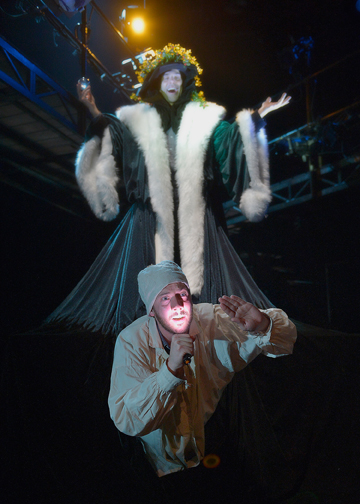
Strangely beautiful and eerie images fill the stage in SSU’s mesmerizing production of The Ghost Sonata at the Evert B. Person Theatre. Written in 1907 by tormented Swedish playwright August Strindberg, it was first staged in his own Intimate Theater in Stockholm the following year. It is one of the earliest examples of Expressionistic Theatre, where time, space and reality bend to the creative will of  the playwright and director.  For this reason, The Ghost Sonata is rarely seen, due to the difficulty in conveying the story’s meaning, which is enclosed in a dreamlike shroud.

The plot involves a young Student who appears to be fascinated by the people living in a fine house. An Old Man in a wheelchair that he meets outside has the key that will unlock the mystery of what goes on in the house. Its inhabitants include a screeching banshee-like woman called The Mummy who was once a young and beautiful wife; her husband The Colonel with secrets of his own, and their pretty daughter, “The Young Lady”. The action onstage is almost entirely in reaction to prior events that the audience has not seen, and so live on in the characters’ memories. They are all living in the past, focused on sordid deeds and revenge, a kind of living death that has many parallels in people we all know. There is a vampire-like Cook that drains the essence of life from those around her, servants wearing half-masks and a black-clad figure that emerges to project images of faces and fire.

The ensemble performance by the student cast is superb.  Connor Pratt as The Student has a magnetic stage presence and moves gracefully through the dreamscape. Also noteworthy is Cassandra Slagle as The Mummy, a frenzied shadow of her former self. The Old Man, played by David O’Connell, is also a well-done and compelling performance. Creative direction and staging by Judy Navas brings it all together with surreal set design (by Anthony Bish) and highly imaginative costumes (by Michelle Dokos). Elements of Japanese Noh Theatre are added for good measure

The inventive use of black light lends an otherworldly appearance to furniture and props that at times appear to float through the air. Heavy fog, thunderclaps and strobe-lightening provide an unsettled, stormy atmosphere. Music in the third scene recalls “Twin Peaks” by David Lynch, who could have been inspired by Strindberg.

The Ghost Sonata is one of the most successful efforts by SSU to present original, entertaining theatre. Like a musical sonata, the story has no beginning, middle or end. It’s a challenging piece that was delightfully well-executed. Hopefully it will be presented again with a longer run so more will be able to enjoy its free-form, Expressionistic pleasures.

When: Through November 9, 2013

7:30 p.m.

Tickets: $10 to $17

Location: Evert B. Person Theatre at Sonoma State University

1801 E. Cotati Ave.
Rohnert Park, CA 94928
Phone: 707-664-4246

Website: www.sonoma.edu/theatreanddance/productions

Coming up at SSU:

Mega Hot Lava New Play Festival

By SSU Students
Curated by Scott Horstein

November 14-16, 2013
Studio 76, Ives Hall

Original script-in-hand readings of new short plays from SSU’s playwrights of tomorrow! Who knows what this year’s festival will bring?

Fairfax protester-artist playfully jabs at society’s toxins

By Woody Weingarten

Sierra Salin blows bubbles at Fairfax Festival parade. Behind him is his “plastic drag,” a “visual and visceral” political statement about toxic waste and environmental destruction.

Sierra Salin, in one of his artistic boxes at a Fairfax town picnic, wears tinfoil to poke fun at those who refer to some homeless as “tinfoil loonies.”


To say Sierra Salin is unconventional is to state the obvious.

According to a character-reference by former Fairfax Mayor Pam Hartwell-Herrero, it “might be easy to look at him as some sort of wacky, offbeat, troublemaker.”

But that, she said, is because “he challenges the status quo, makes us think about our role in community, and always brings a smile and fresh insight to the dialogue.”

He tells me he’s primarily a carpenter and artist.

But he’s also a photographer, jewelry-maker, environmentalist, documentary filmmaker and playful inventor of words.

Sierra, added Hartwell-Herrero, “is a wonderful family man…ever present at town gatherings and important meetings. He is a…good person who cares deeply for the planet and all the creatures living on it. He volunteers his time on campaigns that benefit the town.”

I find it tough to encapsulate him.

The physical part is easy: He sports shoulder-length, curly dark hair and a bushy gray beard. A gold tooth shines from the rear of his mouth when he smiles.

But when he declares, “I never grew up,” he’s not referring to his six-foot stature.

It’s his man-child passions I can’t boil down.

He usually writes on medical forms, “I am allergic to bureaucracy.”

He frequently scratches that itch.

A recent protest by the midlifer targeted a tower that would facilitate more cell phones. “Why are we filling the air with electrosmog?” he asked.

His street theater in Fairfax Festival parades have included a Styrofoam drone augmented by 20-foot high “homeland insecurity” surveillance cameras; a mock nuclear reactor spewing dry-ice radiation fumes; and a “plastic drag,” a “visual and visceral” statement about waste and environmental destruction.

When I asked about his first protest, he friskily replied, “When somebody didn’t give me milk.”

As we sit now on a log in Bolinas Park, conversationally flitting like fireflies escaping a real blaze, he tells me he recently moved, a stone’s throw from his old place (if you have a strong arm).

But when I first chatted with him, in his old Fairfax backyard a year ago, I ascertained he superimposes original thinking on familiar subjects. He’d created, for instance, a “peace is patriotic” pinball machine for the 2011 Marin County Fair.

His environmental focus seems ingrained, I decided — then and now.

He drives his car “as little as possible,” for example, opting to ride his bicycle.

And he fulminates: “We’ve got fracking here, Fukushima there, we’ve got Gulf Oil spills, we’ve got genetically modified organisms everywhere. I’m really, really distressed about the future.”

When he needs to escape, he puts on headphones and stares at stars. “I like solitude and my own space,” he tells me.

Outside his former home, he cherished his gardens and beehives. Inside, he surrounded himself with what others might call clutter.

I was particularly taken with his wife’s weaving-looms and their huge Buddha (“just your basic garage-sale find”). But Sierra is nothing if not eclectic, unattached to a single dogma. Miniature kitchen flags represented major religions plus Sufi, Gaia, Om, Native Americans.

Fascinating, too, were frames filled with photos of his mother and her shadow.

His art, forever scattered, falls into a pigeonhole of “whatever strikes me in the moment.”

While comforting, neither artwork nor protests are relaxing. So he unwinds by singing tenor in a barbershop quartet, and by playing dulcimer and guitar.

He’s a Drake High grad who attended two colleges and earned certification as an EMT, which he practiced for years. He’s proud he’s “been physically and vocally involved in the schools — Manor and White Hill — and my community for years.”

Sierra was born Lothar Norber George Salin in Marin General but toyed with his moniker ever since. He switched to Sierra, although he sometimes sports Shinybright now, because he adores the land “between Truckee and Whitney.”

Occasionally he uses Tunafish as a middle name. “People remember it,” he says.

His name-switches occasionally bring trouble — and First Amendment tilting at judicial windmills. Such as a skirmish with El Dorado County traffic officials who cited him for using a pseudonym, “Love Heals.”

Ultimately, he was sentenced to 32 hours of community service.

He once signed checks “Bush Sucks!” — “out of frustration with the state of America and the world.” He acknowledges that was “a little confrontational.”

He once stood in front of Good Earth with a dried-out Christmas tree and sixty $2 bills he distributed while suggesting passersby “do something for someone else.”  Many folks, suspicious, ignored him.

He once walked into a police station and said he wanted “to turn myself in because society is a menace to me.” “Scram,” they said.

When I asked, “How do we change the world?” he responded: “Love each other.”

It’s still obvious that the more he talks, the more I agree. Maybe I’m just a bit wacky, eclectic and playful, too.

A charming, vivacious 1938 musical I MARRIED AND ANGEL by 42nd Street Moon

By Kedar K. Adour

l-r: Angel “Brigitta” (Kari Yancy) charms a perplexed “Count Willy Palaffi” (Sean Thompson) in
I MARRIED AN ANGEL at 42nd Street Moon, playing Oct 30 – Nov 17 at The Eureka Theatre. Photo credit David Allen

I MARRIED an ANGEL (1938): Music by Richard Rodgers. Lyrics by Lorenz Hart
Book by Richard Rodgers and Lorenz Hart. Based on the play by Janos Vaszary. 42nd Street Moon, Eureka Theatre, 215 Jackson St., San Francisco. Box Office:  415/255-8207 or www.42ndstmoon.org.   October 30 -November 17, 2013
A charming, vivacious  1938 musical I MARRIED AND ANGEL by 42nd Street Moon  [rating:4] (5/5 stars)

Greg MacKellan is a master at staging old fashioned musicals and has done it again with the 75 year old Richard Rogers and Lorenz Hart fantasy I Married an Angel that ran for a year on Broadway followed by a one year National tour that ended in San Francisco’s Curran Theatre in 1940.  This production at the Eureka Theatre is studded with fine singing, acting and dancing including this reviewers favorite musical comedy star Bill Fahner whose role as Harry Mischka Szigetti is sort of the deus ex machina.
The play is based on the play by Hungarian Janos Vaszary, and the action takes place mostly in Budapest,  so be ready for other names to match. Bachelor Count Willy Palaffi (Sean Thompson) has dumped American fortune-hunter Anna Murphy (Halsey Varady) stating that any woman he marries must be an angel and ‘poof’ an Angel (Kari Yancy) appears complete with wings. After a night of love-making prior to marriage (oh, horrors) Angel loses her wings. Never fear, they legalize the affair and the fun begins.
Willy’s private bank is in trouble and there will be a run on the bank if new money is not forth coming. But this is all hush-hush from his investors. Angel’s angelic nature does not allow her to tell a lie that creates havoc as well being hilarious. Truth does not will-out whenl Willy’s sister Countess Peggy Palaffi (Allison Rich) teaches her the social graces of being less than truthful.
Beware a woman scorned. That happens to be Anna who spills the beans. The potential savior is unattached romantically inclined deep pockets Harry and he is the object of Peggy and Anna’s desires all be it for different reasons. Before the evening ends a quartet of Angels (Victoria Stewart-Davis, Megan Stetson, Abby Sammons, Elena Ruggiero).
Enough of the convoluted plot. It is the lovely songs of Rogers and Hart that are sung by the fine voices of matinee idol handsome Sean Thompson, saccharine sweet Kari Yancy, dominate Allison Rich, comedic Halsy Varady and scene stealer Bill Fahrner.

l-r: “Henry Szigetti” (Bill Fahrner) gets a little too cozy with “Brigitta” (Kari Yancy) much to the consternation of her husband “Count Willy Palaffi” (Sean Thompson)

They are aided and abetted by Zack Thomas Wilde’s choreography that includes soft shoe and tap numbers. Nathaniel Rothrock, a look-alike to Sean Thompson, does the honors with his solos and when he shares the stage with many of the ladies. He out does himself in the show stopping  “Roxy Music Hall” production number.
The first act setting up the plot and characters is a bit slow and runs a tad too long but the second act is an energetic roller coaster leaving the audience with a warm feeling as they leave humming the tunes. Running time 2 hours and 30 minutes.
Honors go to the entire production crew: Directed by GREG MacKELLAN; Music Director: DAVE DOBRUSKY; Choreographer: ZACK THOMAS WILDE; Stage Manager: KRIS VECERE; Production Manager: HECTOR ZAVALA; Set Design: HECTOR ZAVALA; Costume Design: RUTH RASER TIMBRELL; Lighting Design: DANNY MAHER;  Props: STEPHANIE SUAREZ; Intern/Set Painter: ARAEL DOMINGUEZ; Woodwinds: NICK DI SCALA; Rehearsal Pianists: KEN BRILL & JONATHAN ERMAN.


Kedar K. Adour, MD
Courtesy of www.theatreworldinternetmagazine.com

Hilarity reigns in ‘God of Carnage’ in Palo Alto

By Judy Richter

By Judy Richter

A polite effort by two couples to deal with the aftermath of a playground fight between their 11-year-old sons quickly goes downhill in “God of Carnage,” presented by Palo Alto Players.

Running about 80 minutes without intermission, Yasmina Reza’s hilarious, cutting comedy won the 2009 Tony Award for Best Play. It’s easy to see why in PAP’s finely tuned production directed by Jeanie K. Smith. The show gets a few extra laughs because PAP sets it inPalo Alto with some local references.

As the play opens, Michael and Veronica Novak (Todd Wright and Betsy Kruse Craig) are playing hosts to Alan and Annette Raleigh (Scott Solomon and Melissa O’Keefe), whom they hadn’t known previously.

Michael deals in wholesale products for the home, and Veronica is an art historian specializing inAfrica. Alan is a lawyer, and Annette is a wealth manager.

The Novaks are concerned because the Raleighs’ son hit their son in the mouth with a stick and broke two front teeth. At the very least, the Novaks want the Raleigh boy to apologize, but his parents don’t know if he’s sorry.

Alan’s cell phone frequently interrupts the conversation, much to everyone’s growing annoyance. He’s worried about the possibility of adverse publicity about a drug made by one of his clients.

One thing leads to another with subtle digs and sarcasms becoming less subtle and more biting. Not only are the two couples arguing with each other, but each couple begins battling, dredging up long-held resentments. Things only get worse when a bottle of rum enters the picture.

Smith has directed this fine ensemble cast to react with both words and actions, even if it’s only a slight change of posture or a look of dismay. Everyone is fully involved, making the resulting mayhem credible.

Kuo-Hao Lo designed the comfortable living room set, complemented by Selina Young’s lighting and Gordon Smith’s sound. The character-specific costumes are by Shannon Maxham.

The program cover calls this play “a brilliant comedy of manners … without the manners.” Add “and with lots of laughs,” and you have an apt description.

“God of Carnage” will continue at the Lucie Stern Theater, 1305 Middlefield Road, Palo Alto, through Nov. 17. For tickets and information, call (650) 329-0891 or visit www.paplayers.org.


Falstaff — San Francisco Opera Performance Review

By Joe Cillo

Falstaff

San Francisco Opera Performance

November 2, 2013


Every time I go to the opera I am struck by how conservative it is.  It has to be the most conservative art form in its philosophical and social outlook.  Falstaff exemplifies this beneath a rollicking, lighthearted surface.  It is a fast moving, involved plot line.  It is harder to follow on paper than in the stage realization.  If you just read the synopsis, it seems complicated, because there are so many characters and relationships to keep straight, but when you see it, everything is clear and natural.

The production is excellent.  The cast and orchestra are all of special merit.  The sets were not particularly imaginative or noteworthy, but they were effective and satisfactory.  Falstaff is the weighty center of the story.   His dominating presence carries the performance, very effectively portrayed by Bryn Terfel.  In contrast to The Flying Dutchman, which is a static, repetitious, psychological drama where almost nothing happens, Falstaff is nonstop action with a minimum of theorizing.  But it is not at all clear what the message is, or if there is one.  It seems rather confused and mixed up.

Falstaff is presented as an aging rogue, hopelessly deluded about himself, pursing younger (married) women whom he has no chance of winning.  The women take exception to his misguided interest and spend the whole play making sport of it and taking cruel, sadistic vengeance upon him.  It suggests the mean spirited side of Halloween.  Beneath the playful pretense, there is sharp-edged animosity.  Men are presented as bumbling fools (except for Fenton), Falstaff as delusionally grandiose, Ford as delusionally jealous.  Women are manipulative, conniving, controlling, and cruel, while superficially presenting as virtuous and innocent.  It is very simplistic and simpleminded.

I liked way the sadism and cruelty were emphasized in the third act.  During the scene at Herne’s Oak the fairies and goblins appear in white costumes with pointed hats reminiscent of the Ku Klux Klan and carrying a cross to boot.  They then proceed to pepper Falstaff with all manner of abuse as he is lying helplessly on the ground.  It was rather excessively sadistic, I thought.  I was wondering if they were going to set that cross on fire.  I’m not one to insist on political correctness, but this was a rather odd sight to see in San Francisco:  the Ku Klux Klan torturing a helpless victim underneath a tree with the presumption of moral rectitude on the side of the torturers.  It was another graphic representation of the persecution of male desire that is so rampant in this society.  The whole community gangs up on old Falstaff just because he wants to have an affair with a miserably married woman whose jealous, possessive husband imagines her having affairs behind his back at every opportunity and regards marriage as the bane of his life.  It doesn’t really make sense, because if Falstaff is such a ridiculous figure who is not to be taken seriously, then why is it so necessary to mobilize the entire community to reign down this excessive punishment on him?  Maybe Falstaff is more of a threat than he is given credit for.  It is supposed to be comic and funny, but there really isn’t anything to laugh at.  Maybe my sense of humor has been poisoned by modern life.

In the end all is forgiven and we see the triumph of marriage after its being under withering attack throughout the whole drama.  This is what I mean by conservatism.  Traditional (Catholic Christian) values always seem to triumph in these operas.   Dissenters are vilified and punished and things are left pretty much the way they were at the outset.  If you like things the way they are, and have a generally cynical attitude toward life, you might go for this.


FGHT FOR THE FINISH

By Joe Cillo

THE CLEAN PLATE CLUB

Life is uncertain;
Eat dessert first.
Ernestine Ulmer

Peter Svacha was halfway through eating his chocolate pudding, when the restaurant where he was eating told him it was closing time.  He was furious.  He left the place, got a chain saw, sliced a hole in the establishment’s door and crawled back to the table to finish his pudding.

I know exactly how he felt.  I too would obliterate anything that kept me from finishing my dessert.  I blame this determination on my mother.

My mother’s forte was creating yummy desserts.  She had one number that she always served after spaghetti dinner that was amazingly beautiful and absolutely luscious.  She would bake an angel food cake from scratch (my mother would have sooner danced nude on a fire hydrant than use a cake mix).  The finished product was so light she needed to weight it down to stay on the plate.  She whipped up a custard of eggs, milk, vanilla, sugar and pineapple juice and frosted her cake with it.  She decorated the entire production with pineapple slices, maraschino cherries and strawberries and served it with a lots of whipped cream and a flourish.

BUT there was a catch.  My mother never allowed us to touch dessert until we cleaned up everything she put on our dinner plates. Before we could tuck into her pineapple delight, we had to demolish spaghetti with meatballs, broccoli in a cheese sauce, a green salad and garlic bread. We suffered for that cake.  Indeed we suffered. We endured tummy aches, stomach spasms and guilt…but we managed to down it  and when we did, we finished it down to the last bit of pineapple.

My mother’s chocolate cake was the eighth wonder of the world.  It was made with six eggs, a ton of butter and enough chocolate to keep a candy store supplied for ten years. She topped it with a mint chocolate frosting to die for and set it in the middle of the dining room table so we could see what we had to look forward to at the end of the meal.

But first, we had to finish dinner. Remember?   She would serve us a huge slab of steak, potatoes with cheddar cheese, asparagus hollandaise, a tossed salad and wait until we cleaned our plates before we could touch that cake. I still feel the pain of forcing that cake into my packed middle but I know that even if my stomach burst, I would let absolutely nothing interfere with my demolishing that wonderfully melt in your mouth cake.

All I can say, is “go for it Peter Svacha. “ Finish that pudding and never count the cost.  For what is dinner without a sweet finish?? It is nothing more than duty with no reward, a rose with no fragrance, sex without climax. Life is to be lived, of course, but if it is to be savored, we must have dessert.


Unforgettable story told in ‘Pianist of Willesden Lane’

By Judy Richter

By Judy Richter

Music is the international language, and it speaks most eloquently in “The Pianist of Willesden Lane,” presented by Berkeley Repertory Theatre.

This 90-minute, one-woman music-drama features concert pianist Mona Golabek as her mother, Lisa Jura, a young Austrian pianist who survived the horrors of World War II, thanks to her musical talent as well as her courage and grit. Jura went on to become a concert pianist and to give piano lessons to her two daughters in theUnited States.

In partnership with Lee Cohen, Golabek told her mother’s remarkable story in a book, “The Children of Willesden Lane.” In turn, it was adapted as a play by Hershey Felder, who also directs. BRT audiences will recall Felder’s recent memorable performance in his own one-man show, “George Gershwin Alone.”

The story begins inViennain 1938 when Lisa learned that her piano teacher could no longer teach the 14-year-old Jewish girl because the Nazis had forbidden such interactions. With the Nazis becoming ever more menacing against Jews, Lisa’s father secured the document necessary to send one of his three daughters to relative safety inEngland in 1940. Lisa was chosen to take part in Kindertransport, an operation that rescued thousands of children, most of them Jewish, and sent them from the Continent to foster families, hostels, group homes or farms throughout England.

Lisa was sent to an estate outside of London, but when she was told that the piano there was only for show, not for making music, she ran away to London. There she wound up in a Willesden Lane hostel that was home to more than two dozen children. She was put to work in a factory sewing military uniforms, but she continued to play piano, enchanting her friends and the staff at the hostel. All the while, she had no idea what had happened to her parents and sisters back inVienna.

The tale goes on to relate how she survived the Blitzkrieg, including a direct hit on the hostel, managed to find another piano teacher and eventually had a chance to audition for a scholarship at London’s Royal Academy of Music. She also got a job playing for soldiers on leave in a swank hotel, where she met her future husband.

As Golabek relates her mother’s story, she intersperses it with virtuoso playing of musical greats like Beethoven, Debussy, Chopin, Bach and others. The unifying work is Grieg’s challenging Piano Concerto in A minor, with the first movement opening the performance, the second movement coming in the middle and the third movement providing the dramatic climax.

Her narrative is illustrated by photos and newsreel clips assembled by Andrew Wilder and Greg Sowizdrzal and projected onto the four gilded picture frames suspended over the set designed by Felder and Trevor Hay. Lighting by Christopher Rynne and sound by Erik Carstensen add to the drama. Golabek’s simple black dress is by Jaclyn Maduff.

Several excellent articles in the program provide relevant information about the events surrounding World War II.

Although Golabek is a musician first and an actress second, her story is so compelling and moving and her performance so brilliant that one is quickly captivated. It’s a truly unforgettable theatrical experience.

“The Pianist of Willesden Lane” will continue through Dec. 8 at Berkeley Repertory Theatre’s Thrust Stage, 2025 Addison St., Berkeley. For tickets and information, call (510) 647-2949 or visit www.berkeleyrep.org.