

Hillbarns Theatre, in Foster City production of MAME, for the most part is very good. Annemarie Martin as MAME SHINES. Her supporting cast is highlighted by the young man playing, Young Patrick. All others in cast are meerly “OK”.
I’m ignorant about oh, so many things.
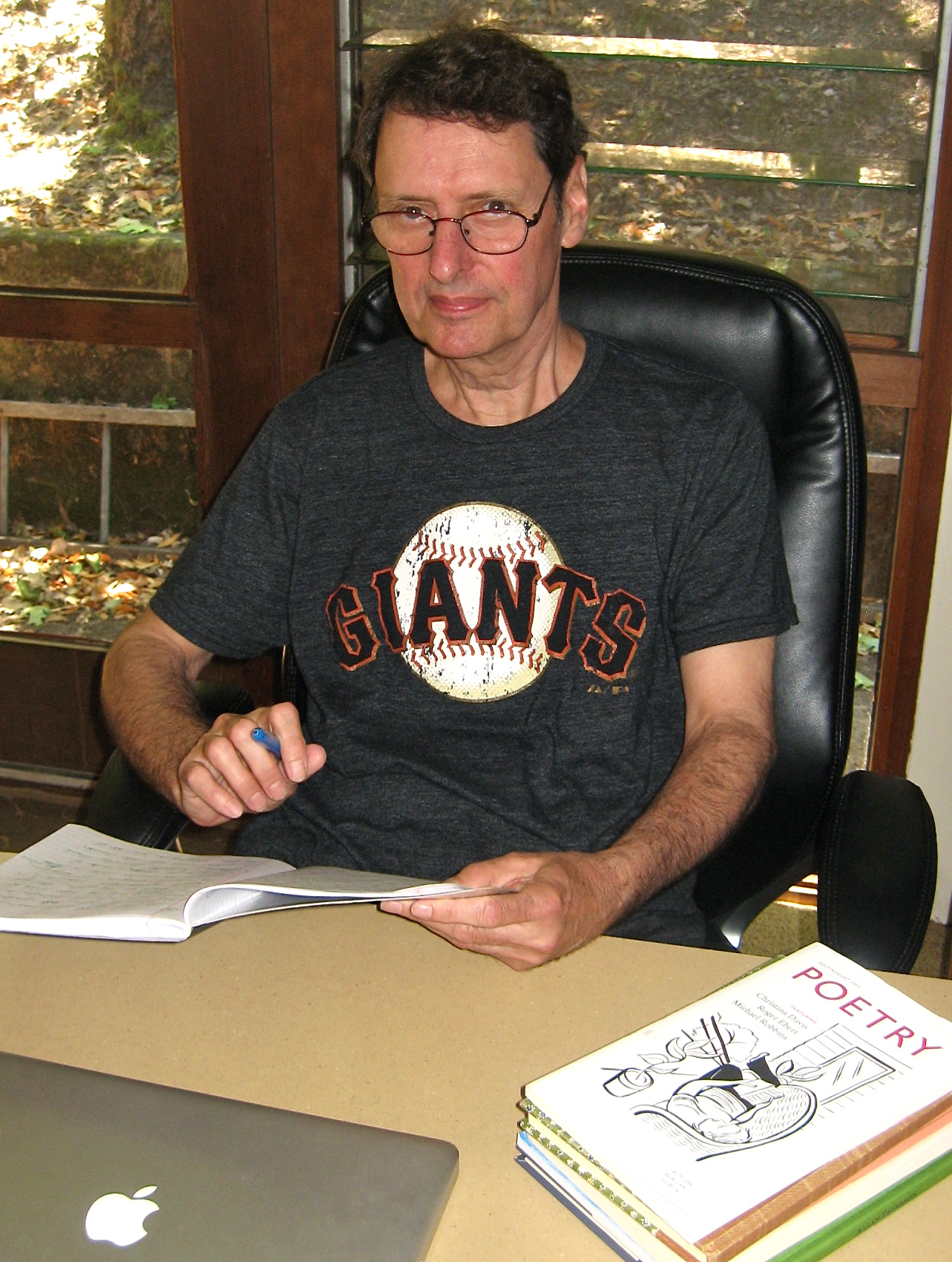
Joe Zaccardi, in his home office, contemplates a new poem. Photo: Woody Weingarten.
Poetry may top the list.
So it amazed me that I wanted to interview Joseph Zaccardi, Fairfax resident and Marin’s poet laureate.
Joe’s scarcely the only poet in Fairfax. There’s also Kay Ryan, Pulitzer Prize-winner and U.S. poet laureate whom Barack Obama just handed a major medal (along with filmmaker George Lucas, a San Anselmo resident).
Can I deduce poetry’s as popular hereabouts as Indiana Jones and Yoda (who are standing tall — and short — in San Anselmo’s Imagination Park)?
No way.But down-to-earth Joe Zaccardi could become the antidote for anti-poets.
His tips: “Don’t be afraid of poetry. You have to cultivate a taste for it. Read widely. Try writing free verse — you’ll surprise yourself. You’ll find yourself writing about love, or the death of someone. You’ll remember something someone said. Or you might ask yourself a question, really off the wall, like, ‘I wonder if they ever fried insects.’”
Of his work, the 65-year-old notes, “Every once in a while my sense of humor slips into my poetry and I leave it there. But I’m usually serious.”
He cites as a solemn for-instance, “Arroyo’s Soul,” which emphasizes subject matter “that’s really quite deep — about our not believing in anything anymore.”
Joe’s background isn’t riddled, however, with the snooty posturing sometimes attributed to writers.For much of his life, after apprenticing as a butcher, he functioned as “a barber, not a stylist, and I used to tell people I do one style — it’ll be shorter.”
He hung up scissors and combs in 2003.
Retirement means he now can take whatever time is necessary, rather than jotting down a word or two between clients. First drafts average 30 to 40 minutes. “Of every 10 of those, I only continue one or two” — and then his editing process “can be another month.”
He’s published 240 poems so far but is “sure I’ve written 1,000.”
“Written” is precise.Although he utilizes a computer for other tasks, he creates poems in longhand, in a notebook, in pen.
Joe gets $5,000 for his two-year stint as poet laureate, barely enough to buy writing materials. But the meager honorarium isn’t the point: The position enables him not only to promote poetry but use the bully pulpit to stage a panel discussion on “bullying and bystanders.”
He remembers being 13.
“A fat kid was picked on at lunch every day. One day six guys were doing it. I’m not brave, but I stepped in front of him and said, ‘Hit me instead.’ The leader said, ‘Let’s leave them alone.’ And I realized one person could make a difference.”
Also as a teenager, Joe — who last month married his longtime partner, Dave Eng — recognized he was gay.A teacher concurrently spurred his interest in poetry through William Carlos Williams, a New Jersey native like Joe, and advised him not to worry about punctuation marks or rhymes.
At 25, though, he started punctuating. “Now I love it,” he says, “especially semi-colons.”
Today he’s drawn to Jane Hirshfield of Mill Valley, Pablo Neruda, Gerald Stern “and lots of Chinese poets.” Earlier favorites? Shakespeare, Chaucer and Allen Ginsberg.
Ginsberg, in fact, had hit on him.“I was in my 20s and I met him. He bought me a Heineken’s beer, put his hand on my leg and said, ‘You have very nice thighs,’ and I said, ‘The thigh’s the limit.’”
Joe laughs at both pun and memory.
The skinny, six-foot poet’s totally animated when speaking. His hands perpetually move, and he occasionally jabs a finger at something invisible. Off and on go his wire-rimmed eyeglasses.
His soulful eyes remind me of actor Steve Buscemi’s.
“They used to be brown, but now they look gray, really strange,” Joe says, not
ing that as a schoolboy he asked a nun what color Jesus’ eyes were. “The color of yours, I’m sure,” she replied.Since the early ‘80s, he’s been hanging out at the Marin Poetry Center in San Rafael, which “puts on monthly sessions with visiting poets, an open mic once a month, and a wonderful thing called the Summer Traveling Show, which sponsors about 125 readings in various venues.”
He likes reading aloud: “You can feel an audience when you read a poem.”
When, at his request, I audibly read one — about his father, from his anthology “Render” — I’m overwhelmed by its power.
And I understand why Zaccardi’s a very special Joe, not an ordinary one.
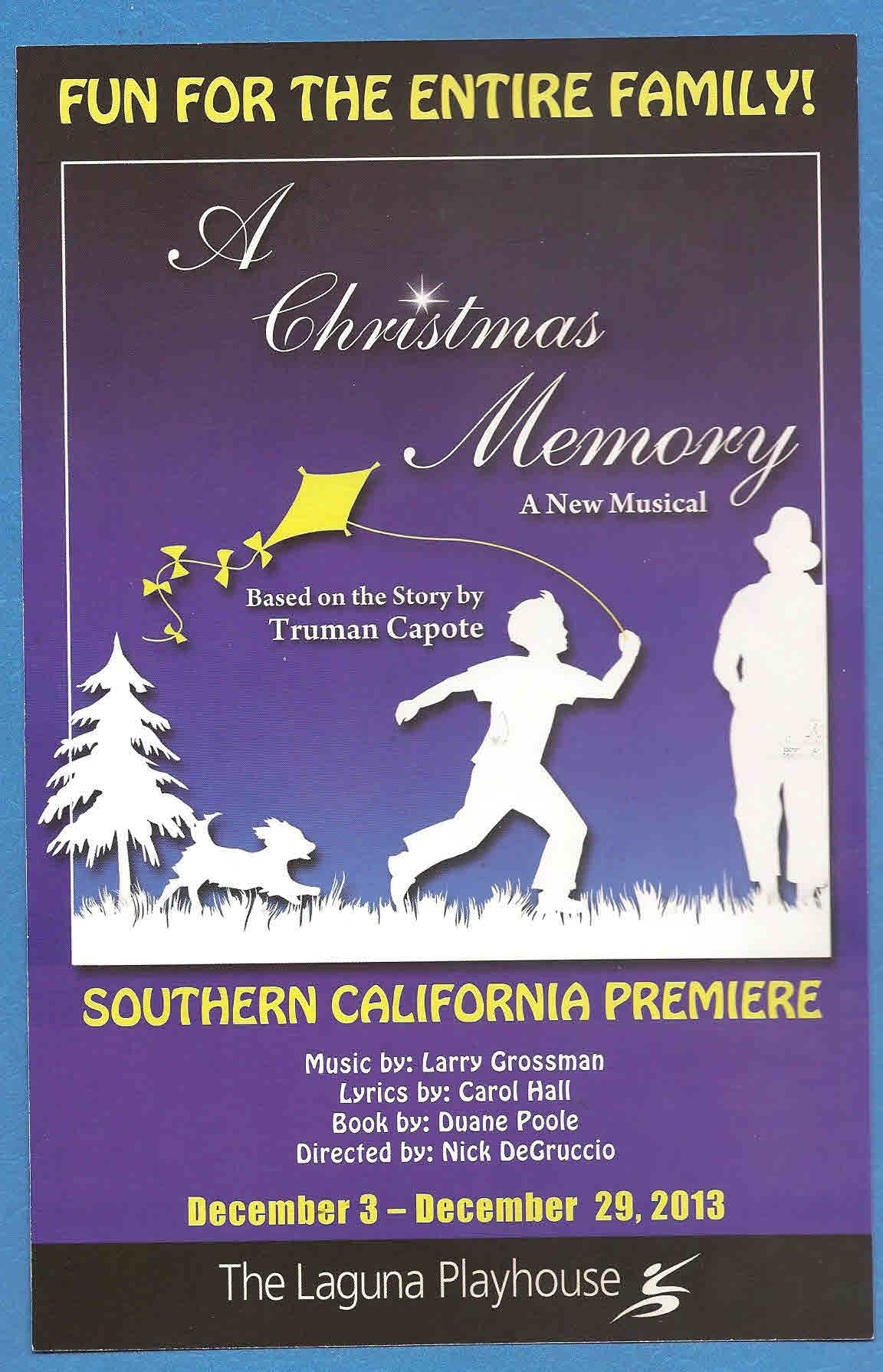 A CHRISTMAS MEMORY: A Musical Adaptation. Book by Duane Poole based on the short story by Truman Capote. Music by Larry Grossman and lyrics by Carol Hall. Directed by Nick DeGruccio. The Laguna Playhouse, 606 Laguna Canyon Road, Laguna Beach, CA. 949-497-2787 or www.lagunaplayhouse.com.
A Christmas Memory: The Musical will not replace A Christmas Carol
Truman Capote’s short story A Christmas Memory was an instant classic when it first appeared in “Mademoiselle” magazine in December 1956. Since that time it has been a mainstay on radio and is extremely popular as stage dramatizations. One of the finest was by the Word for Word Company’s presentation in the San Francisco Bay area. In that staging the story is acted with the actual words including the “he said” and “she said” etc. It is a perfect way to present Capote’s beautiful writing. In this musical adaptation many of those words poignantly drift across the footlights with fine actors skillfully giving meaning to their lines.
However, one might wonder why a musical version is necessary. It is not necessary but the Laguna Playhouse Company is giving it a valiant and often heart touching rendition and this reviewer reservedly gives it a “thumbs up.”
The use of a narrator, in the mode of Our Town is essential in keeping with the style of the short story. The adept staging by Nick DeGruccio on the attractive atmospheric open set (D Martyn Bookwalter) allows the story to flow. It is a semi-autobiographical memory play of Capote’s early life in rural Alabama during the Great Depression that often tugs at your heart wishing for less materialistic times.
In the story, seven year old Buddy (William Spangler) is the unwanted child who is sent off to live with distant cousins. The members of the house are poor and include the elderly child-like Sook (Marsha Waterbury), her sister Jennie (Tracy Lore) the supporting head of the household, ineffectual brother Seabon (Tom Shelton) and the mangy-loveable dog Queenie (Pickle).
Outside the household there is the friendly neighbor Anna Stabler (Amber Mercomes) and young buddy’s friend and partner in shenanigans Nelle Harper (Siena Yusi). Tom Shelton does triple duty as the inquisitive postman Farley and HaHa Jones the moonshiner who supplies the secret ingredient (liquor) for the fruit cakes made with loving care by young buddy and Sook, to the charming song “Alabama Fruitcake.”
Before ubiquitous fruitcakes enter the picture, the narrator Adult Buddy (Ciaran McCarthy) and the company set the tone with a nostalgic “Imagine a Morning.” Attractive McCarthy has an expressive tenor voice that gives depth to his solos of “What’s Next” and “Paper and Cotton.” In the second act his versatility is displayed in the trio “Nothing More Than Stars” blending seamlessly with the baritone voice of Shelton and the prepubescent voice of Spangler.
The adult members of the cast (all Equity actors) are excellent performers bringing their characters to life and adding further class with fine singing voices. Marsha Waterbury’s depiction of Sook is a joy to watch and a pleasure to hear in her duets with young Buddy and the tear producing “The Kite Song.” Amber Mercomes gets her turn to shine with “Detour” and Tracy Lore gains our understanding with “You Don’t Know It.” William Spangler’s taxing role as young Buddy does not quite create the needed empathy written into the story line.
Running time 2 hours and 15 minutes including an intermission.
Production Staff: Scenic designer D Martyn BookWalter; Costume designer Bruce Goodrich; Lighting designer Steve Young; Sound designer Joshua McKendry; Stage managers Don Hill and Luke Yankee; Musical Director Darryl Archibald. Musicians Darryl Archibald, Tyler Emerson and Drew Hemwell.
Kedar K. Adour, MD
Courtesy of www.theatreworldinternetmagazine.com
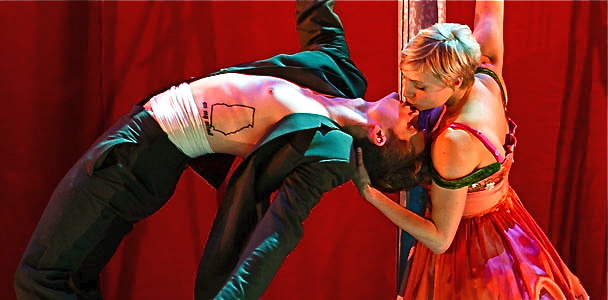
Andrew Durand and Patrycja Kujawska fill the title roles in “Tristan & Yseult.” Photo by Steve Tanner.
Woody’s [rating:3.5]
Expectations can be killer, especially high ones.
I often find I like performances better when anticipating less. So I was slightly worried about attending “Tristan & Yseult” at the Berkeley Rep.My hopes had been dialed up to max.
It was, you see, a revival from Kneehigh Theatre, Cornwall creators of “The Wild Bride,” an earlier Rep spectacle I’d found thoroughly enchanting. Charming.
And unadulterated fun.
Regretfully, my trepidation about “Tristan” was justified.
It definitely incorporates elements that are wonderful, in both the delightful and filled-with-wonder senses of the word.
And like “Bride,” it’s an amalgamation of music, comedy, dance, ingenious staging and passion.As stunningly surreal as a Dali painting magically come to life.
It also dabbles in acrobatics and simulated sex.
But its major problem is being way overladen with gimmickry (such as a carnival-like “love-ometer”). The cornucopia of theatrical tidbits can become extremely tiresome.
Some of the humor, moreover, is veddy British and may be difficult for Americans to absorb — though the accents can easily be discerned.That said, “Tristan,” is a mesmerizing, one-of-a-kind two-hour funny melodrama with a sad worldview that unleashes the story of an adulterous affair. It bursts with all the inherent, predictable dangers of a love triangle.
And, just for spice, it stirs into the concoction a love potion both toxic and intoxicating.
Emma Rice imaginatively adapted the play from a Cornish myth dating to the 12th century. She also directed it. The book, by Carl Grose and Anna Maria Murphy, is fantastic, in both the fanciful and incredible senses of that word.
And music by Stu Barker (played by a quartet under the direction of Ian Ross) runs the proverbial gamut — from country & western to jazz and Latin rhythms, from rock to classical.
The ensemble cast of eight can fairly be labeled (you can pick the appropriate word, or all of them) splendid, excellent, inspired.
Cornish King Mark (Mike Shepherd, Kneehigh’s founder) rules with his brain until he falls from a distance for his enemy’s sister, Yseult (Patrycja Kujawska, who also starred in “Bride”).
She not only becomes the king’s wife but the lover of Tristan (Andrew Durand), a buff warrior and Mark’s neo right-hand man.
Add to that mix the exaggerated Frocin (Giles King), Mark’s psychotic henchman, and Mistress Whitehands (Carly Bawden), part-time narrator, part-time singer, part-time part the story.
Finally there’s Craig Johnson, who splits his time cross-dressing in a chiefly comic role as Brangian and an understated one — Yseult’s brother, Morholt.
Most fascinating, though, is the morphing of male performers into balaclava- and anorak- and horned-rim-glasses-wearing Everyman “lovespotters” who often peer at the world through binoculars. Their buffoonery (and use of bird and other stick puppets) contrasts with their slick knife-fighting choreography and mock brutality.
In effect, they form a modern-dress Greek chorus that occasionally dons floppy headdresses with crushed tin cans and various other amusements.
“Tristan” is a show filled with tension, drama, rhyming verse and Monty Pythonesque hijinks — including an audience release of squealing balloons and a shower of small proclamations containing threats of exile or death.
Plus exciting lighting by Malcolm Rippeth, sonorous sound effects by Gregory Clarke, and a nifty set by Bill Mitchell.
“Tristan & Yseult” was the show that made the fledgling Kneehigh troupe’s reputation a decade ago. The myth on which it’s based, not incidentally, is a forerunner to the legendary triangle of King Arthur; his Queen consort, Guinevere; and Arthur’s main knight, Sir Lancelot.
If you want the ultimate tragic version of the Tristan story, you might want to skip this production and to seek out, instead, a production of Richard Wagner’s epic opera, “Tristan und Isolde.”
I’d suggest, though, that you ignore any expectations you believe I’ve set up.When all things are considered, it’s actually a no-brainer:
If you enjoy “different,” go.
“Tristan & Yseult” plays at Berkeley Rep’s Roda Theatre, 2015 Addison St., Berkeley, through Jan. 18. Night performances, 8 p.m. Tuesdays through Saturdays, 7 p.m. Wednesdays and Sundays; matinees, 2 p.m. Saturdays and Sundays. Tickets: $14.50 to $99, subject to change, (510) 647-2949 or www.berkeleyrep.org.
“Little Women,” Louisa May Alcott’s endearing, enduring novel, comes to vivid life in the musical adaptation presented by TheatreWorks in Palo Alto.
Set mostly in Concord,Mass., during the mid-1860s, “Little Women” follows the four March sisters and their mother at home while Mr. March is serving as a Union chaplain during the Civil War.
The primary focus is on the second-oldest daughter, Jo (Emily Koch). The free-spirited, tomboyish Jo longs to become a self-supporting writer and see the world, but she’s had no success in getting her blood-and-guts stories published.
The oldest daughter, the kindly Meg (Sharon Rietkerk), works as a governess. After Jo there’s gentle Beth (Julia Belanoff). The youngest is the artistic Amy (Arielle Fishman), who’s something of a social climber and who can become jealous of her older sisters’ privileges.
The family’s rock is the mother, Marmee (Elizabeth Ward Land), who dearly misses her husband but who guides her daughters as lovingly and wisely as she can. As a result, the girls and she are all quite close.
Completing the family is the stern Aunt March (Elizabeth Palmer), who lives nearby and who, unlike the others, is financially well off.
As time goes on, other people enter the family orbit. The first is the energetic Laurie (Matt Dengler). He has come to live with his grandfather, the grouchy Mr. Laurence (Richard Farrell), who lives across the street. Laurie and Jo become best buddies, but to his great disappointment, Jo has no romantic interest in him.
Laurie’s tutor, John Brooke (Justin Buchs), begins to woo Meg after meeting her at a dance.
Finally, there’s Professor Bhaer (Christopher Vettel), who’s from Germany. He lives in the same New York City boardinghouse as Jo, who has temporarily gone there to seek her fortune as a writer. He finds that he misses her when she goes home because Beth is ill.
The show is filled with lovely songs composed by Jason Howland with lyrics by Mindi Dickstein. One of them, the bouncy “Off toMassachusetts,” is part of one of the show’s sweetest scenes. As Beth plays it on the family harmonium, the visiting Mr. Laurence unexpectedly joins her at the keyboard and begins to show his softer, more generous side.
As directed by artistic director-founder Robert Kelley, the show works well in the intimate Lucie Stern Theatre, especially when the action involves the family and their friends. However, the fantasy scenes, which enact Jo’s potboiler stories, interrupt the dramatic flow of the show’s book by Allan Knee.
Joe Ragey’s simple set evokes the era with gas lamps and Currier & Ives-like prints, complemented by Steven B. Mannshardt’s lighting. The handsome period costumes are by Fumiko Bielefeldt.
Musical director William Liberatore conducts four other musicians from the keyboard in the orchestra pit.
Overall, the show is well done and well cast with all of the actors creating memorable characters who also sing well. Although it’s not a holiday show per se, “Little Women” is nevertheless a heartwarming musical imbued with life and love befitting the season.
It continues at the Lucie Stern Theatre, 1305 Middlefield Road, Palo Alto, through Jan. 4. For tickets and information, call (650) 463-1960 or visit www.theatreworks.org.
Thanks in large part to Annmarie Martin’s star turn in the title role of “Mame,” Hillbarn Theatre in Foster City has a hit on its hands.
Martin plays Mame Dennis, a free spirited New Yorker who finds herself taking care of her young nephew, Patrick Dennis (the poised Nicholas Garland), after her brother’s death. Even though Mame has a decidedly different approach to parenting, she and Patrick develop a close bond and share some great adventures. Her primary adversary is Dwight Babcock (Jesse Caldwell), the attorney appointed to oversee Patrick’s welfare.
This 1966 musical is based on a play, “Auntie Mame,” by Jerome Lawrence and Robert E. Lee, who wrote the book for the musical and who based their play on a novel of the same name, in which author Patrick Dennis recounts his life with his Bohemian aunt.
Jerry Herman’s music and lyrics for “Mame” include such well known songs as “Open a New Window,” “We Need a Little Christmas,” “Bosom Buddies,” “If He Walked Into My Life,” and of course the title song. Martin, a terrific singer, is featured in all of them except “Mame,” when she holds the stage with her charismatic presence.
The story takes place in Mame’s apartment inNew York Citystarting in 1928 and continues through various settings until 1946, when Patrick is now a young adult played by Matt Waters. By then he has become engaged to an airhead, Gloria Upson (Katherine Goldman), but Mame cleverly devises a way to scuttle that relationship.
Besides Patrick, the main people in Mame’s life are Vera Charles (Jenifer Tice), her best friend; and Beauregard Jackson Pickett Burnside (Daniel Kapler), the wealthy Southerner who falls in love with her, marries her and takes her on a two-year round-the-world honeymoon. Also important is Agnes Gooch (Jayne Amini), Patrick’s repressed nanny.
Mae Matos’s costume designs are terrific for everyone, but she has created one stunning outfit after another for Martin.
Directed by Bill Starr with choreography by Gary Stanford Jr. (who’s also in the ensemble) and musical direction by Greg Sudmeier, the large cast is quite good.
The set by Kuo-Hao Lo accommodates the many scene changes, but movement of the curtain and set pieces is sometimes clunky. Don Coluzzi’s lighting works well for the most part except for the “Bosom Buddies” duet by Mame and Vera, when Vera’s follow spot seems weak. The sound is by Alan Chang.
Overall, though, this is a well done show, one that benefits enormously from Martin’s polished performance.
“Mame” will continue at Hillbarn Theatre, 1285 E. Hillsdale Blvd., Foster City, through Dec. 22. For tickets and information, call (650) 349-6411 or visit www.hillbarntheatre.org.
“Jacob Marley’s Christmas Carol” at Marin Theatre Company and “Scrooge” at Spreckels Theatre Company
Reviewed by Suzanne and Greg Angeo
A Tale of Two Scrooges
‘Tis the season for holiday classics. While many take comfort in tradition and the reassuring messages of generations past, some like a fresh approach. Fine examples to satisfy either taste are on view at two Bay Area theatres.
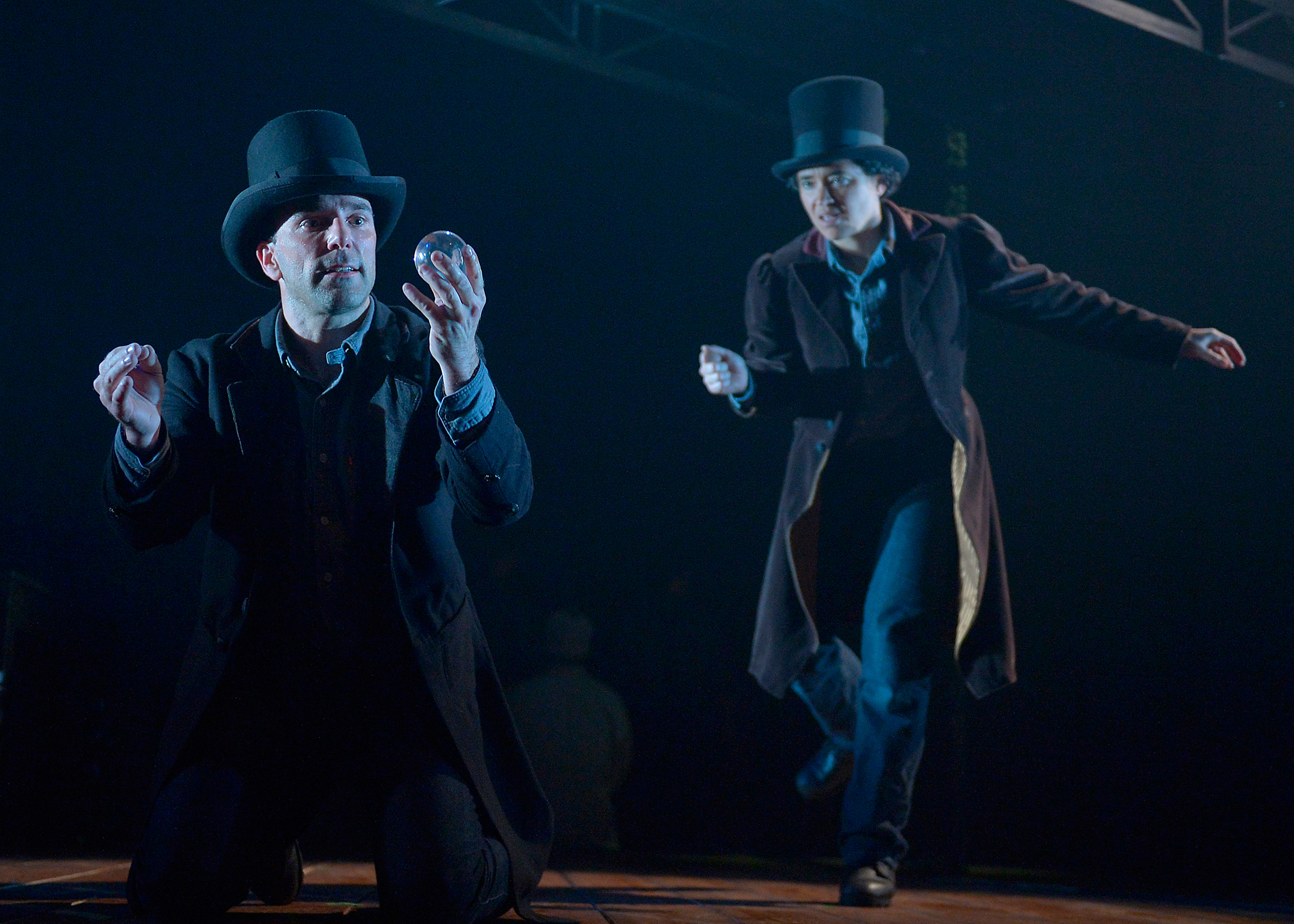
Khris Lewin, Rami Margron
(photo courtesy of MTC)
There are countless versions of Charles Dickens’ yuletide standard A Christmas Carol, and they all focus on what happens to that old meanie, Ebenezer Scrooge. But what about the catalyst for Scrooge’s salvation – his equally mean and miserly partner, dead-as-a-doornail Jacob Marley? Award-winning playwright, actor and director Tom Mula answers this question and more in his startling, otherworldly Jacob Marley’s Christmas Carol, based on his novel of the same name. The audio version of the novel enjoyed great success on National Public Radio and ran for six seasons, winning the INDI Award for Spoken Word. Mula then crafted his book into a solo piece which he performed himself during its debut in 1998 at the Goodman Theater in Chicago. Later he reworked the piece into a play for four actors, and this is the version now being presented at Marin Theatre Company in Mill Valley. It’s a truly original experience, combining elements of radio drama, comedy, traditional theatre and pantomime in the most enchanting and unexpected ways.
The story begins in the afterlife where Marley, in chains, comes to realize that he can only redeem himself by redeeming the miserable Scrooge. He sets out on his mission accompanied by a sort of puckish angel-guide known as The Bogle. His interactions with Scrooge and the three Spirits of Christmas (Past, Present and Future, played by each of the cast members in multiple roles) are by now well-known, but presented here with a more poignant urgency since we now know the reason behind this ghostly intervention. There are intense physical gymnastics required of the actors, which heightens the visual impact. Characters also must pivot from third-person to first-person narratives in the blink of an eye.
Khris Lewin in the lead role of Marley brings great emotional shading and empathy to this heretofore mysterious and stunted character of classic literature. His resourceful sidekick The Bogle is played like a gutsy Tinkerbelle by Rami Margron, perhaps the most entertaining and engaging performer in the show. Nicholas Pelczar is effective as Scrooge, playing second fiddle to Marley in this story, but he can’t match Lewin’s energy and seems almost subdued in comparison.
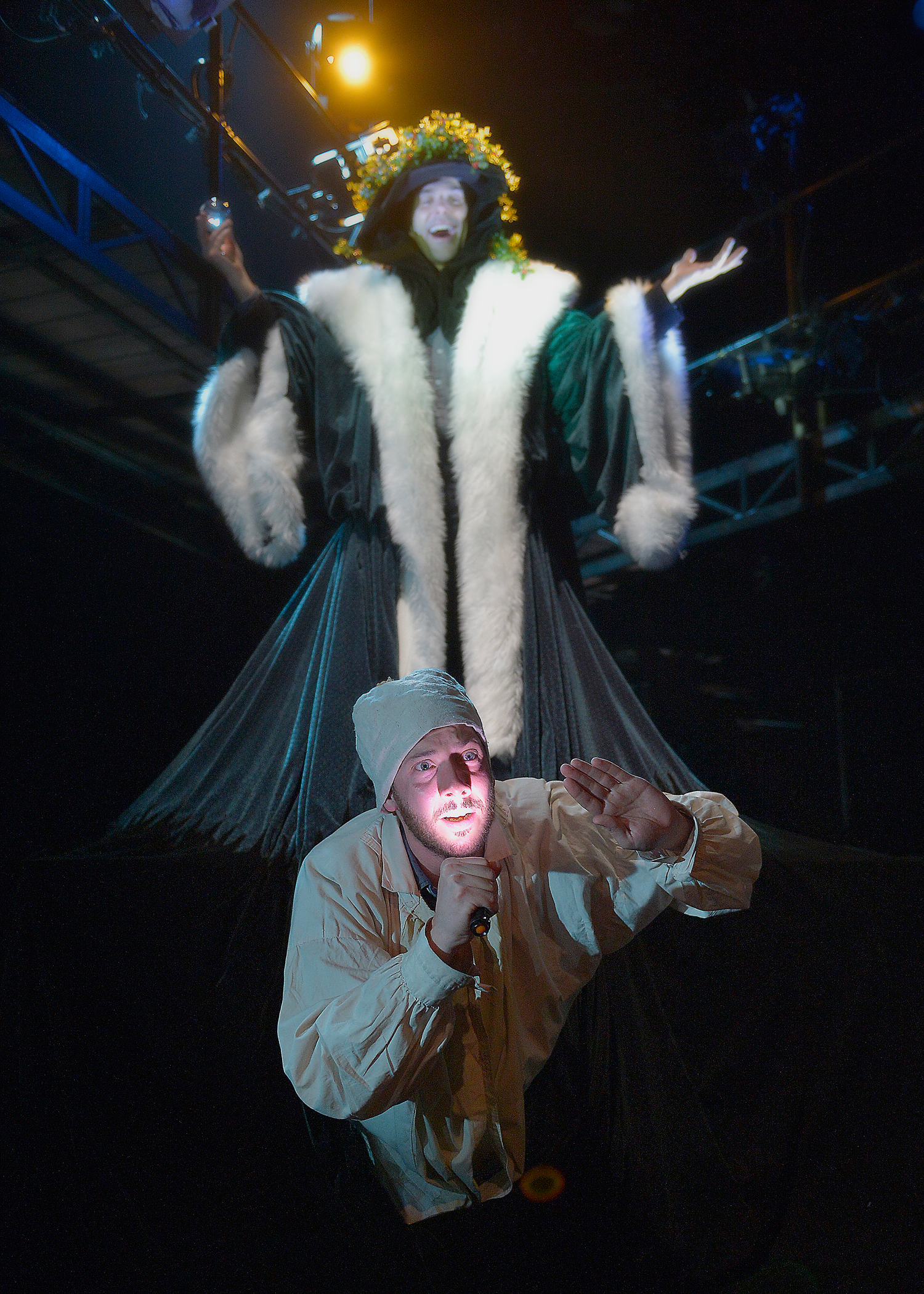
Khris Lewin (standing), Nicholas Pelczar
(photos courtesy of MTC)
The role of the Record Keeper was to be played by Stacy Ross, but just moments before curtain at a recent matinee, she was rushed to the hospital with a severe back injury. MTC Artistic Director Jasson Minadakis bravely stepped into the breach to read her part off-book. There’s no doubt the show was thrown a little off-balance for this one performance, but unfortunately the MTC budget does not allow for understudies. Minadakis did the best he could on such short notice.
A network of scaffolding and pipes that extends the width of the stage serves as the set, with no props to speak of with the possible exception of one large, thick-limbed table that is flipped and repositioned to serve many different forms. Jon Tracy’s fluid direction and choreographic staging keeps the cast in constant, hyper-kinetic motion. Dazzling light effects by Kurt Landisman include a universe of stars that fill the theater. Flashlights are put into the hands of the actors to highlight certain scenes in highly creative ways. The beams form the frames of a window, radiate like angel wings or spotlight another character’s face at critical moments. This Christmas Carol is a thrilling, truly exceptional show, a perfect harmony of performers, light and sound.
Meanwhile, to the north, there’s Scrooge, the musical version of the Dickens classic A Christmas Carol. Delighting audiences and rattling the walls at the small 84-seat black box theater at the Spreckels Performing Arts Center in Rohnert Park, it’s a wondrous tempest in a teacup, definitely family fare.
Here we’re in more familiar territory, with Scrooge being Scrooge, and getting his ghostly visits accompanied by lively musical numbers and show-stopping choreography. Based on the 1970 film with music and lyrics by Leslie Bricusse, the production at Spreckels features unique scenic and lighting effects courtesy of their proprietary Paradyne projection system. Director Gene Abravaya was aware of the challenges of staging such a big show in a small space and ensures that the action never lets up. Each member of the cast of 19, from lead performers to ensemble, remains fully animated. It’s a wonder, but they manage to use every square inch of space during the dance numbers nicely choreographed by Michella Snyder, pulling it off with nary a hitch.

Harry Duke, Tim Setzer
(photo by Eric Chazankin)
Tim Setzer leads the way as the nasty Scrooge. He has a very special intensity playing this difficult role, and he’s in superb voice as his character transforms; churlish growls give way to tender entreaties and joyful shouts. His is possibly the best performance in the show, and he’s in good company. Dwayne Stincelli as Fezziwig and Peter Warden as Scrooge’s nephew Fred offer fine, nuanced performances. Also noteworthy are Pam Koppel as the Ghost of Christmas Past and Sam Starr as Tom Jenkins. The key role of Tiny Tim is played by little Andrea Luekens who has a lovely singing voice. Marley’s ghost (Harry Duke, looking and sounding much like a baleful Alfred Hitchcock) arrives on the scene early on and, setting the tone, is more comic than spook. But there are some scary moments to be sure, with loud rumblings that vibrate the very rafters and ghostly zombies slithering out from under the front-row seats.
Abravaya says that the intimacy of this smaller venue demands a higher level of emotional reaction from his cast to keep the audience fully engaged. When you see the performers from inches away, every subtle reaction counts, where a bigger theater is more forgiving and gestures can be more broad. This strategy is a great success, fully showcasing the talent of the cast. As for music, there’s only an electronic piano played by music director Cynthia Heath, along with bass and drums to provide accompaniment to the elaborate musical numbers, but it works. Some of the more inspiring songs include “ Make the Most of This World”, “The Minister’s Cat”, “Love While You Can”, and the especially rousing “Thank You Very Much”. Costume designer Pamela Enz does a remarkable job, effectively calling up the Dickensian world.
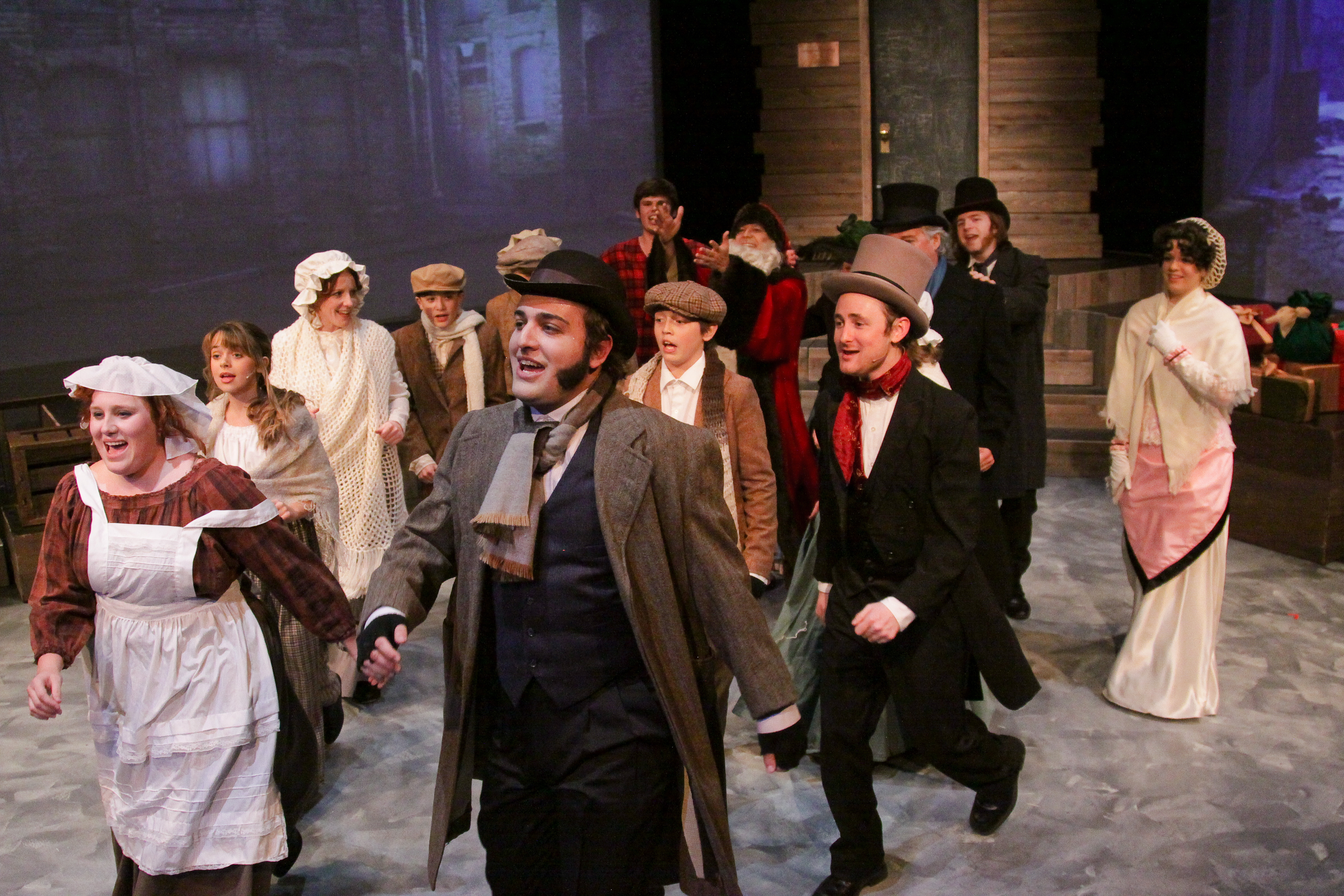
Cast of “Scrooge”
(photo by Eric Chazankin)
In Jacob Marley’s Christmas Carol, Marley ultimately loses his chains, but he’s not so lucky in Scrooge. These two productions present very different views of the infamous Scrooge, but they have a common theme: our time on Earth is short, and we must cherish each moment and the ones we love. Both leave you invigorated, with a warm and cozy outlook just right for celebrating the holidays. See one or both – you can’t go wrong.
Jacob Marley’s Christmas Carol presented by Marin Theatre Company
When: now through December 22, 2013
8 p.m. Tuesdays, Thursdays, Fridays and Saturdays
7:30 p.m. Wednesdays
2 p.m. and 7 p.m. Sundays
2 p.m. Saturday, December 28
Tickets: $37 to $58
Location: Marin Theatre Company
397 Miller Avenue, Mill Valley CA 94941
Phone: 415-388-5208
Website: www.marintheatre.org
Scrooge presented by Spreckels Theatre Company
When: Now through December 22, 2013
7:30 p.m. Thursdays
8:00 p.m. Fridays and Saturdays
2:00 p.m. Saturdays and Sundays
Tickets: $22 to $26 (reserved seating)
Location: Bette Condiotti Theater at Spreckels Performing Arts Center
5409 Snyder Lane, Rohnert Park CA
Phone: 707-588-3400
Website: www.spreckelsonline.com

Three critters jumpstart the laughter in “Frogz,” a Cal Performances show in Berkeley.
- Singing cowboy has a little trouble staying erect in “Frogz.”

- Leapin’ lizards? No. They just slither, in “Frogz.”

Woody’s [rating:5]
Three humans in full frog costumes sit silently at centerstage. They don’t move.
For what seems a long time.
That alone makes much of the audience laugh — most likely in expectation.
When one head finally bobbles, I smile. My wife laughs. Our six-year-old granddaughter giggles aloud.
Moments later, when all three are leap-frogging, stretching via calisthenics and frog-kicking wildly, I smile a bunch, my wife laughs again, and the kid giggles and giggles and giggles.
She also squeals in delight.
And that’s the way it continues, intermittently, for an hour and a half at the multi-costumed, masked Cal Performances show in Berkeley — charming both children and adults in the cavernous, 2,000-seat Zellerbach Hall.
Who says today’s entertainment must be filled with sexploitation, f-bombs or blood and guts?
Not I certainly.
Wholesome family entertainment obviously still exists.
My wife and I had seen the Portland-based Imago Theatre’s signature piece before, years ago. Watching it with the kid made it even more pleasurable.
There were times when it became extremely difficult to decide where our attention should be — on the antics of the five performers or on the delighted face of our granddaughter.
The wordless but musical two-act performance was fantastic, in every sense of that word.
Mostly whimsical. Almost magical.
Momentarily, a viewer might find hints of the mask-mime performers of Mummenschanz, the dancers of Philobolus, the acrobats of Cirque du Soleil or the illusionists of Momix.
Somewhere over the rainbow — perhaps in Kansas, maybe in Brigadoon — there may be another show that features penguins playing musical chairs, sloths that have trouble spelling, papa and mama and baby accordions that move like a Slinky, flittering lights and flying schools of fish, huge balls that momentarily squoosh an equally huge toddler, an alligator and lizard that squirm into the audience, and a singing cowboy with a non-stop changing head.
But I doubt it: “Frogz” is special, one-of-a-kind.
Flawlessly, it blends lively cartoonish characters with imaginative illusions that utilize mime, dance, acrobatics and puppetry.
Carol Triffle and Jerry Mouawad, artistic co-creators, dreamed up the show in the late 1970s. And it’s clear they dreamed in comic relief and primary colors.
The original sound design of Katie Griesar complements their efforts.
Griesar, the program guide acknowledges, “makes music with guitar, antique and toy musical instruments, found objects, collected sounds, wrong notes, and awkward gestures.”
Imago began as a mask theater company, inspired by French mime-actor Jacques Lecoq’s idea that performers could show emotions and characters through moment despite their faces being hidden.
Since its inception, it has performed all over the world — including three Broadway runs.
The troupe also has ventured into purely adult fare such as Harold Pinter’s “The Carpenter,” Anton Chekhov’s “Uncle Vanya” and Jean-Paul Sartre’s “No Exit.”
In case you missed “Frogz,” Cal Performances offers other excellent choices for families. Try, for example, these upcoming show: the Peking Acrobats, Jan. 25 and 26; Michael Cooper’s “Masked Marvels & Wondertales,” Feb. 9; and “Aesop Bops!” with David Gonzalez and the Yak Yak Band, April 6.
Borough President (Gabriel Marin) begins to “feel alive” in Storefront Church
[rating:5] (5/5 stars)
San Francisco Playhouse presents Storefront Church, the third play in John Patrick Shanley’s “Church and State” trilogy. This play stands up to the two previous plays–the Pulitzer Prize winning Doubt (2004) and Defiance (2006). Here the playwright grapples with conflict between greed and redemption.
Brilliantly directed by Joy Carlin and featuring an accomplished cast, Storefront Church is a beautifully constructed play. Thrown together by a mortgage crisis, a basically decent, ethically conflicted Bronx borough President (Gabriel Marin) and a high minded preacher who’s a Katrina refugee from New Orleans (Carl Lumbly) square off in an intense confrontation about their individual commitments to their social and spiritual beliefs.
Gabriel Marin is scrappy and cynical as an up and coming politician Donaldo whose somewhat naïve constituent, Jessie Cortez (a whimsically funny Gloria Weinstock) comes to him for help with an imminent foreclosure after ill advisedly taking out a second mortgage so the preacher could renovate her first floor storefront into a church.
Jessie believes the preacher (strongly portrayed by Carl Lumbly), even though he hasn’t paid her back any money in ten months. After her husband (a down on his luck, hard working, elderly accountant played mainly for laughs by Ray Reinhardt) has a heart attack in front of the loan office, Jessie is determined to get Donaldo to intercede with the bank.
Rod Gnapp is excellent as Loan Officer, Reed. Derek Fischer, as a senior bank officer, plays his part with a well-tuned false heartiness.
When all six characters come together for a Sunday morning service in the humble storefront church, the outcome is both surprising and satisfying. Even a shabby room can become a community—a sanctuary for respite from what the preacher calls “mindless activity” and “organized greed.”
All of the play’s wonder is made possible with Bill English’s remarkable set, Abra Berman’s costumes and David K.H. Elliott’s lighting. The entire production is a delightful Christmas gift from the remarkable San Francisco Playhouse.
Storefront Church runs November 26, 2013-January 11, 2014. SF Playhouse is located at 450 Post Street (2nd floor of Kensington Park Hotel, b/n Powell and Mason), San Francisco. Performances are held Tuesday-Thursday at 7 p.m. and Friday-Saturday at 8 p.m. Matinees are 3 p.m. Saturday and 2 p.m. Sunday with an added 7 p.m. Sunday performance on December 22. No show December 24, 25 and January 1. For tickets, call 415-677-9596 or go online at www.sfplayhouse.org.
Coming up next at SF Playhouse will be Jerusalem by Jez Butterworth and directed by Bill English January 22-March 8, 2014.
Flora Lynn Isaacson
By Judy Richter
San Jose Repertory Theatre is bravely presenting the world premiere of an ambitious homegrown musical, “The Snow Queen.”
Based on the fairy tale by Hans Christian Andersen, this adaptation follows the intrepid young Gerda (Eryn Murman) as she tries to find and then rescue her friend, Kai (Tim Homsley), who has fallen into the clutches of the evil Snow Queen (Jane Pfitsch).
During Gerda’s long journey she meets some good and some bad people as well as some good animals and flowers. Most actors in the energetic 10-person ensemble play several roles, and some take up instruments to play with the three-person onstage band.
All of this takes place on a two-level set with movable platforms designed by Erik Flatmo. Lighting and artistic projections, especially the lovely aurora borealis, by David Lee Cuthbert help to define settings.
The show features a book by associate artistic director Kirsten Brandt and artistic director Rick Lombardo, who also directs and choreographs the production. The music is by Haddon Kime with lyrics by all three. Musical direction is by Dolores Duran-Cefalu, who conducts from the keyboard.
Kime’s music is a mix of ballads and rock, some of it sounding the same. Some of it seems derivative of Stephen Sondheim’s “Into the Woods.” The show’s best received song was “Flying,” which ends the first act. “Never Give Up,” which opens the second act, is also noteworthy for Lombardo’s choreography.
The show would benefit from some cutting. For example, the scene with the Old Crow (Jason Hite) goes on too long, especially with his overacting. “I Want That,” sung by Robber Girl (Cindy Im), who captures Gerda, could be eliminated.
Frances Nelson McSherry has designed some fanciful costumes and outfitted the Snow Queen in a beautiful, glittering white gown, but Gerda’s outfit seems drab. For that matter, Murman’s performance lacks the stage presence and spark that would make Gerda a stronger heroine.
When it comes to stage presence, Pfitsch has it in spades as the Snow Queen. Another strong presence comes from Lee Ann Payne in her multiple roles, especially as Gerda’s grandmother, the Witch and the Wise Woman of the North. Homsley is noteworthy as Kai. Rhett George’s best moments come when he portrays the reindeer that helped Gerda.
This two-act show runs more than two hours, including a 20-minute intermission. Because it tends to be episodic and because the diction could be better in some songs, it’s sometimes hard to follow. That’s where judicious pruning would be helpful, as would a more detailed synopsis in the program.