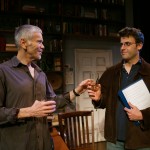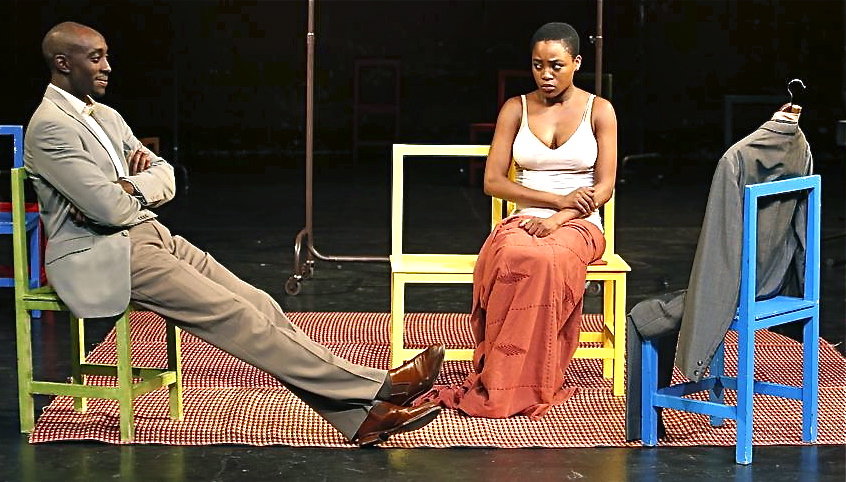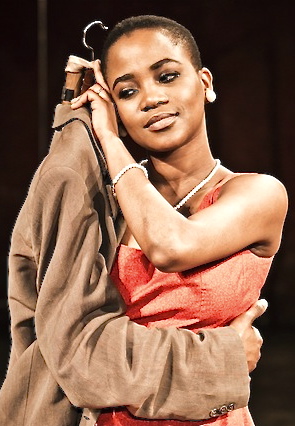
NOT A GENUINE BLACK MAN a 10th anniversary success at Berkeley Rep

By Kedar K. Adour

NOT A GENUINE BLACK MAN: Dramatic Monolog. Written and performed by Brian Copeland.  Developed by Brian Copeland and David Ford. Directed by David Ford. Berkeley Rep, The Osher Studio, 2055 Center Street, Berkeley, CA 94704 (Located in the Arts Passage on Center Street between Shattuck and Milvia — just a block from Berkeley Rep) (510) 647-2949 or www.berkeleyrep.org.

EXTENDED THROUGH JUNE 28

NOT A GENUINE BLACK MAN a 10th anniversary success at Berkeley Rep [Rating:4] (4 of 5 stars)

Brian Copeland

You may wonder who is Brian Copeland and what does he have to say that has kept his dramatic monolog in the public eye for 10 years. Opening to rave reviews at The Marsh in San Francisco in 2004 the monolog and the performer have been equally well received throughout the United States. Last night he received a standing ovation at Berkeley Rep’s Osher Studio again demonstrating his skill as a performer but with a suggestion that over familiarity with his material has taken some sting out of his horrendous story of being a black man in a racist white environment.

The environment in question is Bay Area suburb of San Leandro that was a hotbed of racism in the 1970s when, at the age of eight, he moved with his family into an all-white neighborhood. There he his family received intimidation, racial slurs and eventually threat of eviction. Now at age 50 he is very successful radio and TV host and still lives in San Leandro that initially was 99% white but now is one of the most ethnically diverse communities in America.

He starts the evening with a few humorous anecdotes that quickly shift to startling stories of what he had to endure. The title for his monolog is attributed to a letter he received from a black listener to a radio show he was hosting. He was accused of not being “a genuine black man.” He questions of why black people say this of him. Are there distinctive traits, other than skin color, that deserve the label of being a genuine black man? The question is rhetorical and Copland moves on to tell the shocking stories of his life beginning with a father, Sylvester, who “went out for groceries and never came back.” When he did come back he was abusive to the entire family.

Copland is a master at changing his voice and using body language to depict the various people who inhabited his world. There is the thin voice of his mother who insists she was born in Rhode Island rather than Alabama. Then there are the strong declarations of his grandmother, the vicious diatribes of Sylvester, the childlike speech of his young sisters, and a plethora of characters that impinge on his life. He is masterful at becoming himself as an eight year old.

How he ever was able to rise above the hate and other tribulations that surrounded him is a story that deserves telling again and again. As a seasoned performer with an excellent director and he is able to balance much of the heartache with humorous quips to give the audience breathers between the dramatic sequences.  An unexpected shocker takes place at the end of act one when Copeland describes his bouts with depression and attempted suicide.

In act one Copeland’s change from the voices of his characters to his own mature voice seems at times to be by rote and does not fully express the monstrosity of the various incidents. In the second act that apparent lapse is not present and he reaches out with his professional demeanor to encircle the audience with his passion as they rose for a standing ovation. Running time about two hours with an intermission.

Kedar K. Adour, MD

Courtesy of www.theatreworldinternetmagazine.com.

Photo by Joan Marcus

WITTENBERG an intellectual hilarious romp at Aurora

By Kedar K. Adour

Hamlet (c. Jeremy Kahn*) is torn between Faustus (l. Michael Stevenson*) and Martin Luther (r. Dan Hiatt*) in Wittenberg

Wittenberg: A Tragical-Comical-Historical in Two Acts. By David Davalos. Directed by Josh Costello.  Aurora Theatre, 2081 Addison St., Berkeley. (510) 843-4822. www.auroratheatre.org. Extended through May 11, 2014.

WITTENBERG an intellectual hilarious romp at Aurora [rating:4] (4 of 5 stars)

The subtitle of David Davalos’ Wittenberg: “A Tragical-Comical-Historical in Two Acts”, is extremely descriptive of what you will see and hear in this laugh out loud, with occasional “Oh, no!” guffaws, production that is gracing the Aurora stage. Being familiar with Shakespeare’s Hamlet, Marlowe’s The Tragical History of the Life and Death of Doctor Faustus and the teachings of Martin Luther will enhance your evening. Consider what would happen at a meeting between fictional Hamlet, semi-fictional Faustus and real life Luther and you have the outline of Davalos’ smart, intellectual comedy.

Davalos postulates that Wittenberg University in Germany is common ground where the three could have met. In Shakespeare’s Hamlet he leaves Wittenberg returning to Denmark to avenge the death of his father.  Luther was a learned theologian and lecturer at Wittenberg where he nailed 95 Theses to the church door unmasking the corrupt practices in the Catholic Church leading to the Protestant Reformation. He and his followers demonized the real, self-proclaimed astrologer, physician and magician Faustus for witchcraft due to his dismissal of theology as false teaching.

Hamlet is portrayed as an ineffectual/vacillating senior student/athlete who still has not yet declared his major. That leaves him fair game for Luther’s theology and Faustus’ hedonistic philosophy as they vie for his soul. Davalos may try to give equal shrift to Luther’s and Faustus’ beliefs but after the scene where Luther proclaims that his cleansing bowel movement, actually brought on by a laxative given him by Faustus, was the cleansing of his soul, the advantage goes to Faustus.

The word ‘advantage’ has a more plebian definition when Hamlet plays a simulated tennis match with the unseen Laertes from a rival University. Copernicus enters in the rivalry when his concept of the earth moving around the sun is considered heresy.

All is not theology and philosophy since Davalos has written hilarious scenes liberally borrowing lines from Shakespeare and Marlowe irreverently subverting their intent.  He also invents the proverbial student ale drinking house, “The Bung Hole”, with a two stein minimum and ‘all the tripe you can eat.’

Dr. Faustus’ excessive appetite for living and female sex reaches a climax (actually multiple climaxes) during his dalliances with lover Helen while Luther is pontificating from the pulpit on the marvelous faux Cathedral set (Eric  E. Sinkkonen). Elizabeth Carter does quadruple duty as all four women in the cast giving each a distinctive flair.

Faustus’ (l. Michael Stevenson*) love interest, Helen (c. Elizabeth Carter*), flirts wildly with Hamlet (r. Jeremy Kahn*) after he wins a tennis match in Wittenberg


One could not ask for a more superlative cast that director Costello almost keeps in balance since the role of Faustus as played by Michael Stevenson is allowed to dominate the stage during his solo and ensemble time upon the stage. Jeremy Kahn should audition for the role of Hamlet in any forthcoming production of the Bard’s play since his depiction of the melancholy Dane rings true even though he must bound upon the stage in tennis regalia (brilliant costuming by Maggie Yule) to win his match with Laertes. Local favorite Dan Hiatt gives depth to Luther’s beliefs and has a subtle approach to comedy inherent in the script matching Stevenson scene for scene.  Running time 2 hours and 10 minutes with an intermission.

THE CAST: (in alphabetical order) Elizabeth Carter, Gretchen, Helen, Mary, Voltemand; Dan Hiatt, Luther; Jeremy Kahn, Hamlet; Michael Stevenson; Faustus; Jeffrey Lloyd Heatherly, Voice of the Judge; Daniel Petzold,, Voice of  Laertus.

DESIGNERS & CREW: Lighting designer, Jim Cave; Stage Manager , Leslie M. Radin; Properties, Laraine Gurke; Set designer , Eric Sinkkonen; Sound design, Chris Houston; Costume design: Maggi Yule

Kedar K. Adour, MD

Courtesy of www.theatreworldinternetmagazine.com. 


Little Shop of Horrors, Andrews Hall at Sonoma Community Center, Sonoma CA

By Greg & Suzanne Angeo

Reviewed by Suzanne and Greg Angeo

Members, San Francisco Bay Area Theatre Critics Circle

Matlock Zumsteg & Harry Duke

Shoppin’ and Boppin’ – This Horror Rocks

Andrews Hall is located inside the Sonoma Community Center, a beautiful, century-old Greek Revival building in downtown Sonoma. It’s a lovely drive from Santa Rosa down picturesque Highway 12, through bucolic scenes of vineyard and farmland. This serene landscape does little to prepare you for what’s in store, however, if you’re planning to see Little Shop of Horrors, presented at Andrews Hall by the Narrow Way Stage Company in its second season with the Sonoma Theatre Alliance.

This perky yet darkly comic rock-and-roll musical is based on Roger Corman’s 1960 film of the same name. It was adapted for the stage and first opened off-Broadway in 1982 and ultimately ran for five years. It garnered numerous awards, due in large part to the catchy songs by Howard Ashman and Alan Menken, who drew heavily from early Motown and other pop music from the early 60s. This ambitious production by Narrow Way is a fun and lively show, a pleasant way to spend an afternoon or evening. The best efforts of cast and crew are only partly hampered by the lack of space, which presents a challenge in shows of this kind. Especially if there’s a large, funky flesh-eating plant that takes up most of the stage.

The setting is a failing Skid Row flower shop.  Harry Duke as the schlumpy shopkeeper Mr Mushnik displays good instincts in presenting his character, who’s fallen on hard times. Duke seems to be channeling Tevye in Fiddler on the Roof. His perfect Russian Jewish accent pays off handsomely and his soft baritone lends a nice quality to the show.

Mushnik’s sad sack shop assistant Seymour (Matlock Zumsteg) finds an odd little plant one day during an eclipse, and brings it back to the shop. He soon discovers it needs more than just water and sunshine…it needs human blood in order to thrive. Seymour does his best to oblige, and the plant not only grows large and menacing, but develops a bellowing voice, demanding (in raucous song) even more from its hapless caretaker. Seymour makes a Faustian bargain with the beastly plant – success in return for human sacrifice. A perfect setup for laughs and rollicking rock and roll music, right?

Nora Summers & Matlock Zumsteg

Zumsteg gives Seymour a shy, nerdy likeability that goes beyond his comic strip confines.  His voice is well suited for the score, strong and steady. Seymour has an unrequited crush on shop girl Audrey (Nora Summers) who in turn has a weakness for no-goodnicks. Case in point: her current boyfriend, the sadistic biker-dentist Orin (Dallas Munger) who keeps her in black eyes and ace bandages. Summers plays Audrey as sort of a trashy-sweet innocent kid, not easy to pull off, but she does it and she’s the heart of the show. Munger, as Orin, comes off like a crazed hipster in black leather who just happens to carry a small can of nitrous oxide for a quick blast wherever he goes. Munger hams it up with mad abandon, but not-so-divine justice is waiting just around the corner for Orin.

The events in the story give theatre companies ample opportunity to explore their creativity in crafting puppets to represent the ever-growing ghoulish vampire plant, and Narrow Way gets to show their stuff in this regard. Music and voiceover artist Butch Engle gives the ferocious fern plenty of Wolfman Jack soul and campy attitude. He’s quite simply the best thing in the show and worth the price of admission. Engle is discreetly tucked away upstage on scaffolding above the action, along with the Skid Row Band, which is equally fabulous under the able direction of Justin Pyne. The score is simply infectious, and it’s almost impossible to resist the urge to jump up and dance on your chair. Songs like the rockin’ “Skid Row” performed by the company, Munger’s anthem “Dentist!” and the lovely, wistful “Somewhere That’s Green” sung by Audrey. Even perched on high way back upstage, you can still see the band, and at times Engle is more fun to watch than the plant.

Regie Padua, Alexis Long and Laura Levin as Ronette, Crystal and Chiffon – three street urchins that form a sort of doo-wop girl group Greek chorus – interpret the action onstage for the audience throughout the show. As characters, they provide a great bridge between scenes. As singers, they are only adequate; pitchiness and lack of sustained vocal quality create an uneven feel to the show.

Choreographer Alise Girard, so splendid in shows with large casts and elaborate dance numbers, isn’t as challenged with the small cast and stage this time, but does a commendable job nonetheless. Director Christopher Ginesi makes good choices and takes some creative risks that work most of the time. It takes ingenuity to fit a big show into a small space and have it work this well. With all its imperfections, this Little Shop is really entertaining and well worth a visit.

When: Now through May 4, 2014

8:00 p.m. Thursdays, Fridays & Saturdays

2:00 p.m. Sundays

Tickets $20 to $30


Andrews Hall at Sonoma Community Center

276 East Napa Street

Sonoma, CA 95476

(707) 938-4626

www.sonomatheatrealliance.org

SLEEPING CUTIE almost ready for prime time.

By Kedar K. Adour

Jesse Caldwell and Marissa Joy Ganz

Sleeping Cutie:A Fractured Fairy Tale Musical. Music by Doug Katsaros .Lyrics and book by Diane Sampson.Directed by Cindy Goldfield.Music Direction by David Aaron Brown.  Off a Cliff ProductionsSponsored by Playground @ Thick House – 1695 18th St. (Between Arkansas & Carolina Streets), San Francisco, CA 94107 Tickets: www.sleepingcutiemusicaltix.comor 415- 992-6677World Premiere – Limited Engagement –April 17 – May 11, 2014

EXTENDED THROUGH MAY 21, 2014

SLEEPING CUTIE almost ready for prime time. [Rating:3] (3 of 5 stars)

PlayGround is the Bay Area’s incubator for new playwrights and this 18th year of supporting fledgling writers is their most ambitious. They have elected to begin with a world premiere musical commissioned and supported by the New Play Production Fund. The play began as a ten minute Monday night reading in 2012 and is now a full length two act barrel of fun receiving its world premiere at the intimate Thick House. Although it provides a fun evening there is much to be done before it is ready for the road.

It is a very clever but hardly original concept that is outlined in a sprightly opening number “What it Isn’t” by the seven member cast and three man onstage band. It is a fairy tale with “action in a modern vein”, “not big or fancy”, and “no orchestra and no pit” because the “stage is too small.” Diane Sampson’s lyrics fit the eclectic music with an occasional banal rhyme earning a chuckling groan.

The promise of the rousing opening number is lost with Marissa Joy Ganz’s rendition of “Drummer Queen” a witty patter song listing the names of notable former drummers. Those names are unintelligible and Ganz never gains the audience’s approbation in this promising musical. The rest of the enthusiastic cast almost regain the momentum and get to have a reprise of “What it Isn’t” to open the second act.

The story line “in the modern vein” is based on the machinations of Bernie Madoff, who engineered the Ponzi scheme Enron Scandal. His role is listed as Father (Jesse Caldwell) with Ganz as his estranged teenage daughter Lucy. Lucy’s caretaker Mary (Stephanie Prentis), in an underwritten part is given two ballads to sing. One of those ballads “Some Way to Get Through the Night” is shared witha charming Luke Chapman playing blind Charlie, the love interest.  Then there is the semi-mysterious Woman (excellent Gwen Loeb) who is instrumental to a “happily ever after” finale.

Filling in the gaps with multiple roles are Man 1(John Patrick Moore) and Man 2 (Buzz Halsing) who give the show a boost when they make their entrances and exits. They get to perform soft shoe dances complete with canes as well as a cacophonic “Apocalypse” rock’n role number. They bring down the first act curtain with “Lawyerese.”

A label cannot be assigned to this show since the music is a pastiche of Broadway, jazz, rock and classical music that adroitly fit the storyline and add pizazz to Sampson’s lyrics. The finale by the company of “Deus Ex Machina” is a must see production number that partially erases the ambivalent feelings generated by this uneven production. Running time under two hours including an intermission.

CAST: Jesse Caldwell* (Father); Luke Chapman (Charlie); Marissa Joy Ganz* (Lucy); Buzz Halsing* (Man 2); Gwen Loeb* (Woman); John Patrick Moore* (Man 1) and Stephanie Prentice* (Mary).

Production: David Aaron Brown, Keyboard; Lily Sevier, Drums; Vincenzo DeLaRosa, Bass; Producer, Jim Kleinmann; Stage Manager, Bethanie Baeyen; Lighting Designer, Mark Hueske; Costume/Props Designer, Cindy Goldfield; Sound Designer, Josh Senick; Dresser, Melissa Kallstrom; Production Manager, Marcus Marotto; Production Assistant, Solia Martinez Jacobs; Publicist, Lawrence Helman; Casting Consultant, Annie Stuart; Associate Producer, Peter B. Miller

Kedar K. Adour, MD

Courtesy of www.theatreworldinternetmagazine.com

Triumphant Trio Scores in Fences at MTC

By Flora Lynn Isaacson

Margo Hall as Rose and Carl Lumbly as Troy in Fences at MTC. Photo by Ed Smith.

 [rating:4] (4/5 stars)

Bay Area veteran actors Carl Lumbly, Margo Hall and Steven Anthony Jones give moving performances in Fences by August Wilson and brilliantly directed by Derrick Sanders.

Fences is a 1983 play by American playwright August Wilson set in 1957 in the yard of the Maxson’s home in the Hill District of Pittsburgh, Pennsylvania. Fences is the sixth in Wilson’s ten-part “Pittsburgh Cycle.”  Like all of the Pittsburgh plays, Fences explores the evolving African-American experience and examines race relations among other themes.  This play won the 1987 Pulitzer Prize for Drama and the 1987 Tony Award for Best Play.

The focus of Wilson’s attention in Fences  is Troy Maxson (Carl Lumbly), a 53-year-old head of household who struggles with providing for his family.  Troy was a great baseball player in his younger years but then spent time in prison for an accidental murder he committed during a robbery.  Because the color barrier had not yet been broken in Major League baseball, Troy was unable to make much money or save for the future.  He now lives a menial, though respectable life of trash collecting, remarkably crossing the race barrier and becoming a driver instead of just a barrel lifter.  He lives with his wife Rose (Margo Hall), his son Cory (Eddie Ray Jackson) and Troy’s younger brother Gabriel (Adrian Roberts)—an ex-soldier.  Lyons (Tyee Tilghman) is Troy’s son from a previous marriage and lives outside the home.  Jim Bono (Steven Anthony Jones) is Troy’s best friend who has recently moved out and rented a room elsewhere but is still in the neighborhood.  Makaelah Bashir injects a possible ray of future hope in her role asTroy’s illegitimate daughter, Raynell.

Derrick Sanders stages Fences with excellent attention to realistic detail and evokes solid performances from his very talented cast.  The fence referred to in the title is revealed in the final set of the play.  It is not immediately known why Troy wants to build it, but a monologue in the second act shows how he wants to keep the Grim Reaper away.  Rose also wanted to build the fence and forced her husband to start it as a means of securing what was her own—keeping what belonged inside in and what should stay outside, out.

Fences plays at Marin Theatre Company April 10-May 11, 2014 with performances Tuesday and Thursday-Saturday at 8 p.m., Wednesday at 7:30 p.m. and Sunday at 7 p.m. Matinee performances will be held at 2 p.m. on Sundays and also Thursday April 24 and Saturday, May 3 and 10.  Performances are held at Marin Theatre Company, 397 Miller Avenue, Mill Valley.  For tickets, call the box office at 415-388-5208 or go online at www.marintheatre.org.

Coming up next at MTC will be the West Coast Premiere of Failure:  A Love Story by Philip Dawkins and directed by Jasson Minadakis, June 5-June 29, 2014.

Flora Lynn Isaacson


‘Tribes’ explores family, deafness

By Judy Richter

Deaf from birth, a young English man born into a hearing family has become skilled at reading lips. A young woman, who could hear when she was born into a deaf family and has learned sign language, is losing her hearing.

Their differing backgrounds and abilities form the essential conflict in Nina Raine’s sometimes amusing “Tribes,” presented by Berkeley Repertory Theatre.

When they become romantically involved, Sylvia (Nell Geisslinger) teaches Billy (James Caverly) sign language. He then insists that he and his family communicate that way only, much to their dismay.

His family is a loud, expletive-prone, dysfunctional group presided over by his pompously intellectual father, Christopher (Paul Whitworth), and his mother, Beth (Anita Carey), a would-be writer. Like Billy, their other two adult children, Daniel (Dan Clegg) and Ruth (Elizabeth Morton), still live at home, unable to get on with their lives. Daniel has mental health issues, while Ruth aspires to be an opera singer until she hears a recording of herself singing.

The play’s title, “Tribes,” comes from the hierarchical nature of the community of the Deaf (capitalized in the members’ preferred style), depending on whether one was born deaf or became deaf and whether one’s parents were deaf or hearing. Signing and lip reading are other factors.

No matter how one is classified, however, the community is insular, Sylvia complains. Although she had been comfortable in it, she’s having doubts just as her hearing loss is worsening.

Although the concept is intriguing and worthy of consideration, it’s difficult to care about any of the characters except Billy and Sylvia. Christopher, the father, is too blustery and critical. Daniel, whose problems manifest themselves in hearing voices and stuttering, is dependent on Billy and doesn’t want him to leave. Ruth is a cipher who complains a lot and fights with Daniel. Beth, the mother, tries to be a peacekeeper, but she’s an enabler, too.

Some plot threads go nowhere. One of the lesser ones is what has happened to the boyfriend that Sylvia had when she and Billy met. The more glaring one comes after Billy gets a job as an expert witness who reads lips in videos involving criminal cases and his employer discovers that he invented some dialogue.

California Shakespeare Theater artistic director Jonathan Moscone has a good cast, but he needs to exercise a firmer hand on the scenes involving Christopher and sometimes Daniel, who can become manic.

Caverly, who is involved with the National Theatre of the Deaf, has played the role of Billy elsewhere and does a terrific job, especially with his concentration in watching others speak and with his speech, which is generally clear.

Geisslinger has a strong stage presence and convincingly embodies Sylvia’s conflicted emotions as her hearing dwindles. Todd Rosenthal’s set features floor-to-ceiling shelves filled with books, indicative of the family’s academic bent.

“Tribes” has been a hit at theaters in England and the United States, and Berkeley Rep’s opening night audience gave it a rousing ovation. Nevertheless, it’s not entirely satisfying.

It continues at Berkeley Rep’s Thrust Stage, 2025 Addison St., Berkeley, through May 18. For tickets and information, call (510) 647-2949 or visit www.berkeleyrep.org.
TRIBES explores the world of silence at BerkeleyRep

By Kedar K. Adour

(l to r) James Caverly (Billy), Anita Carey (Beth), Dan Clegg (Daniel), and Elizabeth Morton (Ruth) take center stage in the Bay Area premiere of Nina Raine’s critically acclaimed family drama Tribes at Berkeley Rep.

TRIBES: Written by Nina Raine. Directed by Jonathan Moscone. Berkeley Repertory Theatre Thrust Stage, 2015 Addison Street @ Shattuck, Berkeley, CA 94704.510-647-2918 or www.berkeleyrep.orgEXTENDED through May 18, 2014.

TRIBES explores the world of silence at BerkeleyRep. [rating:5] (5/5 Stars)

Every so often audiences are treated a production that can be described as the “whole package.” BerkeleyRep has done it again with Nina Raine’s Tribes. The play is intelligent, expertly crafted with one minor exception, populated with impressive actors, directed with panache, staged with lights, sound/music befitting the subject matter and performed on a memorable set (Todd Rosenthal).  The standing ovation was well deserved.

Be advised to pay attention since the major character is a man born deaf, living with his normal hearing family Tribe. Much of the dialog is in sign language with projections often translating what is said. Billy (James Caverly) is the youngest member of the family and was born deaf. Patriarch Christopher (Paul Whitworth ) and mother Beth (Anita Carey ) have made the decision to bring up Billy without the benefit of sign language. Intelligent Billy has become an expert lip reader and has learned to talk, although with the truncated words typical of the hearing impaired.

In the opening scene with Christopher, Beth and the older children, Daniel (Dan Clegg) and Ruth (Elizabeth Morton) involved in loud, contentious bantering Billy is quietly sitting at the dinner table unaware of the turmoil.  It is a clever way author Raine demonstrates Billy’s  lack of involvement within the family. It foreshadows future conflict.

The family is living in an academic world with retired professor Christopher trying to learn Chinese and Beth unsuccessfully writing a novel. Ruth is trying to be an opera singer and earns a few dollars singing in cafés and churches. Daniel is a perpetual student working on a thesis and has problems maintaining female companionship. He also hears debilitating voices in his head that he cannot separate from reality suggesting schizophrenia.

(l to r) James Caverly (Billy) and Nell Geisslinger (Sylvia) fall in love

Within the confines of the family Tribe there is a balance that appears at times to be tenuous. When Billy meets Sylvia he falls in love. She is born of deaf parents who carry a “deafness’ gene causing their children to be born deaf or become deaf at a young age. Sylvia is an expert at signing since, other than in writing, that was her means of communication with her parents. Her hearing loss is progressive. Sylvia introduces Billy to the Deaf community and for her sake he learns sign language.

Within the Deaf community there are severe schisms with strong proponents of signing versus lip reading with actual hierarchies established. When Gallaudet University of the Deaf hired a “hearing” President the student body rose up in defiance and he was replaced. The more militant group within the Deaf tribe insists that they are not “different” or “abnormal” and oppose hearing aids and especially cochlear implants.

Drama and conflict arise within the play when Billy questions his parents’ decision to bring him up “normally” without the benefit of sign language. That leads to a cataclysmic second act that will have you on the edge of your seat. When Sylvia is introduced to the family the interrelationships are even more complicated since she knows the “hearing world” that she is losing. When she goes to play the piano at the end of act one you will feel deep anguish especially since her external hearing is paradoxically replaced by noises within her head.

The cast is marvelous. Paul Withworth is a master at subjugating his personae into the characters he is playing. In Shining City at SF Playhouse he sat perfectly still for his entire time on stage and yet created a well rounded character. Underneath his vociferous demeanor in this play he still earns our belief that his intentions were noble. Anita Carey stands toe to

(l to r) Paul Whitworth (Christopher) and Anita Carey (Beth)

toe with Withworth adding luster to her talents. Nell Geisslinger makes you feel Sylvia’s fear of progressive deafness. Dan Clegg and Elizabeth Morton have been given histrionic roles and earn their share of accolades.

The greatest number of accolades go to James Caverly who is deaf, a graduate of Gallaudet University, is a member of the National Theatre of the Deaf and has played the role of Billy in Boston and Washington. His acting skills are a wonder. 

Chalk this play up as a “must see.” Running time 2 hours including a 15 minute intermission.

 CAST: Anita Carey (Beth), James Caverly (Billy), Dan Clegg (Daniel), Nell Geisslinger (Sylvia), Elizabeth Morton (Ruth), and Paul Whitworth (Christopher)

 Creative team: Todd Rosenthal (scenic designer), Meg Neville (costume designer), Christopher Akerlind (lighting designer), Jake Rodriguez (sound designer), and Joan Osato (video designer). (All photos by mellopix.com)

Kedar K. Adour, MD


Program 6 — San Francisco Ballet Performance — Review

By Joe Cillo

Program 6

San Francisco Ballet Performance

April 15, 2014


Program 6 is three distinct ballets:  Maelstrom, Caprice, and The Rite of SpringMaelstrom was conceived and choreographed by Mark Morris, a sometime collaborator with the San Francisco Ballet, to Beethoven’s “Ghost” Trio, Op. 70, No. 1.  I don’t know why they called this “Maelstrom.”  There is nothing of a maelstrom in it.  It is a rather tame ballet.  The most interesting movement was the second, to the “Ghost” movement of the Beethoven Trio.  The name “Ghost” doesn’t apply very well to this music either.  The music is somber, even melancholy, but I don’t know what that has to do with a ghost.  My experience with ghosts is limited, but encountering a ghost is almost always a disturbing experience, or at best, enigmatic.  A ghost is usually sinister, foreboding, even malevolent.  But the music in Beethoven’s trio does not feel that way, nor does Morris’s dance.  I got the feeling that this Beethoven Trio does not lend itself well to dance, and maybe that is why this ballet never got off the ground.  The third movement is energetic and relatively light hearted.  The dance throughout this movement consisted of brief segments of dancers in twos and threes.  They would make a very brief appearance on stage, dance a brief vignette, and then exit to be replaced by another small group for another very short interlude, then exiting similarly, and so forth, through the entire movement.  This structure of brief episodes strung together gave the movement a very choppy feel.  It must have been intended for people with short attention spans.  The dance was furthermore not very interesting.  It had a sameness to it that became monotonous after a while.  The dancers did the best they could with it, but I didn’t think it was a very good concept.

Caprice is a world premier by San Francisco Ballet director Helgi Tomasson, set to music by Camille Saint-Seans.  This ballet was very well conceived, beautifully executed, imaginatively staged, and very interesting to watch.  I had the feeling that I was watching a master craftsman showing us what he’s got.  The movements were strong and decisive showing a lot of variety and imagination.  The highlight was the second of two adagio movements with two long male-female duets followed by the two couples sharing the stage.  The music was adagio, that is, a rather slow tempo, but it was not sad, somber, melancholy, or nostalgic.  It had a rather positive spirit, and underlying sense of well being and optimism.  The dance reflected that, which I was very pleased to see.  It was a male-female duet that was close, if not intimate, but at the same time, not overly emotional.  It was not restrained either; it was stalwart and sedate.  Tomasson hit it just right.  He had superb dancers to work with.  Luke Ingham is a magnificent specimen of masculine humanity who performed several impressive solos as well as the duets.  Caprice is an excellent ballet, and a pleasure to watch.

The Rite of Spring, set to music by Igor Stravinsky and choreographed by Yuri Possokhov, was the dramatic climax to the evening.  This ballet is visually captivating against a rich and varied musical score.  The dance perfectly mirrored the mood and temper of the music.  When a dance performance does this, it intensifies the emotional impact on the viewer.  The dancing underlines the emotional tone set by the music and realizes the musical mood in a visual experience.  But the dance also interprets the music and imparts a sense and a meaning to it that it might not have simply as a listening experience.  This ballet makes that point to the hilt.

There is a strong erotic feeling throughout the ballet that at times becomes downright lewd.  Movements are bold and forceful.  There is strong connection between the sexes.  Males and females strongly interact with one another with clear erotic intent.  But what happens?  The strong eroticism is decisively repudiated, in a similar vein to Wagner’s opera, Tannhäuser.  In Tannhäuser, after a brazenly erotic opening where Venus is unabashedly worshipped, Tannhäuser decides to forsake her for Mary, the mother of God.  The rest of the opera is the unfolding of this conflict in Tannhäuser, and in the end Venus and erotic love is spurned.  In this ballet one of the girls in the group of dancers is singled out and ritualistically killed as a sacrifice.  And that is how the ballet ends, with a girl being executed for reasons we are not given.  It is bleak and rather abrupt and comes across as a negative judgment on the manifested eroticism of the girls throughout the ballet.

What is the nature of this sacrifice and why was it done?  In the program we are told that the ballet reflects a practice of “primitive” people.  “Primitive” people kill one of their daughters as a ritual sacrifice.  Oh, really?  It’s too bad the primitive people are not here to mock and deride this ridiculous depiction of themselves.  Possokhov says that he believes it is abnormal people among the primitives who decide who should be killed.  That is why we have the two males with their bodies painted to represent a sort of shaman, who dance in a shared skirt throughout the ballet.  I guess that passes for abnormality.  But in a primitive tribe leaders are chosen by consensus.  One becomes a leader naturally by strength of personality and by displaying leadership skills that are crucial to survival of the entire group.  A leader cannot effect anything without the backing of many if not most of the group.  So an action of this magnitude that would deeply affect the entire group must be the responsibility of the entire group and not just a few aberrant leaders.  In other words, Possokhov’s conception of this ballet is based on nonsense.

The oldest man-made figures are nude females.  They go back some 25-30,000 years.  Primitive people worshipped females.  They exalted female sexuality.  In the Old Testament one of the greatest disgraces for a woman was to be barren.  Women were brought up to have sex and to have babies.  It was necessary.  It was vital to the survival of the tribe.  Fertility of the flocks, the game animals, and especially fertility of the young girls, were the highest values in primitive societies.

As Robert Graves observed in his study of Greek mythology,1

The whole of neolithic Europe, to judge from surviving artifacts and myths, had a remarkably homogenous system of religious ideas, based on the worship of the many-titled Mother-goddess . . . Ancient Europe had no gods.  The Great Goddess was regarded as immortal, changeless, and omnipotent; and the concept of fatherhood had not been introduced into religious thought.  She took lovers, but for pleasure, not to provide her children with a father.  (p. 13)

It is civilization that seeks to kill the sexuality of women.  Once it began to matter who the father of a child was, then necessarily female sexual behavior had to be curtailed.  This began with the development of private property and inheritance.  Once there was an estate to divide up after a man died, it became imperative to know which kids belonged to which man.  In a society that lived off the land by hunting and gathering this was not necessary.   The invention of private property and the acquisition of durable wealth meant that females had to become monogamous — which they had never been prior.

So this ritual sacrifice that we see in The Rite of Spring is a sacrifice demanded of young women by civilization, not by so-called “primitive” people.  There is a lie being told here, an arrogant misconception, that we, the civilized ones, are superior to the “primitive” people of long ago who supposedly sacrificed their young women — for what?  It doesn’t make any sense.  It is we who sacrifice young women; it is we who crucify them; we destroy them in order to maintain a society based on wealth, inequality, and inheritance.  That is why their natural eroticism has to be stifled.  We modern people are the abnormal ones, not the primitive tribes who are no longer here to answer for themselves.

The Rite of Spring is a bold, imaginative ballet with a confused, distorted message, but it is nevertheless a mesmerizing spectacle.  I would say it is one of the best ballets I have seen, really a masterpiece.  Unfortunately, it displaces the carnage that we wreak upon the psyches of women, and blames it on a false conception of the long lost past, when the real villains are here and now.


1.  Robert Graves (1955 [1992]) The Greek Myths: Complete Edition.  London:  Penguin Books.

FENCES is powerful but partially flawed at MTC.

By Kedar K. Adour

Margo Hall as Rose and Carl Lumbly as Troy Maxson in August Wilson’s Fences, running at Marin Theatre Company in Mill Valley through May 11. Photo by Ed Smith.

FENCES: Drama by August Wilson. Directed by Derrick Sanders. Marin Theatre Company ( in association with Lorraine Hansberry Theatre) Marin Theatre Company (MTC), 397 Miller Avenue, Mill Valley, CA 94941. www.marintheatre.org  or| (415) 388-5208 or boxoffice@marintheatre.org

EXTENDED THROUGH MAY 11, 2014

FENCES is powerful but partially flawed at MTC.  [rating:4] (4/5 stars)

August Wilson was a giant in the theatrical world and his legacy will live on for years. His magnum opus “The Pittsburgh Cycle” often called “The Century Cycle” is a 10 play compendium; Fences and The Piano Lesson were awarded Pulitzer Prizes for Drama and Fences won Tony Awards for its 1987 and the 2010 revival on Broadway. The plays are set in each decade beginning in 1900 and ending in 1990s depicting the African-American experience in the twentieth century mostly in the Hill District of Pittsburgh.

Fences is set in the 50s and briefly extends into the 60s for its dramatic dénouement. Carl Lumbly and Margo Hall play the major characters Troy Maxson and wife Rose with varying degrees of intensity and conviction. They are ably supported by Eddie Ray Jackson (Cory), Steven Anthony Jones (Jim Bono), Adrian Roberts (Gabriel), Tyee Tilghman (Lyons) and Jade Sweeney (12 year old Raynell alternating with Makaelah Bashir) who provide expressive sounding boards for Troy’s diatribes and justifications for his actions.

Marin Theatre’s production, in conjunction with the Lorraine Hansberry Theatre, as directed by Derrick Sanders is by far the darkest version to play the boards in the Bay Area. J.B Wilson’s powerful stunning set adds timbre to the action.  Lumbly’s gives a mostly one-dimensional depiction of the bitter Troy now a garbage worker who was baseball star in the Negro leagues denied a position in the all-white major leagues. Troy dominates his family, especially the youngest son Cory whose athletic abilities have the potential to outshine Troy’s feats. Rose is the faithful wife who attempts to intercede between the two.

The construction of the play relies on long external/internal monologs to define character by vocalizing previous experiences. Such construction requires superb acting and directing to prevent the evening from becoming long and tedious. Marin Theatre’s production is a qualified success with sections of brilliance interspersed with questionable directorial conceits. Margo Hall, a Bay Area favorite, can pull any audience into the play and does so for most of the evening. Inexplicably in the confrontational scene when Rose learns about Troy’s unfaithfulness, director Sanders allows her to wildly flail her arms about rather than reflect the strong deeply hurt matriarch of the family and lover to Troy.

The fence referred to by the play’s title is finished in the final act.  Rose wants the fence built to keep what belongs to her inside and what belongs outside, outside.  It is not immediately known why Troy wants to build it, but Wilson gives him a dramatic monologue in the second act conceptualizing it as an allegory—to keep the Grim Reaper away.

Steven Anthony Jones as Troy’s best friend Jim Bono nails the line, “Some people build fences to keep people out and other people build fences to keep people in. Rose wants to hold on to you all.” Considering the standing ovation on this second night of the show, you may have to break down the fences to see it.

Production Staff: Directed by Derrick Sanders; Scenic designer J. B. Wilson; Lighting designer Kurt Landisman, Costume designer Christine Crook;  Composer Chris Houston; Sound designer Will McCandles; Stage Manager Jessica Aguilar; Properties Artisan Seren Helday; Casting director Meg Pearson; Dramaturg Margot Melcon; Assistant director Edgar Gonzalez.

FEATURING: Margo Hall;  Eddie Ray Jackson;  Steven Anthony Jones; Carl Lumbly; Adrian Roberts; Tyee Tilghman with Makaelah Bashir and Jade Sweeney and Michael J. Asberry (understudy).

Kedar K. Adour, MD

COURTESY OF WWW.THEATREWORLDINTERNETMAGAZINE.COM.


Dragon’s ‘Smash’ is a hit

By Judy Richter

Married only 20 minutes, a groom leaves his bride in order to launch his plan to overthrow the British government.

Thus Jeffrey Hatcher’s “Smash” takes the Dragon Theatre audience through a witty satire of romance, education, socialism and lofty but misguided goals.

Hatcher based this two-act play on 1883’s “The Unsocial Socialist,” the last novel George Bernard Shaw wrote before starting to write plays. Hence Shaw aficionados will recognize themes and character types that figure into his plays.

In “Smash,” the time is moved up to spring 1910. The groom is Sidney Trefusis (William J. Brown III), a rich socialist, while his beloved bride is Henrietta Jansenius (Katie Rose Krueger), daughter of a wealthy man.

Disguising himself as a laborer he calls Mengels, Sidney goes to Alton College for women. Since its students are being groomed to become the wives of England’s most powerful men, Sidney plans to indoctrinate them with the ideals of socialism, which they will pass on to their husbands-to-be to begin a revolution.

Complicating matters, one of the students, the spunky, rebellious Agatha Wylie (Sarah Benjamin), falls in love with him. Their main nemesis is Alton’s headmistress, the formidable Miss Wilson (Shelley Lynn Johnson).

Another complication arises when Henrietta and her father, Mr. Jansenius (Paul Stout), an Alton trustee and Agatha’s godfather, arrive for Founders Day. Henrietta pretends not to recognize Sidney, but she’s instrumental in bringing about his comeuppance.

Vickie Rozell skillfully directs the 10-member ensemble cast, with each actor evoking the wit of the writing and the characters’ quirks.

Completing the cast are Kendall Callaghan and Laura Henricksen as Altonstudents; Evan Michael Schumacher and Brian Flegel as the men who love them; and Nicolae Muntean as the school’s longtime handyman.

Lighting and the ivy-walled set by Michael Palumbo work well on Dragon’s small stage. Handsome period costumes are by Y. Sharon Peng. Before Act 2, the sound design by Lance Huntley fittingly features music by Gilbert and Sullivan, whose operettas skewered English society in the late 19th century.

Thanks to this well done production, “Smash” is a rewarding, amusing two hours of theater.

It will continue at Dragon Theatre, 2120 Broadway St., Redwood City, through May 4. For tickets and information, call (650) 493-2006 or visit www.dragonproductions.net.