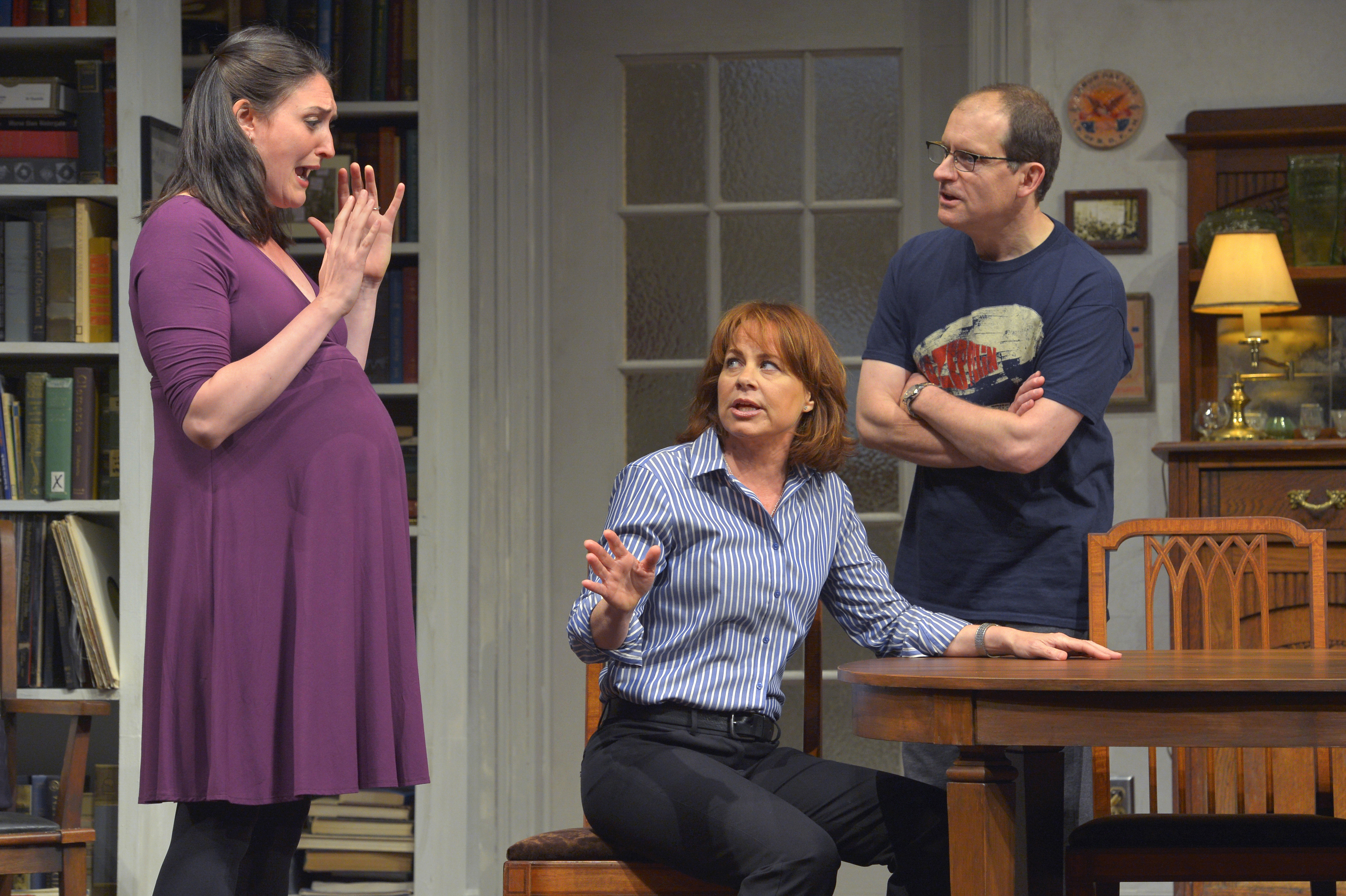
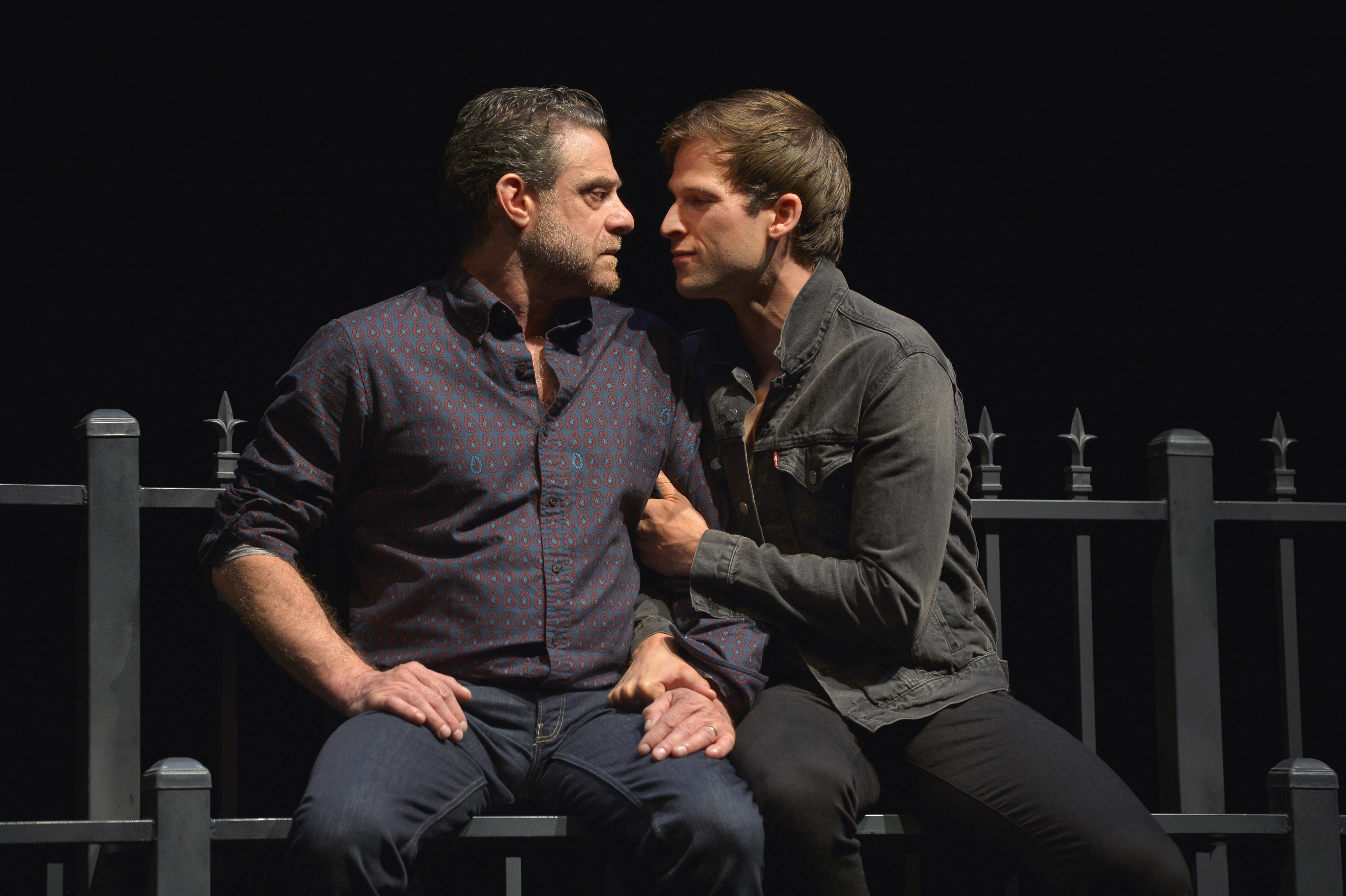
Moon for the Misbegotten: Marin Onstage shines a light

By David Hirzel

This review is only partly for Marin Onstage’s just ended production of Moon For the Misbegotten. Eugene O’Neill’s play may seem in a way dated in its treatment of alcoholism (it was first produced in 1947) but the problems addressed are universal and timeless. We see greed raising its ugly head on a number of fronts, a father and his grown daughter who know each other too well constantly sparring, the tension between two would-be but never-quite-become lovers. There is conniving and scheming, bickering and just-missed assault, all of it fueled by a constant flow of liquor. And just as in real life, these quandaries are addressed and never quite resolved.

That is the essence of this play, made whole in this theater-in-the-round production. St. Vincent’s is a folding-chair sort of a theatrical space with a cabaret touch, with enough room for a half-dozen round tables for the audience to sit at. For this Moon the raised stage was used only as a backdrop, with the skeleton of a dirt-poor farmer’s shanty backed by blackness. The action takes place on the floor, a spare set with the suggestion of bare dirt, a few tree-stumps and a hand-pump well. Every seat is front-row.

The first act introduces the characters and the tensions that bind them to and repel them from each other. Father and daughter Michael and Caitlin Walraven play the farmer Phil Hogan and his daughter Josie. Their real-life relationship informs their portrayals of these characters eking out a living on a patch of rocks owned by landlord James Tyrone. The second act establishes the brewing crisis: the farm is about to be taken over by a greedy neighbor (Will Lamers). But it the third act, where that the play really catches fire, that the power and drama of O’Neill’s script takes flight. Here the long-simmering push-pull tension of disdain and longing between James and Josie ignites and cools again and again, giving them and the audience a sometimes painful at the conflict between what we desire and what we know we will never attain. Stellar performances by Caitlin Walraven and John Nahigian in this highly charged conclusion brought more than a mist of a tear to the eyes of some of us.

Splendidly directed by Ron Nash, who also directed the other two plays in Marin Onstage’s Spring 2014 season at St. Vincent’s. It was an ambitious series with a focus on the power of women in the life of the early years of the last century, a glimpse of how far we have come, a view of the path that brought us to where we are today. Special thanks also to Jeanine Gray and Lisa Immel for such well-tuned costumes.

The season ends today, but you can expect nothing but the best from Marin Onstage in the fall of 2014, at the Little Theater at St. Vincent’s (1 St. Vincent’s Drive, San Rafael CA)

 Theater Marin website:  www.marintheatre.org

 David Hirzel website: www.davidhirzel.net

THE SUIT with an international cast is riveting at A.C.T.

By Lloyd Kenneth

Matilda (Nanhlanhla Kheswa) in the arms of her loving and doting husband Philemon (Ivanno Jeremiah)

THE SUIT: Drama. Adapted by Peter Brook, Marie-Hélène Estienne and Franck Krawczyk from the story and play by Can Themba, Mothobi Mutloatse and Barney Simon. American Conservatory Theater, 415 Geary St., San Francisco. (415) 749-2228. www.act-sf.org. Through May 18, 2014

THE SUIT with an international cast is riveting at A.C.T. [rating:5] (5 of 5 Stars)

It was 30 years ago that San Francisco audiences were treated to a magnificent spectacular production of A Midsummer’s Night Dream by the Royal Shakespeare Company directed by the brilliant Peter Brooks. It is a pity we had to wait so long to see the culmination of his latest opus The Suit that has been created in alliance with a talented aggregate of adapters, musicians and actors. For this 75 minute production the term spectacular is replaced by simplistic but is equally as brilliant and magnificent as Dream.

The simple setting is populated with colorful unadorned wooden chairs, metal-pipe clothes racks and a table that are moved about to create the illusion of interior/exterior buildings, bus stops, train interiors etc and a bedroom. It is the bedroom that takes center stage and is integral to the storyline. Most of the action is in pantomime without props thus allowing the action to flow smoothly.

With soft classical music playing by the on-stage trio, The Narrator Maphikela (Jordan Barbour)  sets the scene in Sophiatown, South Africa during the Apartheid-era. We then meet the young beautiful Matilda (Nanhlanhla Kheswa) sleeping in the arms of her loving and doting husband Philemon (Ivanno Jeremiah). He quietly leaves the bed to serve her breakfast in that fateful bed before he goes to his job as a secretary.

On the way to work he meets Maphikela who reluctantly tells Philemon that a young man has been visiting his Matilda every morning for the past three months. Unbelieving Philemon takes the bus back to his home and chases the young man dressed only in his briefs out the window leaving his suit behind. Surprisingly Philemon’s rage is subverted to a diabolical form of revenge, ordering her to always treat the suit as an honored guest that must be fed and carried with her wherever she/they go. He then goes to a shebeen (a local illegal drinking place) to drink away his sorrow/anger.

The show is filled with music and song that are extremely expressive of inner and external turmoil. All the singing, with one exception (Jordan Barbour sings the foreboding lynching song “Strange Fruit.”), is by Matilda and Nanhlanhla Kheswa is a trained singer with a beautiful expressive voice. When she performs the songs she steps to the stage apron and sings to the enraptured audience. The first song is “Forbidden Games”.

Her punishment continues and in desperation she joins the local Anglican Mission and bonds with the married women. This time she sings the haunting “Ntylio Nytlio.”  She even invites a few friends to come to their home the following Sunday and spends the week preparing to receive them. When they arrive, along with four members of the audience brought up on the stage to share the party,  she is encouraged to sing the haunting south African ballad “Malaika.” At the end of the song Philemon brings out the dreaded “guest of honor” the Suit.

Devastated Matilda’s begging to stop the punishment goes unheeded and Philemon goes off with Maphikela to the shebeen but when he returns his lovely bride is dead.  Ivanno Jeremiah is absolutely superb, keeping complete control while seething inside and when he does raise his voice, only once, all the internal fury spills out. Jordan Barbour is the one who brings the background story of the Apartheid-era forward never letting us forget that the personal tragic happenings are playing out on a tragic political stage.

Franck Krawczyk’s beautiful score perfectly reflects the moods of the characters and the setting. His trio of Arthur Astier, Mark Christine, and Mark Kavuma not only play a plethora of instruments but also step forward to play both male and female characters adding humor to the evening.

Cast: Jordan Barbour, Ivanno Jeremiah, Nohlanhla Kheswa

Production: Scenic/costume design by Oria Puppo; Lighting design by

Philippe Vialatte; Assistant Director Rikki Henry;

Direction, Adaptation, and Music by Peter Brook, Marie-HehIene Estienne, and Franck Krawczyk

Musicians: Guitar Arthur Astier; Piano Mark Christine; Trumpet  Mark Kavuma.

Kedar K. Adour, MD

Courtesy of www.theatreworldinternetmagazine.com

Fences

By Lloyd Kenneth

Lloyd’s [rating:4.5]

Rose (Margo Hall) protects her son, Cory (Eddie Ray Jackson) from her enraged husband, Troy Maxson (Carl Lumbly), in “Fences.” Photo: Ed Smith.

The focus of “Fences,” Troy Maxon, becomes — like Willie Loman of “Death of a Salesman” — trapped by his own limitations, excuses and misperceptions.

And, like Arthur Miller’s classic everyman creation, this August Wilson character takes too much for granted.

Especially his wife, Rose, and sons Cory and Lyons.

Some of Troy’s beliefs are highly questionable. Such as his not being able to graduate from Negro League baseball to the Majors — even after the color barrier had been broken.

He blames prejudice. Rose more realistically faults his having been too old.

Troy demands Cory not play high school football because he sees it as a futile activity for a black-skinned man — even though his son could win a college scholarship (and a future that might surpass his own).

The frequently confrontational ex-con father, we learn, has been in a lifelong battle again racism, death and the devil.

But that doesn’t excuse his being a hard drinker, a philanderer and a procrastinator — a disheartened 53-year-old who in effect holds his culture liable.

His family, of course, bears the brunt of his anger.

In the powerful Marin Theatre Company revival of “Fences,” the biggest trap for Troy, robustly portrayed by Carl Lumbly, becomes the life he’s settled for: a responsibility-burdened family man, invisible garbage collector earning only $76.20 a week, a raider of his war-injured brother’s checks.

In the process, he manages to disrespect his 18-year wife’s loyalty, and disregard the urgent needs of his younger son.

What he ultimately, and tragically, finds is entombment behind a fence he’s forever building.

The play, set in 1957 Pittsburgh, is a cornucopia of metaphors, starting with a fence that keeps folks in as well as out, ending with baseball lingo that precedes a predictable strikeout.

A quarter of a century ago, I walked out of a pre-Broadway performance of “Fences” in San Francisco before it was done, dismayed by what I found to be stereotypical depictions, an excess of what had yet to be labeled “the n-word,” and an unfortunate emphasis on the failings of males in the black culture.

I couldn’t have been more mistaken.

What I overlooked then was the major historic value of the 90-minute play, the accuracy of Wilson’s reflection of how black life really was. Through this brilliant Mill Valley offering, which coincidentally opened on Jackie Robinson Day, I quickly recognized what I’d missed.

The cast made it easy for me. Each member was superb.

Hours later, my mind can’t let go of the images they created — Margo Hall’s frustrated and flailing Rose, Steven Anthony Jones’ drinking-buddy stint as Jim Bono, and Eddie Ray Jackson’s pained poignancy as Cory.

Adrian Roberts skillfully avoids being cartoonish in the role of Troy’s brother, Gabe, a brain-damaged vet, and Tyee Tilghman effectively fills the role of Cory’s wannabe musician older half-brother.

Superb, too, is a front-yard set by scenic designer J.B. Wilson that features a home facade illustrating economic battles  — plus a makeshift tree-limb batting device that allows Troy, momentarily, to purge his anger.

And I’d be remiss if I didn’t cite sound designer Will McCandless’ work, pinpointing between-scene recordings that parallel the storyline and action (from traditional jazz to an edgy crescendo of dissonance, finishing with mournful, almost anti-climactic blues).

The Pulitzer Prize-winning play, presented in association with the Lorraine Hansberry Theatre, is the second to be produced by the Marin Theatre Company in Wilson’s 10-play Century Cycle (sometimes called the Pittsburgh Cycle, with each component representing a decade of the African-American experience in the United States).

Jasson Minadakis, MTC artistic director, hopes to showcase the remaining eight as well.

Director Derrick Sanders, who’d worked with Wilson before his death in 2005, carefully built this emotionally charged, physical version so the second act moves incredibly swiftly, albeit a bit fitfully.

After a slow-moving but tension-packed first act, one attendee said, “I’m pretty sure this train-wreck isn’t going to end well.”

He was right, of course, if you consider only the play itself.

But for theatergoers, the experience does end well, exceptionally well.

“Fences” plays at the Marin Theatre Company, 397 Miller Ave., Mill Valley, through Sunday, May 11. Performances Tuesdays and Thursdays through Saturdays, 8 p.m.; Wednesdays, 7:30 p.m.; Sundays, 7 p.m.; matinees Saturdays and Sundays, 2 p.m. Tickets: $20 to $53. Information: (415) 388-5208 or marintheatre.org. 

‘Tribes’ is laugh-out-loud yet profound Berkeley Rep play

By Woody Weingarten

Billy (James Caverly) signs for Beth (Anita Carey), his mom, and siblings Daniel (Dan Clegg) and Ruth (Elizabeth Morton) in “Tribes.” Photo courtesy of mellopix.com.

Woody’s [rating:4.5]

Distance can be crucial — ordinarily.

Ergo, as a critic, I try to remain at least one or two steps removed from whatever I’m evaluating.

But I couldn’t help but take “Tribes” — the Berkeley Rep’s comic drama about deafness, identity and love, the need to belong and the need to be heard — personally.

My wife, Nancy Fox, is responsible.

She’s been experiencing a deteriorating hearing loss for eight years, so the play had particular meaning — and discomfort — for her (and, by osmosis, for me).

Emotionally, she related most to Sylvia (sensitively depicted by Nell Geisslinger), a hearing person gradually going deaf.

“She feels different from everyone else, including her boyfriend who’s been deaf from birth,” Nancy observed, “and is distressingly aware of her increasing difficulty. Watching her is painful.”

During intermission, while getting the better fitting headphones instead of the ear buds Berkeley Rep personnel originally had supplied, my wife added, “I’m constantly aware of how my own hearing loss is progressing, having observed it in my mother and grandmother.”

Nancy, a professional pianist, also appreciated Sylvia’s musical predicament.

“When Sylvia was at the keyboard, it underscored the fact that the music she once heard and played was disappearing and eventually would not exist anymore. I can’t imagine — and don’t want to think about — what that would be like for me.”

Nancy was particular touched, too, by the bellowing yet silent outcry of Billy (James Caverly), Sylvia’s boyfriend, when he signs that he’s exhausted from having to say, “‘What?’ ‘What?’ ‘What?’ all the time.”

But she, and I, actually reveled in the aggregate professionalism of the ensemble cast (despite an accent or two slipping from time to time).

In addition to Geisslinger and Caverly, the cast includes the artistry of Paul Whitworth as the burly father, Christopher, self-styled nonconformist who clearly adores that his kids have returned to his home and influence; Dan Clegg as Daniel, Billy’s brother who’s tormented by voices and is terrified Sylvia will whisk Billy away from him; Anita Carey as the mother, Beth, whose nascent novel morphed from being about a therapist to being about a family coming unglued; and Elizabeth Morton as Ruth, the sister who simultaneously craves a boyfriend and a singing career.

British playwright Nina Raine provides one original scene after another, never succumbing to the sentimentality the subject matter might easily prompt.

She’s armed with a full quiver of crisp, deep yet hilarious dialogue — and she uses every arrow in it. She alternates noise-athons and silences as dexterously if she were crafting a symphonic masterwork replete with high highs and low lows.

She focuses on Billy and Sylvia’s relationship, sculpted in bas-relief against a backdrop of an often boisterous, sometimes garrulous, always opinionated family that, as one character claims, is a “hermetically sealed community” — with no one allowed in if they aren’t familiar with Czech composer Antonin Dvořák.

The main tribes of the title are not in dispute: Clearly they’re the deaf community and the ultra-creative clan. That the family is Jewish is scarcely touched upon, a fact that’s arguably ironic because of that group’s tribal heritage.

“Tribes,” an off-Broadway success in 2012, opens with rapid-fire, frequently vulgar banter. It closes with tenderness.

Along the way, it offers as fascinating a glimpse into a world I’m unfamiliar with as the Berkeley Rep did via “Chinglish” in 2012. And, like that one, this commendably uses the device of overhead projections of dialogue.

I’m sure director Jonathan Moscone, best known for his longtime role as artistic director of California Shakespeare Theater, was keenly aware that one out of six Americans has some form of hearing loss when he took the assignment.

But he readily joined with dramatist Raine to make sure both hearing and hard-of-hearing theatergoers get a laugh-out-loud yet profoundly moving theatrical experience.

Tribes” plays at the Berkeley Repertory’s Roda Theatre, 2015 Addison St., Berkeley, through May 18. Night performances, Tuesdays, Thursdays, Fridays and Saturdays, 8 p.m.; Wednesdays and Sundays, 7 p.m.; matinees, Saturdays and Sundays, 2 p.m. Tickets: $14.50 to $99, subject to change, (510) 647-2949 or www.berkeleyrep.org.

Critic finds merit, power in ‘Fences’ the 2nd time around

By Woody Weingarten

Woody’s [rating:4.5]

Rose (Margo Hall) protects her son, Cory (Eddie Ray Jackson) from her enraged husband, Troy Maxson (Carl Lumbly), in “Fences.” Photo: Ed Smith.

The focus of “Fences,” Troy Maxon, becomes — like Willie Loman of “Death of a Salesman” — trapped by his own limitations, excuses and misperceptions.

And, like Arthur Miller’s classic everyman creation, this August Wilson character takes too much for granted.

Especially his wife, Rose, and sons Cory and Lyons.

Some of Troy’s beliefs are highly questionable. Such as his not being able to graduate from Negro League baseball to the Majors — even after the color barrier had been broken.

He blames prejudice. Rose more realistically faults his having been too old.

Troy demands Cory not play high school football because he sees it as a futile activity for a black-skinned man — even though his son could win a college scholarship (and a future that might surpass his own).

The frequently confrontational ex-con father, we learn, has been in a lifelong battle again racism, death and the devil.

But that doesn’t excuse his being a hard drinker, a philanderer and a procrastinator — a disheartened 53-year-old who in effect holds his culture liable.

His family, of course, bears the brunt of his anger.

In the powerful Marin Theatre Company revival of “Fences,” the biggest trap for Troy, robustly portrayed by Carl Lumbly, becomes the life he’s settled for: a responsibility-burdened family man, invisible garbage collector earning only $76.20 a week, a raider of his war-injured brother’s checks.

In the process, he manages to disrespect his 18-year wife’s loyalty, and disregard the urgent needs of his younger son.

What he ultimately, and tragically, finds is entombment behind a fence he’s forever building.

The play, set in 1957 Pittsburgh, is a cornucopia of metaphors, starting with a fence that keeps folks in as well as out, ending with baseball lingo that precedes a predictable strikeout.

A quarter of a century ago, I walked out of a pre-Broadway performance of “Fences” in San Francisco before it was done, dismayed by what I found to be stereotypical depictions, an excess of what had yet to be labeled “the n-word,” and an unfortunate emphasis on the failings of males in the black culture.

I couldn’t have been more mistaken.

What I overlooked then was the major historic value of the 90-minute play, the accuracy of Wilson’s reflection of how black life really was. Through this brilliant Mill Valley offering, which coincidentally opened on Jackie Robinson Day, I quickly recognized what I’d missed.

The cast made it easy for me. Each member was superb.

Hours later, my mind can’t let go of the images they created — Margo Hall’s frustrated and flailing Rose, Steven Anthony Jones’ drinking-buddy stint as Jim Bono, and Eddie Ray Jackson’s pained poignancy as Cory.

Adrian Roberts skillfully avoids being cartoonish in the role of Troy’s brother, Gabe, a brain-damaged vet, and Tyee Tilghman effectively fills the role of Cory’s wannabe musician older half-brother.

Superb, too, is a front-yard set by scenic designer J.B. Wilson that features a home facade illustrating economic battles  — plus a makeshift tree-limb batting device that allows Troy, momentarily, to purge his anger.

And I’d be remiss if I didn’t cite sound designer Will McCandless’ work, pinpointing between-scene recordings that parallel the storyline and action (from traditional jazz to an edgy crescendo of dissonance, finishing with mournful, almost anti-climactic blues).

The Pulitzer Prize-winning play, presented in association with the Lorraine Hansberry Theatre, is the second to be produced by the Marin Theatre Company in Wilson’s 10-play Century Cycle (sometimes called the Pittsburgh Cycle, with each component representing a decade of the African-American experience in the United States).

Jasson Minadakis, MTC artistic director, hopes to showcase the remaining eight as well.

Director Derrick Sanders, who’d worked with Wilson before his death in 2005, carefully built this emotionally charged, physical version so the second act moves incredibly swiftly, albeit a bit fitfully.

After a slow-moving but tension-packed first act, one attendee said, “I’m pretty sure this train-wreck isn’t going to end well.”

He was right, of course, if you consider only the play itself.

But for theatergoers, the experience does end well, exceptionally well.

“Fences” plays at the Marin Theatre Company, 397 Miller Ave., Mill Valley, through Sunday, May 11. Performances Tuesdays and Thursdays through Saturdays, 8 p.m.; Wednesdays, 7:30 p.m.; Sundays, 7 p.m.; matinees Saturdays and Sundays, 2 p.m. Tickets: $20 to $53. Information: (415) 388-5208 or marintheatre.org. 

THE SUIT with an international cast is riveting at A.C.T.

By Kedar K. Adour

Matilda (Nanhlanhla Kheswa) in the arms of her loving and doting husband Philemon (Ivanno Jeremiah)

THE SUIT: Drama. Adapted by Peter Brook, Marie-Hélène Estienne and Franck Krawczyk from the story and play by Can Themba, Mothobi Mutloatse and Barney Simon. American Conservatory Theater, 415 Geary St., San Francisco. (415) 749-2228. www.act-sf.org. Through May 18, 2014

THE SUIT with an international cast is riveting at A.C.T. [rating:5] (5 of 5 Stars)

It was 30 years ago that San Francisco audiences were treated to a magnificent spectacular production of A Midsummer’s Night Dream by the Royal Shakespeare Company directed by the brilliant Peter Brooks. It is a pity we had to wait so long to see the culmination of his latest opus The Suit that has been created in alliance with a talented aggregate of adapters, musicians and actors. For this 75 minute production the term spectacular is replaced by simplistic but is equally as brilliant and magnificent as Dream.

The simple setting is populated with colorful unadorned wooden chairs, metal-pipe clothes racks and a table that are moved about to create the illusion of interior/exterior buildings, bus stops, train interiors etc and a bedroom. It is the bedroom that takes center stage and is integral to the storyline. Most of the action is in pantomime without props thus allowing the action to flow smoothly.

With soft classical music playing by the on-stage trio, The Narrator Maphikela (Jordan Barbour)  sets the scene in Sophiatown, South Africa during the Apartheid-era. We then meet the young beautiful Matilda (Nanhlanhla Kheswa) sleeping in the arms of her loving and doting husband Philemon (Ivanno Jeremiah). He quietly leaves the bed to serve her breakfast in that fateful bed before he goes to his job as a secretary.

On the way to work he meets Maphikela who reluctantly tells Philemon that a young man has been visiting his Matilda every morning for the past three months. Unbelieving Philemon takes the bus back to his home and chases the young man dressed only in his briefs out the window leaving his suit behind. Surprisingly Philemon’s rage is subverted to a diabolical form of revenge, ordering her to always treat the suit as an honored guest that must be fed and carried with her wherever she/they go. He then goes to a shebeen (a local illegal drinking place) to drink away his sorrow/anger.

The show is filled with music and song that are extremely expressive of inner and external turmoil. All the singing, with one exception (Jordan Barbour sings the foreboding lynching song “Strange Fruit.”), is by Matilda and Nanhlanhla Kheswa is a trained singer with a beautiful expressive voice. When she performs the songs she steps to the stage apron and sings to the enraptured audience. The first song is “Forbidden Games”.

Her punishment continues and in desperation she joins the local Anglican Mission and bonds with the married women. This time she sings the haunting “Ntylio Nytlio.”  She even invites a few friends to come to their home the following Sunday and spends the week preparing to receive them. When they arrive, along with four members of the audience brought up on the stage to share the party,  she is encouraged to sing the haunting south African ballad “Malaika.” At the end of the song Philemon brings out the dreaded “guest of honor” the Suit.

Devastated Matilda’s begging to stop the punishment goes unheeded and Philemon goes off with Maphikela to the shebeen but when he returns his lovely bride is dead.  Ivanno Jeremiah is absolutely superb, keeping complete control while seething inside and when he does raise his voice, only once, all the internal fury spills out. Jordan Barbour is the one who brings the background story of the Apartheid-era forward never letting us forget that the personal tragic happenings are playing out on a tragic political stage.

Franck Krawczyk’s beautiful score perfectly reflects the moods of the characters and the setting. His trio of Arthur Astier, Mark Christine, and Mark Kavuma not only play a plethora of instruments but also step forward to play both male and female characters adding humor to the evening.

Cast: Jordan Barbour, Ivanno Jeremiah, Nohlanhla Kheswa

Production: Scenic/costume design by Oria Puppo; Lighting design by

Philippe Vialatte; Assistant Director Rikki Henry;

Direction, Adaptation, and Music by Peter Brook, Marie-HehIene Estienne, and Franck Krawczyk

Musicians: Guitar Arthur Astier; Piano Mark Christine; Trumpet  Mark Kavuma.

Kedar K. Adour, MD

Courtesy of www.theatreworldinternetmagazine.com

“Mother Jones in Heaven” by Si Kahn at Main Stage West, Sebastopol CA

By Greg & Suzanne Angeo

Reviewed by Suzanne and Greg Angeo

Members, San Francisco Bay Area Theatre Critics Circle

EXTENDED THROUGH MAY 18TH – SHOWS ARE SELLING OUT FAST

RESERVE YOUR TICKETS TODAY

Photos by Eric Chazankin

Jim Peterson, Mary Gannon Graham

A Triumphant, Dazzling “Mother”

There have been some really remarkable shows presented in Sonoma County these last few seasons; one might almost call it a Renaissance, a Golden Age of local theatre. Surely leading the pack is the powerful and eloquent one-woman musical event, Mother Jones in Heaven. In its California premiere at Main Stage West, it’s the newest work of American folk artist, composer and activist Si Kahn. As Artist in Residence, he has had three other musicals produced at MSW and promises more to come. Like Woody Guthrie and Pete Seeger, he crafts rousing populist anthems to bring attention to the social injustices of our time. Kahn’s songs have been recorded by more than 100 artists and translated into half dozen languages. He’s also a composer, lyricist and book writer for musical theater, with productions staged all over the country including Berkeley Rep and Heritage Music Theatre in Petaluma.

Mary Gannon Graham, Heavenly Band

He has struck pure gold with Mother Jones in Heaven. It’s a look back on the life of Mary Harris Jones,  a ferocious Irish-American labor leader and community organizer that workers affectionately called “Mother Jones”. In the early 1870s, after her four little children and her foundry-worker husband all died in a yellow fever epidemic, she lost a family but gained a cause – fighting for workers’ rights – and became an iconic figure in the social justice movement. Over many decades she gave wisdom and encouragement to hundreds of thousands of workers nationwide, and helped form a number of labor unions. Looking more like an innocent grandmotherly type, in 1902 at age 65 she became known as “the most dangerous woman in America”. In Heaven, Mother reveals the moving story of her life to a quartet of musicians, a “Heavenly Band of Angels”, as they all linger together in a celestial Irish pub. Songs like fiery gems are strung together on a powerful storyline. The effect of the lyrics, melodies and performances by Graham and the band transcend mere words and music. Full of humor, sorrow and rage, the show possesses a fierce beauty, stirring the heart and mind.Hearing Mother’s tale unfold in songs like “Houses on the Hill” and “Tarpaper Shacks”, we realize that times haven’t changed all that much. It’s the same old story of class warfare, as one song explains:

“IF LIVING WAS A THING THAT MONEY COULD BUY

THE RICH WOULD LIVE AND THE POOR WOULD DIE”

From “The Whisky Ring and the Railroad Trust”, Mother Jones in Heaven

Mary Gannon Graham’s courageous return to the stage as Mother Jones after the devastating loss of her husband and mentor, Thomas, marks a high point not only in her career, but in local live theatre. She reached out “across the river”, found Thomas there still beside her, and with this inspiration was guided to lofty new heights of achievement. Graham possesses an irresistible stage presence in full command of her character, her gorgeous voice soaring above the clouds in jubilation, sliding down to the depths in dark despair. Each song, each stage of Mother’s life, is expressed with a full rainbow of emotion that makes the experience intensely personal and real. After recent knockout performances in Souvenir at 6th Street Playhouse and Shirley Valentine and Always, Patsy Kline at Cinnabar Theater, she is widely considered to be one of the most outstanding talents in the Bay Area. Her tour-de-force turn as Mother Jones is another brilliant feather in her cap.  The thunderous, five-minute standing ovation at the end of a recent show is testament to this.

Mary Gannon Graham, Heavenly Band

Director Elizabeth Craven brings her sensitive imagination and warmth to this remarkable show, drawing life and movement from a script that has very little stage direction on its pages. Equal credit must be given to musical director Jim Peterson, who took Kahn’s original score, written for a solo piano, and collaborated with the other three members of the Heavenly Band folk ensemble in arranging their own parts: guitar and drum (Peterson); bass (Tim Sarter); fiddle (Rebecca Richman); harp, penny whistle and accordion (Roxanne Oliva). The cozy set by resident scenic designer David Lear, perfectly angelic lighting by John Connole and a blue firmament backdrop by Millie Boice give the finishing touches that make this production beyond special.

Somewhere up in heaven, Mother Jones is smiling.

Mary Gannon Graham

When: Now through May 11, 2014

8:00 p.m Thursdays, Fridays & Saturdays

5:00 p.m. Sundays

Tickets $15 to $25 (Thursdays are pay what you will)


Main Stage West

104 North Main Street

Sebastopol, CA 95472

(707) 823-0177

www.mainstagewest.com

Palo Alto Players pleases audiences with ‘Young Frankenstein’

By Judy Richter

Mel Brooks has a knack for converting his funny, successful movies into funny, successful musicals.  “The Producers” came first, and then “Young Frankenstein,” which is delighting Palo Alto Players audiences.

Director Patrick Klein has assembled an outstanding cast and artistic team who have all contributed to a polished, hilarious production.

Set in 1934, the book by Brooks and Thomas Meehan concerns a successful American brain surgeon, Dr. Frederick Frankenstein (Steven Ennis), who must travel to Transylvania to claim the estate of his late grandfather.

When he arrives, he’s greeted by his grandfather’s humpbacked lab assistant, Igor (Joey McDaniel), and the comely Inga (Jessica Whittemore), who is to be his assistant, too. Also on hand is his grandfather’s housekeeper-lover, Frau Blücher (Linda Piccone).

He says he wants nothing to do with his grandfather’s work, which involved digging up dead bodies, implanting them with brains, and thus creating scary monsters that kept the villagers on edge.

Nevertheless, Frederick succumbs to the scientific lure, believing that if he implants a body with the brain of a brilliant, good person, the new creation also will be brilliant and good. Unfortunately, Igor mistakenly brings him an abnormal brain.

The resultant monster (Michael D. Reed) is a hulking, shuffling, inarticulate creature who gets loose and sends the village into a frenzy. As he crashes through the woods, he encounter sFrederick’s fiancee, Elizabeth (Lindsay Stark), who had never allowe dFrederick to touch her. She had arrived unexpectedly and found Frederick and Inga in a compromising situation. When she meets the monster, his physical endowments lead to a mutually satisfying union.

There’s more after that. Suffice it to say that the entire show is infused with Brooks’ zany, frequently risque humor as well as tuneful music with clever lyrics. Musical theater fans will find some songs with subtle references to other Broadway hits like “South Pacific” in “(There Is Nothing Like) The Brain,” “Annie” in “Together Again for the First Time” and “Fiddler on the Roof” in “Life, Life.”

Then there’s the direct use of an Irving Berlin hit, “Puttin’ on the Ritz,” that becomes a full-out, tap-dancing production number choreographed by Jennifer Gorgulho. Her work, so well executed by the ensemble and principals throughout the show, is inspired by the original Broadway director/choreographer, Susan Stroman.

Klein’s director’s notes say that when he saw the original Broadway production in 2007, he didn’t think it could be done in a regional theater because it needs “specific actors with impeccable comic timing, giant sets and a million costumes. In short, it requires a giant budget.”

Well, now the show is on a regional, nonprofessional stage without a huge budget, yet artistic creativity and an abundantly talented cast have allayed his concerns. Kuo-Hao Lo’s simple yet evocative sets easily adapt to frequent scene changes. Lighting by Carolyn Foot and sound by Grant Huberty enhance the often eerie moods, while Shannon Maxham’s costumes reflect both the era and the characters’ personalities. Musical director Matthew Mattei leads the mostly satisfactory orchestra.

As Frederick, Ennis is seemingly indefatigable, singing, dancing and acting his way through this demanding role with nary a misstep. Whittemore’s Inga is not only sexy but also multi-talented, as seen in the yodeling she does in “Roll in the Hay.”

McDaniel’s not-too-bright Igor is always amusing. And when it comes to comic timing, no one can beat Piccone as Frau Blücher. A longtime favorite of local theater, she can evoke peals of laughter from her silences and her expressive face, even when it’s deadpan.

Reed as the monster meets the physical requirement with his imposing, NBA-like height along with some agile dancing and operatic vocal abilities seen in his later scenes. Stark as Elizabethis an assured singer.

The men’s and women’s ensembles also are excellent as they sing, dance and portray all the extra characters needed in this show.

The two-act, nearly three-hour “Young Frankenstein” is an ambitious undertaking, but Palo Alto Players has surmounted its challenges to stage a thoroughly enjoyable evening of musical theater


THE LETTERS an Alfred Hitchcock type thriller at Aurora.

By Kedar K. Adour

Anna (Beth Wilmurt) plays a dangerous game of cat and mouse with The Director (Michael Ray Wisely*) in Aurora Theatre Company’s Professional Bay Area Premiere of The Letters. Photo by Sarah Roland

The Letters: Drama by John W. Lowell.  Directed by Mark Jackson. Aurora Theatre Company, Harry’s UpStage in the Dashow Wing, 2081 Addison Street, Berkeley, CA. (510) 843-4822 or at www.auroratheatre.org. Professional Bay Area Premiere. April 24, 2014 – May 25, 2014.

THE LETTERS an Alfred Hitchcock type thriller at Aurora. [rating:3] (3 of 5 stars)


THE LETTERS plays now through June 8 (added performances: Wednesday, June 4, 8pm; Thursday, June 5, 8pm; Friday, June 6, 8pm; Saturday, June 7, 8pm; Sunday, June 8, 2pm) at Harry’s UpStage at the Aurora Theatre in Berkeley.

In the era of black and white TV reception a popular show was Alfred Hitchcock Presents that played for one half hour (including a commercial) and inexorably built suspense with the bad guy (or girl) getting his comeuppance. The 75 minute two-hander, The Letters by John W. Lowell, is reminiscent of that era and at the same time can be considered a modern morality play for present times even though the action is set in 1935 Russia.

During that time the oppressive government engaged in wholesale spying on every level of the populous. There was strict censorship with bureaus set up to enforce the party rules and expunge any hint of “aberrant” behavior. Homosexuality was considered aberrant. This created a dilemma since an internationally famous music composer (think Tchaikovsky) had written letters that contained explicit sexual references. In an attempt to keep this from the world those letters, the driving force in the play, were heavily censored.

Anna (Beth Wilmurt) a low level worker in a censorship bureau has been summoned to the office of the Director (Michael Ray Wisely) ostensibly to be told of her elevation as head of that department. An apparently friendly, but guarded, interchange between the two starts out as casual conversation and gradually escalates into a pointed interrogation about copies of those letters that are missing.

The initially mousy demeanor of Anna undergoes subtle changes from insecurity, shock and disbelief to strength and control. Beth Williams captures those moods matching Michael Ray Wisely’s increasing personality changes from friendly supervisor who came up through the ranks of the military, to inquisitional leader threatening violence and finally to abject fear.

The play takes place in the confined space of the director’s office complete with photos of Stalin and Lenin on the walls and the characters dressed in period clothing (Ashley Rogers). Auteur Mark Jackson is listed as the director but there are no distinctive directorial conceits usually seen in his productions.   

This play inaugurates the company’s new 55 seat second stage performance space named Harry’s UpStage. The steeply raked seating area, which can be taken down for their café shows, allows excellent vision to the non-elevated performing area. Running time 75 minutes without intermission.

Harry’s upstage at Aurora

Cast: Beth Wilmurt as Anna; Michael Ray Wisely as Director

Designers & Crew: Lighting Designer, Joe D’Emilio; Costume Designer, Ashley Rogers; Set Designer, Maya Linke; Properties, Kirsten Royston; Stage Manager, Susan M. Reamy.

Kedar K. Adour, MD

Next to Normal: Please come back, we need you

By David Hirzel

It’s a little late in the game to be posting a review of this show:  today’s (4/27/14) 2:00 matinee was the last performance of Navato Theater Company’s Next to Normal.  It played to a full house—we were lucky enough to get the last two folding chairs before the box office closed for good and had to turn away the last of the eager late-comers.  News of this show had spread like wildfire, and with good reason.

It’s a musical, but not like any other you may have seen.  It deals with mental illness.  Very directly.  It presents the life of a modern American family, dysfunctional as any those we in the audience know from our own lives already.  But above all the tense interactions and confusions and denials lies a shadow.  The doctors have their ideas, their proposals, their drugs and procedures.  But they don’t know the causes of the turmoil and despair, and they can’t cure them.  The healing, partial and imperfect but a start towards something better, comes from within.  Director Kim Bromley sums it up in the liner notes.  “You are on your own path to discovery, as are these characters.”  I know I was.

Next to Normal  as drama, with its unflinching look deep into this family’s problems, is hard to watch.  For many, it looks to closely into their own.  But the intensity is leavened, lightened, by its presentation as a musical.  The music is driving and passionate, winsome and lyrical when it needs to be.   The singing and acting talent of each of the six on stage was uniformly superb.  I’ll briefly mention Julianne Thompson, whose nuanced performance as the teenaged daughter made this seem like a real family.  Like one you have known.  Alison Peltz’s portrayal of the bipolar Diana is beautifully, painfully accurate.

The show ends on a joyous note, a powerful anthem that brought the crowd to its feet.  So, why post a review now, when the show’s over?  Because this show, by this cast and direction, has put together a show that really ought to be seen by a much wider audience here in Marin.  I’d like to see a groundswell of support for another showing or two on a larger stage.  I know it would be difficult-to-impossible to arrange something like that.  The run is over, the set already dismantled.  But it’s a show that touched and moved me deeply, and will be impossible to forget.

Novato Theater Company:  5420 Nave Dr, Novato, CA 94949  (415) 883-4498

Website:  www.novatotheatercompany.org

David Hirzel website:  www.davidhirzel.net