Life Could be a Dream is a smash hit at Center Rep

By Kedar K. Adour

Life Could Be a Dream: Musical. Written & Directed by Roger Bean. Music Direction by Brandon Adams. Choreography by Lee Martino. Center REPertory Company, Lesher Theatre, 1601 Civic Drive in downtown Walnut Creek.  925.943.7469 or www.CenterREP.org.  August 29 – October 5, 2014

Life Could be a Dream is a smash hit at Center Rep. [rating:5] (5 of 5 stars)

In reference to musical genres it seems that a generational gap is common. In Life Could be a Dream the time is the 60s and the place is Springfield, a middle-class America town where the Democrats sit in the back pews at church. That dichotomy is suggested when the unseen mother yells down to the cellar playroom (fantastic set by Michael Carnahan), “you’re not going to play doo-wop in this house” or something to that effect.  Never fear, the fantastic five cast members rock the auditorium with an exuberant musical tribute to that era that eventually morphed into rock-n-roll.

Along with the superb cast Center Rep has brought along the multitalented Roger Bean from New York to direct his opus glorifying the doo-wop era. Yes, it is that Roger Bean who wrote the fantastically successful The Marvelous Wonderettes, and its sequels, that are still playing in theaters across the country. His methodology is deceptively simple by taking an elementary plot, adorn it with songs that forward the action gradually working in conflict and ending on a happy note. He has selected a plethora of doo-wop songs to die for starting with “Sh-Boom[Life Could be a Dream] working in the famous ones “Tears on My Pillows”, “Fools Fall in Love”, “Only You”, “I Only Have Eyes for You”, “Sunday Kind of Love of Love”, “Unchained Melody”, “The Magic Touch” along other lesser known ones to keep everyone dancing and singing through this ‘must see’ 2 hour and 10 minute (including an intermission) show.

Four of the characters are Springfield High School grads and former members of the Glee Club “Crooning Cupcakes.” That signifies that they all have singing talent. Unemployed Denny is putting together a doo-wop group to compete in a talent show with the winner getting a one year world tour gig. Initially it is a two man group, Denny and inexperienced Eugene (Tim Homsley). Enter fellow Glee Club member Wally (Jerry Lee) who joins the group suggesting they get “Big” Earl owner of Big Stuff Auto to sponsor them and pay the $50 entrance fee.

It seems that “Big “ Earl can’t make their audition and his daughter Lois (Sharon Retkerk) is sent to check them out.  As one would expect when a beautiful girl enters into a male bastion there is going to be conflict and there is. That conflict escalates when she suggests her father’s head mechanic Skip, raised on the wrong side of town, with his talent for singing dancing and guitar playing be brought in making the group a quartet. How about a name? Ok, let’s be “Denny and the Dreamers.”

Early on you can guess the rest of the story but before the end you will be entertained with terrific doo-wop numbers, charming humor and fine acting by all who are members of Equity. One local favorite is Ryan Drummond who has an enviable CV, fine singing voice, is a great dancer and shares a role in the ensemble numbers. Beautiful Sharon Rietkerk’s name appears as lead actor throughout the bay Area and is a dream in the eye-popping dresses (Costume Design by Bobby Pearce ) created for her. Did I mention she is a whirlwind of a singer and dancer?

Most of the humor is divided between Tim Homsley and Jerry Lee with Homsley the audience favorite who grows from an insecure, inexperienced nice guy who had been rejected by Lois in the 4th grade into an integral group member. Both Lee and Homsley have their individual share of the spotlight in solo numbers.

Last but hardly least is hunky Derek Keeling, imported from New York to play the role Skip who is Lois’ love interest.  The stage radiates sex during some of his numbers. He like Drummond fit in the ensemble mode when required.

The total production is enhanced by the artistic crew’s efforts with spot-on direction by Roger Bean, choreography by Lee Martino and the unseen band led by musical director Brandon Adams.

Recommendations taken from previous reviews that fit this production to a T: Spectacular, affectionate, high-flying, fabulous, delightful, idiotically infectious etc. and is pure nostalgia.

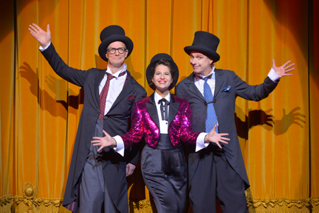
Finale (l-r) Ryan Drummond, Derek Keeling, Jerry Lee and Tim Homsley

CAST: Ryan Drummond, Tim Homsley, Derek Keeling, Jerry Lee, and Sharon Rietkerk .

CREATIVE TEAM: Written and Directed by Roger Bean; Music Direction by Brandon Adams; Choreographed by Lee Martino; Set Design by Michael Carnahan; Costume Design by Bobby Pearce,  Lighting Design by Kurt Landisman; Sound Design by Jeff Mockus; Stage Managed by Kathleen J. Parsons

Kedar K. Adour, MD

Courtesy of www.theatreworldinternetmagazine.com

Ambitious Funny Girl at Hillbarn a winner

By Kedar K. Adour

The entire company sings of Fanny Brice’s success in the number “Henry Street.”

FUNNY GIRL: Musical. Music by Jule Styne. Lyrics by Bob Merrill. Book by Isobel Lennnart from an original story by  Miss Lennart. Hillbarn Theatre, 1285 E Hillsdale Blvd, Foster City, CA (650) 349-6411 or www.hillbarntheatre.org.    August 28 – September 21, 2014.

Ambitious Funny Girl at Hillbarn a winner. [rating:4] (4 of 5 Stars)

In this their 74th season the Hillbarn players under their new Executive Artistic Director Dan Demers have mounted the musical Funny Girl that will forever be associated with Barbara Streisand. She starred in the Broadway show that ran for over 1300 performances and reprised the role for another long run on the West End in London before giving an almost Oscar winning performance in the 1968 movie. When the Paper Mill Playhouse, Millburn, New Jersey produced the musical in 2001 the New York times critic noted “ Few theater companies outside of summer stock, dare to attempt [the] grand spectacle  that propelled Barbara Streisand’s career . . .”

The story is based on the life of Fanny Brice (Melissa Wolfklain) shortly before and after World War I, told with humor, music and song of  her trials, tribulations and successes. It is told in flashbacks with the opening scene backstage at an unnamed theater where she is awaiting her husband Nick Arnstein (William Giammona) who has been released from prison. She reminisces of her time in the Henry Street tenements of Lower East Side Manhattan.

Her mother Mrs. Brice (Tracy Chiappone) is playing cards with the ladies poker club (Maureen O’Neil, Stephanie Case and Regina Quigley). We are reminded in song “If a Girl Isn’t Pretty” chances for star-struck Fanny who is not a beauty to make the big time are minimal. Not to be dissuaded (“I’m the Greatest Star”) she cons local dancer Eddie Ryan (Justin Buchs) to teach her dance steps that lead to a part in the Ziegfeld Follies.

Boy does she take advantage of that small part!! While the tenor (Steven Ennis) is singing “His Love Makes Me Beautiful” and the scantily dressed Ziegfeld Girls are parading down the stairway, Fanny ambles down (very reminiscent of Alice Gooch in Mame) as a pregnant bride creating a classic comedy routine. Rather than fire her, Ziegfeld gives her a role in his shows and you know the rest of the story.

Love enters Fanny’s life after meeting gambler Nick Arnstein and for her it is love at first sight (I Want to Be Seen with You Tonight) and they both go to the Henry Street Party. At this point Fanny and Nick as a pair or alone sing three of the most memorable songs ever written: “People”, “You Are Women, I Am Man” and “Don’t Rain on My Parade.” It is a great first act curtain.

Fanny Brice (Left, Melissa WolfKlain) and NIck Arnstein (Right, Will Giammona) Sing the iconic song “You are Woman, I am Man”

To revive interest in the audience for the second act there is the obligatory upscale ensemble number “Sadie, Sadie” (married lady). Yes she marries Nick and as the axiom goes, “The course of true love never did run smooth.”

If there is a theme, other than ‘try, try again’ to obtain your dream, it is love is truly blind but it can be overcome.

Melissa WolfKlain as Fanny Brice

The book, lyrics and songs are cleverly written and the show is deftly directed by Dan Demers. He wisely has not attempted to mimic the shenanigans or voice intonations of Fanny Brice but allowed Melissa WolfKlain to create a unique, nuanced and believable performance.  It helps that she is a real pro with excellent stage presence and tremendous singing voice. Accolades go to Justin Buchs as Eddie Ryan, Tracy Chiappone as Mrs. Brice and William Giammona, Nick Arnstein.

The ensemble under James Zongus choreography/direction are a delight with their exuberance and polish and earn extra awards for “Rat-tat-tat-tat” tap dance sequence. All this with the cast wrapped up in charming/humorous/revealing costumes by Lisa Cross and wigs/make-up by Dee Morrissey. Not to be forgotten are the 18 member orchestra that do not miss a beat. You too should not miss this charming, entertaining evening with the caveat it does go on for 2 hours and 45 minutes with an intermission.

Cast List: (In Order of Appearance) Melissa WolfKlain, Fanny Brice; Jen Butler, Emma (Fanny Brice U/S); Tracy Chiappone, Mrs. Brice; Maureen O’Neill, Mrs. Strakosh; Stephanie Case, Mrs. Meeker; Regina Quigley, Mrs. O’Malley; Richard Ames, Tom Keeney; Justin Buchs,  Eddie Ryan; Steven Ennis, Ziegfeld Tenor; William Giammona, Nick Arnstein; Dennis Lickteig, Florenz Ziegfeld, Jr. ENSEMBLE: Rachelle Abbey, Christine Baker, Paige Collazo, Jessica Maxey, Lauren Schneider, Emily Mannion, Matt Gill, Jon Toussaint.

Production Team: Directed by Dan Demers; Musical Direction by Joe Murphy; Choreography by James Zongus; Scenic Design by Kuo-Hao Lo; Lighting Design by Don Coluzzi; Props by AJ Diggins; Sound Design by Alan Chang; Costume Design by Lisa Cross; Make-Up and Wigs by Dee Morrissey.

Kedar K. Adour, MD

Courtesy of www.theatreworldinternetmagazine.com.


Melissa WolfKlain as Fanny Brice in Hillbarn Theatre’s production of Funny Girl. – See more at:


The entire company sings of Fanny Brice’s success in the number “Henry Street.” – See more at:

From Left to Right: Mrs Brice (Tracy Chiappone), Mrs. O’Malley (Regina Quigley), Mrs. Meeker (Stephanie Case), and Mrs. Strakosh (Maureen O’Neill) all play poker and talk about Fanny and her dreams of becoming a Ziegfeld Star. – See more at:


Fanny Brice (Left, Melissa WolfKlain) and NIck Arnstein (Right, Will Giammona) Sing the iconic song “You are Woman, I am Man” –

Photos by Mark & Tracy


Hillbarn gets ambitious with ‘Funny Girl’

By Judy Richter

Hillbarn Theatre has begun its 74th season with an ambitious musical undertaking, “Funny Girl.”

Loosely based on the life of comedienne Fanny Brice, the show premiered on Broadway in 1964 and became a popular film in 1968. Both starred Barbra Streisand as Fanny.

Melissa WolfKlain takes on that daunting role in this production and does it more than ample justice with her terrific singing, acting, dancing and comic timing.

Written by Isobel Lennart, the story takes place shortly before and after World War I as Fanny breaks into show business and becomes a star in the Ziegfeld Follies. During that time, she meets the handsome, charming Nick Arnstein (William Giammona), a gambler. Giammona looks the part of Nick, but his acting can be stiff, and there’s not much chemistry between him and WolfKlain.

They marry and have a daughter, but his involvement in a shady bond deal lands him in prison for 18 months and leads to the end of their marriage.

Jule Styne’s music, with lyrics by Bob Merrill, includes such favorites as “I’m the Greatest Star,” “People” and “Don’t Rain on My Parade,” all sung by Fanny.

Besides Nick, another important man in her life is her longtime, loyal friend, Eddie Ryan (Justin Travis Buchs). He’s a vaudeville dancer who coaches her early in her career and quietly carries a torch for her. Buchs is an accomplished dancer who stands out in “Cornet Man” and “Rat-tat-tat-tat.”

Other major figures are Mrs. Brice (Tracy Chiappone), Fanny’s mother; Emma (Jenifer Butler), her friend and assistant; and Florenz Ziegfeld Jr. (Dennis M. Lickteig), Follies producer.

The Hillbarn production features an outstanding ensemble of dancers executing choreography by James Zongus. Seated on a platform behind a new wall in the theater, the 17-piece orchestra is led by musical director Joe Murphy.

Hillbarn’s new executive artistic director, Dan Demers, directs the show and does his best to keep it moving smoothly. However, it has many different scenes, and Hillbarn’s stage is small. Despite the unusual use of a proscenium setting (design by Kuo-Hao Lo), the many set changes lend an episodic feeling, especially in the second act.

Costumes by Lisa Cross provide WolfKlain and the women dancers with one lovely outfit after another. Don Coluzzi’s lighting design isn’t up to his usual standards.

Fanny Brice was born in New York’s Lower East Side in 1891 and died in 1951 at the age of 59. Besides her stage and film work, she created a popular radio character, Baby Snooks.

“Funny Girl” will continue at Hillbarn Theatre, 1285 E. Hillsdale Blvd., Foster City, through Sept. 21. For tickets and information, call (650) 349-6411 or visit www.hillbarntheatre.org.

‘Wicked’ makes welcome return to Bay Area

By Judy Richter

Broadway San Jose is hosting a touring production of “Wicked” that has retained all the elements that have made the musical such a huge hit ever since it opened on Broadway nearly 11 years ago.

“Wicked” is regarded as a prequel to “The Wizard of Oz,” the 1939 film that remains popular today. Audience members will have fun identifying sly references to the film.

“Wicked” (book by Winnie Holzman based on a novel by Gregory Maguire) is primarily the story of the two witches in the film. However, the wicked one doesn’t start that way, nor does the good one begin as quite so virtuous.

Elphaba (Emmy Raver-Lampman, the standby for Emma Hunton) is the green-toned young woman who goes to Shiz, a college in Oz run by Madame Morrible (Alison Fraser). Shunned by nearly everyone, the studious Elphaba is there to take care of her younger sister, Nessarose (Jenny Florkowski), who uses a wheelchair.

Also arriving at Shiz is Glinda (Chandra Lee Schwartz), a beautiful, conceited, devious, vacuous blonde. Much to their mutual consternation, they’re roommates.

The two develop a friendship even though both are attracted to another new student, the handsome, rich Fiyero (Nick Adams), who prides himself on “Dancing Through Life.”

In the meantime, Elphaba realizes that there’s oppression of people who are different or who espouse opposing views in Munchkinland. Therefore, she decides to tell the Wonderful Wizard of Oz (Tim Kazurinsky). She’s bitterly disappointed when she learns the truth about him, but she also discovers her magical powers.

As she endures more disappointments, she vows that “No Good Deed” will go unpunished and becomes known as the Wicked Witch. For Glinda’s part, she matures and becomes more insightful and good.

Stephen Schwartz’s music and lyrics are memorably tuneful. Two of the best songs are “Popular,” sung by the bouncy Glinda as she decides she’ll give Elphaba a makeover, and “Defying Gravity,” sung mainly by Elphaba and Glinda as the rousing end to the first act.

Touring productions can sometimes seem tired and low-budget, but not this one. The singing, dancing and acting are all first-rate, especially by Raver-Lampman as Elphaba and Schwartz as Glinda.

Original director Joe Montello has kept the large cast razor-sharp, just as the original musical stager, Wayne Cilento, has done with the choreography.

Fanciful costumes by Susan Hilferty and ingenious sets by Eugene Lee also come from the original production, as do the sound by Tony Meola and lighting by Kenneth Posner. The fine orchestra is led by music director Andrew Graham.

“Wicked” had its pre-Broadway world premiere in San Franciscoin May 2003.  It returned to the city in 2005, 2009 and 2013 and has been seen throughout the world.

The capacity crowd in San Jose was buzzing with anticipation as the curtain rose and roaring with appreciation during the large cast’s bows.

“Wicked” will continue at the San Jose Center for the Performing Arts, 255 S. Almaden Blvd., San Jose, through Sept. 14. For tickets and information, call (800) 982-2787 or visit http://broadwaysanjose.com.


“Leading Ladies” – Ken Ludwig’s Theatrical Farce At NTC

By Flora Lynn Isaacson

Our play first opens with a clever abridged version of Shakespeare’s Twelfth Night and then proceeds to tell the story about two English Shakespearean actors, Leo Clark (Craig Christianson) and Jack Gable (Robert Nelson), who find themselves down on their luck, so they are performing “Scenes from Shakespeare” in the Moose Lodge circuit in the Amish county of Pennsylvania.

 When they hear that an old lady by the name of Florence (Christina Jacqua) in York, PA, is about to die and leave her fortune to her two long-lost English nephews, they resolve to pass themselves off as her beloved relatives and get the cash.

When they discover that “Max” and “Steve” are actually “Maxine” and “Stephen,” they continue on undaunted, in drag. Leo falls for Florence’s actual niece Meg (Laura Domingo), while Jack swoons over Florence’s part-time aide, Audrey (Laura Espino).

Florence recovers just as the pair arrives, but they decide to keep on, both to try to outlast her health and to stay close to the objects of their interest. Leo convinces Meg, who is enamored with Shakespeare and a fan of Jack and Leo, to put on a production at Florence’s estate, to give himself more of an opportunity to be with her, both as Leo and Maxine.  Meanwhile, Meg’s fiancé Duncan grows increasingly suspicious of the “leading ladies.”

With this play, Ken Ludwig again proves his reputation as the master of American farce, so well established with “Lend Me a Tenor.”

Craig Christianson steals the show as Leo Clark. His performance is varied, subtle and complex, far beyond such broad comedy. Leo’s dialects are quite different for each facet of his character: Shakespearean actor, actor not performing, lover, woman and actress. Christianson’s vocal performance never falters.

Robert Nelson, as Jack Gable, is in control at all times – knowing how much of Gable’s frustration to show each of the other characters and how much to demonstrate to the audience. He has some priceless stage business as the deaf and dumb Stephanie about how she is to understand someone else speaking.

 There are so many other highlights. This is a show in which the wise-cracks come only from smart alecs, and chief among them is Doc Myers, portrayed by the amazing Michael Walraven.

Laura Domingo walks a more subtle line as Meg.  Neither hard-boiled nor dim-witted, Meg is serious and smart and concerned with the interplay of honor and desire. David Kester plays the Rev. Duncan Woolery as oily and superior.

Marie Meier’s and Janice Deneau’s costumes are wonderful, and Michael Walraven’s set is a masterpiece. Superbly staged and paced by Kris Neely, Leading Ladies at the Novato Theater Company is magnificently realized.

Leading Ladies opened on August 22nd and will play through September 14th, 2014, at the Novato Theater Company. Performances are Fridays and Saturdays at 8 p.m. and Sundays at 2 p.m. NTC is located at 5420 Nave Drive in Novato. For tickets, call 415-883-4488, or go online at www.novatotheatercompany.org.

Coming up next at NTC will be Avenue Q, with music and lyrics by Robert Lopez and Jeff Marx and book by Jeff Whitty, from October 9th through November 9th, 2014.


“An Ideal Husband” comes home to Marin Shakespeare

By David Hirzel

The best theater hands us situations in which, though we may not want to, we see ourselves, and even then only after some reflection. Sometimes that reflection is infused with laughs, until an actor standing at the edge of the stage shows in her face the grief that can arise when trust is destroyed by the exposure of a lie. A lie from which she has, no doubt, unwittingly received great financial benefit.

Oscar Wilde’s An Ideal Husband does this, bringing across the span of a century the same sorts of moral dilemmas some of us grapple with even today. Some things never change, and one of those is the temptation toward wealth and power at the expense of honor. This is with us as much today as it was when the play was first shown in London (the very seat of British wealth and power) in 1895. That is what had us talking over breakfast the next morning, after seeing Marin Shakespeare’s premier of the play last night.

The setting is London high society 1895, but could just as easily be Washington DC 2014, except for an underlying sense of morality beneath the gloss and hypocrisy of that long ago day, that one suspects no longer influences today’s extremes of wealth and power. But I digress. . . .

Our glimpse into that society lingers on Sir Robert Chiltern (Nick Sholley), an influential undersecretary of the cabinet, who had bought his place in society with an act that remains to this day a secret. Until it surfaces in a threat of blackmail by Lady Cheveley (Cat Thomson). He knuckles under, of course, until the secret is discovered by his adoring wife Gertrude (Marcia Pizzo). His best friend Lord Goring (Darrin Bridgett), “a bachelor” offers to help, and the plot entangles itself in a convoluted plot of Shakespearean dimension.

Each of the principal characters is flawed, even the most virtuous Gertrude. Each has some twist of the plot reveal these flaws in their multiple dimensions. And Wilde’s genius is this: each of those flaws we can recognize in ourselves. Some of them make us laugh, others make us think. And if we’re paying attention, we come away with a better mirror to our own selves than we had going in.

Now this might be a personal preference, but I’ve found that any production with Darren Bridgett and/or Cat Thompson in it will make you (a) laugh, (b) think, (c) feel more than you expected, in spite of yourself. Reason enough to check out Marin Shakespeare every season, every year.

But in this season’s An Ideal Husband, Marcia Pizzo’s Lady Gerturde Chiltern (Marcia Pizzo) steals the show. The Lady adores her husband for his idealism, is devastated when he proves a bad fit for the pedestal on which she has mounted him, is conflicted as the target of his anger and (as she supposes) the jilted wife, and then relieved when a lie of her own seems to resolve all the conflicts. All of it shows in Pizzo’s manner and her face, and the catbird seat to catch the best of her acting is up close, center-right. There, she’s speaking to you.

Also don’t miss: Julian Lopez-Morillas as the Earl of Caversham, Lord Goring’s lordly father, harrumphing his disdain for all the weaknesses of his offspring and Goring’s friends, then happily endorsing their faults when at last they all meet his approval.

As An Ideal Husband is sure to meet yours.

Review by David Hirzel


Oregon Shakespeare Festival stages classics, premieres

By Judy Richter

Those who stay a week or so in Ashland, Ore., can see up to nine plays ranging from Shakespeare to world premieres in the Oregon Shakespeare Festival’s three theaters.

Altogether, the company stages 11 plays in a season that runs from mid-February through Nov. 2.

Currently playing in the outdoor Elizabethan Theatre are the Bard’s “Richard III” and “The Two Gentlemen of Verona” (with an all-female cast) plus a musical, Stephen Sondheim’s “Into the Woods.”

The indoor Bowmer Theatre features Shakespeare’s “The Tempest” and Irving Berlin and George S. Kaufman’s “The Cocoanuts” along with two world premieres: Tracy Young’s “A Wrinkle in Time,” based on the book by Madeleine L’Engle, and Robert Schenkkan’s “The Great Society.”

Finally, the more intimate Thomas Theatre is the venue for Shakespeare’s “The Comedy of Errors” and the world premiere of Stew’s “Family Album.” After going on hiatus in June, Quiara Alegría Hudes’ “Water by the Spoonful” will return to the Thomas on Sept. 4.

Lorraine Hansberry’s “The Sign in Sidney Brustein’s Window” has completed its run in the Bowmer.

My recent visit included “Richard III,” “Into the Woods,” “The Comedy of Errors,” “The Cocoanuts” and “The Great Society.” Here are brief rundowns on each.

THE GREAT SOCIETY

Of those five, Robert Schenkkan’s “The Great Society” was by far the most powerful and intriguing. It’s the successor to Schenkkan’s “All the Way,” which premiered at OSF two years ago and went on to Broadway to win this year’s Tony Award for best play.

“All the Way” focused on President Lyndon Johnson’s first year in the White House, following the assassination of President John F. Kennedy on Nov. 22, 1963. It looked at Johnson’s successful effort to secure passage of the landmark Civil Rights Act followed by his campaign against Republican Sen. Barry Goldwater to win the 1964 election.

Featuring many of the same actors from “All the Way” and the same director, artistic director Bill Rauch, “The Great Society” looks at Johnson’s push to enact a package of bills focusing on education, anti-poverty programs and medical care, including Medicare for seniors. With black people increasingly demanding an end to segregation and easier access to the ballot box in the South, he also wanted Congress to enact a voting rights bill.

All of this takes place against a backdrop of increasing social unrest, starting mainly with civil rights campaigns that encountered strong resistance in the South by the likes of Alabama Gov. George Wallace, other officials and the Ku Klux Klan. The resultant violence spread throughout the country to such places as Watts in Los Angeles and the slums of Chicago.

In the meantime, the nation became more deeply mired inVietnam, a war that exacted huge costs in American lives and money. The war was so polarizing that Johnson announced in 1968 that he wouldn’t run for a second term. Instead he was succeeded by Republican Richard Nixon.

Once again Jack Willis plays LBJ, a Texan who might have come across as homespun, but he was wily and politically astute. Willis brings all of LBJ’s contrary traits to the fore and convincingly conveys his increasing anguish over the war and social unrest.

The large cast also features Danforth Comins as Sen. Bobby Kennedy of New York, LBJ’s nemesis; Peter Frechette as Vice President Hubert Humphrey; Jonathan Haugen as Wallace, Nixon and others; Kenajuan Bentley as Dr. Martin Luther King Jr.; Mark Murphey as Secretary of Defense Robert McNamara and others; and Richard Elmore as FBI Director J. Edgar Hoover.

Those individuals and more populate this ambitious re-enactment of one of the most turbulent periods in recent history.

Immediately after closing, this play and many of its actors will move to Seattle Repertory Theatre, which commissioned it and co-produced it with OSF. It will run in rotating repertory with “All the Way.” Presumably it will undergo some needed tightening and other improvements.

In the meantime, it evokes vivid memories for those who lived through those painful times and teaches some important lessons to those who were born later. It’s a brilliant accomplishment.

RICHARD III

Shakespeare’s “Richard III” makes strong demands on the title character, a man who left a trail of bodies in his quest for the English throne. Dan Donohue ably meets those demands, making the deformed Richard charming when doing so suited his aims and revealing all of his callous evil at other times.

Director James Bundy moves the action smoothly, thanks to a strong supporting cast, including Robin Goodrin Nordli as Queen Elizabeth, Judith-Marie Bergan as the Duchess of York, Franchelle Stewart Dorn as Queen Margaret and Jeffrey King as George, Duke of Clarence.

William, Lord Hastings, is played by Howie Seago, a deaf actor who delivers his lines in American Sign Language, voiced by Omoze Idehenre as Mistress Jane Shore. She also uses ASL to convey other characters’ lines to him.

Bucking a trend to place the play in another time or place, costumes by Ilona Somogyi and the set by Richard L. Hay are contemporary to Shakespeare’s time.

This is an excellent production of one of Shakespeare’s masterpieces.

THE COMEDY OF ERRORS

An example of moving a Shakespeare play into another time and place is the OSF production of “The Comedy of Errors.” This time the play of mistaken identities takes place the late 1920s, the dawn of the Harlem Renaissance.

Hence most of its actors are black, and Ephesus becomes Harlem, the play’s main setting. Syracuse, the visitors’ homeland, is Louisiana.

The main characters are two sets of identical twins who were born on the same day. One pair, both known as Dromio, are servants to the other pair, both known as Antipholus.

The Dromio-Antipholus pairs were separated in infancy, with one pair landing in Harlem and the other pair returning toLouisiana with Egeon, father of the Antipholuses.

As the play opens, Egeon (Tyrone Wilson) has traveled to Harlem to find the Antipholus and Dromio who had lived with him until setting out in search of their brothers.

As luck would have it, Antipholus and Dromio of Louisiana have just arrived in Harlem, where they are immediately confused with their counterparts, who have lived there for many years.

Although some productions use four actors for the two sets of twins, this one uses only one actor, Tobie Windham, for both Antipholuses and one actor, Rodney Gardiner, for both Dromios. The only exception comes at the very end, when both sets must be on stage at the same time. In this case, two other actors (not identified) are used.

The production is full of pratfalls and slapstick, but director Kent Gash never allows the action to get out of hand. Still, he overuses one gimmick: a chime that sounds at every mention of a ring that is pivotal to the plot. In the midst of all the physical comedy, Mark Murphey, who plays a butler and an Irish cop, is one of the funniest performers because he manages to keep a straight face throughout.

Overall, it’s a fun production.

THE COCOANUTS

In contrast to “The Comedy of Errors,” the antics in “The Cocoanuts” tend to go over the top.

With music and lyrics by Irving Berlin and a book by George S. Kaufman, this adaptation by actor Mark Bedard supposedly features the Marx Brothers as the main characters. Bedard is Mr. Hammer, the Groucho character, while Eduardo Placer is Robert Jamison, the Zeppo character; John Tufts is Chico,  and Brent Hinkley is Harpo.

The setting is the Cocoanut Hotel in Florida in the 1920s. It’s owned by Mr. Hammer, who’s in financial straits but who hopes to get rich by auctioning off some lots during Florida’s land boom. Robert is his beleaguered desk clerk who’s in love with one of the guests, Polly Potter (Jennie Greenberry). She’s the daughter of the very rich Mrs. Potter (K.T. Vogt), who wants her to marry another guest, Harvey Yates (Robert Vincent Frank), who has his own plan in mind with his longtime cohort, Penelope Martin (Kate Mulligan).

Bedard, Tufts and Hinkley are the principal makers of mayhem. Hinkley wears the nonspeaking Harpo’s silly grin and runs around squeezing a horn.

Bedard and Tufts deliver most of the deliciously awful puns. However, they let the silliness get out of hand during the first act when they come down from the stage and involve the audience, taking a woman’s room key and a man’s phone and shoe. They even climb over the seats and venture up several rows to interact with audience members. It’s a ploy that goes on too long.

It should be noted that Bedard, Tufts and Hinkley also were featured as the Marx Brothers in “Animal Crackers” in 2012. It was a far more enjoyable yet still hilarious show because the director had them showing some restraint. The current director, David Ivers, seems to have given them free rein.

It should also be noted that the majority of the audience seemed to love the show.

The rest of the cast, which includes David Kelly as a detective, does well. Special mention goes to Greenberry for her singing.

The colorful set is by Richard L. Hay with costumes by Meg Neville.

INTO THE WOODS

Also in the musical mode is “Into the Woods,” featuring music and lyrics by Stephen Sondheim and a book by James Lapine.

Sondheim and Lapine bring together several fairy tale characters and show them getting their wishes in the first act, when presumably they all live happily ever after. The second act is the ever after, when things aren’t nearly as ideal as the characters had imagined.

Directed by Amanda Dehnert, who does double duty as musical director, the uniformly excellent cast features, among others, Miriam A. Laube as the Witch, Rachel Warren as the Baker’s Wife, Miles Fletcher as Jack (of beanstalk fame), Robin Goodrin Nordli as his mother, Jennie Greenberry as Cinderella, Jeremy Peter Johnson as Cinderella’s Prince and Kjerstine Rose Anderson as Little Red Riding Hood. The versatile Catherine E. Coulson plays Cinderella’s stepmother, Granny, the giant and Milky White, the cow.

With the 25-member orchestra seated upstage, scenic designer Rachel Hauck employs minimal scenery in this outdoor production. Costumes by Linda Roethke are a different story. They’re wonderfully colorful. Some nifty stage magic also helps.

Of course the real stars of this show are Sondheim’s intricate music and lyrics. He’s a genius with both.


‘Fetch Clay, Make Man’ sees two black men trying to make their way

By Judy Richter

After heavyweight champion boxer Cassius Clay had joined the Nation of Islam and changed his name to Muhammad Ali, death threats caused the promoters to move his much-ballyhooed rematch against Sonny Liston to Lewiston,  Maine, in 1965.

Presented by Marin Theatre Company, Will Power’s “Fetch Clay, Make Man” goes behind the scenes into Ali’s locker room (set by Courtney O’Neill with video by Caite Hevner Kemp) as he prepares for that fight.

He seeks help from an unlikely source — actor Stepin Fetchit. Fetchit, whose real name was Lincoln Perry, had created a character that was the epitome of stereotype, a lazy, shiftless Negro. Audiences didn’t perceive how clever he was, but he was the first black actor to become a millionaire.

Ali invited him to serve as his secret strategist before the fight because he had worked with another famous fighter, Jack Johnson. Ali wants Fetchit to teach him the secret “anchor punch” that Johnson had used so successfully.

Eddie Ray Jackson embodies Ali’s dancing footwork as well as his enormous ego. Roscoe Orman is the canny Fetchit, who seems to know the right thing to say and do to protect himself and to defuse some of the play’s tensions.

Much of that tension comes from Jefferson A. Russell as the menacing Brother Rashid, Ali’s bodyguard and strict adherent to Nation of Islam beliefs. Although the relationship between Ali and his wife, Sonji Clay (Katherine Renee Turner), is loving at first, it becomes more dicey when she refuses to wear Muslim garb for women (costumes by Heidi Leigh Hanson) and mentions parts of her past.

Completing the cast is Robert Sicular as William Fox, founder of the Fox movie studio. He’s seen in flashbacks as he and Fetchit negotiate the actor’s contract.

Each in his own way, Ali and Fetchit represent pioneering black men trying to succeed in American society. Playwright Power and director Derrick Sanders weave their stories and relationship into compelling theater.

“Fetch Clay, Make Man” will continue at Marin Theatre Company, 397 Miller Ave., MillValley, through Sept. 7. For tickets and information, call (415) 388-5208 or visit www.marintheatre.org.


TheatreWorks has a hit with ‘Water by the Spoonful’

By Judy Richter

Real and virtual families connect in “Water by the Spoonful,” an intricately constructed, intriguing drama by Quiara Alegría Hudes.

Presented by TheatreWorks, this Pulitzer Prize-winning play focuses on two kinds of families.

The real family is two cousins, Elliot (Miles Gaston Villanueva) and Yazmin (Sabina Zuniga Varela), in a Puerto Rican neighborhood in North Philadelphia. An aspiring actor, Elliot was wounded in Iraq and now works at Subway. He’s haunted by a ghost (George Psarras) from Iraq. Yazmin is a recently divorced Swarthmore professor of music.

Their aunt, whom Elliot calls his mother and whom he cared for, dies of cancer. She reared him after her sister, his crack-addicted mother, gave him up.

In the meantime, his estranged birth mother, Odessa (Zilah Mendoza), who has since kicked the crack habit, administers a virtual family on an anonymous online chat room for other crack addicts in various stages of recovery. Her handle is Haikumom.

This disparate group includes the 50ish Chutes&Ladders (Anthony J. Haney), an IRS employee; the 20ish Orangutan (Anna Ishida), a smart-mouthed Japanese American; and the newest member, Fountainhead (Patrick Kelly Jones). He’s a 30ish entrepreneur on his way down because of his addiction, which he tries to hide from his family. He’s having a hard time kicking the habit.

Over the course of the two-act play, several characters take tentative strides to improve their lives and/or to connect with others, but it’s not easy.

Intelligently directed by Leslie Martinson, each actor portrays a distinct, interesting character confronting challenges.

Erik Flatmo’s multi-level set creates defined spaces for the action, augmented by Erik Scanlon’s projections and Steven B. Mannshardt’s lighting. The character-specific costumes are by Anna R. Oliver. The sound design by Gregory Robinson includes works by pioneering jazz saxophonist John Coltrane, whom Yazmin cites in one of her lectures.

All of these elements add up to a compelling theatrical experience.

“Water by the Spoonful” will continue at the Mountain ViewCenterfor the Performing Arts, 500 Castro St., Mountain View, through Sept. 14. For tickets and information, call (650) 463-1960 or visit www.theatreworks.org.


Water by the Spoonful given a Prize winning performance at TheatreWorks.

By Kedar K. Adour

Strangers (played by clockwise from lower left: Zilah Mendoza, Patrick Kelly Jones, Anthony J. Haney, and Anna Ishida) come together in an online support group in TheatreWorks’ Regional Premiere of the Pulitzer Prize-winning drama WATER BY THE SPOONFUL, playing August 20 – September 14 at the Mountain View Center for the Performing Arts Photo by Kevin Berne

WATER BY THE SPOONFUL: Drama by Quiara Alegria Hudes. Directed by Leslie Martinson. TheatreWorks, Mountain View Center for the Performing Arts, 500 Castro Street, Mountain View. (650) 463-1960 or visit www.theatreworks.org.

August 20—September 14, 2014

Water by the Spoonful given a Prize winning performance at TheatreWorks. [rating:5]

TheatreWorks once again demonstrates its standing as one of the Big Three theatrical groups, along with A.C.T. and Berkeley Rep, in the Bay Area. This time they have mounted a stunning and powerful production of Water by the Spoonful. The play won, and deserved, the Pulitzer Prize for drama in 2012. It is the second part of her “Elliot Trilogy” plays dissecting the life of a Puerto Rican Iraq War veteran living in Philadelphia. It is a standalone play in the trilogy with Elliot (Miles Gaston Villanueva )being the only character from the other plays. It is a play for our time and transcends ethnic stereotyping.

For this reviewer who does not do Facebook, Twitter, Linkedin, have an IPhone or enter chat rooms it was a learning experience. The aforementioned means of communication have replaced personal social interaction and in Quiara Alegia Hudes play she demonstrates their omnipresence in our digital world.

The play’s construction is a fascinating jigsaw puzzle intermingling present day personal action, internet connectivity, out of body experiences, didactics and symbolism. The symbolism of course involves water beginning with the ‘spoonful of water’ and ending with a Puerto Rican waterfall. (Marvelous projections by Erik Scanlon on Erik Flatmo’s three level split set).

In an early scene Quiara Hudes, a trained musician and composer who wrote the book for the Tony Award winning In the Heights”, introduces Yazmin (Sabina Zuniga Varela), cousin to Elliot and a music composition professor. Using John Coltrane’s music as examples, she lectures the students (the audience) on the meaning of dissonance. The tone is set for very dissonant relationships.

Elliot, a wounded Iraqi War veteran would be actor, works in a menial job in a sandwich shop and is the caretaker for his dying aunt who raised him.  He has his own demons from the war experience. When the aunt dies, Elliot and Yazmin search for his birth mother who gave him up as child.

In a parallel story taking place in the digital world , the birth mother Odessa (Zilah Mendoza), known as Haikumom online, functions as a leader in a chat room dedicated to recovering ‘crack-head’ drug addicts. The members of the chat room trust her guidance and are unaware of her own demons.

  The other members of the chat room are “Orangutan/Madeleine” (Anna Ishida); “Chutes & Ladders/Wilkie” (Anthony J. Haney) and “Fountainhead/John.”( Patrick Kelly Jones). Orangutan is in Japan. She had been given up by her mother, adopted and raised in Maine but has returned to Japan to discover her roots. Chutes & Ladders is a middle-aged black man, lives in San Diego and works in a dull office job.   Fountainhead is a former leader in the digital world who has kept his addiction secret from his family. There is seventh character that occasionally roams on stage, is the Arabic ‘Ghost’ in Elliot’s imagination and does not fit very well into the intricately constructed play.

The acting of the each major actor is distinctive, believable and memorable under director Leslie  D Martinson’s  tight control as she moves them like chess pieces on Flatmo’s unique multi-level set amongst brilliant projections and dissonant music. Running time 2 hours 25 minutes with an intermission. Highly recommended.

CAST: Miles Gaston Villanueva as “Elliot”; Sabina Zuniga Varela as “Yazmin”; George Psarras as “Professor Aman/Ghost”;  Zilah Mendoza as “Odessa/Haikumom”; Anna Ishida as “Orangutan/Madeleine”; Anthony J. Haney as “Chutes & Ladders/Wilkie”; Patrick Kelly Jones as “Fountainhead/John.”

Artistic Staff: Scenic Designer,Erik Flatmo;Costume Designer,Anna R. Oliver;Lighting Designer,Steven B. Mannshardt;Sound Designer,Gregory Robinson;Projections Designer,Erik Scanlon;Dialect Coach,Kimberly Mohne Hill;Casting Director;Leslie Martinson;Los Angeles Casting Director, Julia Flores;Stage Manager,Randall K. Lum;Assistant Stage Manager,Stephanie Schliemann.

Kedar K. Adour, MD

Courtesy of www.theatreworldinternetmagazine.com.