“Bell, Book and Candle” at Spreckels Performing Arts Center, Rohnert Park CA

By Greg & Suzanne Angeo

Reviewed by Suzanne and Greg Angeo

Members, San Francisco Bay Area Theatre Critics Circle

Photos by Eric Chazankin

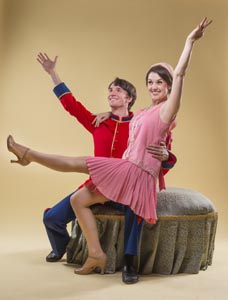
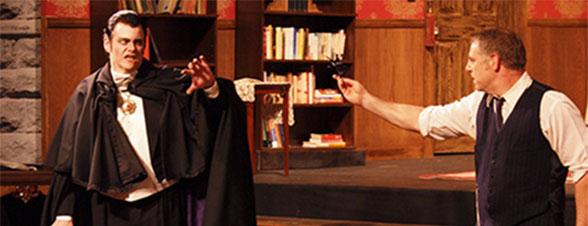
Peter Warden as Nicky, Liz Jahren as Gillian

‘Tis the Season of the Witch

Five of the best comedic actors in the North Bay are all gathered in one small space to help usher in the season of pumpkins and hobgoblins with “Bell, Book and Candle”,  a thoroughly enjoyable if uneven show presented by the Spreckels Theatre Company.

English playwright John Van Druten was very successful in the 1930s with hit shows in the West End. His play “Bell, Book and Candle” premiered on Broadway in 1950, starring Rex Harrison and Lilli Palmer. Van Druten is perhaps better known for 1951’s “I am a Camera” which served as inspiration for the musical “Cabaret”. Ultimately, “Bell, Book and Candle” also served as inspiration – for the popular television series “Bewitched”.

The story: It’s Christmastime in present-day New York City. Gillian, her brother Nicky and their Aunt Queenie form a quirky, crafty trio of witch-folk living the high life. They belong to an esoteric cult that hangs out at the underground Zodiac Club, casting spells but never seeming to get anywhere. Gillian is bored with her life and lack of romance, and decides on a vengeful whim to cast a love spell on her neighbor, a book publisher named Shep, with unintended consequences. One of his clients is an eccentric “authority” on the occult named Sidney who, despite having written a few books on magic, has no clue as to what he’s about to get into.

Larry Williams as Shep, Mary Gannon Graham as Queenie

Comedy powerhouse Liz Jahren plays Gillian as a barefoot goddess, although she’s a little too grounded in the role. She could use a bit more of a lofty, ethereal quality to make more dramatic her fall to earth as she falls in love and loses her magic powers. The usually-goofy Larry Williams as the unsuspecting Shep plays it subdued, cool and conservative, just a normal guy trying to deal with his strange new lover. Peter Warden is reliably puckish in the role of Gillian’s brother Nicky, another really fun-to-watch performance in his ever-growing repertoire. David Yen delivers an uninhibited, crazedly commanding performance as Sidney.

David Yen as Sidney

But it’s really Mary Gannon Graham who seems to be having all the fun. When she takes the stage as the zany, Bohemian flower-child Queenie, you can’t see anybody else up there. She’s absolutely shameless, and why not? With her captivating stage presence and glorious bursts of song, she casts her enchantment over the audience like a magic shawl.

Director Thomas Chapman adapted the 1950 script to a more modern setting, but some anachronistic references remain, which weaken the overall effect. He made interesting, though infrequent use of special lighting, flooding the stage with dazzling, spinning stars and other mystical effects. He was able to create simple staging, allowing the actors to move without upstaging each other. Even though the story is offbeat and wacky, the intimate space calls for just a bit more subtlety.  There is nothing subtle about Elizabeth Bazzano’s set design, which turns Gillian’s Greenwich Village apartment into something closely resembling a florid bordello.

Mary Gannon Graham, Peter Warden

“Bell, Book and Candle” is presented at the Bette Condiotti Theatre, the smaller of the two venues at the Spreckels Performing Arts Center. When these three over-the-top actors – Jahren, Warden and Graham – are onstage at the same time, the performances seem to be directed at folks way up in the balcony in a much bigger space, rather than such an intimate house. It could be dialed back just a bit to connect better with the audience just a few feet away. Nonetheless, it’s a fun, spirited show with lively pacing and fascinating characters, well worth seeing just in time for Halloween.

When: Now through October 12, 2014

8:00 p.m. Fridays and Saturdays

7:30 p.m. Thursday, October 9

2:00 p.m. Sundays

Tickets: $22 to $26

Location: Spreckels Performing Arts Center

5409 Snyder Lane, Rohnert Park CA
Phone: 707-588-3400

Website: www.spreckelsonline.com

A gripping, satirical and humorous Ideation at SF Playhouse

By Kedar K. Adour

IDEATION: By Aaron Loeb. Directed by Josh Costello. San Francisco Playhouse, 450 Post Street, San Francisco (2nd Floor of Kensington Park Hotel, b/n Powell & Mason). 415-677-9596, or www.sfplayhouse.org

A gripping, satirical and humorous  Ideation at SF Playhouse. [rating:4]

Author Aaron Loeb honed his playwriting skills at Playground with 10 minute scripts that earned him seven “Emerging Playwright Awards” before gaining recognition for his edgy full length play First Person Shooter. It received an action packed production in 2007 at the former intimate SF Playhouse venue (99 seats) under Jon Tracy’s signature directorial style. This was followed in 2009 by Abraham Lincoln’s Big, Gay Party that went on to win prizes at the Off Broadway Fringe. Ideation was first staged at the San Francisco Playhouse Sandbox and won the 2014 Glickman Playwriting as the best new play produced in the Bay area.

Because of the critical acclaim of that production, SF Playhouse elected to start its 2014-15 12th season with the Sandbox cast and director intact. Not having seen that staging this review is based on the superb acting, directing and spectacular staging that received a standing ovation on opening night. As with most of Loeb’s plays there is an edgy atmosphere with sufficient humor to break up the tension leaving the audience enough leeway to make their own decision about the full meaning of the dialog?

Corporate executive Hannah (Carrie Paff), has been placed in charge of a three man consultant team to brain-storm (ideate) about a shadowy project that apparently requires the secret mass movement of dead bodies. They have a finite amount of time to prepare a video presentation to a shadowy unseen CEO.  The brash consultants charge into the conference room with bravado galore. There is vociferous egocentric astute Brock (Mark Anderson Phillips) and the older no nonsense pragmatist Ted (Michael Ray Wisely) who is dogmatic in his approach to the solution. The third member is an Indian engineer Sandeep (Jason Kapoor) who is essential to any solution since he has designed a crematorium that may or may not be needed.  The final character is young ineffectual Scooter (Ben Euphart) a son of an influential Board member who has been fostered on Hannah as an assistant.

Scooter is summarily ejected from the proceedings and the trio begins their frantic plans using the huge white board to outline their ideas. As the ideation progresses each universal solution is questioned and reformatted. With each shift of suggestions disagreement and paranoia inevitably divides the trio.  The question arises on who knows the most about this top secret project, and why is it necessary? A further hitch is Hannah’s not so secret affair with Sandeep who becomes the one to question the morality of it all. Does a secret virus exist? Is there to be genocide? How does the Parent Corporation benefit?

Carrie Paff has the most difficult role to create beginning as a believable female executive who has broken the glass ceiling set for women in the corporate world then switching to a needy lover before displaying intense insecurity talking to the unseen and dictatorial CEO. She does not miss a beat. Mark Anderson Phillips is always a joy to watch as Brock’s exterior intellectual bravado breaks down into insecure physicality.  Michael Ray Wisely as the stolid Ted who allows his no-nonsense exterior veneer to crack ending in physical contact with Brock is perfect in the role. Jason Kapoor as Sandeep exudes powerful insecurity with his silence that becomes the plays conscience.  And then there is Ben Euphart who holds his own against the powerful acting of his cast members.

Josh Costello’s perfect direction is enhanced by the fantastic white board-room set created by Bill English that adds to meaning of corporate luxury. This is a should see production since this well written play might suggestion that video game designer Aaron Loeb is almost ready to be able to give up his daytime job. Running time is a taut 90 minutes without intermission.

CAST: Ben Euphrat as Scooter; Jason Kapoor as Sandeep; Carrie Paff as Hannah; Mark Anderson Phillips as Brock; Michael Ray Wisely as Ted; L. Britt Ervin as J.D. (voiceover)

ARTISTIC CREW: Set Design, Bill English; Costume Designer, Abra Berman; Stage Manager, Maggie Koch; Lighting Design, Mark Hueske; Sound Design, Zaque Eyn; Props Artisan, Jacquelyn Scott; Casting Director, Lauren English ;Production Manager, Tatjana Genser

Kedar K. Adour, MD

Courtesy of www.theatreworldinternetmagazine.com.
Bloody Daughter — Film Review

By Joe Cillo

Bloody Daughter

A Film by Stephanie Argerich


The title of this film is misleading.  It suggests either abuse or extreme hardship or menstruation, but none of these play out in the film.  While ninety percent of the film focuses on Stephanie Argerich’s mother, the renowned pianist, Martha Argerich, the title comes from her father, Stephen Kovacevich, himself a pianist of the first order, and seems to refer to the roughness in Stephanie’s relationship with him.  He offers an explanation of the term ‘bloody daughter,’ which doesn’t quite make sense, and seems to reflect confusion and misunderstanding.  The term ‘bloody’ is a British expletive of disputed origins which is used as an intensifier, similar to the way we use ‘damn’ in the United States, or a less savory word that is much rougher and cruder.  It doesn’t really fit well with the content of this film.  I wish they had been able to dream up a different title.

But the film is outstanding.  It is a disarmingly intimate portrait of a very unusual family of remarkably talented people.   It is classified as a documentary, but it is actually a personal journal, rather than an attempt to construct an organized narrative of the facts.  There are very intimate scenes throughout this film.  Things one would not ordinarily include in a documentary.   A sequence of Martha waking up in bed in the morning and sipping her coffee at her bedside.  A tense scene between Stephanie and her father doing paperwork to obtain his official acknowledgement of Stephanie as his daughter.  Kovacevich has stalled and dragged his feet on this matter for thirty-four years.  No explanation of what that is about.  An outdoor scene of Martha and her three daughters painting their toenails and discussing their lives in a park.  Martha is on camera through most of the film.  Stephanie is intently preoccupied with her mother.  There are many close ups of her mother’s face and eyes, as if she is trying to incorporate her mother or understand her mother through the camera.

While there is a lot of conflict and tension within this family, there is also great warmth and strong personal bonds.  I wouldn’t call this a dysfunctional family at all.  The members are engaged with one another, there is good communication between them, and there seems to be a lot of basic good will among them, despite some friction and misunderstanding.   They are a family that introspects more than is common in the United States, I would judge.  They seem to make a genuine effort to understand themselves and their relationships to a degree that I find unusual as an American.  American people are not very self-knowing, and one seldom hears them discuss their family relationships with much sensitivity or insight.  This film is strikingly different in that respect.

There is great music throughout the film.  Both Martha Argerich and Stephen Kovacevich are world class pianists.  There are sequences of them performing at various stages of their lives.  It is clear that music serves as an adhesive that binds all of these people together.

The film is in French and English with subtitles available in a number of other languages as well.  There is a menu where you can select.  Argerich speaks French despite originating in Argentina.  Kovacevich is American, but has lived most of his adult life in England.  Stephanie speaks English, and French with her mother.  If you like classical music, piano, or European life and culture, this is an excellent film that is a personal, in depth study of a fascinating family of top quality musicians.

Fantasy musical ‘Pippin’ mixes elements, stirs up fun

By Woody Weingarten

Woody’s [rating: 4]

Interlocutor/narrator (Sasha Allen, left) oversees a circus stunt in “Pippin.” Photo by Terry Shapiro.

Matthew James Thomas (right) assumes the title role in “Pippin” while John Rubinstein, who played that part in the original, is now his father. Photo by Terry Shapiro.

Sabrina Harper provides eye candy and a strong voice as Fastrada in “Pippin,” Photo by Terry Shapiro.

“Pippin,” fittingly touted as “Broadway’s high-flying musical,” is a seamless balance of acrobatic circus acts and theatrical extravaganza.

It blends impeccable singing and high-kick dancing with plentiful comedic interludes.

It spotlights droll magical illusions — and a cute dog trick guaranteed to keep your memory bank warm.

If only the show had a linear, cohesive storyline.

Still, the 2 hour, 20 minute fantasy-fairy tale at the SHN Golden Gate Theatre in San Francisco roughly based on historical realities won’t disappoint.

“Pippin 2.0,” my artificial designation because it’s so different from the 1972 original, is precisely what I expected from a touring company of the 2013 Tony winner for best musical revival:

Inventive. Glamorous. Spectacular.

What I couldn’t foresee, however, were the perfectly timed sound effects by percussionist Ken Bergman, who used a tiny 3×5 screen to monitor the stage action so he could sync everything without missing a proverbial beat.

He counted out for me during intermission the 31 instruments he utilized (including a small washboard).

“This is difficult,” he said. “Usually there’s a point where you can relax, but in this show, there’s always something coming up.”

True.

Bergman’s equipment is so expansive he requires a space of his own in the orchestra pit.

The other dozen-plus musicians (mostly locals) need something else: a net — in case plummeting detritus, runaway hoops, oversized balls or errant gymnasts fall onto them.

The curtain for “Pippin” gives the impression of a circus tent. When it first parts, an interlocutor/narrator (Sasha Allen, filling a role similar to Joel Gray’s emcee in “Cabaret”) quickly creates the illusion of a show within a show.

Her words, and a portion of others (including those of the mega-vibrant chorus), sometimes can’t be easily discerned. But that doesn’t matter.

The overall effect is so dazzling it etches a perma-smile on my face.

The plot’s basics?

A king — Charlemagne (played vigorously by John Rubinstein, who’d starred as the title character in the original) — wants his soldiers to unite Europe, at any cost.

His son, Prince Pippin (a charismatic Matthew James Thomas, who showed off his plentiful vocal, dance and gymnastic talents in the same role for the revival), is more concerned with uniting the wobbly parts of his personality.

Although he claims to seek the meaning of life, he’s really searching for the meaning of his life. He repeatedly gripes about being “empty and vacant” — even after a wild intro to sexuality.

Sabrina Harper (likewise from the revival cast) also turns in a top-notch performance, as Fastrada, Pippin’s manipulative stepmom.

But the showstopper is the sole property of Lucie Arnaz,.

The svelte 63-year-old daughter of Lucille Ball and Desi Arnaz plays a gyrating granny, Berthe, with enough raw energy to light half the spotlights by her oomph quotient alone.

The audience applauded and cheered. Loudly.

I heartily approved of the outburst.

I also appreciated the fact that director Diane Paulus and circus creator Gypsy Snider, who began her career in San Francisco as a child of the Pickle Family Circus, insisted the acrobats/tumblers/trapeze artists learn dancing and the dancers learn gymnastics.

Paulus, who also was brilliant at the helm of “The Gershwin’s Porgy & Bess” and “Hair,” won a Tony for the revival.

Snider, who’d led her Montreal-based 7 Fingers circus company (officially known as Les 7 doigts de la main) to global success, plucked several of her top performers from it for the “Pippin” revival.

So I wasn’t surprised to find I liked this production more than 1972’s — despite Bob Fosse’s direction and choreography.

This version features dances cobbled by Chet Walker, a Fosse protégé who follows his mentor’s style but adds novel turns of his own. His sexually oriented dance, highlighting a simulated ménage a trois, may not ignite the audience’s fire, but almost everything else he conceived does.

What didn’t work for me?

Scenes like one in which dancers do infantile comedic turns as pigs and chickens. Or an über-melodramatic sequence in which the narrator demands the set be shut down.

Moreover, tunes by Stephen Schwartz, famed for “Wicked” and other Big Apple triumphs, failed to make me leave the theater singing or humming..

Or even thinking about them.

Another minor fault is that the second act, which slows considerably, becomes disjointed as it moves toward a finale that tries to determine if Pippin will settle for something other than his dream of “magic shows and miracles.”

But even with these minor fault-lines, the musical is unique.

And fun.

“Pippin” runs at the SHN Golden Gate Theatre, 1 Taylor St. (at Market), San Francisco, through Oct. 19. Night performances Tuesdays through Saturdays, 8 p.m.; matinees Wednesdays, Saturdays and Sundays, 2 p.m. Tickets: $45 to $210 (subject to change). Information: (888) 746-1799 or shnsf.com.

PIPPIN flies high with magic at the Golden Gate

By Kedar K. Adour

Sasha Allen as Leading Player and the cast of the National Tour of PIPPIN. Credit Terry Shapiro

PIPPIN: Musical Comedy. Book by Roger O. Hirson. Music and Lyrics by Stephen Schwartz. National tour @ SHN Golden Gate, 1 Taylor Street, San Francisco. 888-746-1799 or www.shnsf.com. September 23-October  19, 2014

PIPPIN flies high with magic at the Golden Gate Rating:[rating:5]

In 2006 there was an effort to revive Pippin for a National Road show starting at the GoodSpeed Opera House in Connecticut. The National Critics Institute at the Eugene O’Neil Theater Center sent a contingent to see the show and to interview the producers. In that production the concept of using a traveling circus format to inculcate Pippin into the real world was well received but there were problems working the circus into the storyline. The American Repertory Theater in Cambridge, Mass under Diane Paulus’ ingenious direction turn that concept around creating a spectacular acrobatic circus show with the story secondary to the action.

The characters are all there but it is the Montreal circus troupe Les 7 Doigts de la Main guided by Gypsy Snider who honed her skill at our own Pickle Family Circus that creates a fantastic evening. All the action takes place in a Big Top tent complete with trapeze, rings aplenty and even acts of magic. Not all the members take part in the awe inspiring acrobatics but enough do to keep you wondering who will be tossed around or swing from the rafters. Throw in Stephen Schwartz’s score replete with a mixture of jazz, pop, memorable musical comedy songs and Bob Fosse’s original choreography and the evening is complete.

Into all this action our intrepid Pippin who is searching for meaning in his life takes poor advice from The Leading Player. In 1972 when the show opened on Broadway Ben Vereen gave a Tony Award winning performance as Leading Player that is usually played by man. Paulus has brought aboard the incomparable Sasha Allen to play the role. 

Pippin (Matthew James Thomas) eldest son of Charlemagne/Charles (John Rubinstein who played the original Pippin in 1972) and the stepson of wicked Fastrada (Sabrina Harper). Unlike his gung-ho stepbrother Lewis (Callan Bergmann) Pippin is looking for “His Corner of the Sky.”  After being told that “War is Science” he looks for “Glory” in war. That is not to be so how about trying “Simple Joys?” No? OK, go to see your grandmother Berthe (Lucie Arnaz to be replaced the final two weeks of the run with Tony winner Andrea Martin) and things will get better in “No Time at All.” He doesn’t follow grandma’s advice but listens to scheming Fastrada to “Spread a Little Sunshine” with a revolution by killing Charles and all will be well with “Morning Glory.”

Being a beneficent King is not what it was wrapped up to be when Politics rears its ugly head. Pippin abdicates after encouraging the Players to resurrect the assassinated King. Pippin is off the hook to get “On the Right Track.” After a plethora of sexual orgies he is “rescued” by widowed Catherine (Kristine Reese) who is “That Kind of Woman” and her son Theo (Zachary Mackiewiez alternating with Lucas Shultz). When the simple life is not for Pippin, the angry Player and her Players allow him to take part in the promised grand finale that is less than grand and has an unusual ending.

Forget the storyline and enjoy the stunning display of circus acts, marvelous songs that include audience participation and admire the brilliant acting and singing. The naivety of Pippin by Matthew James Thomas plus his grand singing voice are perfect foils for the sexpot gyrations and vocal range of Sasha Allen’s Leading Player.  John Rubinstein accepts his fatherly role with aplomb and even has his turn with a knife throwing circus act.  Sabrina Harper’s Fastrada oozes evil and sex contrasting with Kristine Reese’s excellent depiction of down-on-the-farm Catherine. There are many show stopping performances but the hands down opening night favorite was Lucie Arnaz as grandma Berthe. She alone is almost worth the price of admission. Running time is 2 hours and 40 minutes with an intermission. This is a not to be missed show.

CAST: Sasha Allen as Lead Player; Matthew James Thomas as Pippin; John Rubinstein as Charles; Sabrina Harper as Fastrada; Kristine Reese as Catherine, Lucie Arnaz as Berthe and Zachary Mackiewicz/Lucas Schultz alternate as Theo.

THE PLAYERS: Callan Bergmann, Skyler Adams, Sascha Bachmann, Bradley Benjamin, Dmitrious Bistrevsky, Mark Burrell, Mathew deGuzman, Fernando Dudka, Mirela Golinska Roche, Kelsey Jamieson, Preston Jamieson, Lisa Karlin, Alan Kelly, Melodie Lamoureux, Zachary Mackiewicz, Lucas Schultz, Tory Trowbridge, Mackenzie Warren, Borris York.

CREATIVE CREW: Scenic design by Scott Pask;  Lighting design by Kenneth Posner; Costumes by Dominque Lemieux; Sound design by Jonathan Deans & Garth Helm;  Illusions by Paul Kieve; Associate choreographers  Mark Burrell & Brad Musgrove; Production stage manager Michael Danek; Music coordinator  John Miller; Orchestrations by Larry Hochman; Music arrangements by Nadia DiGiallonardo; Circus creations by Gypsy Snider of Les 7 doigts de la main; Choreography by Chet Walker in the style of Bob Fosse; Directed by Diane Paulus.


Kedar K. Adour, MD

Courtesy of www.theatreworldinternetmagazine.com.


“Hedda Gabler” by Henrik Ibsen, Main Stage West, Sebastopol CA

By Greg & Suzanne Angeo

Reviewed by Suzanne and Greg Angeo

Members, San Francisco Bay Area Theatre Critics Circle

Photos by Eric Chazankin

Ilana Niernberger, Peter Downey

The Honeymoon’s Over

Norwegian playwright Henrik Ibsen has crafted some of the strongest women characters in theatre. The strongest of them all, and perhaps the most difficult to portray, may be Hedda Gabler. To say she’s a troubled woman is an understatement. She’s an intriguing mix of sociopath, temptress, dominatrix and neurotic, all wrapped up in a very decorative package. Ibsen’s play of the same name premiered in Germany in 1891 and was not well received, and no surprise. Few characters demonstrate such a calculated lack of empathy (with the possible exception of Regina in “The Little Foxes”), and few endings are as dismal. But the play went on to become a classic. The adaptation of Ibsen’s play by Brian Friel, now being presented at Main Stage West, is an intricate story filled with taut suspense and fine performances by every member of the cast.

Dana Scott, Ilana Niernberger

The story takes place entirely in the drawing room of the fashionable villa that Hedda (Ilana Niernberger) shares with her new husband, George Tesman (Peter Downey), an academic with hopes for a professorship at the University. They have just this day returned from a six-month long honeymoon. George’s Aunt Juliana (Kate Bickley) and the housekeeper Bertha (Missy Weaver) are bustling about in preparation for the couple’s return. Paying a visit later are Hedda’s school chum Thea (Dana Scott), good friend Judge Brack (John Craven), and successful author Eilert Loevborg (John Browning), who also happens to be Hedda’s old flame. The storyline is dense and complex, and psychological intrigue abounds, inviting analysis. Through it all, Hedda plays mind games with everyone within reach. She seduces, manipulates, and even takes pot-shots with pistols at an unsuspecting guest. But her biggest conquest, and most horrifying acts, are yet to come.


Niernberger plays Hedda as rigid, humorless and brittle, but nonetheless fascinating to watch. You absolutely cannot take your eyes off of her while she is onstage, which is most of the time. Her predations on those around her, and their reactions, are the driving force of the story. It’s a strong and well-crafted performance, but seems to lack a certain nuance and development. Downey plays George as amiable and ambitious with a personal sense of urgency, giving his character bright energy and charm, in nice contrast to his wife. Bickley as Aunt Julia and Weaver as Bertha lend warmth and a sense of family. They both give nicely balanced and engaging performances. Scott as Thea is like a cute, jittery squirrel with a terrible secret.  She plays her role as an inhibited genius who alternates between heightened awareness and confusion. Craven as the slightly lustful Judge Brock underplays the part as he tries to figure Hedda out. George’s academic (and romantic) rival Loevborg is played by Browning with deliberation and vulnerability, slowly unraveling before our eyes.

Ilana Niernberger, John Craven

As director Beth Craven says, Hedda is “a woman possessed – by love she cannot express, by jealousy she cannot acknowledge, by endless boredom with family life, and by the relentless energy of her spirit that will not be tamed and has no outlet.” Craven’s use of overlapping dialog lends fluidity and realism, which heightens the sense of drama. Simple staging and quite lovely sets by Craven and MSW’s resident scenic artist David Lear, set off nicely with quality costumes by Gail Reine, make this play thoroughly absorbing, artful and enjoyable.

John Browning, Ilana Niernberger

When: Now through October 5, 2014

8:00 p.m Thursdays, Fridays & Saturdays

5:00 p.m. Sundays

Tickets $15 to $25 (Thursdays are “pay what you will” at the door only)

Where: Main Stage West

104 North Main Street

Sebastopol, CA 95472

(707) 823-0177

www.mainstagewest.com

A Stellar Ensemble delivers Vonnegut’s Slaughterhouse Five at Custom Made Theatre

By Linda Ayres-Frederick

It’s an engaging show, Slaughterhouse Five, especially if you are a Kurt Vonnegut fan. And given our continued involvement in war, certainly au courant raising issues about the physical and psychological destruction battle reeks and the reasons behind government decisions to continue bombing when the enemy (in this case Nazi Germany) is close to defeat.

The very precise choreographed movement throughout the play adds a visual element reminiscent of a well-trained military unit. The 90 minute play itself jumps through time and space as much as its main character Billy Pilgrim–played by several actors: Ryan Hayes, as adult Billy, Brian Martin as Young Billy, and Alun Anderman/Myles Cence alternating performances as Boy Billy.

Performed without an intermission, Slaughterhouse Five is Billy’s journey or rather several journeys in and out of Dresden, Germany before, during and after the firestorm bombing that incinerated the city that was once considered the cultural center of Northern Germany. One such journey takes Billy to the planet Tralfalmador where, unlike earth, peace is known to reign on occasion and Billy finds respite from earthly conflict. The narrator Man, presumably Vonnegut, (Dave Sikula) wanders in and out of the action much as he does in the novel itself. Adapted for stage by Eric Simonson of Chicago’s Steppenwolf Theatre, Slaughterhouse Five is directed by Custom Made Artistic Director Brian Katz who rises to the most challenging aspect of the piece–keeping the threads of the story visible, a task much like dressing an octopus.  If there is any annoying aspect in the production, it might be the blinding flashes from the upstage baton of stage lights that assault the senses of anyone sitting in the center section of the venue. One can view this as a taste of torture experienced by the American soldiers placed in the P.O.W. holding cell of the slaughterhouse after capture by the Germans or just a dramatic indicator of change in time and space.

The ensemble’s work is stellar keeping the pace moving forward continuously. Among the highlights is the intense monologue about poisoning an annoying dog delivered by Sam Tillis as Paul Lazzaro –so reminiscent of the character Jerry in Albee’s Zoo Story. Speaking of Edward Albee, next up at Custom Made is his Three Tall Woman.

Slaughterhouse Five (or the Children’s Crusade) continues Thurs-Sat 8pm; Sun. 7pm; Sunday Oct 5 & 12 3pm. at Gough Street Playhouse 1620 Gough St (at Bush) SF. Tickets: $20-$50. Discounts available for Seniors, Students & TBA members. http://www.custommade.org/slaughterhouse

by Linda Ayres-Frederick

The Fox on the Fairway

By Flora Lynn Isaacson

RVP OPENS 85TH SEASON WITH

THE FOX ON THE FAIRWAY 

By Ken Ludwig

The Fox on the Fairway is a hilarious farce by the incomparable Ken Ludwig (Lend Me a Tenor and Leading Ladies). The Fox on the Fairway takes us on a romp which pulls the rug out from underneath the stuffy members of a private country club. This play is a charmingly nutty adventure about love, life, and man’s eternal love affair with golf.

Bingham (Louis Schilling) President of the Quail Valley Country Club, is in a difficult position, less by finding out that his newly hired hand, Justin (Derek Jepsen) is in love with Louise (Lydia Singleton), the waitress at the clubhouse, but by finding out that the golfer he thought would play for his club has switched sides – recruited by his counterpart and opponent, the cocky and arrogant Dickie (Javier Alarcon), and the huge bet he had foolishly wagered is likely to be lost. Fortunately, he discovers that Justin is actually quite a good golfer and finagles his nomination.

Justin does not disappoint and has a huge lead, when close to its end the tournament is interrupted by bad weather. When Justin learns that Louise has lost the engagement ring he gave her – she accidentally flushed it down the toilet – he comes unglued. The game resumes the next day, but Justin loses the lead and, upset, takes an unfortunate swing, breaking his arm. Bingham is desperate, and the appearance of his wife Muriel (Sumi Naendran) complicates the matter, as she catches him much too close to Pamela (Eileen Fisher), his sex-starved Vice-President.

Can Bingham find a replacement for Justin to win the game, win the wager, and get his life in order? Come and see this madcap comedy at Ross Valley Players, and find out.

Julianna Rees, the Director, knows how to keep the machinery percolating –The Fox on the Fairway barrels along. Ken Rowland’s clubhouse set is suitably sporty, and the costumes by Michael A. Berg are swanky.

The Fox on the Fairway knocked one straight off the tee and hit a hole-in-one, as it mixes golf, romance and fashion, keeping the audience in stitches. The Fox on the Fairway began with a preview on Thursday, September 11th and will run through Sunday, October 12th. Thursday performances are at 7:30 p.m.; Friday and Saturday at 8 p.m.; and Sunday matinee at 2 p.m. All performances take place at the Barn Theatre, home of the Ross Valley Players – 30 Sir Francis Drake Blvd., Ross CA. For tickets, call 415-456-9555, ext. 1, or visit www.RossValleyPlayers.com.

Coming up next at Ross Valley Players will be Jane Austen’s Persuasion, adapted by Jennifer LeBlanc, directed by Mary Ann Rodgers, from November 14th through December 14th, 2014.

Flora Lynn Isaacson

BAD JEWS a taut, thoughtful comedy at the Magic

By Kedar K. Adour

Bad Jews: Comedy. By Joshua Harmon. Directed by Ryan Guzzo Purcell. Magic Theatre, Building D, Fort Mason Center. S.F. (415) 441-8822 or www.magictheatre.org.

September 19- October 5, 2014.

BAD JEWS a taut, thoughtful comedy at the Magic [rating:3]

In this their 48th season Magic Theatre continues its tradition of presenting provocative intellectually stimulating plays that often send the audience away with ambivalent feelings. The previous such play was pen/man/ship by budding playwright Christina Anderson and directed by Ryan Guzzo Purcell.  This time Purcell returns to direct Joshua Harmon’s 2012 comedy Bad Jews that played to rave reviews in New York City and is now making the rounds at a number of theatres across America. In pen/man/ship conflict was centered on Blacks with different ideologies. In Bad Jews it is amongst two Jews with polemic opinions about being Jewish.

The combatants are Daphna Feygenbaum (Rebecca Benhayon) and her first cousin Liam Harber (Max Rosenak).  Liam has a younger brother Jonah (Kenny Toll) who is reluctantly drawn into the conflict.  They are all grandchildren of a holocaust survivor who carried a gold amulet called a chai (a religious symbol meaning “life”) throughout his internment. Daphna knows that a chai is typically worn by men but hyper-religious Daphna feels that she is the only one in the family who deserves it because of her unquestioning belief in Jewish Faith.

Daphna is a bright senior at Vassar planning after graduation to immigrate to Israel to do rabbinical studies and marry an Israeli she met on Facebook. Liam, the oldest grandchild is a Chicago postgraduate student working on his PhD in Asian studies. He is the epitome of a “bad Jew” having missed his grandfather’s funeral, does not partake of religious ceremonies and is content to be assimilated into the secular world. Their initial quarrel is the ownership of the chai.

They meet in a cramped studio apartment in New York City after the burial of the patriarch.  Motor-mouth Daphna is furious that Liam has brought along his gentile girlfriend Melody (Riley Krull) who becomes the target of Daphna’s vitriol.  With Melody and Jonah looking and listening, the vicious verbal ranting between Liam and Daphna raise serious questions about what it means to be Jewish in our modern world.

Author Harmon imbues his antagonists with cogent arguments to buttress their beliefs giving each a viable position in their nasty give-and-take face-offs.  It is not necessary to be Jewish to appreciate this play since there is a touch of universality in the arguments of the adversaries. Many religious families face similar situations as each succeeding generation draws away from dogmatic religion.  Harmon is hardly impartial since the Daphna he has created is totally unlikeable and exudes cruelty when she humiliates Melody.  Liam bares a streak of that same cruelty when he exposes Daphna’s true nature leaving her bereft in the final scene.

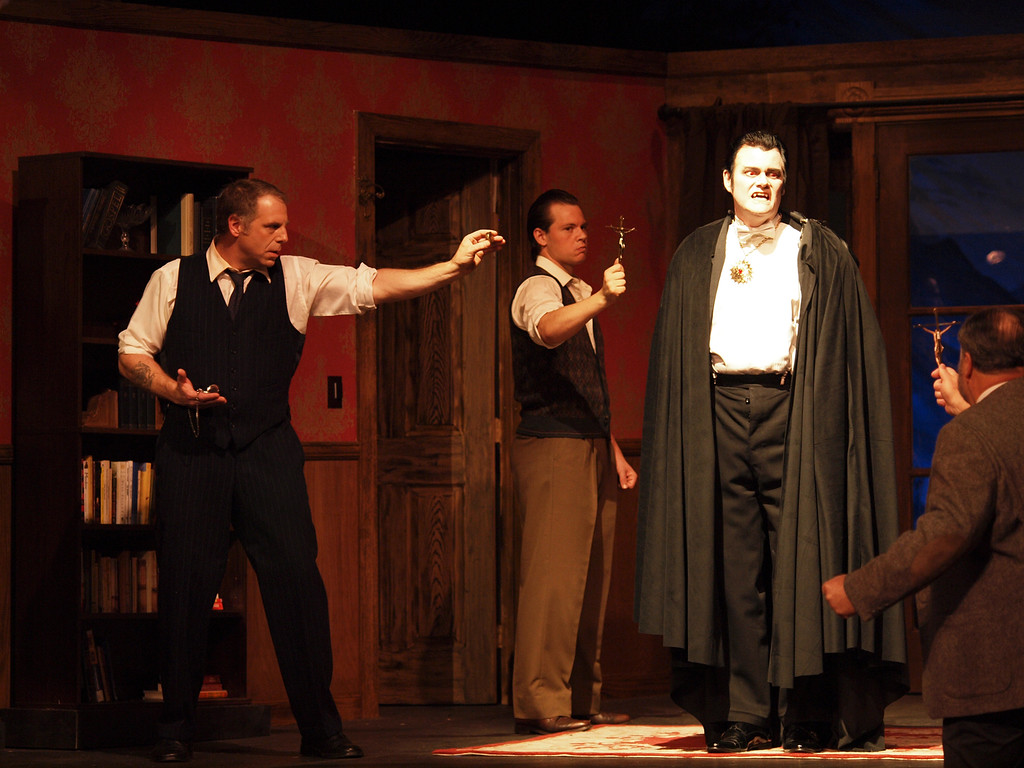
Before that devastating final scene plays out the actors give tour-de-force performances with Rebecca Benhayon’s non-stop-talking Daphna dominating the play from the opening scene with the docile Jonah. Kenny Toll has the most difficult role in the almost no-speaking part as Jonah. Toll gave a Tony Award type performance in Dracula Inquest when he was in a strait jacket the entire play. His simple declaration of not wanting to be the final arbiter in the decision about who deserves the chai rings true. Max Rosenak does not quite match the power of Benhayon but does have some of the audience routing for him especially when he drops Liam’s shouting posture to express his love for Melody. Beautiful Riley Krull is perfect as Melody.

Ryan Guzzo Purcell moves his characters around Eric Flatmo’s cramped, claustrophobic set as if they are boxers in a ring throwing their verbal punches with direct and glancing blows. The quiet final scene with Daphna and Jonah contrasts beautifully, but sadly, with loud bombast that dominates the evening. Running time a fast 90 minutes.

CAST: Daphna Feygenbaum – Rebecca Benhayon; Liam Haber – Max Rosenak; Jonah Haber – Kenny Toll; Melody – Riley Krull.

CREATIVE TEAM: Scenic Design by Erik Flatmo; Costume Design by Antonia Gunnarson; Lighting Design by Ray Oppenheimer; Sound Design by Sara Huddleston.

Kedar K. Adour, MD

Courtesy of www.theatreworldinternetmagazine.com.
 

Cousins fight over family heirloom in ‘Bad Jews’

By Judy Richter

Playwright Joshua Harmon is a 31-year-old who shows great promise, as evidenced by “Bad Jews.”

Presented in its Bay Area premiere to open Magic Theatre’s 48th season, the play looks at what it means to be a Jew as seen mainly through the eyes of two antagonistic cousins, both in their 20s, as are the play’s other two characters.

It takes place in a New York City studio apartment the evening of the family patriarch’s funeral. Jonah (Kenny Toll), a college student who co-owns the apartment, and his cousin, Daphna (Rebecca Benhayon), a senior at Vassar, are staying there for the funeral and shiva.

They’re awaiting the other owner, Jonah’s brother, Liam (Max Rosenak), a University of Chicago graduate student who missed the funeral because he lost his phone while skiing at Aspen.

They’re surprised when Liam arrives with his gentile girlfriend, Melody (Riley Krull), whom he intends to marry, they learn.

Daphna and Liam have long been at odds, mainly because she’s so insistent on observing Jewish traditions, while he isn’t. Their conflict comes to a head over their grandfather’s Chai, a symbol that means “life” in Hebrew and that is sacred to Jews. Daphna wants the Chai because she believes she’s the most observant Jew of the three grandchildren.

Liam wants to give it to Melody instead of an engagement ring, just as their grandfather gave it to their grandmother when they became engaged after World War II. As revealed by Daphna, the Chai also symbolizes their grandfather’s survival of the Holocaust.

During the 90-minute, intermissionless play, both Daphna and Liam have long, vitriolic speeches expressing their disdain for each other. Unwillingly stuck in the middle, Jonah just wants to stay out of the argument, and Melody pleads for them to treat each other as human beings.

Director Ryan Guzzo Purcell paces the action well, but some of his blocking poses sight-line difficulty for people seated on the right and left sides of the stage.

However, he has chosen his actors with care. Benhayon as Daphna and Rosenak as Liam both handle their long speeches capably, while Toll as Jonah shows his character to be a man who cares more than he initially reveals. Krull embodies Melody’s sweetness and lack of artifice.

“The play begs the distinction between religion and tribe,” Magic’s producing artistic director Loretta Greco writes in the program. It’s a fascinating look at how young people today are deciding if and how they will preserve their family’s legacy and traditions.

“Bad Jews” will continue at the Magic Theatre, Building D, FortMasonCenter, San Francisco, through Oct. 5. For tickets and information, call (415) 441-8822 or visit www.magictheatre.org.