Berkeley drama swings from plodding to powerful

By Woody Weingarten

[Woody’s [rating: 4]

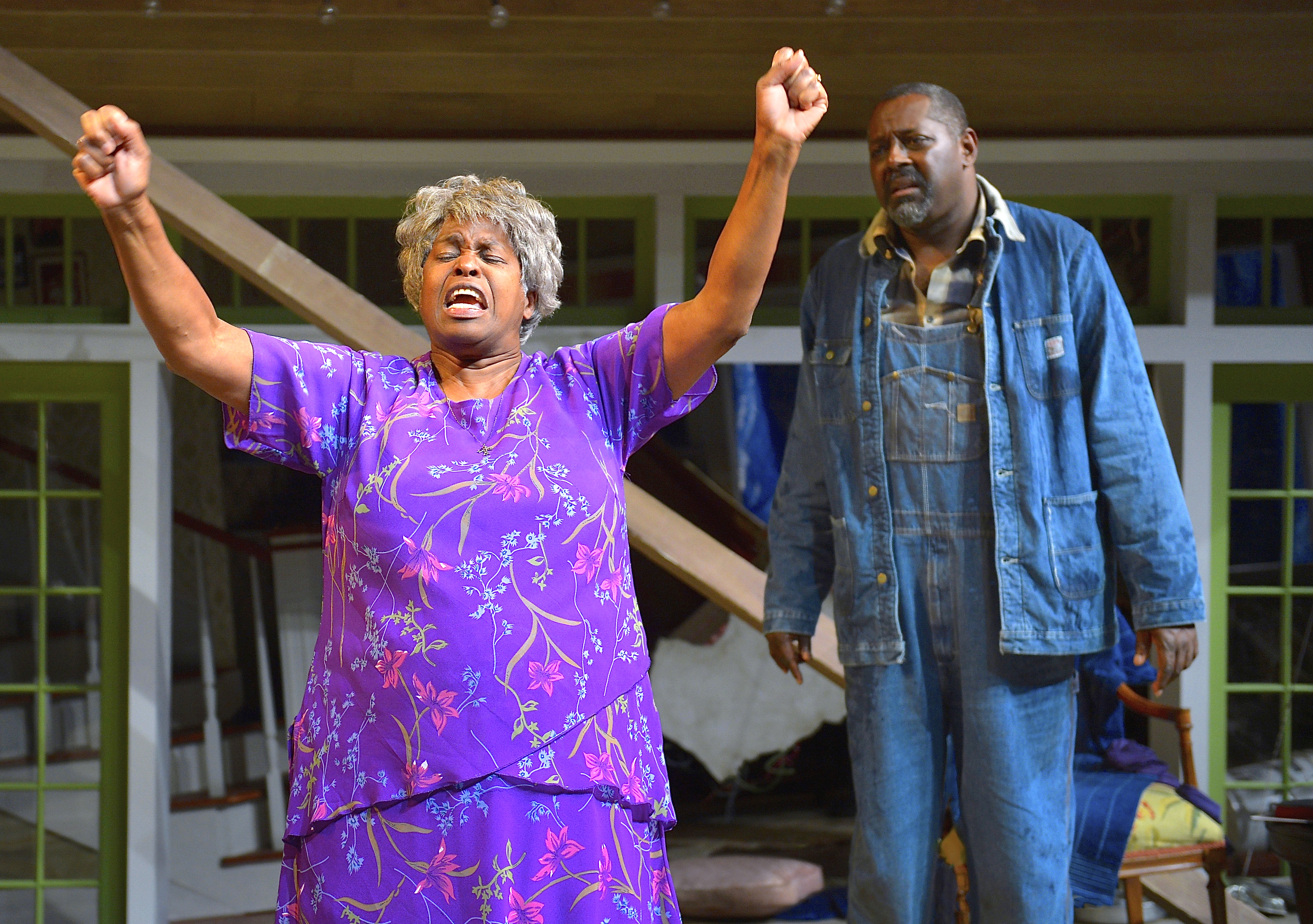
Shelah (Cheryl Lynn Bruce) tests her faith as Creaker (Michael A. Shepperd) looks on in “Head of Passes.” Photo courtesy of kevinberne.com

When “Head of Passes” ended, a stunned audience forgot to clap for a few seconds.

Thunderous applause then filled the void.

And the crowd silently shuffled from the Thrust Stage of the Berkeley Rep, struggling to decrypt mentally what it just experienced.

“Head of Passes” is a play on many levels — an epic about loss and an African American family in the marshlands of southern Louisiana, certainly — but mostly it’s about faith.

And after a first act that ground exceedingly slow, I could intensely feel playwright Tarell Alvin McCraney’s power in the second — his power to enthrall, to confuse, to evoke long discussions afterward.

My wife and I dissected it for a full hour on the way home.

To no conclusion.

Or accord.

The allegorical, mostly tragic drama bursts with homages to the biblical tale of Job.

But the modernized lightning rod for good and evil is Shelah Reynolds, a widow so pious she can’t stand even hearing the phrase deviled eggs.

She’s seriously ill, coughing up blood.

An increasingly dense storm threatens her home, outside and in, and a metaphorical tempest imperils her family on the eve of her birthday.

A remarkable Cheryl Lynn Bruce plays Shelah with alternating disorder and control, making the central role even more her own than when Chicago’s Steppenwolf Theatre Company first produced the play in 2013.

McCraney’s reworked other parts of “Head of Passes” as well, declaring in a Berkeley Rep magazine interview that it’s gotten “deeper and more focused.”

Shelah’s sermonettes to her family and herself gradually build to a soliloquy-crescendo in a tirade to God about life and sin.

Her patience and her rage become the hues on a canvas splashed with semi-madness, muddle and, finally, clarity.

The gifted cast adds many textures.

Francois Battiste and Brian Tyree Henry ably support Bruce as Shelah’s adult sons, garrulous Aubrey and lethargic Spencer.

And Nikkole Salter brings her drug-addicted half-daughter, Cookie, to life.

But I dare not omit any actor because each does well in a play in which family relations are cavernous, complicated and chaotic.

That includes Michael A. Shepperd as Creaker, a giant-sized employee responsible for much of the play’s sparse but welcome humor; Kimberly Scott as Mae, a bouncy friend; Jonathan Burke as Creaker’s indecisive son, Crier; and James Carpenter, as Shelah’s dispirited healer, Dr. Anderson.

Finally, a buff angel only Shelah can see hangs around, tolerantly watching and waiting for her to strip away her wig, outer garments, character armor and lies.

Sullivan Jones portrays him as embodied with both menace and hope.

Despite McCraney’s talent and the skill of the players, G.W. Skip Mercier’s set almost overpowers everything. It comes apart on cue, ostensibly destroyed by the deluge, with parts of the stage incrementally becoming a moat-like riverbank.

It’s the most memorable stagecraft I’ve seen in decades, as imaginative as the falling chandelier of “Phantom.”

Longtime McCraney collaborator Tina Landau directed “Head of Passes,” which refers to the tri-forked marshlands where the Mississippi joins the Gulf of Mexico.

She’d been with McCraney at Steppenwolf, too, so the pair has shaped the play from its genesis.

The playwright, Bay Area theatergoers may remember, created the Brothers/Sisters Plays, a trilogy performed at the Marin Theatre Company, the Magic Theatre and the American Conservative Theater.

For me, “Head of Passes” brings to mind, at once, the Old Testament, Kafka and Shakespeare.

Inspired antecedents, indeed.

And powerful.

“Head of Passes” plays at the Berkeley Rep’s Thrust Stage, 2025 Addison St., Berkeley, through May 24. Night performances, 8 p.m. Tuesdays and Thursdays through Saturdays, 7 p.m. Wednesdays and Sundays. Matinees, 2 p.m. Thursdays, Saturdays and Sundays. Tickets: $14.50 to $79, subject to change. Information: (510) 647-2949 www.berkeleyrep.org

Contact Woody Weingarten at voodee@sbcglobal.net or check out his website at http://vitalitypress.com

Floral exhibit enriches paintings, sculpture at de Young

By Woody Weingarten

[Woody’s [rating: 4.5]

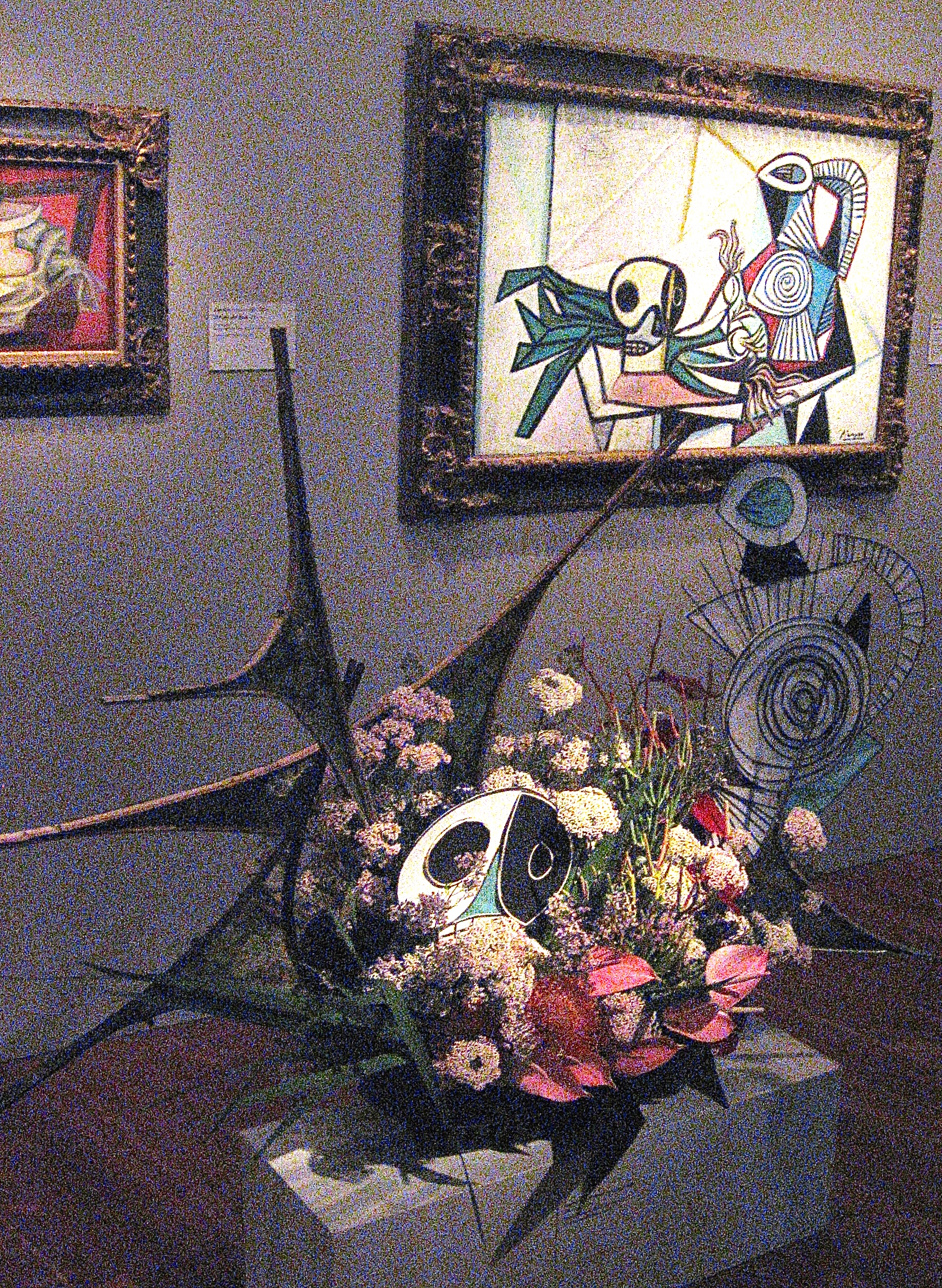
Picasso’s “Still Life with Skull, Leeks and Pitcher” hangs on de Young Museum wall. In foreground is “Bouquets to Art” impression of it by Hunter-Lee Flowers. Photo: Woody Weingarten

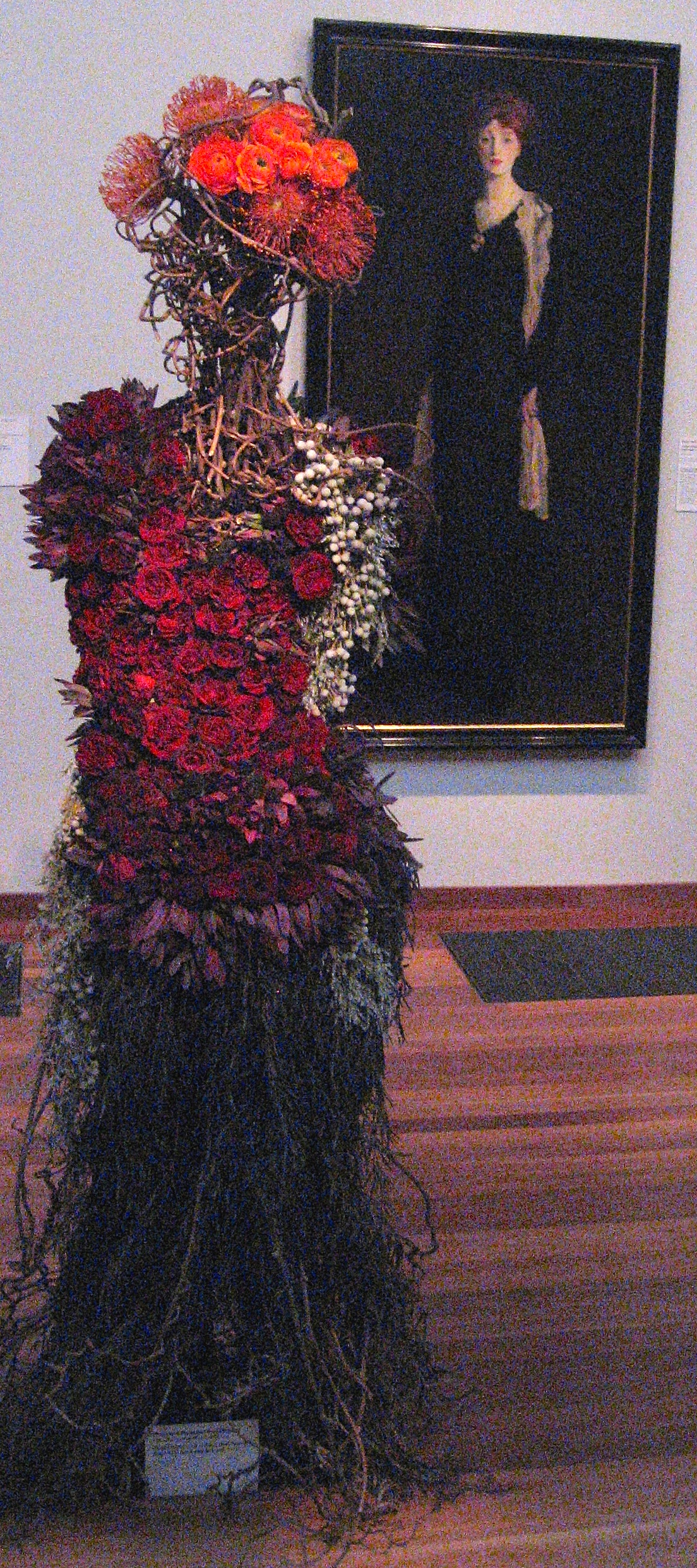
Life imitating art? “Lady in Black with Spanish Scarf,” by Robert Henri, is simulated by a Plumweed Floral and Event Design construction. Photo: Woody Weingarten.

I was afraid I wouldn’t like it.

I’ve been going to the de Young Museum’s “Bouquets to Art” for so many years I thought I might be too jaded.

I wasn’t.

What I’d forgotten was that not only is each year’s floral art exhibit different by its very nature, trends spawn even greater changes.

The first time — when my wife had to drag skeptical me there because I was pre-positive it would be neither art nor good — I was totally blown away by how outstanding, how unique, the floral arrangements were.

Oh, how those designs enhanced and enriched the museum’s permanent collection.

That year, as the several before when my wife had gone alone, displays consisted basically of flowers, flowers and more flowers.

And green leaves.

A gadzillion varieties of flora to simulate the paintings and sculptures in front of which they rested.

Not many non-living materials.

Not many foundations.

Not many structures.

But inch by inch, year by year, like osmosis, those elements slipped in.

So it shouldn’t have surprised me that his year’s four-day displays were more structural than ever.

It turns out that that wasn’t a bad thing at all. It just meant more elaborate designs.

More — and more elaborate — eye candy.

And visceral joy.

Such as the Hunter-Lee Flowers’ impression of Picasso’s “Still Life with Skull, Leeks and Pitcher.”

Floral artist Valerie Lee Ow, marking her 16th year as a participant in “Bouquets to Art,” refreshes some flowers in her design (which sits in front of “Rhapsody” by Richard Mayhew). Photo: Woody Weingarten.

Floral peacock created by Natasha’s Designs stands in front of “The Flora and Fauna of the Pacific” by Miguel Covarrubias. Photo: Woody Weingarten

Or life imitating art as a Plumweed Floral and Event Design construction simulated “Lady in Black with Spanish Scarf” by Robert Henri.

The bigger and better designs weren’t limited to displays favoring intricacy or heavy foundations, though.

Consider, for instance, the enormous, chock-full-o’-color bouquet by floral artist Valerie Lee Ow, who was celebrating her 16th year as a participant in “Bouquets to Art.”

It sat in front of “Rhapsody” by Richard Mayhew and, in fact, seemed to overpower it.

Want something a bit whimsical yet still colorful? The answer could be found in a floral peacock created by Natasha’s Designs in front of “The Flora and Fauna of the Pacific” by Miguel Covarrubias.

All in all, the evolved, more complex displays somehow helped my wife and me enjoy the show more than ever.

We can’t wait for next year.

Top billing at the de Young, 50 Hagiwara Tea Garden Drive at John F. Kennedy Drive, in San Francisco’s Golden Gate Park, now goes to the “Botticelli to Braque” exhibit, which displays masterpieces from the national galleries of Scotland through May 31, and “Richard Diebenkorn Prints,” which will run through Oct. 4. Information: 1-415-750-3504 or contact@famsf.org.

Contact Woody Weingarten at voodee@sbcglobal.net or check out his blog at www.vitalitypress.com

Alvin Ailey dance troupe still spiritually exciting

By Woody Weingarten

[Woody’s [rating: 4.5]

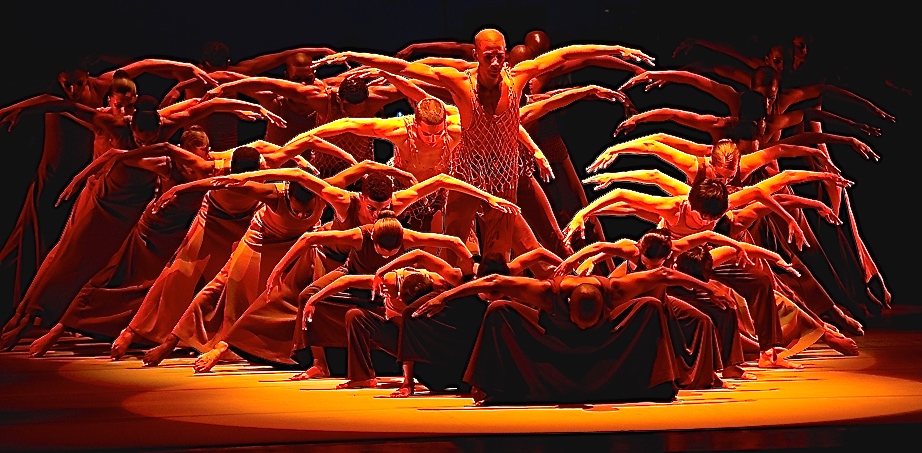
Alvin Ailey American Dance Theater members recreate “Revelations.” Photo by Christopher Duggan.

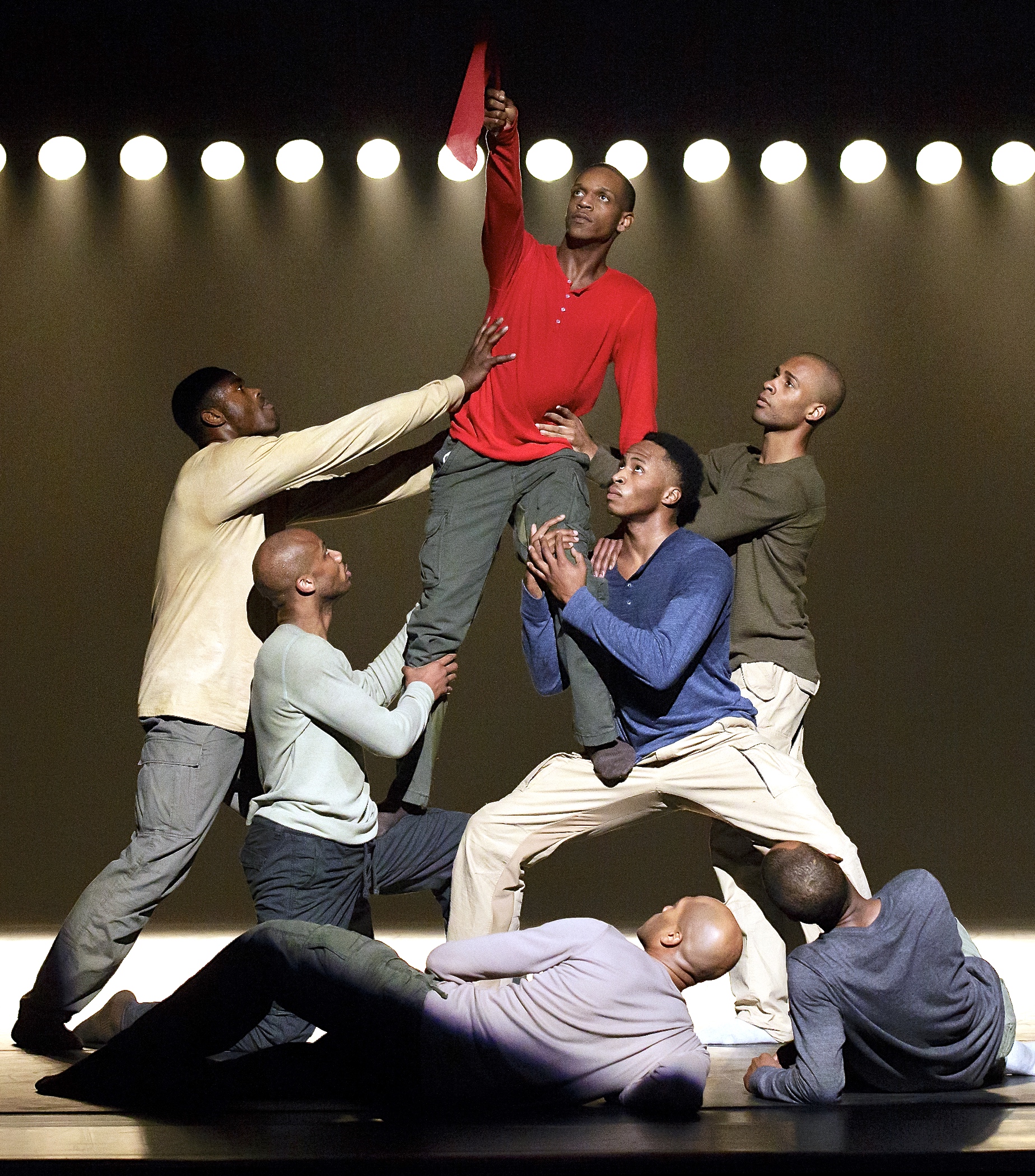
Seven males in Alvin Ailey American Dance Theater execute “Uprising.” Photo by Paul Kolnik.

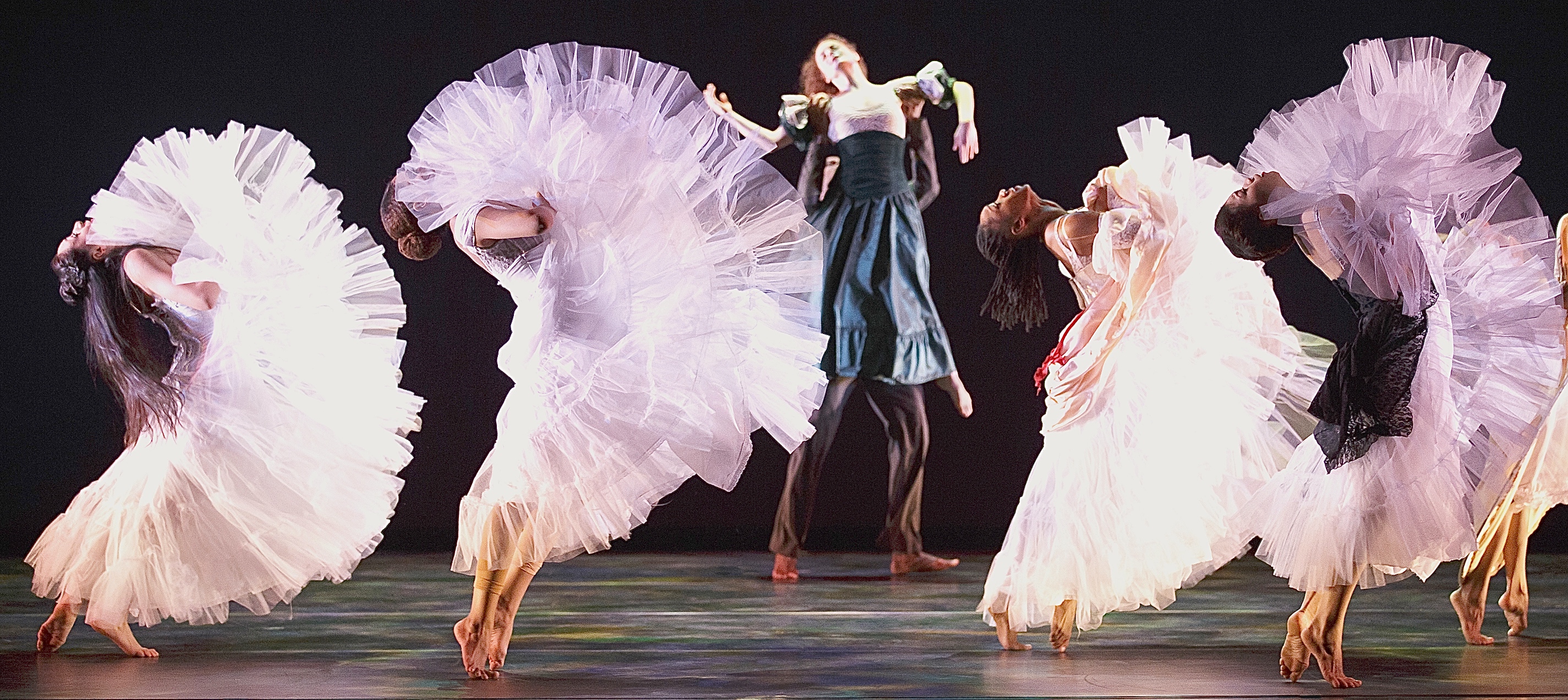
Alvin Ailey American Dance Theater members do “Suspended Women.” Photo by Paul Kolnik.

I first saw Alvin Ailey’s choreography when I lived in New York City in 1960.

That was two years after he’d founded his troupe, one year after I’d returned from post-undergrad stints in Mexico and Hollywood — a time for both of us to be experimenting with innovation.

I embarked on a lifelong career as a journalist. He pursued his dream of coupling traditional African-American culture with modern dance.

And he drew upon his memories of his Baptist church upbringing in Texas, integrating traditional spirituals, gospel and blues in his legendary work, “Revelations.”

Now, 55 years later, the Alvin Ailey American Dance Theater’s still performing that ballet, still celebrating spiritual exuberance.

When I saw the Cal Performances offering at Zellerbach Hall the other night, it was as captivating, as viscerally exciting as ever.

Maybe more so.

I couldn’t help notice it’s aged without a wrinkle.

Two other reprises were equally compelling — the percussive “Uprising,” by Israeli-born Hofesh Shechter and Vex’d, performed with surging testosterone by seven male dancers, and “After the Rain,” a pas de deux by Christopher Wheeldon that gracefully enhances music by Arvo Pärt.

“Suspended Women” by Jacqulyn Buglisi, danced to music by Ravel, seemed flimsy by comparison with the others — almost like watching 14 ballerinas twirling atop a music box.

“Uprising” was intensity incarnate.

It featured mock wrestling, macho slapping and punching, with guys appearing and disappearing into a shadowy mist.

Riveting.

I found it impossible to look away.

But “Revelations” was the most fun to watch.

The “Wade in the Water” sequence was exceptionally eye-catching, with all its costuming and props white except for one blue sheet-like material that seamlessly simulated waves.

Most rousing were the portions devoted to the familiar — “Sinner Man” and “Rocka My Soul in the Bosom of Abraham.”

The traveling troupe’s performances run only through April 26. But if you can make it, do.

In my book, it’s the best dance troupe extant.

A few folks must agree.

The multi-racial New York City-based company has performed before 25 million people in 48 states, 71 countries and on six continents.

Ailey created 79 ballets for the troupe but long wanted it to include works of others.

It has.

More than 235 pieces by more than 90 choreographers now help constitute a repertoire for the company, which after Ailey’s death in 1989 was helmed first by Judith Jamison and now Robert Battle.

Both would have made him proud.

Upcoming Cal Performances dance dates include “Cinderella,” by the Marlinsky Ballet and Orchestra, Oct. 1-4; and Twyla Tharp’s 50th anniversary tour, Oct. 16-18. Information: www.calperfs.berkeley.edu/ or (510) 642-9988.

Contact Woody Weingarten at voodee@sbcglobal.net or at www.vitalitypress.com/

‘The Way West’ loses its way

By Judy Richter

In one way, “The Way West” is about the indomitable spirit that drove pioneers ever westward despite near-insurmountable odds.

In another way? Mona Mansour’s play, presented by Marin Theatre Company doesn’t seem sure where it wants to go.

It’s set in Central California, probably in StocktonorModesto during the recent recession. Mom (Anne Darragh) wants to declare bankruptcy after ignoring unpaid bills. The 62-year-old is also ignoring potentially serious health issues.

Her older daughter, Manda (Kathryn Zdan), is visiting from Chicago to try to organize Mom’s finances. She’s more or less assisted by her sister, Meesh (Rosie Hallett), who is living with Mom and whose finances are shaky, too.

Manda seems fairly OK financially, thinking nothing of paying $150 for a haircut, but she’s heavily reliant on credit cards.

One bit of bad news after another leaves the three women destitute, unable to pay even for a pizza delivery. Nevertheless, Mom remains relentlessly upbeat.

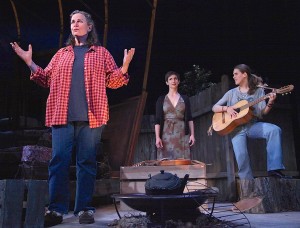
Stressing the pioneer theme, many scenes begin with a Mom monologue telling the story of some pioneer adventure that usually ends badly. Sometimes her daughters join her in song (music and musical direction by Sam Misner and Megan Pearl Smith).

What’s confounding is that no one does anything about Mom’s health issues. A possible rekindling of the romance between Manda and former boyfriend Luis (Hugo E. Carbajal) is left hanging. Some situations seem to come from theater of the absurd.

For example, a family friend, Tress (Stacy Ross), has invested thousands of Mom’s and her own money in a get-rich-quick, get-thin-quick scheme that’s nothing short of ludicrous.

Despite holes in the script, the production directed by Hayley Finn keeps moving thanks to outstanding performances, especially by Darragh as Mom and by Ross, who is underused but brilliant as Tress.

The set by Geoffrey M. Curley (lit by Masha Tsimring) captures Mom’s disorganization while evoking the pioneer theme with overhead arches reminiscent of a covered wagon. Costumes are by Christine Crook with sound by Brendan Aanes.

The two-act play runs about two hours with one intermission. Despite its basic premise and a fine cast, it goes too many different ways to be satisfying.

“The Way West” continues through May 10 at Marin Theatre Company, 397 Miller Ave., MillValley. For tickets and information, call (415) 388-5208 or visit www.marintheaatre.org.


The Way West loses its way at Marin Theatre.

By Kedar K. Adour

Anne Darragh (Mom), Kathryn Zdan (Manda) and Rosie Hallett (Meesh) in the West Coast premiere of Mona Mansour’s The Way West, on stage at Marin Theatre Company

The Way West: Comedy/Fable(?) with Music by Mona Mansour. Directed by Hayley Finn. Song arrangements by Misner and Smith. Marin Theatre Company (MTC), 397 Miller Avenue, Mill Valley, CA 94941. Phone: 415-388-5208 or boxoffice@marintheatre.org.  

April 16 – May 10, 2015

The Way West loses its way at Marin Theatre. [rating:3]

With the desire to foster and encourage playwrights a plethora of new play awards are popping up around the country. It seems inevitable that some questionable award selections lead to main stage productions.  The Way West, that is being given a full-scale treatment at the Marin Theater, was the winner of the company’s 2013 Sky Cooper New American Play Prize is one of those questionable selections.

The Way West received its world premiere in April 2014 at Steppenwolf Theatre Company in Chicago and the reviews were universally tepid, nay even critical. The play has been further developed in a five-day workshop in January 2015 at MTC and song arrangements by local Americana duo Misner and Smith added to the script. Although dramatically staged with a mostly top-notch cast the storyline hit more than a few ruts during this two hour (with intermission) multiple scene play ending with a whimper.

 The various scenes are introduced by large signs enfolding on stage left suggesting the content of the upcoming action beginning with “THE WAY WEST IS BEST.”  Partial list of other signs include, “Help is Here”, “Hope Springs Eternal”, “Another Mouth to Feed”, “Adapt or Die” and the penultimate one (paraphrased) “The Wheels Come Off.”

The main characters are a mother and two daughters; Mom (Anne Darragh), with early signs of dementia being cared for by her youngest illogical Michele (Rosie Hallett) and the eldest level-headed Amanda (Kathryn Zdan) has arrived to help Mom with her filing for bankruptcy. Mom, who lives in a depressed mid-valley town similar to Stockton, has a knack for telling dubious stories about the settling of the West. These improbable stories are the mainstay of the fanciful plot that injects humor into the evening that becomes a hodgepodge of purpose.

It all begins with a dramatic monolog by Mom before the string instruments are brought out and plucked by all three as they sing songs pertinent to the action taking place or about to take place. Although the music is germane the play is not a musical but rather a clever device that adds interest and humor.  

As the evening progresses author Mansour astutely builds solid characters with specific traits being buttressed by word as well as action. Michelle has, unbeknownst to Mom, has used Mom’s over extended credit cards to set up a scheme to earn money on Ebay. The level-headed Amanda lives well by keeping ahead of her creditors/debts by paying off the minimum on the balance.

Added to the script is upbeat, hyperactive Tress (marvelous underutilized Stacy Ross) who has helped drain Mom’s coffers with a hilarious improbable business venture. A questionable love interest for Amanda is present as Luis (Hugo Carbajal) who is there to help with bankruptcy. Carbajal has a great turn as a 30 plus year old pizza delivery man in the best scene in the play as the women try to pay for a delivery with expired credit cards.

Ann Darragh who is a mainstay on local stages does not disappoint in a difficult role. Kathryn Zdan earns the major accolades and receives great support by Rosie Hallett as her antithesis.

The set (Geoffery M. Curley) is a marvel of jumble framed by the skeleton of a pioneer wagon symbolic of Mom’s fanciful journey West told in implausible stories.

CAST: Carbajal (Luis/Pizza man); Anne Darragh (Mom); Rosie Hallett (Michele); Stacy Ross (Tress); and Kathryn Zdan (Amanda).

ARTISTIC STAFF: Directed by Hayley Finn; Scenic Designer, Geoffrey M. Curley; Lighting Designer, Masha Tsimring; Costume Designer, Christine Crook; Sound Designer,      Brendan Aanes; Composers/Music Directors, Sam Misner & Megan Pearl Smith; Stage Manager, Heath Belden; Properties Artisan, Kirsten Royston; Casting Director, Meg Pearson; Dramaturg,    Margot Melcon.

Kedar K. Adour, MD

Courtesy of www.theatreworldinternetmagazine.com

Anne Darragh (Mom), Kathryn Zdan (Manda) and Rosie Hallett (Meesh) in the West Coast premiere of Mona Mansour’s The Way West, on stage at Marin Theatre Company now through May 10.

The Way West: Damsels in Distress

By Test Review

On April 21, 2015, the Marin Theater Company premiered The Way West which had won Marin Theater Company’s 2013 Sky Cooper New American Play Award.   Playwright Mona Mansour was awarded the 2014 Middle East America Distinguished Playwright Award, so expectations were high. The story line revolves around the relationship of a mother and two daughters caught in the maelstrom of the financial collapse.  The mother is attempting to declare bankruptcy, while she tries to evoke hope in the two daughters with references to the Old West and the pioneers. Anne Darragh, as Mom, offers a humorous touch despite her situation, framed by the engaging, light tunes accompanying the story that she and the daughters occasionally sing as counterpoint. Mom copes, but doesn’t seem to have a clue about how she got into the mess or even appear to be concerned about it.  The youngest daughter, Meesh, played by Rosie Hallett, is as numb as her mom, and only contributes to her mother’s financial demise, without any personal recriminations.  The only hope appears to be in the older daughter, Manda, played by Kathryn Zdan, who supposedly holds a reputable job as a grant writer.  But her façade falls as she, too, is knee deep in a credit mess which she fails to recognize because she pays the sizable minimum payments each month and happily offers to open up another credit account, without any compunction.  Soon, through her own irresponsibility, she is out of a job and beset with the same prospect of being out on the street.  Three clueless ladies!

Anne Darragh (Mom), Kathryn Zdan (Manda) and Rosie Hallett (Meesh) in West Coast premiere of Mona Mansour’s The Way West, on stage at Marin Theatre Company

The other two characters in the play, Tress, played by Stacy Ross, and Manny/and the Pizza Man, played by Hugo Carbajal, offer context to the mess. Tress has borrowed money from Mom (Mom’s father’s trust?) to invest in a direst sales scam to sell glorified beauty water, which, naturally, goes belly-up. While she professes responsibility, she is equally lost. Manny, a start-up paralegal, functions as a source of hope for Mom’s bankruptcy request and Manda’s future security as a potential returning beau. Hugo reappears to play the separate role of the pizza man who delivers the message that there is just no more credit! The closest that the play comes to a climax is at the end when Manda says that her Mom is a statistic just like the folks who died on their way West—all optimism and no practicality.  The family takes no responsibility for their mess—just that that they will pack their belongings in boxes, bought on credit, and move on after the house is assumed by the bank.

All this said, the play is engaging, the story line has a relationship to our pioneering forbears who set out optimistically to face the unknown, with all their fatalistic flaws, and the actors charm the audience into believing the premise without totally buying into it. It is a modern take on an old melodrama: the anonymous villain is the credit card company; the damsels in distress are clueless. Alas! There is no hero.

It was an enjoyable evening in an intimate theater. MTC is to be commended for its pioneering spirit!

review by Linda Cederblom, For All Events reviewer

Staycation in Marin features imaginary flight to Zanzibar

By Woody Weingarten

Writer and his wife watch a triple-feature on TV from bed during staycation. Photo by Nancy Fox.

We reveled in our fantasy.

Instead of deck-lounging in San Anselmo, our minds rocketed to Zanzibar, the semi-autonomous part of Tanzania in East Africa that’s housed humans for 20,000 years.

Why there?

God knows, since neither my wife nor I’d ever thought of going there — even when playing “let’s pretend.”

The mental trip was a lot cheaper than real airfare, of course.

And we definitely needed a break, fast approaching total pooped-outedness because of our typically intense, neurotic scheduling.

“I haven’t spotted a native all day,” I mused aloud, “but I have noticed animals nosing around.” Three deer-in-residence that devour whatever flowers dare pop up in our yard were grazing only a few feet away.

I had no clue what they were fantasizing.

Our compulsiveness made us set rules even for last month’s “impromptu” four-day staycation.

We’d monitor but not answer phone calls and emails. Nancy wouldn’t work on her upcoming piano-and-patter performances, nor I on promoting my book, “Rollercoaster: How a man can survive his partner’s breast cancer.”

We mulled taking our dog, Kismet, to a West Marin beach, leisurely buying pants at the Northgate Shopping Center, taking out mu shu from Ping’s in San Rafael.

No deadlines. No schedule. No pressure.

The first morning, I asked our Zanzibarian chef to scramble eggs, with diced onions throughout.

When done, I said, “My compliments to the chef.”

“Thanks,” he replied.

Funny how much “he” resembled my wife.

The eggs were perfect. But we decided we’d prefer eating out most of the time, as if we were in a faraway Airbnb instead of at home in Marin County.

Relaxing has never been our long suit, though.

In fact, years ago I tried pulling off a Do-Nothing Day. It lasted under four minutes, after which I found myself checking 13 bookmarked news sites, exercising, phoning my daughter in New York, walking our dog at Drake High, helping Nancy unclog a filing cabinet, hauling a box to our storage shed, writing to an agent, and crafting a column.

We did better together.

One day we even watched a triple-feature in bed.

Best was “Alive Inside,” gifted us by Nancy’s Sausalito cousin, Laura Scott — a documentary about personalized music on iPods breaking through the solitary confinement of nursing home patients with Alzheimer’s and dementia.

It made us weep.

And rush to our checkbook.

The film also made me again appreciate Nancy’s shows. She regularly plays in memory-care and other senior facilities — geographically spread from The Redwoods in Mill Valley to Atria Tam Creek in Novato.

For years she’s told me of residents exiting almost catatonic states to tap their toes and fingers, swing their arms and mouth words from once forgotten tunes.

A two-way blessing, indeed.

Our second staycation day included laughing and crying at a Fairfax matinee of “The Second Best Exotic Marigold Hotel,” and slowly strolling downtown in San Anselmo.

That was followed by a day of Nancy dipping into Ann Patchett’s anthology, “This Is the Story of a Happy Marriage,” and my reading Roger Ebert’s autobiography, “Life Itself” — books with mega-positive messages.

But our best “go-nowhere day” was the one in which we went somewhere.

Unscheduled.

We rode past Fairfax and San Geronimo through manifold tunnels of trees to South Beach, where we watched huge waves blithely erase both human and dog prints from the sand for hours.

And we topped off the jaunt with an elongated outdoor lunch at Perry’s Inverness Park Grocery while watching sheep across Sir. Francis Drake Blvd. that were even more tranquil than we.

Wristwatches seemed wholly out of place.

Though we did make it through the staycation without working, we also re-discovered our love for — and addiction to — the endeavors that comprise “our revolving-door lives.”

Well, to be honest, we almost made it.

Our final staycation hours were corrupted by a computer glitch on my iMac.

I gave myself papal dispensation to work it out.

Nancy and I chortled at my obsessiveness — and copped to preferring the excitement of fifth gear to the stability of first.

But even if we never repeat our four-day experiment, we at least learned we can take time off from overload.

Maybe half a day.

Or an hour.

Hey, watch out Zanzibar, here we come again.

Contact Woody Weingarten at voodee@sbcglobal.net or at www.vitalitypress.com/

Mirandolina! beautifully staged by CenterRep in Walnut Creek

By Kedar K. Adour

Tracy Hazas as Mirandolina.

Mirandolina! Mistress of a Tuscan Inn: Comedy by Carlo Goldoni. Adapted and directed by Timothy Near., Center REPertory Company, 1601 Civic Dr. Walnut Creek, CA. 925-295-1413 or www.centerREP.org.  April 7 –May 2, 2015.

Mirandolina! beautifully staged by CenterRep in Walnut Creek [rating:5]

PR releases for Mirandolina: Mistress of a Tuscan Inn state it is an adaptation by the legendary Timothy Near of a ‘literal translation’ by Lisa Gottreich.  The question arises as to what constitutes a literal translation? Among the many synonyms of ‘literal’ are accurate, authentic, unvarnished and even simple. Take your choice while this reviewer opts for the unvarnished moniker since the production has enough innuendo with comedia del arte touches to keep you chuckling long after the curtain descends.

Timothy Near who directed this/her adaptation of Goldini’s comedy adds another star to her curriculum vitae after her stunning, award winning mounting of Rumors at CenterRep in 2012. She has brought along husband/CenterRep Artistic Director Michael Butler, Gabriel Marin and Mark Anderson Phillips from that show to fill key roles in this hilarious production. But the major accolades go to the ladies who put the egotistical male characters in their places even though they are theoretically the masters of women in this 1783 play.

Beautiful and independent Mirandolina (Tracy Hazas ) is running a Tuscan Inn at a time when women were considered incompetent to do so. She is in love with her handyman Fabzio (Ben Euphrat) whom she wishes to marry. Meanwhile the impecunious Marchese di Forlipopoli (Mark Anderson Phillips) and egotistical money-rich Count Cavaliere di Ripafratfa, (Michael Butler) vie for her favor. The foppish Marchese wants the dowery/money that will be attached to marriage with her. The Count, the cad, wishes her to be married so that he can take her as his mistress!

Then there is the professed misogynist Cavaliere di Ripafratfa (Gabriel Marin) who wants nothing to do with women. Don’t you just love the pompous male titles? He is about to get his comeuppance when Mirandolina cleverly tricks him into falling in love with her.

The pieces are not yet all in place since Goldoni introduces two beautiful actresses Ortensia (Lynda Di Vito) and Dejanira ( Lizzie O’Hara) to further complicate the plot as they side with the Count to throw all into further awry. Not to be forgotten is Center Rep favorite Colin Thomson playing Carlo, the Cavaliere’s Servant to add further humor to the plot(s).

Tracy Hazas is a statuesque beauty who plays the Mistress with authority and has comedic skills to carry off the necessary deception of Cavaliere who ends up unable to resist her. The accomplished Michael Butler adds the right schtick to his performance to steal more than one scene from his cohorts. You will not recognize

Mark Anderson Phillips as Marchese

Mark Anderson Phillips as he immerses himself in the foppish role of the Marchese but hardly comes off as second best. Then there is Gabriel Marin’s supercilious Count that often takes center stage bringing laughter with his asides to the audience. Dave Mair deserves a Tony for his staging of a duel to end all duels between Marin and Butler.

The duel to end all duels! Michael Butler and Gabriel Marin

To top all this great acting and directing are the stunning costumes by Victoria Livingston Hall and Nina Ball’s magnificent set with a central revolving stage that keeps the non-stop action zipping along at full speed even though the three hour running (with an intermission) time is a bit too much.  Highly recommended.  Your trip to the Lesher Center Rep venue will delightfully transport you to: The Age of Enlightenment, circa 1750. Mirandohina ‘s Inn, Florence, Italy.

Cast: Mirandolina, Tracy Hazas; Fabrizio, Ben Euphrat; The Marchese di Forlipopoli ,Mark Anderson Phillips; The Count di Albafiorita, Michael Butler; The Cavaliere di Ripafratfa, Gabriel Marin; Ortensia,Lynda Di Vito; Dejanira, Lizzie O’Hara; Carlo,the Cavaliere’s Servant,Colin Thomson; Luclo, a servant of the Inn, Joe Metheny; Sirena, a servant of the Inn, Kathryn Butler.

Creative Team: Directed by Timothy Near; Set Design by Nina Ball; Lighting Design by Kurt Landisman; Costume Design by Victoria Livingston Hall; Sound Design by Theodore J. H. Hulsker; Stage Managed by Nicole Langley.

Kedar K. Adour, MD

Courtesy of www.theatreworldinternetmagazine.com

Fire on the Mountain resonates with foot-stompin’ music at TheatreWorks

By Kedar K. Adour

l-r: Robert Parsons, Harvy Blanks, Harry Yaglijian, Molly Andrews, David M. Lutken, Tony Marcus, Karen Celia Heil, and Marie Shell star in TheatreWorks Silicon Valley’s Regional Premiere of Fire on the Mountain, presented April 1 – 26 at the Mountain View Center for the Performing Arts.

Fire on the Mountain: By Randal Myler & Dan Wheetman.  Directed by Randal Myler. Musical Directed by Dan Wheetman. TheatreWorks at Mountain View Center for the Performing Arts, 500 Castro Street, Mountain View.  (650) 463-1960 or visit www.theatreworks.org.

April 1 – 26, 2015

Fire on the Mountain resonates with foot-stompin’ music at TheatreWorks [rating:5]

Fire on the Mountain receiving its breath catching regional premiere at TheatreWorks has its origins in the hard-scrabble lives of coal miners and their families in Appalachia. It is the passionate handiwork of the creators of It Ain’t Nothin’ But the Blues told as a musical revue using rhythms specific to that region. The authors make a distinction between commercial blue grass and old time music. Whereas the former is designed to entertain the latter is a musical history both melancholy and joyous and always gripping storytelling. Although the actually daily hardships continued on for month and years, the love of their land remained strong.

The show has been making the rounds of theatres around the U.S. since its premiere at Chicago’s Northlight Theatre in 2007. The reviews have been raves and the present staging continues that trend. Along with a talented cast of singers and actors most of the acting crew plays multiple instruments and all dance up a storm individually and in groups. Adding to the authentic music of the entire production are archival black and white photos projected on two large screens framing the stage.

The 90 minutes without intermission kept the audience riveted to their seats ending with a spontaneous standing ovation. Highly reccommended.

Cast: Molly Andrews, Harvy Blanks, Nik Duggan, Karen Celia Heil, David M. Lutken, Tony Marcus, Robert Parsons, Marie Shell, Harry Yaglijian.
Artistic Cast: Scenic Design, Joe Ragey; Costume Design, Jill Bowers; Lighting Design, Steven B. Mannshardt; Sound Design ,Brendan Aanes; Stage Manager, Gregg Rehrig; Assistant Stage Manager, Emily Anderson Wolf. 

Kedar K. Adour, MD

Courtesy of  www.theatreworldinternetmagazine.com.

l-r: Robert Parsons, Harvy Blanks, Harry Yaglijian, Molly Andrews, David M. Lutken, Tony Marcus, Karen Celia Heil, and Marie Shell star in TheatreWorks Silicon Valley’s Regional Premiere of Fire on the Mountain, presented April 1 – 26 at the Mountain View Center for the Performing Arts.

Head of Passes: A modern day parable of The Book of Job

By Kedar K. Adour

Sullivan Jones (The Angel) and Cheryl Lynn Bruce (Shelah) perform in Tarell Alvin McCraney’s Head of Passes, a poignant and poetic new play about the journey of family and faith, trial and tribulation at Berkeley Rep. Photo courtesy of kevinberne.com

Head of Passes: Drama by Tarell Alvin McCraney. Directed by Tina Landau. Berkeley Rep. Berkeley Rep’s Thrust Stage, 2925 Addison St., Berkeley. (510) 647-2949 or www.berkeleyrep.org. April 10 –May 24, 2015.

Head of Passes: A modern day parable of The Book of Job [rating:4]

Tarell Alvin McCraney burst on to the Bay Area theatrical scene five years ago when his trilogy The Brother and Sister Plays received spectacular productions at three different theatres.  Those plays explore life in the mythical Louisiana Bayou town of San Pere. They begot life at the Marin Theatre Company with their stunning production of In the Red and Brown Water before the baton for Part Two, The Brothers Size, was passed on to the Magic Theatre receiving a muscular standing ovation production under Octavio Solis’s direction. Part Three: Marcus: The Secret of Sweet, was handed over to A.C.T. who mounted a flashy stirring staging but did not match the muscular productions of Parts One and Two.

Berkeley Rep Stage receives the honors with his return to the Bay Area for Head of Passes as a co-production with New York’s Public Theatre. McCraney again sets his characters in the Louisiana Bayou in the mouth of the Mississippi called ‘the head of passes” where the land is below sea level and is ever shifting because of floods and tidal surges. In The Brother and Sister Plays it is hurricane Katrina that wreaks havoc and it seems a foregone conclusion that McCraney is setting us up for a similar disaster before the play ends.

The inspiration for the play is the Biblical “Book of Job” and was commissioned by Chicago’s Steppenwolf theatre where it was staged in 2010. The concept of Faith again takes center stage with the protagonist Shelah (Cheryl Lynn Bruce), an elderly widowed Black woman questioning, nay accepting God’s creation of death and destruction of her family and home.

(l to r) Cheryl Lynn Bruce (Shelah), Brian Tyree Henry (Spencer), and Francois Battiste (Aubrey)

The family consists of adult children Aubrey (Francois Battiste), and Spencer (Brian Tyree Henry) who are preparing a birthday party for her that is intended to be a surprise. Aiding in that endeavor is a preacher, Creaker (Michael Shepperd) and his son Crier (Jonathan Burke). Non-family uninvited persons include friend Mae (Kimberly Scott) and Shelah’s white doctor Dr. Anderson (James Carpenter). There is “The Angel” (Sullivan Jones), dressed in an elegant black suit and bow tie who wanders in and out of the action. He is seen only by Shelah. Also uninvited is the mysterious volatile sister Cookie (Nikkole Salter) whose arrival is antecedent to the climatic ending of act one.

 As in the Book of Job, when Job’s offspring are having a party a mighty wind sweeps in and collapses the house, killing Job’s beloved children, so it is with Shelah’s home and family. The set (G. W. Skip Mercier) and its fantastic destruction from wind and rising water almost over shadow the brilliant acting and tight direction by Tina Landau who kept the play in check.

Cheryl Lynn Bruce who created the role in its original production is a force of nature when, she like King Lear, rails against the elements questioning God in her 20 minute monolog in the second act. Yet through all this questioning she maintains her faith. Francois Battiste’s range of emotion from the love of his mother to hate for his half-sister Cookie can be felt across the apron of the thrust stage. James Carpenter brings compassion to the role as the doctor especially when he is forced to bring the news to Shelah of the death of her entire family.

To this reviewer there are two caveats; one being the ill-defined reason for the animosity between Cookie and Audrey and the other is the extended final monolog that could be trimmed to create a more powerful ending. Never-the-less this play is highly recommended with a running time two hours with an intermission.

Cast: Francois Battiste (Aubrey), Cheryl Lynn Bruce (Shelah), Jonathan Burke (Crier), James Carpenter (Dr. Anderson), Brian Tyree Henry (Spencer), Sullivan Jones (The Angel), Nikkole Salter (Cookie), Kimberly Scott (Mae), and Michael A. Shepperd (Creaker)

Creative team: Directed by Tina Landau, G, W. Skip Mercier (scenic designer), Toni-Leslie James (costume designer), Scott Zielinski (lighting designer), and Rob Milburn and Michael Bodeen (sound designers)

Kedar K. Adour, MD

Courtesy of www.theatreworldinternetmagazine.com

Sullivan Jones (The Angel) and Cheryl Lynn Bruce (Shelah) perform in Tarell Alvin McCraney’s Head of Passes, a poignant and poetic new play about the journey of family and faith, trial and tribulation at Berkeley Rep. Photo courtesy of kevinberne.com

(l to r) Cheryl Lynn Bruce (Shelah), Brian Tyree Henry (Spencer), and Francois Battiste (Aubrey) perform in Tarell Alvin McCraney’s Head of Passes, a poignant and poetic new play about the journey of family and faith, trial and tribulation.