

There is an old saying: Time reveals all things. In Harold Pinter’s Betrayal, time does something more interesting: it runs backward. A flashback ordinarily takes us into the past to explain the present, but Pinter turns that familiar theatrical device on its head. Here, the past isn’t an occasional detour. It’s the destination.
Watching Betrayal is like peeling an onion. Each scene strips away another layer of deception, revealing what lies beneath. But Pinter’s final layer is the beginning itself. We begin with the wreckage of a love affair and travel backward toward its origins. The further back we go, the more we discover how little we understood.
Emma is married to Robert. Jerry is Robert’s best friend—and Emma’s lover. Their affair lasts 7 years. As the story moves backward, we discover that knowledge itself has been unequally shared. Those who appear deceived may be concealing secrets of their own. The question becomes not merely who betrayed whom, but who knew what, when they knew it—and why they remained silent.
Director Carey Perloff, who worked personally with Pinter, brings a sure understanding of his distinctive theatrical language to Marin Theatre. The set is brilliantly conceived. A double bed sits on a raised platform at center stage—a proscenium altar to infidelity. There it remains, a silent witness to deception, damaged friendship, and the corrosion of trust.
Liz Sklar as Emma, Charlie Semine as Robert, and Tasso Feldman as Jerry deliver accomplished individual performances. Nic Moore completes the cast as the Waiter. Yet something curious happens when the three principals share the stage: the emotional chemistry seems to evaporate. We are watching the aftermath of a 7-year affair, but where is the passion that sustained it?
Is this a shortcoming of the production—or Pinter’s deliberate portrait of people for whom intimacy has become another form of deception?
What is most unsettling is the extraordinary ordinariness of it all.
I confess to a personal antipathy toward such casual infidelity. The destruction of trust strikes me as profoundly corrosive—not only to relationships, but to the people involved. Perhaps that is Pinter’s most disturbing insight. Betrayal need not be accompanied by grand passion, dramatic confrontation, or even much apparent guilt. It can become almost routine.
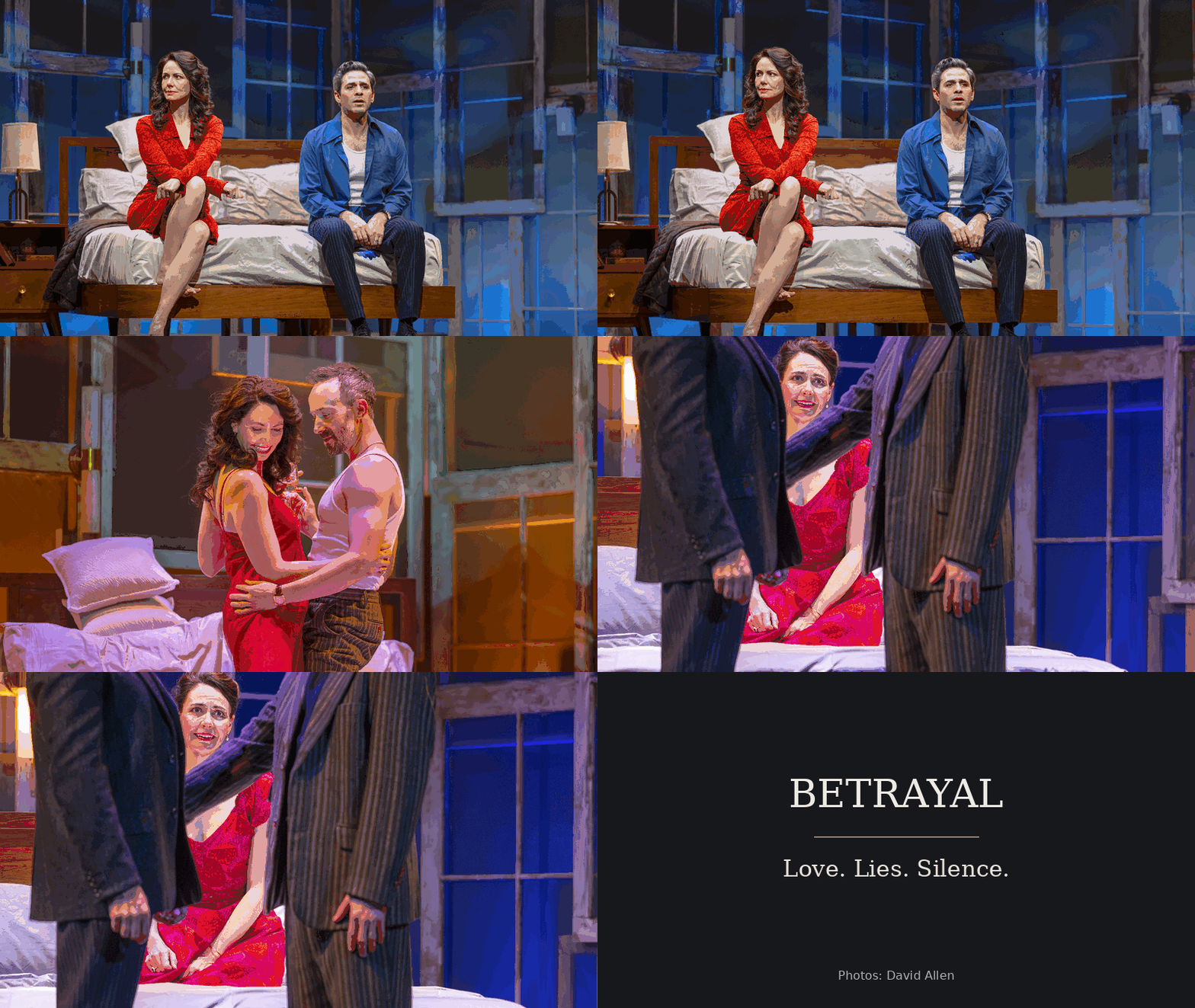
The production features excellent scenic and projection design by Yuki Izumihara, lighting by Russell Champa, sound by Fiona Sharkey, and original music by Jack Perla.
“What can you say when a love affair is over?” asks Antônio Carlos Jobim’s haunting song How Insensitive. Pinter offers an unsettling answer: Perhaps the most revealing things are those never said at all. His characters conceal as much in their pauses as in their words. An innocent question may mask a devastating truth. A casual conversation can become an exercise in mutual deception.
By the final scene—which is actually the beginning—we understand these people differently. Each revelation has changed the meaning of what came after. That is the paradox of this production: excellent acting, ingenious dramatic construction, and relationships strangely devoid of warmth. Perhaps that absence is precisely the point.
Betrayal begins with the consequences and ends with the cause. By then, Pinter has stripped away every layer of deception—leaving us to wonder whether these people ever truly knew one another.
Betrayal by Harold Pinter
Director: Carey Perloff
Through November 15
Marin Theatre, 397 Miller Avenue, Mill Valley
$39–$110, plus $6 handling fee per order
Box Office:
MarinTheatre.org
415-388-5208