Category

Woody Weingarten

Woody
Weingarten

‘Se Llama Cristina’ bends characters and timeframes

By Woody Weingarten

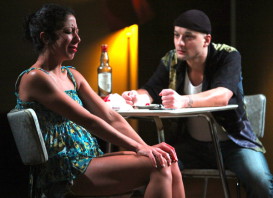
Sarah Nina Hayon and Sean San José star in the Magic Theatre production, “Se Llama Cristina.” Photo: Jennifer Reiley.

Offbeat.

A handful of Bay Area theater companies strive for it by focusing on the uncommon, the unusual, the unique.

These troupes provide a contrast with those that prefer to pick low-hanging fruit like Chekhov’s “The Cherry Orchard” for the 17th time, or retread musicals like “Grease” for the 11th local go-round, or believe casting two women as “The Odd Couple” will add laughs.

The Magic Theatre, thankfully, belongs in the first category.

Witness its latest chancy venture into the known unknown, “Se Llama Cristina.” In it, San Francisco playwright Octavio Solis toys with words (ranging from coarse to poetic) and emotions (ranging all over the proverbial map) and timeframes (troubled flashbacks, a problematic present and tentative flashes forward).

He embraces hyper-serious subject matter, then switches moods by lacing it with verbal gags (many of the gallows humor variety).

His main characters often speak in ultra-short outbursts that can long remain ambiguous (or appear unrelated to the topic at hand).

Vespa (or Vera) and Mike (or Miguel or Miki), start off trapped in a seedy, locked room with drug paraphernalia on the kitchen table, scraps of crumpled poetry covering the floor, and an empty crib (except for a fried drumstick) enticing them.

Are they really victims? Are they really junkies (or alcoholics)? Are they really parents?

Interactions with Rod Gnapp’s alter ego (Abel and Abe) are equally unclear. Is he an abuser, a lover, a sperm donor?

Even if you can answer all those questions, more emerge. Did Vespa’s minister-father impregnate her, beat her, abandon her? Will Mike replicate those patterns?

Does all the action actually take place in one nightmarish room, or does it shift from Texas to New Mexico to Arizona to Daly City, where Miki proclaims, “This ain’t no home. This is squalor. This is a dead end. This is not my California dream.”

Was the pair’s relationship an extension of how they met — a wrong number? If they indeed had a child, is it a “weight” or an “encumbrance”?

Director Loretta Greco, in her fifth season as the Magic’s producing artistic director, keeps the 80-minute, one-act play moving at breakneck speed, and she skillfully keeps the audience guessing about the substantial changes Solis puts his characters through.

Now and then the dialogue acts as synopsis, as clear as a winter’s night illuminated by a full moon: “I’m scared, Miguel, that we’re not going to make it…that you’ll leave me in a town I don’t know with a child so sick and hungry and you’ll be gone. I’m scared that she’s gonna end up like me.”

More often than not, though, it’s terse and punchy: “I’m damaged goods.”

Alas, the comic drama feels marginally derivative, evoking shades of other plays and playwrights.

It may for a moment drag your mind back to the hysterical pregnancy of “Who’s Afraid of Virginia Woolf?” It also may bring to mind the four-letter words and poetic phrases created by David Mamet, or the humor that makes Tony Kushner uses to make his ultra-heavy “Angels in America” bearable.

“Se Llama Cristina” is far from perfect — you’re apt, for instance, to be fuzzy about the protagonists’ backgrounds (at first they don’t speak Spanish despite being of Mexican extraction, then they do, in torrents that include dueling curse words).

Sarah Nina Hayon, who plays Vesta (designated in the program only as “Woman”), and Sean San José, who becomes Mike (“Man”), both deliver potent anguish and stinging humor.

Gnapp, too, holds your attention — with a gamut of verbal moves.

Perhaps one reason the Magic fills most of its seats with enthusiasts under 40, as opposed to the gray-hairs that populate many local venues, is its willingness to take chances — with its plays, playwrights and actors.

“Se Llama Cristina” plays at the Magic Theatre, Building D, Fort Mason Center, Marina Boulevard and Buchanan Street, San Francisco, through Sunday, Feb. 24. Performances Wednesdays through Saturdays, 8 p.m.; Tuesdays, 7 p.m.; Wednesday, Saturday and Sunday matinees, 2:30 p.m. Tickets: $17 to $60. Information: (415) 441-8822 or www.magictheatre.org.

ACT’s ‘4000 Miles’ tenderly targets granny, grandson

By Woody Weingarten

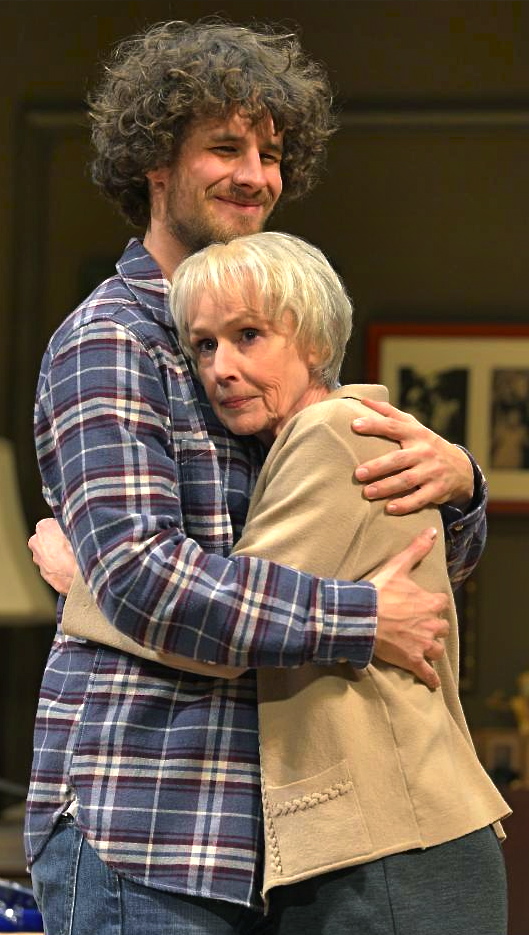
Susan Blommaert portrays Vera, and Reggie Gowland becomes Leo, in ACT’s “4000 Miles” in San Francisco. Photo by Kevin Berne.

My review of “4000 Miles” requires only four words: It’s sweet. See it.

But you have to get there in a hurry — it’s only scheduled to run through tomorrow night.

Prefer a little embellishment? OK then, here goes…

Playwright Amy Herzog, 33, has written a thoroughly charming, tender show about Vera, a 91-year-old granny who’s still a full-blooded Commie-Pinko-Fellow Traveler, and her 21-year-old neo-hippie grandson Leo, a latter-day armchair anarchist stuck in a belated coming-of-age learning curve.

He unexpectedly visits her slightly rundown, rent-controlled Greenwich Village apartment after a cross-country bike trip that’s left him smelly, broke, frazzled, confused and intensely desirous of comfort and love.

He last was there a decade ago, for the funeral of her Marxist editor-writer husband.

More often than not, he calls her Vera or “dude.”

They’re uncomfortable together, and director Mark Rucker underscores those awkward moments by using lengthy pauses that counter the crisp dialogues in the American Conservatory Theater show in San Francisco.

As any semi-astute theatergoer might predict, Vera eventually meets most of the young man’s needs, unscrambling his mind and emotions along the way. He, of course, simultaneously helps her come to grips with her current life instead of focusing on the past or the habituated behaviors that no longer serve her well.

“4000 Miles” is more than the sum of its parts, though: Herzog turns a soft, endearing, often humorous series of vignettes into a sympathetic single-act portrait of, as the old song lyric goes, people who need people.

The play’s most dramatic moments take place offstage or in conversation, yet not once did I think the piece could be improved by an explosion, stabbing or car chase.

The comic drama, which deftly contrasts leftist politics of yesteryear with those of today, is staged without frills: The characters simply talk to each another.

Their venue, Vera’s apartment, should be recognizable as one inhabited by Every American Widow.

But the main characters’ flesh-and bloodness shouldn’t surprise anybody who googled Herzog’s background — Vera was directly inspired by the playwright’s now 96-year-old grandmother (who’s not above protesting in the streets yet).

“4000 Miles” also leans on a six-month stint the writer, then a novice actor, had spent living with the old lady in The Big Apple.

It was a period in which, she has contended, “It wasn’t clear the relationship would survive.”

The playwright also lifts another page from her mental autobiography: She’d made a painful, exhausting eight-week 4,250-mile trip across the United States with Habitat for Humanity.

Plot highlights, ranging from droll to poignant, include Vera detailing her husband’s sexual affairs; the bizarre death of Leo’s best friend, Micah; a misimpression about Leo kissing his adopted sister, Lily; and a granny-grandson stoner session that celebrates the autumnal equinox.

Susan Blommaert, wholly believable as Vera (although the actor is actually much, much younger), finds a synchronistic stage partnership in Reggie Gowland as the youth.

The show, which runs only an hour and 20 minutes without intermission (and which won two Obie Awards for its 2011 Lincoln Center staging in Manhattan), is not a sequel to Herzog’s “After the Revolution” despite Vera being a continuing character.

Speaking of characters, Camille Mana gloriously renders Amanda as a high-energy art student and Leo pickup who’s an almost-one-night-stand. She appears in only one scene but nearly steals the show.

OMG. It seems I’ve written a deluge of words. I probably should have stopped at the pithier “It’s sweet. See it.”

“4000 Miles” plays at the American Conservatory Theater, 415 Geary St., San Francisco, through Feb. 10. Performances Tuesdays through Sundays, 8 p.m.; matinees, Wednesdays, Saturdays and Sundays, 2 p.m. Tickets: $20 to $105. Information: (415) 749-2228 or www.act-sf.org.

Revival of ‘Wicked’ delivers spectacular stagecraft

By Woody Weingarten

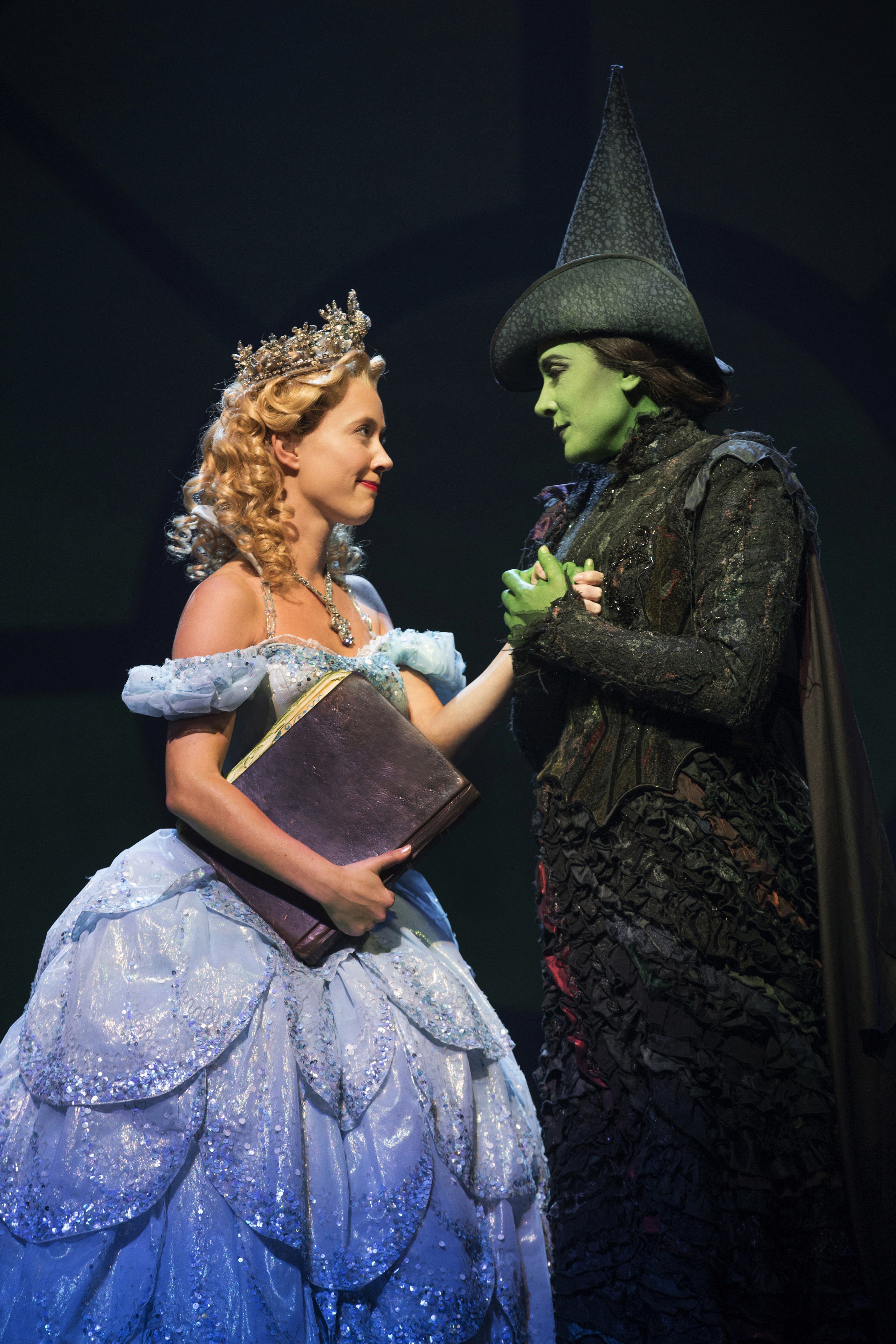
In “Wicked,” Dee Roscioli (right) plays Elphaba, and Patti Murin normally morphs into Glinda, but flu felled Murin opening night. Photo by Joan Marcus.

Has it really been 10 years since I first saw “Wicked” in its pre-Broadway run in San Francisco?

Indeed.

Back when, I thought the show was as deep as a pool that had been drained yet as light and wondrous as an exquisite soufflé.

Recently I went to opening night of its latest incarnation, at SHN’s Orpheum Theatre in San Francisco.

The show, which has grossed more than $500 million over the last decade on the Great White Way, where it’s still financially healthy, was severely restructured before it originally opened in New York.

And it’s been retailored a bit since.

Now, unless you’re in the mood for a dose of heavy Shakespeare or Kafka or perhaps an experimental John Cage-like version of “Les Miz,” you should find this a spectacular divertissement — in every sense of the word spectacular.

The glitz-laden stagecraft — including gigantic sets with their zillion lights ablaze and guaranteeing to keep PG&E in the black for a long time — will keep you, well, spellbound.

And you’re likely to find the sumptuous, ruffled costumes equally stunning.

Expect total visual and vocal candy.

That having been said, the musical comedy’s still as deep as a pool that had been drained yet as light and wondrous as an exquisite soufflé.

The lead role of Elphaba, the Wicked Witch of the West, which was padded exponentially since the show’s inception, lies now in the green makeup and extremely capable throat and of Dee Roscioli, a Broadway luminary who’s portrayed Elphaba more than 1,000 times.

The clout of her pipes is amazing to behold.

On opening night, the role of Glinda, the Good Witch of the North, was sung by Cassie Okenka, arguably the most skilled understudy since Barbra Streisand exploded onstage in “Funny Girl.”

Replacing the flu-ravaged Patti Murin, Okenka was no slouch in the comedy department, either.

Her enchanting scratchy voice is akin to that of Kristin Chenoweth (who’d blossomed here in the pre-Broadway version and then went to New York wearing full star skin), and her outrageously manic body movements kept the entertainment moving as fast and exciting as magical white river rapids.

The fantasy plotline, a prequel/sequel to “The Wizard of Oz,” hasn’t changed: Elphaba and Glinda are mismatched roommates and schoolyard best friends. They become rivals. They grow and overcome their differences.

Along the way, “Wicked,” in hit-and-run fashion, digs into the subjects of popularity, power and prejudice.

Think about it.

Think, too, about The Emerald City and Dorothy’s shiny red slippers, as well as the Tin Man and the Scarecrow and the Cowardly Lion.

Then, perhaps, think about The Odd Couple meeting The Lord of the Rings.

Opening night of the revival, Kevin McMahon’s thinking was probably elsewhere — on how to suitably step in for the flu-ish Tom McGowan as the wizard.

He needn’t have worried: He was strong.

Strong support also came via the performances of Kim Zimmer as lower-level villainess Madame Morrible; Demaree Hill as Nessarose, Elphaba’s disabled younger sister; Clifton Davis as a goat/scapegoat/professor, Dr. Dillamond; and Cliffton Hall as Fiyero, Glinda’s intended who’d rather be with Elphaba.

But the two-hour, 25-minute production did have a few weak spots.

Words sung in unison by the chorus were sometimes muffled to the point of being indecipherable. Much of the choreography seemed like works in progress, with the flying monkeys flailing wildly and the rest of the ensemble twirling and kicking with bland precision. Superficiality prevailed.


And Act I felt a trifle long at an hour and a half.


Highlights were not difficult to ascertain, though. They included the first act finale, “Defying Gravity,” which ended with breathtaking special effects; several duet riffs by the two witches; and the lone memorable Stephen Schwartz tune, “Popular.”


All in all, hilarity was almost ubiquitous in the audience. Simple lines like “Something’s wrong — I didn’t get my way” evoked big laughs.


Belted-out songs, meanwhile, drew big applause and boisterous cheers — even if no one could remember the words or melodies five minutes after leaving the theater.


You might pay no-never-mind to that, however, since “Wicked” has more pleasurable big-production numbers per square inch, more buoyance per minute, than any show in recent memory.


Versions were previously staged in San Francisco — in addition to the initial 2003 run — in 2005 and 2010. In each of them, the Glinda character came and went in an ostentatious bubble, a quick prompt to the show’s bubbly mien.


And with all that effervescence, it was — and is — virtually impossible for anyone who loves flamboyant theatricality to dislike this variation on a familiar theme.


“Wicked” runs at the Orpheum Theatre, 1192 Market St., San Francisco, through Feb. 17. Night performances Tuesdays through Saturdays, 8 p.m.; Matinees, Wednesdays, Saturdays and Sundays, 2 p.m. Tickets: $50 to $275 (subject to change). Information: (888) 746-1799 or shnsf.com.