
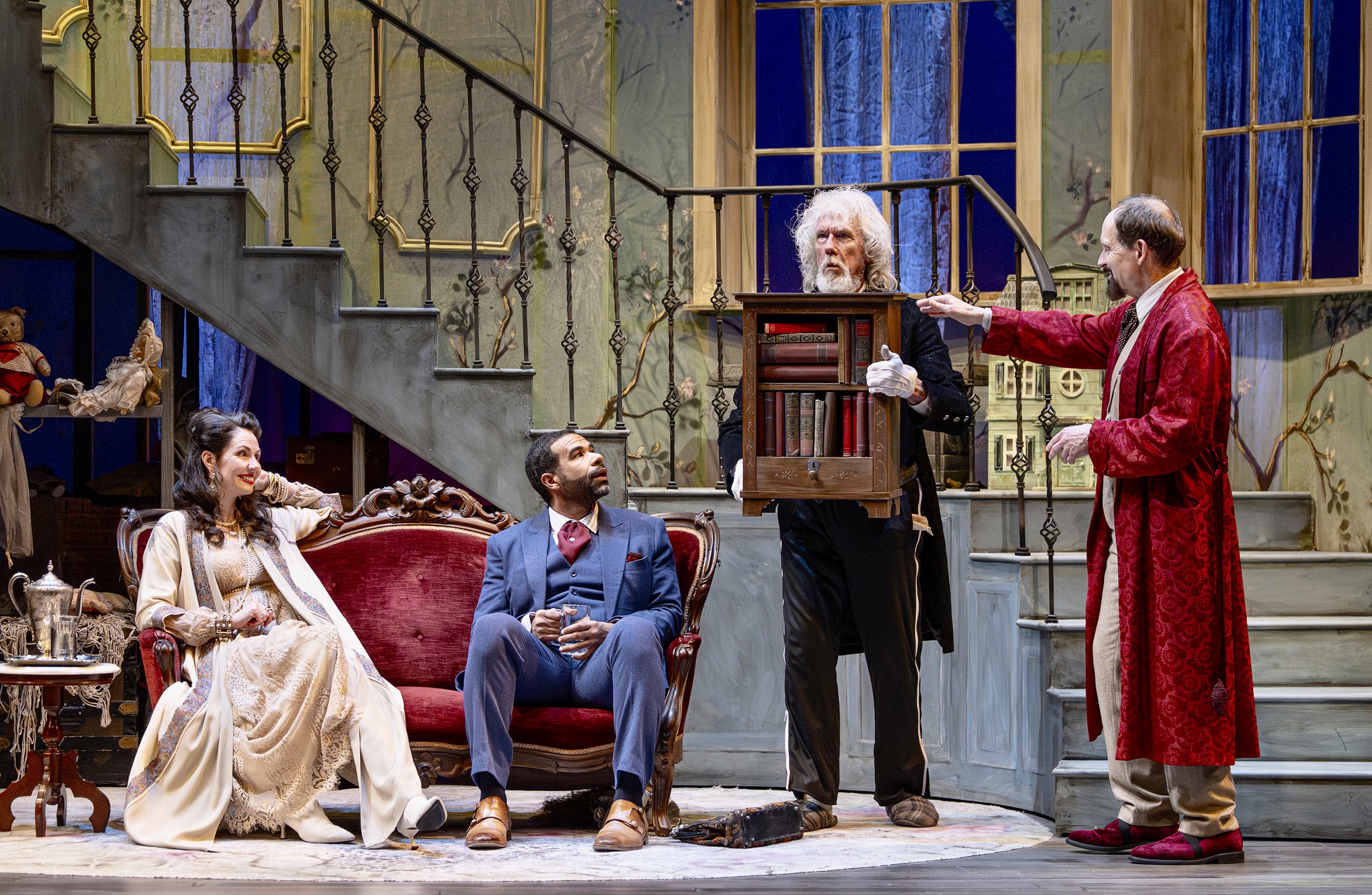
A zoned-out servant, Firs, clutches 100-year-old bookcase to show it off to cast of The Cherry Orchard. Photo by David Allen.
By WOODY WEINGARTEN
Nina Ball’s classy set for Marin Theatre’s The Cherry Orchard is exceptional, fully capturing the sense of an aristocratic, past-its-sell-date Russian estate.
Lydia Tanji’s costumes for the almost three-hour modern-language comedy are delightful, some comic, some gorgeously reinforcing the sense of powerless, turn-of-the-20th-century characters all dressed up with nowhere to go.
Superlative is the direction of the two-act classic Anton Chekhov play by Carey Perloff, who helmed the American Conservatory Theatre for 26 years, carefully extracting both comic and tragic emotions from an energetic, top-notch cast that’s mercurial yet predictable.
Bay Area actors with familiar faces — Howard Swain, Liz Sklar, Anthony Fusco, and Lance Gardner, for example — are inspiring, often briskly moving the 1904 modern-language play along with subtle eye or mouth movements or silences that brilliantly flesh out a fading upper-crust. For pure theatrical pleasure, check out Swain as Firs, an aged butler who’s ultimately abandoned after being in everyone’s face; Sklar as Liubóv, a frivolous, ineffectual “loose woman” who’s clueless about how to overcome a debilitating family debt; and Fusco as Gáyev, Liubóv’s brother, who revels in prattling but is often shut down.
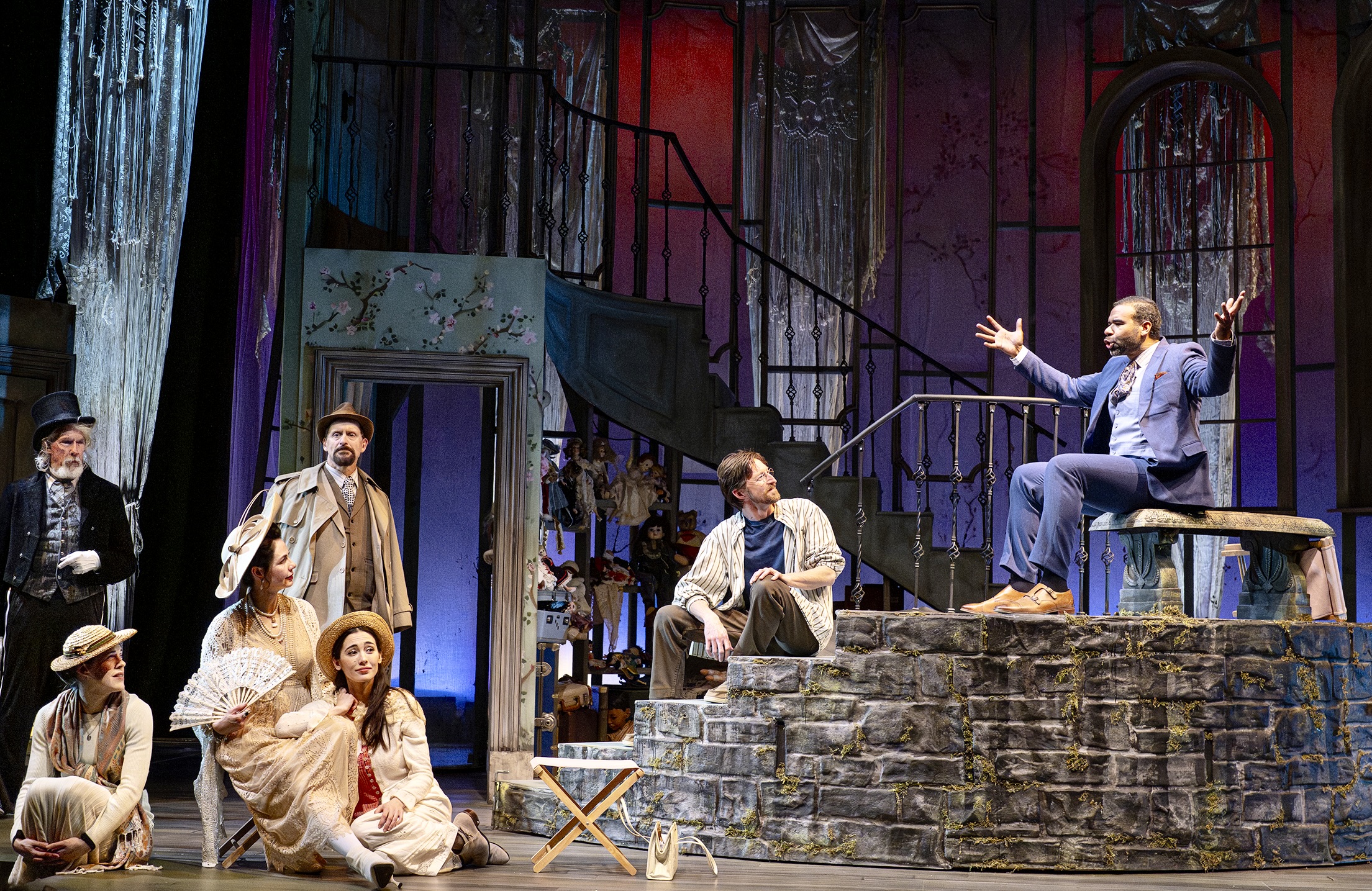
Lopákhin (right) excitedly holds attention of cast in The Cherry Orchard. Photo by David Allen.
Tour de force becomes the appropriate label for Gardner, the theater company’s executive artistic director who cloaks himself in the persona of status- and money-hungry Lopákhin, who thinks the orchard, which “is mentioned in the encyclopedia,” should be cut down and developed as vacation housing. Gardner’s verbal pauses demand attention. So do his statements like “I’m rich. I’ve got lots of money,” contrasted with his unrelenting belief that he’s still just a poor schnook from the country. The actor, in fact, quietly draws scrutiny even before the play opens as he sleeps center-stage on a divan with an open book on his chest.
For those looking for comedy, The Cherry Orchard provides plenty of over-the-top clowning and pratfalls, as well as sly verbal humor and running gags, not to mention mock-violence that might have been lifted right out of a zany Three Stooges playbook or a Road Runner cartoon.
For those seeking drama, the production delivers sufficient riveting themes — such as grieving over a child, multiple references to slavery, and class differences at a time when society’s underpinnings are shaky and the Russian Revolution waits in the wings. Illicit relationships cause ripples, and cherry blossoms and a 100-year-old bookcase and a slew of broken dolls, all symbolic, help create a thought-provoking atmosphere.
Descriptive phrases are common. One character, for example, accuses another of being “like an animal that eats everything in its path.”
Oddly juxtaposed are a female, dressed as if she stepped out of a Nickelodeon telecast, who does card tricks and a guy who does ventriloquy.
One downside is that the farce starts off frenzied while introducing too many characters at once. It’s parallel to many Russian novels where, despite accompanying graphics of family trees, it takes a while to unravel who’s related to whom.
Once you figure out who’s connected to whom, however, the play’s easy to relate to, especially its political undercurrents that resemble today’s, including obsessions with a new world order and either begging for or stockpiling money.
Compassion was Chekhov’s hallmark, according to dramaturg Michael Paller. “He never judged his characters one way or the other.” But we can.
Perloff, a press release reports, says the play, which she’d commissioned Paul Schmidt to translate, is “about why change is crucial and why we always resist it. It’s…full of narcissistic characters who are sure they’re the star of their own story, but fail to realize the damage they’re causing to the people around them.”
Know anybody like that?
The Cherry Orchard will play at the Marin Theater, 397 Miller Ave., Mill Valley, through Feb. 22. Tickets: $15 to $89 (plus $6 handling fee per order). Info: 415-388-5200 or www.marintheatre.org
Sherwood “Woody” Weingarten, a longtime voting member of the San Francisco Bay Area Theater Critics Circle, can be contacted by email at voodee@sbcglobal.net or on his websites, https://woodyweingarten.comand https://vitalitypress.com. His books include Rollercoaster: How a man can survive his partner’s breast cancer, aimed at male caregivers; MysteryDates — How to keep the sizzle in your relationship; The Roving I, a compilation of 70 of his newspaper columns; and Grampy and His Fairyzona Playmates, a whimsical fantasy intended for 6- to 10-year-olds that he co-authored with his then 8-year-old granddaughter.