Category

Joe Cillo

Joe
Cillo

Moby-Dick San Francisco Opera Performance

By Joe Cillo

Moby Dick
San Francisco Opera Performance
October 26, 2012

Moby-Dick has been a source of joy and inspiration to me for many years. I often pick it up and peruse it and read sections from it. I came to this opera well disposed toward its subject hoping to like it. I knew that it would necessarily be an abbreviation; selections would have to be made, a concept and an approach would have to be developed. It is not an easy book to adapt for a staged presentation. Much of the book is reflective commentary, metaphorical descriptions, and symbolic representations. Any attempt to produce this for the stage will necessarily be an interpretation. One cannot expect the full grandeur of Melville’s sweeping prose to be reproduced in an opera that spans even several hours. I watched it suspending judgment, stifling a growing dissatisfaction until a point in the second act where Ahab and Starbuck sing a duet, and Starbuck tries to cloy Ahab into turning back from his quest to find the White Whale with sentimentalizing images of a boy waiting in a window in far off Nantucket. This nauseated me, and at that point I stopped trying to like it. The duet comes from section 132 of the book, entitled The Symphony. Starbuck and Ahab do indeed have such a conversation. Ahab recounts to Starbuck how he has been at sea for forty years, how he married a young girl when he was past fifty, and left her the day after the wedding to go back to the sea, “I see my wife and child in thine eye,” he tells him. Starbuck, seizing the chance, gives vent to his longing to flee this perilous life at sea and importunes the Captain to turn back and head for Nantucket. The operatic recreation engenders a feeling of a common bond between Starbuck and Ahab, that Ahab shares Starbuck’s homesickness and longing for the security and warmth of the hearth and home. It is not a faithful representation of that encounter and grossly misrepresents Ahab. They misunderstand Ahab’s comment to Starbuck, “I see my wife and child in thine eye.” What he meant was that he saw in Starbuck’s eye the longing to return to his home, his family in far off Nantucket. He did not mean that he felt the same longing. Ahab had long repudiated and walled himself off from any such feeling or desire for connection. Starbuck briefly reminded him of such long buried feelings, but he was not about to allow them to be rekindled. When Starbuck is making his plea, the text tells us, “Ahab’s glance was averted; like a blighted fruit tree he shook, and cast his last cindered apple to the soil. ‘What is it, what nameless, inscrutable, unearthly thing is it; what cozzening, hidden lord and master, and cruel, remorseless emperor commands me; that against all natural lovings and longings, I so keep pushing, and crowding, and jamming myself on all the time; recklessly making me ready to do what in my own proper, natural heart, I durst not so much as dare? . . ” At the end of Ahab’s reverie Starbuck has gone. “But blanched to a corpse’s hue with despair, the mate had stolen away.” (132)
This conversation is not properly represented by a duet. It is a supplication by Starbuck that was futile from the beginning. Ahab is beyond reach. These sentimental images of a boy’s face in a window will never reach Ahab. Starbuck and Ahab are not singing from the same score, and they have very different melodies in their hearts.
When the Pequod meets the Rachel, another whaling vessel they encountered at sea (128), the captain of the Rachel pleaded with Ahab to assist in the search for his son, who was lost in a small boat pursuing the White Whale on the previous day.
Meantime, now the stranger was still beseeching his poor boon of Ahab; and Ahab still stood like an anvil, receiving every shock, but without the least quivering of his own.
“I will not go,” said the stranger, “till you say aye to me. Do to me as you would have me do to you in the like case. For you too have a boy, Captain Ahab — though but a child and nestling safely at home now — a child of your old age too — Yes, yes, you relent; I see it — run, run, men, now, and stand by to square in the yards,”
“Avast,” cried Ahab — “touch not a rope-yarn;” then in a voice that prolongingly moulded every word — “Captain Gardiner, I will not do it. Even now I lose time. Good bye, good bye. God bless ye, man, and may I forgive myself, but I must go.” . . . Hurriedly turning, with averted face, he descended into his cabin, leaving the strange captain transfixed at this unconditional and utter rejection of his so earnest suit. (128)
This gave me the clue to why I found this opera unsatisfying. It took me some time to figure it out and articulate it. I almost gave up and decided not to review it, but I persisted. I felt I owed it to all those many people who will come to this opera blissfully ignorant of Melville’s magnificent original. They will sit through this opera and emerge thinking they have seen Moby-Dick. That would be a travesty. On the night I went I saw a large group of adolescents that I surmised were some sort of class on a field trip, perhaps a high school literature class that was reading Moby-Dick. I hope the teacher makes the students redouble their application to the book after this performance. It is for them that I write this.
The problem with this opera is not a matter of facts or details, although there are many alterations of the original, but of spirit. This is a voyage of death and doom by men who are practically indifferent to life, the only exception being Starbuck. The opera treats them as a group of men who all harbor this middle class longing to get the job done and get back to their families and children, perhaps akin to soldiers in Afghanistan or Iraq.
The book opens with the immortal line “Call me Ishmael.” The opera does not heed that admonition. It does not use the voice of Ishmael. Ishamel does not appear in this opera. The character closest to Ishmael is called “Greenhorn” in the opera. It was a significant departure from the tone and voice of the text that indicates that these authors intended to rewrite the story of Moby-Dick rather than faithfully recreate it. There is nothing wrong with taking inspiration from a classic work or the work of a predecessor and creating one’s own variant or take off from it. Many brilliant works of art have originated that way. Sometimes the derivative works are actually better and more successful than the original source. The risk that is run by taking a classic of the stature of Moby-Dick, reworking it and then putting the same title on it as the original, is that you invite comparisons between the classic work and your own revamped version which are unpromising. Let us consider the opening passage:
Call me Ishmael. Some years ago — never mind how long precisely — having little or no money in my purse, and nothing particular to interest me on shore, I thought I would sail about a little and see the watery part of the world. It is a way I have of driving off the spleen, and regulating the circulation. Whenever I find myself growing grim about the mouth; whenever it is a damp and drizzly November in my soul; whenever I find myself involuntarily pausing before coffin warehouses, and bringing up the rear of every funeral I meet; and especially whenever my hypos get such an upper hand of me, that it requires a strong moral principle to prevent me from deliberately stepping into the street, and methodically knocking people’s hats off — then I account it high time to get to sea as soon as I can. This is my substitute for pistol and ball. With a philosophical flourish Cato throws himself upon his sword; I quietly take to the ship. (1)
Ishmael is a man on the verge of suicide, who has no strong investment in life, who chooses the peril and adventure and loneliness of life at sea in the company of likeminded men equally absorbed within their own private dungeons of torment and regret.
Death seems the only desirable sequel for a career like this . . . therefore, to the death-longing eyes of such men who still have left in them some interior compunctions against suicide, does the all-contributed and all-receptive ocean alluringly spread forth his whole plain of unimaginable, taking terrors, and wonderful, new-life adventures; and from the hearts of infinite Pacifics, the thousand mermaids sing to them — ‘Come hither, broken hearted; here is another life without the guilt of intermediate death; here are wonders supernatural, without dying for them. Come hither! bury thyself in a life which, to your now equally abhorred and abhorring, landed world, is more oblivious than death. Come hither! put up thy grave-stone, too, within the churchyard, and come hither, till we marry thee!’ (112)
It is this spirit of despair of life and indifference to death, punctuated by moments of high excitement, that is missing from the operatic recreation. There is a gloom that pervades this story, and ineffable darkness of the soul worthy of Wagner, that this opera fails to capture.
There is a wisdom that is woe; but there is a woe that is madness. And there is a Catskill eagle in some souls that can alike dive down into the blackest gorges, and soar out of them again and become invisible in the sunny spaces. And even if he for ever flies within the gorge, that gorge is in the mountains; so that even in his lowest swoop the mountain eagle is still higher than other birds upon the plain, even though they soar. (96)
This recreation by Scheer and Heggie stays on the plain. It doesn’t reach the deep gorges and exuberant sunny spaces that would give the performance a powerful dramatic intensity. By concentrating on characters and relationships rather than the inward pathos expressed through a myriad of symbols and metaphors in Melville’s text the character of the whole enterprise is fatefully transformed. The authors of the opera assume a bias favoring human relations and human connection. That’s how they created the opera by building it upon five main characters: Greenhorn, Queequeg, Pip, Starbuck, and Ahab. Each character is also substantially reworked from the original presentation in Melville. However, the people and the world that Melville describes in Moby-Dick are men who have reduced their human connectedness to the barest minimum. It is a world and a mindset of profound alienation. Moby-Dick is not a story about relationships and their vicissitudes. It is a searching commentary on life and on the world at large from the standpoint of a man who has little stake in it and little use for conventional values and outlook. This opera is a sanitized, normalized version of Moby-Dick crafted to appeal to a contemporary white American middle class audience.
Completely absent from the opera are any sexual allusions which Melville’s book is full of. There is one scene in the opera where the sailors on the ship dance with one another, but it is done in a farcical style that trivializes itself to the point of self-mockery. It brought chuckles from some in the audience. This opera is afraid to touch the same sex attractions that were and are a major attraction of men going to sea. The erotic overtones of the relationship between Queequeg and Ishmael are completely ignored. The sailors on the Pequod tend to be men for whom the avoidance of women and family responsibilities is a salient characteristic. That doesn’t mean they don’t have sex. But this production treats the sailors as homesick to return to their wives and children in Nantucket. Clearly a fantasy of the writers, not a representation of nineteenth century sailors, and certainly not of Melville’s work.
The introduction of a religious point of view through the character of Starbuck, who acts as a kind of conscience to Ahab, is particularly foreign and distasteful. There are allusions to religion, religious figures, and religious ideas throughout Moby-Dick, but they do not take the form of a moralistic conscience that is pressing against the whole way of life of sailing as in the opera. Moby-Dick does not have a moral point of view. It presents a tale that clearly illustrates the ultimate universal destructiveness of monomaniacal vengeance, but it does not say that this is a bad thing. Ishmael is clearly steeped in the religious ideology of his day, but he has his own take on it. His point of view and his use of religious allusion is very idiosyncratic and unorthodox, but the opera takes a very conventional outlook that will be readily acceptable to mainstream American viewers.
Also missing from this opera is the whale. Except for a cameo appearance at the end, the whale is scarcely mentioned. But a high percentage of Melville’s Moby-Dick is taken up with descriptions of whales, their characteristics, behavior, and the vicissitudes of hunting them and processing their corpses. The whale has powerful symbolic significance for Ishmael who sees the whale as an almost divine spirit, whom he both respects and reveres while at the same time seeking to kill it.
Wherefore, for all these things, we account the whale immortal in his species, however perishable in his individuality. He swam the seas before the continents broke water; he once swam over the site of the Tuileries, and Windsor Castle, and the Kremlin. In Noah’s flood he despised Noah’s Ark; and if ever the world is to be again flooded, like the Netherlands, to kill off its rats, then the eternal whale will still survive, and rearing upon the topmost crest of the equatorial flood, spout his frothed defiance to the skies. (105)
Dissect him how I may, then, I but go skin deep; I know him not, and never will. But if I know not even the tail of this whale, how understand his head? much more, how comprehend his face, when face he has none? Thou shalt see my back parts, my tail, he seems to say, but my face shall not be seen. But I cannot completely make out his back parts; and hint what he will about his face, I say again, he has no face. (86)
This alludes to the biblical passage in Exodus 33 where Moses is on the mountain with God and God tells him “Thou canst not see my face: for there shall no man see me, and live. And the Lord said, Behold, there is a place by me and thou shalt stand upon a rock: And it shall come to pass, while my glory passeth by, that I will put thee in a cleft by the rock, and will cover thee with my hand while I pass by: And I will take away mine hand, and thou shalt see my back parts: by my face shall not be seen.” The whale to Ishmael is essentially isomorphic to God.
Forced into familiarity, then, with such prodigies as these; and knowing that after repeated, intrepid assaults, the White Whale had escaped alive; it cannot be much matter of surprise that some whalemen should go still further in their superstitions; declaring Moby-Dick not only ubiquitious, but immortal (for immortality is but ubiquity in time); that though groves of spears should be planted in his flanks, he would still swim away unharmed; or if indeed he should ever be made to spout thick blood, such a sight would be but a ghastly deception; for again in unensanguined billows hundreds of leagues away, his unsullied jet would once more be seen. (41)
Ahab cherished a wild vindicitiveness against the whale, all the more fell for that in his frantic morbidness he at last came to identify with him, not only all his bodily woes, but all his intellectual and spiritual exasperations. (41)
He piled upon the whale’s white hump the sum of all the general rage and hate felt by his whole race from Adam down; and then, as if his chest had been a mortar, he burst his hot heart’s shell upon it. (41)
Moby-Dick can be seen as a defiant protest against God himself for all the ills of mankind, the accumulated slings and arrows of outrageous fortune that befall people in life from the beginning of time. It is a powerful repudiation of the religious quest to seek union and reconciliation with God. This is a story of those who are at war with God and seek to destroy him. It is also, I think, a pessimistic commentary on that undertaking. It is a very modern book. However, you won’t get that out of this opera. In fact the opera bypasses these most profound issues and even alters them and makes them conventional and palatable. The more I think about it, the more offensive it becomes.
What was good in this opera was the staging. The sets and the lighting and special effects were outstanding and highly effective. An A+ to lighting designer Gavan Swift and Projection Designer Elaine McCarthy. The imaginative stage presentation creates an engaging spectacle that holds the attention of the audience and keeps it rapt in the story. If you don’t know you are being snookered, you will probably like it on the strength of quality of the presentation. I’ve been thinking about it for over a week now, and the more I think about it, the more firmly I am turning against it. But it is a dazzling spectacle, well presented and well performed. Just don’t kid yourself that it is Moby-Dick.


BLOODY BLOODY ANDREW JACKSON

By Joe Cillo

BLOODY BLOODY ANDREW JACKSON


Reviewed by Jeffrey R Smith of the San Francisco Bay Area Theatre Critics Circle


The all new San Francisco Playhouse, at 450 Post, is presently performing BLOODY BLOODY ANDREW JACKSON by Alex Timbers and Michael Friedman.


Victims of their own success, creative genii Bill English and Susi Damilano were crowded out of their former digs at the Jean Shelton complex; now they seat audiences commensurate with the qualitative edge they enjoy within the San Francisco environs; it is worth noting that their bar has quintupled in length.


Their current performance piece is a unique hybrid of that occupies the very intersection of rock musical, dark comedy, docudrama and political satire.


But don’t be fooled; the music and the comedy are a set up; a conspiracy to lure the audience into a place of vulnerability, susceptibility and receptivity to dark historical truths of American Expansion.


The aegis of our American exceptionalism is temporarily lowered and we are led to see ourselves in the boarder, grittier, historical context.


As the title suggests, Andrew Jackson was bloody; his carnage was equal parts vengeance, political ambition, military stratagem, hatred and racism.


Jackson cleared six states of all pockets of resistance to unbridled American expansion; without Congressional approval he eradicated the Spanish and British influence in the American Southeast.


His imperialistic successes inspired America’s patriotic myth of “manifest destiny;” a myth that was brought to completion by the whole sale annexations of James Polk.


Jackson eliminated his enemies both in the territories and Washington D.C. and like most unchallenged rulers he stepped on to that slippery slope of sic semper tyrannis.


His excesses lead to the infamous Trail of Tears; a forced march impossible to morally differentiate from the Bataan Death March which was of equal scale.


Ashkon Davaran is the star and focus of this show; he commands the stage with high energy, bravado and mesmerizing charisma as he portrays a rustic, accidental leader’s accent to the White House.


The music is reminiscent of Green Day, specifically AMERICAN IDIOT, only better under the capable Musical Direction of Jonathon Fadner.


Wait until you see the cello player’s finale: simply amazing.


A set design, by Award Winning Set Designer—indeed architect—Nina Ball, presages the future of the orphaned pioneer lad in Tennessee.


Angel Burgess is absolutely stunning as she plays Jackson’s wife Rachel: a woman with a heart too big and too filled with longing, loneliness and sorrow not to break.


Director Jon Tracy has bundled a compelling script, a talented cast and rocking musical score to create what is easily the best happening in San Francisco.


It is over-the-top and should not be missed.


For tickets call 415-677-9591 or surf on over to sfplayhouse.org.


Hurry, your historical perspective might never be the same.


Freud’s Last Session

By Joe Cillo

San Jose Rep presents….

FREUD’S LAST SESSION

By Mark St. Germain

Directed by Stephen Wrentmore

Starring Ben Evett & J. Michael Flynn

To be an atheist requires an indefinitely greater measure of faith

Than to receive all the great truths which atheism would deny.

Joseph Addison

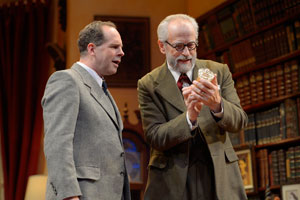
This play is an imaginary glimpse into the minds of two great thinkers, C. S. Lewis and Dr. Sigmund Freud in a conversation the day before England enters World War II and two weeks before Freud, dying of oral cancer ends his own life.  The two men discuss love, sex and the existence of God and debate the value and impact of all three on the human condition.


Kent Dorsey’s magnificent set recreates Freud’s study and sets the mood for the 90 minute discussion between the two men.  Director Stephen Wrentmore manages to keep the play moving by making use of the entire stage.  The characters move from the tea table, to the couch to the radio to listen to the news proclaiming the imminence of war.  Somehow, the combination of excellent direction and superb acting keeps the dialogue from descending into a tiresome recitation of two men’s conflicting philosophies.


C. S. Lewis ((Ben Evett) has recently embraced religion and Freud (J. Michael Flynn) says, “I want to learn why a man of your intellect would abandon truth and embrace a lie.”  The remaining 90 minutes is spent hearing the reason Lewis knows that God exists and Freud is equally sure religion is a myth.


Freud points out that the very existence of Hitler proves that there is no supreme being watching over us and Lewis disagrees.  “Hitler’s actions reinforce the opposite,” he says. “We have to accept that there is a moral law.” And he goes on to say, “The wish that God doesn’t exist can be stronger than the wish that God does.


Freud counters with “Theologians hide behind their ignorance;” and as the discussion continues he says, “I always find what people don’t tell me is less important than what they do.”    Lewis sees that Freud is dying and he says, “How can a man of your intelligence think the end is the end?   When you are faced with death, then what?”


Indeed, through the endless back and forth discussion whether God exists or if He is a product of our imagination, the arguments presented were the same l ones religious leaders and atheist have been tossing back and forth every since religion began.  It was Michael Bakunin who said, “All religions, with their gods, their demi-gods, and their prophets, their messiahs and their saints, were created by the prejudiced fancy of men who had not attained the full development and full possession of their faculties.”


In contrast Calvin Coolidge said, “It is hard to see how a great man can be an atheist. Without the sustaining influence of faith in a divine power we could have little faith in ourselves. We need to feel that behind us is intelligence and love.”


The debate we heard on the San José Repertory’s stage was the one that has been going on for centuries.  There were no shocking revelations, no new lights cast on the eternal conflict between religion and its opponents.  The play is saved by the virtuosity of the actors moving across an amazing set that recreates the time the play is taking place and the pace of the production.  You won’t hear anything new in this play, nor will the ideas presented convince you that your own belief is invalid.  I doubt that either argument presented in the script will be innovative or strong enough to convert a believer and convince one who does not.  The virtue of this production is in the acting and direction and for that alone it is well worth the price of admission.


FREUD’S LAST SESSION continues through  November 4, 2012

San Jose Repertory theatre

101 Paseo de San Antonio

San Jose

Tickets $29-$74 408 367 7255 or www. Sjrep.com


Cash is going away!!!

By Joe Cillo

WHAT WILL THE TOOTH FAIRY DO?

Lynn Ruth Miller


Most people can’t even think what to hope for

 When they throw a penny in a fountain.
Barbara Kingsolver

There is talk on this side of the pond, of getting rid of money. “Today, only 7% of all transactions in the United States are done with cash, and most of those transactions involve very small amounts of money.“ says the internet blog, The Economic Collapse. “Our financial system is dramatically changing, and cash is rapidly becoming a thing of the past.”


These days, it costs more than it’s worth to manufacture the cash we stuff into our wallets and bulging coin purses. In America, it costs 11.18 cents to mint a 5 cent piece and a penny costs 2.41 cents.  It isn’t much better in Britain.  Although the Royal Mint will not reveal how much it costs to mint 1p, rumor has it that the cost from manufacture to distribution is approximately £3.


That doesn’t make sense.


Besides the cost to make them, there is the threat to our health and well being.  Coins and bills land in thousands of pockets, are touched by millions of hands and no one ever cleans them up.  The bills are tattered and full of germs; the coins are not only cumbersome but they create embarrassing bulges that aren’t what you think they are.


When coins were first invented, everyone thought it was the greatest idea since the fig leaf.  Coins didn’t rot or die on you.  Their value didn’t deteriorate with time.  You could stick them in the bank and they would be there for years and still have value. You used them to reward children and toss in fountains.  You stuck them under pillows when children lost their baby teeth and you put them in your shoe for good luck.


What will happen to the Piggy Bank when pennies are no more? When I was a child, this was the time of year when I began stuffing pennies in the little ceramic pig I got for Christmas last year so I could buy my Mama a present for Christmas this year.  Every day, I would put in a penny I had earned for helping her bring in the groceries or drying the dishes (now you know how old I am) and by December first, my little pig was bulging with the hard earned cash I had fed him. I would go to the jewelry store, hand the clerk my piggy bank and say, “What can I buy my mother with this?”  She and I would smash the bank and pile the pennies into columns of ten and then tabulate the results.  One year, I was able to buy my mother a silver candle snuffer and another time, I bought her a lapel pin with a little blue stone in the middle…all with the money I earned doing chores.


Children these days would either have to type in a code on their cell phones or swipe a credit card to pay for that special something they want to buy for their parents.  It just couldn’t give them the same sense of accomplishment.  Every penny I gave that saleslady had a story behind it. All a credit card has is an APR.

Say good-by to wallets when cash is no more.  You can keep all your credit information on your cell phone or slip your credit card in your pocket.   Profiles will be slimmer and, because seeing the cash, made you realize how much you were actually spending, expenditures will go up.  But who cares?  It’s all just numbers and as every politician knows you can make numbers say anything you want.


The good news is if you keep your pennies stashed away in a bureau drawer, they will become valuable relics from another time, like vinyl records and rotary dial phones.   Your heirs can sell your stash for at least 500% of their face value.  That should pay for your casket!

When I was young I thought that money

Was the most important thing in life;

Now that I am old, I know that it is.
Oscar Wilde


Lohengrin — San Francisco Opera Performance

By Joe Cillo

Lohengrin
SF Opera Performance, October 20, 2012

The concept of love put forward in Lohengrin is that of a fragile flower very dependent upon maintaining illusions. Love is equivalent to blind Faith in goodness and constancy that must be absolute and unquestioning. But the underlying anxieties of this kind of naive faith ultimately undermine it and do it in. Lohengrin echoes Christianity in its demand for simple faith and the basic concept of a man is sent from God to rescue a damsel in distress, accused of a terrible crime. He saves her, not through self sacrifice, as in the Christian model, but through militaristic combat — a Wagnerian variant on the Christian theme. Superior prowess on the battlefield saves the girl from her enemies and wins her love. The woman’s love is the hero’s reward for her rescue from desperation. But there is one condition. The woman cannot ask her rescuer who he is or where he comes from. She has to take him completely on faith and let his actions of rescue and his superior strength in battle be the sole foundation of her devotion and love. If she is to question him and demand to know more of who he is, then he will be forced to leave her and renounce her. It is love founded on the most narrow, simplistic grounds and maintained with a gun pointed at the woman’s head, so to speak. Love can only be maintained with the woman in a desperate position of neediness with the man serving as the heroic figure of strength who magnanimously saves her from perpetual impending catastrophe. Love as worship of the conquering hero. While a woman may feel grateful to be delivered from impending doom — at least for a time — she will soon feel the extreme vulnerability of this position of helpless dependence, as the opera demonstrates. She will question her own worthiness of the man’s continuing love, she will want to broaden the base of the relationship and feel more appealing to the man beyond mere helplessness and need. She will feel the fragility of the connection to him. She feels vulnerable to his tiring of her and moving on. She seeks to strengthen her position through a greater understanding of the man, who he is, and what his own needs and vulnerabilities are. The message of Lohengrin is that this is a destructive tendency, that love can only be this primitive, blind devotion stemming from a condition of imminent undoing. Love between a man and a woman essentially depends on a woman being in a perpetual state of crisis. But on the other hand, if the woman gets to know who the man is and where he comes from, then she will realize that he is not the invulnerable hero, not the idealized figure of goodness and strength that he presented himself to be, and thus her love and devotion will be annuled. The man’s insecurity and feelings of unworthiness are activated upon a deeper probing of his true self. It is a very pessimistic outlook on relations between the sexes. Love can only be born and continue within these very narrow confines of faith sustained through willful ignorance, and that fragile foundation gives rise to the anxieties and demands that sabotage and destroy it. It is an outlook on life that is essentially dark and tragic — and a little silly too.
A few quibbles with the San Francisco Opera’s performance.
This production of the opera is set in a modern context in modern costumes, although Wagner’s original conceptualization set it in 10th century Saxony. On the cover of the program is a photograph by Erich Lessing of the destruction of the Stalin monument in Budapest, Hungary, during the Hungarian Revolution of 1956. The idea according to Director Daniel Slater is that a contemporary setting would make it “more exciting and relevant for the audience.” Well, most Americans living today can probably relate to the Hungarian Revolution of 1956 about as well as they can relate to 10th century Saxony. Many of us would be surprised to discover that there was a revolution in Hungary in 1956. And where is Hungary, by the way?
There are some militaristic and nationalistic elements in the opera that resonated well with the National Socialists, but you have to keep in mind that Germany did not even exist as a unified nation at the time this opera was composed. Invasion from the East was a long standing European fear that would be readily grasped by any European audience. The fact that this was a pressing matter in the 10th century would not be peculiar to that time or have any compelling significance as a factor in setting the opera in that time and place. I think Wagner’s purpose in setting the opera long in the past, aside from these nationalistic overtones, was to give the opera a context where the kind of romantic idealizations in the personal sphere that the opera treats would have traction for the viewer free from the distractions of a contemporary political and social context. Moving it forward in time and bringing up contemporary political issues in my view disrupts the essential focus of this opera on the nature of human relationships. True, the opera takes place under the threat of impending war. But this was a condition of European life as far back as one cares to look. So in that sense it did not matter when the opera was set, this background factor of imminent war was going to remain a constant in whatever time period it occurred. Wagner set it long in the past precisely to expunge the contingencies of the immediate contemporary circumstances. Bringing the opera forward and setting it in our own time defeats that artistic purpose and makes the whole thing sort of confusing.
Director Slater sees Lohengrin as a problematic character who renounces his godlike status in order to experience human love with Elsa. This is based on musings external to the opera itself. Within the opera there is nothing problematic about Lohengrin. He was sent on a mission by the Grail. He fulfilled the mission, he accepted Elsa as his prize, he accepted the leadership position as a warrior, he laid out his conditions, and he stuck to them steadfastly and departed without any apparent signs of misgiving. Slater says he is seeking redemption through Elsa’s love and is willing to sacrifice his immortality to achieve it. There is nothing in the opera to substantiate this view. Within the opera, Lohengrin is a knight in shining armor coming to the rescue of a damsel in distress and then to lead an army into battle. Slater puts him instead in a leather trench coat, which tends to deemphasize his heroic qualities. But counterculture figures don’t usually lead armies. I’m not sure that it works. Lohengrin is not Hamlet.
Generally the staging is rather static and unimaginative. At times it gets dull because there is not enough activity in the staging or aesthetic interest in the lighting to sustain one’s attention. The lighting in the first act is bright and harsh. The early part of the second act feels a little cramped against the front edge of the stage. In the original conception the swan was supposed to pull a boat down the river bearing Lohengrin. Slater gives that up and opts for much less impressive imagery of a static pair of wings from which Lohengrin emerges. At the end the long lost Gottfried reappears as a small boy from the transformed swan. But it doesn’t make sense that Gottfried should reappear as a small boy. He disappeared years ago as a child. His sister Elsa has grown into a mature woman. He should be contemporary with Elsa. Furthermore, he is supposed to arrive ready to lead an army into battle, to step into the role being abdicated by Lohengrin, but he can barely lift a sword. What is Slater seeking by casting Gottfried as an 8 year old boy? Some sort of cutesy sentimentality? A child’s appearance at the end of this dark, gloomy opera trying to wave a sword is a rather ridiculous juxtaposition if you ask me, and I take it to indicate that he completely misunderstands what the opera is all about. This is not a child’s opera at all and introducing a child as a final punctuation mark on this tragedy is a colossal malapropism.
What works in this opera is the music. If it wasn’t for the music, it probably wouldn’t even be staged. The orchestra, the singers, the chorus, did a superb job and made it a musical success, even if it left much to be desired as a dramatic production. Wagner’s great creativity and strength was as a composer of music more than as a dramatist or as a prophet. It is clearly evident in this dark opera and in its problematic staging in this San Francisco Opera production.

Marin Theatre has a winner

By Joe Cillo

TOPDOG/UNDERDOG

By Suzan-Lori Parks

Directed by Timothy Douglas

Starring Biko Eisen-Martin & Bowman Wright

Being black is not a matter of pigmentation –

Being black is a reflection of a mental attitude.
Steven Biko

Be prepared to be spellbound from the moment Biko Eisen-Martin walks on the Marin Theatre Company’s stage until the climax of this disturbing, all too real drama, two and a half hours later. You will see and actually feel this story of two brothers barely scavenging their way uphill through one disappointment after another not because of their lack of ability or ambition, but because of what they are and what they have been.


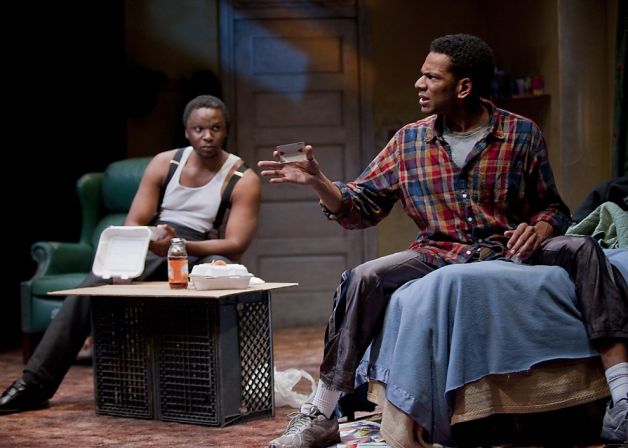
Booth (Biko-Eisen Martin) is living in a one room tenement flat with no running water that his older brother Lincoln (Bowman Wright) is sharing with him because Lincoln’s wife has thrown him out of his former home.  Booth’s is the only bed and Lincoln sleeps in a recliner.


The brothers have managed to survive a rollercoaster childhood. They were abandoned by both parents two years apart; first their mother then their father.  Lincoln, at sixteen, was forced to watch out for Booth who was only 11 years old.  Throughout this play, Lincoln continues to worry about his younger brother. He still feels responsible for Booth’s well-being and he shields him from unpleasant truths.   He gives him the food he prefers, gives him money not just for rent and utilities but for special treats that Booth doesn’t really need.  Booth’s talent is stealing and he is so light-fingered he can take any product from anywhere undetected.  Lincoln’s talent is dealing cards but he has given up that kind of life for a conventional one with a real job with benefits….and he isn’t doing very well.


His job is Impersonating Lincoln the day he was assassinated.  He has to whiten his face to resemble the famous president  and he is being paid less than the going rate for his services because he is black.  He swears he likes his job because it gives him time to think about things and compose songs in his head, but he is worried he is going to be replaced by a fabric dummy.  The real reason Lincoln clings to the daily grind that is wearing him down is his determination to live the conventional way with a steady job, one where he isn’t depending on his wits for fast cash.  Before he started this job, he was a highly successful dealer in a Three Card Monte scam.  Three Card Monte is a con game that no one can ever win.


The game is as much a performance as it is a contest that proves the hand is always quicker than the eye.  Lincoln was so quick with his hands that he was the best on the street.  He made more money than he could spend and he felt good about himself.  His luck seemed eternal until his mark, Lonny, the man who starts the betting and keeps the game moving, was killed.  In that moment, Lincoln saw the game for what it was and he knew he wanted no part of it.   Still, dealing is his special gift and he is proud of what he could do.  “Lucky?” he says.  “Aint nothing lucky about cards.  Cards aint luck.  Cards is work. Cards is skill. Ain’t never nothing lucky about cards.”


Booth doesn’t share his brother’s sense of right and wrong and he is desperate to earn the kind of money his brother once did on the street. .  He believes the two of them can start their own game and earn a living together.  Booth is sure he can be a dealer because he is so quick and facile with his hands.  He is so adept at stealing that he managed to get both them both new suits, a room divider, a blanket and food.


This play is dialogue driven and the plot takes its shape from the brothers’ rapid fire conversation.  The acting is beyond wonderful and the two men manage to make their characters loveable and very vulnerable.  We know that they are trapped their life because of their color and because of the disruptive, chaotic childhood that prepared them for nothing but a desperate, frustrating fight to keep their heads above water.  The author Suzan Lori Parks says “There is no such thing as THE Black Experience.  That is there are many experiences of being Black which are included in the rubric….What can theatre do for us? We can tell it like it is, tell it as it was, tell it as it could be.”


And in Top dog/ Underdog that is just what she does, using rich and textured dialogue delivered with consummate skill by Martin and Wright.  Make no mistake.  This is not a play about being black.  It is about being poor and underprivileged.  It is about living on the edge of society, never feeling that your humanity gives you privilege.


This production sparkles and moves at so rapid a pace one cannot believe over two hours have passed since the play began.   Timothy Douglas’s direction is a masterpiece of movement and staging.  The men co-ordinate their actions across the stage as if in a macabre dance.  As their dialogue bounces off one another, we relive their hopes, their disappointments and we ache for them.  We watch in terror as they deceive themselves and each other leading them both to their own inevitable destruction.


I realize that I’m black, but I like to be viewed

as a person, and this is everybody’s wish.
Michael Jordan


Topdog/Underdog continues through Oct. 28.

Marin Theatre Company, 397 Miller Ave., Mill Valley.

Tickets  $36-$57. (415) 388-5208. www.marintheatre.org.


ACTORS THEATER HAS A WINNER

By Joe Cillo

SPEED THE PLOW

David Mamet

Directed by Carole Robinson & Christian Phillips

Starring Joseph Napoli, Dean Shreiner & Sydney Gamble

PHOTO BY MAXUDOV

Actor’s Theatre never fails to amaze me.  Christian Phillips manages by some miracle of talent and determination to put up truly compelling productions of American classics that speak to every generation.  He does this  on a minuscule budget in a tiny, spare theater void of any pretentious décor.


In this production of SPEED THE PLOW, he and his co-director Carole Robinson have gone far beyond their previous successes.  Their interpretation of David Mamet’s classic tale of unscrupulous greed and ambition has elevated this excellent script into a work of art that cannot help but mesmerize with its rapid fire dialogue across a stark almost empty stage. There is very little movement on stage, but every gesture makes an impact.   The program notes tell us that “Mamet’s plays often deal with the decline of morality in a world which as become an emotional and spiritual wasteland,” and the bleak stage with its bare walls is the ideal setting for a play whose central theme is how easily our souls are bought . All three characters in the play are merciless and narcissistic human beings  without a shred of compassion for one another.


Let us talk first about the actors.  It is hard to believe that these three people are not among the top performers in the bay area, so professional were the interpretations of their characters.  Dean Shreiner’s Bobby Gould is right on the mark.  He is a self-serving, greedy movie producer whose eye is always on profit at the expense of art.  As the play develops, we see beneath his brittle crust to the insecure, needy man beneath.    When, in the third act, we realize he has succumbed to Karen (Sydney Gamble)’s seduction, he says, “She understands that I suffer,” and his persona visibly softens.  The audience can see his vulnerability and feel his desperate need to do something “good” with his life. ”You look forward to your life and you think it’s never going to happen.  Deep down inside I never thought it would,” he says.


And Charlie (Joe Napoli)  replies “You’re a whore, Bob.” And he is right. The reality is that Bobby has compensated for that need to be special by being rapacious and hard- nosed in an industry where sentimentality is a death knoll.


Joe Napoli’s Charlie is perfection times ten.  His verbal pace is amazing, his expressions validate his words and his presence on the stage is mesmerizing.  He obviously sees himself as he really is and he likes his image.  ”If I’m just a slave to commerce, I’m nothing…” because for him, the selling and making movies is an exciting and dangerous game that he intends to win no matter what the cost. “We all hope,” he tells Charlie.  “That’s what keeps us alive.”


Sydney Gamble is a student at The Academy of Art in San Francisco but in this production she has the professional polish of an actress twice her age and four times her experience.  Her Karen combines an innocence with a hard core that is fascinating to watch and always believable.  When she visits Bobby to talk about the vapid script she just read, one senses that she knows as well as he does that it is not commercial. Her purpose in going to his flat was to better herself, not to report on the script.  She  has set her sights on producing that film with him and so she hits him where he is weakest: his self esteem.  “We are all frightened, she says.  “I listened to your heart and I saw you.  You were put in the world to make movies people need to see.“ (In direct contrast to Charlie’s pronouncement in the first act when he tells Bobby, ”Your job is to make movies that make money.”)


Karen knows she has scored a hit with Bobby when she appeals to his better self and she pursues her advantage by telling him she knew why he asked her to his apartment and she is willing to pay the price.  She knows it will get her exactly what she wants.  She says, “You asked me to come.  Here I am.”


There is not a trace of the coquette in her interpretation of her role.  Her speech seems innocent and altruistic and yet everyone in the audience knows exactly what she is.  We see in her very presence that she has a goal and that goal will serve her purpose, alone.   That is acting taken to its best level.


“When the curtain falls on this short and unsparing study of sharks in the shallows of the movie industry, it’s as if you had stepped off a world-class roller coaster. The ride was over before you knew it, but you’re too dizzy and exhilarated to think you didn’t get your money’s worth,” says Ben Brantley in his New York Times review of the production of the play in 2008 on Broadway.  “The slangy, zingy patter of exaggerated insult and tribute swapped by the studio executives Bobby Gould and Charlie Fox isn’t just air filler; it’s the existential warp and woof of their lives. ….”Speed-the-Plow” is about what happens when the shiny bubble produced by this talk is punctured by someone who doesn’t speak the language.”


And that sums up this Actors Theatre production, as well.  It is a polished, glistening gem of a play that shows us what we are beneath the veneer we assume in public.  Mamet sees us all as base creatures ready to sell every value for a pot of gold.  One walks out of one of his plays furious at the human condition and perhaps it is that fury…and that fury alone…that will spur us on to make ourselves better.


If you love theater, you will want to se this production of SPEED THE PLOW again and again.  It is everything fine dramatization should be from the first words spoken on that stage until the last.


Plays until November 10th, 2012; Wednesdays through Saturdays at 8pm.

Venue: Actors Theatre of San Francisco, 855 Bush St, Between Taylor and Mason

Box Office: (415) 345-1287 or online at DramaList.com

Tickets: General: $38, Students & Seniors: $26


SLEEPWALK WITH ME

By Joe Cillo

SLEEPWALK WITH ME

Directed by Mike Birbiglia

Starring Mike Birbiglia and Lauren Ambrose


Being in a relationship is a full time job

So don’t apply if you’re not ready

Unknown

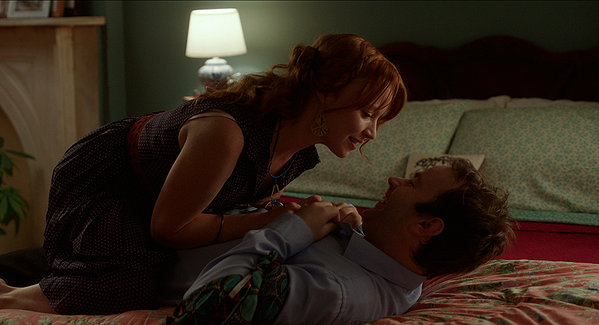
I am a stand up comic.  I have been fighting to succeed in this very challenging profession for eight years and I am finally seeing hope.  So much of this movie rang true that it was actually painful to see.  Matt (Mike Birbiglia) wants to do stand up comedy because he can’t seem to succeed at anything else.  He has two big problems:  He has lousy material and he isn’t funny.  One would think that would be enough to discourage him from pursuing this very low paying often thankless job….but no…as his agent (Sondra James) tells him, “You don’t have to be funny…you just have to get booked.”


And she is right.  One of the most telling lines in the play and the most real is the “veteran” comedian(Marc Maron) who tells Matt (Mike Birbiglia) how disgusted he is that comedians who have no jokes and never get laughs are rising to the top, while he is struggling to get at least some gigs that pay.  This couldn’t be a more accurate description of this very difficult profession.


No one realizes how difficult it is to make a group of strangers laugh at something you think is hilarious.  When you are on that stage, the audience judges every word and all too often comedians simply do not listen to the response they get.  They refuse to admit that no one laughed at any of their jokes and indeed some people actually fell asleep.  Matt is one of those comedians. One laugh in the midst of 20 minutes of silence,  is all he needs to keep him plugging away at his new found career.  And somehow, some way, he manages to get paying gigs to sustain him.


Even as his comedy is improving (but not by much) he is overwhelmed with doubt about committing to an 8 year relationship with the adorable and very sweet Lauren Ambrose.  Just before he is about to break up with her, he reminds the audience in the ongoing narrative that holds the shaky plot together, “Before I tell you this part of the story, I want to remind you that you’re on my side.”


Perhaps some of us are.  Birbiglia’s persona is irresistible and his plight is acerbated by the severe sleeping disorder that he ignores.   He acts out his night mares and until the night he crashes through a window of his hotel room, he refuses to do anything to help himself.    His father’s (James Rebhorn) determination to get him properly diagnosed was a bit overbearing to me and his ditzy mother (Carol Kane) did not convince me that she was real.  Birbiglia and Ambrose carry the film and it is their charm that keeps our interest until the all too predictable end.


This is a very lightweight film, but there is something so real about the characters that the action holds our attention.   I thought it was charming, but then I too am fighting to become a recognized stand-up comedian and I know how all-consuming that can be.   I am not so sure it would hold together for someone not so involved in the field.


Girl Model — Film Review

By Joe Cillo

Girl Model
Directed by David Redmon and Ashley Sabin

This film is a public relations piece for organized criminal rackets operating internationally between Russia and the Far East. I couldn’t quite figure out why this film was made. It is a pack of lies and misrepresentations from beginning to end. The proof of this is in the film itself and I will point it out to you, although the film tries to cast itself as something benign or even benevolent. But it is such a thin veneer that it is almost laughable. This is quite obviously sordid and sinister. The more I think about it, the darker and more frightening it becomes. It’s very curious what was motivating these filmmakers?
It starts out in Siberia, of all places. Really. The opening scene reminded me of a factory farm where animals are kept in large warehouse-like facilities by the hundreds and thousands being raised in close quarters for slaughter. Except these are girls between the ages of about twelve and fifteen. Their bikini covered bodies are examined one after another in a seemingly endless assembly line, supposedly in search of some ideal of feminine beauty that will be successful as a model in Japan.
From the outset it is apparent that this is a scam. If these self appointed mavens of the fashion world actually knew as much as they claim about the tastes of Japanese publishers and fashion, then there would be successful models to interview to validate the success of their judgments. But there are none. The only adult woman interviewed in the film is Ashley Sabin, one of the filmmakers, who seems deeply ambivalent about the modeling business and who said that “no one hated the modeling business more than me.” Yet she is now a recruiter for the enterprise she once despised, and she doesn’t seem all too pleased with herself.
I spent the first part of the film wondering why this was taking place in Siberia? I’m not sure I’ve got it right, but Siberia is an out of the way place and far from media attention and public scrutiny. The population is mostly rural and economically challenged, let’s say, and probably unsophisticated in their knowledge of the outside world. It’s a good place to do something if you want to keep a low profile, and there is evidently a large pool of naive young girls who dream of escaping to a better life in a faraway place.
Tigran, the supposed owner of the modeling agency that recruits the Russian girls and transports them to Japan, is the paradigm of a smooth talking con man. He presents himself as something a few pegs below sainthood, giving these deprived girls from rural Siberia an opportunity to live an exciting life as a model in Japan and make a lot of money for their struggling families. But this avatar of his organization is belied on a number of counts, and once quite explicitly and threateningly, which I found very interesting, and a bold intimation of what he is really all about.
First of all, there are no successful models who can be held up as examples of what he has can accomplish for a girl. A successful agent should have successful clients as examples of his capabilities and judgment, and he doesn’t have any.
Second, the contract that the girls have to sign with his agency is actually quoted on screen, and promises them two jobs in Japan and $8000. But Madlen and Nadya, the two girls followed in the film, do not get jobs, and leave Japan at least $2000 in debt — to him. So they are lied to and swindled.
Third, the contract specifies that the terms of the contract can be changed from day to day at the will of the agency. This means that there is no contract, that they are basically working at his whim.
Fourth, once the girls are in Japan, he does not attend to them in any way. They are passed on to Japanese handlers who send them on an series of fruitless auditions that amount to nothing. If they do get work or their photos are used they are not paid for it, and he does not see to it that they are paid. There is not one named Japanese advertising agency, publication, retail business, or fashion house in the whole film that has used the models that this agency has represented. Not a single one.
Fifth, and most tellingly, he relates how some young girls can be”difficult” — Lord knows — and in order to subdue them, he takes them on an outing to the morgue, so they can see the dead bodies of other young girls like themselves. Purportedly, this is to discourage the girls from drug use. Tigran vouches for its powerful effectiveness. But if this is such an effective technique for keeping young girls off of drugs, maybe we should start doing it here. Why hasn’t anyone here ever thought of this after so long in the War on Drugs? Maybe we should start organizing field trips for young girls to visit morgues to see the bodies of other young girls who died from drug abuse? Perhaps this film does have one valuable insight to offer that can turn young girls’ lives around.
Actually, this is intimidation of the most heavy handed sort. This is to let the girls know that ‘you belong to us, now. We own you. And you’d better do as we tell you, or this is your destiny.’ It is a very stark choice, and he means it. He admits that he used to be in the military and that he has killed a lot of people. He wants you to know that he is capable and experienced at killing people. The military part of it is questionable, but that this man is a killer I have no doubt. This guy is intimidating and very dangerous.
The scam works like this. Girls from poor families in rural Russia are recruited by the Russian Mafia. Ashley works as a scout and a recruiter. She gives the whole process its veneer of benign legitimacy. The modeling tryouts and the search for the ideal of feminine beauty are a sham. What they are really looking for, and Tigran says this explicitly, are girls from disadvantaged backgrounds whose families have financial problems. He said they check the girls out very carefully in terms of their background and their family circumstances. They are looking for girls with the right kind of vulnerabilities. Once they find an appropriate candidate, they are lured to Japan or Taiwan or somewhere else in the Far East with the promise of a successful modeling career. But, of course, that does not happen. The girls are treated miserably. They barely have enough to eat. They have to call home to get money to live on. They get no jobs. If their photos are used, they are not paid for it. After a while they are sent home several thousand dollars in debt to the “modeling agency.”
The one instance where Nadya’s photo does appear in a magazine is one where her face is covered. Why is her face covered? With her face covered she can’t be identified. We don’t even know for sure if that is her. This “modeling agency” does not want anyone to see their models in a magazine. They don’t want anyone to know she was ever in Japan. They want her to remain invisible. What about all the tryouts and photo shoots? Some of the photos may indeed be used, but probably not in Japan, and she will never be paid for any of them. What is really going on here?
This is recruitment for prostitution. Prostitution is where the real money is, not modeling. The criminal gangs have no illusions. Very few girls can make much money modeling, but almost any girl can make substantial money as a prostitute, even a gray mouse like Nadya. That is what this is about, ladies and gentlemen. This is why the film you saw doesn’t make sense, and why it is hard for me to figure out why it was even made in the first place. The “modeling agency” is just an elaborate cover. The few thousand dollars spent on sending the girl to Japan and shaking her loose from her family is the mob’s initial investment, their startup cost. Once the girl is working as a prostitute, she will make that back and more in a very short time.
The first step is to get the girl deeply in debt. Once she is in debt beyond her ability to repay, and her family unable to bail her out, the Russian Mafia makes her an offer she can’t refuse. Remember that girl you saw in the morgue? We spent a lot of money to send you to Japan or Taiwan on those fruitless modeling tryouts, and we expect to get that money back. You’ve proven that you can’t make money as a model. But we’ve got a surefire way for you to make money, but it is not exactly modeling. It’s a little different, but another way of selling your body.
Ashley Sabin talks a little bit in the latter part of the film about prostitution and how some girls who fail as models end up going that route. She points out how some countries and cultures do not stigmatize prostitution and claims it is a perfectly legitimate way to earn a living. She professes not to know anything about that aspect of the modeling business, and claims she has nothing to do with it herself. This is very likely a lie, along with the lie we see her relating in the next few moments to Russian parents of prospective recruits that the girls from her modeling agency never return to Russia with debt, when we have just seen two girls from her agency return to Russia with thousands of dollars in debt. So her credibility is zero, and her capability and effectiveness at deception is documented right before our eyes. Some women are able to deal their way out of the prostitution aspect of the business by acting as recruiters of younger girls. That could be Ashley’s story, but she speaks very good English and appears to be an American. Perhaps those qualities were seen as more valuable assets that working as a prostitute. Ashley is a bit of a puzzle, but there is clearly much that she is not telling. It is evident that she has very mixed feelings, but apparently strong survival instincts, and she is doing what she has to do.
At the very end of the film in a textual postscript, we are told that Nadya went back to Japan the following year — a rather surprising turnaround given her disagreeable experience the first time — but maybe not, if you consider the scenario that I have painted. We are told that she failed again to achieve success as a model and racked up still more debt and was sent on to Taiwan and China and other places in the Far East. It did not tell us what she was doing or how she was living, but I think we can make a pretty good surmise that she is not making money as a model. If she was, then they would have pictures and publications and advertisements to show us as evidence of her success. But rest assured, she probably is making money, and more than she could ever make modeling, but she is not getting much of it. Ask Tigran where the money goes.
This film leaves me puzzling. Not about what is going on. That is very clear. But what were the filmmakers intentions in making this film? What were they trying to accomplish? They didn’t seem to be able to bring themselves to tell the real story, so they concocted something half-assed, that intimated very obliquely what was going on, and left a lot of loose ends dangling nonsensically, but they never really pursued the matter in any depth. And they promoted a viewpoint that they knew very well was a lie. They seem afraid to really follow this where it is leading, — understandable, actually — but if they don’t want to tell the story, why make the film at all? The people and organizations running this operation don’t usually like to be the subjects of documentary films. Why would a guy like Tigran appear in this film? Did he really think that people would buy his tale about his having such a good heart and doing this for the good of the girls, when the film plainly shows that that could not be true in any shape or form? Did they delude themselves into thinking that this would encourage young girls around the world to want to become models? I don’t get it. It must have something to do with the relationship between Ashley and Tigran. I think she is very much afraid of him. I can’t even speculate about it.

TIME STANDS STILL

By Joe Cillo

TheatreWorks presents…..

TIME STANDS STILL

By

Donald Margulies

Directed by Leslie Martinson

Starring Rebecca Dines, Mark Anderson Phillips, Rolf Saxon & Sarah Moser

Your only obligation in any lifetime

Is to be true to yourself. Richard Bach

This is a play about finding out who you really are.  “One of our greatest contemporary dramatists, Donald Margulies is a photojournalist of our lives, gifted with an extraordinary lens,” says TheatreWorks Artistic Director Robert Kelly.


In Time Stands Still, Margulies examines the conflict we all face in sorting out what we need to be as human beings and what we are actually doing with our lives.  Although the plot weaves many themes together, that of career, marriage, human need, and our obligation to ourselves and to society, the real story is the juxtaposition of the relationships of the two couples we see on stage.  The play “is very much about the choices and compromises we all make —in love, in work, and particular to this play, in war,” says Margulies.  “Ethical struggles touch on all aspects of life.”


Rebecca Dines is Sarah, a photojournalist severely injured while recording the terror and slaughter in Iraq.  We meet her when her lover Jamie (Mark Anderson Phillips) is bringing her home, her leg and arm broken and her body a mass of abrasions.  Jamie went to a hospital in Germany to be with her as she fought for her life. “I had my fifteen minutes (to become famous)  and I spent it unconscious,” she says.


As she contemplates her career and her need to return to it, she says, “I live off the suffering of strangers.”


Jamie counters with, “You help them in ways you can’t see,” but the truth is that Sarah gets far more out being in the midst of combat than a good picture.  She is addicted to the danger and feeds off the violence she captures on film. ‘The women and men who put themselves in unimaginable situations to capture images and stories…aren’t simply doing it for the public good,” says Margulies.  “Their courage is immense, to be sure, but there is an unmistakable kind of thirst for it as well.”


Jamie is a journalist who uses words to record the horrors that Sarah photographs and he has had enough.  “We don’t have to do this,” he says to Sarah.  “I don’t want to watch children die.  I want to watch them live.”


The other couple, Richard (Rolf Saxon) and Mandy (Sarah Moser) is in direct contrast to the tormented, battle scarred main characters.  Richard was once Sarah’s lover and employer. He is a newsmagazine photo editor and is instrumental in creating a book of Sarah’s photographs and Jamie’s writing.  He is wildly in love with Mandy now, an idealistic, sweet and unbelievably naïve girl thrust into the company of three hard core liberal realists. Richard excuses her:  “She’s young,” he says but Sarah delivers the final put down”  “There’s young and there’s embryonic.” she says.


Mandy has brought Sarah balloons to cheer her up and she says, “Balloons have an amazing way of making you feel better.”


Although Sarah and Jamie obviously dismiss her as inconsequential, Sarah Moser has given Mandy an exquisite persona the audience cannot help but love.  She is obviously sincere and there is a great deal of wisdom in her innocence.  She tells Sarah, “I’m an event planner,” and Sarah counters with, “I’m in events, too.  War.”


But Mandy refuses to be diminished and she will not allow Sarah to believe her relationship with an older man is nothing but fluff and sex.    “People think I am Richard’s mid-life crisis,” she tells Sarah.  “But it is not that at all.  Whatever it was that brought us together was what brought us together.”


As the action develops, we see that Richard and Mandy have built a solid foundation for their relationship.  It is a fulfilling one for them both without a hint of the sugar-daddy/bimbo infatuation Jamie and Sarah assume created it.   All the actors in this production are superb, but I have to say that Moser and Saxon mesmerized me with the veracity of their portrayals.  They brought their characters to compassionate life without a hint of sentimentality.  When Mandy hears that Sarah has photographed a dying child, she is horrified that the older woman did nothing to help or save that child.  She cannot believe the cynicism she feels in the room and she says, “There is so much beauty in the world.  I wish you’d let yourself feel the joy.  Otherwise what’s the point?”


It might sound trite and it might be a one dimensional sentiment said by anyone else, but Moser transforms her lines into exquisite observations on what we can make of our destiny if we really want to see its potential instead of its loss.  When the two get married and have a baby, Mandy decides to stay home to rear it.  “You make me feel like less of a woman because I want to stay home with my baby,” she tells Sarah and Sarah understands, but she knows that isn’t the life she would choose.


It is when Jamie sees how happy Richard is that he realizes that he and Sarah can have something more…the happiness, the positive future, the security…if they will but give it a chance.  He tells Sarah: “When a couple has been together as long as we have and has seen what we’ve seen and done what we’ve done, it’s time to call it what it is…a marriage.”


And Sarah agrees…in principle…but she doesn’t take into consideration her own drive to do the thing she loves and her thirst for the action that feeds her. She justifies the value of her work to herself and to Mark.   “If it wasn’t for people like me, the ones with the cameras, who would know?  Who would care?“ she says and he realizes then that the relationship isn’t going to work for him.  “You need drama more than you need me,” he says.


Until the final scene, the plot held together beautifully for me.  Leslie Martinson is a superb director and the movement of the characters, the use of silence, the juxtaposition of innocence and cynicism is masterful.  Erik Flatmo’s scenic designs are right on the mark, accenting the action and never detracting from the action on stage.  Both Dines and Phillips occasionally had trouble convincing me that they were the real thing and often their chemistry on stage disturbed rather than enhanced the action. There was falseness to their intensity that did not ring true.   It was Saxon and Moser who charmed me throughout.  That said, the entire production is a must see on every level.  The script is truly wonderful and TheatreWorks has given us a theatrical masterpiece, beautifully presented. As an ensemble production, it excels.


Time Stands Still continues through Sept. 16. at the  Mountain View Center for the Performing Arts, 500 Castro St., Mountain View. Tickets  $23-$73.

More information: (650) 463-1960, www.theatreworks.org.