Robert Wilson’s The Old Woman with Baryshnikov & Dafoe

By Jo Tomalin
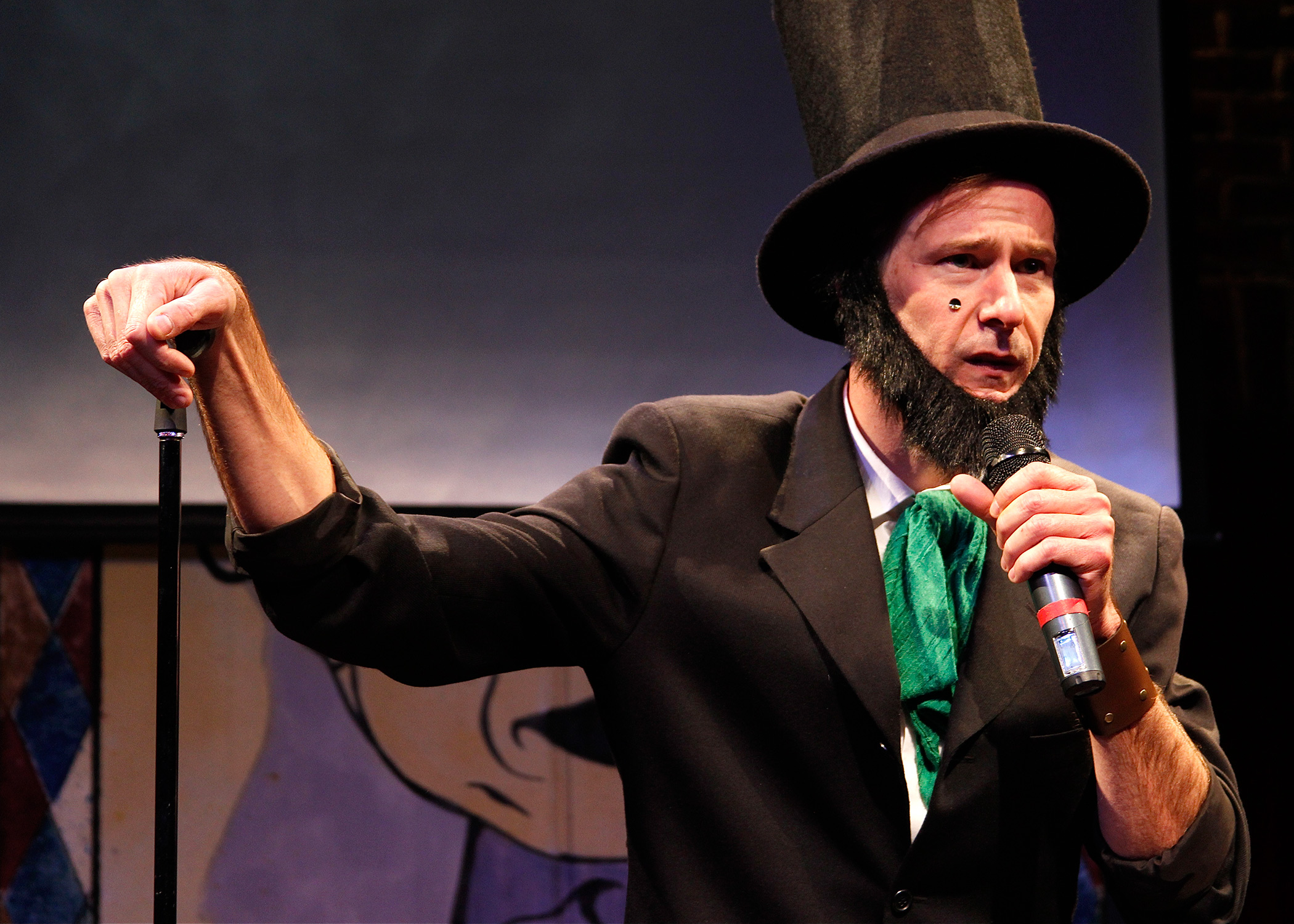
above: THE OLD WOMAN Pictured: (r) Mikhail Baryshnikov and (l) Willem Dafoe star in Robert Wilson’s The Old Woman, Friday & Saturday, November 21 & 22, 2014 and Sunday, November 23, 2014 in Zellerbach Hall.  PHOTOS: Courtesy of Cal Performances

Review by Jo Tomalin

Breathtaking Abstract Theatre

THE OLD WOMAN Pictured: (r) Mikhail Baryshnikov and (l) Willem Dafoe star in Robert Wilson’s The Old Woman, Friday & Saturday, November 21 & 22, 2014 and Sunday, November 23, 2014 in Zellerbach Hall.  PHOTOS: Courtesy of Cal Performances

The collaboration of three extraordinary creative artists – Robert Wilson, Mikhail Baryshnikov and Willem Dafoe offers a breathtakingly precise and visually stunning evening of absurdist theatre. Based on the 1930s political novella by Daniil Kharm and adapted by Darryl Pinckney, The Old Woman is a black comedy about a disillusioned writer and a visitor – playing November 21 – 23, 2014 in Zellerbach Hall through Cal Performances.

THE OLD WOMAN Pictured: (r) Mikhail Baryshnikov and (l) Willem Dafoe star in Robert Wilson’s The Old Woman (PHOTOS: Courtesy of Cal Performances)

Brilliantly conceived and Directed by Robert Wilson, the renowned experimental theatre director who brought his acclaimed Einstein on the Beach to Cal Performances in 2012, this visually sensory production sweeps the audience up on an evocative wave of stark, rich, geometric, melodic, abstract – yet always fascinating – encounters, superbly performed by legendary performer Mikhail Baryshnikov and stage and screen actor Willem Dafoe. There’s never a dull moment as Baryshnikov and Dafoe expertly interact together, with snappy dialogue, precise movement and emotive monologues taking the audience on a journey – somewhere!

THE OLD WOMAN Pictured: (r) Mikhail Baryshnikov and (l) Willem Dafoe star in Robert Wilson’s The Old Woman in Zellerbach Hall.  (PHOTOS: Courtesy of Cal Performances)

Baryshnikov and Dafoe seem like magicians at first, mysterious with only their faces lit against a black stage. Both are dressed in identical debonair black suits and white dress shirts (Costume Design by Jacques Reynaud), full white face clown makeup (Makeup by Marielle Loubet and Natalia Leniartek), and dark gray hair. Each is distinguished by a large curved quiff of hair (curving up to Baryshnikov’s left who wears a black tie, and curving up to Dafoe’s right who wears a black bow tie), appearing next to each other each is half of a whole. In fact, they complete eachother’s sentences, repeat eachother’s text and movements with strange reactions all underscored by an eclectic range of ethereal to jazzy music including selections by Tom Waits and Arvo Pärt (Music by Hal Willner) or dramatic sounds (Sound Design by Marco Olivieri).

THE OLD WOMAN Pictured: Mikhail Baryshnikov in Robert Wilson’s The Old Woman in Zellerbach Hall.  (PHOTOS: Courtesy of Cal Performances)

There’s humor in this piece, too, with a charming touch of vaudeville, eccentric dancing, switching characterizations, playing female characters, Baryshnikov’s singing, all evoking a sweet genteel spirit in their idiosyncratic universe.

Undoubtedly the set and lighting are as astonishing as the two performers in this piece with bold quirky Set Design and an exquisite Lighting Concept by Robert Wilson with Light Design by A.J. Weissbard.

THE OLD WOMAN Pictured: Mikhail Baryshnikov and Willem Dafoe star in Robert Wilson’s The Old Woman in Zellerbach Hall.  (PHOTOS: Courtesy of Cal Performances)

I wonder how long we will wait until another production comes along that is so remarkable. If you missed it, try to find it – it’s well worth it!

More Information:


Jo Tomalin, Ph.D. reviews Dance, Theatre & Physical Theatre Performances
More Reviews by Jo Tomalin
TWITTER @JoTomalin
www.forallevents.com  Arts & Travel Reviews

Dementia takes toll in “The Other Place”

By Judy Richter


Dementia takes a terrible toll not only on the victim and family but also on society in general. Sharr White’s “The Other Place” shows how dementia affects one woman and her family.

In the Dragon Theatre production directed by Kimberly Mohne Hill, Judith Ann Miller plays Juliana Smithton. She’s a 52-year-old neurologist who has developed what appears to be a breakthrough product to treat dementia and, presumably, Alzheimer’s disease, although that term is never used.

Pitching it to a group of doctors at a seminar in the Virgin Islands, she becomes distracted by what she says is a young woman wearing a yellow bikini and sitting in the back. She becomes so distracted that she can’t continue.

Shorty thereafter, her husband, Ian (Mark Drumm), an oncologist, refers her to a neurobiologist colleague, Dr. Cindy Teller (Maureen O’Neill, called The Woman in the program), for an evaluation.

Juliana is hostile, accusing Cindy and Ian of having an affair and saying that he wants to divorce her. Ian denies her accusations.

Juliana also insists that she has been in touch with their daughter, Laurel (O’Neill), who disappeared 10 years ago at the age of 15. The Smithtons never knew what happened to her. She might have run off with Juliana’s research assistant, Richard Sillner (Paul Stout, called The Man in the program), or she might have been abducted after running away.

The play’s title refers to the family’s former weekend cottage on Cape Cod. In her delusional state, Juliana goes there. Instead she encounters the owner, a woman (O’Neill) who — after first being angry — kindly appeases her.

Despite the play’s tragic topic, it has its humorous moments. It also has moments of hope.

Miller skillfully navigates Juliana’s emotional journey through personality changes and intellectual decline. Because so much of what she says may or may not be true, the audience must depend on Drumm’s Ian for the truth. O’Neill does well in the other female roles, especially the woman in the cottage. Stout does well in his limited role as The Man.

Brian Corral’s set, lit by Jeff Swan, is relatively bare bones but allows for shifting scenes. Costumes by Heidi Kobara are appropriate for the characters, but the sound by Rory Strahan-Mauk can become too loud between scenes.

Running 80 minutes without intermission, “The Other Place” is an absorbing look at the effects of dementia. Since it’s so prevalent throughout society, many in the audience will no doubt recall their own experience with an afflicted family member or friend.

“The Other Place” will continue at Dragon Theatre, 2120 Broadway St., Redwood City, through Dec. 14. For tickets and information, call (650) 493-2006 or visit www.dragonproductions.net.


“Rocks in My Pockets”–more than just an animated feature film

By David Hirzel

Signe Baumane‘s new feature-length animated film “Rocks in My Pockets” makes good use of this medium to enter a territory that more conventional films cannot reach—that of your own mind. Her characters, simply rendered in two dimensions, wind their way through fanciful paper mache landscapes into some of the darkest, bleakest recesses of the mind—Baumane’s, her extended family’s, your own. Her deeply personal statement becomes universal.

It begins with the courtship of her Latvian grandparents and the unasked, unanswered questions of the madness in her family background, that we might today call mental illness. Their marriage evolves, as many do, into something less than romantic, with growing disillusionment and a concurrent resolve to do our best with the choices we have already made. There are moments of joy, but more of resignation, of sorrow, and they seem to resonate through succeeding generations in the film.

In 1941 war comes to Baumane’s native Latvia, laying waste with singular ravages such as we in 21st century USA can only imagine. Those who claim to defend and protect individuals and society instead betray and destroy them. These calamities give her family history a weight that bears down on her, and them. The hardships of their lives gave that depression, a richer, more fertile ground in which to thrive. We all of us have dysfunction in our families, in our own lives. Denial is woven through the narrative of this movie, as it is in all our lives.

The story takes place in Latvia. It is narrated in English entirely by Baumane; the accent of her native tongue places it outside our comfortable United States, in a foreign land where we find ordinary people in their inward human hearts no different from us. The artwork is entirely hers, thousands of handmade drawings moving through dozens of richly decorated paper mache sets giving a three-dimensional feel to this patient singleminded animation, produced in her apartment/studio in Brooklyn. Lighting, technical effects, script advice and voice coaching by Baumane’s long-time companion actor/director Sturgis Warner.

When asked how her family reacted to such exposure, Baumane indicated that some were aghast, some indifferent, and some appreciated that someone who know from inside who knew the truth had chosen to shine a light on it. This was one of the choices that she had to make on her own, free of the preconceptions of how others might respond drive her decisions of what to say, and how to say it.

Whether the film would make money, or find a wide audience, did not really enter into the decisions. This was a story she wanted to tell, in her own way. The essence of art.

There is light within, through, and beyond the darkness. Moments of joy, of dark humor, of connection and redemption. The rocks in our pockets have a dangerous weight, but with insight and resolve their weight can can be reduced; they can be cast away.

At Rafael Theater Monday, November 24 at 7:00.

1118 Fourth Street, San Rafael, CA 94901 415.454.5813 Main Office 415.454.1222 Info-Line for

Film Website: http://www.rocksinmypocketsmovie.com/

Review by David Hirzel

Hi-5 — Post Ballet Performance Review

By Joe Cillo

Hi-5

Post Ballet Performance — Z Space

November 22, 2014


This was not to my taste.  It was five short dance performances to mostly live musical accompaniments by The Living Earth Show.  The dancing for the most part lacked emotional content, did not sync with the sound tracks, and had a sameness to it that seemed to lack imagination.

The first one, Flutter, was three dancers: two males and one female, in two skits.  The first was to hand clapping accompaniment provided by The Living Earth Show.  The second was to a solo violin performance of the Sarabande from Bach’s Partita in D minor played live on stage by Kevin Rogers.  Rogers did a nice job on the Sarabande.   He didn’t really need the dancers and they did not add much to his performance.  I could see immediately that these dancers were not at the highest level of technical proficiency, and this dance they were asked to perform was not of great interest.

Sixes and Sevens was a solo performance by Tetyana Martyanova, accompanied by a chaotic, confusing, mishmash of noisy, monotonous soundtracks that do not fit together at all.  Tetyana is a tall, beautiful girl, who is a very fine dancer — probably the best dancer on the stage tonight.  It would have been much more effective if she had danced to silence instead of that awful soundtrack.

Yours is Mine showed some promise.  It was three males in various antagonistic, somewhat homoerotic configurations.  This one had the most discernible emotional content of all of the vignettes, and the most meaningful interactions between the dancers.  If it had continued developing the male-male themes it might have been good, but about midway through a female dancer enters.  Her entry destroys the momentum of the male-male interactions, but she does not provide a new focus for the skit.  Instead the dance becomes diffuse and sort of melts into a bland mass.  The woman, qua woman, is ignored and she almost becomes one of the guys.  Except she is not one of the guys.  In fact, there are no guys any more.  They are just dancers cavorting around without any real purpose.

North Pacific Garbage Patch is a musical interlude performed by The Living Earth Show.   This band consists of two guys, the one artist bashes rambunctiously on a set of drums while the other artist blasts an electric guitar tuned to sound like a cross between a snow blower, a table saw, and sometimes a freight train.  I couldn’t have chosen a better title for this myself.  I think it perfectly captures the flavor of this performance.

Tassel, the final vignette, comes the closest to being interesting.  Five dancers plus The Living Earth Show in an energetic romp that uses the entire stage.  One begins to notice as the dancers blitz back and forth that they are each taking off their clothes a piece at a time.  It becomes an incipient group strip tease that draws one subtly in.  But they don’t have the nerve to carry it to its ultimate conclusion, and instead change direction bringing out suitcases full of clothes that are throw wildly into the air and about the stage while the dancers impetuously change into new garb.   The dance ends as it began with the dancers placidly seated at tables, but dressed in a different wardrobe.

The performance lasted just over an hour without an intermission.  I like performances like this that are not real long and omit the intermission.  It makes for a pleasant experience that is not too taxing.  They are a young, energetic group that needs a sense of purpose beyond dancing for the sake of dance.  I might be tempted to go see them again, but I would like to see something with more substance and definitely better taste in the soundtrack.

“Jolly Juliana” and “The Festive Holiday Vaudeville”, 6th Street Playhouse, Santa Rosa CA

By Greg & Suzanne Angeo

Reviewed by Suzanne and Greg Angeo

Members, San Francisco Bay Area Theatre Critics Circle (SFBATCC)


Photos by Eric Chazankin

Fruits and Nuts Take the Stage

A delightful slice of nineteenth-century Americana is being served up in its world premiere at 6th Street Playhouse complete with old-timey footlights, just perfect for the holidays. “Jolly Juliana”, with the loaded subtitle “Her Fruitcake Has Nuts”, is an original melo-dramedy written and directed by local renaissance man Larry Williams. It’s a play-within-a play set in the Santa Rosa of 1905 performed by “Osgood’s Traveling Vaudevillians” and serves as the first act. For the most part Williams keeps the energy wheel spinning, and it only slows down in a couple of spots. There are place references and local jokes galore (Lucifer’s Rancheria draws a huge guffaw).

Evan Attwood, April Krautner in “Jolly Juliana”

“Juliana” is faithful to the exaggerated and hyper-emotional style of acting that saw its heyday in the 1800s. Williams adds a generous helping of broad comedy which makes this show really fun to watch. The cast mostly has the melodramatic thing nailed down, especially April Krautner  as our sanguine Heroine and major fruitcake-baker  Juliana, and Williams as the evil Lucifer Bellows. Remember the now-cliché scene where the villain ties his victim to a railroad track with a speeding train approaching? It was first seen in 1870 in a play called “Under the Gaslight” and  ever after was shown again and again in early films like “The Perils of Pauline”. Naturally, Juliana soon finds herself in this predicament, with Evan Attwood as our Hero Teddy saving the day.  A nice assortment of nutty performers rounds out the cast. Just one tiny issue with the play-within-a-play concept: if you were watching the show without seeing the playbill, you never would know that you are watching actors playing other actors.

The second act is “The Festive Holiday Vaudeville”, a series of lively vaudeville-style skits that are pure pleasure and really hold your attention, relying heavily on audience participation. Notable are the spectacular vocals of Robert Ellison who, in addition to playing the singing Narrator of “Juliana”, also delivers one of the high points in the vaudeville part of the show, a thrill that brings down the house. The wildly funny finale features a rousing and zany version of “The Twelve Days of Christmas”. Through it all, it’s plain that Krautner – here at her lovable, goofy and gorgeous best – is the star of the show. The girl can’t help it.

Ensemble cast, “The Festive Holiday Vaudeville”

The ensemble in both acts worked well, with Williams doing a nice job blocking and staging the movements of the cast and guiding the difficult techniques that are used in the melodramatic and vaudevillian arts. Seeing Krautner, Williams and Ellison do their stuff is well worth the price of admission. All in all, it’s jolly cornball fun for the whole family.

When: Now through December 21, 2014

8:00 p.m. Thursdays, Fridays and Saturdays (no show on Thanksgiving Day, November 27)

2:00 p.m. Saturdays and Sundays

Tickets: $15 to $32

Location: GK Hardt Theater at 6th Street Playhouse

52 West 6th Street, Santa Rosa CA
Phone: 707-523-4185

Website: www.6thstreetplayhouse.com

Wild Women

By Joe Cillo

Well-behaved women seldom make history.
Laurel Thatcher Ulrich

My friend Nancy was married to a man she liked well enough.  They had a little daughter together and life went along smoothly. When the little girl was 2 years old, Nancy went to a party and met the most exciting, marvelous romantic man she ever imagined.  She danced two dances with him, called her husband and said, “Put the baby to sleep. I won’t be home tonight.  I am in love.”

Wow.

My buddy Helen nursed her husband through a six-year fight with cancer. The day after he died, she realized she was a millionaire. She booked a trip to India, took a vacation in Cuba, found a hot Samba dancer to squire her around and became a fan dancer. She never once wore black.

These days, women are tough.  They learn karate and they fight back.  The day of The Little Woman is long gone .  My father taught me that if there was a man in the room, a lady never touches a doorknob.  If I tried that little trick today I would never get out of the room.  Women today are liberated…. But to me they aren’t very interesting.  They are overworked and underappreciated.

Nora Ephron said that the only thing a woman gained from the Women’s Movement is paying her own way. I see the modern matron, dressed in her trim executive suit, running an office all day, driving home battling rush hour traffic and stopping at the super market to pick up food for dinner.  She pulls into the driveway, grabs her laptop and two bags of groceries, kicks the door open with her foot and staggers into the kitchen to put her purchases away.

She pulls off her shoes, asks the kids about their homework, kisses her husband and says “How was your day, darling?”

She starts dinner and goes upstairs to change into something a bit less constraining than her office garb.  You can’t really do a job with dinner when you are constricted by a latex tummy controller and a push up bra.  She manages to put together a stir-fry, salad and ice cream for dessert and calls everyone to the table.  Her oldest son says he isn’t hungry, the middle one takes his plate up to his room and her daughter refuses to eat anything but the ice cream.

She cleans the kitchen, hauls out the hoover and does the rugs.  She has been on the go since 6 a.m. when she got up to pack lunches for the children. She is too exhausted to make conversation and way too tired for romance.

Today’s woman can try anything and be anything as long as she is willing to take less pay for twice as much work.  She can be an executive that runs complex multifaceted companies.  But she needs to ignore those snide remarks about emasculating men or being a bit…well you know…a bit ballsy.

If this is liberation, I want none of it. I would rather be interesting and out of the box.

I don’t want to do it all for everyone.  I want to do it all for myself.  I am untamed and erratic.  I wear feather boas in Tesco’s and drink champagne for breakfast. I cook dinner naked and put on my slippers to get the mail.  I am wild. And wild is very interesting.

When I walk into a room, the sun to rises and the blinds blink.  I am so unusual, cows give me whipped cream and bread turns into toast.   So do men.

It seems to me that liberated women play so many roles they don’t have time to be themselves. That is too tame for me. I want to be wild…I want to be interesting…I want to be fun.  All it takes is a little determination and a lot of red wine.

Once upon a time in the dark ages of the twentieth century there were man things and women things.  Men took out the trash, fixed the cars and lifted heavy stuff.  They drove cars and demanded food.  They earned money.  Women stayed at home and talked on the phone.  They pushed buttons on their modern appliances, shopped at the mall and went to their psychiatrist on a weekly basis.  They felt used.  They had to give sex on demand and still cook dinner and wash the dishes.  And so they rebelled.

NOW they have it all…..because they have to do it all.

I think it is time to share the chores and divide the pleasures.  The only problem is that no red blooded liberated woman wants to have sex with a guy in an apron….unless he isn’t wearing anything else.

Two Albee plays on college campus are funny, intense and absurd

By Woody Weingarten

Woody’s [rating: 4]

Mrs. Barker (Isabel Heaviside) seemingly is shocked by what Grandma (Keara Reardon) divulges in “The American Dream.” Photo by Robin Jackson.

Daddy (Jon Demegillo) and Mommy (Melanie Macri) act like flesh-and-blood wind-up dolls in Edward Albee’s “The American Dream.” Photo by Robin Jackson.

Skylar Collins (right, as Jerry) and Jesse Lumb (as Peter) star in “The Zoo Story.” Photo by Robin Jackson.

Director Mike Nichols’ death saddens me.

His eclectic work ranks high on my all-time favorites’ list, especially the Monty Python musical “Spamalot” and a pair of films, “The Graduate” and “Who’s Afraid of Virginia Woolf.”

Three disparate entertainments indeed.

At the pinnacle is “Virginia Woolf,” the Edward Albee masterwork that ripped the veneer off the institution of marriage.

No director ever pulled more out of Elizabeth Taylor or Richard Burton.

I distinctly remember, too, that Uta Hagen and Arthur Hill had blown me away in the original “Virginia Woolf” on Broadway in 1963.

All that history bounced around in my mind as I walked into the College of Marin’s Studio Theater to watch two cerebral but passionate one-act Albee plays, 1959’s “The Zoo Story” and 1961’s “The American Dream.”

Despite having seen thousands of theater pieces, somehow I’d never seen either.

To be sure, these were campus performances, yet both were equal to the professionalism of any Bay Area community theater — and, in fact, to some of the top nearby stages.

Funny. Intense.

Absurd.

W. Allen Taylor, whose directorial chops leave nothing to be desired here, notes in the program that, although neither play rings “a rational bell,” both clearly address Albee’s “dissatisfaction with [the American emphasis] on material and consumer-driven values.”

“The Zoo Story,” in which human beings eventually mirror a vicious dog and other animals, slowly builds on a foundation of isolation, loneliness, dysfunctionality and non-communication.

The two-man park bench encounter tragically ends in violence.

Supposedly penned in less than three weeks, “The Zoo Story,” which triggered Albee’s reputation as a pioneer of the Theatre of the Absurd movement, was the playwright’s first major drama. Its West Berlin debut was half a double bill with Samuel Beckett’s “Krapp’s Last Tape.”

Its power — and a stunning performance of Skylar Collins as Jerry, a “permanent transient” — actually made me shudder at its climax.

“The American Dream,” in sharp contrast, made me laugh aloud — numerous times.

Despite it dealing with real or imagined adoption, mutilation and murder.

With a spartan set and tasteful costuming appropriately limited to shades of ultra-neutral beige, the background blandness helps exaggerate the perma-smiles plastered onto the faces of flesh-and-blood wind-up dolls, Mommy and Daddy, and their haughty socialite visitor, Mrs. Barker.

Melanie Macri, Jon Demegillo and Isabel Heaviside, respectively, nail the satire with over-the-top looks that pinpoint their faux sincerity and politeness (even to the point of partially disrobing when requested).

And Keara Reardon goes them one better as an absent-minded yet crafty Grandma.

Albee, an 86-year-old, three-time Pulitzer Prize winner, has peppered the play with wondrously insightful one-liners.

Such as: “I can live off you because I married you.”

He has said “The American Dream” is “a condemnation of complacency, cruelty, and emasculation and vacuity, a stand against the fiction that everything [in the United States] …is peachy-keen.”

On the College of Marin stage, though, because of the supreme skills of playwright, director and actors, everything is peachy-keen.

“The American Dream” and “The Zoo Story” will run at the College of Marin’s Studio Theater, 835 College Ave. (corner of Sir Francis Drake and Laurel Avenue), Kentfield, through Dec. 7. Night performances, Fridays and Saturdays, 7:30 p.m.; matinees, Sundays, 2 p.m. Tickets: $10 to $20. Information and tickets: 585-9385 or www.marin.edu/performingarts/drama/contact.html

Contact Woody Weingarten at voodee@sbcglobal.net or check out his new blog at www.vitalitypress.com/

VIEW FROM ACROSS THE POND: OMG

By Joe Cillo

OH MY GOD!!!!

Only when we are no longer afraid
Do we begin to live.
Dorothy Thompson

It is always something…and that something terrorizes us.  In Britain, we are all petrified of spiders and the strongest among us get queasy when we look down from a high place. If we are planning suicide, we much prefer to hang ourselves or swallow poison.  It isn’t as scary.

All of us can feel our blood pressure rise when we hear what is happening to the ozone layer even though not one of us have ever seen it or really know what it is.

We were warned that greater exposure to ultra violet rays has caused a rise in melanomas to eat away our skin even as it blinds innocent fish and little bunnies.  Every educated person worries that our deserts are expanding and we are going to dry out if we are not completely cooked by global warming or drowned by the melting glaciers first.  Worse, the air has become so polluted that if anyone dares to take a deep breath these days, he will die. Now it is the Ebola Virus that is seeping in from Africa and will kill every one of us within moments.

What next?

I have lived through it all and I can testify that all of it is smoke and mirrors.  My mother believed that the Russians created the Asian Flu epidemic and I believed she was the cause of all my cavities.  My sister blamed my mother for making her so fat and my mother blamed my father when the car stalled.

All of us are afraid that we won’t have enough money to take care of ourselves until we die and now that we all live longer, we are stashing funds into retirement accounts, under mattresses and behind the furnace just in case we have the bad luck to live to be 110.

The truth is that all the fuss about organic foods is spoiling dinner. I am sorry if the beef I eat was taken from viciously murdered cows and I feel terrible for the spinach soaked in nasty insecticides so it wouldn’t look like green Swiss cheese when it arrived at the table. If am going to worry that the vegetables in my salad had an unhappy childhood or the cream I rub on my face is nothing but wax, I am not going to have time to go dancing.

Hooray for caring about our environment.  Hooray for doing our best to clean up the air and return to real food instead of the genetically modified, tasteless fakes the supermarkets give us.  Hooray, too,  for medical advances that protect us from epidemics.  I believe in doing our best to do our best for ourselves now….and deal with disaster when it happens. If the coward dies 1000 deaths and the hero dies but one, I want to be a hero.


VIEW FROM ACROSS THE POND: NO THANK YOU

By Joe Cillo


NO, THANK YOU

If the only prayer you ever say in your entire life
Is “No thank you,” it will be enough.
Lynn Ruth and Meister Eckhart

No one likes to take responsibility for their own destiny and the American people are a prime example.  They have blamed the car manufacturers for our automobile fatalities, the cigarette manufacturers for lung cancer and now they are blaming dessert creators for our obesity.  It turns out that unsuspecting consumers are not at fault for increasing their circumference faster than the speed of light.  Nor is it their doing that they no longer fit in a revolving door.  The blame is now on those profit-mongering villains who make delectable biscuits, marvelous confections and delicious drinks to quench our thirst. Indeed, these greedy monsters are deliberately adding a ton of sugar to all the goods we adore for the sole purpose of making diabetes our national disease.

The latest scientific studies confirm their corruption.  Sugar is toxic and unscrupulous manufacturers like Sara Lee (yummy cheesecake) or Krispy Kreme Doughnuts have deliberately stuffed their products with this poisonous substance that has been proven to kill us even faster than fatty beef will clog our arteries.

In less informed times, these bakers were our heroes.  We longed for their recipes, gobbled up their products and reveled in the sugar high we got to finish our meal.  We reached blindly for them in the mid-afternoon to pep us up when the “threesies” hit.  Now, thanks to those experts who conduct scientific studies that destroy our confidence in our own preferences, we all know better.  We have been the innocent pushovers of a diabolical plot to put money in the pockets of the obscenely rich manufacturers of cookies, cakes and pies even as we collapse in droves from insulin failure.

The baking industry and the soft drink tycoons are scandalized at the accusations the scientific community has made to smudge their good name and destroy their public image. After all, they say, all they did was create a product that people enjoyed eating. “Don’t talk to me about nutrition,” one reportedly said. “Talk to me about taste, and if this stuff tastes better, don’t run around trying to sell stuff that doesn’t taste good.”

I cannot help but remember my sister who turned to hypnotism to help her when she topped 400 pounds.  “My right hand was hypnotized so it would not touch the refrigerator,” she said.  “So I learned to open it with my left.”

Now, I know perfectly well that it has become politically incorrect to blame the consumer for what he consumes but I cannot help but remember my dear old mother (who wasn’t dear ALL the time but sadly almost always right) when she said.  “If you don’t want it, just say, ‘no thank you.’”

I would love to see a scientific study that figures out why the obese among us are incapable of pushing away that second piece of pie, or turning their noses up and their fifth glass of soda pop.  I suspect that if we could create a no thank you serum to inject into ourselves before dinner, we would save a fortune in diabetic remedies, fat farms and gastric by-passes.  Isn’t funny, how simple solutions seem to escape us?

In the dark ages when I was a child, Gwendolyn Turner and I took my chubby sister to an ice cream parlor and, because we only had thirty-five cents between us, we ordered a chocolate soda with three straws.  My sister, who was the shortest, grabbed her straw and began drinking.  Gwendolyn and I kept bumping heads trying to get to our straws and before we managed to solve this spatial challenge my sister had finished the soda.  Moral: If you want something bad enough, there is always a way to avoid sharing it.

My mother’s family was very poor and ate potatoes almost every night.  Every once in a while, my grandma managed to bake a cake for her 4 daughters and her son, Charlie.  She would cut it into portions, put it on the table and as soon as all four little girls look rapturously at their dessert, my Uncle Charlie would point to the ceiling and shout “LOOK!!!”  When his sisters looked down again at their plates, their cake had disappeared.  Moral: Brothers cannot be trusted any more that the manufacturers of sugar-filled products; scheming monsters every one of them.


VIEW FROM ACROSS THE POND :NAKED

By Joe Cillo

NAKED IS AS NAKED DOES

The male body is hairy and lumpy
And should not be seen by the light of day
Richard Roeper

Americans do not mind seeing people murdered on their television screen and they love watching heads flying and limbs severed at the movies.  They like the rat-a-tat-tat of gunfire, bodies strewn across the pavement and little children crying for their lost mummies and daddies.   The more violence the better.  That is the American way.

The truth is that violence and tragedy make great entertainment.  So does pornography.  Americans actually prefer to watch lust happening even more than they like doing it. What a thrill to see a man and women tearing each other’s genitals to pieces or whipping and chaining each other for the sheer pleasure of hearing them scream.  Porn is almost as popular in America as violence.  We watch both every day and love it all.

But let some poor schnook walk outside to get the newspaper in the altogether and he ignites public outrage. “It offends me to see anyone that way,” said one insulted observer. “It is disgusting.”

That is why San Francisco decided to compromise its image of freedom of expression and tolerance of the odd-ball and ban public nudity from its streets.  No more can raunchy old men spread a towel on a stone bench and sun themselves in the Castro district.  No more, can its citizens strip to the flesh to bathe in the afternoon sun.  San Francisco now supports the theory that our bodies are so hideous they must be concealed in public.  No matter, that liberated women, forward thinking men and eating disorder specialists are trying to make us comfy with our diverse shapes and sizes.  In San Francisco, it is pc to be ashamed.

Now, it seems that the Japanese, too are offended by nudity, but they have taken it one step further.  They do not want to see representations of the human body, much less the real thing. Michelangelo’s David  was presented to the town of Okuizumo and the inhabitants ran for cover.  “It’s frightening the children and worrying the adults with its nakedness,” said one of the town’s bigwigs.

I can only assume that they have also stripped their museums of reproductions of Van Gogh’s NUDE WOMAN ON A BED or Renoir’s AFER BATHING not to mention Whistler’s shocking NUDE GIRL WITH A BOWL.

Obviously, the very sight of a naked body horrifies the more sensitive among us.   It is difficult to understand why we think the sight of a penis or a breast will frighten our children more than the sight of shattered limbs and battered heads. Will our innocent youth smash the bathroom mirror when one day they see those very banned organs protruding from their own bodies?

The truth is that in America our bodies are considered repulsive and offensive unless we film them and flaunt them on a screen.  The only answer to this dilemma is to cover every baby at birth with ornamental tattoos so that as they mature, no one will recognize the new growth.  And everyone will be amazed when it rises to an occasion.


I don’t even like to be naked
In front of myself!
Camryn Manheim