
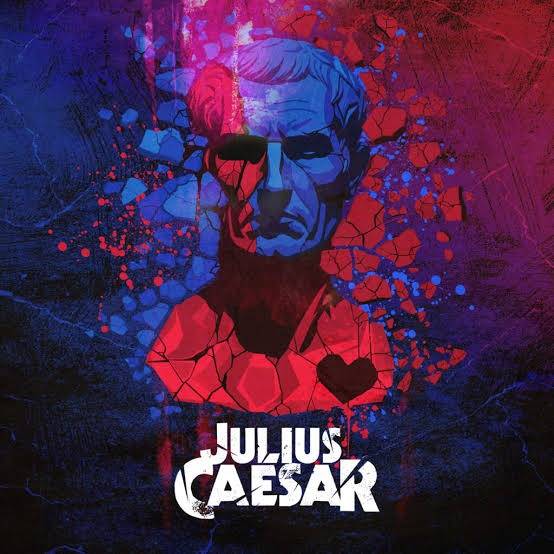
 Ancient Rome. Modern tensions. Terrific theater.
Under the summer sky at Forest Meadows, Julius Caesar is big, bold, sometimes funny, frequently violent — and thoroughly entertaining.
Director Jon Tracy takes Shakespeare’s familiar tragedy and makes us look at it anew.
Caesar has a Walkman and a guitar. Brutus and Cassius are sisters. Rome lives somewhere between the late 1960s and early 1980s. A massive wall dominates the stage, while helicopters, gunfire and military activity tell us that trouble is never far away.
This isn’t Shakespeare preserved under glass.
It’s alive.
This isn’t Caesar in modern dress. It’s Rome reimagined from the inside out.
The Story — In Brief
Julius Caesar returns to Rome enormously popular and increasingly powerful. Cassius fears he will become a tyrant and persuades Brutus and other senators that Caesar must die to save the Republic.
They assassinate him.
Mark Antony turns Caesar’s funeral into a devastating act of persuasion, the Roman people turn against the conspirators, and the struggle to save the Republic becomes civil war.
They kill Caesar to save Rome — and help destroy it instead.
That’s Shakespeare’s story.
What Tracy does with it is something else.
Johnny Moreno’s Caesar is the first surprise.
He appears in casual attire, headphones connected to a Walkman, acoustic guitar in hand. He takes his pills and struggles with a chord.
So much for the marble statue.
Moreno gives us an aging, vulnerable Caesar increasingly captivated by his own public image. The music grows. The crowds gather. Adoration builds.
The private man becomes the public Caesar.
Tracy makes Brutus and Cassius sisters, played by real-life sisters Bridgette Loriaux and Charisse Loriaux.
It’s an inspired choice.
And the Loriaux sisters are very good.
Their scenes together give the conspiracy an emotional dimension that goes well beyond politics. Cassius pushes. Brutus struggles. Family loyalty collides with political conviction.
Brutus isn’t simply at war with Caesar.
She’s at war with herself.
Politics starts the conspiracy. The sisters make it personal.
Everyone has a reason.
Caesar believes in his greatness. Brutus believes in honor. Cassius believes Caesar must be stopped. Antony believes in vengeance.
Nobody thinks they’re the villain.
That’s what makes them dangerous.
Tracy’s real subject isn’t simply assassination. It’s how people get there — how fear becomes conviction, conviction becomes certainty, and eventually something unthinkable begins to seem necessary.
Then comes Brady Morales-Woolery’s Mark Antony and the speech everyone knows.
Morales-Woolery makes the moment less about hearing famous words and more about watching persuasion happen.
Antony works the crowd, and before our eyes public opinion begins to turn.
The words haven’t changed. The crowd has.
Forest Meadows is a wonderful setting for all of this. Daylight fades. The hillside darkens. Tracy’s strange new Rome gradually takes over.
And somehow ancient Rome doesn’t seem very ancient anymore.
The result is accessible, imaginative, visually exciting and enormously entertaining Shakespeare — with something unsettling just beneath the surface.
More than four centuries later, Tracy makes the story feel immediate again.
That’s quite an accomplishment.
And perhaps that’s why Shakespeare survives.
We keep returning.
He keeps surprising us.
And this Julius Caesar leaves us with one particularly good question:
Who is telling our story?
Historical Footnote: What Happened After Caesar?
The great irony of Caesar’s assassination is that it accomplished almost exactly the opposite of what his killers intended.
Brutus, Cassius and their fellow conspirators believed killing Caesar would save the Roman Republic. Instead, his death unleashed another series of civil wars. Mark Antony survived the assassination and initially joined forces with Caesar’s young heir, Octavian, to defeat Brutus and Cassius at the Battle of Philippi. Both Brutus and Cassius died by suicide.
Antony and Octavian then became rivals. Antony allied himself with Cleopatra of Egypt, but their forces were defeated by Octavian at the Battle of Actium in 31 BCE. Antony and Cleopatra subsequently died by suicide. Octavian emerged as Rome’s undisputed ruler and, in 27 BCE, became Augustus, generally regarded as Rome’s first emperor.
They killed Caesar to save the Republic. Instead, Caesar’s death helped bring the Republic to an end.
JULIUS CAESAR
Marin Shakespeare Company
Forest Meadows Amphitheatre
Dominican University, San Rafael
Through September 13
Performance Schedule:
Thursday–Saturday at 7:30 PM
Sunday at 5:00 PM
Tickets: $22–$70
Youth: $10, ages 25 and under
Thursdays: Pay What You Will
Box Office: (415) 499-4488
Tickets & Information:
Marin Shakespeare Company — Tickets
Recommended for audiences who enjoy bold, imaginative theater, strong performances and Shakespeare that feels fresh, accessible and thoroughly entertaining.