Monthly Archives

May 2014

Fringe of Marin Spring 2014: Season Opener

By David Hirzel

The Fringe of Marin has gotten off to a good start for Spring 2014, opening their 33rd season’s Program One at Dominican University’s Angelico Hall.  This relatively new venue (2nd season there) is in most ways a decided improvement over the stage at Meadowlands.  There is, for example, a real theatrical sound and lighting system, a real stage and several hundred banked seats.  These, taken together, add a theatrical polish to the overall production, and this in turn brings out the best in the performances.

One of the best of these is the opener, “Fourteen” (written by Inbal Kashtan), a glimpse into the frustration and desperation of an adolescent girl (very well played by Stefanee Martin) seeking connection in a disintegrating household.  Very well staged and directed by Jon Tracey.  Gaetana Caldwell-Smith’s “Andrew Primo” looks into a woman’s discovery that her man is, literally, a machine.  Wth Edith Reiner’s performance as Elaine, it all makes sense.  Lesbian honeymooners on a camping trip are “Fighting for Survival” against all intruders—men, bears, nude dancers, a thunderstorm.  Lucas Hatton’s over-the-top stint as a hapless campground-census taker brought the evening’s richest laughter.  Dylan Brody’s “PreOccupy Hollywood” takes us to the staging room of a group of movie extras hoping for a shot at the bigger time.

For all that this new venue adds, something has been taken away—the close-in intimacy of Meadowlands’ black-box narrow hall.   This is particularly noticeable in “Little Moscow” where Rick Roitinger’s estimable portrayal of a Russian Jewish tailor’s reflective monologue to an unseen customer loses much of the potency of Alecks Merilo’s powerful script to the cavernous auditorium.  It is a credit to his performance and physical embodiment of that tailor, that Roitinger transcends the difficulties of giving an outward projection to the thoughts and words of an inwardly-directed character.

Altogether, a great evening’s entertainment right here in San Rafael.  Program Two promises at least as much, if not more.  Premiere Program Two Saturday May 24, 2:00.

For all dates this season, click Fringe Spring 2014

Box office:  Fringe 2014

Review by David Hirzel  www.davidhirzel.net

Kushner fascinates in ‘Intelligent Homosexual’s ….’

By Judy Richter

There’s no doubt that Tony Kushner is one of the nation’s most brilliant, erudite playwrights. His much-honored “Angels inAmerica” is the best example of his genius.

Now Berkeley Repertory Theatre is staging a more recent work, “The Intelligent Homosexual’s Guide to Capitalism and Socialism with a Key to the Scriptures.” While it doesn’t equal the power and fascination of “Angels,” it nevertheless is absorbing and often humorous throughout most of its three hours and 40 minutes (including two 15-minute intermissions).

The title itself reflects Kushner’s wide-ranging intellect, referring to playwright George Bernard Shaw’s nonfiction “The Intelligent Woman’s Guide to Socialism and Capitalism” and Christian Science founder Mary Baker Eddy’s “Science and Health with Key to the Scriptures.”

The play, however, is primarily a family drama set in the Brooklyn brownstone of the Marcantonio family in 2007. The sister of the Italian American family’s patriarch, 72-year-old Gus (Mark Margolis), has gathered his three adult children and their significant others because he wants to sell the house and commit suicide. He says he’s developing Alzheimer’s.  It later turns out that Gus, a retired longshoreman, former Marxist and labor leader, also has grown disenchanted with the 21st century.

Although his announced intention is the catalyst for the play, it also focuses on relationships within the family and between the children and others, starting with his son Pill (Lou Liberatore). He’s a history teacher who recently moved to Minneapolis with his longtime lover and now husband, Paul (Tyrone Mitchell Henderson). The couple moved from New York because of Pill’s romantic relationship with a young hustler, Eli (Jordan Geiger).

Gus’s only daughter is Empty (her real name is Maria Teresa, or MT), a lawyer played by Deirdre Lovejoy. Her wife, Maeve (Liz Wisan ), is eight months pregnant with sperm from Empty’s other brother, Vito (Joseph J. Parks), a contractor, who is married to Sooze (Tina Chilip). Empty’s former husband, Adam (Anthony Fusco), lives in the home’s basement apartment.

Completing the family circle is Gus’s taciturn sister, Clio (Randy Danson), a former nun who does social work in the slums of nearby Patterson,N.J. The only outside character is Gus’s friend Shelle (Robynn Rodriguez), who appears briefly in Act 3 and details how he can kill himself.

There’s a great deal of angst, argument and political philosophy as events unfold. Often everyone talks at once, but does anyone listen?

Directed by BRT artistic director Tony Taccone, the acting is excellent and most of the characters are sharply etched, but Kushner hasn’t developed some as well as others.

Christopher Barecca’s set design features the two-level brownstone and other locations that are slid or lowered into place. Completing the design team are Alexander V. Nichols, lighting; Jake Rodriguez, sound; and Meg Neville, costumes.

Even though Taccone does his best to keep the action flowing and Kushner has revised the play since its 2009 premiere in Minneapolis, it still could benefit from revisions. Some scenes, especially those involving Pill and Eli, are too long. Some of the secondary characters, such as Sooze and Maeve, need more fleshing out. Some plot developments seem abrupt.

In short, Kushner weaves a rich tapestry, as he always does, but this one has some loose threads.

The play will continue at Berkeley Repertory Theatre, 2015 Addison St., Berkeley, through June 29. For tickets and information, call (510) 647-2949 or visit www.berkeleyrep.org.


Big Marcus Shelby band uniquely weds jazz to Shakespeare

By Woody Weingarten

 Woody’s [rating:3.5]

Marcus Shelby skipped the hat and wore less conspicuous shoes for his Cal Performances tribute to Duke Ellington. Courtesy photo.

To be inventive or not to be inventive, that is the question.

When it’s bandleader-bassist Marcus Shelby doing the asking (as well as the innovating), the answer is a resounding “yes.”

In a Cal Performances concert at Zellerbach Hall in Berkeley celebrating Duke Ellington’s 115th birthday, Shelby flaunted his calculated risk of failing — by juxtaposing swinging big-band jazz and Shakespeare.

He didn’t fail.

Instead, he and his 15-member, mostly-brass ensemble evoked toe tapping, applause, whistling, cheers and foot stomping with each section of the obscure but stimulating “Such Sweet Thunder.”

The suite had been popularized by the Duke on vinyl but written by his longtime collaborator, Billy Strayhorn.

Shelby’s sidemen brought out each segment’s uniqueness, helping me see how Strayhorn was in effect trying to cover the entire jazz landscape in a single symphonic work.

And each segment’s pithiness left me wanting more.

Because the music was based on the plays and sonnets of the Bard, it was a big deal but not a big surprise that Shelby integrated soliloquys by five actors from Cal Shakes, more formally known as the California Shakespeare Theater.

While all the spoken-word interludes were top-notch, I found some connections to the music tangential at best and, thereby, hard to distinguish — even given information that “the essence” of Shakespeare’s material was being emphasized rather than any one scene or character.

I did find a few links clear-cut, though.

A Juliet balcony scene obviously bonded with a ballad, “The Star-Crossed Lovers,” and a bluesy waltz-time “Lady Mac” danced a direct path to “Lady Macbeth.”

“Sonnet to Hank Cinq” was, of course, a hip reference to Henry V, and “Sonnet for Sister Kate” might have had a little to do with Willie the Shakes’ “Taming of the Shrew.”

In my mind’s eye, by evening’s end I’d labeled the experiment fascinating and a success.

Even though I’d have liked the music alone.

The pre-intermission set of the concert, which also marked the 15th year of the Shelby group and the 40th anniversary of Ellington’s death, consisted of more familiar melodies.

It was dubbed “The Legacy of Duke Ellington: 50 Years of Swing!”

And swing it did.

For me, the highlight was an unbilled rendition of “Take the ‘A’ Train,” but I was also delighted by “Perdido,” the show’s bouncy opener; “C Jam Blues,” its rousing closer; and “Don’t Get Around Much Anymore” and “Hit Me With a Hot Note” in the middle.

The San Francisco-based Shelby, who took only one solo, happily spotlighted other musicians from his troupe as well as his guest stars.

Into the latter category fell scat vocalist Faye Carol (the high-strutting, scat-singing “Queen Bee” who’s worked with Shelby for 20 years), violinist Matthew Szemela (who occasionally kept time with both feet at the same time), sax vet Jules Broussard (whom the bandleader labeled one of his mentors) and trumpeter Joel Behrman.

Perfection was elusive, however.

I couldn’t appreciate a trumpet solo despite Shelby’s explanation that some of its notes were un-trumpet-like.

And I cringed when Carol grew raspy several times on “In My Solitude.”

Duke Ellington composed almost 1,000 pieces of music. The concert only skimmed the proverbial surface. But it did provide a glimpse into the man’s genius — through an exciting evening of standard and not-at-all-standard jazz.

In case you missed the Shelby orchestra, Cal Performances offers other excellent jazz choices. Try, for example, vocalist Mavis Staples on Oct. 30, Irvin Mayfield and the New Orleans Jazz Orchestra on Nov. 16, the Peter Nero Trio (playing Gershwin compositions) on Feb. 8, Cassandra Wilson (singing Billie Holiday tunes), or pianists Chick Corea and Herbie Hancock on March 19. Information: www.calperfs.berkeley.edu/buy/ or : (510) 642-9988.

An energetic/delightful/winning The 25th Annual Putnam County Spelling Bee at Center Rep.

By Kedar K. Adour

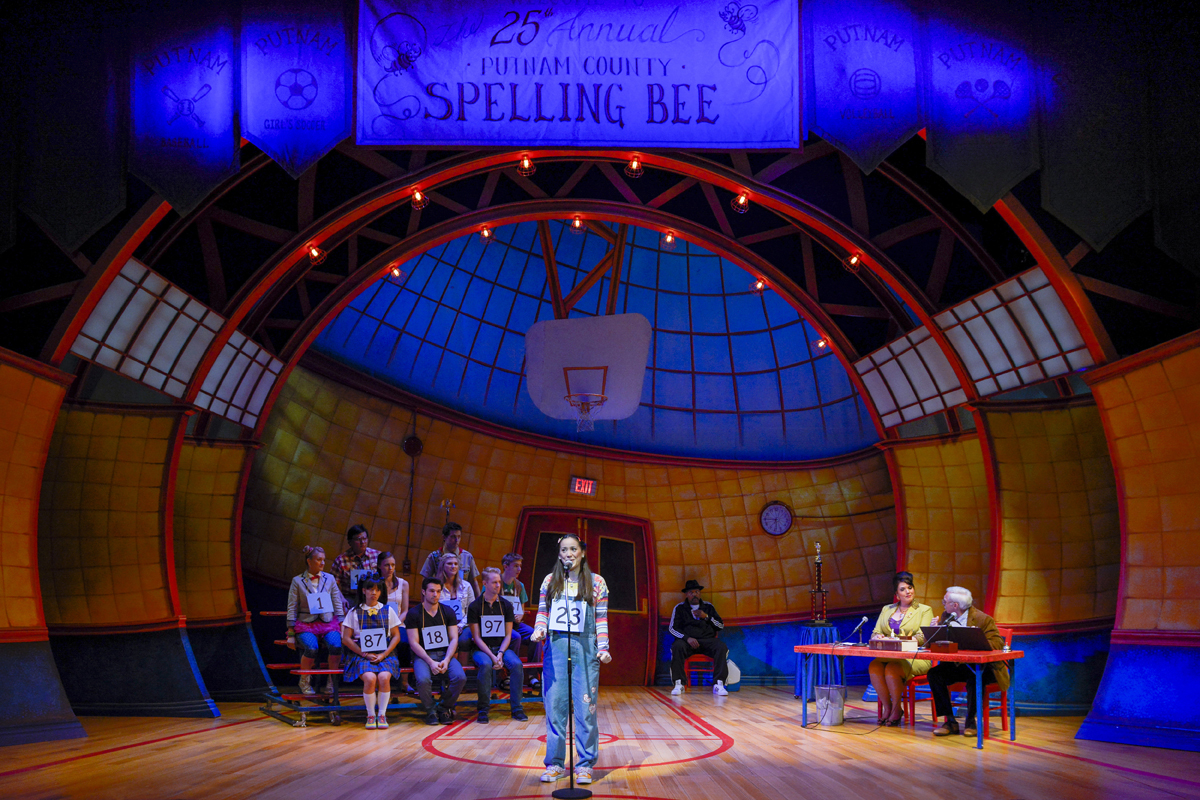
                              The Cast of The 25th Annual Putnam County Spelling Bee at CenterRep

The 25th Annual Putnam County Spelling Bee: Musical Comedy. Music and Lyrics by William  Finn. Book by Rachel Sheinkin. Conceived by Rebecca Feldman. Directed by Jeff  Collister.  Music Direction  by Brandon Adams. Choreographed by Jennifer Perry. Center REPertory Company 1601 Civic Drive in downtown Walnut Creek. 925-943-7469, or  www.CenterREP.org.  May 16 – June 21, 2014

[rating:5] (5of5Stars)

An energetic/delightful/winning The 25th Annual Putnam County Spelling Bee at Center Rep.

The 25th Annual Putnam County Spelling Bee (APCSB) hit the Broadway stage in 2005 after a circuitous journey starting from improvisational act called C-R-E-P-U-S-C-U-L-E ( meaning tenebrosity. . . look it up) and lasted for 1,136 performances winning multiple awards before its journey to multiple local venues around the U.S.A. In 2009 the Willows Theatre’s performed it in a miniscule cabaret in Martinez and as directed by Marilyn Langbehn was described by this reviewer: “The cast seemed to have as much or more fun than the audience since they emphasize the humor without fully developing the bittersweet pathos written into the text.” That same year San Jose Rep mounted the play under Timothy Near’s direction: “If there were Tony Awards for West Coast shows San Jose Rep’s production of . . .  Spelling Bee would garner multiple nominations and winners.”

Center Rep has taken a different approach creating a gay splash emphasizing musical aspects with exuberant dancing (Jennifer Perry) and singing and allowing the superb cast to pull out all the stops with broad acting yet keeping more than a modicum of pathos. All this plays out on a fantastic semi-surrealistic (Kelly Tighe) gymnasium set with lighting design by Kurt Landisman. Once again CenterRep has a “must see” show.  

The place is the gymnasium of the Putnam County Middle School where the 25th Annual Spelling Bee is being held under the leadership of the County’s number one realtor Rona Lisa Perretti (Leanne Borghesi) who was the winner of the 3rd APCSB by spelling “syzygfy.” She is assisted by the Vice Principal Douglas Panch (Michael Patrick Gaffney) who has the dubious pleasure of reiterating, with the company as backup, “The Rules.”  Then there is Mitch Mahoney (Berwick Haynes) an ex-con doing community service as the “Official Comfort Counselor” who gives the losers a hug and a box of fruit juice as he leads them off stage.

Enough about the adults, except to say, that Borghesi and Haynes have powerful voices and excellent comedic timing holding their own with the talented cast of “youngsters.” Those “youngsters” are not by any stretch of the imaginations middle-school denizens but they add a lot of verisimilitude to their roles as youngsters and all give whirlwind performances.

Before the evening is over you will have your own preference/choice for who should be the winner. Of course there is only one winner but before the show ends the company reminds us of that coming in second is not so bad with the upbeat song “Second.”

You will not recognize Brittany Danielle with her blond hair pulled almost into a pony-tail and a lisp in her voice as Logainne SchwartzandGrubenniere the daughter of two gay men who would do anything for her to win.  The most poignant of the group is charming Mindy Lym as Olive Ostrovsky whose mother is in India and her father is working late and may miss the contest. Her final duet with Zac Schuman as William Barfee (pronounced Bar-Fay) is a gem. He initially comes on stage a bit too strong but is marvelous as the speller with the magic foot who may be willing to forfeit winning for the love of Olive. Then there is Adam Elsberry as Issac ‘Chip’ Berkowitz the winner of last year’s competition but finds that puberty is affecting his concentration.

Zac Schuman as William Barfee (bar-Fay)

Adding to the fun are three members selected from the audience to participate in the spelling bee. One by one they are eliminated until only of the youngsters is the winner.  That information will remain a secret. Consider it another reason to see this hilarious musical. Running time a fast paced 90 minutes without intermission.

CAST: Leanne Borghesi as Rona Lisa Perretti; Brittany Danielle as Logainne SchwartzandGrubenniere; Adam Elsberry as Isaac “Chip” Berkowitz;  Michael Patrick Gaffney as Vice Principal Douglas Panch; Berwick Haynes as Mitch Mahoney; Lindsay Hirata as Marcy Park; Mindy Lym as Olive Ostrovsky;  Zac Schuman as William Barfee; Warren McLean Wernick as Leaf Coneybear.

ARTISTIC CREW: Directed by Jeff Collister; Music Direction by Brandon Adams; Choreographed by Jennifer Perry. Creative Team: Set Design by Kelly Tighe; Lighting Design by Kurt Landisman; Costume Design by Victoria Livingston-Hall; Sound Design by Jeff Mockus;  Stage Managed by Nicole  Langley*

Kedar K. Adour, MD

Courtesy of www.theatreworldinternetmagazine.com

Buried Family Secrets In Other Desert Cities at RVP

By Flora Lynn Isaacson

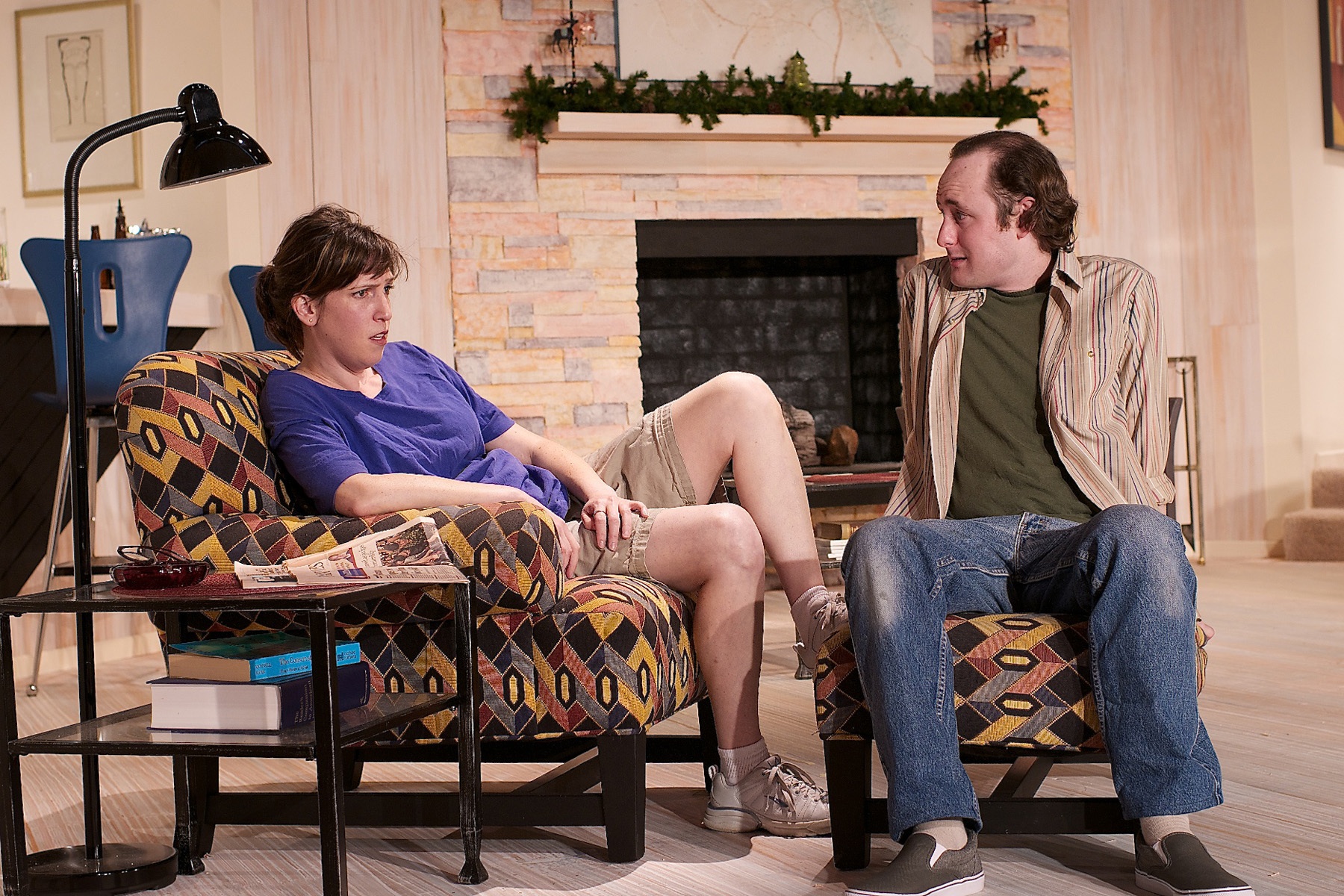
Jennifer Gregory as Brooke Wyeth & Peter Warden as Trip Wyeth. Photo by Robin Jackson.

 [rating:4] (4/5 stars)

Ross Valley Players currently presents the 2012 Pulitzer Prize Nominee for Best Drama, Other Desert Cities by Jon Robin Baitz and directed by Phoebe Moyer.

The play’s name refers to a guide sign on eastbound Interstate 10 in California which indicates that the freeway is headed towards Indio, California and “other desert cities” (that is the rest of the Coachella Valley).

The play’s events occur around the Christmas, 2004 holiday when the family of Polly (Ellen Brooks) and Lyman Wyatt (Dick Martin) gather in Palm Springs. Their daughter Brooke Wyeth (Jennifer Gregory) returns home after six years.  Brooke’s brother, Trip Wyeth (Peter Warden) is also present.   Polly’s sister Silda Grauman (Kristine Ann Lowry), a recovering alcoholic is also visiting on a break from rehab.  Polly and Lyman are Republicans while Silda is liberal. The sisters wrote a series of MGM comedies in the 1960’s. The wonderful set design by Ronald Krempetz is of an upscale, easy living, desert style living room.

The play is set into motion when daughter Brooke announces to her family she is about to publish a memoir dredging up a pivotal and tragic event in the family’s history—a wound they don’t want to have reopened.  That event is the suicide of her late brother Henry who had been involved in a radical underground subculture.  When this happens, the holiday reunion is thrown into turmoil as family members struggle to come to terms with their past as the Wyeth clan soon realizes some secrets cannot stay buried forever.

The play is well constructed and extremely well written. The cast could not be  better under Phoebe Moyer’s firm hand.  The actors never strike a false note.  In their speech rhythms and body language with one another, their relaxed intimacy or wary distress, their camaraderie or distance, their easy banter or silent hostile regard—they are unmistakably a family.

Other Desert Cities runs at Ross Valley Players May 15-June 15, 2014.  Regular Thursday performances are at 7:30 p.m., Friday-Saturday at 8 p.m., and Sunday matinees at 2 p.m. All performances take place at the Barn Theatre, home of the Ross Valley Players, 30 Sir Francis Drake Blvd., Ross, CA. For tickets, call 415-456-9553, ext. 1 or visit www.rossvalleyplayers.com.

Coming up next at Ross Valley Players will be Old Money by Wendy Wasserstein and directed by Kim Bromley July 18-August 17, 2014.

Flora Lynn Isaacson


OTHER DESERT CITIES earns the drive to RVP

By Kedar K. Adour

OTHER DESERT CITIES: Comedy/drama by Jon Robin Baitz . Directed by Phoebe Moyer . Ross Valley Players (RVP) @ Barn Theatre at the Marin Art & Garden Center, 30 Sir Francis Drake Blvd. in Ross. For tickets, call 415-456-9555 or go to www.rossvalleyplayers.com.

Runs through June 15, 2014

OTHER DESERT CITIES earns the drive to RVP  [rating:3] (3 / 5 stars)

In Southern California U.S. Route 10 traverses the entire State and as you travel East through the  Banning Pass entering the desert on the Eastern side of the mountains you come across a sign indicating that Route 111 leads to “Other Desert Cities.” This will take you to Palm Springs, the locale of Jon Robin Baitz award winning play Other Desert Cities. Having spent 10 winters in Palm Springs there were personal reason to see this play.

Palm Springs was the Mecca for Hollywood and Los Angeles glitterati but now is an upscale resort city with the “other desert cities” such as Indian Wells the most likely area to meet the characters with the financial means to live in the beautiful ostentatious style home created for this play (Ron Krempetz). The skillfully constructed set, with everything in its place, matches perfectly the skillfully constructed plot line with all the actions taking place within 24 hours with an epilog set 10 years later to add finality.

The plot has been used in A. R. Gurney’s The Cocktail Hour where a family member turns up with a soon to be produced play script that bares the foibles of his family. Gurney’s play is a true comedy with a touch of discomfiture.  In Other Desert Cities comedy is at a minimum allowing the engrossing dramatic details to unfold with the suggestion of impending disaster.  Author Baitz is a master at unraveling the tangled web leading to a terrific penultimate scene.

The Wyeths have gathered in the family home on Christmas Eve 2004. The patriarchs are Polly (Ellen Brooks) and Lyman (late replacement Dick Martin ) with their mature children Brooke (Jennifer Gregory) and Trip (Peter Warden ). Living with the Wyeths is Polly’s sister Silda Grauman (Kristine Ann Lowry) a recovering alcoholic. The elder Wyeths are affluent right wing Republicans active in the desert political life and members of an elite country club.  Brooke, who has been in and out of mental hospitals for the past 6 years being treated for depression has written a memoir with emphasis on the suicide of her older brother Henry, a member of a radical underground subculture. If published those revelations could decimate the lives of the entire Wyeth clan.

Seven months ago TheatreWorks in conjunction with San Diego’s Old Globe Theatre staged a brilliant production of Other Desert Cities. Seeing the play for a second time within 6 months after that staging seems to create a necessity for comparison. It probably is unfair since RVP is a non-equity community theatre. In this their 84th year of producing plays they have staged many plays that were highly praised. Other Desert Cities misses the mark.

Initially RVP and director Moyer rounded up a fine five member cast to perform this family drama that requires ensemble acting while giving each actor their moment to shine in various scenes. That ensemble contingent must have suffered a serious blow when a RVP stalwart Craig Christiansen departed from the cast two weeks before opening night.  This may explain why the timing between the actors was lost and the play lasted 20 minutes longer than the TheatreWorks’ two hour staging. Both timings include a 15 minute intermission.

On opening night Ellen Brooks was perfect in the pivotal role of Polly although she dropped beats with her studied delivery of her lines. She earned complete audience approval for her command of the stage. Those dropped beats may account for Peter Warden’s attempt to pick up the pace with more than a bit of over acting. In act two he did a fine job as the attempted peace-maker in the family.  Jennifer Gregory entered the stage on a high giving verisimilitude to Brooke’s mental instability but showed little variation in her quieter moments. Kristine Ann Lowry makes the most of her secondary but at one point pivotal role as Silda who refuses to be a sounding board for domineering Polly but is fully aware of her dependence on sister’s beneficence. Late replacement Dick Martin is a true pro and will surely fit into the ensemble acting mode as the run continues.

Director Moyer is a pro at blocking a show and she moves her actors adroitly about suggesting boxers in a ring each circling for that perfect punch.

CAST: Polly Wyeth, Ellen Brooks; Lyman Wyeth, Dick Martin; Brooke Wyeth, Jennifer Gregory; Trip Wyeth,  Peter Warden; Silda Grauman, Kristine Ann Lowry.

PRODUCTION STAFF: Director, Phoebe Moyer; Production Manager, Maureen O’Donoghue; Stage Manager, Maureen Scheuenstuhl; Asst Stage Manager, Caroline M. Doyle; Set Design, Ron Krempetz; Costume Design, Michael Berg; Lighting Design, Jon Gourdine; Lighting Operator,   Ian Tillotson; Lighting Assistant,  Iam Lamers; Sound Design, Billie Cox; Property Design,  Christina Jacqua; Set Construction, Eugene DeChristopher; Set Painter, Ryan Martin; Rehearsal Assistant, Maureen O’Donoghue.

Kedar K. Adour MD

Courtesy of  www.theatreworldinternetmagazine.com.

‘Inspector Calls’ still timely at Stanford

By Judy Richter

Even though J.B. Priestley’s “An Inspector Calls” is set in Brumley, England, in 1912, it could just as easily be set in the United States in 2014.

Its condemnation of an elitist attitude that disregards the needs of the less privileged is as relevant today as it was then. Stanford Repertory Theater (formerly Stanford Summer Theater) makes that point clear in its excellent production directed by Rush Rehm.

Priestley’s original, written in the winter of 1944-45, near the end of World War II, was in three acts and ran for more than two hours. Rehm apparently is using the streamlined, 90-minute Royal National Theatre adaptation by director Stephen Daldry, which won four 1994 Tony Awards and came to San Francisco in 1996.

The action takes place in the drawing room of the wealthy Birling family. They’re celebrating the engagement of daughter Sheila (Kiki Bagger) to Gerald Croft (Ethan Wilcox). His father’s firm is the chief rival to Sheila’s father’s firm. Her father, the socially and financially ambitious Arthur (James Carpenter), foresees a successful business alliance in their romantic relationship.

Joining the celebration are Sheila’s mother, Sybil (Courtney Walsh), and brother, Eric (Andre Amarotico).

Their evening is interrupted by the arrival of Inspector Goole (Weston Gaylord) of the Brumley police. He says that a young woman has committed suicide by swallowing disinfectant, leading to an agonizing death.

Their reaction, although horrified, amounts to “So what? This has nothing to do with us.” Inspector Goole disagrees, and proceeds to show how actions by each person led to her final desperate act.

Her downfall started two years earlier when she was working in Arthur’s factory. He fired her because she led a campaign to raise his workers’ wages. He said that if he paid his workers more, his profits would drop.

Later, she was working in a fashionable women’s clothing store when Sheila demanded that she be fired because of a perceived impertinence. When Gerald and then Eric met her, she was desperately poor. Each man helped her for a bit, but Gerald abandoned her, and she broke off with Eric. Finally, she went to a committee that helps poor women, but her request was refused by Sybil, the committee head.

Hence, they see how each one bore some responsibility for the woman’s fate. Shortly thereafter, however, they suspect that what Goole has told them isn’t true and that he isn’t who he says he is.

The elder Birlings and Gerald are relieved and readily resume their elitist attitudes. However, Sheila and Eric seem transformed by their feelings of guilt. The audience is left to ponder who Goole (rhymes with ghoul) really is and why he arrived that evening.

As is true with Stanford Rep’s summer productions, this one features both seasoned, professional actors alongside students. The professionals here are Carpenter and Walsh, who so ably portray the parents and their sense of privilege. The students do an excellent job of bringing out the nuances of their characters. The cast is completed by another student, Jenna Wisch, as the Birlings’ maid.

Production values are high with period costumes by Connie Strayer and lighting by Dan Wadleigh. Erik Flatmo’s dining room set features an ample dining table, sideboard and grandfather clock, which shows the correct time.

In today’s terms, one might say that the people in the Birlings’ dining room represent the 1 percent. Therefore, it’s appropriate that this production is a part of the Ethics of Wealth series presented by Stanford’s Ethics in Society program.

It’s both theatrically rewarding and intellectually intriguing.

“An Inspector Calls” will continue in Piggott Theater (Memorial Auditorium), 551 Serra Mall, Stanford, through May 24. For tickets and information, call (650) 725-5838 or visit http://taps.stanford.edu/

Seminar-Lessons In Human Dynamics at SF Playhouse

By Flora Lynn Isaacson

Leonard (Charles Shaw Robinson) comes to agreement with Martin (James Wagner).  Photo by Jessica Palopoli.

Seminar by Theresa Rebeck and directed by Amy Glazer is a comedy about four aspiring novelists who are paying $500 a week to take a writing seminar with a famous international author. According to Artistic Director, Bill English, “the word ‘seminar’ suggests a classroom–supposedly an environment that is structured to be a safe place to learn–but in Theresa Rebeck’s world, Seminar is far from safe.”

Set in present day New York City, Seminar follows Kate (Lauren English) who overcompensates trying to prove her writing abilities and Martin (James Wagner) who is struggling financially and afraid to show anyone his work.   Douglas (Patrick Russell) is the nephew of a famous playwright from Harvard. He is a good writer but a bit of a “name dropper.”  Izzy (Natalie Mitchell) writes well from the start. She figures at the center of the romantic conflict within the group. Their professor, Leonard (Charlie Shaw Robinson)’s career as a writer has been legendary. Seminar takes place in Kate’s Upper West Side apartment handsomely designed by Bill English.  The play captures aspects of their lives including their writing, romance, conflict and the future.

This play is more driven by characters than by plot, but Seminar is full of satire and quite entertaining.  Leonard, the Professor is an amazing role for Charles Shaw Robinson who brings out his character’s humanity in every moment.

Amy Glazer keeps the action moving at a crisp pace, which accentuates Rebeck’s comedy.  The costume design by Abra Berman is at the same time imaginative and appropriate for the characters.

Seminar is a fascinating presentation of the truth about human dynamics and writers’ fragile egos.  The play runs April 29-June 14, 2014 at the San Francisco Playhouse on the 2nd Floor in the Kensington Park Hotel at 450 Post Street (between Mason and Powell Streets), San Francisco.

Performances are held Tuesday-Thursday at 7 p.m.; Friday-Saturday at 8 p.m.; Saturday at 3 p.m. and select Sundays (May 18, June 1 and June 8) at 2 p.m. For tickets call the box office at 415-677-9596 or go to www.sfplayhouse.org.

Coming up next (June 24-September 6, 2014) at SF Playhouse will be Into the Woods by James Lapine (book) and Stephen Sondheim (music and lyrics). Susi Damilano directs.

Flora Lynn Isaacson


Family evolves over generations in ‘The Big Meal’

By Judy Richter

In an intricately constructed 90 minutes spanning five generations and several decades, San Jose Repertory Theater is staging “The Big Meal” by Dan LeFranc.

All of the action takes place in a restaurant — not necessarily the same one over the years — where the story begins with the meeting of Sam, a customer, and Nicole. After some ups and downs, they marry, have kids, grandkids and even a great grandchild. Along the way there are marriages, deaths, spats, humor and an underlying sense of caring.

The action is propelled by four pairs of actors: two children, two young adults, two middle-aged adults and two senior citizens. Youngsters Sophia Grace Cuthbert and Nicolas Garcia play all of the children’s roles. The adults portray Sam and Nicole at various stages in their lives.

When first seen, Sam and Nicole are played by Aaron Wilton and Jessica Lynn Carroll. As their characters mature, they’re replaced by Carrie Paff and Mark Anderson Phillips. Finally, Catherine MacNeal and Richard Farrell, who are first seen as Sam’s parents, become Sam and Nicole. Along the way, the actors portray other characters. For example, Wilton and Carroll, the young adults, become Sam and Nicole’s young adult children, Robbie and Maddie.

As the play continues, it’s sometimes difficult to keep up with everyone. A family tree in the program would help.

Director Kirsten Brandt moves the action briskly. For example, an actor might exit as one character and immediately return as another. Before a character dies, he or she eats one last meal (brought by an uncredited stage hand), then quietly exits.

In one of the final scenes, Sam and Nicole (MacNeal and Farrell), are elderly. Because Sam has dementia, probably Alzheimer’s, Nicki lovingly feeds him before he exits. It’s a moving moment.

Nina Ball’s set features diner-style tables downstage with several booths upstage, backed by a set of doors and several windows that enable to audience to see a character’s final exit. The effective lighting is by Kurt Landisman, with unobtrusive sound by Jeff Mockus. Costumes by Shannon Sigman easily span the decades.

All of the actors in this ensemble work are excellent. The play itself reflects the changes in family dynamics that take place over time. No doubt some in the audience might recognize scenes from their own families.

“The Big Meal” will continue at San Jose Repertory Theatre, 101 Paseo de San Antonio, San Jose, through June 1. For tickets and information, call (408) 367-7255 or visit www.sjrep.com.


Spreckel’s Theatre Company Produces Another Success!

By Guest Review

“Catch Me If You Can”, another success at Spreckel’s Theatre Company


by Richard Riccardi

“Catch Me If You Can” is the latest production in a current series of high-energy, large scale musicals presented by Spreckels Theatre Company in Rohnert Park. Overall I found it to be a very entertaining and expertly done evening of musical theatre. Zack Howard, as the young Frank Abagnale, delivered a tour de force portrayal of the young swindler and con artist, with timing and delivery far exceeding his young years and experience. David Yen, as the FBI agent Carl Hanratty, reminded me of Barry Morse’s portrayal of Lieutenant Philip Gerard in the old television series “The Fugitive,” ever-chasing, stubborn, and palpably frustrated. Garet Waterhouse and Betsy Glincher, as Frank Abagnale, Sr and Paula Abagnale, delivered memorable and poignant scenes depicting the portrait of the true unhappiness they experienced in their relationship. Kelly Brandeburg, known for her “why-the-heck-aren’t-you-in-New-York?” voice, plays Brenda Strong, the nurse who emerges as Frank Jr’s love interest, and possibly his downfall. Her performance was a lovely rendering of Brenda’s earnestness, naïvete, and sweetness. Brenda’s parents, Carol and Roger Strong played by Pam Koppel and Tim Setzer, hilariously completed the picture of the family duped by Frank Abagnale Jr. Supporting actors, singers and dancers completed the picture to make this show a very congealed and successful ensemble.

Choreography should be at the top of the list of credits for “Catch Me If You Can”. Michella Snider has consistently shown that she is clearly at the top of her game in musical theatre, and this production didn’t disappoint. Dance highlights by the ensemble were clearly the nurses and the PanAm stewardesses! Raucous, uplifting, and lots of gorgeous gams.

Aligning with many of the past productions of the Spreckels Theater Company, “Catch Me If You Can” utilizes a series of projections supporting the set design. These projections in a way reminded me of the early days of Cinerama, a brainchild of Fred Waller and originally produced by Mike Todd, using wide angles and three projectors. Although these are ‘still’ projections, not often moving, they do lend support to stage shows which can financially benefit from minimal scenery. It certainly is fair to say that the overall effect of the projections not only enhanced the show, but combined with it very satisfactorily. I did however find myself occasionally distracted by the projection as a show unto itself (was that a picture of the historic Penn Station in New York City?) and caused a bit of wandering in my concentration. The use of projections certainly isn’t new, and there have been some spectacular ones, to wit, the large projection of Air Force 1 in San Francisco Opera’s production of “Nixon in China” which seemed to envelop the entire stage. Spreckels is a large theater on a City of Rohnert Park budget, so Gene Abravaya has found a brilliant solution to filling the stage without astronomical set-costs.

The musical score for this production, adapted from the non-musical movie of the same name, was light, fun, at times sixties-groovy and supportive of the story line, but I frequently wished for more sound. I heartily applaud Janis Wilson and her band of five, who did an incredibly precise job of supporting the stage, but clearly the score is written for a big band of many more instruments, and certainly would have benefited, not only from the number of instruments it was written for, but for a placement in the pit, where orchestras are designed to play from, for many musical and acoustic reasons. From experience, I know that it takes at least four dozen extra, unpaid hours on the part of the musical director (and the band itself) to reduce a score for 14 instruments down to a group of 6. Janis Wilson deserves a medal!

Kudos to set designers Eddy Hansen and Elizabeth Bazzano for creating clever stage pieces which were artfully integrated with the projections. Pamela Enz’s costume design was period accurate, and at times extremely sexy (my favorites were the nurses outfits, my wife’s favorites were the bright-blue Pan Am stewardesses). The production was directed seamlessly by Gene Abravaya.

“Catch Me If You Can” plays until May 25, 2014. For show schedules and ticket information, please contact the Spreckels box office at (707) 588-3400 or online at www.spreckelsonline.com