Monthly Archives

May 2014

Potent A.C.T. musical drama, ‘The Suit,’ stirs emotions

By Woody Weingarten

Woody’s [rating:4]

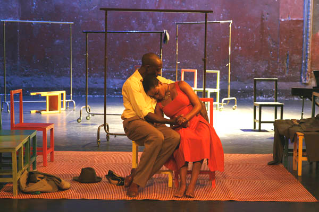
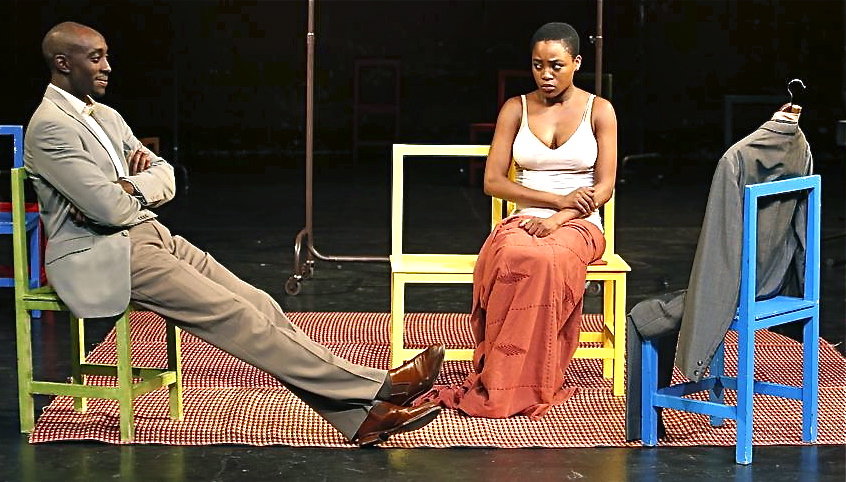
Extraordinary actors Nonhlanhla Kheswa (right) and Ivanno Jeremiah and an ordinary suit star in “The Suit.” Photo by Pascal Victor/ArtComArt.Photo by Pascal Victor/ArtComArt.
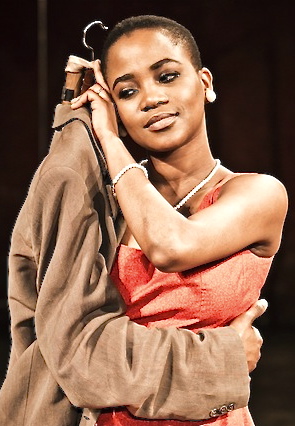
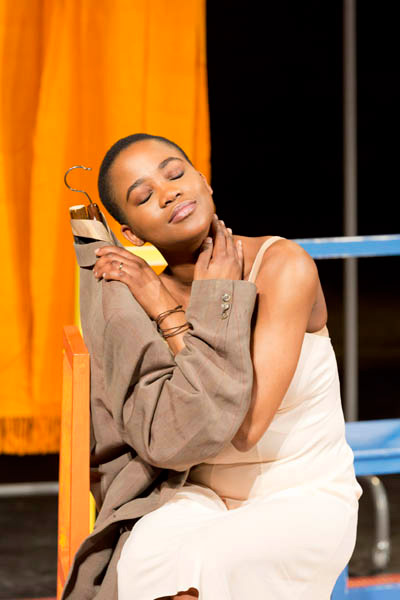
Nonhlanhla Khesa effectively uses her arm to romantically caress herself, puppet-like in “The Suit.” Photo by Johan Persson.

Racism, as depicted in the apartheid-fouled Johannesburg of “The Suit,” is downright ugly.

And brutal.

Palpably tragic.

Worst of all, it’s reflective of today’s racism in an America that pretends it’s integrated when its all-too solid walls of bigotry remain intact.

It’s a fascinating coincidence that “The Suit” opened at San Francisco’s A.C.T. Theatre only one day after L.A. Clippers’ owner Donald Sterling was fined $2.5 million and barred for life from the National Basketball Association for overtly anti-African American statements.

Though peppered with multiple instances of levity, “The Suit” is a solemn theatrical time bomb intentionally ignited by Peter Brook, an 89-year-old British director.

Brook clearly stages the kind of in-your-face prejudice I’ve always found abrasive and offensive.

Adapted from a Can Themba short story, the 75-minute drama thrusts into the foreground a husband who, after discovering his wife in bed with a lover, insists she take with her wherever she goes the suit her fleeing sex partner left behind.

It becomes, essentially, a scarlet letter, the traditional sign of sin.

Over all, the play exudes a surreal, fable-like quality, abetted by a Dali-esque set consisting of unadorned (yet colorful) wooden chairs and bare clothing racks.

But the extraordinary three-actor cast seamlessly integrates poignancy, music and pantomime.

Nonhlanhla Kheswa, Johannesburg native and veteran of Broadway’s “The Lion King,” is outstanding as the adulterous Matilda. Her body language and elegiac voice unerringly convey how she wears her punishment.

Ugandan-born Ivanno Jeremiah adeptly plays her humiliated, vengeful spouse, Philomen, middle-class wage-slave who’s suffered daily abuse from a system that downgraded a whole black population to second-class status.

New Jersey-born Jordan Barbour skillfully fills in the gaps as he jumps from role to role.

Musical interludes range from traditional African melodies to timeless American jazz pieces such as “Feelin’ Good,” the Nina Simone standard, and the painful Billie Holiday classic about lynching, “Strange Fruit.”

To prevent my review from being disingenuous, I must mention that the touring production from Théâtre des Bouffes du Nord is imperfect.

Even heavy-handed sometimes.

As when the fourth wall is broken by actors who provide the audience with invisible joints, or when folks are invited to represent white participants onstage at a shebeen, a speakeasy-like party.

Additionally, Brook, whose “The Empty Space” has been a theatrical bible for generations, has paced the play so deliberately I twice felt compelled to check my watch.

None of that, however, undercuts the emotional impact of the show.

Besides, “The Suit” contains numerous magic moments.

When, for instance, Matilda puts one arm into the empty outfit and, puppet-like, achingly caresses herself as if it were still being worn by her absent lover. When she sings, in Swahili, an upbeat song that’s crushed by Philomen with only a few words. When she foreshadows crucial action by dedicating a melancholy tune to “each and everyone who cannot get what they want in life.”

Or when the actors pantomime being on a rolling commuter train.

When trumpeter Mark Vavuma wrings every possible emotion from his muted horn. Or when Mark Christine underscores the play’s tragic ménage à trois via a soulful Bach “St. Matthew Passion” on a solo compact synthesizer.

“The Suit” is set in the 1950s in Sophiatown, an overcrowded black appendage of Johannesburg that actually was bulldozed.

With more than 65,000 blacks forcibly removed.

I, frankly, was grateful the stream of real 1950s violence was referenced but not shown onstage. It was surely enough just to envision each of a black man’s fingers being bloodied, and his being shot 34 times.

The first-impression simplicity of “The Suit” is purposefully deceptive, making its vivid ending even more powerful, more numbing.

The opening night audience, in fact, seemed so stunned it took it a few seconds to rise for a well-earned standing ovation — and then it did so almost in slow motion.

“The Suit” plays at the American Conservatory Theater, 415 Geary St., San Francisco, through May 18. Performances Wednesdays through Saturdays, 8 p.m.; Tuesdays, 7 or 8 p.m.; matinees, Wednesdays, Saturdays and Sundays, 2 p.m. Tickets: $20 to $120. Information: (415) 749-2228 or www.act-sf.org.

Hillbarn presents ambitious ‘The Color Purple’

By Judy Richter

Leaving her post after 16 years, Hillbarn Theatre artistic director Lee Foster has made “The Color Purple” her swan song with the Foster City company.

It’s an ambitious undertaking with a 23-member, mostly black cast telling a story that spans nearly 40 years (1909 to 1945) in the life of a black woman in the South.

That woman, Celie (Leslie Ivy), is first seen as a 14-year-old impregnated for the second time by Pa (Andy Serrano), the man she believes to be her father. After the baby is born, Pa says he’ll get rid of it, just as he did the other child, much to Celie’s distress.

A neighboring farmer Mr. ____ (Anthone D. Jackson), calls on Pa hoping to marry Celie’s beloved younger sister, Nettie (Jacqueline Dennis), but winds up with Celie instead. After staving off advances by both Pa and Mr. ____, Nettie leaves, again to Celie’s distress.

Celie’s life with Mr. ____ is just as miserable as it was with Pa. She’s nothing more than a servant whom he mistreats and abuses. However, her fortunes begin to change when Shug Avery (Dawn L. Troupe), a popular singer and Mr.’s ____ longtime lover, moves in with them and sings at the juke joint owned by his son Harpo (Brian M. Landry).

Eventually Celie breaks away from Mr. ____, learns about real love thanks to Shug, gains self-respect and becomes a successful business woman, first in Memphis and then back in her hometown of Eatonton, Ga.

The story unfolds episodically, but the set by Kuo-Hao Lo (lighting by Don Coluzzi) accommodates quick scene changes. Costumes by Margaret Toomey help to define changing times.

Besides those already mentioned, the other major character is Harpo’s wife, Sofia (Jihan Sabir), a strong-willed woman who refuses to be subservient to anyone, a trait that proves costly.

Three Church Ladies, played by Ladidi Garba, Debra Harvey and Pam Drummer-Williams, serve as a kind of Greek chorus, commenting on the action. Others in the cast play a variety of characters.

Overall, the performance level is quite high by everyone, especially the principals. Choreography by Jayne Zaban is outstanding, especially in the juke joint scene, “Push Da Button.” The men’s dancing is especially notable.

The singing is generally quite good under the leadership of musical director Greg Sudmeier, who is Foster’s husband and who also is leaving the company. Much of the musical accompaniment is recordings from Right On Cue Services.

However, the lyrics are often difficult to follow because of diction and the Southern black dialect. Compounding the comprehension problem is Alan Chang’s sound design, which is so loud that it distorts the lyrics.

“The Color Purple” began life as a 1982 novel by Alice Walker of San Francisco. From there it became the 1985 film that helped launch the career of Oprah Winfrey, who played Sofia. She subsequently became one of the producers bringing the story to the Broadway musical stage in 2005. The national tour came to San Francisco in 2007.

Marsha Norman adapted the musical from Walker’s book. The music and lyrics by Brenda Russell, Allee Willis and Stephen Bray encompass several styles such as gospel, blues, honky-tonk and ragtime.

The two-act production at Hillbarn clocks in at nearly three hours, in part due to long restroom lines at intermission but in larger part due to the show itself. Despite the many years that it covers, some scenes seem expendable, especially in the second act. It opens with two long scenes from Africa, where Nettie has become a missionary who has Celie’s children with her. Only the first scene, which has some terrific dancing, works well. Another expendable scene is “Is There Anything I Can Do for You?” a duet for Harpo and Sofia. It’s well done but doesn’t do much to advance the story, especially since the adaptation is a bit short on developing some characters and clarifying some plot details.

Despite shortcomings in the show itself, this production serves it well, thanks in large part to a talented, energetic, committed cast and Foster’s astute direction.

“The Color Purple” will continue at Hillbarn Theatre, 1285 E. Hillsdale Blvd., Foster City, through June 1. For tickets and information, call (650) 349-6411 or visit www.hillbarntheatre.org.

The Best of PlayGround 18 a charming/sweet/sad/satiric fun filled evening at the Thick House.

By Kedar K. Adour

Adam Roy, Stacy Ross, Rinabeth Apostol and Howard Swain in Ruben Grijalva’s MR.WONG’S GOES TO WASHINGTON, from Best of PlayGround 18.

Best of PlayGround 18: Five short plays and one musical. Thick  House, 1695 18th Street, San Francisco, CA.  (415) 992-6677 or visit  www.PlayGround-sf.org/bestof.

May 8 – May 25, 2014   [Rating:4] (4 of 5 stars)

The Best of PlayGround 18 a charming/sweet/sad/satiric fun filled evening at the Thick House.

PlayGround, the showcase for promising new playwrights in Bay Area, has come up with another winner for their 18th season. This year they again are using the intimate 99 seat Thick House Theatre for their productions. There was not an empty seat and the appreciative audience (certainly many were/are friends of the writers) was treated to a 90 minute, without intermission, roller-coaster of emotional theatre.

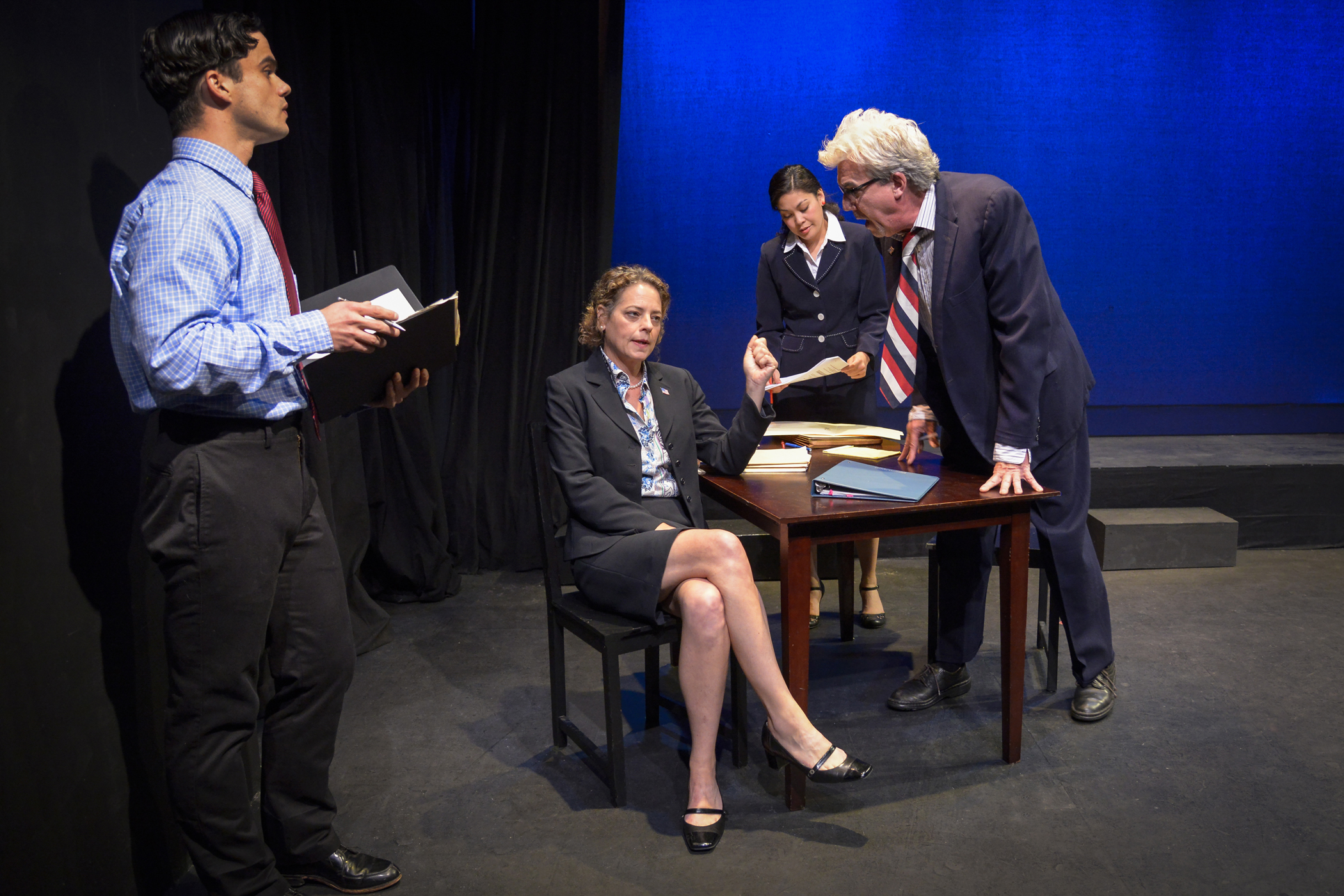
The curtain raiser, a cutting/satirical /farce  (Mr. Wong’s Goes to Washington by Ruben Grijalva,  directed by M. Graham Smith) started out the evening on a hilarious note.  The marvelous ensemble acting (Rinabeth Apostol, Stacy Ross, Adam Roy, Howard Swain, and Jomar Tagatac) skewers US Governmental decision making over such a mundane choice of Chinese take-out food or cheaper sandwiches from the local deli.

This was followed by (When You Talk About This by Patricia Cotter, directed by Tracy Ward) a direct take-off on David Mamet’s  Oleanna  and Robert Anderson’s  Tea and Sympathy. For this two-hander author Cotter envisions a liaison with a young student poet (Adam Roy) taking a course in statistics from 40 year female professor (Stacy Ross). When Stacy utters the fateful line, “(Years from now)When you talk about this, and you will. . .) the final words are not “be kind.”

Adam Roy and Stacy Ross in Patricia Cotter’s WHEN YOU TALK ABOUT THIS

After the two opening plays getting off to an excellent start there is a letdown with The Broken-Tooth Comb a mathematical fantasy by William Bivins, directed by Katja Rivera.

Since the set changes are minimal there is little time to cogitate on the previous 10-15 minute play. So it was with Stranger in a Stranger Land by Karen Macklin, directed by Michael French. Newly arrived in San Francisco, Lynn (Stacy Ross) is looking of Mr. Right. Her first encounter with hippie Mitchell (Teddy Spencer) at Starbucks is a disaster as is it is with Brian (Jomar Tagatac) who runs an Internet “Cuddling Service.” When handsome, charming Paul (Adam Roy) takes her to a (shocking) nude beach Lynn is about to give up and ends up depressed at the Museum of Modern Art. There is a bitter-sweet ending with Brandon (Howard Swain) that will cheer you up and make you want to applaud.

Riding Dragonsby Victoria Chong Der, directed by Nancy Carlin was my seat mate’s favorite and for good reason. What starts out as mother/daughter (Stacy Ross/ Rinabeth Apostol) discussion with an unseen school official, adroitly becomes a mother/daughter generational gap conflict that melts into a heart-tugging mystical ending.

Stacy Ross and Rinabeth Apostol in Victoria Chong Der’s RIDING DRAGONS

The curtain comes down on the evening with the musical Love Spacewalked Inby Maury Zeff, directed by Jim Kleinmann with music and lyrics by George and Ira Gershwin. What would happen if the onboard hydro-waste recycler in a space ship orbiting the moon suddenly has a “log-jam” (their words not mine)? It just happens that the inventor of the recycler, Russian Lieutenant Valentina Blazenhov (Rinabeth Apostol) is only minutes away surveying the Sea of Tranquility for Vladimir Putin’s beach house. She enters with a snorkel and a diver’s mask and holds a plunger. Love blossoms in a most unusual way and all end up singing “Love Walked In.” Oh, I forgot to mention that it is a full cast production that director Kleinman has fun moving them around in zero gravity.

Front) Howard Swain, Jomar Tagatac, Adam Roy, (Back) Rinabeth Apostol and Teddy Spencer in Maury Zeff’s LOVE SPACEWALKED IN,

Recommendation: Well worth seeing and mostly satisfying.

Ensemble Cast: Rinabeth Apostol, Stacy Ross, Adam Roy, Howard Swain, Jomar Tagatac, and Teddy Spencer.

Artistic Staff: Lighting Designer,Mark Hueske; Sound Designer, Josh Senick; Costume Designer,Jocelyn Leiser Herndon; Casting Director, Annie Stuart;      Properties Artisan, Cindy Goldfield; Production Manager, Marcus Marotta; Stage Manager,Bethanie Baeyen;Assistant Stage Manager, Siobhan FitzGerald; Production Assistant/Dresser, Melissa Kallstrom.

Kedar K. Adour, MD

Courtesy of www.theatreworldinternetmagazine.com.


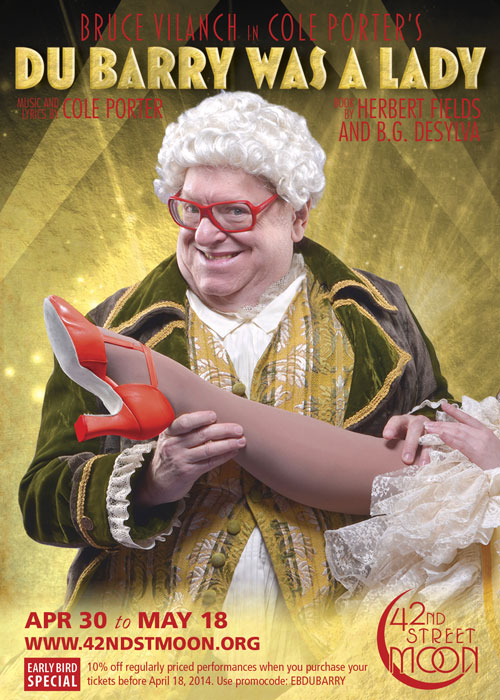
DU BARRY WAS A LADY scintillates but does not titillate at 42nd Street Moon.

By Kedar K. Adour

Bruce Vilanch finds himself transformed into King Louis wooing Madame Du Barry (Ashley Rae Little) in 42nd Street Moon’s production of Du Barry Was a Lady, playing April 30 – May 18, 2014 at The Eureka Theatre

DU BARRY WAS A LADY: Musical. Music & Lyrics by Cole Porter. Book by Herbert Fields & B.G. De Sylva. Directed and Choreographed by Zack Thomas Wilde. 42nd Street Moon at the Eureka Theatre, 215 Jackson Street, San Francisco in Gateway Plaza (between Battery & Front). (415) 255-8207 or www.42ndStMoon.org.  April 30 to May 18, 2014

 DU BARRY WAS A LADY scintillates but does not titillate at 42nd Street Moon. [rating:4] (4 of 5 stars)

When Du Barry Was a Lady tried out in Boston before its Broadway run in December 1939 the censors did not approve of the double-entendres in the seminal song “But in the Morning, No” but it was a show-stopper appreciated by the New York audiences. In 42nd  Street Moon’s staging the stars of the show Bruce Vilanch and Ashley Rae Little create a hilarious duet singing the song with only a smidgen of the bawdy. It is easy to visualize original leads Bert Lahr and Ethel Merman doing that number with full scale innuendo.

Forget the bawdy and go to see this show. It is the last show of the 2013-2014 season and they have pulled out all the stops beginning with bringing in the nationally famous Bruce Vilanch who has for years written the jokes for the Oscars and has the timing of a professional comedian. He moves his rotund frame, occasionally with arms flailing to accentuate his pliable face and enters into the fray. In doing so he does not throw the ensemble out of whack and becomes part of the whole yet being very distinctive in his humorous demeanor.  Of course he plays the part written for Bert Lahr. Ashley Rae Little playing the role made famous by Ethel Merman is a match for Vilanch and can really belt out a song.

This show playing at the intimate Eureka Theatre is the first full scale production since 1941. It is classic Cole Porter with suave lyrics to delightful music. These include, “Friendship”, “Well, Did You Evah?”; “Do I Love You?”; “When Love Beckoned on 52nd Street” and “Katie Went to Haiti” and others. To buttress the music and lyrics they have created an attractive set (Jennifer Veres) including a fold down Murphy bed, with bright snazzy costumes (Felicia Lilienthal) ranging from skimpy chorus girl outfits to hysterical knock-offs of male and female attire found in King Louis XV of France’s court.

Fields and De Sylva cleverly switch from a 1930s night club to King Louis’ court with a storyline about a hapless but generous/loveable wash-room attendant Louie Blore (Vilanch) in love with café star May Daly (Ashley Rae Little) who is in love Alex Barton (Jack Mosbacher) who is still married to Alice (Nicole Renee Chapman). Louie has won the Irish Sweepstakes thus attracting many friends (money does that). Charley (Jordan Sidfield), Louie’s shady replacement suggest he temporarily get rid of Alex by slipping him a Mickey Finn. You guessed it, Louie gets the Mickey and goes off to Louie XV’s court while the quartet sings “Dream Song.”

Louie becomes Louis the XV with May becoming his reluctant potential mistress Du Barry. It seems that song writer Alex(andre) has written a naughty song “Du Barry was a Lady” and is pursued  by Louie’s inept minions. Charley is now The Dauphin, the child-like heir to the Throne saves Du Barry from a night in bed with Louie with a well placed arrow to Louie’s posterior.

It goes on and on with some exuberant and sometimes humorous dance numbers by a very professional cast. These include soft shoe duets by Nathaniel Rothrock and Nicole Renee Chapman, ensemble tap dance, “Gavotte” by the Courtiers, and a show-stopper “Katie Went to Haiti” by the ensemble chorus.

Handsome Jack Mosbacher has an excellent tenor voice and gets to sing “Do I Love You” and “Written in the Stars.”  Ashley Rae Little brings down the house with “Give Him the Oo-la-la,” and shares the spotlight at the end of act two with Vilanch in the catchy “Friendship.”

The show is one of 42nd Street Moon’s best and this reviewer gives it a four star rating. Running time 2 hours and 20 minutes with an intermission.

CAST: Bruce Vilanch(Louie/King Louis); Ashley Rae Little(May Daly/Du Barry); Jack Mosbacher (Alex Barton/Alexandre); Nathaniel Rothrock (Harry Norton/Lebel); Nicole Renée Chapman(Alice Barton/Alisande);Jordan Sidfield(Charley/The Dauphin); Abby Sammons(Vi/Mme De Villardell);Ryan Drummond (Kelly/Docteur/Paingrillé); Roy Eikleberry(Doctor/Zamore);Rudy Guerrero(Jones/Choiseul); Kathryn Han (Gemze/Gruyere); Adrienne  Herro(Betty/De Verney) ;Katherine Leyva (Mitzi/Roquefort);Anthony Rollins-Mullens(Reporter/Fondue).

CREATIVE TEAM: Ben Prince (Musical Director);  Josh Anderson (Stage Manager); Carol). Felicia Lilienthal (Costume Designer) ; Danny Maher (Lighting Designer); Hector Zavala (Sets/Production Manager); Samantha Young (Props); Arael Domínguez (Scenic Design Assistant).

Kedar K. Adour, MD

Courtesy of www.theatreworldinternetmagazine.com.


Bruce Vilanch finds himself transformed into King Louis wooing Madame Du Barry (Ashley Rae Little) in 42nd Street Moon’s production of

Du Barry Was a Lady, playing

April 30 – May 18, 2014 at The Eureka Theatre

Moon for the Misbegotten: Marin Onstage shines a light

By David Hirzel

This review is only partly for Marin Onstage’s just ended production of Moon For the Misbegotten. Eugene O’Neill’s play may seem in a way dated in its treatment of alcoholism (it was first produced in 1947) but the problems addressed are universal and timeless. We see greed raising its ugly head on a number of fronts, a father and his grown daughter who know each other too well constantly sparring, the tension between two would-be but never-quite-become lovers. There is conniving and scheming, bickering and just-missed assault, all of it fueled by a constant flow of liquor. And just as in real life, these quandaries are addressed and never quite resolved.

That is the essence of this play, made whole in this theater-in-the-round production. St. Vincent’s is a folding-chair sort of a theatrical space with a cabaret touch, with enough room for a half-dozen round tables for the audience to sit at. For this Moon the raised stage was used only as a backdrop, with the skeleton of a dirt-poor farmer’s shanty backed by blackness. The action takes place on the floor, a spare set with the suggestion of bare dirt, a few tree-stumps and a hand-pump well. Every seat is front-row.

The first act introduces the characters and the tensions that bind them to and repel them from each other. Father and daughter Michael and Caitlin Walraven play the farmer Phil Hogan and his daughter Josie. Their real-life relationship informs their portrayals of these characters eking out a living on a patch of rocks owned by landlord James Tyrone. The second act establishes the brewing crisis: the farm is about to be taken over by a greedy neighbor (Will Lamers). But it the third act, where that the play really catches fire, that the power and drama of O’Neill’s script takes flight. Here the long-simmering push-pull tension of disdain and longing between James and Josie ignites and cools again and again, giving them and the audience a sometimes painful at the conflict between what we desire and what we know we will never attain. Stellar performances by Caitlin Walraven and John Nahigian in this highly charged conclusion brought more than a mist of a tear to the eyes of some of us.

Splendidly directed by Ron Nash, who also directed the other two plays in Marin Onstage’s Spring 2014 season at St. Vincent’s. It was an ambitious series with a focus on the power of women in the life of the early years of the last century, a glimpse of how far we have come, a view of the path that brought us to where we are today. Special thanks also to Jeanine Gray and Lisa Immel for such well-tuned costumes.

The season ends today, but you can expect nothing but the best from Marin Onstage in the fall of 2014, at the Little Theater at St. Vincent’s (1 St. Vincent’s Drive, San Rafael CA)

 Theater Marin website:  www.marintheatre.org

 David Hirzel website: www.davidhirzel.net

THE SUIT with an international cast is riveting at A.C.T.

By Lloyd Kenneth

Matilda (Nanhlanhla Kheswa) in the arms of her loving and doting husband Philemon (Ivanno Jeremiah)

THE SUIT: Drama. Adapted by Peter Brook, Marie-Hélène Estienne and Franck Krawczyk from the story and play by Can Themba, Mothobi Mutloatse and Barney Simon. American Conservatory Theater, 415 Geary St., San Francisco. (415) 749-2228. www.act-sf.org. Through May 18, 2014

THE SUIT with an international cast is riveting at A.C.T. [rating:5] (5 of 5 Stars)

It was 30 years ago that San Francisco audiences were treated to a magnificent spectacular production of A Midsummer’s Night Dream by the Royal Shakespeare Company directed by the brilliant Peter Brooks. It is a pity we had to wait so long to see the culmination of his latest opus The Suit that has been created in alliance with a talented aggregate of adapters, musicians and actors. For this 75 minute production the term spectacular is replaced by simplistic but is equally as brilliant and magnificent as Dream.

The simple setting is populated with colorful unadorned wooden chairs, metal-pipe clothes racks and a table that are moved about to create the illusion of interior/exterior buildings, bus stops, train interiors etc and a bedroom. It is the bedroom that takes center stage and is integral to the storyline. Most of the action is in pantomime without props thus allowing the action to flow smoothly.

With soft classical music playing by the on-stage trio, The Narrator Maphikela (Jordan Barbour)  sets the scene in Sophiatown, South Africa during the Apartheid-era. We then meet the young beautiful Matilda (Nanhlanhla Kheswa) sleeping in the arms of her loving and doting husband Philemon (Ivanno Jeremiah). He quietly leaves the bed to serve her breakfast in that fateful bed before he goes to his job as a secretary.

On the way to work he meets Maphikela who reluctantly tells Philemon that a young man has been visiting his Matilda every morning for the past three months. Unbelieving Philemon takes the bus back to his home and chases the young man dressed only in his briefs out the window leaving his suit behind. Surprisingly Philemon’s rage is subverted to a diabolical form of revenge, ordering her to always treat the suit as an honored guest that must be fed and carried with her wherever she/they go. He then goes to a shebeen (a local illegal drinking place) to drink away his sorrow/anger.

The show is filled with music and song that are extremely expressive of inner and external turmoil. All the singing, with one exception (Jordan Barbour sings the foreboding lynching song “Strange Fruit.”), is by Matilda and Nanhlanhla Kheswa is a trained singer with a beautiful expressive voice. When she performs the songs she steps to the stage apron and sings to the enraptured audience. The first song is “Forbidden Games”.

Her punishment continues and in desperation she joins the local Anglican Mission and bonds with the married women. This time she sings the haunting “Ntylio Nytlio.”  She even invites a few friends to come to their home the following Sunday and spends the week preparing to receive them. When they arrive, along with four members of the audience brought up on the stage to share the party,  she is encouraged to sing the haunting south African ballad “Malaika.” At the end of the song Philemon brings out the dreaded “guest of honor” the Suit.

Devastated Matilda’s begging to stop the punishment goes unheeded and Philemon goes off with Maphikela to the shebeen but when he returns his lovely bride is dead.  Ivanno Jeremiah is absolutely superb, keeping complete control while seething inside and when he does raise his voice, only once, all the internal fury spills out. Jordan Barbour is the one who brings the background story of the Apartheid-era forward never letting us forget that the personal tragic happenings are playing out on a tragic political stage.

Franck Krawczyk’s beautiful score perfectly reflects the moods of the characters and the setting. His trio of Arthur Astier, Mark Christine, and Mark Kavuma not only play a plethora of instruments but also step forward to play both male and female characters adding humor to the evening.

Cast: Jordan Barbour, Ivanno Jeremiah, Nohlanhla Kheswa

Production: Scenic/costume design by Oria Puppo; Lighting design by

Philippe Vialatte; Assistant Director Rikki Henry;

Direction, Adaptation, and Music by Peter Brook, Marie-HehIene Estienne, and Franck Krawczyk

Musicians: Guitar Arthur Astier; Piano Mark Christine; Trumpet  Mark Kavuma.

Kedar K. Adour, MD

Courtesy of www.theatreworldinternetmagazine.com

Fences

By Lloyd Kenneth

Lloyd’s [rating:4.5]

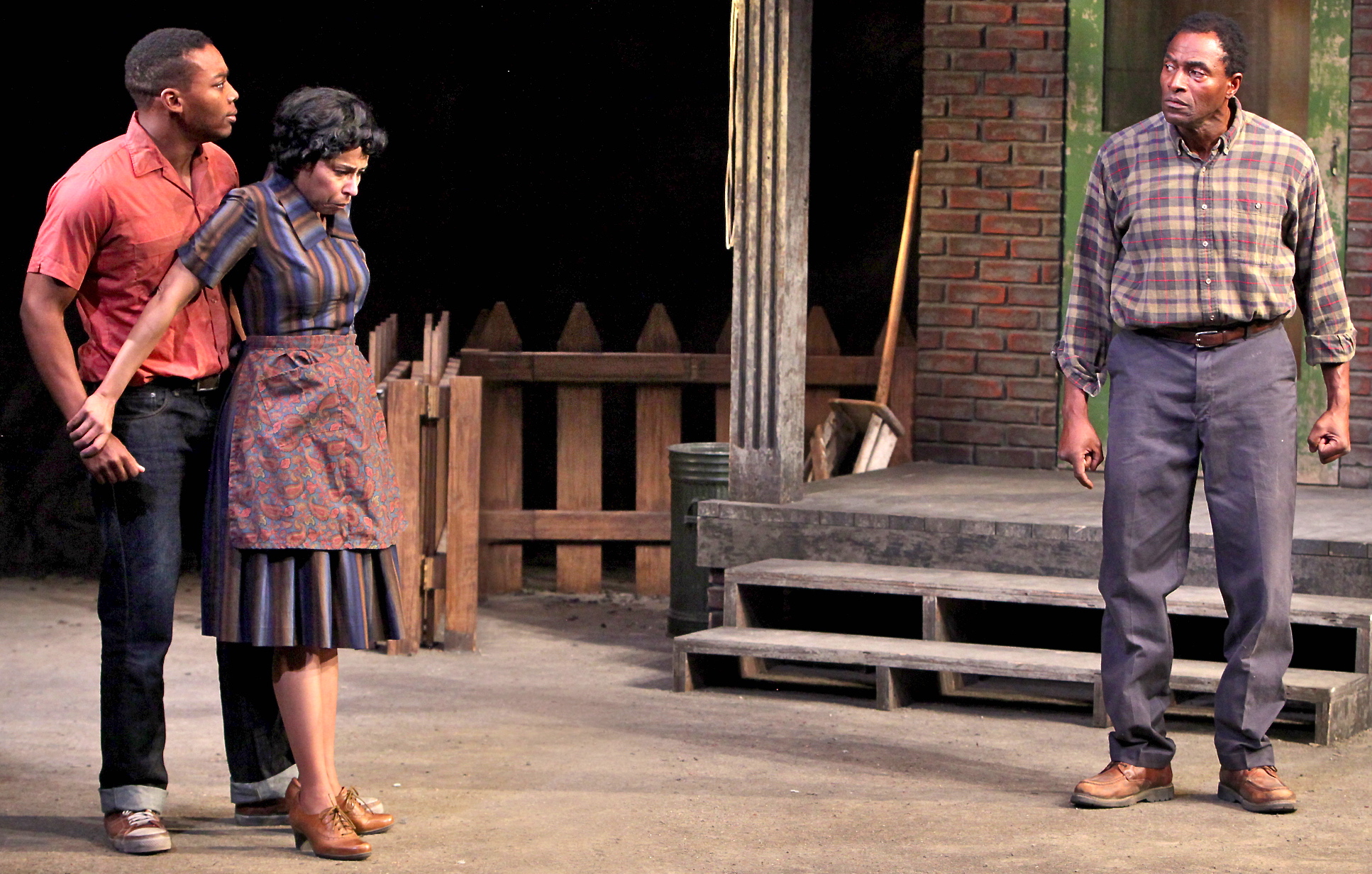
Rose (Margo Hall) protects her son, Cory (Eddie Ray Jackson) from her enraged husband, Troy Maxson (Carl Lumbly), in “Fences.” Photo: Ed Smith.

The focus of “Fences,” Troy Maxon, becomes — like Willie Loman of “Death of a Salesman” — trapped by his own limitations, excuses and misperceptions.

And, like Arthur Miller’s classic everyman creation, this August Wilson character takes too much for granted.

Especially his wife, Rose, and sons Cory and Lyons.

Some of Troy’s beliefs are highly questionable. Such as his not being able to graduate from Negro League baseball to the Majors — even after the color barrier had been broken.

He blames prejudice. Rose more realistically faults his having been too old.

Troy demands Cory not play high school football because he sees it as a futile activity for a black-skinned man — even though his son could win a college scholarship (and a future that might surpass his own).

The frequently confrontational ex-con father, we learn, has been in a lifelong battle again racism, death and the devil.

But that doesn’t excuse his being a hard drinker, a philanderer and a procrastinator — a disheartened 53-year-old who in effect holds his culture liable.

His family, of course, bears the brunt of his anger.

In the powerful Marin Theatre Company revival of “Fences,” the biggest trap for Troy, robustly portrayed by Carl Lumbly, becomes the life he’s settled for: a responsibility-burdened family man, invisible garbage collector earning only $76.20 a week, a raider of his war-injured brother’s checks.

In the process, he manages to disrespect his 18-year wife’s loyalty, and disregard the urgent needs of his younger son.

What he ultimately, and tragically, finds is entombment behind a fence he’s forever building.

The play, set in 1957 Pittsburgh, is a cornucopia of metaphors, starting with a fence that keeps folks in as well as out, ending with baseball lingo that precedes a predictable strikeout.

A quarter of a century ago, I walked out of a pre-Broadway performance of “Fences” in San Francisco before it was done, dismayed by what I found to be stereotypical depictions, an excess of what had yet to be labeled “the n-word,” and an unfortunate emphasis on the failings of males in the black culture.

I couldn’t have been more mistaken.

What I overlooked then was the major historic value of the 90-minute play, the accuracy of Wilson’s reflection of how black life really was. Through this brilliant Mill Valley offering, which coincidentally opened on Jackie Robinson Day, I quickly recognized what I’d missed.

The cast made it easy for me. Each member was superb.

Hours later, my mind can’t let go of the images they created — Margo Hall’s frustrated and flailing Rose, Steven Anthony Jones’ drinking-buddy stint as Jim Bono, and Eddie Ray Jackson’s pained poignancy as Cory.

Adrian Roberts skillfully avoids being cartoonish in the role of Troy’s brother, Gabe, a brain-damaged vet, and Tyee Tilghman effectively fills the role of Cory’s wannabe musician older half-brother.

Superb, too, is a front-yard set by scenic designer J.B. Wilson that features a home facade illustrating economic battles  — plus a makeshift tree-limb batting device that allows Troy, momentarily, to purge his anger.

And I’d be remiss if I didn’t cite sound designer Will McCandless’ work, pinpointing between-scene recordings that parallel the storyline and action (from traditional jazz to an edgy crescendo of dissonance, finishing with mournful, almost anti-climactic blues).

The Pulitzer Prize-winning play, presented in association with the Lorraine Hansberry Theatre, is the second to be produced by the Marin Theatre Company in Wilson’s 10-play Century Cycle (sometimes called the Pittsburgh Cycle, with each component representing a decade of the African-American experience in the United States).

Jasson Minadakis, MTC artistic director, hopes to showcase the remaining eight as well.

Director Derrick Sanders, who’d worked with Wilson before his death in 2005, carefully built this emotionally charged, physical version so the second act moves incredibly swiftly, albeit a bit fitfully.

After a slow-moving but tension-packed first act, one attendee said, “I’m pretty sure this train-wreck isn’t going to end well.”

He was right, of course, if you consider only the play itself.

But for theatergoers, the experience does end well, exceptionally well.

“Fences” plays at the Marin Theatre Company, 397 Miller Ave., Mill Valley, through Sunday, May 11. Performances Tuesdays and Thursdays through Saturdays, 8 p.m.; Wednesdays, 7:30 p.m.; Sundays, 7 p.m.; matinees Saturdays and Sundays, 2 p.m. Tickets: $20 to $53. Information: (415) 388-5208 or marintheatre.org. 

‘Tribes’ is laugh-out-loud yet profound Berkeley Rep play

By Woody Weingarten

Billy (James Caverly) signs for Beth (Anita Carey), his mom, and siblings Daniel (Dan Clegg) and Ruth (Elizabeth Morton) in “Tribes.” Photo courtesy of mellopix.com.

Woody’s [rating:4.5]

Distance can be crucial — ordinarily.

Ergo, as a critic, I try to remain at least one or two steps removed from whatever I’m evaluating.

But I couldn’t help but take “Tribes” — the Berkeley Rep’s comic drama about deafness, identity and love, the need to belong and the need to be heard — personally.

My wife, Nancy Fox, is responsible.

She’s been experiencing a deteriorating hearing loss for eight years, so the play had particular meaning — and discomfort — for her (and, by osmosis, for me).

Emotionally, she related most to Sylvia (sensitively depicted by Nell Geisslinger), a hearing person gradually going deaf.

“She feels different from everyone else, including her boyfriend who’s been deaf from birth,” Nancy observed, “and is distressingly aware of her increasing difficulty. Watching her is painful.”

During intermission, while getting the better fitting headphones instead of the ear buds Berkeley Rep personnel originally had supplied, my wife added, “I’m constantly aware of how my own hearing loss is progressing, having observed it in my mother and grandmother.”

Nancy, a professional pianist, also appreciated Sylvia’s musical predicament.

“When Sylvia was at the keyboard, it underscored the fact that the music she once heard and played was disappearing and eventually would not exist anymore. I can’t imagine — and don’t want to think about — what that would be like for me.”

Nancy was particular touched, too, by the bellowing yet silent outcry of Billy (James Caverly), Sylvia’s boyfriend, when he signs that he’s exhausted from having to say, “‘What?’ ‘What?’ ‘What?’ all the time.”

But she, and I, actually reveled in the aggregate professionalism of the ensemble cast (despite an accent or two slipping from time to time).

In addition to Geisslinger and Caverly, the cast includes the artistry of Paul Whitworth as the burly father, Christopher, self-styled nonconformist who clearly adores that his kids have returned to his home and influence; Dan Clegg as Daniel, Billy’s brother who’s tormented by voices and is terrified Sylvia will whisk Billy away from him; Anita Carey as the mother, Beth, whose nascent novel morphed from being about a therapist to being about a family coming unglued; and Elizabeth Morton as Ruth, the sister who simultaneously craves a boyfriend and a singing career.

British playwright Nina Raine provides one original scene after another, never succumbing to the sentimentality the subject matter might easily prompt.

She’s armed with a full quiver of crisp, deep yet hilarious dialogue — and she uses every arrow in it. She alternates noise-athons and silences as dexterously if she were crafting a symphonic masterwork replete with high highs and low lows.

She focuses on Billy and Sylvia’s relationship, sculpted in bas-relief against a backdrop of an often boisterous, sometimes garrulous, always opinionated family that, as one character claims, is a “hermetically sealed community” — with no one allowed in if they aren’t familiar with Czech composer Antonin Dvořák.

The main tribes of the title are not in dispute: Clearly they’re the deaf community and the ultra-creative clan. That the family is Jewish is scarcely touched upon, a fact that’s arguably ironic because of that group’s tribal heritage.

“Tribes,” an off-Broadway success in 2012, opens with rapid-fire, frequently vulgar banter. It closes with tenderness.

Along the way, it offers as fascinating a glimpse into a world I’m unfamiliar with as the Berkeley Rep did via “Chinglish” in 2012. And, like that one, this commendably uses the device of overhead projections of dialogue.

I’m sure director Jonathan Moscone, best known for his longtime role as artistic director of California Shakespeare Theater, was keenly aware that one out of six Americans has some form of hearing loss when he took the assignment.

But he readily joined with dramatist Raine to make sure both hearing and hard-of-hearing theatergoers get a laugh-out-loud yet profoundly moving theatrical experience.

Tribes” plays at the Berkeley Repertory’s Roda Theatre, 2015 Addison St., Berkeley, through May 18. Night performances, Tuesdays, Thursdays, Fridays and Saturdays, 8 p.m.; Wednesdays and Sundays, 7 p.m.; matinees, Saturdays and Sundays, 2 p.m. Tickets: $14.50 to $99, subject to change, (510) 647-2949 or www.berkeleyrep.org.

Critic finds merit, power in ‘Fences’ the 2nd time around

By Woody Weingarten

Woody’s [rating:4.5]

Rose (Margo Hall) protects her son, Cory (Eddie Ray Jackson) from her enraged husband, Troy Maxson (Carl Lumbly), in “Fences.” Photo: Ed Smith.

The focus of “Fences,” Troy Maxon, becomes — like Willie Loman of “Death of a Salesman” — trapped by his own limitations, excuses and misperceptions.

And, like Arthur Miller’s classic everyman creation, this August Wilson character takes too much for granted.

Especially his wife, Rose, and sons Cory and Lyons.

Some of Troy’s beliefs are highly questionable. Such as his not being able to graduate from Negro League baseball to the Majors — even after the color barrier had been broken.

He blames prejudice. Rose more realistically faults his having been too old.

Troy demands Cory not play high school football because he sees it as a futile activity for a black-skinned man — even though his son could win a college scholarship (and a future that might surpass his own).

The frequently confrontational ex-con father, we learn, has been in a lifelong battle again racism, death and the devil.

But that doesn’t excuse his being a hard drinker, a philanderer and a procrastinator — a disheartened 53-year-old who in effect holds his culture liable.

His family, of course, bears the brunt of his anger.

In the powerful Marin Theatre Company revival of “Fences,” the biggest trap for Troy, robustly portrayed by Carl Lumbly, becomes the life he’s settled for: a responsibility-burdened family man, invisible garbage collector earning only $76.20 a week, a raider of his war-injured brother’s checks.

In the process, he manages to disrespect his 18-year wife’s loyalty, and disregard the urgent needs of his younger son.

What he ultimately, and tragically, finds is entombment behind a fence he’s forever building.

The play, set in 1957 Pittsburgh, is a cornucopia of metaphors, starting with a fence that keeps folks in as well as out, ending with baseball lingo that precedes a predictable strikeout.

A quarter of a century ago, I walked out of a pre-Broadway performance of “Fences” in San Francisco before it was done, dismayed by what I found to be stereotypical depictions, an excess of what had yet to be labeled “the n-word,” and an unfortunate emphasis on the failings of males in the black culture.

I couldn’t have been more mistaken.

What I overlooked then was the major historic value of the 90-minute play, the accuracy of Wilson’s reflection of how black life really was. Through this brilliant Mill Valley offering, which coincidentally opened on Jackie Robinson Day, I quickly recognized what I’d missed.

The cast made it easy for me. Each member was superb.

Hours later, my mind can’t let go of the images they created — Margo Hall’s frustrated and flailing Rose, Steven Anthony Jones’ drinking-buddy stint as Jim Bono, and Eddie Ray Jackson’s pained poignancy as Cory.

Adrian Roberts skillfully avoids being cartoonish in the role of Troy’s brother, Gabe, a brain-damaged vet, and Tyee Tilghman effectively fills the role of Cory’s wannabe musician older half-brother.

Superb, too, is a front-yard set by scenic designer J.B. Wilson that features a home facade illustrating economic battles  — plus a makeshift tree-limb batting device that allows Troy, momentarily, to purge his anger.

And I’d be remiss if I didn’t cite sound designer Will McCandless’ work, pinpointing between-scene recordings that parallel the storyline and action (from traditional jazz to an edgy crescendo of dissonance, finishing with mournful, almost anti-climactic blues).

The Pulitzer Prize-winning play, presented in association with the Lorraine Hansberry Theatre, is the second to be produced by the Marin Theatre Company in Wilson’s 10-play Century Cycle (sometimes called the Pittsburgh Cycle, with each component representing a decade of the African-American experience in the United States).

Jasson Minadakis, MTC artistic director, hopes to showcase the remaining eight as well.

Director Derrick Sanders, who’d worked with Wilson before his death in 2005, carefully built this emotionally charged, physical version so the second act moves incredibly swiftly, albeit a bit fitfully.

After a slow-moving but tension-packed first act, one attendee said, “I’m pretty sure this train-wreck isn’t going to end well.”

He was right, of course, if you consider only the play itself.

But for theatergoers, the experience does end well, exceptionally well.

“Fences” plays at the Marin Theatre Company, 397 Miller Ave., Mill Valley, through Sunday, May 11. Performances Tuesdays and Thursdays through Saturdays, 8 p.m.; Wednesdays, 7:30 p.m.; Sundays, 7 p.m.; matinees Saturdays and Sundays, 2 p.m. Tickets: $20 to $53. Information: (415) 388-5208 or marintheatre.org. 

THE SUIT with an international cast is riveting at A.C.T.

By Kedar K. Adour

Matilda (Nanhlanhla Kheswa) in the arms of her loving and doting husband Philemon (Ivanno Jeremiah)

THE SUIT: Drama. Adapted by Peter Brook, Marie-Hélène Estienne and Franck Krawczyk from the story and play by Can Themba, Mothobi Mutloatse and Barney Simon. American Conservatory Theater, 415 Geary St., San Francisco. (415) 749-2228. www.act-sf.org. Through May 18, 2014

THE SUIT with an international cast is riveting at A.C.T. [rating:5] (5 of 5 Stars)

It was 30 years ago that San Francisco audiences were treated to a magnificent spectacular production of A Midsummer’s Night Dream by the Royal Shakespeare Company directed by the brilliant Peter Brooks. It is a pity we had to wait so long to see the culmination of his latest opus The Suit that has been created in alliance with a talented aggregate of adapters, musicians and actors. For this 75 minute production the term spectacular is replaced by simplistic but is equally as brilliant and magnificent as Dream.

The simple setting is populated with colorful unadorned wooden chairs, metal-pipe clothes racks and a table that are moved about to create the illusion of interior/exterior buildings, bus stops, train interiors etc and a bedroom. It is the bedroom that takes center stage and is integral to the storyline. Most of the action is in pantomime without props thus allowing the action to flow smoothly.

With soft classical music playing by the on-stage trio, The Narrator Maphikela (Jordan Barbour)  sets the scene in Sophiatown, South Africa during the Apartheid-era. We then meet the young beautiful Matilda (Nanhlanhla Kheswa) sleeping in the arms of her loving and doting husband Philemon (Ivanno Jeremiah). He quietly leaves the bed to serve her breakfast in that fateful bed before he goes to his job as a secretary.

On the way to work he meets Maphikela who reluctantly tells Philemon that a young man has been visiting his Matilda every morning for the past three months. Unbelieving Philemon takes the bus back to his home and chases the young man dressed only in his briefs out the window leaving his suit behind. Surprisingly Philemon’s rage is subverted to a diabolical form of revenge, ordering her to always treat the suit as an honored guest that must be fed and carried with her wherever she/they go. He then goes to a shebeen (a local illegal drinking place) to drink away his sorrow/anger.

The show is filled with music and song that are extremely expressive of inner and external turmoil. All the singing, with one exception (Jordan Barbour sings the foreboding lynching song “Strange Fruit.”), is by Matilda and Nanhlanhla Kheswa is a trained singer with a beautiful expressive voice. When she performs the songs she steps to the stage apron and sings to the enraptured audience. The first song is “Forbidden Games”.

Her punishment continues and in desperation she joins the local Anglican Mission and bonds with the married women. This time she sings the haunting “Ntylio Nytlio.”  She even invites a few friends to come to their home the following Sunday and spends the week preparing to receive them. When they arrive, along with four members of the audience brought up on the stage to share the party,  she is encouraged to sing the haunting south African ballad “Malaika.” At the end of the song Philemon brings out the dreaded “guest of honor” the Suit.

Devastated Matilda’s begging to stop the punishment goes unheeded and Philemon goes off with Maphikela to the shebeen but when he returns his lovely bride is dead.  Ivanno Jeremiah is absolutely superb, keeping complete control while seething inside and when he does raise his voice, only once, all the internal fury spills out. Jordan Barbour is the one who brings the background story of the Apartheid-era forward never letting us forget that the personal tragic happenings are playing out on a tragic political stage.

Franck Krawczyk’s beautiful score perfectly reflects the moods of the characters and the setting. His trio of Arthur Astier, Mark Christine, and Mark Kavuma not only play a plethora of instruments but also step forward to play both male and female characters adding humor to the evening.

Cast: Jordan Barbour, Ivanno Jeremiah, Nohlanhla Kheswa

Production: Scenic/costume design by Oria Puppo; Lighting design by

Philippe Vialatte; Assistant Director Rikki Henry;

Direction, Adaptation, and Music by Peter Brook, Marie-HehIene Estienne, and Franck Krawczyk

Musicians: Guitar Arthur Astier; Piano Mark Christine; Trumpet  Mark Kavuma.

Kedar K. Adour, MD

Courtesy of www.theatreworldinternetmagazine.com