Category

Woody Weingarten

Woody
Weingarten

‘Incredibly good’ classical-jazz pianist will solo on campus

By Woody Weingarten

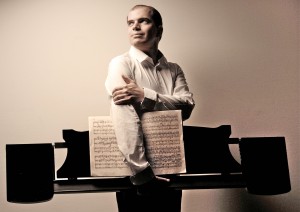
Pianist Kirill Gerstein literally carries a tune — and a piano music stand. Photo: Marco Borggreve.


OK, I’ll cop to it — I’ve been living in a constricted mind-tunnel of my own making.

Not that strange for a “retiree,” of course.

Many men just beyond my state of geezerhood have no time for anything fresh because they’re too busy shuffling off to a lab where some kid who can’t shave yet takes blood, or too busy sipping tea laced with aspartame with old ladies thrilled that somebody with different plumbing’s still breathing and will keep ‘em company, or too busy hoping they can dribble to an easy layup without inducing a stroke.

I have a radically different agenda, naturally, and it typically involves situating my butt in front of a computer.

Meeting deadline after deadline after deadline.

So I not frequently get overloaded writing reviews, concocting columns and desperately seeking not Susan or Madonna or Miley Cyrus but someone who’ll publish my book manuscript.

Truth is, when it comes to the entertainment world, I don’t recognize the names of three of every thousand performers anymore.

Until a week ago, to be honest, I’d never heard of pianist Kirill Gerstein.

But then I was urged to promote the pianist’s 8 p.m. June 5 concert with the San Francisco Symphony at the Green Music Center on the Sonoma State University campus — in advance.

So I am.

Why? Because I listened to some of his stuff on YouTube, and it’s incredibly good (more about that later).

The Sonoma concert will take place in the state-of-the-art Weill Hall, which, according to the symphony’s website, “boasts outstanding acoustics, artistic wood interiors, and stunning wine country views.”

Sounds good to me.

The 35-year-old Russian-born Gerstein will be the soloist for Beethoven’s “Piano Concerto No. 2,” with frequent San Francisco guest conductor Charles Dutoit, who’s the main man for the London Royal Philharmonic, leading the orchestra.

Shostakovich’s “Symphony No. 10,” composed after Stalin’s death in 1953, fills out the bill.

For those who prefer a more urban setting, three duplicative concerts will take place at Davies Symphony Hall in San Francisco at 8 p.m. June 4, 6 and 7.

Who’s this guy I’m just beginning to know?

Gerstein at 14 became the youngest student at Boston’s Berkelee College of Music, where he was a jazz prodigy. His classical interpretations, indeed, display moments when that energetic training shines through.

His newest album, “Imaginary Pictures: Mussorgsky, Schumann,” I’m told, will be released around the time of the concerts.

As for the YouTube excerpts, though he’s mostly in the background on “Summertime” as jazz stalwart Storm Large makes the tune her own, you certainly know Gerstein’s there.

And he’s utterly brilliant on “Ophelia’s Last Dance,” an introspective mash-up of classical and jazz, a nine-minute exercise composed specifically for him that blends tomorrow with yesterday and today — and adds a touch or two of humor.

Other YouTube pieces that gave me a glimpse into his excellence include the first movement of Rachmaninoff’s “3rd Piano Concert” and the original 1924 band version of George Gershwin’s “Rhapsody in Blue.”

Winners all.

Bob Dylan knew it decades before I did: The times they are a-changin’. And that’s a good thing.

Tickets to the June 4-7 San Francisco Symphony concerts with Kirill Gerstein run from $15 to $156. Information: and (866) 955-6040 and gmc.sonoma.edu, or www.sfsymphony.org and (415) 864-6000.

Big Marcus Shelby band uniquely weds jazz to Shakespeare

By Woody Weingarten

 Woody’s [rating:3.5]

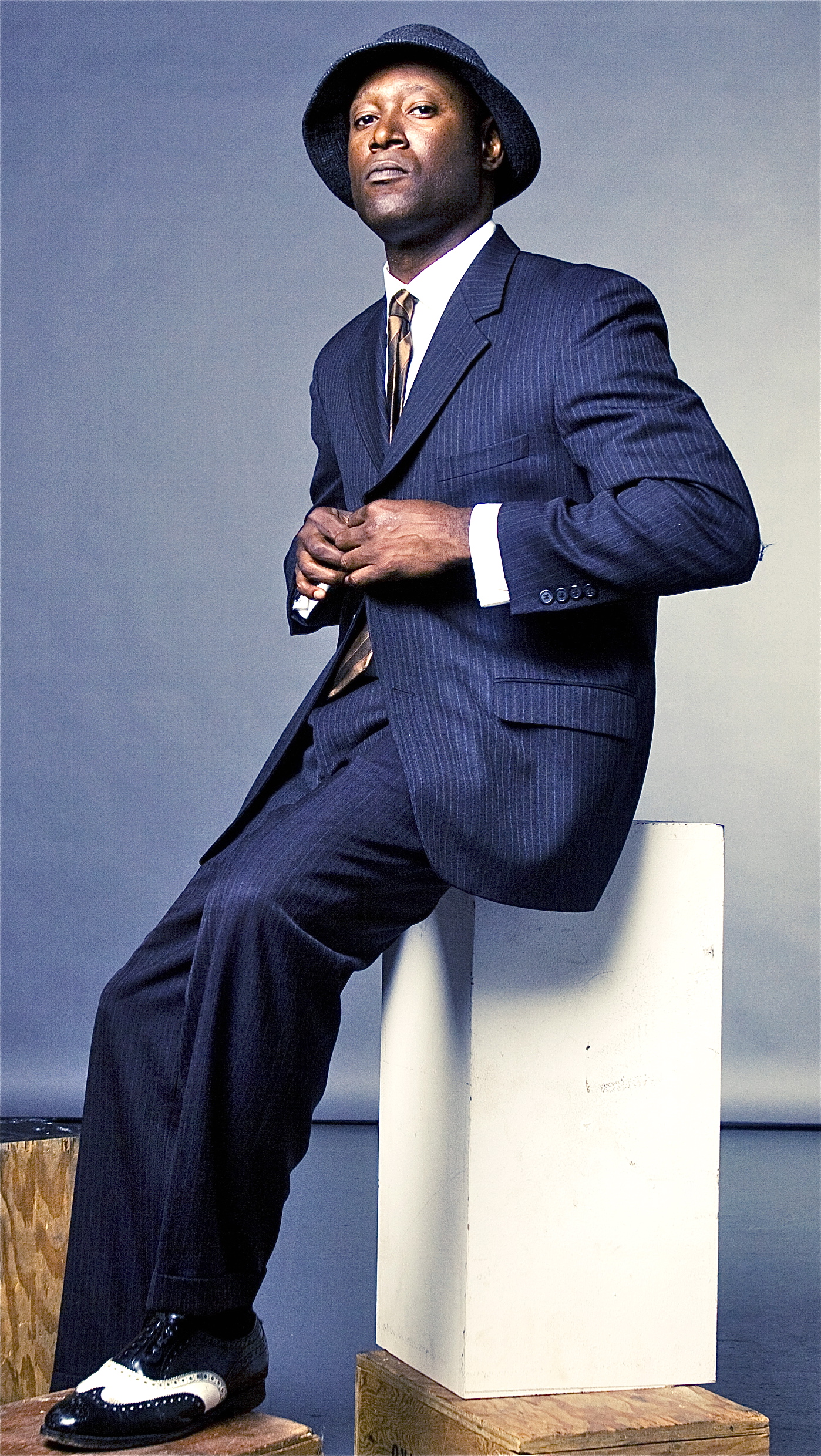
Marcus Shelby skipped the hat and wore less conspicuous shoes for his Cal Performances tribute to Duke Ellington. Courtesy photo.

To be inventive or not to be inventive, that is the question.

When it’s bandleader-bassist Marcus Shelby doing the asking (as well as the innovating), the answer is a resounding “yes.”

In a Cal Performances concert at Zellerbach Hall in Berkeley celebrating Duke Ellington’s 115th birthday, Shelby flaunted his calculated risk of failing — by juxtaposing swinging big-band jazz and Shakespeare.

He didn’t fail.

Instead, he and his 15-member, mostly-brass ensemble evoked toe tapping, applause, whistling, cheers and foot stomping with each section of the obscure but stimulating “Such Sweet Thunder.”

The suite had been popularized by the Duke on vinyl but written by his longtime collaborator, Billy Strayhorn.

Shelby’s sidemen brought out each segment’s uniqueness, helping me see how Strayhorn was in effect trying to cover the entire jazz landscape in a single symphonic work.

And each segment’s pithiness left me wanting more.

Because the music was based on the plays and sonnets of the Bard, it was a big deal but not a big surprise that Shelby integrated soliloquys by five actors from Cal Shakes, more formally known as the California Shakespeare Theater.

While all the spoken-word interludes were top-notch, I found some connections to the music tangential at best and, thereby, hard to distinguish — even given information that “the essence” of Shakespeare’s material was being emphasized rather than any one scene or character.

I did find a few links clear-cut, though.

A Juliet balcony scene obviously bonded with a ballad, “The Star-Crossed Lovers,” and a bluesy waltz-time “Lady Mac” danced a direct path to “Lady Macbeth.”

“Sonnet to Hank Cinq” was, of course, a hip reference to Henry V, and “Sonnet for Sister Kate” might have had a little to do with Willie the Shakes’ “Taming of the Shrew.”

In my mind’s eye, by evening’s end I’d labeled the experiment fascinating and a success.

Even though I’d have liked the music alone.

The pre-intermission set of the concert, which also marked the 15th year of the Shelby group and the 40th anniversary of Ellington’s death, consisted of more familiar melodies.

It was dubbed “The Legacy of Duke Ellington: 50 Years of Swing!”

And swing it did.

For me, the highlight was an unbilled rendition of “Take the ‘A’ Train,” but I was also delighted by “Perdido,” the show’s bouncy opener; “C Jam Blues,” its rousing closer; and “Don’t Get Around Much Anymore” and “Hit Me With a Hot Note” in the middle.

The San Francisco-based Shelby, who took only one solo, happily spotlighted other musicians from his troupe as well as his guest stars.

Into the latter category fell scat vocalist Faye Carol (the high-strutting, scat-singing “Queen Bee” who’s worked with Shelby for 20 years), violinist Matthew Szemela (who occasionally kept time with both feet at the same time), sax vet Jules Broussard (whom the bandleader labeled one of his mentors) and trumpeter Joel Behrman.

Perfection was elusive, however.

I couldn’t appreciate a trumpet solo despite Shelby’s explanation that some of its notes were un-trumpet-like.

And I cringed when Carol grew raspy several times on “In My Solitude.”

Duke Ellington composed almost 1,000 pieces of music. The concert only skimmed the proverbial surface. But it did provide a glimpse into the man’s genius — through an exciting evening of standard and not-at-all-standard jazz.

In case you missed the Shelby orchestra, Cal Performances offers other excellent jazz choices. Try, for example, vocalist Mavis Staples on Oct. 30, Irvin Mayfield and the New Orleans Jazz Orchestra on Nov. 16, the Peter Nero Trio (playing Gershwin compositions) on Feb. 8, Cassandra Wilson (singing Billie Holiday tunes), or pianists Chick Corea and Herbie Hancock on March 19. Information: www.calperfs.berkeley.edu/buy/ or : (510) 642-9988.

Potent A.C.T. musical drama, ‘The Suit,’ stirs emotions

By Woody Weingarten

Woody’s [rating:4]

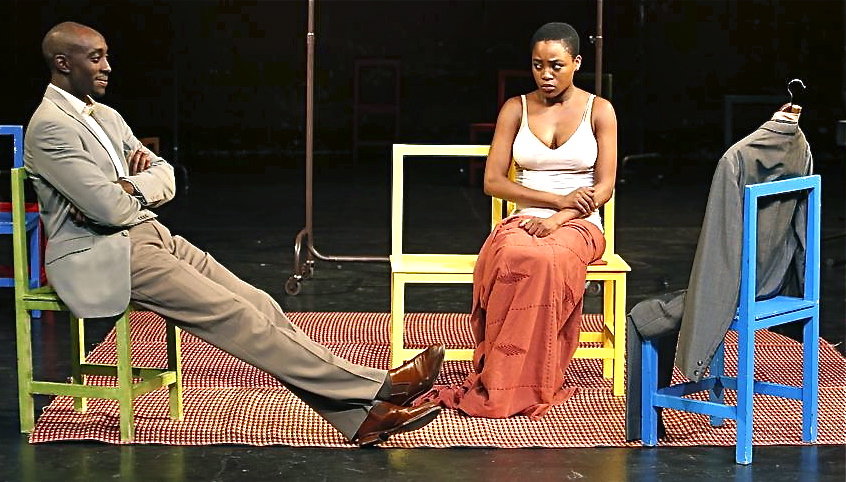
Extraordinary actors Nonhlanhla Kheswa (right) and Ivanno Jeremiah and an ordinary suit star in “The Suit.” Photo by Pascal Victor/ArtComArt.Photo by Pascal Victor/ArtComArt.

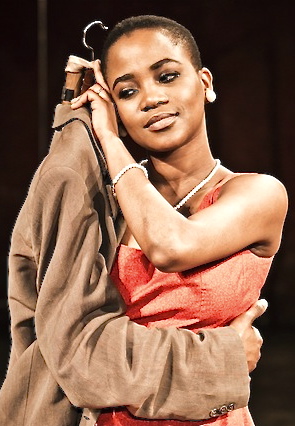
Nonhlanhla Khesa effectively uses her arm to romantically caress herself, puppet-like in “The Suit.” Photo by Johan Persson.

Racism, as depicted in the apartheid-fouled Johannesburg of “The Suit,” is downright ugly.

And brutal.

Palpably tragic.

Worst of all, it’s reflective of today’s racism in an America that pretends it’s integrated when its all-too solid walls of bigotry remain intact.

It’s a fascinating coincidence that “The Suit” opened at San Francisco’s A.C.T. Theatre only one day after L.A. Clippers’ owner Donald Sterling was fined $2.5 million and barred for life from the National Basketball Association for overtly anti-African American statements.

Though peppered with multiple instances of levity, “The Suit” is a solemn theatrical time bomb intentionally ignited by Peter Brook, an 89-year-old British director.

Brook clearly stages the kind of in-your-face prejudice I’ve always found abrasive and offensive.

Adapted from a Can Themba short story, the 75-minute drama thrusts into the foreground a husband who, after discovering his wife in bed with a lover, insists she take with her wherever she goes the suit her fleeing sex partner left behind.

It becomes, essentially, a scarlet letter, the traditional sign of sin.

Over all, the play exudes a surreal, fable-like quality, abetted by a Dali-esque set consisting of unadorned (yet colorful) wooden chairs and bare clothing racks.

But the extraordinary three-actor cast seamlessly integrates poignancy, music and pantomime.

Nonhlanhla Kheswa, Johannesburg native and veteran of Broadway’s “The Lion King,” is outstanding as the adulterous Matilda. Her body language and elegiac voice unerringly convey how she wears her punishment.

Ugandan-born Ivanno Jeremiah adeptly plays her humiliated, vengeful spouse, Philomen, middle-class wage-slave who’s suffered daily abuse from a system that downgraded a whole black population to second-class status.

New Jersey-born Jordan Barbour skillfully fills in the gaps as he jumps from role to role.

Musical interludes range from traditional African melodies to timeless American jazz pieces such as “Feelin’ Good,” the Nina Simone standard, and the painful Billie Holiday classic about lynching, “Strange Fruit.”

To prevent my review from being disingenuous, I must mention that the touring production from Théâtre des Bouffes du Nord is imperfect.

Even heavy-handed sometimes.

As when the fourth wall is broken by actors who provide the audience with invisible joints, or when folks are invited to represent white participants onstage at a shebeen, a speakeasy-like party.

Additionally, Brook, whose “The Empty Space” has been a theatrical bible for generations, has paced the play so deliberately I twice felt compelled to check my watch.

None of that, however, undercuts the emotional impact of the show.

Besides, “The Suit” contains numerous magic moments.

When, for instance, Matilda puts one arm into the empty outfit and, puppet-like, achingly caresses herself as if it were still being worn by her absent lover. When she sings, in Swahili, an upbeat song that’s crushed by Philomen with only a few words. When she foreshadows crucial action by dedicating a melancholy tune to “each and everyone who cannot get what they want in life.”

Or when the actors pantomime being on a rolling commuter train.

When trumpeter Mark Vavuma wrings every possible emotion from his muted horn. Or when Mark Christine underscores the play’s tragic ménage à trois via a soulful Bach “St. Matthew Passion” on a solo compact synthesizer.

“The Suit” is set in the 1950s in Sophiatown, an overcrowded black appendage of Johannesburg that actually was bulldozed.

With more than 65,000 blacks forcibly removed.

I, frankly, was grateful the stream of real 1950s violence was referenced but not shown onstage. It was surely enough just to envision each of a black man’s fingers being bloodied, and his being shot 34 times.

The first-impression simplicity of “The Suit” is purposefully deceptive, making its vivid ending even more powerful, more numbing.

The opening night audience, in fact, seemed so stunned it took it a few seconds to rise for a well-earned standing ovation — and then it did so almost in slow motion.

“The Suit” plays at the American Conservatory Theater, 415 Geary St., San Francisco, through May 18. Performances Wednesdays through Saturdays, 8 p.m.; Tuesdays, 7 or 8 p.m.; matinees, Wednesdays, Saturdays and Sundays, 2 p.m. Tickets: $20 to $120. Information: (415) 749-2228 or www.act-sf.org.

‘Tribes’ is laugh-out-loud yet profound Berkeley Rep play

By Woody Weingarten

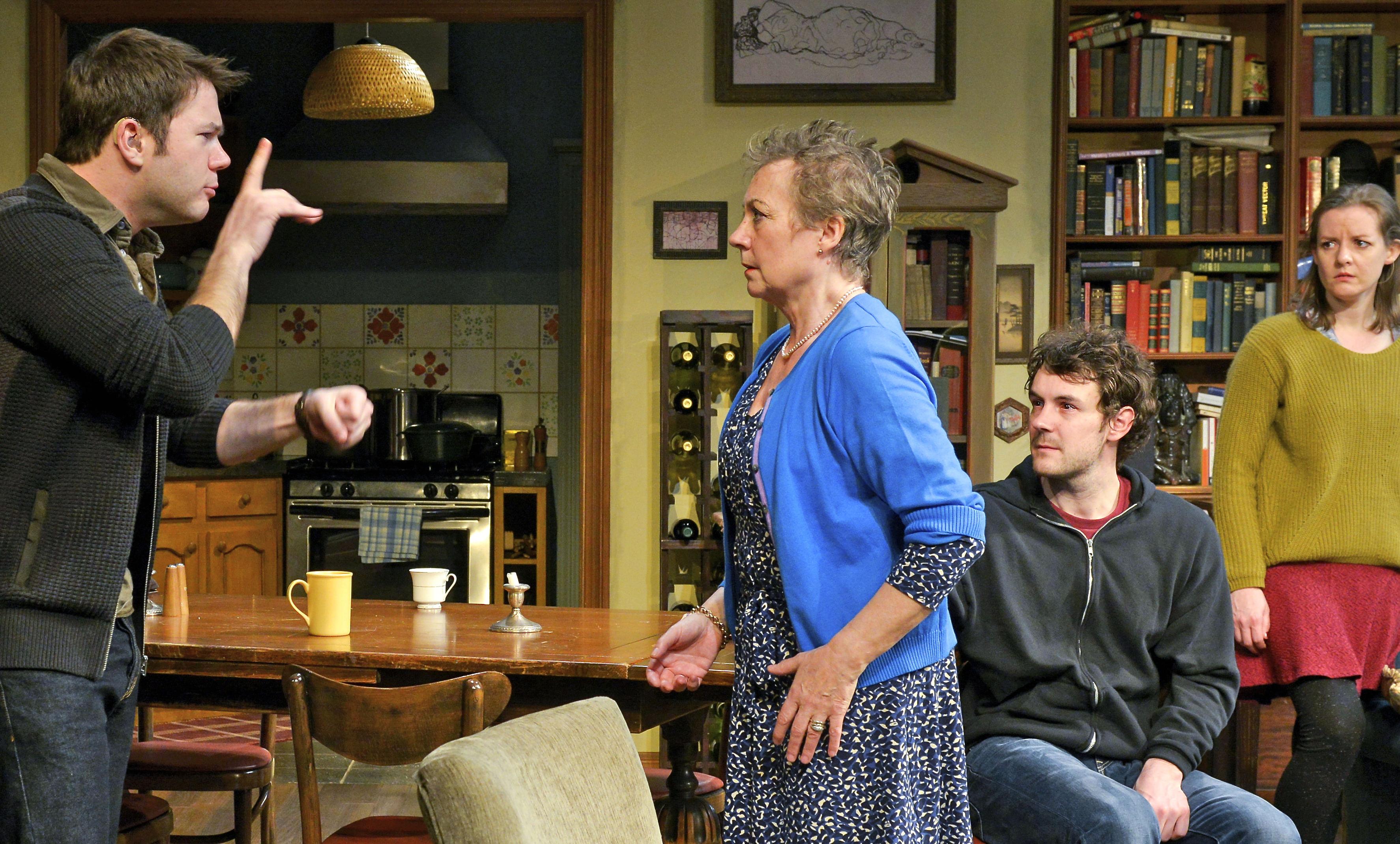
Billy (James Caverly) signs for Beth (Anita Carey), his mom, and siblings Daniel (Dan Clegg) and Ruth (Elizabeth Morton) in “Tribes.” Photo courtesy of mellopix.com.

Woody’s [rating:4.5]

Distance can be crucial — ordinarily.

Ergo, as a critic, I try to remain at least one or two steps removed from whatever I’m evaluating.

But I couldn’t help but take “Tribes” — the Berkeley Rep’s comic drama about deafness, identity and love, the need to belong and the need to be heard — personally.

My wife, Nancy Fox, is responsible.

She’s been experiencing a deteriorating hearing loss for eight years, so the play had particular meaning — and discomfort — for her (and, by osmosis, for me).

Emotionally, she related most to Sylvia (sensitively depicted by Nell Geisslinger), a hearing person gradually going deaf.

“She feels different from everyone else, including her boyfriend who’s been deaf from birth,” Nancy observed, “and is distressingly aware of her increasing difficulty. Watching her is painful.”

During intermission, while getting the better fitting headphones instead of the ear buds Berkeley Rep personnel originally had supplied, my wife added, “I’m constantly aware of how my own hearing loss is progressing, having observed it in my mother and grandmother.”

Nancy, a professional pianist, also appreciated Sylvia’s musical predicament.

“When Sylvia was at the keyboard, it underscored the fact that the music she once heard and played was disappearing and eventually would not exist anymore. I can’t imagine — and don’t want to think about — what that would be like for me.”

Nancy was particular touched, too, by the bellowing yet silent outcry of Billy (James Caverly), Sylvia’s boyfriend, when he signs that he’s exhausted from having to say, “‘What?’ ‘What?’ ‘What?’ all the time.”

But she, and I, actually reveled in the aggregate professionalism of the ensemble cast (despite an accent or two slipping from time to time).

In addition to Geisslinger and Caverly, the cast includes the artistry of Paul Whitworth as the burly father, Christopher, self-styled nonconformist who clearly adores that his kids have returned to his home and influence; Dan Clegg as Daniel, Billy’s brother who’s tormented by voices and is terrified Sylvia will whisk Billy away from him; Anita Carey as the mother, Beth, whose nascent novel morphed from being about a therapist to being about a family coming unglued; and Elizabeth Morton as Ruth, the sister who simultaneously craves a boyfriend and a singing career.

British playwright Nina Raine provides one original scene after another, never succumbing to the sentimentality the subject matter might easily prompt.

She’s armed with a full quiver of crisp, deep yet hilarious dialogue — and she uses every arrow in it. She alternates noise-athons and silences as dexterously if she were crafting a symphonic masterwork replete with high highs and low lows.

She focuses on Billy and Sylvia’s relationship, sculpted in bas-relief against a backdrop of an often boisterous, sometimes garrulous, always opinionated family that, as one character claims, is a “hermetically sealed community” — with no one allowed in if they aren’t familiar with Czech composer Antonin Dvořák.

The main tribes of the title are not in dispute: Clearly they’re the deaf community and the ultra-creative clan. That the family is Jewish is scarcely touched upon, a fact that’s arguably ironic because of that group’s tribal heritage.

“Tribes,” an off-Broadway success in 2012, opens with rapid-fire, frequently vulgar banter. It closes with tenderness.

Along the way, it offers as fascinating a glimpse into a world I’m unfamiliar with as the Berkeley Rep did via “Chinglish” in 2012. And, like that one, this commendably uses the device of overhead projections of dialogue.

I’m sure director Jonathan Moscone, best known for his longtime role as artistic director of California Shakespeare Theater, was keenly aware that one out of six Americans has some form of hearing loss when he took the assignment.

But he readily joined with dramatist Raine to make sure both hearing and hard-of-hearing theatergoers get a laugh-out-loud yet profoundly moving theatrical experience.

Tribes” plays at the Berkeley Repertory’s Roda Theatre, 2015 Addison St., Berkeley, through May 18. Night performances, Tuesdays, Thursdays, Fridays and Saturdays, 8 p.m.; Wednesdays and Sundays, 7 p.m.; matinees, Saturdays and Sundays, 2 p.m. Tickets: $14.50 to $99, subject to change, (510) 647-2949 or www.berkeleyrep.org.

Critic finds merit, power in ‘Fences’ the 2nd time around

By Woody Weingarten

Woody’s [rating:4.5]

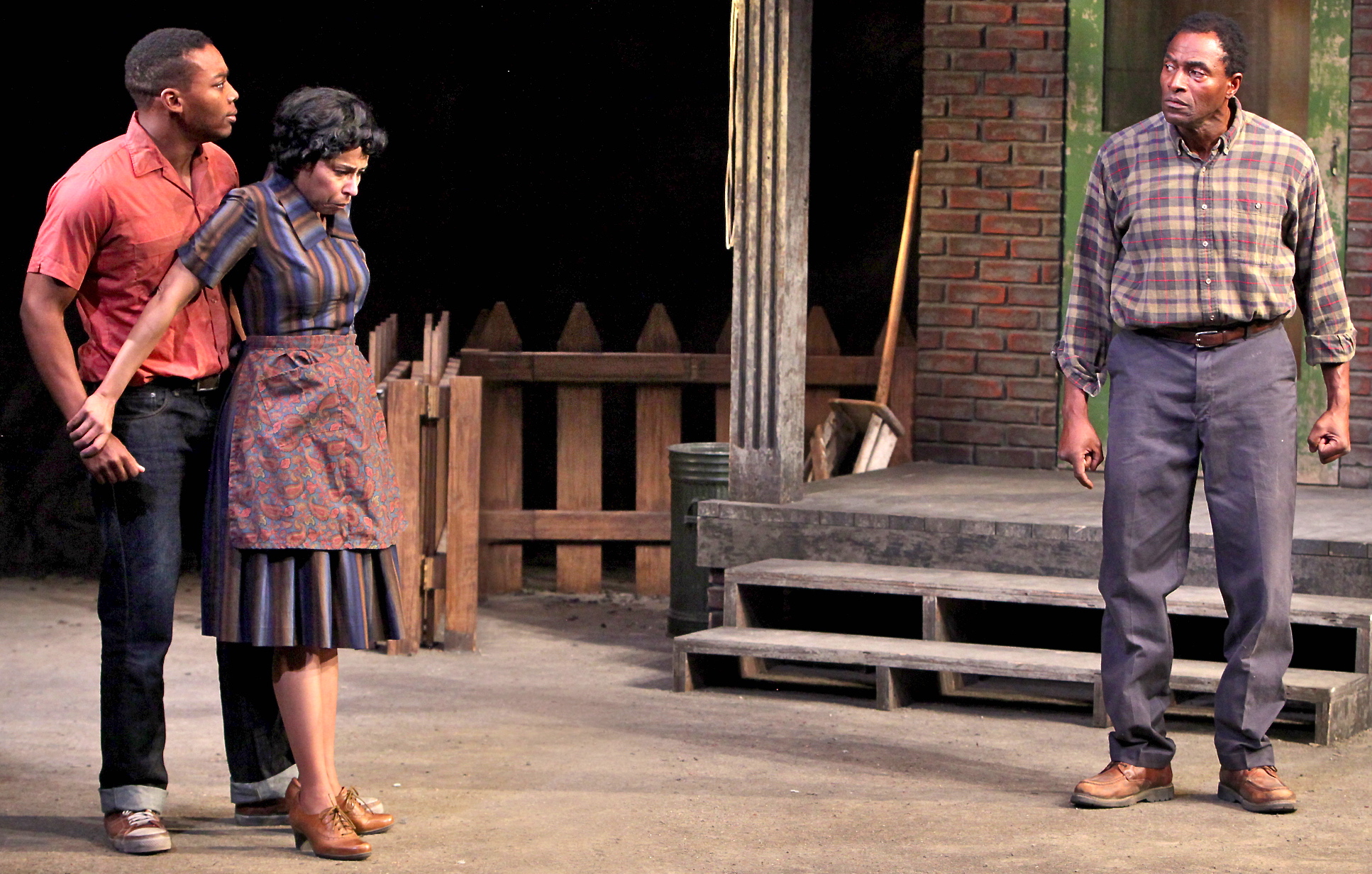
Rose (Margo Hall) protects her son, Cory (Eddie Ray Jackson) from her enraged husband, Troy Maxson (Carl Lumbly), in “Fences.” Photo: Ed Smith.

The focus of “Fences,” Troy Maxon, becomes — like Willie Loman of “Death of a Salesman” — trapped by his own limitations, excuses and misperceptions.

And, like Arthur Miller’s classic everyman creation, this August Wilson character takes too much for granted.

Especially his wife, Rose, and sons Cory and Lyons.

Some of Troy’s beliefs are highly questionable. Such as his not being able to graduate from Negro League baseball to the Majors — even after the color barrier had been broken.

He blames prejudice. Rose more realistically faults his having been too old.

Troy demands Cory not play high school football because he sees it as a futile activity for a black-skinned man — even though his son could win a college scholarship (and a future that might surpass his own).

The frequently confrontational ex-con father, we learn, has been in a lifelong battle again racism, death and the devil.

But that doesn’t excuse his being a hard drinker, a philanderer and a procrastinator — a disheartened 53-year-old who in effect holds his culture liable.

His family, of course, bears the brunt of his anger.

In the powerful Marin Theatre Company revival of “Fences,” the biggest trap for Troy, robustly portrayed by Carl Lumbly, becomes the life he’s settled for: a responsibility-burdened family man, invisible garbage collector earning only $76.20 a week, a raider of his war-injured brother’s checks.

In the process, he manages to disrespect his 18-year wife’s loyalty, and disregard the urgent needs of his younger son.

What he ultimately, and tragically, finds is entombment behind a fence he’s forever building.

The play, set in 1957 Pittsburgh, is a cornucopia of metaphors, starting with a fence that keeps folks in as well as out, ending with baseball lingo that precedes a predictable strikeout.

A quarter of a century ago, I walked out of a pre-Broadway performance of “Fences” in San Francisco before it was done, dismayed by what I found to be stereotypical depictions, an excess of what had yet to be labeled “the n-word,” and an unfortunate emphasis on the failings of males in the black culture.

I couldn’t have been more mistaken.

What I overlooked then was the major historic value of the 90-minute play, the accuracy of Wilson’s reflection of how black life really was. Through this brilliant Mill Valley offering, which coincidentally opened on Jackie Robinson Day, I quickly recognized what I’d missed.

The cast made it easy for me. Each member was superb.

Hours later, my mind can’t let go of the images they created — Margo Hall’s frustrated and flailing Rose, Steven Anthony Jones’ drinking-buddy stint as Jim Bono, and Eddie Ray Jackson’s pained poignancy as Cory.

Adrian Roberts skillfully avoids being cartoonish in the role of Troy’s brother, Gabe, a brain-damaged vet, and Tyee Tilghman effectively fills the role of Cory’s wannabe musician older half-brother.

Superb, too, is a front-yard set by scenic designer J.B. Wilson that features a home facade illustrating economic battles  — plus a makeshift tree-limb batting device that allows Troy, momentarily, to purge his anger.

And I’d be remiss if I didn’t cite sound designer Will McCandless’ work, pinpointing between-scene recordings that parallel the storyline and action (from traditional jazz to an edgy crescendo of dissonance, finishing with mournful, almost anti-climactic blues).

The Pulitzer Prize-winning play, presented in association with the Lorraine Hansberry Theatre, is the second to be produced by the Marin Theatre Company in Wilson’s 10-play Century Cycle (sometimes called the Pittsburgh Cycle, with each component representing a decade of the African-American experience in the United States).

Jasson Minadakis, MTC artistic director, hopes to showcase the remaining eight as well.

Director Derrick Sanders, who’d worked with Wilson before his death in 2005, carefully built this emotionally charged, physical version so the second act moves incredibly swiftly, albeit a bit fitfully.

After a slow-moving but tension-packed first act, one attendee said, “I’m pretty sure this train-wreck isn’t going to end well.”

He was right, of course, if you consider only the play itself.

But for theatergoers, the experience does end well, exceptionally well.

“Fences” plays at the Marin Theatre Company, 397 Miller Ave., Mill Valley, through Sunday, May 11. Performances Tuesdays and Thursdays through Saturdays, 8 p.m.; Wednesdays, 7:30 p.m.; Sundays, 7 p.m.; matinees Saturdays and Sundays, 2 p.m. Tickets: $20 to $53. Information: (415) 388-5208 or marintheatre.org.