Category

Woody Weingarten

Woody
Weingarten

‘Stuck Elevator’ is astute musical look at immigration

By Woody Weingarten

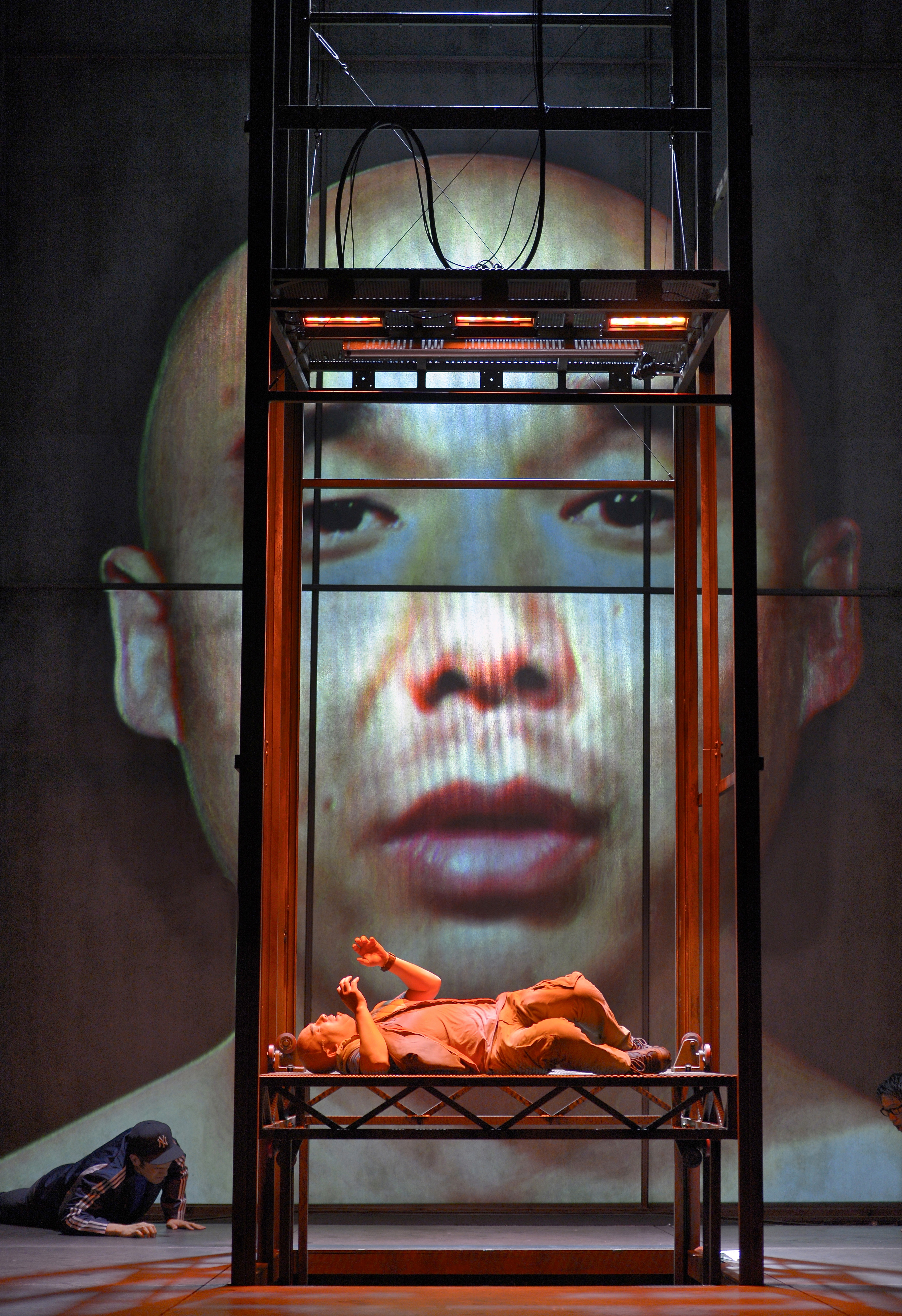
Julius Ahn portrays Guāng in A.C.T.’s “Stuck Elevator.” Photo: Kevin Berne.


Like God with a capital G, the little-g theater gods work in mysterious ways.

Or maybe it’s all happenstance.

Either way, A.C.T.’s “Stuck Elevator,” an insightful peek at the mental meanderings of Guāng, an undocumented Chinese worker, coincided with the U.S. Senate beginning debate on immigration reform and feasible pathways to legalization and citizenship.

The American Conservatory Theatre’s world-premiere musical leans on a true story of a takeout delivery guy trapped in a Bronx elevator 81 hours.

It’s chiefly about fear:

Rescuers might learn he has no papers, and that would lead to deportation.

Guāng frets, too, about thieves stealing the seat of his bike, a Mexican deliveryman “getting all my tips,” and being fired because he’s too old.

Stuck Elevator,” like Joseph’s biblical coat of many colors, rapidly becomes a metaphor, in this case unveiling deep personal feelings of apprehension, frustration and prejudice.

Its framework is a bilingual montage that conveys multi-pronged points (led by the strain of being an outsider).Thematically, the 80-minute, one-act show works incredibly well.

Yet it lacks the musical power it might have had despite the commendable operatic voices of Julius Ahn as Guāng and Marie-France Arcilla as Ming, his wife (who’s also stuck — in a Nike factory in China).

Because the issues are so blatant, the blandness in some of the sung-through score by Byron Au Yong and verbal redundancies by librettist Aaron Jafferis may leave audiences desiring more oomph. That’s true even with the show’s two dozen tunes cross-fertilizing contemplative Chinese melodies (albeit sometimes too withheld, other moments too screechy) with bouncy Latin airs and wistfully romantic refrains.

Ahn, as an immigrant caught as much in his fantasies and self-limitations as he is by the shaft, gets enough stage time for a one-man performance though four supporting actors play multiple roles.In rapid succession, he thrusts his voice, body language and facial expressions into an emotional gamut: fear, sadness, joy, acceptance.

But it’s Joel Perez as Guāng’s co-worker, Marco, who stops the show with a hip-hop tune.

In addition, Raymond J. Lee is artfully villainous as Snakehead, the human parasite who forced Guāng into lifelong debt by charging $120,000 to smuggle him and his nephew into this country. And Joseph Anthony Foronda is appropriately over-the-top in the drag role of the Ross’ Wife and the armor-clad Elevator Monster.

It takes no time for Ahn to bring home everyone’s dread of elevator entrapment and claustrophobia.

And it takes no time for the crowd to adjust to supertitles that alternately translate the lyrics into Chinese or English, depending on which language is being sung.

Occasional bittersweet humor makes the sung-through show’s earnestness more palatable — like a line referring to Guāng’s predicament being “the first time in my life I haven’t had to share a room.”Quirky characters that populate his past, current and future daydreams and nightmares also amuse.

Guāng sings and sings and sings — to himself, to his family, to the elevator.

His mental twists and turns include, at one point, being attacked in song by a

mugger, his boss’ wife, his own wife — and his bladder. At another juncture, he imagines becoming so successful he can make Donald Trump deliver chicken to him.

In his darkest reverie, though, he watches “the edge of mind…starting to fray.”

His fantasies sharply vary in tone.

The best one may be a sequence in which characters drum with chopsticks and then use them as utensils to poke at a carcass on a table.“Stuck Elevator” is ably supported by Daniel Ostling’s set design (with dreamlike frame and simple cage), effective projections by Kate Freer, lighting by Alexander V. Nichols that facilitates quick mood changes, and costuming by Myung Hee Cho that detail characters’ socioeconomic status as it showcases flamboyant figments of Guāng’s imagination.

The Bay Area, with its large blocs of new Hispanic and Asian immigrants (as well as older Italians, Russians and you-name-its), people who fled poverty and oppression, should be particularly receptive to “Stuck Elevator.”

Regular theater buffs are likely to enjoy it because it’s different.

Once-in-a-whilers might consider it because it’s inspirational, a paean to the human spirit.

“Stuck Elevator” plays at the American Conservatory Theater, 415 Geary St., San Francisco, through April 28. Night performances Tuesdays through Saturdays, 8 p.m., and Sundays, 7 p.m. matinees, Wednesdays, Saturdays. Tickets: $20 to $85. Information: (415) 749-2228 or www.act-sf.org.

‘Whipping Man’ is a fresh, exciting Mill Valley must-see

By Woody Weingarten

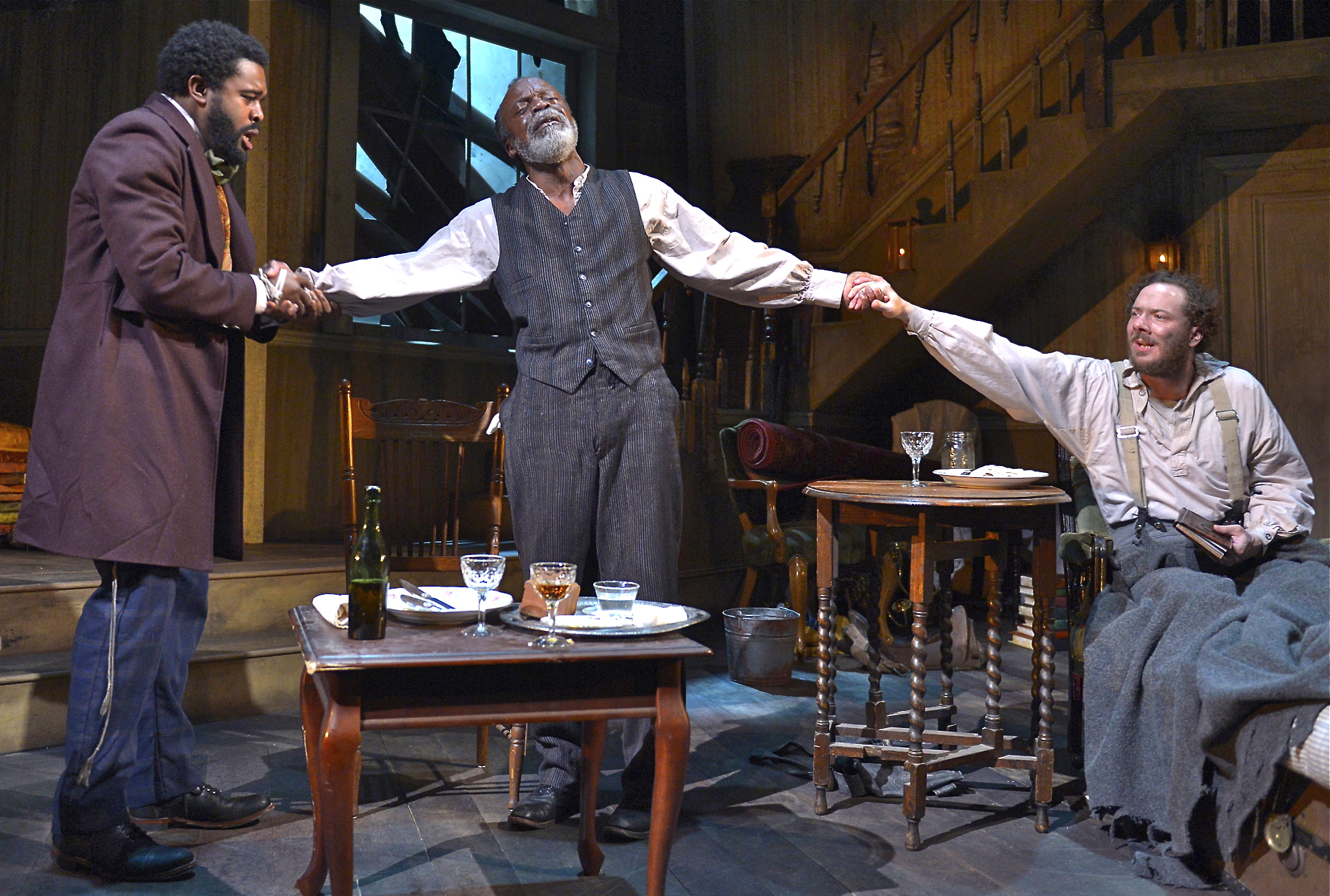
Momentarily celebrating in “The Whipping Man” are (from left) Tobie Windham (as John), L. Peter Callender (Simon) and Nicolas Pelczar (Caleb). Photo: Kevin Berne.


Minutes into it, I surmised that all the elements in “The Whipping Man” would come together as exquisitely as a Rubik’s Cube.

My instincts were right.

The drama by Matthew Lopez, who simultaneously slices into the vagaries of humanity and inhumanity as skillfully as he depicts a gangrenous Civil War amputation, is a one-of-a-kind powerhouse despite it making me think of August Wilson one minute and Redd Foxx the next.

The Marin Theatre Company production in Mill Valley in fact isn’t derivative. It’s as fresh and exciting as anything on the boards in the entire Bay Area.

Director Jasson Minadakis has excelled his previous successes with this show, making the opening night audience leap to its collective feet with approval. Like a magician whose magic wand is finely tuned, he ensures that each action, each phrase, each emotion is cloaked in authenticity.

The acting — by L. Peter Callender as black patriarch and ex-slave Simon; Tobie Windham as John, a freed sneak thief and dreamer seeking refuge; and Nicholas Pelczar as Caleb, a Jewish white slaver’s scion who’s been wounded in more than one way — is universally superb.Inspired, also, are the intentionally decrepit set by scenic designer Kat Conley, the dramatic lighting by Ben Wilhelm, the moody sound effects by Will McCandless and the apt costumes by Jacqueline Firkins.

On the surface, the play — marked by sharp dialogue that draws not nervous laughter but guffaw

s triggered by genuine characters rather than stereotypes — is about Jews and blacks and, surprisingly, black Jews. Its themes erupt in a series of verbal mazes — including the DNA of slavery, the roots of freedom, and the construction and deconstruction of family and forgiveness.Let alone brotherhood, faith and hypocrisy.

Much of the subject matter’s been tackled before, but rarely executed as well, possibly never in a scenario involving black Jews.

The scene is a dilapidated homestead in Richmond, Virginia, in 1865, over a stormy three-day peri

od that includes Abe Lincoln’s assassination.A makeshift Passover Seder (commemorating the Israelites escape from Egyptian bondage) becomes an unusual focus, masterfully created by Lopez, a gay Episcopalian of Puerto Rican and Polish-Russian heritage whose direct knowledge of Jewish holidays apparently came in part from attending ritual meals hosted by his Semitic aunt and cousins.

The play, presented as a co-production with Virginia Stage Company, stays on point throughout — another kudo due Minadakis.

Its only inconsistency is the dialogue, which sometimes veers into current usage rather than yesterday’s.

And its only flaw is that once in a while a character talks in needlepoint-speak. Such as: “War is not proof of God’s absence; it’s proof of his absence from men’s hearts.”More insightful is what I perceive to an accurate portrayal of Jewish sensibility: “We talk with God…sometimes we even rassle with Him. But [as Jews] we keep asking questions.”

Astute, too, is this poignant passage about slavery: “It wasn’t a friendship…not when one owns the other.”

Lopez is consistently sharp but occasionally shows flashes of brilliance. As in labeling Lincoln, in keeping with biblical inserts and the Exodus theme of Passover, as “Father Abraham, who set us free” and “our American Moses.”

Highlights in “The Whipping Man” range from a hilarious set piece about cutting and chewing horsemeat to a rousing rendition of a multi-purposed spiritual, “Let My People Go” — along with shocking, intense moments stemming from both verbal and visual reminders of whippings and their aftermath.Revelations of long-held secrets only deepen the drama.

“The Whipping Man,” finally, attacks with passion and muscle. There’s no question that it burned into my brain and resonated long after I left the theater. Bay Area showcases seem to exist in every nook and cranny, but a theatrical must-see is rare.

This is one.

“The Whipping Man” plays at the Marin Theatre Company, 397 Miller Ave., Mill Valley, through Sunday, April 28. Performances Tuesdays through Saturdays, 8 p.m.; Sundays, 7 p.m.; Wednesdays, 7:30 p.m.; matinees Saturdays and Sundays, 2 p.m. Tickets: $15 to $57. Information: (415) 388-5208 or marintheatre.org.

‘The Happy Ones’ fails to make reviewer happy

By Woody Weingarten

Woody [rating:3] (3/5 stars)

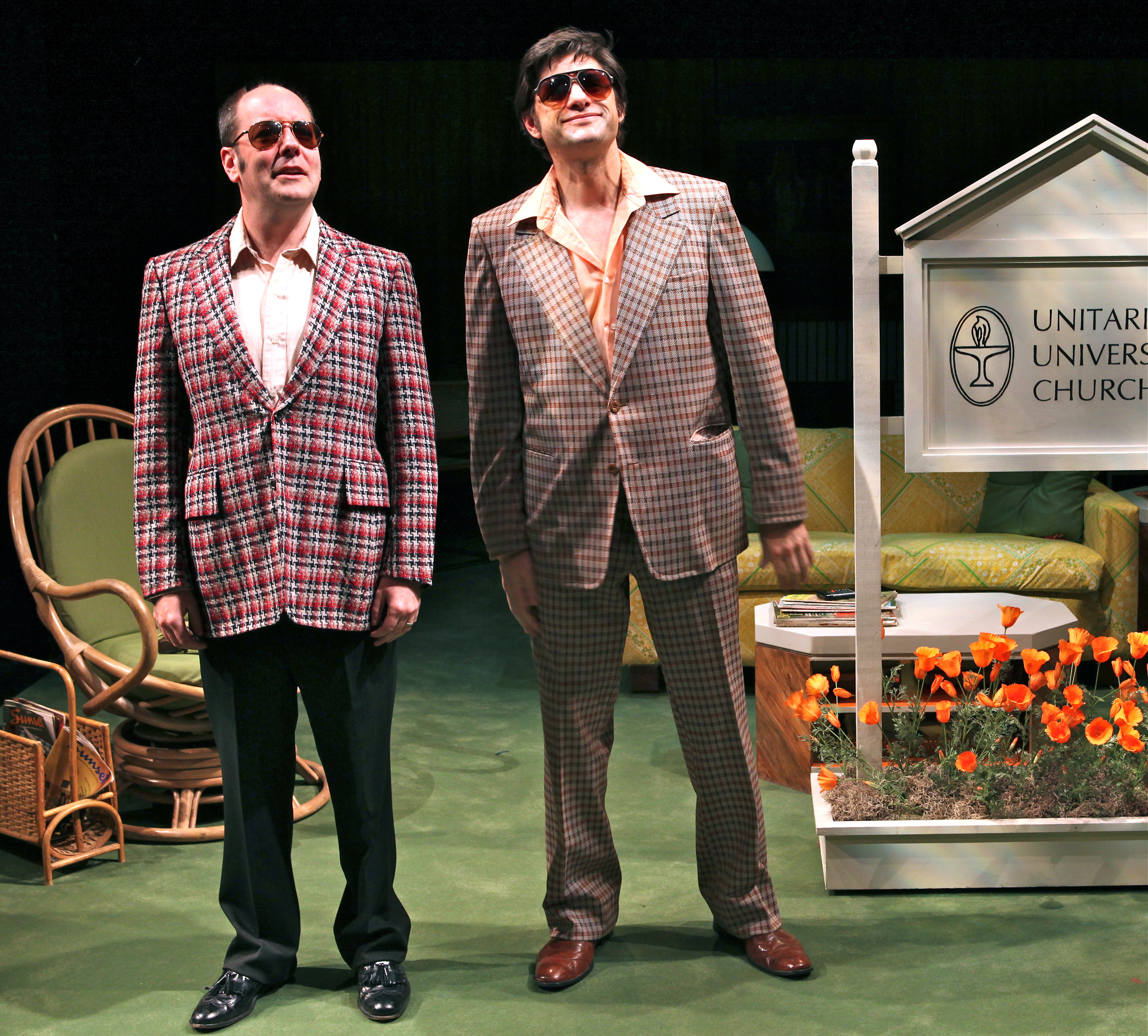
Walter (played by Liam Craig, left) and Gary (Gabriel Marin) momentarily experience a 1975 version of the Good Life in “The Happy Ones.” Photo: Jennifer Reiley.

The Magic Theatre habitually risks audience disapproval.

It nurtures edginess.

It wrestles with uncomfortable subject matter.

And, happily, it aims many productions at crowds more youthful — and ready to laugh and cry — than your average card-carrying AARP member/theatergoer.

In recent years, it has produced “Any Given Day,” a tragicomedy that examined fear and hope through two developmentally disabled characters; “Jesus in India,” which tackled and turned upside down the oft-debated lost years; “Brothers Size,” a tear-jerking drama (peppered with spicy humor) about brotherly love; and “Another Way Home,” a serio-comedy that probed how a family’s life could be narrowed by a teenager’s mental problems.They all flourished. They all pleased me. A lot.

“The Happy Ones,” unfortunately, is an exception that proves different isn’t necessarily good.

The synthetic comic drama falls several degrees south of mediocre.

In my view, the Bay Area premiere at San Francisco’s Magic was almost totally void of theatrical magic.Ostensibly a peek at lives being inside-outed by a fatal accident, Julie Marie Myatt’s play simply languishes as it turns grief into boredom.

Before it flat-lines, her creation crawls like an injured sloth, working its predictable storyline about suburban Paradise Lost into a non-crescendo — despite a final scene that contains the lone sincerely touching moments in close to two hours.

It’s a shame, because all four actors — Jomar Tagatac as Bao Ngo, Marcia Pizzo as Mary-Ellen Hughes, Liam Craig as Walter Wells and Gabriel Marin as Gary Stuart — are top drawer as they project awkwardness and distance (and because the details of the period set, costuming and ‘70s music work extremely well).

Yet all of it becomes wasted wrapping paper for a basically empty gift box.Opening night, “The Happy Ones” — which drew lukewarm laughter and polite applause from a mega-friendly audience — kept the word “contrived” flashing in my mind like a neon sign gone bonkers.

That made it difficult for me to relate to the plights of the Orange County husband/father/appliance store owner who discovers his American Dream turned into a nightmare, the accidental Vietnamese killer who repeatedly says he wants

to die but can’t and therefore concocts an unbelievable route to forgiveness, a fifth-rate minister who repeatedly bemoans his being a fifth-rate minister, and an aging, insecure sexpot looking for a good time or a good partner, whichever comes first.In a similar vein, allusions to the end of the Vietnam War and the wave of refugees to the United States had zero emotional impact for me.

I’d hoped to find “The Happy Ones,” as advertised, hilarious and heartbreaking — filled with nuances and strength.

I didn’t.

“The Happy Ones” plays at the Magic Theatre, Building D, Fort Mason Center, Marina Boulevard and Buchanan Street, San Francisco, through Sunday, April 21. Performances Wednesdays through Saturdays, 8 p.m.; Tuesdays, 7 p.m.; matinees, Saturdays and Sundays, 2:30 p.m. Tickets: $22 to $62. Information: (415) 441-8822 or www.magictheatre.org.

Drama scrutinizes famed journalist’s mind, spirit, vitriol

By Woody Weingarten

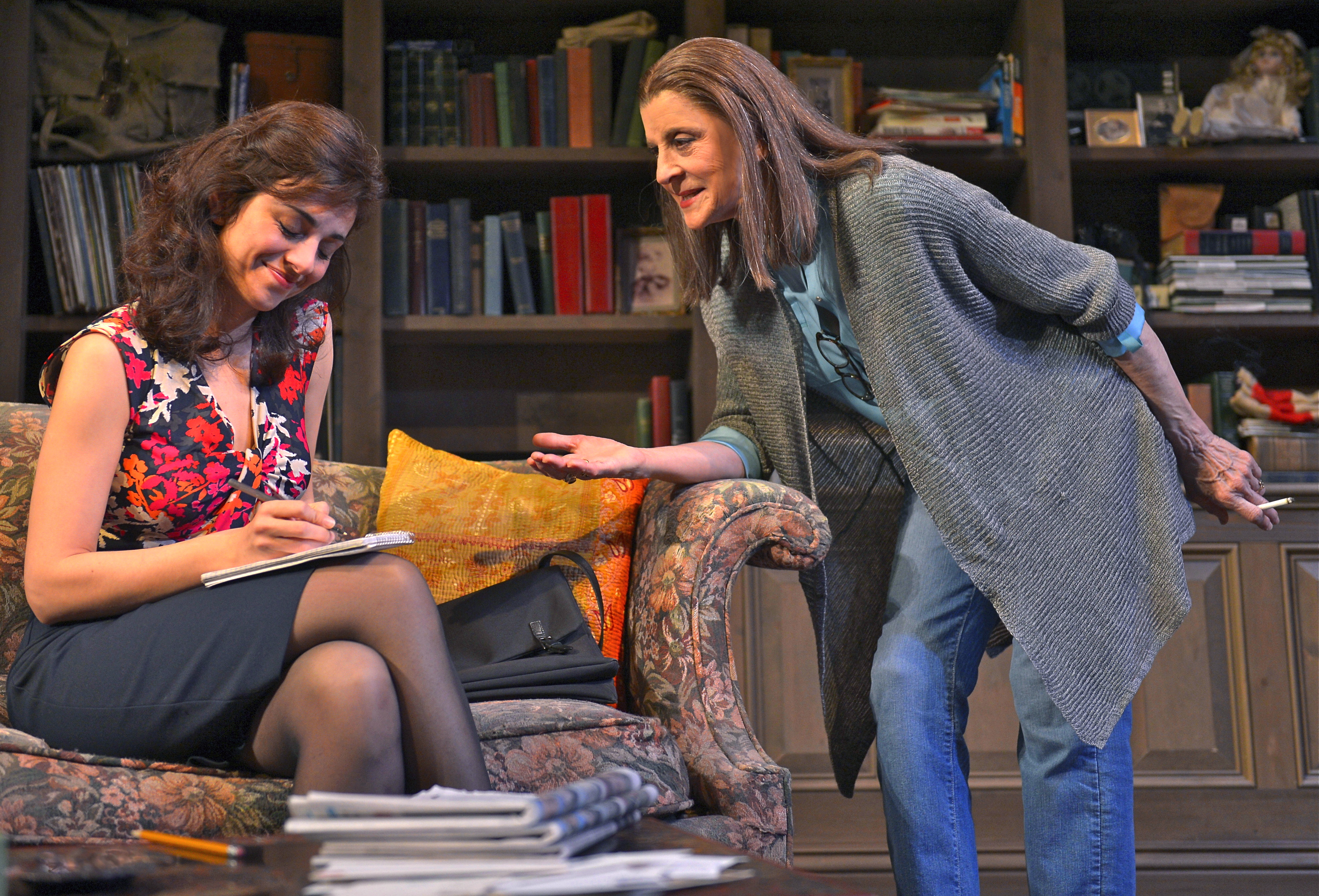
Concetta Tomei (right, as Oriana Fallaci) and Marjan Neshat (as a journalist) star in “Fallaci” at the Berkeley Rep. Photo, courtesy kevinberne.com.

“Fallaci” is — according to my personal stage evalu-ometer — 85.3 percent brilliant, 14.7 percent boring or overly dense.

It’s 82.2 percent sterling drama (with a tinge of comedy), 17.8 percent polemic.

Despite its negligible drawbacks, I believe the drama’s definitely worth experiencing.

“Fallaci,” at the Berkeley Rep through April 21, confronts myriad Big Issues — truth, women’s freedom and power (and their nonexistence), domestic abuse, torture, tyranny, hatred, destiny, motherhood, father-daughter relationships, anti-Islamism, forgiveness.

So many, in fact, it’s easy to become inundated with the gravitas.

Playwright Lawrence Wright probes the liberation of women through the famed, cynical eyes of inconsistent, caustic Italian journalist Oriana Fallaci, who insists that, always, “you have to find the lie” underneath what interviewees offer as the truth.

Contrasted and compared is the view of a young female writer, Maryam, who wavers between awe and distaste for the elder journalist’s technique, mind and spirit but settles for empathy.

Wright’s skill at fictionally getting inside Fallaci’s head at the tail of her life is complemented tidily by the unwavering direction of Oskar Eustis.

It’s noteworthy that these two talented men are responsible for the onion-like peeling that occurs on stage to delineate each woman’s self-deception and lies — a verbal scrutinizing that links the essences of the females.

Wright, a writer for The New Yorker and author of eight books, including a Pulitzer Prize-winning volume on al-Qaeda and a headline-grabbing tome on Scientology, actually traces Fallaci’s life all the way back to her childhood resistance against the Nazis.

Concetta Tomei portrays the combative, opera-loving Fallaci with a comprehensive range of emotions and outbursts as omnipresent as the cigarette in her aging hand.

Tomei, whose Broadway credits include stints with Kevin Kline and David Bowie, smoothly captures the polarized segments of Fallaci’s life — after a tenure in Hollywood, she becomes the verbal darling of the left (when she mercilessly bludgeons the likes of Ayotollah Khomeini, Moammar Qaddafi, Yasser Arafat and Fidel Castro), then is adopted by the right after she attacks all of Islam in reaction to 9/11.

The actor’s Italian accent and physicality are impeccable.

Majan Neshat competently plays a “lowly” obituary writer cum inquisitor — first with a coupling of reserve and youthful brashness, then with panache.

She seamlessly integrates her Iranian background and position with The New York Times in a way that makes her believable, all the while running a heady gauntlet to unearth her own truth.

The lone set by Robin Wagner, a three-time Tony Award-winner, represents Fallaci’s obsession with words via a cavernous room that has books stacked on the floor, a table and ceiling-high shelves.

The costumes (by designer Jess Goldstein, also a Tony winner) are drab, drabber and drabbest (perfectly in keeping with outer-appearances).

Considering the fiery quality of Fallaci, one of the first rock stars of modern journalism, and some of the gut-wrenching topics it tackles, it’s strange the highly intellectual play lacks much of a visceral punch.

Intermittently, in fact, I now and then felt I was witnessing a tableaux of a corpse being autopsied, made even worse by a hokey ending.

Wright, unfortunately, may have become too entangled in his theatrical conceit of a writer writing about two writers.

Still, “Fallaci,” which reveals how debilitating a diet of controversy, controversy and controversy ultimately can be on a journalist, can be riveting — especially whenever it pauses to let the audience’s reactions catch up with the verbiage.

That said, it should be noted that I often found Wright’s weighty subject matter stunning (for instance, when a reflective Fallaci wistfully intones, “They say I lost the appetite for blood”).

Opening night, despite the 90-minute show being without intermission, not one soul left the theater before the play went dark.

It may be ironic that the opening of this world premiere, which at one point deals with the rape of a condemned woman who can’t be executed unless her virginity is taken, occurred on the same day as some fundamental Muslims ripped into a U.S. document on combatting violence against women.

So it looks like “Fallaci” is hardly just a story of yesterday.

“Fallaci” plays at the Berkeley Repertory Theatre‘s Roda Theatre, 2015 Addison St., Berkeley, through April 21. Night performances Tuesdays, Thursdays, Fridays and Saturdays, 8 p.m.; Wednesdays and Sundays, 7 p.m.; matinees, Thursdays, Saturdays and Sundays, 2 p.m. Tickets: $14.50 to $89, subject to change, (510) 647-2949 or www.berkeleyrep.org.